Quantcast

Mailbox Monday #159

Mailbox Mondays (click the icon to check out the new blog) has gone on tour since Marcia at A Girl and Her Books, formerly The Printed Page passed the torch. This month’s host is the At Home With Books.

Kristi of The Story Siren continues to sponsor her In My Mailbox meme.

Both of these memes allow bloggers to share what books they receive in the mail or through other means over the past week.

Just be warned that these posts can increase your TBR piles and wish lists.

Here’s what I received this week:

1.  What Looks Like an Elephant by Edward Nudelman, which I’ll be reading and discussing as part of the Indie Lit Awards short list titles.

2.  Sonics in Warholia by Megan Volpert, which I’ll be reading and discussing as part of the Indie Lit Awards short list titles.

What did you receive?
2011 Indie Lit Awards Short List

After all the prodding and poking my team and I did on Facebook, Twitter, and our blogs, the nominations for poetry rolled in with over 200 nominations coming in for a variety of poetry.

But there were some clear favorites in the voting, with one short listed nominee collecting more than 70 votes alone.

I want to take this moment to thank the judging panel — Diary of an Eccentric, Necromancy Never Pays, 1330V, and Regular Rumination — for all of their help.  And as you know, with the announcement of the short list, your jobs are not over.  It is now time to read and discuss the short listed titles below.

  • Beyond Scent of Sorrow by Sweta Vikram (Modern History Press)
  • Catalina by Laurie Soriano (Lummox Press)
  • What Looks Like an Elephant by Edward Nudelman (Lummox Press)
  • Three Women: A Poetic Triptych and Selected Poems by Ramos, Emma Eden (Heavy Hands Ink)
  • Sonics in Warholia by Megan Volpert (Sibling Rivalry Press)

Luckily, the individual presses of these books have kindly offered to send copies of the books to all the panelists.  I wish all of the poets luck.

Please visit the Indie Lit Awards Short List for the nominees in Fiction, Biography/Memoir, Nonfiction, Mystery, Speculative Fiction, and GLBTQ

It by Stephen King

It by Stephen King is more than 1,000 pages and very detailed; set in Derry, Maine, (a fictional town) evil lurks beneath the city streets and in the sewers.  This novel has everything readers are looking for in a book:  family drama, coming of age story, friendship, an evil clown that is much more sinister than he looks, mysticism, a highly detailed world, and triumph.  The main characters are young kids — six boys and one girl — who are the misfits in school for one reason or another and whose families are loving for the most part, though there are a few with messed up parents.  The town is at the center of a rash of child killings and the killer is still on the loose in 1958, and their parents and the town adopt a strict curfew.  Bill, however, is the most touched by It when his brother is killed by the silver-suited clown with orange pom-pom buttons, and his family begins to pull away from one another, leaving Bill to blame himself.

“Smells of dirt and wet and long-gone vegetables would merge into one unmistakeable ineluctable smell, the smell of the monster, the apotheosis of monsters.  It was the smell of something for which he had no name:  the smell of It, crouched and lurking and ready to spring.  A creature which would eat anything but which was especially hungry for boymeat.”  (page 6)

The kids — Ben, Bill, Richie, Mike, Eddie, Stan, and Beverly — join together to form the Losers club and stand up against the town bully, Henry Bowers and his cronies on more than one occasion.  Readers are left in the dark as to how the gang gets rid of It until the very last 200 pages, but it is worth the wait as King allows his readers to get to know each character so well that they become friends.  Readers feel like they are part of the gang, and they begin imagining their worst nightmares come to life when It arises from the sewers to take another child or to taunt the Losers.  King is adept at handling seven major characters and showing readers facets of their personalities and back stories like no other author.  His prose is not flowery and is very straightforward, but he captures the emotions and thoughts of all of his characters well, making them vivid and real.

In a world where evil lurks to strike at any moment and without warning, readers are taken on a Herculean journey in which seven children believe that they are the only ones capable of stopping It from destroying more families’ lives and taking the town down.  Belief and faith play a major role in the book, and King raises a great many questions about the role they play in having power over each of us as individuals.  Some instances of faith and belief can be good and positive, but others can be utterly destructive.  Like most of us, each of the members in the Losers Club has a crisis of faith and this is when they become the most vulnerable to It.

Through a back and forth narrative between 1958 and 1985, readers unravel the mysteries of Derry, the mysterious ritual that saves the town and is performed by mere kids, and are swept up in a journey that will leave them on the edge of their seats until the very conclusion.  It by Stephen King is a fantastic read even the second time around.  One of the best King has written.

I read this is part of the Stephen King’ It Read-a-Long I co-hosted with Diary of an Eccentric.  Please visit the more in-depth discussions for Part 1, Part 2, Part 3, Part 4, and Part 5.

The End: Stephen King’s IT Read-a-Long

Anna and I are co-hosting the Stephen King IT Read-a-Long.  We are having discussions once per month through the end of the year about the parts we’ve read.

Each month you had the option to answer the questions on the hosting blog or in your own post, but please go back to the monthly host to leave your discussion link.

Remember that these posts can contain spoilers.

For the first discussion of part 1, plus the following interlude, go here.

For part 2′s discussion, please visit Diary of an Eccentric.

For the discussion of part 3, go here.

Part 4’s discussion can be found on Diary of an Eccentric.

Today, we’re taking a look at Part 5: The Ritual of Chud, the last interlude, and the epilogue.

1.  Of the seven in the gang of Losers, which character do you believe is the direct opposite to the evil of IT and why?

2.  At one point, Eddie talks about how he loves Bill and that Bill is loved, but wonders if that is too much power to have.  What do you think he meant by that? And do you agree?

3.  Forgetting is a theme in the novel, why do you think these characters forget or begin to forget once It has receded?

4.  The turtle shows up in this section, but what is the turtle? theories about its purpose?

5.  What are your final impressions of IT?  Would you read another Stephen King book?

Please leave your comments below.  We can’t wait to hear what you have to say about the final scenes.

Month 4: Stephen King’s IT Read-a-Long

Anna and I are co-hosting the Stephen King IT Read-a-Long.  We are having discussions once per month through the end of the year about the parts we’ve read.

Each month you will have the option to answer the questions on the hosting blog or in your own post, but please go back to the monthly host to leave your discussion link.

Remember that these posts can contain spoilers.

For the first discussion of part 1, plus the following interlude, go here.

For part 2′s discussion, please visit Diary of an Eccentric.

For the discussion of part 3, go here.

The discussion for Part 4:  July of 1958 and the interlude is at Diary of an Eccentric today! Come join us.

Postponed: Month 4: Stephen King’s IT Read-a-Long

Anna and I are co-hosting the Stephen King IT Read-a-Long.  We are having discussions once per month through the end of the year about the parts we’ve read.

Each month you will have the option to answer the questions on the hosting blog or in your own post, but please go back to the monthly host to leave your discussion link.

Remember that these posts can contain spoilers.

For the first discussion of part 1, plus the following interlude, go here.

For part 2′s discussion, please visit Diary of an Eccentric.

For the discussion of part 3, go here.

The discussion for Part 4:  July of 1958 was scheduled at Diary of an Eccentric for Nov. 30, but life events have intervened and we are postponing until Anna returns from her grandmother’s funeral.  Thank you for your patience.

Month 3: Stephen King’s IT Read-a-Long

Anna and I are co-hosting the Stephen King IT Read-a-Long.  We are having discussions once per month through the end of the year about the parts we’ve read.

For the first discussion of part 1, plus the following interlude, go here.

For part 2′s discussion, please visit Diary of an Eccentric.

Today is a discussion of Part 3:  Grownups and Derry:  The Third Interlude.

Following Part Two in which King revealed the individual encounters with IT and that IT had been around a lot longer than the kids suspected, Part Three picks up back in Derry when the kids meet again as grown-ups because IT has started once again. Here are the questions that came to my mind while reading this section:

1. Like most towns, Derry has changed with more developments and banks, but to the “gang” some things remain the same? Do you think they are trapped by nostalgia or something more frightening?

2. The canal plays a prominent role, and as it runs through, around, and beneath the town it collects all of the waste and darkness from its sewers. What are your theories about the canal and its role in Pennywise’s cycles and mayhem?

3. The “gang” seems to have come together to work against the clown, and whatever they did is lost to their memories as they revisit sights that meant something to them in childhood. Chüd, silver dollars, and other items are mentioned. Was Mike’s suggestion that they spend time alone in Derry aimed at jogging their memories of what happened or was there another purpose?

4. Do you agree or disagree with Mike’s theory that after the “gang” stopped the killing cycle, something changed that allowed them to be more successful away from Derry than if they stayed? Why or why not?

There are a few other questions that really don’t have answers at this point that I continue to ponder, such as what is Chud, what is this turtle, and how does IT know what these adults will fear most? Are their fears easier to gauge because of the connection they now have with IT since they put a stop to the previous cycle of murders? Or are these adults more connected to their childhoods than other adults may be — especially given some of their more creative jobs; doesn’t that require them to remain a bit in touch with their child-like selves?

Please share your thoughts in the comments, and I’ll be sure to discuss with everyone. Thanks for joining in!

If you decide to do your own blog post, please leave the full link to that post in the Mr. Linky below:

For discussion of Part 4 and its following interlude, please stop by Diary of an Eccentric on Nov. 30.

Dewey’s 24-Hour Read-a-Thon Wrap Up

This weekend was Dewey’s 24-hour read-a-thon. I read on and off yesterday in between traveling to Anna’s house to celebrate her husband’s birthday. It was a great time and Wiggles was a very happy camper most of the time, but with three teeth coming in at once, she did have her cranky moments.

Ok, so you really want to know how much I read and of what. I finished up Mr. Dary’s Undoing by Abigail Reynolds at 11 PM last night, reading about 250 pages since I started it earlier in the week. Then I read about 10 more pages of Simon Pegg’s memoir, Nerd Do Well, before falling asleep.

Overall, I didn’t get much reading done, but it was fun. How did you do?

Interview With Alma Katsu

If you are anything like me, then when you really love a book you want everyone to check it out.  You might be on Taker overload, but I’m going to hit you one more time this week.

What I loved most about The Taker is the darkness that is explored, how easy it is to be led astray when you think your life has changed inexorably, and what it means to love.  Love is a tricky emotion, particularly when you are obsessed with the object of that love.

What’s even better than loving the book, is adoring the author behind the book.  Alma Katsu is adorable, fun, and so intelligent, it hurts.  I was lucky enough to get her to answer a few interview questions via email, and I’m here to share them with you.  Of course, if you are looking for yet another entry to my ARC giveaway, please leave a comment below.

Without further ado, please welcome Alma.

The Taker is about love and immortals, but not vampires or werewolves. You may have been asked this question before, but why not vampires since they seem to be so popular right now?

When I started writing The Taker over ten years ago, the horror genre was languishing. Nobody wanted anything new that was ‘horror’, whether it was a vampire or a werewolf or something completely different. You’ve probably heard The Taker being compared to early Anne Rice; well, I remember at the very first agent consultation I had for The Taker, a well-known agent told me that no one wanted a vampire story, and there was room for only one Anne Rice in the business, so I should hang it up.

To be fair to the agent, my writing was pretty bad then, and maybe he thought he was doing a favor to the industry by trying to discourage me so very thoroughly. It just goes to show, though, that no one really knows what’s going to be popular in publishing (and again, to be fair to publishers, they admit this themselves.)

The atmosphere in your novel is rather ominous throughout, was it hard to ensure that condition endured through the entire book? Were there moments that were edited out that would have lightened the mood? If so, why did you eliminate them?

No, if anything, previous versions were darker! I think during my formative years as a reader, fiction tended to be darker and, in general, different from what modern readers have come to expect. And I have a fairly dark outlook on life, so the story it didn’t seem unusual to me.

(I would have loved to read the darker versions!)

You mentioned during the Novel Places event for The Taker that you admire Shirley Jackson and particularly, The Lottery. Did you have other influences as a reader and writer, and what about their style influenced you and can you see those influences in your work (i.e. feel free to provide an example of style from another writer in The Taker if you like)?

Speaking of writers of melancholy stories—Thomas Hardy was an influence (Hardy and not Dickens, that should give you some idea.) Patricia Highsmith, the crime and mystery writer. Nathaniel Hawthorne. Also, novels such as Fanny Hill or Moll Flanders—or their modern counterparts, Slammerkin by Emma Donoghue or Fanny by Erica Jong—that told the story of a woman trying to survive and making her way in the world during inopportune times.

I noticed a bit of a nod to Edgar Allan Poe in The Taker. Was that intentional? Have you read Poe? Which of his works would be a favorite?

I read a lot of Poe when I was very young. I admire his ability to create such original, yet deeply macabre, stories. He was not afraid to dwell on the dark thoughts that most of us occasionally have, and investigate them fully in order to find the story in them. Many writers toy at darkness and mimic what they’re read elsewhere, but Poe was willing to really understand darkness.

As a writer do you have any obsession and/or habits while writing, or music or how-to writing manual preferences? And can you offer advice as to whether an MFA is necessary for an amateur writer to get their book published or if the degree is worthwhile?

I went to a graduate writing program—Johns Hopkins—and while I got a lot out of that experience, I don’t think it’s necessary for everyone. It’s definitely a personal decision. Most programs won’t necessarily open doors to the publishing industry—only certain schools are well-connected enough to merit special treatment from a few agents or publishers. The only way to get the interest of an agent and publisher is to have written a darned good book or have an irresistible platform (for instance, you’re a big television star.)

I don’t think I have any obsessions but I try to have good habits: I work at writing every day, try to grow as a writer and produce better material today than I did yesterday.

Thanks, Alma, for sharing your thoughts on writing and writers.  If you are up in New England over the next week or so, Alma will be out and about signing books.  Pop by to see her, and please tell her I sent you.

Oct. 23 at Concord, Mass., Festival of Authors on the New Literary Voices panel at 3 p.m.

Oct. 27 at Longfellow Books in Portland, ME (This works well with her recent mention in Down East magazine and a short story in Portland magazine)

Oct. 28 at Jabberwocky Books in Newburyport, Mass. at 7 p.m.

This is a stop on The Literary Road Trip since Katsu has worked in Washington, D.C., and now resides in Virginia.
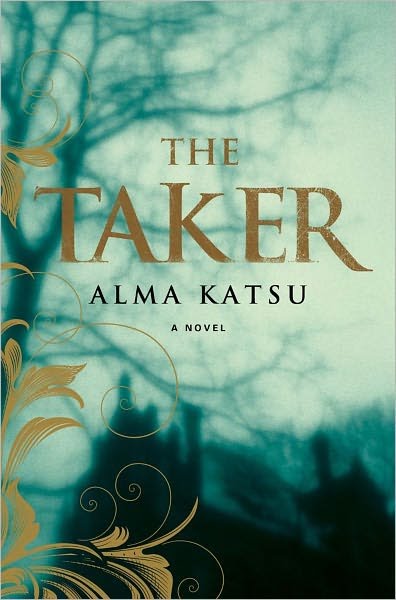
The Taker by Alma Katsu

Alma Katsu’s The Taker has received a number of rave reviews and some unfavorable reviews, and it was recently listed in BookList’s Top 10 Debut books.

Lanore, “Lanny,” shows up in her northern Maine hometown covered in blood, and the police say that she has confessed to killing a man and leaving him in the frozen woods.  ER doctor, Luke Findley, becomes the recipient of a Gothic fairy tale that is more dark and sinister than full of fairy dust, unless that fairy is an evil alchemist and sodomite.

“The stranger had appeared suddenly, at the edge of the gathering that evening.  The first thing Adair noticed about him was that he was very old, practically a shrunken corpse leaning on his walking stick, and as he got closer, he looked older still.  His skin was papery and wrinkled, and dotted with age spots.  His eyes were coated with a milky film but nevertheless had a strange sharpness to them.  He had a thick head of snow white hair, so long that it trailed down his back in a plait.  But most notable were his clothes, which were of Romanian cut and made of costly fabrics.  Whoever he was, he was wealthy and, even though an old man, had no fear of stepping into a gypsy camp alone at night.”  (page 162)

The Taker is a story within a story, within a story, spanning from the dark ages through the present day, and Lanny claims to be immortal, but do not be mistaken into thinking she’s a vampire or werewolf.  She is neither.  Her unrequited love for the town pretty boy, Jonathan St. Andrew, is the main crux of the story and how it brings about her downfall that leads to her life as an immortal.  Katsu spoke recently at Novel Places about the book and revealed that the story of Pinocchio is the backbone of her novel, which is clear in how the desire to grow up and become a woman with her own life separate from her family propels Lanny to be easily led astray.  However, that is where the similarity ends.  Katsu’s novel is ripe with sodomy, rape, kidnapping, murder, and more, which is why it would be a perfectly dark book to read this season as Halloween approaches and is what would once have been considered horror (rather than the popular category of paranormal, which has a “lighter” tone to it).

Lanny tells her story to Luke in the present day, but a more effective approach would have been to have her merely tell her story to the reader.  As many know story framing or using one character as a plot device for another character to tell his/her story is bothersome if the character/plot device is not well developed.  While Luke does have a back story here, it fails to round out the character enough, leaving him flat and boring compared to the characters of Lanny and Adair.  Even Jonathan is little more than a caricature of the pretty boy of the town’s founders, and it would have served to have more of him and Lanny’s interactions in the book at the beginning of their “romance” to demonstrate their affection for one another.  However, being told from Lanny’s point of view, it is incredibly difficult to demonstrate Jonathan’s perspective on their relationship and oftentimes he comes off as a callous womanizer who is incapable of love.

With that said, however, Katsu is adept at time shifts within the story that keep the pace of the novel moving quickly.  Moreover, she creates a deeply atmospheric novel where readers are combing through the mist to grasp the truth of Lanny’s story and to unravel the mystery of her immortality.  Some have said this is a romance; it is not.  Most will debate who is “The Taker,” but there is certainly more than one, and it will depend on your personal perspective as to which you believe is the taker.  They all are takers in their own way — taking what love and affirmation they can, taking the loyalty of others by forcing their hands, and taking pleasure in the act of taking.  Readers who shun violence in books, particularly against women should steer clear.  Katsu’s The Taker is dark and decadent; an excellent debut novel for those looking to tantalize their darker senses with interminable consequences.

Stay tuned for the next two books in this series; I know I will be waiting on the edge of my seat. I’m always on the lookout for horror books, as I’ve grown tired of EMO vamps and werewolves.

For a chance to win my gently used ARC (which has a signed bookplate), please visit this post about Alma Katsu’s reading near me.  If you’re looking for another bonus entry, leave a comment on this review.

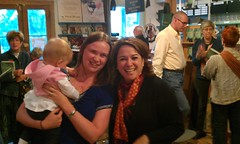
Alma Katsu (right) Me & Wiggles

About the Author:

Alma Katsu is a 30-year DC veteran who lives in two worlds: on one hand, she’s a novelist and author of The Taker (Simon & Schuster/Gallery Books). On the other hand, she was a senior intelligence analyst for CIA and NSA, and former expert in multilateral affairs.  Watch the book trailer or this one.


This is a stop on The Literary Road Trip since Katsu has worked in Washington, D.C., and now resides in Virginia.


This is my 61st book for the 2011 New Authors Reading Challenge.

Month 2: Stephen King’s IT Read-a-Long

Anna and I are co-hosting the Stephen King IT Read-a-Long.  We are having discussions once per month through the end of the year about the parts we’ve read.

For the first discussion of part 1, plus the following interlude, go here.

For part 2’s discussion, please visit Diary of an Eccentric today.

Each month you will have the option to answer the questions on the hosting blog or in your own post, but please go back to the monthly host to leave your discussion link.

Remember that these posts can contain spoilers.

For our 3rd discussion, we will be reading part 3 and the discussion will be hosted here on Oct. 31 in time for Halloween, but please visit Anna’s blog for today’s discussion.

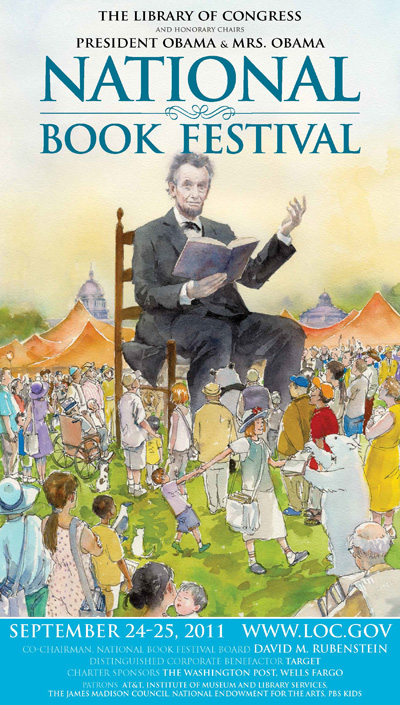
A Weekend of Firsts at the 2011 National Book Festival

It was a weekend of firsts for the National Book Festival and “Wiggles.”

For the first time, Wiggles rode on an escalator, the subway, went to Washington D.C., saw the Washington Monument, the Vietnam Wall Memorial, the National Mall, the National Book Festival, and Jill from Rhapsody in Books and her husband (forgive me I cannot remember his name — having a sleepy brain moment).  She also met the Cat in the Hat, a Honker from Sesame Street, and got her own first free books from a publisher, Penguin.

That leads me to the firsts for the festival.  For the first time in its 11-year history, it was held over two days. And both days were chock full of authors and activities, which made it even more worthwhile to go since one day was no better than the other, depending on your author preferences.

Additionally, while they have generously offered Library of Congress programs, bags, bookmarks, and audio samplers from classics, publishers do not frequent the festival and offer free books.  Imagine our surprise when Penguin was there offering giveaways of children’s books — which may be related to this year’s theme of reading aloud — in addition to all of their other fun activities for kids.  Wiggles was too young for the activities, but The Girl from Diary of an Eccentric had some fun making bookmarks.

Kelly Cherry--VA Poet Laureate

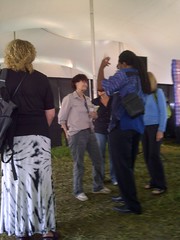
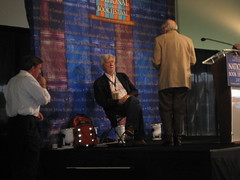
Another first for the festival was a tent on Sunday dedicated to the States’ Poets Laureate, though they only had poet laureates from Maryland, Virginia, Washington, D.C, California, and Maine.  They did indicate at the beginning of the program that it was an experiment to see how popular it would be.  It had a decent crowd for the poets we saw, Kelly Cherry (pictured above) and Stanley Plumly, (pictured below) who was introduced by the Architect of the Capitol — a big fan of his poetry. Unfortunately, we only heard bits and pieces from these two poets because Wiggles was in need of a diaper change, but I’ve read Plumly’s work before and Cherry’s presence gave me another poet to check out.

Stanley Plumly -- MD Poet Laureate

Most of the poetry I experienced was on Sunday, rather than Saturday, which we spent mostly wandering around with “Wiggles” to places like the Washington Monument to check out the cracks from the earthquake and the Vietnam Wall memorial. The only poet we heard read was Kimiko Hahn, who was a boring speaker. I haven’t read much of her poetry, but I have a feeling that its more academic than most and you’d have to spend time reading it on the page, rather than listening to it being read. I missed Rita Dove earlier in the day on Saturday, thanks to the lovely Metro track work.

Please check out the slideshow of the photos I took:

Sunday was the day I looked forward to all month — meeting Yusef Komunyakaa for the first time; I consider him a rock star of poetry to be honest. I did actually speak to him about my Vietnam Veteran uncle and writing for a bit, and learned there is an anthology being worked on with poetry from family members of Vietnam veterans, which would be incredibly interesting.

Yes, I picked up his new book. Yes, I was tongue-tied talking to him, and yes, I was in awe. So in awe, that I forgot to give him a business card for both Savvy Verse & Wit and War Through the Generations. Beyond that, hearing him read his poems in his own voice is just what I imagined it to be — each has a soul and a rhythm that you can imagine, but it is SO MUCH better to hear from the source.

Hence, my YouTube video for you of his recitation of Grenade:

I did upload another of his poems being read, but I didn’t catch the name of it and someone walked through my video, so you’ll have to ignore that if you check it out. The crowd to hear Yusef gives me hope that poetry has a wide audience that only has room to grow further. It was a packed audience, no empty chairs, and standing room only.

How was your experience?