Quantcast

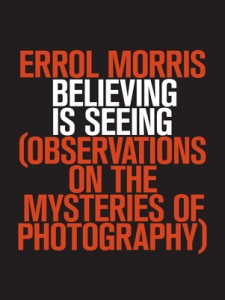
Believing Is Seeing by Errol Morris

Believing Is Seeing: (Observations on the Mysteries of Photography) by Errol Morris, a filmmaker, unravels the mysteries of documentary photography.  Why is Morris so skeptical about documentary photographs?  Does it relate to his deceased father and the secrecy around his role in the family or to his eye surgery as a child?  Beyond that, Morris seeks out factual evidence through testimony, history, and careful examination of light and contrast to determine the authenticity of photos and the stories behind them.

While some of the discussion and technical analysis of the Fenton photographs of the Crimean War can be a bit much for some readers, the conclusions drawn from these discussions are captivating.  Did Fenton stage the photo with the cannon balls on the road or did he not and which photo did he take first — The one with the cannon balls on the road or in the ditch?  When I first looked at the photographs, the one with the cannon balls on the road appeared to be a more powerful image, but then it appears to be staged because the balls are too evenly randomized.

“To use the familiar gestalt image of the duck-rabbit:  if we believe we see a rabbit, we see a rabbit.  If we believe we see a duck, we see a duck.  But the situation is even worse than the Gestalt psychologists imagined.  Our beliefs can completely defeat sensory evidence.”  (page 83-4)

Photographers often frame images in a way that captures the best of a scene, that’s the most aesthetically pleasing, and that provides the best lighting.  Moreover, photographers will take more than one picture of the same scene, if possible, and choose the best image to submit to magazines, etc.  They are framing the image we see regardless of whether readers realize it or not, but readers also are framing the scene and history.  Morris aptly titles this examination of photography “Believing Is Seeing” because each viewer’s beliefs, prejudices, etc., often frame their perspective when looking at a photograph.

Morris’ book is tutorial, historical, and poignant in how it examines photography, conjecture about photography and news articles, and human reactions to images.  My analytical brain was working overtime with this analysis, particularly when I got to the Abu Ghraib’s The Hooded Man.  One thing Morris clearly demonstrates is that each photo has a history or a context behind it, and without conducting appropriate research and background verifications, viewers and readers can draw the wrong conclusions.  In the discussion of The Hooded Man photo and the false identification of Ali Shalal Qaissi (called The Claw) as that man, two photos from two different perspectives are discussed, one taken by Sergeant Ivan Frederick without the flash that became iconic and one taken with a flash by Sabrina Harman.  While Qaissi is not the man in the iconic photo, Abdou Hussain Saad Falah (called Gilligan) is said to be that man, but in his testimony to the Taguba Commission he mentions a flash when his captors took his photo with the hood and blanket on.  So, is this telling us that he only remembers the flash and that maybe something happened between Frederick’s photo session and that of Harman’s, or is the flash more memorable because he was wearing a hood?

Believing Is Seeing: (Observations on the Mysteries of Photography) by Errol Morris is captivating from page one, and it will have readers, photographers, and more reassess their view of photography and history.  It raises questions about whether appropriate research was conducted, evidence collected, and correct facts appropriately used.  Like any good journalist or photographer, documents should include the facts of the moment, the event, and the context, and Morris’ book demonstrates that while many blame the 24-7 world in which we live for the slipshod journalism completed today, it has happened throughout the ages and may have less to do with technology and more to do with human nature and our desire to frame the story.  Photography is not the mystery here, it is the human mind and human behavior that is the mystery.  How are things cropped, framed, and modified to suit our purposes and why?  How can we as readers know that images and stories are modified to suit a specific purpose?  Morris suggests research, analysis, and skepticism, but also a curious mind bent on uncovering the truth.

About the Author:

Errol Morris is a world-renowned filmmaker—the Academy Award-winning director of The Fog of War and the recipient of a MacArthur genius award. His other films include Mr. Death, Fast Cheap & Out of Control, A Brief History of Time, and The Thin Blue Line.

Find out more about Errol Morris at his website, and follow him on Twitter.  Also there is this interesting interview from California Magazine.


Click the TLC Book Tours button to see the rest of the stops on the tour.


This is my 51st book for the 2011 New Authors Reading Challenge.

Giveaway: Safe From the Sea by Peter Geye

Unbridled Books will release Safe From the Sea by Peter Geye in paperback on Sept. 6.  If you haven’t read this poignant and deeply riveting novel yet, you have got to check it out.  I reviewed it last year when the hardcover came out, and it has stayed with me since then.

“For a first novel, Safe From the Sea has very few flaws with only the relationship between Noah and Natalie feeling a bit confused, changing from a semi-adversarial relationship to a loving one once she too arrives in Minnesota.  Complex relationships abound in this novel and mirror the churning lake waters when storms approach, but calmer waters prevail as the family comes to terms with reality and the love they share.”

This is one of the best debut novels I’ve read in a long time.

For my US/Canada readers, I’ve got 1 copy up for grabs thanks to the publisher:

1.  Please leave a comment about what book has stayed with you long after reading it.

2.  Blog, Tweet, and Facebook the giveaway for an additional entry and leave a link in the comments.

Deadline Sept. 16, 2011, at 11:59PM EST.

Mailbox Monday #142

Mailbox Mondays (click the icon to check out the new blog) has gone on tour since Marcia at A Girl and Her Books, formerly The Printed Page passed the torch.  This month our host is Amused by Books.  Kristi of The Story Siren continues to sponsor her In My Mailbox meme.  Both of these memes allow bloggers to share what books they receive in the mail or through other means over the past week.

Just be warned that these posts can increase your TBR piles and wish lists.

Here’s what I received this week:

1.  My God, What Have We Done? by Susan V. Weiss for a TLC Book Tour at the end of September.

2. Devil Sent the Rain by Tom Piazza for review.

Books I purchased:

3. Black Hills by Dan Simmons

4. The Vampire Diaries: Stefan's Diaries: Origins by L.J. Smith

5. The Vampire Diaries: Stefan's Diaries: Bloodlust by L.J. Smith

6. The Vampire Diaries: Stefan's Diaries: The Craving by L.J. Smith

7. The Phantom of Pemberley by Regina Jeffers

8. Stories for Nighttime and Some for the Day by Ben Loory

9. Saving Cee Cee Honeycutt by Beth Hoffman for my mom.

10. Blue Bloods: Keys to the Repository by Melissa de la Cruz

11. Misguided Angel by Melissa de la Cruz

What did you receive this week?

Virtual Poetry Circle #113

Welcome to the 113th Virtual Poetry Circle!

Remember, this is just for fun and is not meant to be stressful.

Keep in mind what Molly Peacock’s books suggested. Look at a line, a stanza, sentences, and images; describe what you like or don’t like; and offer an opinion. If you missed my review of her book, check it out here.

Also, sign up for the 2011 Fearless Poetry Reading Challenge because its simple; you only need to read 1 book of poetry. Please contribute to the growing list of 2011 Indie Lit Award Poetry Suggestions, visit the stops on the National Poetry Month Blog Tour from April.

Today’s poem is from Adam FouldsThe Broken Word (Excerpt) (It is the winner of the Costa Poetry Award):

The Broken Word (page 16-7)

4:  Facing Ngai

Mid-morning after rain.
Mountains flowing rapidly under clouds.
The valley paths a freshened red
with yellow puddles, glittering weeds.

Tom walked between the lines
of coffee for half a mile,
knocking fragments
of water onto his sleeves --
little bubble lenses
that magnified the weave
then broke, darkening in.
He walked to within earshot
and no further.

A surprisingly dull sound of ceremony,
one voice then many voices,
that recalled school chapel
although probably they were spared hymns.
Tom remembered the hymns,
the light, weakly coloured by the windows,
falling on the boys opposite,
standing, opening their mouths;
and the hymn books,
the recurrent pages greyish,
worn hollow like flagstones
with pressure of thumbs, over years,
years of terms, the books staying always
on their dark shelves in the pews.
The days he wanted to stay
all day alone in the pretty, scholarly chapel.

And then over the voices,
another sound.
Faintly, from behind the house,
Kate practising with a pistol,
its faint, dry thwacks
a fly butting against a window pane.

Let me know your thoughts, ideas, feelings, impressions. Let’s have a great discussion…pick a line, pick an image, pick a sentence.

I’ve you missed the other Virtual Poetry Circles. It’s never too late to join the discussion.

The End of an Era: Weekly Geeks 2011-03

Weekly Geeks, the brainchild of Dewey at The Hidden Side of a Leaf, is over.

I had taken more than a year off from the meme, but had recently begun to participate again.  I had enjoyed the recent memes about what books I’d recommend about my state and my genre prejudices and suggested Weekly Geeks topics.

I was saddened to learn that this meme was closing, but without Dewey’s dedication, I think the meme had waned in popularity.  I also think that the book blogging world had expanded so much so that it got lost in the meme world and was unable to break through the other niches that have emerged as a result.

In a final goodbye to Weekly Geeks, which I would love to revive on my own, we’re asked to post about a favorite memory of Dewey (but honestly, I’ve done that already) or do a post of one of the previous topics covered.  I’m going to do one better.  I’m going to do a few short weekly geeks exercises:

The Readers Bill of Rights was posted on Aug. 25, and I’ve chosen to write about #6. The right to escapism.  This right is important to me because life can just get in the way sometimes, make you feel overwhelmed (like it has for me lately), and just run you ragged.  Books can take you to far off places, slip you into fantastical lives, lives that are easier or more adventurous, and they can make you feel better by providing hope.

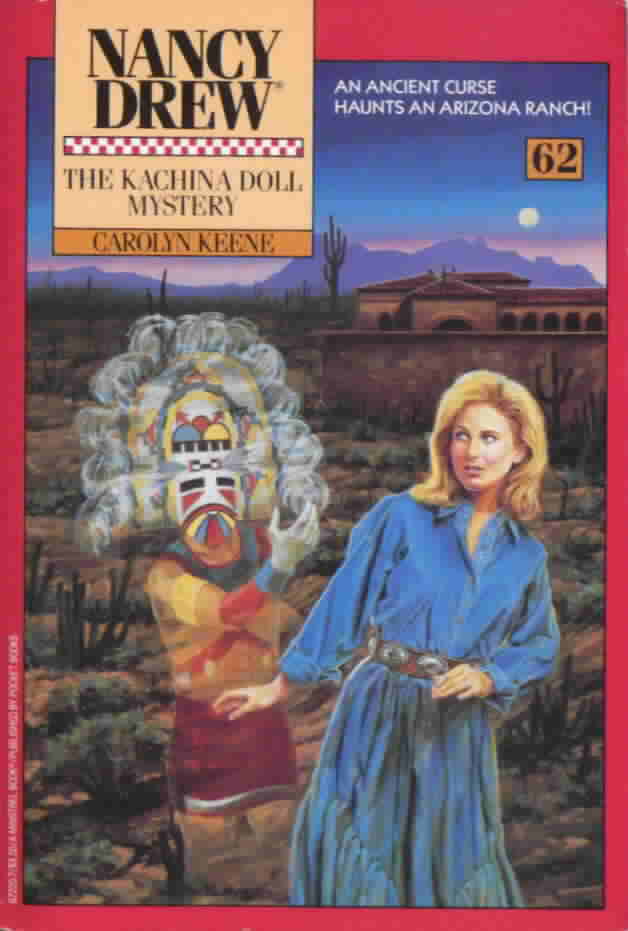
Cover of the edition I read as a kid several times!

Back to School was posted on Aug. 6, and I’ve chosen to talk about this question, “Do you remember what books you checked out at the school library?”  Yes, I do.  I was in middle school, and we often spent time in the library for English or Reading class, and incidentally, that’s where all those Scholastic Book Fairs were.  Anyway, I discovered this entire 2 shelves full of Nancy Drew books by the librarian’s office.  I would reach into those shelves and grab the next two in the series whenever I got the chance.  Those books started my love of the mystery novel and my love for strong female characters.  Nancy was never afraid of anything, not even adults or the dark.  She was my hero back then, and she was so smart.  My favorite was The Kachina Doll Mystery.

Literary Prizes was posted on July 16, and I don’t follow literary prizes or purposely read books on them.  But I did want to talk about this question: “Do you keep a running tally of the books you’ve read for a particular prize? Share a link to your tracking page.”  I’ve kept track of the Pulitzer Poetry Prize winners, and I’ve probably only read 1-2 of those books and by accident.  I also check out the Pulitzer Prize for Fiction from time to time, and the only time I made a conscious decision to read a book from the list was when it was won by Cormac McCarthy for The Road.

I hope that even if you haven’t participated before, that you’ll check out the Weekly Geeks Archives and try on one of the memes.  Let’s make this a goodbye that makes Dewey’s lingering spirit smile.

Here are some other fantastic goodbye posts.

Guest Post: After the Novel: Re-Finding Your Writing Groove by Áine Greaney

Yesterday, I reviewed Áine Greaney‘s Dance Lessons, which is a phenomenal story about the secrets families keep and how forgiveness can transcend the grave.  Part mystery and part romance and family drama, the story follows Ellen Boisvert as she uncovers her husband’s past.  Today, Áine Greaney has graciously offered to talk about her writing space and the time between a finished novel and the next one or the next project.

After the Novel:  Re-Finding Your Writing Groove

My second novel, DANCE LESSONS, took me seven years to write. During the early years, I worked on that book in spurts. There were entire weeks and months when I abandoned it altogether, when I let the book’s women characters slip from my mind.   Jo? Jo who?

Interruptions, they say, are not what distract us from life. They are life. During my seven-year book process, there were urgent trips back to my family in Ireland. There was a day job to go to.  There was a house move. There were other deadlines to meet.

Eventually, in fits and starts, I whipped and whittled that book into shape.

During those final edits and re-writes, my women characters moved in to live in my head and house. At night I dreamed about Jo Dowd, the book’s 84-year-old Irish character.   When I went out for a walk, I tramped along with Ellen Boisvert, the book’s 39-year-old American widow.  Once, as I panted my way through a workout at a local gym, one of the staff smirked at me and said, “You’re grinning again. That means you’re thinking about that teenage character of yours. I can tell.”

The gym woman was right. I was thinking about 14-year-old Cat and her hip-hop dance lessons.

Last April, 2011, I stood in my local Indie bookstore with almost 140 people (I have good friends) at my book’s launch party. For the next month, I read about my book and myself in blog posts and articles. At a fundraiser dinner one night, a woman crossed the room to tell me why she personally had it in for Jo, my Mommy Dearest old-lady character.

And then?  The summer of quiet.

It’s been four months since the release of my novel.  During the four months, the national bestseller lists have changed, then changed again (and again). The titles and rankings have flipped and clacked like that T.V. advertisement for the price slashers at Wal-Mart.  In maternity wards across America, new babies have been born. In chapels and homes and hospice facilities, people have bade a final goodbye to people they loved.

In other words, the world doesn’t stop or change because you write a novel.

A month after the release of DANCE LESSONS, an inner voice urged me to get off the poseur podium and get to work on the (gulp!) next writing project.

So I’ve started two new projects: a third novel; and a fledgling creative non-fiction (a memoir?) book.  Thing is, I find myself working on both of my new projects in scattered, hand-written drafts.  I oscillate between loving my new ideas and hating them.

They both terrify me, especially the non-fiction project.

I’m impatient with my disorganized, scattered process.  A no-nonsense voice tells me to sit up straight at my desk and focus. “Stop scribbling and start typing,” says that strident voice. “And for God’s sake get the cat off the table.”

But it’s not time. Not yet.

Thanks, Áine, for sharing with us your writing space and the time of refocus following that published novel.  I love that she writes her novels in long hand, or at least her notes, and that red wall I spy is my favorite!

Dance Lessons by Áine Greaney

Dance Lessons by Áine Greaney is about the dance we play with our husbands, wives, in-laws, and our own parents as we strive to keep things amicable and not reveal too many of our own secrets, especially secrets we’re not comfortable with ourselves.  Sometimes, it is about the dance the characters play with themselves, balancing the truth and the lies.  Set in Boston, the North Shore, and mostly Gowna, Ireland, Greaney’s prose sways like a graceful dancer telling Ellen Boisvert’s (a young lecturer at Coventry Academy) story.  She learns that her Irish husband, Fintan, was not an orphan as he had told her, but has a mother still in Ireland, and there are many other secrets he never revealed to her while alive.

“Ellen has read this about nurses, psychotherapists, doctors.  Even the largest or most life-saving job boils down to its component pats, a roster of daily tasks.”  (page 132)

Despite Ellen’s desire to leave her husband, she stayed with him for more than a decade and never left him before he died in a tragic sailing accident.  Upon learning that she has a mother-in-law, she writes a letter to inform Jo Dowd of her son’s death.  After an eerie conversation with the woman and several ghostly dreams, Ellen decides to travel to Ireland.  Each step and each movement is part of a larger story, a larger existence.  Fintan’s life and decisions had more of an impact on those around him than he realized, from his mother to his one-time girlfriend and his current wife, Ellen.  Greaney’s story is not one just of grief, but of moving on, stepping out into the light and claiming one’s life back.

“It comes at night, that dagger-pain in the lower back.  It jolts her awake, then circles, snakes up to her shoulders.  You can bear anything, she tells herself, then tries to go back to sleep.  She reminds herself of all the pain, years and years of it, she has borne and borne well, without troubling a soul.  Giving birth.  And there were bee stings as a child.  Or once, years ago, in one of the upper meadows, a hay fork went straight through her foot.”  (page 53-4)

In death, there is a renewal, a new beginning, but people have to be willing to reach out and grab it.  Ellen, like Jo, has lived in the shadow of her sister, but unlike Jo, she is given the chance to excel to take a hold of the reins and steer her own destiny.  Greaney’s story is heartbreaking, heart warming, and as turbulent as the weather of Ireland and the human heart.  Readers also get a taste of the Irish hierarchy and the depressed economic times of the 1950s, and the influx of foreigners.  From jealousy and rage to pity and understanding, the range of emotions in Dance Lessons are reminiscent of the ballet and operatic pieces of some of classical’s greatest artists.

About the Author:

Born and raised in County Mayo, Áine Greaney is a writer and editor living on Boston’s North Shore. She is the author of the novel The Big House and the short story collection The Sheep Breeders Dance. In addition, she has written several award-winning short stories and numerous feature articles for the Irish Independent, the Irish Voice, Creative Nonfiction, and the Literary Review, among others.


This is my 2nd book for the Ireland Reading Challenge.


This is my 50th book for the 2011 New Authors Reading Challenge.

Nominations Are Open!

***This is a Sticky Post***

Today is the first day of nominations for the Indie Lit Awards. What are the Indie Lit Awards? 

The Independent Literary Awards are book awards given by literary bloggers. Lit bloggers write about books and literary related items. They are the fastest growing form of publicity in the literary world, though most are still independently run and do not receive compensation for their reviews or recommendations. All directors and voting members for theses awards are completely independent and do not receive compensation for reviews nor their work on the award board.

The categories seeking nominations include:

Several of these are new categories for the 2011 year, including Poetry.

In order to nominate please refer to the following:

  • Books nominated must have a 2011 release date.
  • You may nominate a book that has already been listed (the books with the most nominations will be what we add to the Long List).
  • You may nominate books in more than one genre, up to 5 per genre.
  • Nominations are open to all readers who do not make their income through the sales of books (i.e. not authors, publishers, or publicists) — hence “independent” from the publishing industry.
  • Nominations are open midnight PST September 1, 2011 – 11:59 PST December 31, 2011.

If you haven’t read any poetry or want some suggestions, I’ve got a running list up and ready for you to visit.

I’d like to make the Poetry category a success this year with a wide range of nominations beyond the popular titles, like Caroline Kennedy’s She Walks in Beauty

I know that there are many of you out there who can make that happen, especially since each of you has the opportunity to nominate up to 5 poetry titles from 2011.

***Please scroll down for today’s review one of the best pieces of fiction I’ve read in a long while.

Mr. Darcy Goes Overboard by Belinda Roberts

Mr. Darcy Goes Overboard by Belinda Roberts reads like a campy “Lifestyles of the Rich and Famous” with its posh boutiques and yachts, and it is a parody of Jane Austen’s Pride & Prejudice.  In the seaside resort town of Salcombe, the Bennets are on vacation and their mother is thrilled to learn that Netherpollock has been bought by Mr. Bingley, an eligible bachelor.  The quest to marry off one of her daughters has begun, though the appearance of Mr. Darcy on the yacht, Pemberley, sours the first meeting as he considers Lizzy only tolerable.  All of this should very familiar to those who love Austen’s classic, but the story is more modern in its sensibilities and humor.

Roberts characterizations of Kitty and Lydia as in competition over dresses and boys, and Lydia’s “valley girl” attitude and use of “like” and “whatever” in conversation are welcome updates to the classic.  Humorously, the soldiers are now lifeguards in this story, and naturally, Lydia and Kitty are eager to become the “victims” in their training exercises.  Unlike the classic where their catty and flirtatious nature are subdued, Lydia and Kitty are more over the top as they become streakers at one gathering.

“The ordeal of a near drowning for the second time in one day had so shocked Mr. Collins that he was unable to stand, so Darcy was forced to carry him, in his arms, up the steps.  Physically, Mr. Collins succumbed like a baby to this mode of transport.  Mentally, however, he was quite alert and was not one to miss an opportunity.  Recovering slightly, he could see the closeness of the situation was the perfect moment for a little intimate conversation and proceeded to wrap his arms fondly around Darcy’s neck and to introduce himself.”  (page 84 of ARC)

There are moments of utter ridiculousness, and Roberts stays as true to the characters as she can in her wild rendition.  However, readers will note that her characterization of Mr. Bingley as a bit dim is outside the mark.  He cannot remember Mr. Bennet”s name correctly, and he continues to dig himself a hole when he talks of Jane’s various body parts in traction and how he will miss them, but she is still beautiful, though he doesn’t want her inconvenienced.

Readers looking for a story that is closer to the original will be disappointed, but if they are seeking a fun, parody of the classic, Mr. Darcy Goes Overboard is for them.  A quick light read to pick you up when you need it.

This is my 49th book for the 2011 New Authors Reading Challenge.

Here, Bullet by Brian Turner

Here, Bullet by Brian Turner, who served in the U.S. army for seven years after receiving his MFA and was a team leader for one year in Iraq with the 3rd Stryker Brigade Combat Team, won the 2005 Beatrice Hawley Award and was printed by Alice James Books — a nonprofit cooperative poetry press.  (The title poem, Here, Bullet,” was recently profiled in the Virtual Poetry Circle.)  The collection is broken down into four sections, and each section is preceded by a quote relevant to it, with some even quoting the Qur’an.  Turner is adept at illustrating the violence of war, but also the humanity that accompanies it.  From the startling nature of rockets going off over head to the silence of bullets as they enter the body, he provides a keen eye into how those instruments of war impact both sides of the battle equally psychologically, physically, and spiritually.

Soldiers who craft wartime poetry have generally either fallen into the category of using graphic violence to shock and awe the reader or using quieter imagery to bring about reader understanding about psychological impacts of battle.  There also are those that have political poems that are heavy on criticism or propaganda, but those would fall less into the wartime poetry category.  Turner combines both violence and peace in his imagery, but in a unique way that has violence silently creeping into the lines and shocking readers.  For instance, in “Eulogy” (page 20), readers may hardly notice the suicide of Private Miller because he takes “brass and fire into his mouth,” but once the birds fly up off the water by the sound, it is clear the brass and fire are from a gun.  While outright, violent images can be eye-opening for readers, the quiet power in some of Turner’s lines are that much more lasting.

From “Katyusha Rockets” (page 32), “Rockets often fall/in the night sky of the skull, down long avenues/of the brain’s myelin sheathing, over synapses/and the rough structures of thought, they fall/into the hippocampus, into the seat of memory–/where lovers and strangers and old friends/entertain themselves, unaware of the dangers/headed their way, or that I will need to search/among them.”  These poems not only pay tribute to soldiers on all sides, but the civilians, the heroes, and a soldier’s fears and his regrets.  Some poems are infused with deep sadness, while others are steeped in great pride.

Here, Bullet by Brian Turner and the title poem are a testament to war and all of its trappings.  Readers will enjoy the quiet power these poems hold and the deft hand with which Turner paints the humanity of both sides in war.  The collection also contains moments of observation that will have readers thinking about war in the greater context of our own “supposed” morality as espoused by the Bible and the Qur’an, noting in “Dreams From the Malaria Pills (Turner)” (page 46), “He knows the Qur’an and the Bible/have washed page by page to the shore,/their bindings stripped loose, their ink/blurred into the sea.//”

About the Poet:

Brian Turner is a soldier-poet who is the author of two poetry collections, Phantom Noise (2010) and Here, Bullet (2005) which won the 2005 Beatrice Hawley Award, the New York Times “Editor’s Choice” selection, the 2006 Pen Center USA “Best in the West” award, and the 2007 Poets Prize, among others. Turner served seven years in the US Army, to include one year as an infantry team leader in Iraq with the 3rd Stryker Brigade Combat Team, 2nd Infantry Division. Prior to that, he was deployed to Bosnia-Herzegovina in 1999-2000 with the 10th Mountain Division. Turner’s poetry has been published in Poetry Daily, The Georgia Review, and other journals, and in the Voices in Wartime Anthology published in conjunction with the feature-length documentary film of the same name.


This is my 48th book for the 2011 New Authors Reading Challenge.


This is my 22nd book for the Fearless Poetry Exploration Reading Challenge.