Quantcast

Guest Post & Giveaway: Liza Gyllenhaal’s Move to Rural Inspiration

Today’s guest is Liza Gyllenhaal, author of So Near, and she’s going to share with us her writing space.

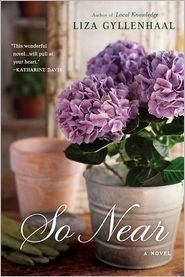
But first, let’s take a look at her book.  According to Amazon.com’s synopsis, “In the aftermath of a devastating loss, Cal and Jenny Horigan’s marriage is unraveling.  Both are plagued by guilt, unable to seek comfort from one another.  Burdened by remorse, they begin to lose sight of the love that once anchored them-together with their sense of right and wrong.  As the Horigans try different ways to deal with their pain, a new acquaintance seems to offer the support they desperately need-though at times they are unsure whether his guidance is leading them back to each other or further apart.”

Look at that cover, those big flowers are just so eye-catching and remind me of spring and renewal.  Let’s hope the same renewal can happen for Gyllenhaal’s characters, which you can find out if you win the giveaway. 

For some reviews of So Near, please check out Life in the Thumb and 5 Minutes for Books.

Without further ado, please welcome Liza Gyllenhaal:

Where Liza works in the winter

During the years I worked in advertising in New York City, I would try to fit in an hour or two of writing every morning in my cramped apartment. I used to dream of one day having my own writing studio. If Henry James thought “summer afternoon” were the two most beautiful words in the English language, I began to feel that “writing studio” took a close second. I imagined it in the woods somewhere with a fireplace or wood-burning stove — rustic and musty and so quiet you could hear the mice scrabbling around in the walls.

Writing studio in the Berkshires

Fifteen years ago, I was able to sell my advertising agency and buy my dream — a place in the country — or, more specifically, the beautiful Berkshire Hills of Western Massachusetts. It included a small farmhouse and an old horse stable which became my “writing studio.” It still has the old iron stall feeders and leather harnesses on the walls. It remains permeated by a wonderful smell of animal and old hay. It’s where I wrote most of my first novel Local Knowledge and my just published new novel called So Near — both set in the Berkshire area.

Liza inside the studio — on the laptop

I wake up early and reread and rewrite on my laptop in the house, but in the afternoon I go out to the studio, bolt the door, and start the hard work of writing the next new word, sentence, paragraph, chapter. In the winter I have a fire going in the Jotul stove, in the summer I have all the windows open and can hear the seasonal brook and birdsong. This summer, I watched a family of wild turkeys — 17 in all — parading up and down in the old paddock. Other sightings: woodchuck, coyote, fox, and early last spring, when the trees were just greening out, a big black bear. It was a breathtaking moment when this wall of darkness lumbered right past me — so close that, if the window had been open, I could have reached out and run my hand through the bear’s ink-black fur.

Thanks so much for sharing your writing space with us, Liza.

Sounds like a place I’d love to visit just for some down time and relaxation, though I do more writing in public places where there are lots of people to watch!

About the Author:

She was raised in a small town in Pennsylvania which, at the time she was growing up, was fairly rural and very lovely—much like the area of the Berkshire Hills in Massachusetts where she now live part of the time with her husband.

She studied poetry at University of Iowa Writing Workshop before moving to New York City and began a career in publishing and advertising.  She tried to continue writing poetry, but gradually moved to romance and other genres before her first novel.

In addition to writing, she works on behalf of various non-profits in New York City and the Berkshires. She also is the past chairperson of The Academy of American Poets and currently serves on its executive committee. (– excellent news to me since I just love that organization, am a card-carrying member, and blog about it all the time — funny how small the world is sometimes).

Please follow her on Twitter and Facebook, and check out her blog.

Now for the giveaway.  I have 2 copies So Near for US/Canadian readers.

1.  To Enter, leave a comment about where you do your blogging or reading and why.

2.  Facebook, Tweet, or blog about the giveaway for additional entries. (for up to 3 other entries).

3.  Follow this blog for another 2 entries. If you already follow, let me know.

Deadline for the giveaway is Sept. 30, 2011, at 11:59PM EST.
Interview With Poet Jessica Piazza

Poet Jessica Piazza

Last week an interview with Poet Jessica Piazza posted on 32 Poems.

Please check out a part of the interview below, and give her a warm welcome.

How would you introduce yourself to a crowded room eager to hang on your every word? Are you just a poet, what else should people know about you?

Usually I just tell people that I’m a word-nerd and that I’m generally ridiculous. I like getting that out there early. I also probably pipe in that I’m from Brooklyn, New York pretty early on, because I’m really proud of where I come from. Brooklyn has definitely become the trendy place to be for artists and hipsters of all ilk, but growing up deep in South (read: uncool) Brooklyn is a completely different story, and a very particular story at that. Other than that, I’m more likely to talk about my dog than myself. His name is Special and he’s seriously….special.

Do you have any obsessions that you would like to share?

Ha! Obsessions are my obsession. A quick Googling of me reveals that my entire writing life for the past few years focused almost primarily on ruminations about clinical phobias and clinical philias. I wrote poem after poem inspired by these weird obsessive fears and obsessive loves, and my entire manuscript is anchored by them. For me, that was subject was a natural one, since I get addicted to ideas or projects themselves and have to play them out until I’ve killed them in some emotional way. I mean, I *only* write poems in projects, and that’s beginning to bite me in the ass as I try to create a second manuscript. For example, how do you fit together a dozen strange ekphrastic poems with erasure poems made from news articles and tiny, technical poems about bridges? It ain’t easy, kids. That’s all I’m saying..

Most writers will read inspirational/how-to manuals, take workshops, or belong to writing groups. Did you subscribe to any of these aids and if so which did you find most helpful? Please feel free to name any “writing” books you enjoyed most (i.e. Bird by Bird by Anne Lamott).

I’m not much a reader of books on writing, but one did move me, years ago. It’s not specifically writing focused, even! It’s called “Art & Fear: Observations On the Perils (and Rewards) of Artmaking” by David Bayles and Ted Orland. It contains this astonishing tidbit: “If ninety-eight percent of our medical students were no longer practicing medicine five year after graduation, there would be a Senate investigation, yet that proportion of art majors are routinely consigned to an early professional death. Not many people continue making art when – abruptly – their work is no longer seen, no longer exhibited, no longer commented upon, no longer encouraged. Could you?”

Reading that only articulated my already steadfast determination to provide artistic communities: spaces for the sharing and appreciation of poetry, in person and on the page. A year interning with Robert Pinsky (and Maggie Dietz!) at “The Favorite Poem Project” in Boston—an endeavor that set out to prove poetry touched ordinary Americans—was the perfect groundwork for me. As hundreds and hundreds of love letters to poetry poured in that first year, I realized that the power of great literature is not esoteric—it’s visceral, vibrant and necessary. It was right there…proof that poetry could have power as a pop-cultural force, not just an academic byproduct. I wanted to find a way to work with this idea, both expanding poetry’s place (and scope) in education, and simultaneously ensuring its recognition as a viable source of popular entertainment and inspiration.

To that end, over the years I helped to found a popular reading series (Speakeasy Poetry Series in NYC), a successful national literary journal (Bat City Review) and a small university press (Gold Line Press). Funny, though…it’s ironic that, at first, I never thought of teaching as a way to advocate poetry in the community. But when I started as a Teaching Assistant in 2003, I saw the impression that well-made literature could make on generally unimpressed students, and I’m proud to say that I’ve helped create many new poetry lovers over the last eight years of teaching at a college level. No wonder teaching became a passion—it doesn’t get much more inspiring than that.

Thanks, Jessica, for answering my questions. For the rest of the interview, visit 32 Poems.

About the Poet:

Jessica Piazza was born in Brooklyn, has a B.S. in Journalism from Boston University, an M.A. in English and Creative Writing from the University of Texas at Austin and is currently a Ph.D. candidate in English Literature and Creative Writing at the University of Southern California. She is a co-founder of Bat City Review, an editor at Gold Line Press, a contributing editor at The Offending Adam and has blogged for The Best American Poetry and Barrelhouse. Among other places, her poems have appeared or are forthcoming in 32 Poems, The National Poetry Review, The Missouri Review, Agni, Indiana Review, Mid-American Review, Rattle, 42 Opus and Forklift, Ohio. Her dissertation focuses on the intersection between literary analysis and neuroscience, which means she reads a lot of science articles, which also means she’s constantly tempted to shuffle around like a zombie screaming “BRAINS!!!!” at random poets and writers.

Check out a sample poem:

Eisoptrophilia
           Love of mirrors
                               Impression pressed upon the glass perfects
                               even the grossest forgeries.  Reject
                               the sea.  Reject the turning tide.
                               Just below clear water, I reside
                               as duplication of the lake.  Take me
                               away, another underneath again.
                               What mirrors cannot ditto isn’t sin.

Eisoptrophobia
        Fear of mirrors
                                What mirrors cannot ditto isn’t sin
                                simply performed behind the glass.  Within
                                the frame of windowpane, negated dark.
                                Those fleeting squares reveal our darkness back.
                                Aloof, the rain plays taps.  Above, the trees
                                are inimitable.  Distinct, thus blessed.
                                Reflected, I am never at my best.

--Originally published in Mid-American Review, Volume XXX, Numbers 1 & 2 Fall 2009/Spring 2010

Around Germantown (MD) Then & Now by Margaret Coleman

Around Germantown (MD) Then & Now by Margaret Coleman takes a look at what Germantown was like before 1980 and what it was like after the Maryland-Nation Capital Park and Planning Commission adopted the area.  Coming from Massachusetts where many of the towns are older than the actual state and older than the United States, I had no idea that towns/cities were actually planned out ahead of time.  I really thought that they just came about when people started settling into an area and the businesses just cropped up naturally to service those people.  Silly, me.

Germantown, Md., is made up of six villages and the heart of the city has been moved a couple of times as populations and transit projects changed.  My husband and I looked at this book together and I told him we must have been destined to move here, since some of the founding families have the same last name as those of the town we grew up in.  The town also was settled by German farmers in addition to the English farmers already here.

We really enjoyed the photos of places that were and what they came to be, though it saddened us that so many of the original historic structures in the town had burned (on purpose or accidentally) and were not restored and of those that were restored were moved to other locations.  Unfortunately, progress seems to be the mainstay of this town as historic homes have been replaced by gas stations and other signs of commerce.  The tone of the book doesn’t seem as maudlin as I do about it, however.

Around Germantown (MD) Then & Now by Margaret Coleman is an interesting peak into the history of this town, its people, and its growth over the years.  I’d recommend it to locals interested in the area they have moved to or to those who have lived here but know little of its history.  I’ve always enjoyed these types of books even if I don’t live in the areas discussed.  The inclusion of photos of places then and now rounds out the story.

This is my 55th book for the 2011 New Authors Reading Challenge.

Mailbox Monday #144

Mailbox Mondays (click the icon to check out the new blog) has gone on tour since Marcia at A Girl and Her Books, formerly The Printed Page passed the torch.  This month our host is Amused by Books.  Kristi of The Story Siren continues to sponsor her In My Mailbox meme.  Both of these memes allow bloggers to share what books they receive in the mail or through other means over the past week.

Just be warned that these posts can increase your TBR piles and wish lists.

Here’s what I picked up from a library sale a weekend or two ago:

1.  American Sublime by Elizabeth Alexander

2.  Barefoot by Elin Hilderbrand

3.  Exercises for the Everyday Writer by Lex Runchiman and Francine Weinberg; there are new versions of this reference.

4.  The Penguin Book of First World War Poetry edited by Jon Silkin; I have an older version from 1979.

5.  The Trumpet of the Swan by E.B. White for “Wiggles”; the version I picked up for her has the blue cover with the drawing of the boy and the swan by a pond; the same version I had as a kid.

These are books I picked up at the 90% off sale at my Borders in its final days:

6.  Under Fishbone Clouds by Sam Meekings

7.  The Wolves of Andover by Kathleen Kent; though looks like this book has been reissued with a different title.

8.  Lady Vernon and Her Daughter by Jane Rubino and Caitlen Rubino Bradway

9.  Red April by Santiago Roncagliolo, translated by Edith Grossman, which is part of my effort to read more translated works.

10.  The Kitchen Boy by Robert Alexander

11.  Tethered by Amy MacKinnon

12.  From the Land of the Moon by Milena Agus, translated by Ann Goldstein

13.  Blue Nude by Elizabeth Rosner

14.  These Things Hidden by Heather Gudenkauf

15. Around Germantown (MD) (Then and Now) by Margaret Coleman, which I purchased at my new bookstore Novel Places.

What did you receive this week?

Novel Places, the New Bookstore for You

One thing I always loved about Massachusetts bookstores was the old town feel, since quite a few are in older homes or businesses, and the combination of new and old and/or used books. There are certain things I would do when I went home to visit my parents — eat mom-and-pop place pizza and subs, eat my favorite Chinese food, and go to an indie bookstore.

IMG-20110917-00101

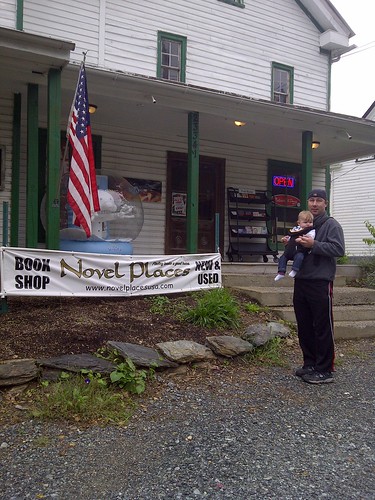
I’ve got my very own mom-and-pop pizza place and the best part is I can walk to it, which just opened here this year.  And now, I’ve finally found the equivalent of my favorite bookstores in Maryland!  It’s only taken me 10 years.  Novel Places is that bookstore, and their motto is very accurate!

My husband, “Wiggles,” and I took a little ride to visit this cute little store on Frederick Road in Clarksburg.  It’s not that far from where we live and its a cute little shop inside an old general store/post office.  I have a thing for older buildings, perhaps its growing up in a post-and-beam construction house that was always in need of  repairs and upgrades, especially when you find tree trunks in the walls with bark still on them.

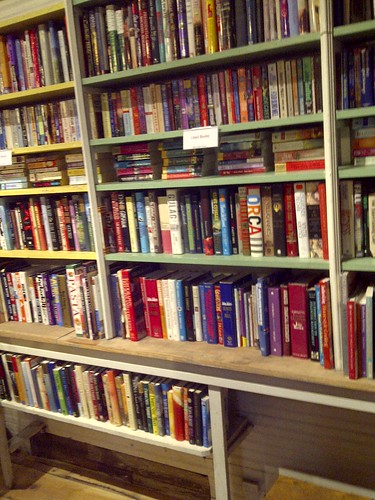
Used Books in Novel Places

Novel Places has a great selection of used books from mystery/thriller to nonfiction and reference. There are a great number of new books as well, and there is a large section of children’s toys, including those wood peg puzzles. In addition to books, the store offers space for up to 25 people for gatherings, tournaments, and other meetings. When we were there, they had a Magic tournament going on. Now, if I ever get another book club going, maybe we could have our meetings there! So if there are any interested people in Maryland near Clarksburg interested in starting a book club, I’m all ears.

Currently, they are honoring Borders Rewards members, which came in handy for me when I wanted to pick up a cool book about my current city/town!  The store also offers Google ebooks downloading for those of you with ereaders, and you can get them to track down those hard to find books for you.  There are some great gifts like book covers made of various fabrics and one of my favorite finds was the nice Atticus Books display, which is one of my favorite local publishers in Maryland (though I still am waiting for Tracks to arrive!).  Check out these great photos from inside the store.  I can’t wait to see them expand upstairs!

Take the time to click on the Novel Places Logo at the top of the post, visit them on Facebook, and follow them on Twitter to see what’s new.  You can also find the owner, Patrick on LinkedIn.  Come experience the quaint bookstore with me when you’re in town!

BBAW Winners and More Winners

The winner of The Gendarme by Mark Mustian was Jill of Rhapsody in Books.


The winner of Operation Blue Light by Philip Chabot and Laurie Anne Blanchard during BBAW is Emily of Emrelove.


The winner of Enemy Women by Paulette Jiles during BBAW was Florinda of The 3 Rs Blog.


The winner of Women Know Everything! by Karen Weekes during BBAW was Aths of Reading on a Rainy Day.


The winner of The Snow Whale by John Minichillo during BBAW was Amy of The House of Seven Tails.


The winner of When She Woke by Hillary Jordan during BBAW was Lauren of Shooting Stars Mag.


Congrats to all of you and I hope you enjoy the books.


Virtual Poetry Circle #115

The Other Man is Always French (page 38-40)
by Richard Peabody from Buoyancy and Other Myths (my review)

The other woman can be
a blonde or a redhead
but the other man
is always French.

He dresses better
than I ever will.

He can picnic
and stroll
with a wineglass
in one upraised hand.

Munch pate,
drink espresso,
and tempt with
ashy kisses.

He hangs out
at Dupont Circle
because the trees
remind him of Paris.

Did I mention sex?

Face it--
he's had centuries
of practice.

I'm an American.
What do I know?

He drives a fast car,
and can brood like
nobody's business,
while I sit home
watching ESPN.

He's tall and
chats about art--
I don't even want
to discuss that accent.

He's Mr. Attitude.

My fantasy is to call
the State Department
and have him deported.

Only he'll probably
convince you to marry him
for a green card.

No way I'm going to win--
the other man is
always more aggressive,
always more attentive.

The other man
is just too French
for words.

From now on
I'm going out
with statuesque German women

so next time we run
into each other
they can kick his butt
for me.

As part of the 115th Virtual Poetry Circle, I’d like to welcome you and hope you will read the above poem more than once.

I find reading poems out loud is helpful in understanding what they are talking about.

Remember, this is just for fun and is not meant to be stressful.

Molly Peacock’s books are a great resource about how to examine a poem.  She suggests selecting a line, a stanza, sentences, and images and look at the poem in pieces.

I’m looking to you to describe what you like or don’t like; and offer an opinion. If you missed my review of Peacock’s book, check it out here.

Also, sign up for the 2011 Fearless Poetry Reading Challenge because its simple; you only need to read 1 book of poetry.

Please contribute to the growing list of 2011 Indie Lit Award Poetry Suggestions (NOMINATIONS ARE OPEN through Dec. 31, 2011) and visit the stops on the National Poetry Month Blog Tour from April.

Above all, have fun and join the discussion.

She by Saul Williams

She by Saul Williams is a collection of interconnected musical poems coupled with a collection of images from Marcia Jones that tells a story about a woman and their journey together.  On his Website, he says, “This book chronicles my thoughts and feelings as a young man working through an early relationship with an amazing visual artist as we embark on adulthood and parenthood in the same breath.”

Each of Williams’ poems has a unique rhythm to it, and should be read aloud for effect.  Each is as expressive as you would expect Williams to be in real life, becoming an extension of himself and his digital, visual, and audio art.  Unlike other collections, Williams’ She is a story beginning to end with a prologue and epilogue and prose poetry.  The nameless She is integral to the journey, a connection to the past and the future, illustrated through short lines and “out loud” cadence that screams to be read aloud.

While readers could dip in and out of the collection and experience it in small chunks, it is best to read it cover to cover to grasp its full impact. Tackling issues of separatism, aging, and opposing desires, Williams pinpoints the harshest of realities and deals them a deft blow when he demonstrates the commonalities between us all. Because these poems do not have titles, the clear intent is to create a continuous narrative in which “calamity makes cousins of us all” (page 22) and “we live.” (page xi)

Nature imagery and personification can make the issues more vivid, “there is a gathering in the forest. the leaves have refused to change. they say that they are tired of things never remaining the same, of dying to be reborn, of winter’s dry withered hand.” (page 7) But lest the images become to heavy, there are moments of whimsy as well.

I have seen the truth
many times
but for the first time
she saw me

I wore suspenders
for the judgment
in my pants

(page 13)

As the relationship goes down hill, readers will not a dramatic change in the poems as the narrator struggles to let go for the sake of love. “I am a canvas/painted over/whether it be by your hand/or mine own.” (page 113) The images included in the book are unusual and appear to mix mediums, and often resemble pages from a scrapbook that a mother would keep of her children. In a way these pages resemble Williams’ play on words as he picks them apart and alters their definitions to explain the moment he is in.

Reading She alone in a room is not enough. It should be read aloud, shared with others, and most who pick up a copy will do just that. Seeing Saul Williams read it would make it even better, but its up to you to find out where he’s reading or performing next. There is not enough that can be said about this collection, except go read it!

Some reason Saul reminds me of Don Cheadle in this photo.

About the Poet:

Saul Williams is an American poet, writer, actor and musician known for his blend of poetry and alternative hip hop and for his leading role in the 1998 independent film Slam.

From Wikipedia about Williams and Marcia Jones’ relationship:

Williams and artist Marcia Jones began their relationship in 1995 as collaborative artists on the Brooklyn performance art and spoken word circuit. Their daughter, Saturn, was born in 1996. His collection of poems S/HE is a series of reflections on the demise of the relationship. Marcia Jones, a visual artist and art professor, created the cover artwork for The Seventh Octave, images through-out S/HE in response to Williams, and set designed his 2001 album Amethyst Rock Star.

This is my 24th book for the Fearless Poetry Exploration Reading Challenge.


This is my 54th book for the 2011 New Authors Reading Challenge.

BBAW, the Final Send Off

It has been a crazy week of book blogging and celebrations, and I wanted to take a moment to thank everyone who voted, participated, commented, read, and brought the giveaways and posts to the community.  You’re all fantastic people and your voices have been heard.

I also want to thank you for voting for my blog as Best Poetry Blog.  I appreciated that more than you know.

Three Tips for Blogging:

1.  Be Creative:  Come up with your own events, challenges, review formats, weekly features, and interview questions.  Take inspiration from other blogs, television, your neighbors, strangers on the subway, and wherever else you find it.

2.  Try it Out:  Even if you try out an idea and it doesn’t work, you gave it a chance.  You should also give it more than a few weeks.  Keep the events, formats, and other stuff you try going for a month or more because the blogging world is so big, it takes more time to get noticed.  You can help that along by following tip #3.

3.  Spread the Word:  Facebook, Twitter, and commenting are your friends.  Its how you make connections, how you build a following, and how you inform others of what you are doing.  This works for your reviews, your interviews, your giveaways, your events, and more.  If you are starting your own challenge, you should submit the information to the Novel Challenge blog.

One of the latest things I’ve done is make a Facebook page for the blog, and use it to spread information about poets, interesting articles, and publishing updates and trends.  It’s been a great way to keep discussion going, and you don’t need to constantly watch it like you do Twitter.

I hope everyone had a great time this week and found some more blogs to follow and enjoy.  Take the time to read through these new blogs and get to know the people behind them.  You’ll be richer for it.

What are your tips?

Since I received a second copy of When She Woke by Hillary Jordan, I’m going to pass one along to a book blogger. I haven’t read this yet, but it sounds fantastic.

All you have to do is comment and leave a link to your blog so I can visit.

This International giveaway ends Sept. 16, 2011, at 11:59PM EST.

Buoyancy and Other Myths by Richard Peabody

Buoyancy and Other Myths by Richard Peabody is a slim collection that gets at the heart of family drama broken into three parts:  Shooting Myself in the Foot, Kissing Games, and Between Funerals.  The narrator in these poems ages and matures from a young boy eager to help his father but afraid of falling short to an older man similarly worried about falling short, but more accepting of reality.

Unlike the young man in “Family Secrets” who is shaking sense into his brother, the man in the latter poems, like “Orbits,” comes to the realization that the past cannot be hidden and regrets do nothing but hold you back.  You must roll with the punches.  What is striking in some of these poems is the calmness of the narrator, even as violent thoughts or actions are being displayed.  For instance, in “Family Secrets” (page 11) — which is a powerful way to start a collection — “Music isn’t enough tonight./Scratching, clawing, eyes like stones./If I erase him I will expand./His sins wiped clean. Nowhere/for him to leer from. No perch/or receptacle that can hold that/particular weight. He gives up./”  Is his brother still living and he wishes that he didn’t have to remember him or is it what happened to his brother that he does not wish to remember and it would be easier to erase him entirely?

Nearing the end of the collection, it seems as though this narrator has found peace or at least outwardly demonstrates contentment, or is it resignation?  In “I Live Behind a Bakery” (page 55-6), “Only most days/it’s easier/to just read a book/with that smell/all around me/and think buttery thoughts.//”  Peabody has a lot of cutesy ideas that he plays with in his poetry, like living behind a bakery or dating vampires, but these images are metaphors for other things like the contentment that you find in the simple things of life or even in the relationships you have.  However, there is an undercurrent in these poems urging readers to move beyond contentment, leap into more dangerous and possibly fulfilling territory.

Guitar Player (page 36)

Fingers know secrets
that eyes can’t understand.

While not all the poems are memorable or strong, there are a few gems within the collection’s pages that are worth reading more than once. Some are simply powerful in a few lines. Buoyancy and Other Myths by Richard Peabody explores the nature of relationships and how they propel us to greater things to seek out new directions and yes, to grow.

About the Poet:

Richard Peabody, a prolific poet, fiction writer and editor, is an experienced teacher and important activist in the Washington , D.C., community of letters. Peabody is the editor of Gargoyle Magazine (founded in 1976), and has published a novella, two books of short stories, six books of poems, plus an e-book, and edited (or co-edited) nineteen anthologies including: “Mondo Barbie,” “Conversations with Gore Vidal,” “A Different Beat: Writings by Women of the Beat Generation,” and “Kiss the Sky: Fiction and Poetry Starring Jimi Hendrix.” Peabody teaches fiction writing for the Johns Hopkins Advanced Studies Program.

This is my 23rd book for the Fearless Poetry Exploration Reading Challenge.


This is my 53rd book for the 2011 New Authors Reading Challenge.


This is a stop on The Literary Road Trip since Richard Peabody is a local Washington, D.C., area poet.