Quantcast

Interview With Emma Eden Ramos

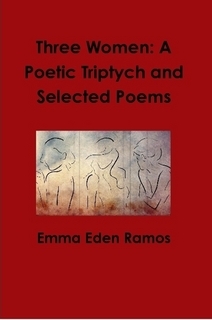
I recently had the pleasure of reading and reviewing Emma Eden Ramos‘ first chapbook, Three Women:  A Poetic Triptych and Selected Poems at the beginning of November.  Her collection creates three unique female voices who are connected.  I had the pleasure of interviewing Emma via email to learn a little more about her as a poet and her collection.

Without further ado, please welcome her.

1.  How would you introduce yourself to a crowded room eager to hang on your every word?  Are you just a poet, what else should people know about you?

I’m pretty shy and self-conscious in front of large groups of people, so I would probably begin with a short anecdote as a way to personally connect with the crowd. From there, I would go into my background.

I am a twenty-four-year-old student from New York City. I’ve wanted to be a writer since I was about seven-years-old. That year I wrote my first short story, a fable, which ended up in a collection of children’s stories called Witches Brew.

I became interested in poetry later when my mother gave me a collection of Emily Dickinson‘s poems in my freshman year of high school. That was a rough year and I remember finding a great deal of solace in Dickinson’s words. I wrote my first poem that year, a poem about the main character from Edith Wharton‘s novel Summer. My English teacher was very supportive and encouraged me to continue writing. I did, on and off, until 2009 when I decided to take my writing more seriously. I wrote a novelette entitled Where The Children Play that was published in the Spring of 2010. I’ve been writing continuously ever since.

2.  How did you create the three women in your chapbook, Three Women:  A Poetic Triptych and Selected Poems?  Were they based upon people you know or yourself?

After I agreed to write a poetry chapbook, I grew nervous. though I have a deep love for poetry, I see myself as more of a fiction writer. Creating and developing characters is essential to my writing process. I need them as guides. With Three Women I was lucky because, though the editor of Heavy Hands Ink had never published a chapbook with a storyline and characters before, he was supportive of the idea.

When developing the three characters, I attached each woman to a certain female archetype from Greek Mythology. I saw Annette as a manifestation of Aphrodite. She is outwardly beautiful and has relied on her beauty throughout her life. However, after her son’s suicide, Annette’s physical “perfection” has become more of a handicap. The beauty she once treasured now fully masks Annette’s internal torment.

I saw Julia as Persephone. She is the daughter trapped in the Underworld, which in her case, is adolescence. However, Julia is also very much based on myself.

Milena is a warrior. I have met many women like her and am always floored by their resilience. As an archetype, I saw her as Athena. Milena possesses courage, intelligence, wisdom, and strength. She may be under Annette’s “professional” care, but she is not the one who is lacking in emotional resources.

3.  Do you see spoken word, performance, or written poetry as more powerful or powerful in different ways and why? Also, do you believe that writing can be an equalizer to help humanity become more tolerant or collaborative? Why or why not?

I love spoken word and performance poetry and am a fan of artists such as Ursula Rucker and Anne Waldman. There is a power, an electricity, that comes from experiencing a poem  performed. Initially, I think performance poetry is probably more powerful than written poetry because it is synesthetic. There is a hidden quality to the written word, however, that I think makes it more durable. When I read a poem, the words are locked in my consciousness in a very different way than when I hear a poem performed.

I do believe that writing can be an equalizer, a tool through which human beings can find a common ground. Writing is a form of communication. Thoughts and perhaps, more importantly, feelings are channeled and conveyed through writing. While individuals are different, as a collective we share feelings that are fundamental to the human condition. Writing–poetry, fiction, non-fiction–can and has been a medium through which those universal feelings are expressed.

4.  Poetry is often considered elitist or inaccessible by mainstream readers.  Do poets have an obligation to dispel that myth and how do you think it could be accomplished?

When I hear people say that they struggle with this or that poem, find it impenetrable, I often agree. I cannot count the number of occasions that I have finished reading a poem and thought, “Wow. Beautiful language. Beautiful imagery. If only I knew what the writer was talking about.” I don’t know why this is. I have heard poets argue that poetry is personal. It comes from an unconscious place and therefor can only be understood by the poet. I respect this answer and the artist’s desire for self-expression. However, as I said earlier, writing, poetry included, has the potential to be a tool for communication.

5.  Please share some of your favorite contemporary and classic poets and a favorite collection or two from those poets and why you enjoy their work.

One of my favorite contemporary poets is a woman named Brooke Axtell. I discovered Brooke when I came across her first poetry collection, Daughter of the Burning. This collection, as well as Axtell’s other work, is a perfect example of the power poetry has to communicate strong emotions and inspiration.

Other poets I love are Adrienne Rich, Patricia Smith, Linda Gregg, Sarah Hannah, Sharon Olds, and the list could go on.
Thanks so much Emma for answering my questions.  I wish you great success in your poetry.

Mailbox Monday #151

First, I would like to congratulate (Ryan) on winning My Soul to Take by Tananarive Due (my review) from the last Mailbox Monday giveaway.

Mailbox Mondays (click the icon to check out the new blog) has gone on tour since Marcia at A Girl and Her Books, formerly The Printed Page passed the torch. This month’s host is the Mailbox Monday tour blog.

Kristi of The Story Siren continues to sponsor her In My Mailbox meme.

Both of these memes allow bloggers to share what books they receive in the mail or through other means over the past week.

Just be warned that these posts can increase your TBR piles and wish lists.

Here’s what I received this week:

1.  You Are My Only by Beth Kephart; finally my 5 pre-ordered books arrived (so the two of you readers who have won a copy should receive them soon from me) and 1 autographed copy from Beth after I won her Treasure Hunt, which I will treasure forever.

2.  Dreaming of Mr. Darcy by Victoria Connelly for review in January from Sourcebooks.

3.  Christmas at Pemberley by Regina Jeffers for review in December from Ulysses Press.

4.  Henry Tilney's Diary by Amanda Grange for review in December from Berkley/Penguin.

5.  The Unexpected Miss Bennet by Patrice Sarath for review in December from Berkley/Penguin.

6. Ivan and Misha by Michael Alenyikov, which I won from Unabridged Chick!

7. All the Flowers in Shanghai by Duncan Jepson from Library Thing Early Reviewers.

What did you get in your mailbox?

Some Lucky Winners….

Today, I want to congratulate some winners of some spectacular books.

The two winners of You Are My Only by Beth Kephart:

Jill of Rhapsody in Books
Janel of Janel’s Jumble

The winner of The Taker by Alma Katsu:

Johannah from A Book and a Bite

Congrats ladies!

122nd Virtual Poetry Circle

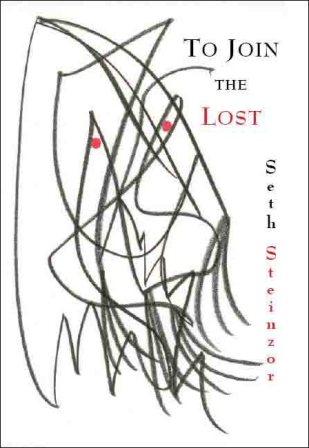
Today’s poem is from To Join the Lost by Seth Steinzor, which I reviewed earlier in the week and modernizes Dante’s Inferno:

Canto I (page 11-6)

Midway through my life’s journey, I found myself
   lost in a dark place, a tangle of hanging
vines or cables or branches – so dark! – festooning
   larger solid looming walls or
trunks or rocks or rubble, and strange shapes
   moving through the mist, silent or
howling, scuffling through the uneven dirt or
   dropping from the blotchy sky like
thicker clouds, so close sometimes I ducked in
   fright so that they never quite touched me.

Someone I had trusted had led me there.
   Perhaps it was persons, I could not remember,
only how their words and gestures, once so
   sensible and clear, gradually grew
obscure, how their features, once so individual
   and expressive – this lifted tuft of
eyebrow, that kindly smile, that belly laugh –
   smoothed to nothing in the murk,
and how at last they turned away, gibbering,
   gone. Without them was no path

that I could see. A bit ahead to the right the
   curtain seemed lighter, its patterns more
distinct and loosely entwined and permeable,
   so I stepped over that way, stumbling
on the occasional root or protuberance,
   until I splashed ankle deep
into a pool of sucking mud that spread
   among the blackened boles and mounds its
unforgiving mirror far as could be
   seen, and I could go no farther.

Perhaps, I thought, what I had followed, moth-like,
   was just the sky’s dim luminescence
the marsh cast back, and then I knew despair,
   and pulled my sodden shoe back out, and
turned, and a cry swelled in my throat. But just
   before I let it loose, another
shimmer caught my eye. Perhaps, I thought,
   I’d wandered off my course through tending
to my feet and not to where they were going;
   and holding my gaze level, and gingerly

feeling the way with toes that slid forward and sometimes
   up and around or suddenly down (so
my attention was sharply bifurcated
   while a third, unattended
part of me coordinated) towards that
   distant barely backlit scrim, while
yet a fourth part of my poor divided
   self was straining not to feel a
thing at all. Of all four tasks, this last was
   hardest. Hope and fear impelled me

“Run!” but who could run on that turf, rough and
   sharp as a grater? And vehement voices
muttering a flow of words so soft they’d
   lost their forms now clogged my hearing,
aural mush, except that here and there, as
   clear and hard as pebbles, numbers
struck me; and unseen hands behind me plucked my
   clothing, grabbed my shoulders, stroked my
hair. My knees gave way. I huddled there, in
   sudden lonely silence, long.

Then slowly, like a fern uncurling, I rose,
   not recalling having fallen
asleep or having passed the border into
   awareness of this dismal dawn.
Before me, jarringly stood the only straight
   and undistorted object in my
view: a man, tall and thin, head topped by
   what I took to be a red fleece
ski hat, barefoot, robed in simple brown he’d
   cinched about the waist with a cord.

His skinny neck, that sprouted from an itchy
   looking undergarment, upheld
a long and narrow face. A long and narrow
   nose, sharply hooked, ran like a
ridge between the hills of his high cheekbones,
   and the basins of his cheeks
converged upon a small and beautiful mouth.
   The upper lip was thin and long,
the lower shorter, plusher, so the top one
   drooped a little at the corners,

and they made an arc much like a bow
   whose arrows aim to pierce the clouds,
not quite primly frowning, more the meeting of
   strength and sensitivity. But his
great, sad, brown eyes! There’s a
   distant gaze that looks within,
and a regard like a net we cast upon the
   outer world, that in his eyes were
combined: alertly pensive, missing nothing.
   They were what held me. I stepped forward.

Glancing at my squelching shoes, “O voi che siete in piccioletta barca, ”
he said, “Oh you who follow me in
   little boats.” His voice was sweet and
soft, and the phrase was one of the few I knew in
   Italian. Odder to meet an Italian who
can’t quote Dante than one who can. Well!
   Humor was the last thing I’d
expected in that desolation. Taken
   quite aback, I paused, and at that

instant, growls, a vicious snarl, a rumble
   low and ominous, all issued
from behind the stumps of a shattered pylon
   thirty feet away. His robe
flaring, he whirled and faced the hidden beasts.
   “Whatever you were seeking, you won’t
find it here,” he said, glancing back.
   (Oddest: how I did not find it
odd to understand him.) “If you don’t lose your
   way yourself, those three will lose it

for you. Come, and I will show you the path
   out of here.” And backing slowly
towards me over shards and ankle-busting
   holes as if his feet had eyes,
he glided, holding all the while the animal
   danger at bay by looking at it with
fiercer focus than any predator, then
   guided me some yards away
behind a ragged rubbish berm. I thought he’d
   stop to talk, then. Instead, assured

I was still with him and unharmed, he whirled so his
   garment flared like a tulip again, and
strode away, impatiently gesturing at me
   to follow. Not that I had much choice,
but still I hesitated. Then I gathered
   in my hope and hurried after,
catching up with him a while before I
   caught my breath enough to ask him,
“Who are you? And what do you want with me?”
   He answered: “Last things first. You are

the one whose fifteenth year blossomed in the
   city by the Arno, where they were
drying the pages of books the river had drenched
   two years before?” My face froze. He nodded.
“And of course you’ve not forgotten her
   you stood with by the river wall,
your arms around each other’s waists, not holding,
   sweetly ratifying the seal your
bodies made from ankle to shoulder?” I could not
   move. He halted with me. “And how

you stood there, watched the brown-green flood,
   minute by minute on the brink of a kiss
that never came because you were afraid?
   Well, it was she who visited me
from one of those bright circles you cannot
   quite bring yourself to believe in, glowing
and slender and blonde and passionate, and she asked me
   to help you find your way. She called you
My Seth, whom I knew as a poet and one of love’s authors.
   She knew how to ask so her will would be mine.”

With finely calculated disregard
   for how much shock I could absorb,
he added, “As for who I am: that year
   you met and said good-bye to her
not knowing how long, you lived in my home town,
   the place they kicked me out of and
set death at the gate to keep me away. You lived
   in a small hotel off Via Fiume
named for her whose hand reached down for me
   as your Victoria reaches for you.”

Welcome to the 122nd Virtual Poetry Circle!

Remember, this is just for fun and is not meant to be stressful.

Keep in mind what Molly Peacock’s books suggested. Look at a line, a stanza, sentences, and images; describe what you like or don’t like; and offer an opinion. If you missed my review of her book, check it out here.

Also, sign up for the 2011 Fearless Poetry Reading Challenge because its simple; you only need to read 1 book of poetry. Please contribute to the growing list of 2011 Indie Lit Award Poetry Suggestions (please nominate 2011 Poetry), visit the stops on the National Poetry Month Blog Tour from April.

What did you think?

Interview With Seth Steinzor

After reading To Join the Lost by Seth Steinzor (my review), I got to thinking about why anyone would “dare” take on Dante and modernize it.  Given the daunting task ahead of Seth when he undertook  the project, its no wonder that there was a very organic germination of ideas as he wrote.

Although some of the epic poem worked better for me as a reader than other places (which is pretty typical with larger poetry works to begin with), it is a solid first book with a great deal to say about our modern world.  Whether you agree is another issue altogether.

Seth was kind enough to answer a few questions about the book and writing in general, so without further ado, please give him a warm welcome.

1. To take on Dante must have been a daunting task, so what prompted you to modernize the tale? Do you have plans to modernize the entire Divine Comedy?

It didn’t start out as a project of modernization, although it certainly was daunting at first. For a while, until I relaxed into it, I felt as if I were building a scale model of the Eiffel Tower out of toothpicks. The idea that got me going is a good example of the convoluted way my mind works. I had loved Dante’s work for decades, but, being neither a scholar nor a critic, I always found myself at something of a loss when I tried to explain to people what I saw in it.

At last I realized that, as a poet, I could speak most comprehensively, vividly and precisely through poetry, and I also realized that the best way to describe what I saw in the Commedia was to place myself in the middle of it. “Modernization” was a consequence of that, but not a goal in itself.

2. Your training as an attorney must have been informed by your younger years as a poet, learning how to use an economy of words and to play with meaning in an effort to reap a desired result. What first drew you to poetry and later to the law? And have the two facets of your life ever conflicted on the page or elsewhere?

Law shares with poetry an extreme sensitivity to the meanings of words and punctuation, and a strong concern with matters of form. Of course, “meaning” in law and “meaning” in poetry are two different concepts. As long as I can remember, I’ve written poems. What drew me to law is a longish story, but basically, after I graduated from college, law presented itself as an interesting and congenial way for me to use my natural abilities and proclivities in the cause of justice. I spent about a year and a half working as an investigator for a Public Defender in Vermont, and then went to law school.

Law school itself turned me off, and although I graduated and passed the bar exam, I didn’t practice law for another eleven years, until I was given an opportunity to do an appellate argument and had great fun with it. I started working as a lawyer not long after that. My experiences working as an investigator and as a lawyer have fed my life as a poet, most conspicuously in the “thieves” and “fraudsters” sections of To Join the Lost. The only conflict, really, is that I have to work to make a living, and that takes time and energy away from my writing.

3. How much of your day job was modified and adapted to fit into To Join the Lost?

A lot. Several sections of the book were drawn from my legal experiences and knowledge. Also, as a lawyer, I have evolved a habit of thinking syllogistically, which in turn has made it easier to relate to Dante, whose primary mode of discursive thought was through aristotelian logic.

4. What kinds of obsessions, habits, or requirements do you have when you write? (i.e. love of chocolate, total silence, raging metal music in the background, etc.)

I need it to be quiet and still. In my house, my computer is in a small room lined with bookcases. The windows are too high to see out of. There’s an oriental rug on the floor and too much clutter on the horizontal surfaces, but it is a still and calming place. When I’m away from home, I use a spiral notebook and a pen and I can jot thoughts down just about anywhere, but for sustained effort I need the isolation and quiet.

On the other hand, once I have settled into the right space – physical and psychological, and the work is flowing, my cat is welcome to come and sit on my lap. I type and she purrs, until she gets bored and goes away. I usually write in the evenings after dinner, or on weekend mornings. Sometimes I wake up in the middle of the night and can’t get back to sleep until I have jotted down whatever lines had popped into my head. About half the time, that “inspired” stuff turns out to be worth keeping,and half the time, it’s junk.

5. What one piece of advice did you receive early on as a writer that propelled you to keep going and who said it?

This is a tough one! The temptation is to recall some bit of ego gratification I received, like when a beloved teacher told me,”You’re a poet.” But honestly, writing is just something I would have done anyway. I wasted a lot of years, time and energy going nowhere with it, however, due to substance abuse and other issues. The best piece of writing advice I ever got, the only one that has really made a difference, was so simple: write every day. I don’t remember where I first encountered it, or who said it in a way that finally sank home, and I don’t actually achieve it, but I actively aspire to it. Even if all I get is one line or phrase, even if I end up crossing that line or phrase out later, the discipline and constant attention to the work make all the difference. It took me years to understand this.

Thanks, Seth, for answering my questions. I wish you much success with your poetry.

To Join the Lost by Seth Steinzor

To Join the Lost by Seth Steinzor is a modernization of Dante’s Inferno, and the irony that Dante takes a lawyer with him on his next visit should not be lost on readers.  Seth infuses his epic poem with modern tools and vices from bulldozers to politics.  Traveling the same path as Dante into the depths of Hell’s nine circles, Seth sees those trapped in between and those who have sinned in a multitude of ways.

With each canto there is a flavor of “famous” sinners, but also references to the poet’s own sins and regrets.  Where the epic poem is strongest is where Steinzor references his own troubles, his own lack of faith, his own indecision, and his own failures. “loading racks and shoving them along a/track of stainless steel into a/box of stainless steel — lower the lever,/close the gate — punch the big red/button, wait — shuddering, hissing — raise/the gate, releasing white clouds –/reach in, extract a rack of formerly filthy,/now gleaming and steaming glasses, or shiny,/clunky porcelain, or scratched-up aluminum/knives, forks, and spoons so hot//” (page 18 of Canto II)

Yes, the poem references some events, many the most horrific in nature (i.e. the Holocaust), and yes, this may seem trite and unnecessary, but these are the moments that most of humanity knows either first hand or through study.  These historic instances of unmitigated evil correlate to the references Dante makes from his historical knowledge, such as the reign of Julius Caesar and family wars that existed during that time.  However, Dante relies heavily on mythology and religious text to craft each of his cantos, though there are references to his own love, Beatrice, within the poem.  This is how Steinzor’s and Dante’s poems are similar.

Unlike Dante who uses mythology and Catholicism to make his points, Steinzor relies more heavily on Buddhism.  “. . .  That flat little pebble’s the/world of your daily awareness.  The pond is/everything else.”  (page 43, Canto VI)  The line break after “is” signifies a Buddhist precept of being in the here and now without thought to the past or the future — to be in the moment.  Many parts of this epic poem are enjoyable, but are bogged down in parts by movement through the circles with Dante and similar pungent smells.  However, Steinzor’s verses shine beneath the mire with vivid imagery in stunning ways occasionally.  “crowd of moving parts that, overlapping,/layer almost to opacity,/the eye drawn in, each figure a mottled window/into unimaginable//dimension, an almost empty pane.”  (page 23 of Canto III) or “Then, suddenly, he dived down smack/upon the landfill — a belly-flop! I sat/on his back, and he body-surfed across/the writhing mass.  We regained our feet near an/idling ‘dozer.” (page 44 of Canto VI)

To Join the Lost by Seth Steinzor modernizes Dante’s Inferno in a way that is personal for the poet and tackles some of histories most evil moments and most controversial politically.  Some readers will not enjoy the comments about a former president or other topics touched upon in this epic poem, but the gems in this epic are the more personal aspects of the piece.

***Stay Tuned tomorrow for my Interview with Seth Steinzor.***

About the Author:

Seth Steinzor has been writing poetry nonstop since his teens. To Join the Lost is his first book.  Visit his Website.  Here’s a preview of one Canto.


Please check out the other stops on the tour by clicking the TLC Book Tours image at the left.


This is my 28th book for the Fearless Poetry Exploration Reading Challenge.


This is my 65th book for the 2011 New Authors Reading Challenge.

Guest Post: The Next Best Thing to Being There by Gillian Bagwell

Gillian Bagwell‘s The September Queen was released on Nov. 1, and I was thrilled to host her again.  Today, she’s going to share with us her journey and give us a sneak peek into her opportunity to write the first fictional account of Jane Lane, an ordinary Staffordshire girl who risked her life to help the young Charles escape after the Battle of Worcester on September 3, 1651.

Jane Lane was a heroic figure, and I just adore historical fiction with such high drama.  Besides, isn’t the cover of this novel just gorgeous?

Please give Gillian a warm welcome.

I was thrilled that when my agent sold my first novel, The Darling Strumpet, she also sold my second book, as yet unwritten, and was very excited to have the opportunity to write the first fictional account of Jane Lane, an ordinary Staffordshire girl who risked her life to help the young Charles escape after the Battle of Worcester on September 3, 1651.

I wanted to retrace the path Jane had taken in her travels with Charles II, and as some of the places associated with my story would be shortly closing for the winter, and traveling around England wouldn’t get any easier as it got colder, wetter, and darker, I immediately planned a research trip. My friend Alice Northgreaves and I set out from London on October 26, 2009, making our way to Worcester, the site of the battle, from which Charles had fled to Staffordshire, where Jane became involved in his desperate flight.

Charles’s six-week odyssey covered more than 600 miles before he was finally able to sail from Shoreham near Brighton on October 15. After he was restored to the throne in 1660, the story of his escape became known as the Royal Miracle, because of the numerous times he narrowly eluded capture. He told the story to Samuel Pepys, and others also recorded their parts in it, so that the route of his travels is well known. The Monarch’s Way footpath can still be followed.

Some of the sites associated with Charles’s adventures are well preserved. It was thrilling to visit Boscobel House and Moseley Hall and to see the actual priest holes into which the fugitive king curled his six-foot-two-inch frame when hiding from Cromwell’s cavalry patrols. These lovely houses are beautifully maintained by English Heritage and the National Trust respectively, and we enjoyed very informative tours. Whiteladies, where Charles arrived and was hidden at about three a.m. on the morning after the battle, is now a ruin, but is only a short walk from Boscobel, and easily found. Jane’s home, Bentley Hall, is unfortunately no longer standing, but thanks to directions from the staff at Moseley, we were able to get pretty close to the site.

Following the path of Charles’s travels with Jane Lane, and in particular finding the sites of the some of the places where events on the journey had taken place – the inn and the smithy where Charles had to have a horse re-shod, for instance – was a little more complicated. Contemporary accounts provided their general route, through Bromsgrove, where Charles’s horse threw a shoe; to Stratford-Upon-Avon, where they had to ride among enemy soldiers crowding the street; and down to Long Marston, where they stayed at the home of Jane’s cousins John and Amy Tomes. They spent the next night in Cirencester, and reached Abbots Leigh near Bristol the following evening.

Finding that no ship would leave Bristol for France or Spain in less than a month, Charles and Jane then made their way southward to Castle Cary and then to Trent, in Dorset, where they stayed at the home of the Royalist Wyndham family.

When Alice and I weren’t sure about the location of some of we had very good success by popping into a pub to ask the locals, and in this way we were helped by the staff and patrons of the Red Lion in Bromsgrove, the Crown in Cirencester, and the George in Castle Cary.

Jane left Charles at Trent and returned home when it appeared that he would shortly be able to find passage on a boat from the southern coast of England. As it turned out, Charles spent another month in England before he was able to make his way to France, traveling to Charmouth, back to Trent in Dorset, then spending several days near Salisbury before sailing from Shoreham. But that part of his ordeal takes place offstage in The September Queen, which tells Jane’s story. Very little is known about what happened to her after she parted from Charles.

From the preliminary research I had done before embarking on my trip to England, I learned that when Jane’s part in helping Charles escape was discovered, she had fled with her brother and walked to Yarmouth, hoping to reunite with Charles in France. As one book identified Yarmouth as a small town on the south coast near the Isle of Wight, I believed that her travels took her through much the same country through which she had journeyed with Charles.

It was only when I got home to California that I learned to my dismay that there was another Yarmouth – on the east coast of England, and so in a completely different direction and through vastly different country than where I thought she had walked. This part of her story was very important, and I needed to know what she had experienced. But it just wasn’t possible for me to go back to England for a second trip.

I would have to reconstruct Jane’s journey some other way. From a book on historical maps, I learned that in 1686 John Ogilby had published a book of road maps of England – 35 years past Jane’s date, but close enough that not much would have changed. I was overjoyed to find online and be able to buy a 1939 facsimile of the book, which shows the routes between major cities, laid out on parallel strips across the page. It’s a little hard to get used to looking at a map like that, but it gave me an idea of much of the route that Jane would likely have traveled to get from Staffordshire to Yarmouth, and just as wonderfully, depicted the roads and the country surrounding them in great detail, showing the kind of terrain, and features such as villages, bridges, and even large houses and windmills.

But the book didn’t provide guidance for some of the way that Jane must have walked. Another difficulty to surmount. Fortunately, a writer today is blessed with the vast resources of the internet, and I was able to accomplish forensic travel research in a way that wouldn’t have been possible even a few years ago. Google Maps and Google Earth to the rescue! I used Google Maps to ask for directions from one major town on Jane’s route to the next, and then zoomed in close enough to discover the names of the roads, which provided major clues. Unlike many roads in the U.S., which are named somewhat haphazardly or fancifully, old roads in England are frequently still called simply by where they led. So, for instance, finding a road labeled Norwich Road let me know that it was likely that was the path Jane would have followed to reach Norwich. Then I could soar along above the road to see what the landscape was like – and again fortunately for me, even now much of England is rural, and the countryside hasn’t changed substantially from what it had been like in 1651.

So miraculously, I was able to write the long sequence in which Jane and her brother walk from Bentley to Yarmouth accurately describing what they would have seen.

I was able to use up-to-the-minute technology to help me with this very old story in another way, too. When Alice and I were where we thought should be the site of Jane’s home Bentley Hall, just off the Wolverhampton Road near Walsall, we weren’t sure we had found it. There was a muddy building site that we thought might be where the house had stood, but the area is sadly very run down and not at all like what it would have been in Jane’s time. We asked in a shop if anyone knew about Bentley Hall, and were directed to the home of a local lady, Pauline Gibson, who we were told knew a lot about the area’s history. But she wasn’t home, and the neighbor with whom we left a note didn’t know when she’d be back.

We had to press on in order to get to our appointment to tour Packington, where Jane lived in later life. But having come so close, I was reluctant to leave without knowing we were in the right place. On an inspiration, I pulled out my iPhone and Googled “Bentley Hall Staffordshire.” Bingo! Up popped Michael Shaw and Danny McAree’s article “The Rediscovery of Bentley Hall, Walsall,” originally published in West Midlands Archaeology Vol. 50 (2007), pages 2-5. It told me that we were very near the site of Jane’s home. We still couldn’t find the cairn that was supposed to mark its location, and it wasn’t until I spoke by phone with Pauline Gibson later that I learned we should have continued another hundred yards or so south, but still, I had been able to find the place that Jane had lived, to see the horizon at which she would have gazed, and to feel the cool October breeze she would have known in that spot.

Still other parts of Jane’s story took place in Paris and The Hague, and to a lesser extent in Breda, Spa, Aix-la-Chapelle, Dusseldorf, and Cologne. It was just as impossible for me to visit those place in person as it had been for me to return to England. But once more I was fortunate in being able to find online old images and descriptions of these places, which, with modern images and descriptions, and help from my friend Kirsten Shepard, who was fortuitously in Paris at the time, I could conjure the backdrops for scenes from my book without ever leaving home.

Not as much fun as traveling for research, but as Jane might have said, “Needs must when the devil drives!”

Thanks, Gillian! Sounds like you really enjoyed your research, and we look forward to more novels.  Please check out the slide show below:

Gillian Bagwell Copyright Brendan Elms

About the Author:

Gillian Bagwell grew up in Berkeley, California, and began her professional life as an actress, studying at the University of California Berkeley and the Drama Studio London at Berkeley before relocating to Los Angeles to pursue a career in film and television. She moved into directing and producing theatre, founding The Pasadena Shakespeare Company, where she served as artistic director for nine years, producing thirty-seven critically acclaimed productions.

She united her life-long love of books, British history, and theatre in writing her first novel, The Darling Strumpet, based on the life of Nell Gwynn. Her second novel, The September Queen, is the first fictional account of the perilous and romantic odyssey of Jane Lane, an ordinary English girl who risked her life to help the young Charles II escape after the disastrous Battle of Worcester in 1651 by disguising him as her servant. Gillian recently returned to Berkeley and is at work on her third novel, about the formidable four-times widowed Tudor dynast Bess of Hardwick.

Please visit her Website, her blog, on Twitter, and on Facebook.

To enter to win 1 copy of The September Queen by Gillian Bagwell (US only):

1.  Leave a comment about why you’d like to read the novel.

2.  Follow Gillian on Twitter and Facebook for 2 more entries, leave your Twitter/Facebook names.

3.  Blog, Tweet, or Facebook the giveaway for up to 3 more entries and leave a link to the posts.

Deadline is Nov. 9, 2011, at 11:59PM EST.

Three Women: A Poetic Triptych and Selected Poems by Emma Eden Ramos

Three Women: A Poetic Triptych and Selected Poems by Emma Eden Ramos, published by Heavy Hands Ink this year (it is eligible for the Indie Lit Awards), is primarily a series of poems about British-American psychotherapist Annette, her daughter Julia, and a Croatian immigrant, Milena.  Ramos uses the idea of the Triptych beautifully here, in which the poems about or told from Julia and Milena’s points of view are hinged on the poems told from Annette’s point of view.  Moreover, the poems from Julia and Milena’s points of view are used to flesh out the larger story of Annette and her grief, establishing not only the entrapment of “troubles” or suicidal feelings felt by the victims, but also the sense of enormous loss and emptiness felt by the surviving family members.  The message is the goal, and it is not bogged down by overly “pretty” or gruesome language.

From Fold One: Introductions in “Annette” (page 5), “I am a beautiful woman, perhaps the most beautiful/I’ve seen/But the exterior, she perjures herself like an unruly/teen.”  The first line of comparison is drawn when the poet takes the reader from this image of a beautiful woman whose exterior is deceiving to her daughter’s introduction, a young woman as troubled as her dead brother and her mother.  The line is further drawn to include Milena, who now feels out of place in her adopted home, America, since her father passed into a world of rest.  This unrest establishes the foundation upon which Ramos builds the Triptych or the links between these women.

On the surface, it is easy to see the connections between a mother grieving for her lost son and Milena grieving for her lost father.  Julia, it appears, is on the outside looking in because she does not believe her mother “sees” her through the grief, which gives her permission to be suicidal.  The connection Julia sees between her mother and her deceased brother are more than she can reconcile, especially when she too lost someone she loved.  It is not until the final panel is revealed — Fold Three: Connections — that the whole picture is revealed.  There is a melding here of these women, a verbal acknowledgment that they are the same.  However, what separates them is how they tackle the aftermath of suicide.

The other selected poems in the work are not as strong, unfortunately, but Emma Eden Ramos’ conversational style is maintained in the final poems.  Moreover, the stories in the final poems are so different that the collection would have been better served by further introspection by the three main women in the beginning set.  Two of the final poems are focused on body image and religion, but one of the poems maintains the examination of suicide, though in a more cryptic, less direct way.

Three Women: A Poetic Triptych and Selected Poems is a unique chapbook from a young poet, Emma Eden Ramos, that demonstrates a personable style that can reach out to readers and draw them into the story.

Please check out one of the best poems in the collection at the Virtual Poetry Circle.

About the Poet:

Emma Eden Ramos is a twenty-four year old writer from New York City. She has had short stories published in literary journals such as BlazeVOX Journal, The Legendary, The Citron Review, Down in the Dirt Magazine, Stories for children Magazine, and The StoryTeller Tymes.

Her poetry has appeared in Calliope Nerve, Ink Sweat & Tears, and Children, Churches and Daddies Magazine. Emma’s novelette, Where the Children Play, was published in the Spring 2010 issue of BlazeVOX Journal. Three Women: A Poetic Triptych and Selected Poems is Emma’s first collection of poems. At present, Emma is writing a middle-grade novelette. She will be a student at Brooklyn College in the spring. Connect with her on GoodReads.

This is my 27th book for the Fearless Poetry Exploration Reading Challenge.


This is my 64th book for the 2011 New Authors Reading Challenge.

Month 3: Stephen King’s IT Read-a-Long

Anna and I are co-hosting the Stephen King IT Read-a-Long.  We are having discussions once per month through the end of the year about the parts we’ve read.

For the first discussion of part 1, plus the following interlude, go here.

For part 2′s discussion, please visit Diary of an Eccentric.

Today is a discussion of Part 3:  Grownups and Derry:  The Third Interlude.

Following Part Two in which King revealed the individual encounters with IT and that IT had been around a lot longer than the kids suspected, Part Three picks up back in Derry when the kids meet again as grown-ups because IT has started once again. Here are the questions that came to my mind while reading this section:

1. Like most towns, Derry has changed with more developments and banks, but to the “gang” some things remain the same? Do you think they are trapped by nostalgia or something more frightening?

2. The canal plays a prominent role, and as it runs through, around, and beneath the town it collects all of the waste and darkness from its sewers. What are your theories about the canal and its role in Pennywise’s cycles and mayhem?

3. The “gang” seems to have come together to work against the clown, and whatever they did is lost to their memories as they revisit sights that meant something to them in childhood. Chüd, silver dollars, and other items are mentioned. Was Mike’s suggestion that they spend time alone in Derry aimed at jogging their memories of what happened or was there another purpose?

4. Do you agree or disagree with Mike’s theory that after the “gang” stopped the killing cycle, something changed that allowed them to be more successful away from Derry than if they stayed? Why or why not?

There are a few other questions that really don’t have answers at this point that I continue to ponder, such as what is Chud, what is this turtle, and how does IT know what these adults will fear most? Are their fears easier to gauge because of the connection they now have with IT since they put a stop to the previous cycle of murders? Or are these adults more connected to their childhoods than other adults may be — especially given some of their more creative jobs; doesn’t that require them to remain a bit in touch with their child-like selves?

Please share your thoughts in the comments, and I’ll be sure to discuss with everyone. Thanks for joining in!

If you decide to do your own blog post, please leave the full link to that post in the Mr. Linky below:

For discussion of Part 4 and its following interlude, please stop by Diary of an Eccentric on Nov. 30.

I’m Hosting Mailbox Monday #150

First, I would like to congratulate (Dianne) on winning Lost Edens by Jamie Patterson from the last Mailbox Monday giveaway.

Stay tuned for the next giveaway later on in the post, but for now, let’s get to this week’s post.

***Also, stay tuned at Noon for the Stephen King’s IT Read-a-Long discussion post.

Mailbox Mondays (click the icon to check out the new blog) has gone on tour since Marcia at A Girl and Her Books, formerly The Printed Page passed the torch. Thanks to Amused by Booksfor hosting last month.

I hope in addition to leaving your post links in Mr. Linky that you’ll peek around Savvy Verse & Wit. Next Month, please visit the Mailbox Monday tour blog for the November MMs.

Kristi of The Story Siren continues to sponsor her In My Mailbox meme.

Both of these memes allow bloggers to share what books they receive in the mail or through other means over the past week.

Just be warned that these posts can increase your TBR piles and wish lists.

Here’s what I received this week:

1.  Camp Nine by Vivienne Schiffer for TLC Book Tour in November. The cover is just gorgeous.

2. Out of Oz by Gregory Maguire from HarperCollins.

Please leave your link below to your mailbox.

Next Month, please visit the Mailbox Monday tour blog for the November MMs.

Now, for the giveaway for the week.

I’m offering my gently used review copy of My Soul to Take by Tananarive Due (my review) to one lucky winner anywhere in the world. Just leave a comment on this post.

Deadline is Nov. 5, 2011, at 11:59PM EST.