Quantcast

Thrall by Natasha Trethewey

Thrall by Natasha Trethewey examines the lines between father and daughter and the African-American experience through a set of personal and analytical poems focused on race and culture.  In “Miracle of the Black Leg,” Trethewey examines the juxtaposition of white and black men in paintings and other artwork in which the leg of one man is taken and attached to the thigh of another man.  There are similarities in pain stricken faces in some images, paralleling their similar situations, but there are also clear disparities in how each man is treated, even if the leg is taken from a newly deceased person.  The imagery she chooses in this poem is particularly haunting, especially when taken in the historical context of how the images are presented throughout the years — with the black donor swept to the side and only the black leg as a representation of the whole.

"See how the story changes:  in one painting
     the Ethiop is merely a body, featureless in a coffin,
so black he has no face.  In another, the patient --
     at the top of the frame -- seems to writhe in pain,
the black leg grafted to his thigh.  Below him
     a mirror of suffering:  the blackamoor --" (page 11)
". . . The black man, on the floor,
holds his stump.  Above him, the doctor restrains
    the patient's arm as if to prevent him touching
the dark amendment of flesh.  How not to see it -- 
    the men bound one to the other, symbiotic --
one man rendered expendable, the other worthy
    of this sacrifice?  In version after version, even
when the Ethiopian isn't there, the leg is a stand-in,
    a black modifier against the white body," (page 12)

The title of the collection tells readers all they need to know about the topics covered, including the moral, mental, and physical slavery or servitude as well as the complete emotional absorption that can happen in relationships. As Trethewey examines works of art through a lens of racial demarcation, she also looks at daughters’ relationships with their fathers, which can sometimes be congenial and at other times turbulent. In “Knowledge,” she is looking at the dissection of a woman and the men who stand around her as the cut is made into her flesh, and Trethewey’s narrator concludes that her father was not just one type of man, but each of the men in the room — all at once contemplative, scientific, and artistic, even though at times she felt he were just one of those men.

It is easy to see why Thrall by Natasha Trethewey could captivate a packed audience at the Library of Congress when she was inducted as the newest U.S. Poet Laureate, and hearing a poet read their own work can be the best gift.  While her reading can enthrall you and bring you near tears, her careful word selection in each poem will ensure that you reflect on the meaning of each line in each verse before you even think about the overarching themes of separation and connection as well as their juxtaposition.  A collection that will be on the best of list for sure.

Check out the recap of the U.S. Poet Laureate Event.

This is the 22nd book for my 2012 Fearless Poetry Exploration Reading Challenge.

King Solomon’s Ring by Konrad Z. Lorenz

King Solomon’s Ring by Konrad Lorenz, an Austrian ethologist, is not your typical science book in that it is written with a less-scientific audience in mind.  Complete with minimal illustrations from Lorenz, the book does not read like a scientific experiment that can be precisely duplicated, but more like a series of observations and anecdotes from a man who invited the wild into his home.  Unlike King Solomon, Lorenz claims not to need a magic ring to learn the language of animals and to communicate with them.  While there are discussions of domesticated and wild dogs, among other animals, Lorenz mainly focuses on the behaviors of the water shrew, his aquarium fish, and the Jackdaw.

While considered a premier examination of animal behavior and discussing in detail the phenomenon of imprinting, on some occasions he appears to anthropomorphize these animals, making them seem more human than they are, particularly when discussing their mating rituals.  Lorenz also is very descriptive of the animals and their interactions with one another and with the humans who lived in the home and surrounding neighborhood.  These descriptions, while interesting to a scientist, may border on tedium for others.

“The whole charm of childhood still lingers, for me, in such a fishing net.”  (page 12)

“I intend to develop further this mixed breed, now that it has happily survived the war, and to continue with my plan to evolve a dog of ideal character.”  (page 142)

He raises some interesting questions about the parallels between certain species and humans in that some species, like humans, share their experiential knowledge of dangers and enemies with their young, rather than their young having an instinctual knowledge of what animals are their natural enemies.  Lorenz also discuss language and how body language is a lost art among humans, but is alive and well among animals, like yawning and smiling in humans to signify an emotion.

His wife must have had enormous levels of patience, though the bit about leaving their own child in a cage while the animals roamed free in the house and outside was hopefully a joke.  King Solomon’s Ring by Konrad Lorenz is light on scientific method and heavy on observation, but at times the descriptions get bogged down with too much detail even for a general audience.  For those who have studied imprinting and other aspects of animal behavior before, the book could seem very repetitive and far from engaging.  Additionally, there are moments where he pats himself on the back or the backs of his friends who achieve some interesting feats with animals, which can seem a bit self-serving.

About the Author:

Konrad Z. Lorenz ForMemRS was an Austrian zoologist, ethologist, and ornithologist. He shared the 1973 Nobel Prize with Nikolaas Tinbergen and Karl von Frisch.


This is my 81st book for the New Authors Reading Challenge in 2012.


What Book Club Thought:

This book, which was our November pick, really wowed one member of the book club, who said he learned a great deal from Lorenz and his theories about animals in his care, while most of us seemed to think that we’d learned all of the things he talked about in the book already through other sources — most likely in school or the animal channel.  The rest of us either thought it was an OK book or didn’t like it very much at all.  Our youngest member said that there should have been more about Penguins, though Lorenz lived in a place where Jackdaws were the most prevalent bird it seemed.  Two members found the chapter about dog ancestry and behavior the most interesting, particularly about the relationship to masters and one another in a pack versus the dog that prefers to be alone.

One heated discussion was about whether animals are intelligent or not, with one member playing devil’s advocate and insisting that animals act on pure instinct and are not problem-solving beings with intelligence.  In one scenario, the member suggested the lion would simply die in the arctic and be unable to problem-solve their way out of the situation or find food, but it was argued that there are different levels of intelligence in the animal kingdom and that some things can be learned by animals and other things cannot.  Additionally, there was a discussion about adaptability versus intelligence as well as the teaching of danger to young animals by their parents, much like humans teach their own children about dangers.

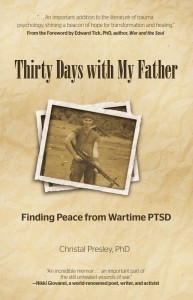
Thirty Days With My Father: Finding Peace From Wartime PTSD by Christal Presley, Ph.D.

Thirty Days With My Father:  Finding Peace From Wartime PTSD by Christal Presley, Ph.D., is the result of a 30-day project Presley undertook to get to know her father and his Vietnam War experiences after not relating for more than a decade, and she got much more than she expected.  Alternating between conversations wither her father and memories written down in her journal — the idea of her therapist — Presley relives parts of her own past just as her father does when speaking of Vietnam and what happened there.

Delmer Presley was drafted into the Vietnam War and never once thought about running off and dodging the draft, and he was a member of Americal Division, First Battalion, Sixth Infantry, referred to as the Gunfighters.  He entered the war following the Tet Offensive and came back a changed man.  While Presley’s book talks about his experiences as they were related to her during phone conversations and other encounters with her father, the memoir focuses mainly on Christal Presley’s intergenerational PTSD symptoms and childhood as it relates to those war memories.

Living in constant fear due to unpredictable behavior and other outside forces can cause heightened awareness fueled by adrenaline.  In the case of warriors and soldiers, this constant state of awareness can be hard to shake even when the unpredictability of the situation is removed and soldiers are sent home.  Consequently, the families that these soldiers return to find that their loved ones are altered, and in some cases, these situations can become very volatile and lead to unintended consequences, such as families subject to verbal abuse and more.

“‘I just didn’t consider those people human.  I never saw a Vietnamese before in my life, and I hated them.  We didn’t even call them Vietnamese back then.  Called them Charlies, dinks, and gooks.  That’s all I knew.  They taught us that.  I was trained not to see them as human.  The government can say whatever they want, but they trained us that way.  It hurt me more to see a dog or cat dead than them Vietnamese.  The government likes young boys who ain’t got no sense.  Easier to train, easier to brainwash that way.'”  (page 59 ARC)

The relationship between father and daughter always has been fragile.  The tentative nature with which Christal makes her calls to her father and feels him out before she asks each question is how readers would imagine any conversation to go given the years of silence between them, but particularly given traumatic nature of her upbringing.  Thirty Days With My Father:  Finding Peace From Wartime PTSD by Christal Presley, Ph.D., is about finding yourself amidst the chaos of family life, particularly a family life full of baggage, and about forgiveness for yourself and your family.  One of the most surprising and astonishing memoirs I’ve read in a long while.  It will have you re-evaluating your own conceptions about your childhood and how to repair relationships that have been damaged.

About the Author:

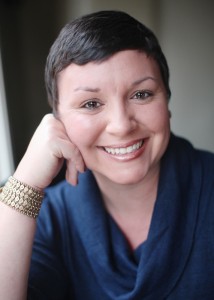
Christal Presley received her bachelor’s degree in English and her master’s degree in English Education from Virginia Tech.  She received her Ph.D in Education from Capella University. She is a former intern at Algonquin Books of Chapel Hill, and spent seven years teaching middle and high school English in Chatham and Danville, Virginia.

Her first book, Thirty Days with My Father:  Finding Peace from Wartime PTSD, will be published by Health Communications, Inc. in November 2012.

Christal grew up in Honaker, Virginia, and currently lives in Atlanta, Georgia. She is the founder of United Children of Veterans, a website that provides resources about PTSD in children of war veterans. In her spare time, you can find Christal playing with her dogs, tending to her chickens, and gardening.

***IF you would like to win a copy, leave a comment on this post about your interest by Nov. 21, 2012, at 11:59 PM EST***

This is my 80th book for the New Authors Reading Challenge in 2012.

Giveaway: When It Happens to You by Molly Ringwald

I’ve got a surprise giveaway for everyone, a signed copy of Molly Ringwald’s When It Happens to You, a novel in stories.  Here’s the skinny:

When it happens to you, you will be surprised. That thing they say about how you knew all the time, but just weren’t facing it? That might be the case, but nevertheless, there you will be.

Molly Ringwald mines the complexities of modern relationships in this gripping and nuanced collection of interlinked stories. Writing with a deep compassion for human imperfection, Ringwald follows a Los Angeles family and their friends and neighbors while they negotiate the hazardous terrain of everyday life—revealing the deceptions, heartbreak, and vulnerability familiar to us all.

In “The Harvest Moon,” a stay-at-home mom grapples with age, infertility, and an increasingly distant husband. In “Ursa Minor,” a former children’s television star tries to rebuild his life after being hospitalized for “exhaustion.” An elderly woman mourns the loss of her husband and her estranged relationship with her daughter in “The Little One.” In “My Olivia,” a single mother finds untapped reserves of strength to protect her flamboyant six-year-old son who wishes only to wear dresses and be addressed as Olivia. And in the devastating title story, a betrayed wife chronicles her pain and alienation, leading to an eviscerating denouement.

As the lives of these characters converge and diverge in unexpected ways, Ringwald reveals a startling eye for the universality of loss, love, and the search for connection. An unflinching yet poignant examination of the intricacies of the human heart, When It Happens to You is an auspicious literary debut.

Enter by leaving a comment on this post by Nov. 20, 2012, at 11:59 PM EST. Giveaway is open to all U.S. and Canadian residents.

Interview with Jill Mansell

As everyone knows, my go-to author for hilarious fun in the Britain is Jill Mansell.  Her books never fail to make me laugh, cry, or just have a great time as her heroines go on adventures that change their lives — whether its a new career, like in Rumor Has It, or finding the Mr. Right, like in Take a Chance on Me.  Her characters are always fresh and quirky, generally naive about themselves and where they are going, and always fun to have at a party.

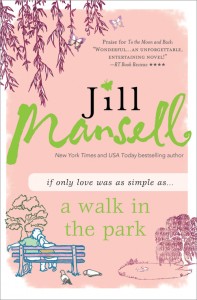
Her latest U.S. release is A Walk in the Park, in which Lara Carson returns home to Bath after leaving her boyfriend Flynn and her family 18 years ago without a word.  You can bet their will be secrets to uncover and blundering around, making Lara’s return a little less smooth than she might expect.  There is a reason that I am a self-proclaimed Mansell junkie, and these story lines are just one reason.  To find out more about why I adore this author and her books, check out the interview:

If there were one genre that you would write other than your current women’s fiction, what would it be and why?  Have you ever tried to write in it before?  How did it go?

Do you know, I never have tried any other genre. Sometimes we just have an instinct for what we’re good at and it seems to make sense to stick to it. When I first started writing I did try category romance (Harlequin) because I thought they might be easy. Needless to say, they weren’t! I sent off a few and the reasons for rejection were always that there was too much humour in them and not enough sustained emotional depth. In the end I gave up and wrote the kind of books I would like to read myself…and that’s how I got my first publishing contract. The term chicklit hadn’t been invented back then!

You’re forthcoming release in the United States is A Walk in the Park.  How does the publishing process in the U.S. differ from others?  How did you go about getting books published in other countries?  What’s the lag time between when a book comes out in England to when it comes out elsewhere?

The time lag varies according to the publisher but Sourcebooks is aiming to catch up with the UK next year and also bring out another of my older books in the US. It’s always entertaining, receiving a long list of British words from my editor that need to be ‘translated’ into American before the book can go to press. We definitely speak a different language! Getting published in other countries is all down to my agent and her sub-agents around the world. It’s brilliant going along to the London Book Fair each year and meeting some of the other agents and publishers from all over.

Who are some up-and-coming writers that readers should be on the look out for?

I’m not reading much fiction, but two books this year by writers new to me have absolutely blown me away.

John Green is a YA author, but this is a book for everyone — The Fault in Our Stars. Astonishing and emotional.

I adored this one too, Wonder by RJ Palacio. Just an amazing, incredible book.

I also loved The Runaway Princess by Hester Browne, which is great fun and a real feel-good read. I always love Hester Browne’s books.

Many writers these days are being told to market their own books through Websites and social media. What’s been your experience? Do you have any tips for others?

Well, it’s entirely my UK publisher’s fault that I’m on Twitter – they asked me to give it a try and I told them I would HATE it. But they insisted, so I gave it a go and within a couple of days I was hooked. I love it so much I’d far rather chat away on Twitter than write my books, which probably wasn’t what they had in mind…

But I think the reason it is working for me is because I do enjoy it and I’m not just endlessly plugging my own work. I very rarely do, in fact. I find relentless self-promotion from others a huge turn-off and it actually makes me LESS inclined to try a new author’s work. I would far rather think for myself how interesting/fun/nice they are, then quietly buy their book.

So the moral of the story is…just have fun and enjoy yourself. The ability to cyber-meet people all over the world is such a magical gift, why spoil it?

Just for fun, what television shows or music are you enjoying or find inspirational?

Well, inspiration can come from anywhere so I feel it’s my duty to watch lots of TV, all in the name of research. I’m getting into Strictly Come Dancing – our version of Dancing With the Stars. Still watching American Idol and UK’s X Factor but maybe starting to get a teeny bit bored with them now. The revelation this year for us in the UK has been the Olympics followed by the even more amazing Paralympics. We had masses of TV coverage and beforehand many people wondered if the Paralympics would be able to match up. Well, I know there was very little coverage of it in the US but let me tell you, it was BRILLIANT, completely life-enhancing and even MORE enthralling and inspirational than the Olympics. It has genuinely changed the view of the nation with regard to physical disability. The paralympic athletes have become superstars and we love every last one of them – our Superhumans. Inspiration-wise, who could ask for more?

Thanks, Jill, for answering my questions.  Your books are always a blast.

Past reviews:

If you’d like to win a copy of A Walk in the Park by Jill Mansell, please leave a comment here.  Deadline is Nov. 20, 2012 at 11:59PM EST  (US/Canada residents Only)

Mailbox Monday #201

Mailbox Mondays (click the icon to check out the new blog) has gone on tour since Marcia at A Girl and Her Books, formerly The Printed Page passed the torch. This month’s host is Bermudaonion.

The meme allows bloggers to share what books they receive in the mail or through other means over the past week.

Just be warned that these posts can increase your TBR piles and wish lists.

Here’s what I received:

1.  Cascade by MaryAnne O’Hara for a TLC Book Tour in December.

2.  The Missing Manuscript of Jane Austen by Syrie James for review.

What did you receive?

175th Virtual Poetry Circle

Welcome to the 175th Virtual Poetry Circle!

Remember, this is just for fun and is not meant to be stressful.

Keep in mind what Molly Peacock’s books suggested. Look at a line, a stanza, sentences, and images; describe what you like or don’t like; and offer an opinion. If you missed my review of her book, check it out here.

Also, sign up for the 2012 Fearless Poetry Reading Challenge because its simple; you only need to read 1 book of poetry. Please visit the stops on the 2012 National Poetry Month Blog Tour.

Today’s poem is from Henry Wadsworth Longfellow:

The Harvest Moon

It is the Harvest Moon! On gilded vanes
  And roofs of villages, on woodland crests
  And their aerial neighborhoods of nests
  Deserted, on the curtained window-panes
Of rooms where children sleep, on country lanes
  And harvest-fields, its mystic splendor rests!
  Gone are the birds that were our summer guests,
  With the last sheaves return the laboring wains!
All things are symbols: the external shows
  Of Nature have their image in the mind,
  As flowers and fruits and falling of the leaves;
The song-birds leave us at the summer's close,
  Only the empty nests are left behind,
  And pipings of the quail among the sheaves.

What do you think?

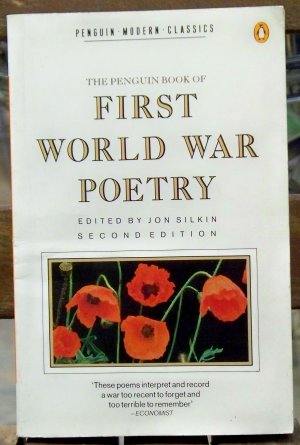
The Penguin Book of First World War Poetry (Second Edition) edited by Jon Silkin, David McDuff

The Penguin Book of First World War Poetry (Second edition) edited by Jon Silkin and David McDuff is a collection of poetry from and about the WWI.  Silkin and McDuff  increased the number of poems in translation included in the collection.  There are poems translated from German, French, Italian, Russian, and Hebrew, and Silkin was a poet himself.  As expressed in the not at the beginning, “For some, war was moral athletics; others looked forward to the experience of war as a ‘vacation from life’ — a vacation from a society disjoined by class and constrained by the rigid structures of labour.”  (page 12)

***However, I’m not one for long introductions so I skipped over it this time around and got straight to the poetry. ***

The anthology includes some of the more well known WWI poets, Thomas Hardy and Robert Graves, but also some who are not as well known.  One of the most well known WWI poems is “Anthem for Doomed Youth” by Wilfred Owen, which seeks to command a respect for the thousands who died in a cause for freedom and defense.  Steeped in religious allusions Owen makes reference to the candles lit where bodies lie and to the drawing of blinds in those same rooms as well as the prayers that often accompany the mourning process, but there also is an underlying celebration for their sacrifice as the bells are rung and anthems are sung.

Each of these poems brings with it a different perspective on war in the trenches, love, life, and loss, but above all patriotism.  Isaac Rosenberg’s “Dead Man’s Dump” (page 211) is particularly haunting:

"The wheels lurched over sprawled dead
But pained them not, though their bones crunched,
Their shut mouths made no moan.
They lie there huddled, friend and foeman,"

Meanwhile, there is a true sense of fear in Ivor Gurney’s “The Silent One,” (page 116):

"Who died on the wires, and hung there, one of two --
Who for his hours of life had clattered through
Infinite lovely chatter of Bucks accent:
Yet faced unbroken wires; stepped over, and went
A noble fool, faithful to his stripes -- and ended
But I weak, hungry, and willing only for the chance
Of line -- to fight in the line, lay down under unbroken
Wires, and saw the flashes and kept unshaken
Till the politest voice -- a finicking accent, said:
'Do you think you might crawl through there: there's a hole'
Darkness, shot at:  I smiled, as politely replied --
'I'm afraid not, Sir.' There was no hole no way to be seen
Nothing but chance of death, after tearing of clothes."

Each poet in the collection bring their own perspective to war, but there seems to be a pervading reverence to the fight these soldiers’ waged and all that they sacrificed.  There were certain translated poems in the book that didn’t resonate as well as some others, including Benjamin Peret’s “Little Song of the Maimed,” but it was good to revisit an old WWI poet, Osip Mandelstam (check out my earlier review of Stolen Air).  The Penguin Book of First World War Poetry (Second edition) edited by Jon Silkin and David McDuff offers a collection of poems that provide a wide perspective on war from the patriotism the soldiers felt to their fear and horror at the experiences they had.

About the Editors:

Jon Silkin was born in London, in a Jewish immigrant family and named after Jon Forsyte in The Forsyte Saga, and attended Wycliffe College and Dulwich College. During the Second World War, he was one of the children evacuated from London, and for a period of about six years in the 1950s, after National Service, he supported himself by manual labour and other menial jobs. He wrote a number of works on the war poetry of World War I. He was known also as editor of the literary magazine Stand, which he founded in 1952, and which he continued to edit (with a hiatus from 1957 to 1960) until his death.

David McDuff is a British translator, editor and literary critic. He attended the University of Edinburgh, where he studied Russian and German. After living for some time in the Soviet Union, Denmark, Iceland, and the United States, he eventually settled in the United Kingdom, where he worked for several years as a co-editor and reviewer on the literary magazine Stand. He then moved to London, where he began his career as a literary translator.


This review first appeared on Historical Tapestry for WWI Week.


This is my 14th book for the WWI Reading Challenge.


This is the 21st book for my 2012 Fearless Poetry Exploration Reading Challenge.

A Walk in the Park by Jill Mansell

A Walk in the Park by Jill Mansell is another engaging story about love and coming together as a family.  Lara Carson is forced to leave home at the age of 16 and returns to Bath 18 years later for her father’s funeral.  Things have changed drastically, but Evie is still the warm friend she remembers.  Lara believes she’s prepared to deal with the past, but when Flynn Erskine arrives unexpectedly her feelings nearly overcome her.  Not only does she owe the two most important people from her past an explanation, but she also has secrets she has to reveal — secrets that Flynn and Evie may not be ready for.

Mansell’s characters are always quirky, and there is no absence of that here, from Lara’s strong Aunt Nettie in Keswick to Don the jewelry shop owner in Bath.  While many of these characters are looking for love, denying that they are looking for love, or hoping to fall out of love with a cad, Mansell quietly addresses the fear that still haunts gays who have not come out of the closet, single-parenting obstacles, and how secrets can topple families.

Meanwhile, Lara is blindly making decisions that are best for her daughter, Gigi, but she refuses to look around her to see how her decisions affect herself and others.  She’s also busy trying to make love matches for her aunt and friends, at the same time she’s struggling to ignore her own passionate feelings for Flynn — her former teenage boyfriend.  Life and love is anything but a walk in the park for Lara and her friends, especially when the death of Lara’s mother raises questions about her mother’s faithfulness and about where she got the money to buy the family home.

Readers will note there are a variety of subplots, and while they are successfully concluded, there are some that felt a little rushed, which may be partially due to the multitude of characters Mansell creates.  Mansell novels are full of romance and flirty fun, but this one has some serious notes and a more mature set of story lines.  With a mother-in-law from hell and the outrageous behavior of rap star EnjaySeven, A Walk in the Park by Jill Mansell is a literary soap opera that leaps off the pages and makes readers thank their lucky stars their lives are less complicated.

About the Author:

Jill Mansell lives with her partner and children in Bristol, and writes full time. Actually that’s not true; she watches TV, eats fruit gums, admires the rugby players training in the sports field behind her house, and spends hours on the internet marvelling at how many other writers have blogs. Only when she’s completely run out of displacement activities does she write.

WWI Week: Review of WWI Poetry

Today on WWI Week at Historical Tapestry, my review of The Penguin Book of First World War Poetry (Second Edition) edited by Jon Silkin and David McDuff.

Mine is just one guest post in a slew of guest posts, reviews, and other activities to remember the 100th Anniversary of the start of WWI.

I hope that you’ll stop by and check out my review and some of the other WWI-related posts between Nov. 4-17.