Quantcast

325th Virtual Poetry Circle

Welcome to the 325th Virtual Poetry Circle!

Remember, this is just for fun and is not meant to be stressful.

Keep in mind what Molly Peacock’s book suggested.

Look at a line, a stanza, sentences, and images; describe what you like or don’t like; and offer an opinion. If you missed my review of her book, check it out here.

This poem is from Edgar Allan Poe:

Alone

From childhood’s hour I have not been
As others were—I have not seen
As others saw—I could not bring
My passions from a common spring—
From the same source I have not taken
My sorrow—I could not awaken
My heart to joy at the same tone—
And all I lov’d—I lov’d alone—
Then—in my childhood—in the dawn
Of a most stormy life—was drawn
From ev’ry depth of good and ill
The mystery which binds me still—
From the torrent, or the fountain—
From the red cliff of the mountain—
From the sun that ’round me roll’d
In its autumn tint of gold—
From the lightning in the sky
As it pass’d me flying by—
From the thunder, and the storm—
And the cloud that took the form
(When the rest of Heaven was blue)
Of a demon in my view—


What are your thoughts?

The Color Monster: A Pop-Up Book of Feelings by Anna Llenas

Source: Sterling Children’s Books
Hardcover, 20 pgs.
I am an Amazon Affiliate

The Color Monster: A Pop-Up Book of Feelings by Anna Llenas is a wonderful use of paper art and color.  Imagine a gray scale world in which the monster is the only one in color, and his rainbow of color signifies that his emotions are out of control.  This young lady has the patience of a saint as she kindly explains the situation to the monster and they set off together to sort out his emotions.

The young lady and her monster go through the book sorting out the emotions by color into jars from the sunshine of happiness to the blue rain clouds of sadness.  In addition to using paper art, these pop-out images also utilize other materials, including string.  And by the end, she and her monster uncover another emotion, one that they haven’t even labeled, which is accompanied by pink hearts.  The Color Monster: A Pop-Up Book of Feelings by Anna Llenas is delightful to look at and read, but it also is a great tool for helping young kids sort out their emotions.


Interview: A Conversation with Juliette Wells for 200th Anniversary of Emma

Juliette Wells is the editor and introducer of EMMA: 200th-Anniversary Annotated Edition (Penguin Classics Deluxe Edition; on-sale September 29, 2015; 9780143107712; $16.00). Please give her a warm welcome.

When we celebrate the 200th anniversary of EMMA, what in particular are we celebrating? What’s new about this edition?

We’re celebrating the 200th anniversary of Emma’s original publication, in London in December, 1815. The date of publication is a little confusing because “1816” was printed on the title page of the first edition of the novel, but it was actually released in December, 1815. I think this gives us the right to celebrate for a whole year!

And what better way to celebrate than to re-read Emma, or read it for the first time? Our 200th-anniversary annotated edition has everything you need, all in one place, to help you appreciate this wonderful novel. You can immerse yourself in Austen’s world and also have, right at your fingertips, explanations of some of the elements of the novel that tend to trip up or puzzle today’s readers.

In the Austen canon, what would you say makes EMMA special and unique?

Emma is special because it’s the capstone of Austen’s career as an author. She had already published three novels (Sense and Sensibility, Pride and Prejudice, and Mansfield Park), and she was at the very top of her game as a writer. She didn’t know it, of course, but Emma would be the last book she saw through to publication. When Austen died in July 1817, she left two essentially completed novels (Northanger Abbey and Persuasion), which her brother published at the end of that year. So Emma is the last Austen novel that was published in the exact form that she herself approved.

Emma is also special because it’s the most perfect example of Austen’s particular genius as an author, which is (I think) to create a recognizable, engaging fictional world from the slenderest of materials. She writes about everyday life and ordinary people—you won’t find kings and queens in her novels, or ghosts or vampires. Her effects are wonderfully subtle.

What was the publishing process like when EMMA was first published? How was the novel received critically? Was Austen as popular in her own day as she is today?

The publishing process was recognizable in some ways and very different in others. Austen didn’t have a literary agent; at that time, authors dealt directly with publishers. With Emma, she chose a new, more prestigious publisher—John Murray—than she had used for her three earlier novels, and she negotiated hard for a good contract with him. As authors are today, Austen was responsible for proofreading and approving copy before publication. Since being a published author was considered not so respectable for an unmarried woman, Austen chose to remain anonymous on her title pages throughout her lifetime. Emma identifies her as “the author of Pride and Prejudice.” Her identity wasn’t made publicly known until after her death.

Like Austen’s earlier novels, Emma was praised by reviewers, who appreciated Austen’s ability to convey a very realistic fictional world. Austen wasn’t a bestseller in her day; then as now, thrillers, adventure stories, and romances outsold quiet literary fiction. But Austen did have the satisfaction of knowing, in her lifetime, that readers appreciated her work. In addition to reading reviews, she kept track of the responses of her friends and family, which offer a wonderful glimpse into what everyday readers of Austen’s own time thought of Emma. Some of what they liked and didn’t like may be very familiar to us!

One of your specialties as a professor of English is how Jane Austen’s work continues to appeal to people, how it remains at the forefront of pop culture conversation. Last year, Alexander McCall Smith updated EMMA, “Pride and Prejudice and Zombies” hits the big screen in 2016, and movie and TV versions of Austen continue to draw viewers. Why do you think we keep updating and adapting Austen? What are your favorite adaptations or updates, and what makes them successful?

Austen really is endlessly adaptable, much like Shakespeare! You can transpose her stories and her characters to other places and times, and they still work. My own favorite creation inspired by Austen is Amy Heckerling’s Clueless, from 1995. Clueless is a joy to experience, and smart too, much like an Austen novel.

I’m also a big fan of Sense and Sensibility, also from 1995, for which Emma Thompson wrote the screenplay. Experiencing Austen through the eyes of a witty, thoughtful contemporary woman—it doesn’t get any better than that! I like Karen Joy Fowler’s novel The Jane Austen Book Club, from 2004, for the same reason—an experienced writer chooses to think about how Austen’s works matter to us today, and takes us along for the ride. Lost in Austen, the British miniseries from 2008, is also a big favorite of mine. A rabid Austen fan finds her way into the world of Pride and Prejudice and messes it up. It’s a hoot to see the Austen characters we know so well doing and saying things that they NEVER would have done or said in the original novel.

I think TV and movie adaptations of Austen are so popular for two main reasons. They’re beautiful to watch, no question. And they offer a respite—which a lot of people of all ages value—from the loud, fast, scary, stuff that much of mainstream entertainment is these days. The tricky part comes, sometimes, when someone knows and loves Austen through the films and then goes to pick up one of the novels, only to discover that the reading experience is a lot more complex and challenging than the viewing experience. I had those first-time readers of Austen very much in mind when creating this new edition of Emma.

What is it like to prepare a new edition of a book that’s so well-known and exists in many editions? What kind of research did you do? Did anything you learned during the process surprise you?

It was really important to me to create a truly new approach to Emma—a welcoming, reader-friendly approach. Excellent editions of Emma already exist for scholars and for devoted “Janeites.” With this anniversary edition, I wanted to open Austen up to people who hadn’t given her a try before, and to support their reading experience by using everything I know from years of teaching undergraduates and from talking with everyday readers. I certainly reached for plenty of scholarly and reference sources on my shelves, but I’d say my most important preparation was to have built up, over time, a sense of what readers are curious about and what frustrates them in their first encounter with an Austen novel. And, through my teaching, I’ve had a lot of practice at explaining historical concepts in an accessible way.

I also had the huge pleasure of re-reading Emma myself, slowly, with pencil in hand, making lists of topics to cover in my contextual essays and marking words that would likely be unfamiliar to present-day Americans. By doing this, I developed a much deeper appreciation of Austen’s artistry with words. This surprised and delighted me—I would have said I appreciated her artistry plenty before! But it wasn’t until I was trying to figure out how to convey the meaning of a particular phrase that I realized how much meaning she packs in with her clever, economical word choices.

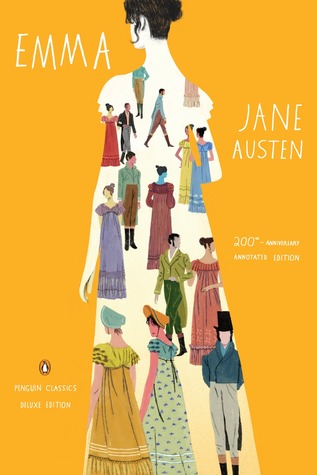
Thinking about readers’ experience with Emma also shaped how the contextual material is presented in this new edition. In my experience, many ordinary readers, and even college students too, are put off by footnotes, or at best ignore them. So we decided instead to group topics together in contextual essays, which are easier—and, I hope, more fun—to read. Here too my experience explaining historical concepts And, there’s no question, the gorgeous cover by Dadu Shin is a beautiful invitation to pick up this Emma!

The illustrations for this edition are drawn from historical copies of Emma in the Jane Austen Collection at Goucher College, where you teach. Can you tell us more about that collection? What is it, exactly?

The Jane Austen Collection at Goucher College in Baltimore, Maryland began as the passion project of an alumna of the college from the 1920s, Alberta Hirshheimer Burke. Alberta loved, loved, loved Jane Austen’s writings and decided that her own purpose in life was to gather as much material as possible relating to Austen. So Alberta bought first and rare editions and even some manuscripts—such as letters in Austen’s handwriting—all of which she felt brought her closer to her beloved author. The images in our new edition reproduce turn-of-the-twentieth century illustrations of Emma by English and American artists, from books that Alberta owned, and which she bequeathed to her alma mater when she died in 1975. (Her manuscripts went to the Pierpont Morgan Library in New York.)

Alberta also cared deeply about ephemera with an Austen connection, such as newspaper and magazine articles, which she preserved in ten overstuffed scrapbooks. So our Austen Collection at Goucher is a terrific resource for popular culture studies as well as book history.

As a college professor, what’s your favorite aspect of teaching Austen? Do you face any challenges in interesting students in her writings?

Absolutely the best part of teaching Austen is that so many students are enthusiastic about studying her writings. She is an easy sell! Shakespeare is the only other English writer who has a draw like hers. And Austen has the advantage that her life story as a woman writer is especially appealing. Many of my students are creative writers themselves and find Austen’s confidence and perseverance to be very inspiring.

That said, I do often encounter people—students and ordinary readers—for whom Austen just seems unappealing. Maybe her novels seem girly; maybe they seem awfully full of privileged white people (not untrue); maybe the sentences or paragraphs are just too long. Stephen King said recently in a New York Times Book Review that he had never read any Austen, and I feel it’s a real shame that a great writer like him has missed a great writer like her! Maybe I’ll have to send him this new Emma and see if he can get into it.

I love it that everyone who reads Jane Austen has her or his own ideas about what’s important and what’s interesting. Some readers gravitate towards her humor, while for others, the morality really resonates. Pretty much all of us can find at least one character who reminds us of someone we know—and we’re lucky if it’s a character who’s nice!

Do you think we have a modern-day equivalent of Jane Austen? Or do you have any “further reading” suggestions for Austen fans who’ve read all of her books a thousand times and are looking for something new?

I love to read contemporary novels and memoirs, and I always keep an eye out for hints that an author is influenced by or interested in Austen. I recently re-read Allegra Goodman’s novel The Cookbook Collector and really appreciated how she weaves in elements from Emma as well as from her more obvious place of inspiration, Sense and Sensibility. I also particularly like that Alison Bechdel, author of the graphic-format memoir Fun Home and the Dykes to Watch Out For comics, gives several shout-outs to Austen. Flyover Lives, Diane Johnson’s hybrid family history / memoir, includes a fascinating account of what Johnson’s foremothers in America were up to at the same time that Austen was writing about much more privileged women in England.

I’d also warmly recommend the novels of Barbara Pym, a 20th-century English writer. Pym’s dry humor and close observation of everyday people ally her very closely with Austen. And it’s always rewarding to read, or re-read, 19th-century novels by authors who knew and loved Austen’s writings. In that category, I’d especially recommend Elizabeth Gaskell (start with Cranford) and George Eliot (outside of Austen, Middlemarch is my all-time favorite novel).

And, finally, I’d say that Austen lovers are the best people to ask about what to read next! Lately, I’ve been hearing a lot of shout-outs for the novels of Anthony Trollope, so I may have to get cracking on his enormous oeuvre . . .

Thank you, Juliette, for spending time with us today.  This is going to be a beautiful book with deckle edge — one of my favorites.

Miss Emily by Nuala O’Connor

Source: Penguin
Paperback, 256 pgs.
I am an Amazon Affiliate

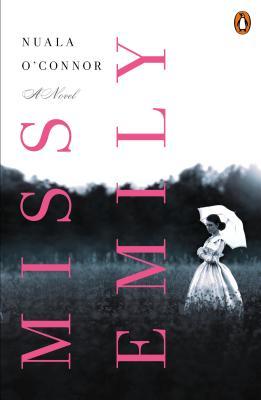
Miss Emily by Nuala O’Connor is told from two points of view, including that of poet Emily Dickinson, and the reader is given a glimpse into the secluded life of the poet through her own eyes as well as those of the new maid and Irish immigrant, Ada Concannon.  Concannon has had wanderlust for some time, and her daydreams have pushed her out of favor with the family her siblings and mother work for, pushing her into a new life in America.  Although she will miss her sisters and family very much, she’s eager to see the world beyond her home.

“‘You cultivate possessiveness,’ Vinnie once told me.  ‘You smother Sue, and every other acquaintance, with friendship.'” (pg. 27 ARC)

“Oh, chimerical, perplexing, beautiful words! I love to use the pretty ones like blades and the ugly ones to console.  I use dark ones to illuminate and bright ones to mourn.  And when I feel as if a tomahawk has scalped me, I know it is poetry then and I leave it be.”  (pg. 40 ARC)

The Dickinson’s are well respected in Amherst, though Emily’s recent withdrawal from society has become part of the town’s gossip.  As a maid in the Dickinson household, she is privy to the inner workings of the family but is also expected to maintain its secrets.  O’Connor has created a believable Emily in terms of action and manner, and her portrayal of immigrants, particularly the Irish, rings true.  O’Connor adopts Dickinson’s style of economical word use to tell her story and it works really well.  These foil characters work well together, as a mutual respect blossoms and friendship emerges between these women.

“But how can I explain that each time I get to the threshold, my need for seclusion stops me? The quarantine of my room–its peace and the words I conjure there–call me back from the doorway.  Ada could not truly appreciate that the pull on me of words, and the retreat needed to write them, is stronger than the pull of people.”  (pg. 52-3 ARC)

“From now on I shall be candle-white.  Dove-, bread-, swan-, shroud-, ice-, extraordinary-white.  I shall be blanched, bleached and bloodless to look at; my very whiteness will be my mark.  But inside, of course, I will roar and soar and flash with color.” (pg. 121 ARC)

Readers will be thoroughly taken in by this novel about Dickinson and the Irish immigrant’s life, and O’Connor provides a real motivating factor for Emily’s seclusion from the outside world.  As Ada’s life is threatened, Emily is forced to act and in so doing, she must leave the home in which she finds solace.  Miss Emily by Nuala O’Connor is stunning and one that should not be missed.  A definite best book of the year.

About the Author:

Born in Dublin, Ireland, in 1970, Nuala O’Connor is a fiction writer and poet. Writing as Nuala Ní Chonchúir she has published two novels, four collections of short fiction, a chapbook of flash fiction and three full poetry collections – one in an anthology. Nuala’s third novel, Miss Emily will be published in 2015.

Nuala holds a BA in Irish from Trinity College Dublin and a Masters in Translation Studies (Irish/English) from Dublin City University. She has worked as an arts administrator in theatre and in a writers’ centre; as a translator, as a bookseller and also in a university library.

Nuala teaches occasional creative writing courses. For the last four years she has been fiction mentor to third year students on the BA in Writing at NUI Galway. She lives in County Galway with her husband and three children.

The Visitant by Megan Chance

tlc tour host

Source: TLC Book Tours
Paperback, 339 pgs.
I am an Amazon Affiliate

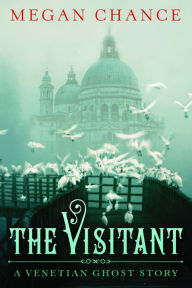
The Visitant by Megan Chance is a ghost story with Gothic romance elements, reminiscent of the Brontes but not as dark.  Elena Spira arrives in Venice in the late 1900s (given the use of Bromide as a cure) with high expectations of caring for Samuel Farber in a plush palazzo, but Ca’ Basilio is rundown and falling apart, with few rooms furnished, a staff that’s very abrasive, and a family with dark secrets.   Samuel’s ailments are a secret as well, as the Basilio family believes him to be merely the victim of a robbery and beating, but there are those in the house who are aware of his true sickness.  Nero Basilio is Samuel’s best friend and when he returns from his trip to Rome, Elena captures his attention.  As he fervently pursues her, Samuel warns her against his darker nature given her virginal innocence, but it’s clear he has designs on her as well.

“When I was finished, the trunk was still half-empty.  So sad, really, that a life could be compressed to so few things.  Three or four books, a photographic portrait of my parents and me.   Should someone wish to write my biography, a paragraph would be enough.” (pg. 88 ARC)

Elena wants more from her life that the future that awaits her if she fails in her mission to return Samuel to health.  Her one mistake led her to this place of desolation, and her success can not only affect her own life, but that of her parents.  Her failure would be devastating for them all.  But even as she finds the palazzo in disrepair and the family without a fortune to repair it, she’s less curious about the house than one would expect in a ghost story, particularly one with Gothic elements.  However, given her heavy guilt, her focus remains where it should be for the most part, though she is not unaware of the oppressive spirit of the house and its former inhabitant.

Chance weaves a captivating story from beginning to end, though Elena could have been a little more perceptive about Nero than she was given her past mistakes, which are referenced a few times.  In the fall season and Halloween around the corner, The Visitant by Megan Chance is a good fit.  It provides enough ghostly elements and enough mystery to keep readers going, and the romantic elements are not over the top.  Another solid novel from this author.

Other reviews:

Inamorata

About the Author:

Megan Chance is a critically acclaimed, award-winning author of historical fiction, including Inamorata, Bone River, and City of Ash. Her novels have been chosen for the Borders Original Voices and Book Sense programs. A former television news photographer and graduate of Western Washington University, Chance lives in the Pacific Northwest with her husband and two daughters.  Visit her Website, Facebook, and Twitter pages.


Mailbox Monday #342

Mailbox Monday, created by Marcia at To Be Continued, formerly The Printed Page, has a permanent home at its own blog.

To check out what everyone has received over the last week, visit the blog and check out the links.  Leave yours too.

Also, each week, Leslie, Vicki, and I will share the Books that Caught Our Eye from everyone’s weekly links.

Here’s what I received:

Water on the Moon by Jean P. Moore for a TLC Book Tour in November.

Early one morning, Lidia Raven, mother of teenage twins, awakens to the sound of a sputtering airplane engine in the distance. After she and her girls miraculously survive the crash that destroys their home, they’re taken in by Lidia’s friend, Polly, a neighbor who lives alone on a sprawling estate. But Lidia has other problems. Her husband has left her for another man, she’s lost her job, and she fears more bad news is on the way when she discovers a connection between her and Tina Calderara, the pilot who crashed into her home. In the months following the crash, Lidia plunges into a mystery that upends every aspect of her life, forcing her to rethink everything she thinks she knows.

Underdays: Poems by Martin Ott, winner of the Ernest Sandeen Prize in Poetry, for review.

Underdays is a dialogue of opposing forces: life/death, love/war, the personal/the political. Ott combines global concerns with personal ones, in conversation between poems or within them, to find meaning in his search for what drives us to love and hate each other. Within many of the poems, a second voice, expressed in italic, hints at an opposing force “under” the surface, or multiple voices in conversation with his older and younger selves—his Underdays—to chart a path forward. What results is a poetic heteroglossia expressing the richness of a complex world.

Mountains Without Handrails by Joseph L. Sax for review.

Focusing on the long-standing and bitter battles over recreational use of our national parklands, Joseph L. Sax proposes a novel scheme for the protection and management of America’s national parks. Drawing upon the most controversial disputes of recent years—Yosemite National Park, the Colorado River in the Grand Canyon, and the Disney plan for California’s Mineral King Valley—Sax boldly unites the rich and diverse tradition of nature writing into a coherent thesis that speaks directly to the dilemma of the parks.

The Kingdom and After by Megan Fernandes for review from Tightrope Books.

From Tanzania to Portugal, from India to Iraq, The Kingdom and After charts the 21st-century imaginative echo of empire and displacement in our current moment of terror and globalization. Sometimes written in frank, shrunken lines and other times exploding with surrealist, jurassic imagery, the poems witness an associative mind leaping from bone temples in Tanga to the pumiced surface of extraterrestrial oceans, from a panic attack in Mumbai to the tumbling spirits of the Big Sur coastline. These poems articulate a complex portrait of female sexuality and personhood. Not only excavating the legacy of empire with philosophical rigor, the speaker also dwells in humiliation and wonder, accusation and regret, while trying to envision what indeed remains after the era of kingdoms and kinghood.

Ghost Sick: A Poetry of Witness by Emily Pohl-Weary for review from Tightrope Books.

When a Christmas Eve shooting devastated Pohl-Weary’s community, she began to hunt through the numbness and grief for some understanding and hopefulness about the future.

In the tradition of Carolyn Forché, Ernesto Cardenal and Shu Ting, Ghost Sick is a poetry of witness. It chronicles the impact of violence on an inner-city Toronto neighbourhood, the power of empathy, and the resilience of the human spirit.

What did you receive?

324th Virtual Poetry Circle

Welcome to the 324th Virtual Poetry Circle!

Remember, this is just for fun and is not meant to be stressful.

Keep in mind what Molly Peacock’s book suggested.

Look at a line, a stanza, sentences, and images; describe what you like or don’t like; and offer an opinion. If you missed my review of her book, check it out here.

This poem is from Emily Dickinson:

 (260)

I'm Nobody! Who Are You?
Are you – Nobody – too?
Then there’s a pair of us!
Don’t tell! they’d advertise – you know!

How dreary – to be – Somebody!
How public – like a Frog –  
To tell one’s name – the livelong June –  
To an admiring Bog!

What do you think?

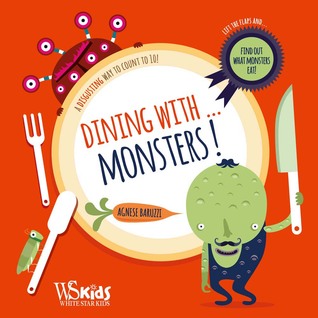
Dining With … Monsters: A Disgusting Way to Count to 10! by Agnese Baruzzi

Source: Sterling Children’s Books
Hardcover, 34 pgs.
I am an Amazon Affiliate

Dining With … Monsters A Disgusting Way to Count to 10! by Agnese Baruzzi is a cute children’s book in which young readers can dine with monsters on some of their favorite foods.  From The Beast with Giant Claws and Scales to Mr. One-Eye Not-So-Nice, these beasts eat spiders, frogs, and more.  My daughter has read and re-read this book several times with me and she enjoys flipping open the flaps to count the disgusting creatures being swallowed whole.  Even when we are not reading together, she often opens the book and creates her own stories about these monsters.

The bright, bold colors in these drawings and the short little rhymes are engaging and entertaining, and these characters are scary and funny at the same time. It’s a fun way to count to 10.  At the end, there is even a recap of all the items eaten, so that young readers can recount these items.  Dining With … Monsters A Disgusting Way to Count to 10! by Agnese Baruzzi was a big hit.  Perfect for Halloween and for R.I.P. X.

About the Author:

Qualified from the ISIA in Urbino in 2004, Agnese Baruzzi currently lives in Bologna, Italy. She has been working as an illustrator and has been publishing children’s books since 2001 in several countries. She collaborates with advertising agencies and leads workshops for kids in schools and libraries.


Teacher’s Pets by Crystal Hurdle

Source: Tightrope Books
Paperback, 150 pgs.
I am an Amazon Affiliate

Teacher’s Pets by Crystal Hurdle is ripe with innuendo, secrets, and more. Readers will venture into the wilderness with a class training group, as their instructor Cam teaches them about nature and all of its wonders. Through the interplay of free verse, overheard conversations between students and between teachers, as well as classroom assignments, Hurdle creates an absorbing setting in which the laws of the outdoors are internalized and the students learn to engage with the theory of evolution — “survival of the fittest.”

From "Robert Sedaris" (pg. 47)

He says some trees' taproots
probe and probe,
seek out the heat at the centre of the earth.

Man, I had no idea.
It's as if all my life I was underground
and have just now poked through the surface.

Robert Sedaris is a character full of foreshadowing, and he alludes to many events to come throughout the collection, but his lines are just subtle enough that they read like discussions of nature. In “Robert Sedaris” (pg. 83), “You hear the first little pop/and then so many that individuals can’t be heard,//they are all one./It blows up into something bigger/than you thought possible,/” Working on two levels, Hurdle has crafted a complex collection with multiple moving parts within and around it. In many ways, these little solar systems are orbiting one another and informing a larger sense of action and purpose.

Teacher’s Pets by Crystal Hurdle deals with some heavy issues and lines that should never be crossed — though they often are. These poems are by turns sad and will have readers shaking their heads at naive children, as well as shaking a fist at adults who should know better.

About the Poet:

Crystal Hurdle teaches English and creative writing at Capilano University in North Vancouver. She is the author of the poetry collection After Ted & Sylvia and her poetry and prose has been published in many journals, including Bogg, Canadian Literature, the Dalhousie Review, Event, Fireweed, and the Literary Review of Canada.


Twenties Girl by Sophie Kinsella (audio)

Source: Public Library
Audiobook, 12 discs
I am an Amazon Affiliate

Twenties Girl by Sophie Kinsella, narrated by Rosalyn Landor, is a wonderful breath of fresh air in which readers are introduced to Lara Lington and her great aunt Sadie Lancaster.  Part ghost story and party mystery, at its heart this is a story about respect, family tradition, and history.  Unlike Kinsella’s hilarious Shopaholic series, there is a great deal more heart and emotion in this one.  Lara is struggling in her new line of work as a head hunter, after her business partner left her in a lurch, but once she’s accosted during a funeral by a ghost, she has little choice but to look beyond her own plans and go on an adventure she’ll never forget.

Sadie and Lara make a fantastic team as they try to locate her great aunt’s favorite necklace, and in the meantime, Sadie’s whispers are making their way through many lives with some hilarious results.  Lara has spent a lot of time hoping for the best and pining away for her ex-boyfriend, pretending that all is well.  But when Sadie enters her life, she’s forced to really reassess where she’s been and what she’s been doing with her life.  Sadie, who didn’t think she amounted to much in 105 years and lost the one true love of her life, spent a great many years having fun and barely committing to anything or anyone.  They are opposites in many ways, but they teach each other how to truly live.  Rosalyn Landor is a terrific narrator who does excellent voices for male and female characters, as well as a stellar British accent.

Twenties Girl by Sophie Kinsella, narrated by Rosalyn Landor, is utterly enjoyable from start to finish, and Kinsella’s characters will have readers itching to break out flapper dresses and dance the Charleston.

About the Author:

Madeleine Wickham is a bestselling British author under her pseudonym, Sophie Kinsella. Educated at New College, Oxford, she worked as a financial journalist before turning to fiction. She is best known for writing a popular series of chick-lit novels. The Shopaholic novels series focuses on the misadventures of Becky Bloomwood, a financial journalist who cannot manage her own finances. The books follows her life from when her credit card debt first become overwhelming (“The Secret Dreamworld of a Shopaholic”) to the latest book on being married and having a child (“Shopaholic & Baby”). Throughout the entire series, her obsession with shopping and the complications that imparts on her life are central themes.

Strange Theater by John Amen

Source: John Amen
Paperback, 112 pgs.
I am an Amazon Affiliate

Strange Theater by John Amen includes surrealism and introspection, as well as poems dedicated to individuals that speak to a broader scope of readers.  It is a peek behind the theater curtain at the backstage machinations of life and the true identity of the theater’s players.  Examining the roles of those on the stage, in the background, the understudies, and the roles that we take in our own lives, Amen takes readers on a roller coaster journey.

From "folk singer" (pg. 91)

of course you're suffering
that goes without saying
alone in yr own private tundra
staggering through the snow

Many of us feel alone with our suffering, and theater, movies, stories, and poetry often help connect us, creating tangential connections between our own suffering to that of others. Some of these poems often draw out the egoism we have about our own lives and suffering, like in “biography,” “ferry approaching in the haze/the monuments he built/he built for himself/for this reason are destined to crumble//” (pg. 17) Many of these players are haunted, haunted by their pasts, their futures, their missteps, and their inability to meet the expectations of others.

from "diaspora" (pg. 30)

last time we talked
I saw deadbolts turning in yr eyes
from light years away you demanded

Amen keeps his readers on their toes as they move from line to line and poem to poem, exploring the uncertainty in all of our lives as it plays out on the biggest stage. Strange Theater by John Amen is wonderfully disconcerting even among the most common of places and people. Imagine looking back on a body of work and seeing only a darkness — a future that hasn’t been written yet — and feel that insecurity that breeds alongside the wondrous possibilities, and you’ll know what it is to walk out on Amen’s poetic stage.

Other Reviews:

About the Poet:

John Amen is the author of three collections of poetry: Christening the Dancer (Uccelli Press 2003), More of Me Disappears (Cross-Cultural Communications 2005), and At the Threshold of Alchemy (Presa 2009), and has released two folk/folk rock CDs, All I’ll Never Need and Ridiculous Empire (Cool Midget 2004, 2008). His poetry has appeared in various journals and anthologies, including, most recently, Rattle, The New York Quarterly, The International Poetry Review, Gargoyle, and Blood to Remember. He is also an artist, working primarily with acrylics on canvas. Amen travels widely giving readings, doing musical performances, and conducting workshops. He founded and continues to edit the award-winning literary bimonthly, The Pedestal Magazine.

Mailbox Monday #341

Mailbox Monday, created by Marcia at To Be Continued, formerly The Printed Page, has a permanent home at its own blog.

To check out what everyone has received over the last week, visit the blog and check out the links.  Leave yours too.

Also, each week, Leslie, Vicki, and I will share the Books that Caught Our Eye from everyone’s weekly links.

Here’s what I received:

Blue Shoes and Happiness (#7) by Alexander McCall Smith, which I purchased at the library for 50 cents and now I only need to find #9 in the series.

Life is good for Mma Ramotswe as she sets out with her usual resolve to solve people’s problems, heal their misfortunes, and untangle the mysteries that make life interesting. And life is never dull on Tlokweng Road. A new and rather too brusque advice columnist is appearing in the local paper. Then, a cobra is found in the offices of the No. 1 Ladies’ Detective Agency. Recently, the Mokolodi Game Preserve manager feels an infectious fear spreading among his workers, and a local doctor may be falsifying blood pressure readings. To further complicate matters, Grace Makutsi may have scared off her own fiancé. Mma Ramotswe, however, is always up to the challenge.

These came in a box from my friend and her daughter in Colorado:

Pinkalicious: Pinkie Promise by Victoria Kann

When Pinkalicious uses all of Alison’s pink paint in class, Pinkalicious knows just how to make it up to her best friend!


A Fairy Ballet: Rainbow Magic by Daisy Meadows

The Weather Fairies are putting on a ballet!

Fairyland’s Fairy Godmother is putting together a show for the King and Queen, and she’s asked the Weather Fairies to perform. The fairy sisters work very hard and decide to put on a ballet celebrating the changing seasons and weather. All their hard work pays off, as they get a standing ovation! Bravo!

The Fairy Berry Bake-Off by Daisy Alberto

TARTS, CUPCAKES, PIES galore! The baking-talent fairies are hard at work, making the sweetest treats in Pixie Hollow. But when Dulcie and Ginger begin competing against each other, flour starts flying and chaos ensues. Find out who is the best baker in all of Pixie Hollow in this Step 4 reader.


Amelia Bedelia’s First Apple Pie by Herman Parish, Lynn Avril
Amelia Bedelia is sure she will love everything about autumn.

The colorful trees
Jumping in the leaves
Apples, apples, apples
Warm apple pie
Fun family projects

Amelia Bedelia can’t wait. What could be better? Autumn! Hooray for apples and fall!

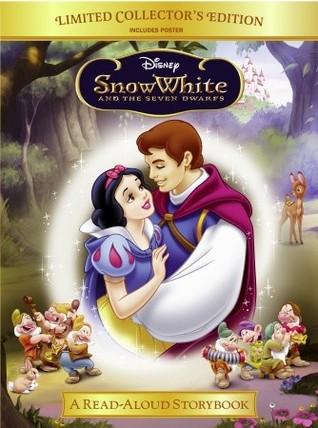
Snow White and the Seven Dwarfs: A Read-Aloud Storybook by Liza Baker

Relive the classic story of Walt Disney’s first-ever animated feature, Snow White and the Seven Dwarfs! This limited collector’s edition Read-Aloud Storybook includes a beautiful pull-out poster and will be available just in time to celebrate the release of the Platinum Edition DVD in fall 2009.


Frozen Sing-Along Storybook

This deluxe picture book features a full retelling of Frozen, plus lyrics to your favorite songs! As an added bonus, the book includes a CD featuring three instrumental tracks!

What did you receive?