Quantcast

327th Virtual Poetry Circle

Welcome to the 327th Virtual Poetry Circle!

Remember, this is just for fun and is not meant to be stressful.

Keep in mind what Molly Peacock’s book suggested.

Look at a line, a stanza, sentences, and images; describe what you like or don’t like; and offer an opinion. If you missed my review of her book, check it out here.

This poem is from Adelaide Crapsey:

To the Dead in the Graveyard Underneath My Window
Written in A Moment of Exasperation

How can you lie so still? All day I watch
And never a blade of all the green sod moves
To show where restlessly you toss and turn,
And fling a desperate arm or draw up knees
Stiffened and aching from their long disuse;
I watch all night and not one ghost comes forth
To take its freedom of the midnight hour.
Oh, have you no rebellion in your bones?
The very worms must scorn you where you lie,
A pallid mouldering acquiescent folk,
Meek habitants of unresented graves.
Why are you there in your straight row on row
Where I must ever see you from my bed
That in your mere dumb presence iterate
The text so weary in my ears: "Lie still
And rest; be patient and lie still and rest."
I'll not be patient! I will not lie still!
There is a brown road runs between the pines,
And further on the purple woodlands lie,
And still beyond blue mountains lift and loom;
And I would walk the road and I would be
Deep in the wooded shade and I would reach
The windy mountain tops that touch the clouds.
My eyes may follow but my feet are held.
Recumbent as you others must I too
Submit? Be mimic of your movelessness
With pillow and counterpane for stone and sod?
And if the many sayings of the wise
Teach of submission I will not submit
But with a spirit all unreconciled
Flash an unquenched defiance to the stars.
Better it is to walk, to run, to dance,
Better it is to laugh and leap and sing,
To know the open skies of dawn and night,
To move untrammeled down the flaming noon,
And I will clamour it through weary days
Keeping the edge of deprivation sharp,
Nor with the pliant speaking on my lips
Of resignation, sister to defeat.
I'll not be patient. I will not lie still.

And in ironic quietude who is
The despot of our days and lord of dust
Needs but, scarce heeding, wait to drop
Grim casual comment on rebellion's end;
"Yes, yes . . Wilful and petulant but now
As dead and quiet as the others are."
And this each body and ghost of you hath heard
That in your graves do therefore lie so still.

What do you think?

Ava the Monster Slayer by Lisa Maggiore, illustrated by Ross Felten

Source: Sky Pony Press
Hardcover, 32 pgs.
I am an Amazon Affiliate

Ava the Monster Slayer by Lisa Maggiore, illustrated by Ross Felten, is another hit with my daughter with its comic book style illustrations.  It’s like a beginner’s comic book.  She is hooked.  Ava is a young girl with a favorite stuffed animal and an active imagination, which is fueled by the stories of her older brother.

When her mother tells her that her stuffed animal is in the dryer, she is determined to save him from the monsters in the basement.  She transforms herself into a monster slayer with a cape, a crown, and pink rain boots when she realizes that she’s on her own in her quest.  There are action sequences, moments of tension in which Ava’s confidence is shaken, and large old-school “Pow” and “Wham”-type exclamations.  She is on a mission to save her friend, Piggy, despite the dangers.

Ava the Monster Slayer by Lisa Maggiore, illustrated by Ross Felten, is an origin story, and it seems as though there are more adventures to come for Ava.  My daughter adores these adventure stories, and this one has great illustrations.


Twisted by Laurie Halse Anderson (audio)

Source: Public Library
Audiobook, 5 CDs
I am an Amazon Affiliate

Twisted by Laurie Halse Anderson, narrated by Mike Chamberlain, examines teenage life with an inside look through Tyler Miller’s eyes.  Miller was an average student and teen with a dysfunctional family, and he makes one mistake — paints graffiti on the school and lands on probation.  Miller’s life is further upended by the attention of popular girl, Bethany Milbury.  He has had a crush on this girl for a long time, and when she pays him attention he cannot believe his luck.  However, his one chivalrous decision ends up landing him in hot water with the school and the police.  Chamberlain’s voice is perfect for the voice of this teenage boy, who is by turns comic, tortured by bullies, and entertains thoughts of suicide.

Miller’s parents are consumed by their work and are barely home to care for their kids, and the father is clearly in need of anger management.  And Anderson raises questions about what it means to be a man in today’s society, how teen boys can face pressures that even their parents are unaware of, and what it means to be the subject of bullying.  Miller is a genuine teen boy, and readers will see why Anderson’s prose is so well praised in the young adult fiction community and beyond.  She is in tune with today’s teens and their struggles.

Twisted by Laurie Halse Anderson, narrated by Mike Chamberlain, is tragic and real at the same time, and the Miller family is in dire need of therapy.  This book is funny, horrifying, and poignant given the two-income households that abound in modern society, the need of families to find balance between work and home life, and the bullying that happens in many high schools.

About the Author:

Laurie Halse Anderson is the New York Times-bestselling author who writes for kids of all ages. Known for tackling tough subjects with humor and sensitivity, her work has earned numerous ALA and state awards. Two of her books, Speak and Chains, were National Book Award finalists.

Mother of four and wife of one, Laurie lives in Northern New York, where she likes to watch the snow fall as she writes. You can follow her adventures on Twitter and on her tumblr.


Radioactive: Marie & Pierre Curie: A Tale of Love and Fallout by Lauren Redniss

Source: Public Library
Hardcover, 208 pgs.
I am an Amazon Affiliate

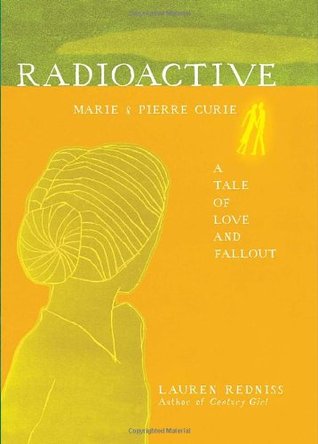
Radioactive: Marie & Pierre Curie: A Tale of Love and Fallout by Lauren Redniss has a cover that glows like the radium discovered by Marie and Pierre Curie, and the collage format allows the text, photos, illustrations, and documents to inform one another in a unique way.  Not only does Redniss use interviews with scientists, A-bomb survivors, and Marie and Pierre Curie’s own granddaughter, but she also utilizes Marie Curie’s own words from her diaries and letters.  The book chronicles not only the discovery of Radium and Polonium, but also how Marie and Pierre came to be working and living their lives together, as well as Marie’s life after the death of her husband.

What’s interesting about this book is that it not only examines the history of discovery and the resistance to commercialization held at the time by the Curie’s and other scientists.  There are some points in the book where the transition between the historic events and the more recent consequences of Curie’s discoveries could have been smoother, particularly the section about the Chernobyl Nuclear Plant meltdown that comes right after Marie has lost her husband and moves with her daughters closer to Pierre’s father.  Beyond that, those who have studied Curie in school may not know about her work with hospital X-ray units or how her work was carried on by her children.

Radioactive: Marie & Pierre Curie: A Tale of Love and Fallout by Lauren Redniss condenses a lot of historic fact into a small volume and offers supporting documentation for her findings.  This collection would be a great addition to school classrooms and could help make a hard-to-understand subject easier to digest.

***Another thank you goes to Bermudaonion for bringing my attention to this one***

About the Author:

Lauren Redniss is the author of Century Girl: 100 years in the Life of Doris Eaton Travis, Last Living Star of the Ziegfeld Follies and Radioactive: Marie & Pierre Curie, A Tale of Love and Fallout, a finalist for the 2011 National Book Award for nonfiction. Her writing and drawing has appeared in numerous publications including the New York Times, which nominated her work for the Pulitzer Prize. She was a fellow at the Cullman Center for Scholars & Writers at the New York Public Library in 2008-2009, became a New York Institute for the Humanities fellow in 2010, and is currently Artist-in-Residence at the American Museum of Natural History. She teaches at Parsons the New School for Design in New York City.

Displacement by Lucy Knisley

Source: Public Library
Paperback, 161 pgs.
I am an Amazon Affiliate

Displacement by Lucy Knisley is part travelogue, part memoir, part comic, and it does an excellent job of illustrating the fears of younger generations when it comes to caring for elderly parents or grandparents.  Lucy volunteers to take her elderly grandparents on a cruise with their senior housing community, and while she loves her grandparents, she, like many grandchildren, still see them as capable and active adults, even though their health has declined.  Traveling with aging grandparents through a series of connecting flights and the boarding of a cruise ship is difficult, especially as Knisley’s grandmother is losing her memory and her grandfather has bladder control issues.  Readers are likely to giggle about some comedic moments, but what makes this book shine is the compassion, angst, and love that shines through in every page.

Knisley ponders what it means to be a good person and what her own motivations are for coming on the trip, as well as why her own family has a hard time expressing love for one another — with the closest to an “I love you” being “we’re so proud of your academic achievements.”  Although her grandparents have lost some of their memories, Knisley is lucky to have her grandfather’s memoir about his WWII experiences.  She discovers while reading this memoir in preparation for the cruise that her grandfather often threw caution to the wind, like not wearing a parachute while flying because it was uncomfortable.

Displacement by Lucy Knisley is not just about mortality and how many young people do not want to face it.  It is also about having compassion and love for your own roots, so much so that you set aside your own discomfort to make sure elderly relations enjoy their own time on vacation or just with family.  It also sheds light on the incredibly hard job it is to be a caregiver for the elderly, particularly when you’re not related to them.  Knisley gives readers a new respect for those working in nursing homes and elderly communities.

A definite contender for the year-end best list.

***Thanks to Bermudaonion for reviewing this one and calling my attention to it.***

Other reviews:

About the Author:

Beginning with an love for Archie comics and Calvin and Hobbes, Lucy Knisley (pronounced “nigh-zlee”) has always thought of cartooning as the only profession she is suited for. A New York City kid raised by a family of foodies, Lucy is a graduate of the School of the Art Institute of Chicago currently pursuing an MFA at the Center for Cartoon Studies. While completing her BFA at the School of the Art Institute, she was comics editor for the award-winning student publication F News Magazine.

Lucy currently resides in New York City where she makes comics. She likes books, sewing, bicycles, food you can eat with a spoon, manatees, nice pens, costumes, baking and Oscar Wilde. She occasionally has been known to wear amazing hats.

Mailbox Monday #344

Mailbox Monday, created by Marcia at To Be Continued, formerly The Printed Page, has a permanent home at its own blog.

To check out what everyone has received over the last week, visit the blog and check out the links.  Leave yours too.

Also, each week, Leslie, Vicki, and I will share the Books that Caught Our Eye from everyone’s weekly links.

Here’s what I received:

1. Seriously, You Have to Eat by Adam Mansbach, illustrated by Owen Brozman for review from LibraryThing Early Reviewers!

On the heels of the New York Times best seller You Have to F**king Eat (a sequel to the worldwide mega-best seller Go the F**k to Sleep), now comes the version that is entirely appropriate to read to–and with–children. While the message and humor will be similar to the adult version, there will, of course, be no profanity whatsoever.

Step aside Green Eggs and Ham, there’s a new, 21st-century book in town that will compel all finicky children to eat!

What did you receive?

326th Virtual Poetry Circle

Welcome to the 326th Virtual Poetry Circle!

Remember, this is just for fun and is not meant to be stressful.

Keep in mind what Molly Peacock’s book suggested.

Look at a line, a stanza, sentences, and images; describe what you like or don’t like; and offer an opinion. If you missed my review of her book, check it out here.

This poem is from Robert Burns:

Halloween

Upon that night, when fairies light
On Cassilis Downans dance,
Or owre the lays, in splendid blaze,
On sprightly coursers prance;
Or for Colean the route is ta'en,
Beneath the moon's pale beams;
There, up the cove, to stray and rove,
Among the rocks and streams
To sport that night.

Among the bonny winding banks,
Where Doon rins, wimplin' clear,
Where Bruce ance ruled the martial ranks,
And shook his Carrick spear,
Some merry, friendly, country-folks,
Together did convene,
To burn their nits, and pou their stocks,
And haud their Halloween
Fu' blithe that night.

The lasses feat, and cleanly neat,
Mair braw than when they're fine;
Their faces blithe, fu' sweetly kythe,
Hearts leal, and warm, and kin';
The lads sae trig, wi' wooer-babs,
Weel knotted on their garten,
Some unco blate, and some wi' gabs,
Gar lasses' hearts gang startin'
Whiles fast at night.

Then, first and foremost, through the kail,
Their stocks maun a' be sought ance;
They steek their een, and graip and wale,
For muckle anes and straught anes.
Poor hav'rel Will fell aff the drift,
And wander'd through the bow-kail,
And pou't, for want o' better shift,
A runt was like a sow-tail,
Sae bow't that night.

Then, staught or crooked, yird or nane,
They roar and cry a' throu'ther;
The very wee things, todlin', rin,
Wi' stocks out owre their shouther;
And gif the custoc's sweet or sour.
Wi' joctelegs they taste them;
Syne cozily, aboon the door,
Wi cannie care, they've placed them
To lie that night.

The lasses staw frae 'mang them a'
To pou their stalks of corn:
But Rab slips out, and jinks about,
Behint the muckle thorn:
He grippet Nelly hard and fast;
Loud skirl'd a' the lasses;
But her tap-pickle maist was lost,
When kitlin' in the fause-house
Wi' him that night.

The auld guidwife's well-hoordit nits,
Are round and round divided,
And monie lads' and lasses' fates
Are there that night decided:
Some kindle coothie, side by side,
And burn thegither trimly;
Some start awa, wi' saucy pride,
And jump out-owre the chimlie
Fu' high that night.

Jean slips in twa wi' tentie ee;
Wha 'twas she wadna tell;
But this is Jock, and this is me,
She says in to hersel:
He bleezed owre her, and she owre him,
As they wad never mair part;
Till, fuff! he started up the lum,
And Jean had e'en a sair heart
To see't that night.

Poor Willie, wi' his bow-kail runt,
Was brunt wi' primsie Mallie;
And Mallie, nae doubt, took the drunt,
To be compared to Willie;
Mall's nit lap out wi' pridefu' fling,
And her ain fit it brunt it;
While Willie lap, and swore by jing,
'Twas just the way he wanted
To be that night.

Nell had the fause-house in her min',
She pits hersel and Rob in;
In loving bleeze they sweetly join,
Till white in ase they're sobbin';
Nell's heart was dancin' at the view,
She whisper'd Rob to leuk for't:
Rob, stowlins, prie'd her bonny mou',
Fu' cozie in the neuk for't,
Unseen that night.

But Merran sat behint their backs,
Her thoughts on Andrew Bell;
She lea'es them gashin' at their cracks,
And slips out by hersel:
She through the yard the nearest taks,
And to the kiln goes then,
And darklins graipit for the bauks,
And in the blue-clue throws then,
Right fear't that night.

And aye she win't, and aye she swat,
I wat she made nae jaukin',
Till something held within the pat,
Guid Lord! but she was quakin'!
But whether 'was the deil himsel,
Or whether 'twas a bauk-en',
Or whether it was Andrew Bell,
She didna wait on talkin'
To spier that night.

Wee Jennie to her grannie says,
"Will ye go wi' me, grannie?
I'll eat the apple at the glass
I gat frae Uncle Johnnie:"
She fuff't her pipe wi' sic a lunt,
In wrath she was sae vap'rin',
She notice't na, an aizle brunt
Her braw new worset apron
Out through that night.

"Ye little skelpie-limmer's face!
I daur you try sic sportin',
As seek the foul thief ony place,
For him to spae your fortune.
Nae doubt but ye may get a sight!
Great cause ye hae to fear it;
For mony a ane has gotten a fright,
And lived and died deleeret
On sic a night.

"Ae hairst afore the Sherramoor, —
I mind't as weel's yestreen,
I was a gilpey then, I'm sure
I wasna past fifteen;
The simmer had been cauld and wat,
And stuff was unco green;
And aye a rantin' kirn we gat,
And just on Halloween
It fell that night.

"Our stibble-rig was Rab M'Graen,
A clever sturdy fallow:
His son gat Eppie Sim wi' wean,
That lived in Achmacalla:
He gat hemp-seed, I mind it weel,
And he made unco light o't;
But mony a day was by himsel,
He was sae sairly frighted
That very night."

Then up gat fechtin' Jamie Fleck,
And he swore by his conscience,
That he could saw hemp-seed a peck;
For it was a' but nonsense.
The auld guidman raught down the pock,
And out a hanfu' gied him;
Syne bade him slip frae 'mang the folk,
Some time when nae ane see'd him,
And try't that night.

He marches through amang the stacks,
Though he was something sturtin;
The graip he for a harrow taks.
And haurls it at his curpin;
And every now and then he says,
"Hemp-seed, I saw thee,
And her that is to be my lass,
Come after me, and draw thee
As fast this night."

He whistled up Lord Lennox' march
To keep his courage cheery;
Although his hair began to arch,
He was say fley'd and eerie:
Till presently he hears a squeak,
And then a grane and gruntle;
He by his shouther gae a keek,
And tumbled wi' a wintle
Out-owre that night.

He roar'd a horrid murder-shout,
In dreadfu' desperation!
And young and auld came runnin' out
To hear the sad narration;
He swore 'twas hilchin Jean M'Craw,
Or crouchie Merran Humphie,
Till, stop! she trotted through them
And wha was it but grumphie
Asteer that night!

Meg fain wad to the barn hae gaen,
To win three wechts o' naething;
But for to meet the deil her lane,
She pat but little faith in:
She gies the herd a pickle nits,
And two red-cheekit apples,
To watch, while for the barn she sets,
In hopes to see Tam Kipples
That very nicht.

She turns the key wi cannie thraw,
And owre the threshold ventures;
But first on Sawnie gies a ca'
Syne bauldly in she enters:
A ratton rattled up the wa',
And she cried, Lord, preserve her!
And ran through midden-hole and a',
And pray'd wi' zeal and fervour,
Fu' fast that night;

They hoy't out Will wi' sair advice;
They hecht him some fine braw ane;
It chanced the stack he faddom'd thrice
Was timmer-propt for thrawin';
He taks a swirlie, auld moss-oak,
For some black grousome carlin;
And loot a winze, and drew a stroke,
Till skin in blypes cam haurlin'
Aff's nieves that night.

A wanton widow Leezie was,
As canty as a kittlin;
But, och! that night amang the shaws,
She got a fearfu' settlin'!
She through the whins, and by the cairn,
And owre the hill gaed scrievin,
Whare three lairds' lands met at a burn
To dip her left sark-sleeve in,
Was bent that night.

Whyles owre a linn the burnie plays,
As through the glen it wimpl't;
Whyles round a rocky scaur it strays;
Whyles in a wiel it dimpl't;
Whyles glitter'd to the nightly rays,
Wi' bickering, dancing dazzle;
Whyles cookit underneath the braes,
Below the spreading hazel,
Unseen that night.

Among the brackens, on the brae,
Between her and the moon,
The deil, or else an outler quey,
Gat up and gae a croon:
Poor Leezie's heart maist lap the hool!
Near lav'rock-height she jumpit;
but mist a fit, and in the pool
Out-owre the lugs she plumpit,
Wi' a plunge that night.

In order, on the clean hearth-stane,
The luggies three are ranged,
And every time great care is ta'en',
To see them duly changed:
Auld Uncle John, wha wedlock joys
Sin' Mar's year did desire,
Because he gat the toom dish thrice,
He heaved them on the fire
In wrath that night.

Wi' merry sangs, and friendly cracks,
I wat they didna weary;
And unco tales, and funny jokes,
Their sports were cheap and cheery;
Till butter'd so'ns, wi' fragrant lunt,
Set a' their gabs a-steerin';
Syne, wi' a social glass o' strunt,
They parted aff careerin'
Fu' blythe that night.

What do you think?

Monster Trouble! by Lane Fredrickson, illustrated by Michael Robertson

Source: Sterling Children’s Books
Hardcover, 26 pgs.
I am an Amazon Affiliate

Monster Trouble! by Lane Fredrickson, illustrated by Michael Robertson, was a big hit.  Winifred Schnitzel has an active imagination and is fearless, even when monsters arrive in her bedroom.  Like my daughter, she loves Halloween, monsters, and ghouls, but what she doesn’t like is interrupted sleep.  She tries to ignore their noises and their distractions, but it’s of no use.  The more the monsters come and visit, the sleepier she is during the day.  She can’t even have fun.

While the immediate subtext for adults is that this child who loves monsters is having dreams that keep her from achieving full rest — they might be nightmares.  Parents can use this story to teach little ones about being strong and taking care of their nightmares with their imaginations.  Winifred uses a Monsters Beware book to lay traps, use smelly cheeses, and more to get the monsters to leave.  But the biggest weapon she has is her love for all that’s ghoulish.

Monster Trouble! by Lane Fredrickson, illustrated by Michael Robertson, has been read more than once, and my daughter adores the colorful “scary” monsters and the traps Winifred sets for them.  We were giggling as the monsters get trapped and outwit her, until finally she turns on the love.


The Colorado Kid by Stephen King (audio)

Source: Public Library
Audiobook, 4 CDs
I am an Amazon Affiliate

The Colorado Kid by Stephen King, narrated by Jeffrey DeMunn, is one of those mysteries that King does from time to time, bringing his readers on a journey through evidence and oddities in a case.  King’s use of small town, older journalists in a Maine town gives the story a rather low key quality, as they talk about the 25-year-old mystery of an unidentified man found dead.  The dead man has no identification on his body, but as they unravel the mystery of his identity, the case gets stranger.

These characters are in a small town that crawls with tourists in the summer and sometimes big city journalists looking for their big break in the headlines about small town freakish accidents and murders.  Those who live in the town look suspiciously at those from out of town.  What’s important here is not solving the mystery of the man’s death but the journey of uncovering the truth, even if cases are not neatly tied up.  DeMunn does a fantastic job in his narration, providing a local-sound drawl for these Mainers.

The Colorado Kid by Stephen King, narrated by Jeffrey DeMunn, is a mystery that could leave some readers frustrated, either because of its conclusion or because the story is mainly two men recounting their efforts to solve a 25-year-old case in which an unidentified man is found dead.  However, like with many King novels, this one is more than its surface reading — it’s about the niggling feeling at the back of your mind to uncover the truth to find out why things happen they way they do, rather than make up a story that is plausible but not likely to be true.  Good journalists and detectives have this desire, this passion for uncovering facts.  King is paying homage to those who do their best to uncover the facts of unsolved murders and unexplained deaths.

About the Author:

Stephen King is the author of more than fifty books, all of them worldwide bestsellers. His recent work includes Doctor Sleep and Under the Dome, now a major TV miniseries on CBS. His novel 11/22/63 was named a top ten book of 2011 by The New York Times Book Review and won the Los Angeles Times Book Prize for Mystery/Thriller as well as the Best Hardcover Book Award from the International Thriller Writers Association. He is the recipient of the 2003 National Book Foundation Medal for Distinguished Contribution to American Letters. He lives in Bangor, Maine, with his wife, novelist Tabitha King.


All the Words Are Yours: Haiku on Love by Tyler Knott Gregson

Source: Penguin Random House
Hardcover, 144 pgs.
I am an Amazon Affiliate

All the Words Are Yours: Haiku on Love by Tyler Knott Gregson is a collection of haiku poems — though not all of them include references to nature — about love and all of its manifestations. This small collection, however, is just a taste of what love can mean, bring, and be to many of us. These verse reveal a poet who is romantic and optimistic, as these poems espouse not only how passionate love can be but also how transformative and consuming it is.

I am broken down
and shattered into pieces
You are still barefoot
Your soul knew my soul
long before we needed skin
to spend a life in.
Lay down your roots now, 
let them wrap tight around mine,
sink deep in the soil.

In each of these short haiku, readers will get a glimpse of the form and its power to punctuate a feeling or a moment, so that they can stop and listen to their own feelings and thoughts, compare their own past and present loves, and be more introspective. Gregson lays his heart out and is unafraid of those who would poke fun at his cheesy lines or his unabashed love expressed in intimate ways. It’s like peering into his life, watching how he forms attachments, reveres them, and carries them forward.

All the Words Are Yours: Haiku on Love by Tyler Knott Gregson could be a romantic gift for your spouse, boyfriend, girlfriend on an anniversary, as an every day gift, or something special for Valentine’s Day, that most commercial of holidays.  However, Gregson’s haiku also challenges the traditional use of the form, driven by nature imagery, to consider more abstract things as natural because we are aware of them — such as love or the soul.  Some of these haiku also leave you breathless.

Wintergirls by Laurie Halse Anderson (audio)

Source: Public library
Audiobook, 6 CDs
I am an Amazon Affiliate

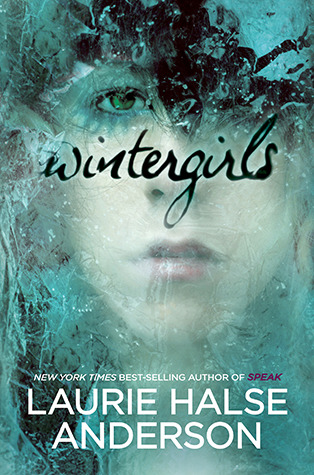
Wintergirls by Laurie Halse Anderson, narrated by Jeannie Stith, is an extremely disturbing look at the mindset of a teenager caught in the grips of anorexia.  Cassie calls Lia a wintergirl, a girl living between life and death with a beating heart but not really living.  Lia and Cassie are no longer friends by the time we meet Lia, who is trapped in a world of counting and restraint.  Like her mother, Lia wants to be in control and she keeps her feelings bottled up inside.  Her parents are frustrated, and Lia’s frustrated with herself because she cannot be thin enough, she cannot escape Cassie’s taunting, and she cannot change.  Her parents are as trapped as she is, but Anderson has crafted a narrative that forces the reader to be trapped with them.

Lia’s plight will make readers uncomfortable, especially if they have ever thought they were too fat or unpopular.  Most teens have been bullied for one reason or another, but Lia’s problems go deeper than what her peers call her — the biggest problem is what she calls herself and how she hates herself when she eats, when she doesn’t act “normal,” and when she fails those around her and herself.  This is a harrowing tale and a nightmarish narrative that will shake readers from their complacent ideas about anorexia.

Wintergirls by Laurie Halse Anderson, narrated by Jeannie Stith, is disturbing and world-shaking.  Anderson is a powerful writer who understands teens very well, and her stories are relevant and worth reading for adults and teens.  While the subject matter may hit too close to home and concern parents that teens will take the narrative to heart and begin their own anorexia journeys, these are the books that are here to challenge our way of thinking, to make us reassess our perceptions of these disorders, and incite us into action.

I read this for Banned Books Week.

About the Author:

Laurie Halse Anderson is the New York Times-bestselling author who writes for kids of all ages. Known for tackling tough subjects with humor and sensitivity, her work has earned numerous ALA and state awards. Two of her books, Speak and Chains, were National Book Award finalists.

Mother of four and wife of one, Laurie lives in Northern New York, where she likes to watch the snow fall as she writes. You can follow her adventures on Twitter and on her tumblr.


Mailbox Monday #343

Mailbox Monday, created by Marcia at To Be Continued, formerly The Printed Page, has a permanent home at its own blog.

To check out what everyone has received over the last week, visit the blog and check out the links.  Leave yours too.

Also, each week, Leslie, Vicki, and I will share the Books that Caught Our Eye from everyone’s weekly links.

Here’s what I received:

All the Words Are Yours: Haiku on Love by Tyler Knott Gregson for review from Literary & Lifestyle Publicity.

Every day for the past six years, Tyler Knott Gregson has written a simple haiku about love, and posted it online. These heartfelt poems have attracted a large and loyal following around the world. 

This highly anticipated follow-up to Chasers of the Light, presents Tyler’s favorites, some previously unpublished, accompanied by his signature photographs, which capture the rich texture of daily life.

This vibrant collection reveals the intimate reflections of one of poetry’s most popular new voices — honest, vulnerable, generous, and truly present in the gift that is each moment.

What did you receive?