Quantcast

321st Virtual Poetry Circle

Welcome to the 321st Virtual Poetry Circle!

Remember, this is just for fun and is not meant to be stressful.

Keep in mind what Molly Peacock’s book suggested.

Look at a line, a stanza, sentences, and images; describe what you like or don’t like; and offer an opinion. If you missed my review of her book, check it out here.

Today’s poem is from Sabrina Benaim:

Explaining my depression to my mother: A conversation

Mom, my depression is a shapeshifter
One day it’s as small as a firefly in the palm of a bear
The next it’s the bear
On those days I play dead until the bear leaves me alone
I call the bad days “the Dark Days”
Mom says try lighting candles
But when I see a candle I see the flicker of a flame
Sparks of a memory younger than noon
I am standing beside her open casket
It is the moment that I learn everyone I will ever come to know will someday die
Besides Mom, I’m not afraid of the dark, perhaps that’s part of the problem
Mom says I thought the problem was that you can’t get out of bed
I can’t, anxiety holds me a hostage inside of my house inside of my head
Mom says where did anxiety come from
Anxiety is the cousin visiting from out of town that depression felt obligated to invite to the party
Mom, I am the party, only I’m a party I don’t want to be at
Mom says why don’t you try going to actual parties, see your friends
Sure I make plans, I make plans I don’t want to go to
I make plans because I know I should want to go I know sometimes I would have wanted to go
It’s just not that fun having fun when you don’t want to have fun Mom
You see Mom each night Insomnia sweeps me up in his arms dips me in the kitchen in the small glow of the stove-light
Insomnia has this romantic way of making the moon feel like perfect company
Mom says try counting sheep
But my mind can only count reasons to stay awake
So I go for walks, but my stuttering kneecaps clank like silver spoons held in strong arms with loose wrists
They ring in my ears like clumsy church bells reminding me that I am sleepwalking on an ocean of happiness that I cannot
Baptize myself in
Mom says happy is a decision
But my happy is as hollow as a pin pricked egg
My happy is a high fever that will break
Mom says I am so good at making something out of nothing and then flat out asks me if I am afraid of dying
No Mom I am afraid of living
Mom I am lonely
I think I learned that when Dad left how to turn the anger into lonely the lonely into busy
So when I say I’ve been super busy lately I mean I’ve been falling asleep on the couch watching SportsCenter
To avoid confronting the empty side of my bed
But my depression always drags me back to my bed
Until my bones are forgotten fossils of a skeleton sunken city
My mouth a bone yard of teeth broken from biting down on themselves
The hollow auditorium of my chest swoons with the echoes of a heartbeat
But I am just a careless tourist here

I will never truly know where I have been
Mom still doesn’t understand
Mom, can’t you see
That neither can I

What do you think?

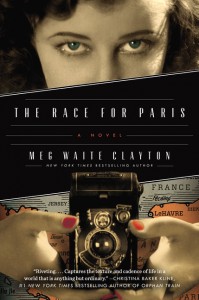
The Race for Paris by Meg Waite Clayton

tlc tour host

Source: TLC Book Tours
Hardcover, 336 pgs.
I am an Amazon Affiliate

The Race for Paris by Meg Waite Clayton is riveting from the start and a careful blend of fact and fiction about WWII and the female reporters and photographers who were often relegated to the field hospitals and sidelines while their male counterparts were allowed closer to the front and on reconnaissance missions.  Clayton’s characters tough cookies, and they have to be as they face the possibility of death once they’ve ignored their orders to remain at the field hospital.  Liv Harper, an Associated Press photographer know for her blurred faces, and Jane, a reporter for the Nashville Banner, find themselves accompanied by Fletcher, Liv’s husband’s friend.  Fletcher is a British military photographer who often goes it alone in the field to gather intelligence with his photos for the Allied forces, but he’s had a flame burning for Liv ever since he met her.  This unlikely trio is determine to make it to Paris before the other reporters to photograph and tell the tale of its liberation.

“That was the way it was, covering war.  The little bits of detail you could get on paper or on film were just that, little bits that didn’t tell the whole story.  And you couldn’t possibly capture the whole of it no matter how far back you stepped.” (pg. 217 ARC)

Liv has secrets too, and only Jane is aware of some of them.  While Fletcher and Liv are striving toward the front as if chased by ghosts, Jane is tagging along, not so much for the good of her career as someone who cushions the blows that they receive along the way.  She becomes the sounding board for each of them, while she keeps her own council.  Jane is a strong woman, though timid, while Liv is a wild wire set to explode.  Fletcher has taken it upon himself to protect them both, though his desire for Liv often steers him into danger.  While Clayton’s triangle here could be construed merely as a romantic tug-of-war, it is isn’t.  There are more nuanced dynamics at play here, as WWII has touched Fletcher and Liv in very different ways and Jane is observing it as it plays out.

The Race for Paris by Meg Waite Clayton looks through the lens of journalists during one of the most sweeping, horrifying, and tense wars in our world history to provide an encapsulated view of the fighting, the discrimination against female journalists, and the battles dedicated people had to endure to achieve their goals.

About the Author:

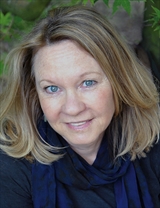
Meg Waite Clayton is the New York Times bestselling author of four previous novels: The Four Ms. Bradwells; The Wednesday Sisters; The Language of Light, a finalist for the Bellwether Prize; and The Wednesday Daughters. She’s written for the Los Angeles Times, the New York Times, the Washington Post, the San Jose Mercury News, Forbes, Writer’s Digest, Runner’s World, and public radio. A graduate of the University of Michigan Law School, she lives in Palo Alto, California.

Find out more about Meg at her website, and connect with her on Facebook and Twitter.


The Story of Beautiful Girl by Rachel Simon (audio)

Source: Hachette
Audiobook, 12 hours
I am an Amazon Affiliate

The Story of Beautiful Girl by Rachel Simon, narrated by Kate Reading, is rough story with a shining light of hope at its center.  Beautiful girl, who has a developmental disability, meets a deaf African-American man at the School, which is really just an institution for disabled people, in 1968.  Spanning about 40 years, readers are taken on a mysterious journey with beautiful girl, Lynnie, and with Homan as they seek to achieve self-actualization, while still hoping that their dearest wishes will come true.  After a fateful escape from the school and leaving her baby with Martha at a farmhouse nearby, Lynnie is recaptured and returns under the secret tutelage of Kate, who helps her learn to speak again.  As Lynnie grows as an artist and as a young woman, she still harbors the desire to see the man she loved, even though she did not know his name, and her baby again.

Lynnie and Homan are drawn incredibly well and with a compassionate hand by Simon, and the narration by Kate Reading is superb.  Readers will be drawn into their hardships, their hopes, their dreams, and their friendships along the way, and like them, readers will hope for the best possible outcome.  Despite speech difficulties, learning to read, learning sign language, and overcoming harsh disappointments, Lynnie and Homan never become more than human, while they have buried their hopes inside and think about them, they face their disappointments as many of us would.  They despair, they cry, they worry, and they dream.

As a sister of a disabled brother, Simon’s novel hit home in a lot of ways because we knew about these institutions and my parents had decided to keep my brother home and found him area programs that would help him when they could afford them.  The abuse that the disabled suffered in these institutions was nothing short of horrific, and I cannot imagine how my brother would have endured those things.  Lynnie and Homan are discriminated against, made fun of, and more, but its the moments of kindness, compassion, and love that field their journeys.

The Story of Beautiful Girl by Rachel Simon, narrated by Kate Reading, is stunning, compassionate, and emotional.  It is a testament to a world in need of healing and greater inclusion and understanding.  I’m only sorry that it took me so long to listen to this phenomenally touching story.

About the Author:

Rachel Simon is an American author of both fiction and non-fiction. Her six books include the 2011 novel The Story of Beautiful Girl, and the 2002 memoir Riding The Bus With My Sister.


About the Narrator:

Kate Reading has been a freelance narrator for over twenty years. She received an Audie Award for Bellwether by Connie Willis; an Audie nomination for The Gathering Storm by Robert Jordan and Brandon Sanderson, recorded with her husband, Michael Kramer; and an Audie nomination for Blow Fly by Patricia Cornwell. She has also received numerous Earphones Awards from AudioFile magazine, which has named her Narrator of the Year and, for two years running, Best Voice in Science Fiction and Fantasy for her narration of Jim Butcher’s Codex Alera series. As Jennifer Mendenhall, she has worked as a stage actor in the Washington, D.C.

How the Trees Got Their Voices by Susan Andra Lion

Source: Conscious Media Relations
Hardcover, 30 pgs.
I am an Amazon Affiliate

How the Trees Got Their Voices by Susan Andra Lion uses colored pencil-like drawings to bring the woods to life as a group of girls and their chaperone enjoy camping.  While the girls are singing in the tent after a long day of hiking and other activities, the chaperone hears whispers.  These whispers are carried on the wind, and she begins to realize that the creator’s trees are speaking to her.  They are carefully telling her about how they wanted what all of the other animals had — voices.

At the beginning of the book there’s an author’s note that indicates the book has two layers — the story of the woman learning of the myth of how the trees got their voices and the story of the animals in the woods.  Reading through the first story, its hard to keep a younger child’s attention focused on just what the chaperone is hearing and learning and passing on to the younger girls.  Kids tend to want to know everything all at once, and when an animal catches their eye, it’s best to read the little box of information to them.  Not only does it satisfy their own curiosity, but it will enrich their understanding of how the world in interconnected.

How the Trees Got Their Voices by Susan Andra Lion is a cute story but its set up may be a little distracting for younger readers, but like other picture books, it can be used as a teaching tool.  It has some great information about ecology and the animal kingdom, and Lion clearly aims to teach younger readers how to respect their surroundings.

Shopaholic to the Stars by Sophie Kinsella (audio)

Source: Public Library
Audiobook, 12.5 hours
I am an Amazon Affiliate

Shopaholic to the Stars by Sophie Kinsella, narrated by Clare Corbett, is a fun romp with Becky Brandon (nee Bloomwood) in the Hollywood hills as her husband, Luke, takes a temporary marketing position with actress Sage Seymour.  Becky is thrilled with the idea of being in Los Angeles, and she suddenly envisions a life of red carpet affairs, movie premiers, and becoming a stylist to the stars.  Becky, Luke, and Minnie are swept up into all things Hollywood, but Luke, naturally, remains the most level-headed.  Despite Becky’s over-shopping issues, which manifest in pre-purchases for stars she either has barely met or never even had any contact with, she’s managed to make some connections and be set on the path of her dreams.

Things get a bit complicated when there is a very public mix-up that fuels and ongoing feud between Sage and her movie-star rival, Lois Kellerton.  However, any potential character arc with Becky has ceased, at least so it seems in this book, and readers are likely to see her return to her old, selfish ways that often got her into too much trouble and places where her own rationalizations sound feeble even to her.  Although she now realizes, at least some of the time, that her rationalizations for purchases and bad behavior are just that, she continues on a path that while amusing, is devastating to those around her, even without her meaning it to be.  She even finds herself wrapped up so tightly in Hollywood’s machinations that she doesn’t think to herself that she should just walk away.

Becky’s head used to be easily turned by the prettiest bobble or the latest fashion, but in this one, her head is turned by attention, as if her husband and daughter do not dote on her constantly.  Her ego is larger than the series at this point, and while readers may want to see what happens after the end of this really open-ended book, they may not want to read more of the same character.  Shopaholic to the Stars by Sophie Kinsella, narrated by Clare Corbett, was fun to listen to and Kinsella is definitely a talent when it comes to writing quips, comebacks, and witty dialogue, but by the seventh book in the series, we want more depth from Becky Bloomwood.  While an entertaining way to spend the afternoon, the series has become a bit stale.

About the Author:

Madeleine Wickham is a bestselling British author under her pseudonym, Sophie Kinsella. Educated at New College, Oxford, she worked as a financial journalist before turning to fiction. She is best known for writing a popular series of chick-lit novels. The Shopaholic novels series focuses on the misadventures of Becky Bloomwood, a financial journalist who cannot manage her own finances. The books follows her life from when her credit card debt first become overwhelming (“The Secret Dreamworld of a Shopaholic”) to the latest book on being married and having a child (“Shopaholic & Baby”). Throughout the entire series, her obsession with shopping and the complications that imparts on her life are central themes.

Mailbox Monday #338

Mailbox Monday, created by Marcia at To Be Continued, formerly The Printed Page, has a permanent home at its own blog.

To check out what everyone has received over the last week, visit the blog and check out the links.  Leave yours too.

Also, each week, Leslie, Vicki, and I will share the Books that Caught Our Eye from everyone’s weekly links.

Here’s what I received:

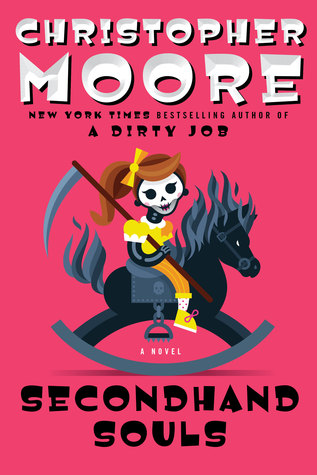
1. Secondhand Souls by Christopher Moore for review from LibraryThing Early Reviewers.  So EXCITED!

In San Francisco, the souls of the dead are mysteriously disappearing—and you know that can’t be good—in New York Times bestselling author Christopher Moore’s delightfully funny sequel to A Dirty Job.

Something really strange is happening in the City by the Bay. People are dying, but their souls are not being collected. Someone—or something—is stealing them and no one knows where they are going, or why, but it has something to do with that big orange bridge. Death Merchant Charlie Asher is just as flummoxed as everyone else. He’s trapped in the body of a fourteen-inch-tall “meat” waiting for his Buddhist nun girlfriend, Audrey, to find him a suitable new body to play host.

To get to the bottom of this abomination, a motley crew of heroes will band together: the seven-foot-tall death merchant Minty Fresh; retired policeman turned bookseller Alphonse Rivera; the Emperor of San Francisco and his dogs, Bummer and Lazarus; and Lily, the former Goth girl. Now if only they can get little Sophie to stop babbling about the coming battle for the very soul of humankind.

2. The Lost Journals of Sylvia Plath by Kimberly Knutsen for review from MBM Book Publicity.

Set in the frozen wasteland of Midwestern academia, The Lost Journals of Sylvia Plath introduces Wilson A. Lavender, father of three, instructor of women’s studies, and self-proclaimed genius who is beginning to think he knows nothing about women. He spends much of his time in his office not working on his dissertation, a creative piece titled “The Lost Journals of Sylvia Plath.” A sober alcoholic, he also spends much of his time not drinking, until he hooks up with his office mate, Alice Cherry, an undercover stripper who introduces him to “the buffer”—the chemical solution to his woes.

Wilson’s wife, Katie, is an anxious hippie, genuine earth mother, and recent PhD with no plans other than to read People magazine, eat chocolate, and seduce her young neighbor—a community college student who has built a bar in his garage. Intelligent and funny, Katie is haunted by a violent childhood. Her husband’s “tortured genius” both exhausts and amuses her.

The Lavenders’ stagnant world is roiled when Katie’s pregnant sister, January, moves in. Obsessed with her lost love, ’80s rocker Stevie Flame, January is on a quest to reconnect with her glittery, big-haired past. A free spirit to the point of using other people’s toothbrushes without asking, she drives Wilson crazy.

What did you receive?

320th Virtual Poetry Circle

Welcome to the 320th Virtual Poetry Circle!

Remember, this is just for fun and is not meant to be stressful.

Keep in mind what Molly Peacock’s book suggested.

Look at a line, a stanza, sentences, and images; describe what you like or don’t like; and offer an opinion. If you missed my review of her book, check it out here.

Today’s poem is from Pablo Neruda:

Here I love you.
In the dark pines the wind disentangles itself.
The moon glows like phosphorous on the vagrant waters.
Days, all one kind, go chasing each other.

The snow unfurls in dancing figures.
A silver gull slips down from the west.
Sometimes a sail. High, high stars.
Oh the black cross of a ship.
Alone.

Sometimes I get up early and even my soul is wet.
Far away the sea sounds and resounds.
This is a port.

Here I love you.
Here I love you and the horizon hides you in vain.
I love you still among these cold things.
Sometimes my kisses go on those heavy vessels
that cross the sea towards no arrival.
I see myself forgotten like those old anchors.

The piers sadden when the afternoon moors there.
My life grows tired, hungry to no purpose.
I love what I do not have. You are so far.
My loathing wrestles with the slow twilights.
But night comes and starts to sing to me.

The moon turns its clockwork dream.
The biggest stars look at me with your eyes.
And as I love you, the pines in the wind
want to sing your name with their leaves of wire.

What do you think?

Piglet Bo Can Do Anything! by Geert de Kockere, illustrated by Tineke Van Hemeldonck

Source: Sky Pony Press
Hardcover, 32 pgs.
I am an Amazon Affiliate

Piglet Bo Can Do Anything! by Geert de Kockere, illustrated by Tineke Van Hemeldonck, is a story that will give kids the self-confidence to embark on any journey no matter how big or small.  Piglet Bo psyches himself up through his mantra, “If I want to, I can do anything.”  He thinks about each task and repeats his mantra, and even as kids and parents know that some of the feats he strives to accomplish are impossible, Piglet Bo overcomes the odds, with a little bit of help from nature and the animals around him.  Even though Piglet Bo believes he has accomplished great things on his own, it will become clear to kids and their parents that he’s had help along the way.

This collection of vignettes involving Piglet Bo can become a series of teachable moments for kids about having confidence in their own abilities but also learning to be humble enough to realize that they may need help along the way.  My daughter believes she can do anything, and she’s confident that she can accomplish any task she sets her mind to, whether it’s as simple as putting the straw in her own juice box or getting the dresses out of her closet.  While she still has trouble accepting help, books like Piglet Bo can help reassure her that accepting help does not mean she is incapable of the task.  My mantra for her is, give it a try and when you think you want help, ask.  This enables her to try new things and do it herself, while letting her know that she can ask me for assistance and still garner a sense of accomplishment.

The illustrations in Piglet Bo Can Do Anything! by Tineke Van Hemeldonck, are wonderfully done, with a mixture of simply drawn animals and paint strokes.  Piglet Bo is set to have a series of adventures in this book, right alongside younger readers.

About the Author:

Geert De Kockere studied to become a teacher but instead became a professional journalist. Currently he is the editor of Buitenbeen, a nature magazine for Flanders and the Netherlands. He has written many children’s books, including several collections of poems, and has won a variety of book prizes for his work. He resides in Kempen, Belgium.

About the Illustrator:

Tineke Van Hemeldonck studied graphic design, specializing in illustration, at Provinciale Hogeschool Limburg in Hasselt. She has done all kinds of graphic design work, and this is her first children’s book. She currently resides in Bunsbeek, Belgium.

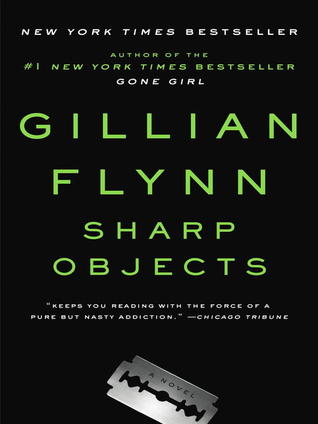
Sharp Objects by Gillian Flynn

Source: Purchased
Paperback, 254 pgs.
I am an Amazon Affiliate

Sharp Objects by Gillian Flynn, which was our book club selection for August, is a suspenseful, twisted tale for a modern audience of Grimms’ fairytale lovers.  Camille Preaker is a mediocre reporter from a small paper in Chicago, and while her editor remains behind her 100%, he sends her home to Wind Gap — a place she has not visited in nearly a decade — to cover a couple of child murders.  Flynn’s style can be abrasive and abrupt, but it fits the mood of the novel well, instilling suspense and the right amount of creepiness.

“For no good reason, I held my breath as I passed the sign welcoming me to Wind Gap, the way kids do when they drive by cemeteries.  It had been eight years since I’d been back, but the scenery was visceral.” (pg. 7)

This small town has dark secrets, and these secrets are about to explode as Camille and the cop from Kansas City start poking around to find the killer.  Flynn’s narration is clipped and fast moving, and her characters are off-the-chain and some are surreptitiously evil.  Camille’s dysfunctional relationship with her mother is just the tip of the iceberg, and the more she sees about her step-sister’s life with their mother, the more disturbed she becomes.  Identifying with the young victims in the case she’s reporting on, Camille is falling down a dark rabbit hole that could possible swallow her whole.

Sharp Objects by Gillian Flynn is an train wreck that readers will be unable to look away from, but its graphic language and description could be a bit much for some readers.  Fans of Stephen King and other horror writers will find this novel as equally twisted.  As a debut novel, Flynn has clearly made a splash in this genre.

About the Author:

Gillian Flynn is an American author and television critic for Entertainment Weekly. She has so far written three novels, Sharp Objects, for which she won the 2007 Ian Fleming Steel Dagger for the best thriller; Dark Places; and her best-selling third novel Gone Girl.

Her book has received wide praise, including from authors such as Stephen King. The dark plot revolves around a serial killer in a Missouri town, and the reporter who has returned from Chicago to cover the event. Themes include dysfunctional families,violence and self-harm.

11/22/63 by Stephen King (audio)

Source: Public Library
Audiobook, 30.75 hours
I am an Amazon Affiliate

11/22/63 by Stephen King, narrated by Craig Wasson, is a time travel novel in which teacher Jake Epping is tasked with the impossible — stop the assassination of President John F. Kennedy.  The local diner owner Al has the cheapest prices in town, but the town continues to speculate that his hamburgers are made from local cats and other pets.  After reading a brilliant essay from a GED student, Epping finds himself embroiled in a secret that is almost too fantastical to be real.  A bubble in the time line has enabled Al to return to 1958 repeatedly and buy the same cheap meat over and over.  Although Epping — who begins to write a novel that’s eerily similar to that of King’s IT set in Derry, N.H. — agrees to check things out and try to determine if Oswald had worked alone in assassinating the president, he finds himself swept up in a life he could be happy in, even though there is no Internet.

Although this book takes on the larger question of how one man could have impacted history had JFK lived and what would have happened had he not been killed and the country forced to mourn alongside his wife and child, King’s talent is in the small town experiences of that time period and the connections that seemed prevalent then that are not as present now.  Epping is skeptical about his task and even as he makes changes to the lives he knows about in the now and some for the better, he’s still not convinced that he can accomplish the bigger task of stopping the assassination.  And like many of us, Epping loses himself in the past — only in his case he literally loses himself.

11/22/63 by Stephen King is chock full of side stories, deeply sketched characters, and small town nuance.  Although there are a number of characters, readers can follow along from time line to time line because the “past harmonizes,” and readers are likely to be swept up into the story with little issue.  King is a master storyteller, which is a statement that I probably have beaten into your heads by now, so don’t miss out on his books any longer.  They’re an investment worth making.

About the Author:

Stephen King is the author of more than fifty books, all of them worldwide bestsellers. His recent work includes Doctor Sleep and Under the Dome, now a major TV miniseries on CBS. His novel 11/22/63 was named a top ten book of 2011 by The New York Times Book Review and won the Los Angeles Times Book Prize for Mystery/Thriller as well as the Best Hardcover Book Award from the International Thriller Writers Association. He is the recipient of the 2003 National Book Foundation Medal for Distinguished Contribution to American Letters. He lives in Bangor, Maine, with his wife, novelist Tabitha King. (Photo Credit: Denver Post)

Bleedovers by William Todd Rose

tlc tour host

Source: TLC Book Tours
ebook, 176 pgs.
I am an Amazon Affiliate

Bleedovers by William Todd Rose is the second dystopian novella starring Chuck Grainger — you’ll want to read Crossfades first — a man who works for a secret organization that helps lost souls cross The Divide. Grainger has become “famous” within the agency, although his fame is not something he’s comfortable with, especially when his supervisor reminds him of all the protocol he broke during the last Crossfade mission. Beyond his noteriety, he has experienced many sleepless nights related the ordeal, which he thought ended on the battlefield on the Crossfades. Evidence begins to pile up that the battle may not have been won.

Rose has created a world in which even readers who shy away from science fiction and more fantasy-related fiction can get swept up in by providing just enough technical detail to keep the story grounded and believable. Grainger has been a man on a mission and content in his work as a Whisk, but his nightmares have given him pause. He’s unsure if he wants to continue, but he finds that he has little choice when Bleedovers become more common than before. Marilee Williams enters our story, bringing with her special gifts that The Institute has enhanced to help with Non-Corporeal Manifestations (NCMs). Grainger, who acts like a lone cowboy in his work, is suddenly forced to work more closely with his partner, Control, and Marilee. The dynamics between Control and Grainger have evolved since the previous novella, and while Control could usually sense when he went off script, in this novella she is less like the voice of reason and more like a partner.

“The energy comes from Crossfades. As they jump from Crossfade to Crossfade, NCMs collect tiny bits of residual energy. They store it up, like a battery bein’ charged.”

Bleedovers by William Todd Rose is a strong second novella in a series, and readers will want more of this strange world. There is so much more to be explored. Is the last battle the end, or are there more to come? Will Grainger be able to fully free himself from the past and his notoriety? Rose has a gift for creating believable science fiction worlds that are wrought with real, and even imagined, dangers around every corner.

About the Author:

William Todd Rose writes dark, speculative fiction from his home in West Virginia. His short stories have been featured in numerous anthologies and magazines, and his work includes the novels Cry Havoc, The Dead & Dying, and The Seven Habits of Highly Infective People, and the novella Apocalyptic Organ Grinder. For more information on the author, including links to bonus content, please visit him online.

a Rafflecopter giveaway

Mailbox Monday #337

Mailbox Monday, created by Marcia at To Be Continued, formerly The Printed Page, has a permanent home at its own blog.

To check out what everyone has received over the last week, visit the blog and check out the links.  Leave yours too.

Also, each week, Leslie, Vicki, and I will share the Books that Caught Our Eye from everyone’s weekly links.

Here’s what I received:

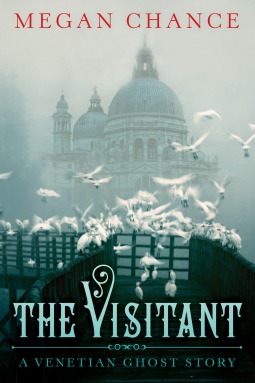
1. The Visitant: A Venetian Ghost Story by Megan Chance for review with TLC Book Tours.

After she nearly ruins her family with a terrible misstep, Elena Spira is sent to Venice to escape disgrace and to atone by caring for the ailing Samuel Farber. But the crumbling and decaying Ca’ Basilio palazzo, where Samuel is ensconced, holds tragic secrets, and little does Elena know how profoundly they will impact her. Soon she begins to sense that she is being watched by something. And when Samuel begins to have hallucinations that make him violent and unpredictable, she can’t deny she’s in mortal danger.

Then impoverished nobleman Nero Basilio, Samuel’s closest friend and the owner of the palazzo, arrives. Elena finds herself entangled with both men in a world where the past seeps into the present and nothing is as it seems. As Elena struggles to discover the haunting truth before it destroys her, a dark force seems to hold Samuel and the Basilio in thrall—is it madness, or something more sinister?

2.  How the Trees Got Their Voices by Susan Andra Lion for review.

Awarded 11 national awards and honors! While camping with a group of girls, Susan Andra Lion was given this tale about trees, nature and also the relationship of living things within a forest ecosystem. This highly visual story book not only presents a fascinating story that children ages 3 and older will enjoy, but also tells a second story about animals, plants, birds, and the Earth itself. Children will learn about the integrated way in which Earth’s inhabitants live in relationship to each other, and learn the value of respect for each form of life. This is a unique and marvelous book helps its readers to regard their world as a complex tapestry of life and living things. Children will be delighted by the thumbnail descriptions which surround the outside of each page, inviting them in and helping them learn about the world of the forest and greater ecosystem of Mother Earth.

Winner of the Moonbeam Children’s Literacy Award — Mind, Body, Spirit Category. Winner of the Mom’s Choice Award Gold Medal; Winner of Creative Child Magazine 2014 Book of the Year; Overall Winner, 2015 Next Generation Indie Awards, Best Design Fiction; Finalist, 2015 Next Generation Indie Awards, New Age Category; National Parenting Publications Awards (NAPPA) Silver award winner; Coalition of Visionary Resources: Winner — Visionary Fiction Category; Winner — People’s Choice Award Book of the Year 2015; Finalist, Children’s and Teens Books; Finalist, Conscious Living Books; Winner 2015 International Book Awards: Children’s Mind/Body/Spirit category.

3. The Storied Life of A.J. Fikry by Gabrielle Zevin, which I purchased at the library for 50 cents.

On the faded Island Books sign hanging over the porch of the Victorian cottage is the motto “No Man Is an Island; Every Book Is a World.” A. J. Fikry, the irascible owner, is about to discover just what that truly means.

A. J. Fikry’s life is not at all what he expected it to be. His wife has died, his bookstore is experiencing the worst sales in its history, and now his prized possession, a rare collection of Poe poems, has been stolen. Slowly but surely, he is isolating himself from all the people of Alice Island-from Lambiase, the well-intentioned police officer who’s always felt kindly toward Fikry; from Ismay, his sister-in-law who is hell-bent on saving him from his dreary self; from Amelia, the lovely and idealistic (if eccentric) Knightley Press sales rep who keeps on taking the ferry over to Alice Island, refusing to be deterred by A.J.’s bad attitude. Even the books in his store have stopped holding pleasure for him. These days, A.J. can only see them as a sign of a world that is changing too rapidly.

What did you receive?