Quantcast

I’m Just Sayin’! by Kim Zimmer and Laura Morton

I’m Just Sayin’!: Three Deaths, Seven Husbands, and a Clone! My Life on Guiding Light and Beyond by Kim Zimmer and Laura Morton is as spontaneous as Reva Shayne was on Guiding Light, and while most of the memoir is linear in nature, there are moments where the flashbacks are a bit out of sequence — though never hard to follow.  Zimmer pulls no punches with her memoir and does not sugarcoat anything that happened in the latter years of Guiding Light, which experienced severe budget cuts and went downhill in terms of quality where production was concerned.  On the flip side, she’s also willing to admit her mistakes and allowed her temper to get the best of her when she should have tried a more diplomatic approach when story lines and production were falling by the wayside.

Even more interesting were the early years in which she made some tough decisions about college and acting, when she met her soul mate (A.C. Weary), and when she put her family first and left Guiding Light the first time.  She shares some acting techniques she learned, including substitution in which an actor uses real life images and memories as stand ins for the characters’ current situations.  Zimmer didn’t find this effective, and in fact, found it very distracting.  One of the most interesting things in the book was that she took the bus to the studio rather than have a car pick her up or driver herself to work in the early days, which some of her co-stars found odd.  (I applaud her for using public transportation!)

“A.C. and I joked about getting married any number of times, but one of us always managed to change the subject.  If memory serves me correctly, in the summer of 1980, we were in our teeny-tiny kitchen making dinner when we started talking about having a baby.  I believe I said I’d love to have a kid but I wanted to be married first.  Hint, hint, wink, wink!

A.C. said something like, ‘Are you asking me to marry you?’

I said, ‘If you want me to have your babies, then yes, I’m asking you to marry me!'”  (Page 42)

While some may think that Zimmer is a diva, she certainly is in the sense that she’s talented and passionate about her work.  She talks a lot about fighting for her characters and the show, which she thought of more like a family — and in many ways was more attached than probably some other actors would be to their roles and television shows.  Her resolve and determination helped Reva Shayne’s character grow, but unfortunately, the show itself was not something should could have saved on her own.  Becoming so attached to the show and her character ultimately weighed too heavily on Zimmer and caused her to make some choices she might not have otherwise.

I’m Just Sayin’!: Three Deaths, Seven Husbands, and a Clone! My Life on Guiding Light and Beyond by Kim Zimmer and Laura Morton is not only about acting and her family, but about a passion for her job that became all-consuming and led her astray for a while.  But lessons are always available when people make mistakes, even celebrities.  Zimmer’s memoir seems to have been cathartic for her in that it helped her assess herself and her role as wife, mother, and actress.  She’s candid and funny, but never overly apologetic.  A great memoir for those looking for behind-the-scenes shenanigans, serious acting business, and life-work balance decisions.

***On another note***

My husband and I watched Guiding Light together, and Jonathan and Reva’s story line was one that we loved watching unfold as he was the son she had left behind.  We loved the dynamic of these characters, and it was great to learn about the audition between Zimmer and Tom Pelphrey, which was too funny.  The chemistry between the characters was superb. Another of my favorite pairings was Reva with Jeffrey!  I loved their “What the hell” nature and the jokes and genuine fun time they seemed to be having.  It was so refreshing.  On the flip side, I loved Harley and Gus on the show, a relationship that was torn asunder by the writers and angered me beyond imagination.

It was hard for me to watch the production quality of this show decline, and my mother would call and ask me what the heck they were doing to our show.  The shaky cameras and the outside scenes in which you couldn’t hear the dialogue too well and the overpowering music.  Like Zimmer, I was very attached to these characters, and in many ways they were real….I was sad to see the characters of Springfield go.

About the author:

Four-time Emmy® award winner Kim Zimmer is a veteran television actress. In 1984, she joined the cast of Guiding Light, and stayed with the series for over two decades. She and her husband live mostly in New Jersey with their three children.


This is my 65th book for the New Authors Reading Challenge 2012.

Across the Mekong River by Elaine Russell

Across the Mekong River by Elaine Russell is part PTSD (post-traumatic stress disorder) and part immigration story set just after the end of the Vietnam War.  Nou Lee and her family were forced to flee Laos following the Vietnam War after her father fought with the special forces alongside the Americans.  His life and that of his family were threatened by the succeeding communist government, forcing them to take flight in the middle of the night across the Mekong River.

Across the river that takes some of the lives in an explosion of gunfire and rapids, the family finds itself in a refugee camp in Thailand.  To be Hmong family means duty and hard work for the good of the entire family from grandparents to cousins and aunts and younger siblings, and above all respect for culture and ancestors.  The hard life this family has seen from their days in Laos and in Thailand where they struggle to feed their children makes the dream of freedom in America even more alluring.

“On another, taller mountain deep in the woods, we built small shelters, tying bamboo poles together against trees and covering them with thatch.  I think we were there six months, maybe longer.  We could only plant a small vegetable patch and search for food in the forest.  But somehow our husbands found us and brought whatever supplies they could carry.”  (Page 22)

“A barbed wire fence surrounded Nong Khai Camp.  Three Thai soldiers stood sentry at the gate, brandishing their rifles.  As we drove into the compound, I did not know if I should feel afraid.  Officials would explain that the guards were for our protection so no one from outside could take advantage of us.  Through the barbed wire, I watched the Thai farmer we had just passed driving his water buffalo into his field.  He never looked our way, as if we did not exist.”  (Page 36)

Her parents struggled to keep the rest of the family safe and together as they remained in camp in Thailand, and when the promise of America came, many were reluctant to go for it meant change and adjustment.  In 1982, the Lee family moves, taking with it their hopes for a new future and freedom, but hanging over this new adventure are the ghosts of the past, which threaten to pull them back into the abyss and keep them from finding their place.  Nou, a young girl in a strange land and with no knowledge of English, is thrust into an unknown school and unfamiliar culture that since the Vietnam War has bred prejudice against those from Asia.

Her adjustment into the new world is anything but seamless and she’s forced to bury her resentments of her mother and family deep as she navigates peer pressures and bullying, even from her own Hmong family members.  As the family moves to better opportunities, her previous experiences have colored her perception of Americans and adopts a new name and a new life.  Although her thrift store clothes and restrictive customs tell her true story, she is leading not only a double life, but a triple life when Dang Moua enters the picture and her mother begins to talk of marriage and children.

Elaine Russell has a gift for bringing out the nuances of the Laotian culture, particularly that of the Hmong people, in the multiple family points of view she uses.  In addition to the cultural norms, she easily weaves in the ravages of war and its effect not only on the fighting soldiers, but the families they leave behind who face torturers face-to-face.  Across the Mekong River, the Lee family finds freedom, but it comes with a price.  Struggling to maintain their cultural identity in a melting pot of America, the Lee family not only struggles with the secrets of their shared past, but the secrets they now keep from one another as they vacillate between being truthful and relying on age-old customs that elders are to be respected and never questioned.  Russell has created a tale that leaves a deep impression on the emotions of the reader and raises questions about what it means to be American as an immigrant.

About the Author:

Elaine Russell graduated with a BA in History at University of California, Davis, and an MA in Economics at California State University Sacramento. She worked as a Resource Economist/Environmental Consultant for 22 years before beginning to write fiction for adults and children. She became inspired and actively involved with the Hmong immigrant community after meeting Hmong children in her son’s school in Sacramento and reading Anne Fadiman’s The Spirit Catches You and You Fall Down. Since then she has been to Laos many times to research her book and as a member of the nongovernment organization Legacies of War.

This is my 63rd book for the New Authors Reading Challenge 2012.

The Voice I Just Heard by Susan Dormady Eisenberg

Look at this book’s cover, as the woman walks out on the stage and sees the waterfalls before her, this is a perfect metaphor for the stage fright that grips Nora Costello when she sings, especially when her dismissive parents are in the audience. Imagine what singing is like for an artist, it is the air they breathe and the thrum of their soul, but imagine how it would be to recapture your flagging confidence in the presence of parents who disapprove of the theater as a career, particularly after one of your staunchest supporters, your brother Liam, dies in the Vietnam War dashing your father’s hopes of another brilliant doctor in the family.  The Voice I Just Heard by Susan Dormady Eisenberg is an operatic debut of epic proportions, with a story that takes readers behind the scenes of theater and opera through an emotional journey of losing a brother at one of the most controversial times in U.S. history — the Vietnam War.

“As Liam and I stood elbow to elbow at the fence, he said, ‘I should’ve memorized the whole poem, but I only recall the first four lines and the last four.’  His expression turned solemn.  ‘Here’s how it ends.  “Oh may my falls be bright as thine, may heaven’s forgiving rainbow shine, upon the mist that circles me, as soft as now it hangs o’er thee.”‘

‘That’s sweet,’ I said.  ‘But what does it mean?’

‘I asked Sister Perpetua.  She said we have the power of the falls in each of us.  When we screw up, heaven sends us a rainbow to tell us we’re forgiven.’  He shrugged.  ‘It’s weird.  I’ve come here three times and never seen a rainbow, so I wonder if Moore made it up.'”  (page 152)

Eisenberg, who has written profiles of singers, actors, and more, deftly weaves in the story of Liam and Nora’s childhood and the pressures they faced to be perfect for their upper crust parents — even if that meant tamping down their desires for a new direction and passion — with the present day family dynamics of losing a son to war.  Nora is set adrift without the anchoring relationship of her brother, who in a way was her buffer between her passions and dreams and her parents’ disapproval.  Her father is stoic in his response to his child’s death, and her mother withdraws from everything.  Eisenberg’s prose brings to life the grief of these characters as the mother goes to mass daily, the father buries himself in work, and Nora seeks solace in the theater where she runs public relations for the summer showing of Annie Get Your Gun in Cohoes, N.Y., alongside her gay boss Graham Chase.  A former mill town, Cohoes is a hot bed of hidden beauty in more ways than one, and it’s the perfect setting for two battered singers to meet — Nora Costello and Barton Wheeler, where they can come to terms with the right path for their artistry and their souls.

Eisenberg’s characters are deeply emotional, high strung, and respond before thinking, which gets them into a number of situations that can be misinterpreted and blown out of proportion, and in this way, her dramatic story resembles the missteps in Pride & Prejudice.  Nora must learn to see the courage within herself, repair her relationships with her parents and childhood friend Liz, and determine what path is best for her without the influence of others.  Bart, on the other hand, is balancing his true career with the need to support his two daughters from a previous marriage, while still holding onto the family business.  When they come together sparks fly.

The Voice I Just Heard by Susan Dormady Eisenberg is about finding the confidence in oneself to reach out passionately for the life you want to lead and to never let go of it, not matter what the detractors say.  Sage advice for any artist — whether singer or poet.  Nora is spunky, head strong, and passionate, while Bart is more restrained (probably due to his age and life experiences), but he’s equally adrift as he’s lost confidence in his abilities and the right path for himself.  From the stage in Cohoes to Washington, D.C., Nora and Bart grow into themselves and their voices — voices that are their own and remind them of where they belong.  When overture sounds and the cast steps on the stage, the voices in this novel will sweep the reader away into a operatic crescendo like no other.

There is some strong sexual language in this book, so beware.

About the Author:

Susan Dormady Eisenberg is a writer based in Maryland. She has published articles in Opera News and Classical Singer (such as a November 2011 cover profile of baritone Robert Orth), as well as The Hartford Courant and The Albany Times Union. On February 3, 2012, she released her first novel, The Voice I Just Heard, as an indie ebook.

As a freelancer Susan has written promotional publications for clients throughout Greater D.C. Prior to launching her business, she did publicity for Goodspeed Opera House and Syracuse Stage, and marketing for the Joffrey Ballet/New York.

Please also check out my interview with her for the D.C. Literature Examiner.

This is my 61st book for the New Authors Reading Challenge 2012.


The Disappearance of Georgiana Darcy by Regina Jeffers

The Disappearance of Georgiana Darcy by Regina Jeffers is a Pride & Prejudice mystery with heart and a devotion to Jane Austen’s characters as she envisioned them.  The beauty of this  novel is that it not only holds true to the original and what happened between the Bennets, the Darcys, and the Bingleys, but it also demonstrates that those characters can change and become more than Austen intended.

Georgiana has vanished among the moors in Scotland while she waits for her husband Major General Edward Fitzwilliam to return from fighting France at Waterloo, and her brother Mr. Darcy and his wife Elizabeth are preparing for the wedding of her younger sister Kitty.  The Darcys may be enjoying being new parents and building their small community of friends and family, but the Wickhams and Mrs. Bennet’s mischief are never too far away.

“For a brief second, Darcy’s brain told him that his vision had betrayed him.  It could not be George Wickham aiming one of the military’s best personal weapons at him, but he rejected that erroneous assumption immediately.  It was Wickham, and Darcy was the target.”  (Page 142)

Jeffers is true to the original characters, while intermingling the elements of gothic literature found in the prose of the Brontes.  She creates situations with new characters that generate serious suspense that will have readers on the edge of their seat about the safety of Georgiana.  Darcy is a loving husband, but he and his wife still have that back-and-forth banter that readers of Austen love.  But their relationship has matured, with an absence of misunderstandings and temper flare-ups that got them into hot water with one another in the first place.  Jeffers is at her best here with prose that keeps to the customs and diction of the past and mixes it seamlessly with modern sensibility.

“‘Elizabeth?’ Darcy asked eagerly as he stood mesmerized by his son’s antics.  ‘Have you seen what Bennet has accomplished?’

His wife joined him in his sitting room.  ‘What would that be?’ Her voice betrayed her amusement.

Darcy turned his head to glare at her.  ‘I suppose Bennet’s turning from his knees to his back is not a recent achievement?’

Although she attempted a sympathetic countenance, Elizabeth’s smile widened.  ‘If it is of any consequence, your son has only mastered the rotation in the last week.’

Darcy threw up his hands in frustration.  ‘That settles it! I refuse to be away from my family ever again.  Bennet grows too quickly as it is.  . . . ‘” (Page 394)

The novel pulls readers in easily, particularly with the mystery that leaves Georgiana’s captors and location a mystery until the latter quarter of the novel.  The technique of intermittently showing readers Georgiana’s thoughts and concerns about her location as her kin learn of the erroneous reports that reached her in Scotland and her subsequent disappearance are well done.  Jeffers also creates a set of villains that rival even Mr. Wickham, and the secrets revealed about the MacBethan family in Scotland will cause some readers to have nightmares or at least feel very uncomfortable.  The Disappearance of Georgiana Darcy shows that beloved characters can evolve, have adventures, and learn to forgive.

About the Author:

A teacher for nearly 40 years in the public school systems of three different states, Regina Jeffers is a Time Warner Star Teacher Award winner, a Martha Holden Jennings Scholar, a Columbus Educator Award winner, and a guest panelist for the Smithsonian. She served on various national educational committees and is often sought as a media literarcy consultant. Like many “snow birds,” Jeffers moved to the South several years ago. She is late to the publishing business, having written her first book on a dare from her students, who, literally said, “If you know all this, why do you not do it yourself?” On a whim, she self published her first book, and from there, everything happened at once. Now, writing for Ulysses Press in California, Jeffers is the author of several Jane Austen adaptations including Darcy’s Passions, Darcy’s Temptation, Vampire Darcy’s Desire, The Phantom of Pemberley, and Captain Wentworth’s Persuasion. She considers herself a Janeite – a member of the Jane Austen Society of North America and spends lots of her free time involved in such. Jeffers has now branched out into the Historical Romance genre. Her first book in the Realm series, The Scandal of Lady Eleanor, will be released in early 2011.

Wayne of Gotham by Tracy Hickman

Wayne of Gotham by Tracy Hickman is an exploration into the Wayne legacy and its role in Gotham’s early days and its current influence on the city as Bruce Wayne dons a cape and cowl and chases criminals as Batman.  Through a series of flashbacks to the 1950s, Bruce and the reader learn about his father, Dr. Thomas Wayne, and the family secrets.  Bruce is clearly not the only Wayne who has kept big secrets from the rest of the family and the outside world.

The parallels Hickman draws between Bruce and his grandfather, Patrick, are intriguing as both men tend toward the aggressive nature of their personalities and are not afraid to meet violence with violence.  Thomas, on the other hand, wants no part of that violent world, even though his father believes he should be able to defend himself.  However, in Hickman’s novel Bruce Wayne is middle-aged and feeling the impact of his year’s saving Gotham from criminals as Batman, and his reliance on technological advances in his suits and cars tells a far greater tale of this aging hero.

“The garden was dead.  The roses had gone wild and died during the succession of winters without care.  Their gnarled limbs reached up like claws from the edges of the footpaths, which were covered in dead leaves decomposing into dirt.  The prize lilacs his mother had been so proud of now reached up menacingly over the walls.  The garden had gone native, weeds choking and obscuring the careful planning that now lay buried ad barely recognizable.”  (Page 35)

What’s interesting about Hickman’s take on the comic character and his family is that Batman uncovers a past that is not as rosy as he expects about his father.  Dr. Thomas Wayne and his work with Dr. Richter are more than his son can digest in one sitting, but Batman is hardly given the chance to do so as he’s being drawn deeper and deeper into a spider’s trap as ghosts from the past seek to right the wrongs of the past.  Through a series of surprising turns connected to the German Nazis, eugenics, and more, Batman is confronted with a father who is not as perfect as he thought and he must reconcile what he has learned with what he thought he knew about the man.

The criminal mastermind here is slightly obvious from early on, but that is not as bothersome as the incessant talk early on about Batman’s vehicles and gadgets, which don’t necessarily add to the plot especially when the narration focuses on the evolution of the Batmobile from its early incarnations to the present.  However, that’s a minor drawback that fades away once the novel gets going.  Hickman has clearly done his research into several incarnations of the Batman myth, but the plot movement with the entrance of criminals, like The Joker, is abrupt on occasion as their motivations are unclear and the catalyst of their involvement is murky until the end.

Wayne of Gotham by Tracy Hickman is a satisfying read for those interested in the past of the Wayne family and its role in the rise and potentially the degradation of Gotham City.  Warring within each of these men is the duty to do good and the desire to just be free and follow their passions.  The relationship between Thomas Wayne and his father is clear from the beginning, but the relationship between Thomas and his son Bruce is less clear as Bruce himself is unsure how to view his father in light of the secrets revealed.  In many ways, this novel may have worked better as a graphic novel, but Hickman does a good job sticking to the origins of the character and bringing in unique story lines to fill out the ancestry of Wayne family.  By the end of the novel, it would also seem that more needs to be said and uncovered, especially when the second son of Thomas and Martha Wayne is alluded to, but not seen.

About the Author:

Tracy Hickman is a best-selling fantasy author, best known for his work on Dragonlance as a game designer and co-author with Margaret Weis, while he worked for TSR. He married Laura Curtis in 1977, and together they have four children.

This is my 59th book for the New Authors Reading Challenge 2012.
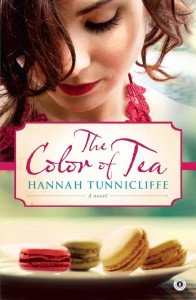
The Color of Tea by Hannah Tunnicliffe

Macau is a former Portuguese colony and is now a special administrative region of China and a hub of gambling and more.  The Color of Tea by Hannah Tunnicliffe is a woman’s journey into a strange land and the time of her life as she trails behind her husband, and their dreams of a new life change drastically.

“Macau: the bulbous nose of China, a peninsula and two islands strung together like a three-bead necklace, though by now the sand and silt have crept up and almost covered the silk of the ocean in between.  Gobbled up, like most everything in Macau, by Progress.  Progress and gambling.”  (Page 1)

Grace Miller is a woman who has lost her dream and builds another with tea and French pastries.  With the help of Leon, a French chef, Grace learns to make macarons and she opens a cafe, breathing new life into her days.  Although she doesn’t know Portuguese, Cantonese, or Mandarin, she finds the strength to become a businesswoman with little help from her husband, Pete.  She finds a new strength in her situation as she creates new kinds of macarons, serves coffee and tea, and provides a community with a little hope and connection.

“The day after the earthquake Lillian’s is packed to the rafters.  It is so crowded that those who can’t find their own tables join strangers and start to talk.  It is as if the catastrophe has brought out the community-minded side of people.  Conversations are hushed, and customers linger over their coffees.  Children are sent to the corner to play with our basket of toys, mutely constructing castles or ships out of LEGOs; even they must sense the need for regrouping and rebuilding.”  (Page 125)

It is the essence of Tunnicliffe’s novel — rebuilding and regrouping — to create something shiny and new out of the rubble . . . to begin again.  Lillian’s is a cafe born from the ashes of a Portuguese restaurant in a Chinese owned commonwealth by a British woman seeking a foothold in a spiraling out of control life, but what this cafe brings to her and to the community is more than she could have bargained for as cultures are bridged and friends are earned.

Grace is dedicated and strong, but she’s also naive about the cultural differences surrounding her, but those traits together make her more endearing.  Peter tries his best to cope with the loss of their dream, but throws himself more and more into his work when his wife withdraws.  His character is less well drawn, but the novel is told from Grace’s perspective, so that is to be expected.  Gigi, Leon, Celine, Rilla, Marjory, and Yok Lan are secondary characters who are full of life, teaching one another how to have patience with one another and grow.

Tunnicliffe’s debut novel is ripe with sugar and creamy pastry as each new relationship adds to the culinary masterpiece that is The Color of Tea.  It is Grace’s story.  Through her baking she comes alive, and subsequently comes into her own.  Tunnicliffe is talented and makes Macau come alive through food, relationships, and tea — creations that transcend sorrow and class.

About the Author:

Hannah Tunnicliffe was born in New Zealand but is a self-confessed nomad.  After finishing a degree in social sciences, she lived in Australia, England, and Macau.  A career in human resources temporarily put her dream of becoming a writer on the back burner.  The Color of Tea is her first novel.

This is my 58th book for the New Authors Reading Challenge 2012.



If you’d like to win a copy and live in the US or Canada, please leave a comment about your favorite tea or pastry.

Deadline is Aug. 16, 2012, at 11:59PM EST

When She Woke by Hillary Jordan

When She Woke by Hillary Jordan has been compared to The Scarlet Letter by Nathaniel Hawthorne and The Handmaid’s Tale by Margaret Atwood, but it is really a combination of the two as Hannah Payne is not melachromed for adultery, but for another sin and she lives in a world where the separation between church and state has been broken.  Roe vs. Wade has been overturned once a scourge has rendered most women unable to have children and men who are carriers unwittingly have passed the disease onto unsuspecting partners.  Under the defense of saving the human race, society has outlawed abortion.  This idea parallels the notions of The Handmaid’s Tale, though the society in that novel is more severe in terms of limiting women’s rights and control over their bodies.

Punishment for breaking the laws of this society are no longer being thrown in jail, but being chromed and thrown back out into society to face ridicule and stigmatization.  Chroming takes place when a virus — which had unknown side effects for many years and often results in fragmentation of the brain if not re-administered every six months or reversed properly — turns the skin the color of the crime, such as red for violent offenders and blue for molesters.  Once back in society these men and women are looked upon as freaks and outsiders, and they are lucky if they are given jobs to survive on their own while their sentence is carried out.

“The virus no longer mutated the pigment of the eyes as it had in the early days of melachroming.  There’d been too many cases of blindness, and that, the courts had decided, constituted cruel and unusual punishment.”  (Page 6-7)

Aiden Dale in Jordan’s book is very reminiscent of Arthur Dimmesdale in The Scarlet Letter in that his character is very weak and he is forced by the pressures of guilt to confess.  Naturally, Hannah is a young women in a close knit community of religious communities and the injury of her father leaves the family in a precarious position until their pastor Aiden Dale comes to the rescue.  His character is only seen through Hannah’s eyes as she is the main point of view throughout the novel, which leaves a lot of his motivations in question, especially given the relationship he embarks upon as a pastor and married man.

Jordan’s novel is very fast-paced, and may even be too fast-paced as it seems that Hannah needs a moment to slow down, breathe, reflect but her character is very emotional, impulsive, and impatient.  Given her upbringing in a religious community, it is clear that she knows little of the outside world in Texas, which is cliche location for a novel about ultraconservative religious groups, etc.  Her actions are frustrating, but at least they are understandable given her upbringing, but there are other occasions where she seems superior in her perceptions of others’ personalities and actions and yet completely oblivious when others are plying her with food and a place to sleep after being chromed.

When She Woke by Hillary Jordan is ultimately a mesh of worlds that does not go to the extremes of the other nations created by Atwood and Hawthorne, and in that, the world building loses ground as it uses a heavy-handed nature in drawing parallels to today’s society, its punishments, and our own history of discrimination against certain groups.  However, this novel would make an excellent selection for a book club discussion given the issues it raises about the separation of religion and government, abortion, crime and punishment, and other topics.

About the Author:

Hillary Jordan received her BA in English and Political Science from Wellesley College and spent fifteen years working as an advertising copywriter before starting to write fiction. She has an MFA in Creative Writing from Columbia University.  (Photo by Michael Epstein)

What the Book Club Thought (beware of spoilers):

When She Woke by Hillary Jordan was one of the two books I nominated and the book club selected it for this month’s discussion.

Most members agreed that the character of Aiden was very weak and that we disliked him.  One member insisted that most of us had laid too much blame on Hannah for what happened to her, but the women of the group said that blame lied with both Aiden and Hannah.  Given that Hannah knew Aiden was not only her pastor, but also a married man, she should not have engaged in an illicit affair with him, and he knew he was married and a paragon of the community.  While this is billed as a love story, I didn’t see the depth I expect from love-based relationships and the relationship between Aiden and Hannah appeared to be more one of lust and passion than of love.

While some of the sci-fi elements worked best for one member of the book club, others of us were happy that unlike the Hunger Games series of books the back story as to why the society had changed so drastically was presented.  Some of the members thought that Jordan skewed some elements of the society such as making all of the religious figures and members mean or evil, except for the one female priest.  But one of us thought there was a balance in the casting as there were good and bad in both the religious community from the bad priest and his wife to Hannah’s father who was more tolerant and in the Novemberists (which reminded me of the V is for Vendetta movie with its focus on November and bombing, etc.) there were good and bad guys as well.

In terms of the books we’ve read so far, this one generated a great deal of discussion about what would happen in today’s society if Roe vs. Wade was overturned (which most of us don’t see happening), what punishments are considered cruel and unusual, what being a second-class citizen would entail if we were chromed, and how the women in the group felt about abortion.  One of our members also suggested that the book is focused on demonstrating that we should not judge others and their sins but worry about ourselves, even if we are devote Catholics, etc.

This is my 57th book for the New Authors Reading Challenge 2012.

Monarch Beach by Anita Hughes

Monarch Beach by Anita Hughes is one of those beach reads that barely scratches the surface about what divorce can do to a family, especially when one spouse cheats on the other and more than once.  To Amanda Blick’s credit she doesn’t go postal and take out her husband’s (Andre) French fondue restaurant in Ross, an exclusive, elite neighborhood, and she doesn’t have a nervous breakdown.  Rather, Blick takers their son, Max, out of the San Francisco area to St. Regis Monarch Beach Resort with her mother, Grace, who promises to quit smoking if they come stay with her for the summer in the Presidential Suite.

Pretty posh lifestyle, but nothing less can be expected from the offspring of a society family, whose friends used to call her parents’ home The Palace.  The relationship between Andre and Amanda is rushed, but that’s to be expected as she meets him just after graduating undergrad following a family tragedy.  When Andre’s restaurant partnership sours, he doesn’t turn to his mother-in-law or his wife for help, but a busty former high school classmate of Amanda’s and her husband Glenn.

Clearly blinded by lust or love, Amanda rushes headlong into a marriage and finds contentment with being a mother and wife, as her dream of becoming a fashion designer fades into the rearview.  But her world crumbles around her when she finds the chef’s legs wrapped around her partially naked husband in the restaurant one afternoon.  She’s forced to make a decision or have a meltdown.

“I pulled into the parking lot at the post office, threw my purse under the seat, and started walking.  I was still in my yoga clothes, so I looked like any other mother going for a morning hike.  I left the parking lot and took long strides till I reached the lake, a walk that usually took me half an hour.  That Tuesday I made it in sixteen minutes.  I sat on a bench watching the ducks and took deep breaths.  It was a beautiful spring day.  The sun was warm, the sky a pale blue, and beds of purple and white daisies surrounded the lake.”  (Page 2)

Hughes creates a woman who copes with heartbreak in the only way she knows: she asks her mother’s advice.  Amanda waffles, she indulges, she cries, and she wallows over the summer, and by turns she’s at the beach, eating, or at the bar, but most of all she’s spending time with her son and her mother, the people she cares most about.  Many readers will envy her lifestyle and wonder what she has to complain about, but upon further reflection, readers will find that heartbreak can transcend classes.

Monarch Beach by Anita Hughes is beach read that will take most readers’ minds off their troubles.  A satisfying peak into the life of the elite, even when heartbreak is the order of the day.  The ending is a bit open-ended, which could leave readers wondering if there is a sequel in the works.

About the Author:

ANITA HUGHES attended UC Berkeley’s Masters in Creative Writing Program, and has taught Creative Writing at The Branson School in Ross, California. Hughes has lived at The St. Regis Monarch Beach for six years, where she is at work on her next novel.  Please check out her Website. (Photo by Sheri Geoffreys)

This is my 54th book for the New Authors Reading Challenge 2012.

The Rose of Fire by Carlos Ruiz Zafón

Carlos Ruiz Zafón, author of The Shadow of the Wind, is like many other authors these days in that he is pumping out short stories for digital devices.  The Rose of Fire is one such story, but this story tells the tale of how the Cemetery of Forgotten Books was born at the time of the Spanish Inquisition in the fifteenth century.  The labyrinth of books is an intriguing idea, and Zafón’s prose is at once lyrical and absorbing, transporting readers into another time and place.

As fear and suspicion are around every corner, many Spaniards keep to themselves in the hope that they will be spared the wrath of the church.  Raimundo de Sempere, who knows too many languages to stay outside the church’s suspicion, is a printer who is asked to translate a mysterious notebook found on Edmond de Luna, the only surviving man of a ship left battered and adrift near Barcelona just after a plague has ravaged the city.

“Edmond de Luna could see himself reflected in those eyes that resembled huge pools of blood. Flying like a cannonball over the city, tearing off terrace roofs and towers, the beast opened its jaws to snap him up.”  (ebook)

Zafón has created a tantalizing back story for his series of books about the library, and for those who have not read his previous books in the series, The Rose of Fire serves as an introduction to that fantasy world he’s created in which magic and nightmares come alive.  While the story is enchanting and absorbing, it is likely to leave readers wanting more in the way of character development that would likely come with a longer piece of work.  In many ways, this ebook release achieves its goal of ensuring the reader will look for more of the author’s work, but it seems to be a means to an end only, rather than a well developed short story.  With that said, Zafón is a talented author who creates believable worlds full of adventure and conflict.

About the Author:

Carlos Ruiz Zafón is a Spanish novelist. Born in Barcelona in 1964, he has lived in Los Angeles, United States, since 1994, and works as a scriptwriter aside from writing novels.

This is my 53rd book for the New Authors Reading Challenge 2012.

Pride & Pyramids: Mr. Darcy in Egypt by Amanda Grange and Jacqueline Webb

Pride & Pyramids: Mr. Darcy in Egypt by Amanda Grange and Jacqueline Webb is one of the most unique spinoffs of Jane Austen’s work as it takes place years after Darcy and Lizzy have been married — double digit years later — and sets them off on what some would consider a dream honeymoon to Egypt, although without the modern conveniences that are likely to be there today.  Darcy’s Cousin Edward has been obsessed with Egypt and a fabled tomb filled with treasure since he was a boy and heard tales of his father’s trip there years before.  Edward’s fantastic stories of the African land tantalize Elizabeth’s desire for adventure.

“As she went over to her writing table, she had a brilliant vision of Darcy and herself standing in the middle of a glorious Egyptian painting, with their children seated in front of them.  She imagined the girls in pristine white dresses and the boys looking immaculate in coats and breeches, surrounded by golden sand dunes.  Then the impossibly perfect picture dissolved as her lively mind provided her with a more realistic picture:  Laurence and Jane running about, Margaret sucking her thumb, and a camel eating the flowers on Beth’s bonnet.”  (Page 39 ARC)

With the introduction of Paul Inkworthy as the Darcy family painter of portraits and archaeologist Sir Matthew Rosen, Grange and Webb have created a new dynamic to the story when Lizzy invites the youngest Lucas daughter, Sophie, along on their trip.  Besides the continued romance between Lizzy and Darcy, we see the budding of young love with Sophie and the early schoolgirl crush of Beth, the Darcy’s daughter.  And of course, our favorite villain George Wickham has to enter the foray and stir things up, and the ridiculous Mrs. Bennet and Lydia offer some comic relief.  Beyond the sweeping Egyptian landscapes and romantic adventures, Grange and Webb also weave in the stories of ancient gods and fairy tales, including one about a jealous woman, Aahotep, who bears a stunning likeness to a doll young Margaret finds and attaches herself too.

The family faces conditions unlike what they are used to, but they are all adventurous and willing to remain positive.  Readers will enjoy seeing how the marriage has matured and how they nurture their children and Sophie as she deals with a broken heart.  Grange and Webb provide glimpses of a parents’ perspective, watching how their children grow and mature and begin to find their own way in the world.  It leaves both with a sense of loss, but accomplishment.  Pride & Pyramids: Mr. Darcy in Egypt by Amanda Grange and Jacqueline Webb is an amazing journey of mystery, love, and family devotion.

About the Author:

Amanda Grange is a bestselling author of Jane Austen fiction (over 200,000 copies sold) and a popular author of historical fiction in the U.K. She specializes in creative interpretations of classic novels and historic events, including Jane Austen’s novels and the Titanic shipwreck. Her novels include Mr. Darcy, Vampyre, Mr. Darcy’s Diary, and Titanic Affair. She lives in England.

As Always, Jack by Emma Sweeney

As Always, Jack by Emma Sweeney is an epistolary memoir in that letters from Sweeney’s father to her mother are shared with several sections of explanation from Sweeney, herself.  After just 11 days together, Jack and her mother corresponded for a year and a half through letters as he went off to help stabilize the Pacific following WWII.  He wrote 45 letters to her mother over seven months in a oddball courtship that showcase her father’s wit and humor as well as his constant devotion.

In many ways the correspondence allowed the young lovers to get to know one another more intimately without the awkward face-to-face interactions.  They learned about their religious beliefs and their thoughts on infidelity when she tells Jack of her boss’ infidelity with one of the dental assistants.  Emma found her father’s letters to her mother after her mother’s death in the back of a drawer, but she never knew him in person as he died before she was born.

“I never told anyone of my discovery that day.  We lived in a big house, and, with twelve brothers and sisters, my things had a way of disappearing.  I put the letter and the photograph in the small cedar box I kept hidden under my bed.”  (page 4)

Jack was a funny man who liked to play cards and talk to his Bebe as much as he could, begging her for photos and tales of her trips to Florida from Coronado, California.  He made jokes, he took on personas, and he laughed at himself.  He wooed her with humor and honesty, and through his devotion, he garnered her love, which she eventually confessed in a letter to him, or at least that is what Jack says in one of his letters back to her.  What’s missing is her mother’s side of the letters and some explanations as to what Jack is referring to on occasion, but there are notations about dates and times in the letters that clarify some of the timeline.

However, this memoir is not only about the love that endures even through space and time, but also the discovery of a daughter of her true father and mother at time when they were youthful and full of hope.  As Always, Jack by Emma Sweeney is in a way a love letter from a daughter to a father.

About the Author:

Emma Sweeney is the author of several gardening books as well as a literary agent based in New York.  She formed her own agency in 2006 and has had five New York Times bestsellers, including the #1 New York Times best seller, Water for Elephants by Sara Gruen.  She is a member of the Association of Authors’ Representatives and the Women’s Media Group, where she served as its president in 2003. She graduated from the University of California at Berkeley with a BA in English Literature.  She divides her time between New York City and Rhinebeck, New York.

If you’d like to win a copy of this book, please leave a comment on this post with an email address.  Deadline to enter is July 20, 2012; This is open GLOBALLY.

This is my 49th book for the New Authors Reading Challenge 2012.

Place: New Poems by Jorie Graham

Place: New Poems by Jorie Graham, who is a Pulitzer Prize winner (1996), is a collection of poems in five parts that is about not just physical places, but also the place points in our pasts and the places in our soul that can define who we are.  Her poetry is clean, clipped, and infused with nature and human perception, espousing the benefits and limitations of humanity.

In part one, the narration talks of places in the moment and in the past and how they change over time based on the perception of the future self.  There is a mother and child, an unspoiled relationship and unspoiled being hovering on the “railing” and in the moment.  Bask in today, the feeling and the being — each poem seems to say.

From "Cagnes Sur Mer 1950" (page 6-8)

How the archway and the voice and the shadow
seize the small triangle of my soul
violently, as in a silent film where the accompaniment
becomes a mad body
for the spirit's skipping images -- abandoned homeland -- miracle from which
we come back out alive.  So here from there again I, 
read it off the book of time, 
my only time, as if in there is a fatal mistake of which
I cannot find the nature -- or shape -- or origin --
From "The Bird on My Railing" (pages 16-19)

From
             the still wet iron of
             of fire
             escape's top
railing a truth is making this instant on our clock
             open with a taut
             unchirping un-
             breaking note -- a perfectly
             released vowel traveling
the high branches across the way, between us and the
             others, in their 
             apartments

There is the moment when life begins — a place — in which at our purest form we are human and untainted.  It is from this moment we are propelled forward, and though we are moving forward in time and in maturity and growth, we also pause to look back to see where we have been.  It is about these places, these experiences of which Graham writes, focusing on observing those moments without judgment.

In the second and third sections of the collection, Graham revisits the notion that “matter is neither created nor destroyed” in that the self is neither created nor innovative because it borrows from its surroundings.  In many ways, humans are on the outside looking in and are intruders to the natural world in some moments.  There are a number of references throughout the collection to plants and generation in these sections, which act as a segue into the next section in which revision occurs and humanity interferes with the natural world.  There is even a revision of the Garden of Eden story here that uncovers the inner thoughts of one resident and the need to grow and experience more than s/he is given.

Place: New Poems by Jorie Graham touches on the inner experience and how “outside” of the world it makes the narrator feel, but it also examines the human need to touch, become, and take over — greedy for it all.  Through an examination of the human relationship to mothers and nature, Graham builds a disconnection between nurturing relationships and the desire for experience and immersion in the world around us.  Finding a place amongst family, nature, work, and the world is a journey all of us take, but not all of us complete.  In many ways, we are only shown slivers of the world outside ourselves and what it means and how it actually is, and even with this knowledge how can we apply it to our own journeys and futures?  The choice is up to us.

About the Poet:

Jorie Graham was born in New York City in 1950, the daughter of a journalist and a sculptor. She was raised in Rome, Italy and educated in French schools. She studied philosophy at the Sorbonne in Paris before attending New York University as an undergraduate, where she studied filmmaking. She received an MFA in poetry from the University of Iowa.

Graham is the author of numerous collections of poetry, most recently Sea Change (Ecco, 2008), Never (2002), Swarm (2000), and The Dream of the Unified Field: Selected Poems 1974-1994, which won the 1996 Pulitzer Prize for Poetry.

You also can check out this review.

This is the 18th book for my 2012 Fearless Poetry Exploration Reading Challenge.