Quantcast

The Birthing House by Christopher Ransom (audio)

Christopher Ransom’s The Birthing House was our latest book club selection, which was supposed to branch myself and Anna of Diary of an Eccentric out into the world of horror, etc.  I started off with an audio book I purchased from the bookstore, but finished up with a borrowed copy of the hardcover from the library.  OK, let’s get to the review.

Conrad Harrison and his wife Jo are having severe marital problems in The Birthing House, and as a way to rebuild his marriage away from the pressures of Los Angeles, Calif., Conrad buys a home in Black Earth, Wisconsin, following the death of his father.  Jo isn’t exactly thrilled with the birthing house or the fact that it was in a small town in the middle of nowhere, but she has little choice after Conrad gives her an ultimatum.

Readers will find moments of suspense and confusion in this novel, which could be traced back to the ability of the writer to properly sequence certain events.  Ransom has a knack for writing internal dialogue that adequately reveals characters’ true emotions and faults.  But in terms of creating a sense of fear in the reader, Ransom’s writing is hit or miss.

“He was starting to doubt that he had actually seen it move when the doll took another step — click — and then another after that one, moving with renewed purpose, as if it had just found what it was looking for.

But that’s crazy, because it has no eyes.

Conrad was splayed crooked on the bed, immobilized as the absurd stick figure doll, no wider than a scarecrow Barbie, came at him in rapid steps — click, click, click, CLICK, CLICK, CLICK! — and raised its pipe cleaner arms to attack.”  (Page 76)

It is clear that as the book moves on that Conrad is losing his mind, but how far has he lost it and how much of the haunting is real, and what is the history of this birthing house?  Ransom waits too long to reveal anything of substance about the birthing house, and readers will grow frustrated as Conrad wanders about, bumbling over the teen next door and her voluptuous, pregnant curves, while his wife is out of town for sales training.  In fact, the absence of Jo and her odd behavior on the phone leaves her character underdeveloped and almost pointless to the story until the final chapters.

“He wanted to touch the ghost, if that’s what it was, maybe even help it.  Her.  He was terrified, repulsed, and drawn to it as he was drawn to the girl and the destruction she would bring down.”  (Page 189)

There are many instances where The Birthing House reads like a bad horror movie in which the characters willingly put themselves in harm’s way and refuse to contact the police or outsiders fail to intervene.  Ransom is a good writer, but this novel falls flat.  The narrator of the audio book was good at differentiating characters’ voices, but the material in the novel made some of the scenes very comical when read out loud.  As a book club selection there is a great deal to talk about, but is it really worth the time spent?

To enter to win a copy of The Birthing House and/or Ravens (click for my review) on audiobook (GLOBAL):


1.  Leave a comment on this post about what horror book you’ve enjoyed.
2.  Facebook, Tweet, blog, or otherwise spread the word and leave a link on this post.

Deadline is March 30, 2010, 11:59 PM EST
This is my 4th book for the 2010 Thriller & Suspense Reading Challenge, and I’m counting this as a horror thriller.


This is my 18th book for the 2010 New Authors Reading Challenge.

FTC Disclosure: Clicking on title and image links will lead you to my Amazon Affiliate page; No purchase necessary, though appreciated.

© 2010, Serena Agusto-Cox of Savvy Verse & Wit. All Rights Reserved. If you’re reading this on a site other than Savvy Verse & Wit or Serena’s Feed, be aware that this post has been stolen and is used without permission.
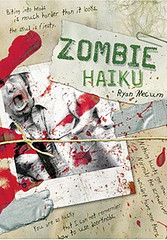
Zombie Haiku by Ryan Mecum

Ryan Mecum’s Zombie Haiku is another fun volume of loose-form haiku, like his recent publication Vampire Haiku (click for my review).  In the initial pages, readers learn that the journal is that of Chris Lynch, and the initial haiku spotlight the beauty of nature coupled with Polaroid images and are interspersed with comments from Lynch about his impending death and transformation.

The bird flew away
with more than just my bread crumbs.
He took my sorrow.  (Page 2)

Readers see first hand the spread of the zombies throughout the city and how they stagger after their latest victims.  Finally, Lynch is attacked himself, bleeding to death from a hole in his neck, before turning into the beings he sees taking over the human race.  Struggling with his transformation, he writes haiku about his love for his mother, and the strength he feels even as he withers and becomes a cannibal.

My lungs slow and stop
and I can’t find my heartbeat
but I’m still hungry.  (Page 30)

With his jaw snapped off
he can’t bite into people,
which means more for me.  (Page 66)

Readers may find that some haiku are not as well formed as others, but that may be because zombies have a mostly one-track mind — brains or eating brains.  Overall, Zombie Haiku is not as engaging as Vampire Haiku was, though in small doses the haiku can be amusing. 

I’m counting this as my 12th book for the poetry reading challenge.

FTC Disclosure:  I purchased my copy of Zombie Haiku by Ryan Mecum.  Clicking on title links or images will bring you to my Amazon Affiliate page; No purchase necessary.

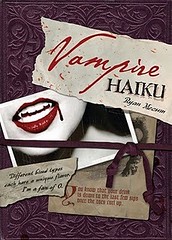
Vampire Haiku by Ryan Mecum

Ryan Mecum’s Vampire Haiku mixes humor and poetry in diary form for vampire William Butten, who was turned in 1620.  He falls in love with a beautiful woman on the Mayflower named Katherine, who turned him into a vampire.  Soon he’s parted from his love to roam America on his own and make his own friends.  There are tales of some well known historic figures from Davy Crockett to Amelia Earhart and famous events in history like the Civil War and Woodstock.

Readers may initialy be attracted to the cover haiku, which also appears on page 37:

“You know that your drink
is down to the last few sips
once the toes curl up.”

Butten has a twisted sense of humor, but readers will enjoy is little anecdotes about becoming a vampire and bumbling around learning how to feed, etc.  Mecum uses his linguistic and historic knowledge to create fun and witty haiku.  Although they are not precisely haiku in the traditional sense, they mostly adhere to the form’s syllable count.  It is fun to see Butten reveal insider knowledge about the deaths of Davy Crockett and other major historical figures.  In some cases, the poems will have readers cringing in disgust.

“Discarded band-aids
are rare unexpected treats.
My version of gum.”  (page 113)

There are even moments in the book where the vampire makes fun of the modern vampire crazes from the goth kids to the latest vampire movies.  One of the best haiku in the book is about the Twilight movie:

“Those were not vampires.
If sunlight makes you sparkle,
you’re a unicorn.”  (page 117)

Will Butten ever find his true love, Katherine, or will he stop searching for her and settle down? Overall, those interested in humor and vampires will find Vampire Haiku to be a treat.  I’m looking forward to reading Ryan Mecum’s Zombie Haiku next.

I’m counting this as my 11th book for the poetry reading challenge.

By the way, I unintentionally read 100 books this year and reviewed all 100!  This is quite an accomplishment for me, since I’m a slower reader than most.  Yipee!

FTC Disclosure:  I purchased my copy of Vampire Haiku by Ryan Mecum.  Clicking on title links or images will bring you to my Amazon Affiliate page; No purchase necessary.

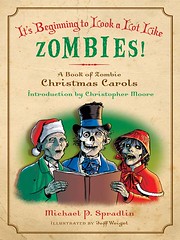
It’s Beginning to Look a Lot Like Zombies! by Michael P. Spradlin, Illus. Jeff Weigel

The holidays are a time for merriment and getting together with family and friends to celebrate and share.  Part of the holidays has always included caroling, at least for some people.  My husband and I love to sing, though we don’t sing well, but we like to make up lyrics from time to time.   It’s Beginning to Look a Lot Like Zombies! by Michael P. Spradlin and illustrated by Jeff Weigel is the perfect collection of remastered Christmas Carols to liven up the holidays.  There’s even an introduction by the witty and dark humored Christopher Moore.
First, can you tell what classic novel this line’s beginning resembles?

“It is universally acknowledged that there are very few literarypursuits which cannot be improved with the addition of zombies, which are to the written word as cheesy goldfish crackers are to life in general; those little cheesy goldfish crackers also improve nearly everything.”  (Page VII)

Christopher Moore certainly has a unique perspective on literature and how it can be improved, but in the case of the zombie Christmas carol book, he may be correct.  Spradlin’s lines are well placed and maintain the rhythm of the original carols.  Family members young and old will love to sing to these revised songs —  from It’s Beginning to Look a Lot Like Christmas, I mean, It’s Beginning to Look a Lot Like Zombies to Deck the Halls With Boughs of Holly, oops I mean, Deck the Halls With Parts of Wally.

Zombie, the Snowman (Page 39)

Zombie the Snowman was a jolly, happy ghoul,
With a corncob pipe and some boy’s nose
And two eyes he got at school.

Zombie the Snowman is a fairy tale, they say;
He was undead, it’s so,
But the children know how he came back to life one day.

There must have been a virus in
That old silk hat they found,
For when they placed it on his head,
He began to dance around.

Oh, Zombie the Snowman was alive as he could be,
And the children say he ate brains all day,
And they ran from that Zombie.

Thumpety, thump thump,
Look at Zombie go.
Thumpety, thump thump,
Thumpety, thump thump, 
Over the hills of snow.

Zombie the Snowman knew the brains were fresh that day,
So he said, “Please run, because it’s lots more fun when I eat your brain that way.”
Down through the village with a femur in his hand,
Running here and there all around the square,
Sayin’, “Decapitate me if you can!” 

He chased them through the streets of town 
And at a traffic cop,
And he barely paused a moment when he heard the cop’s brain pop!

Zombie the Snowman
Had to hurry on his way,
But he waved good-bye, sayin’, “Please do cry,
I’ll eat your brains someday!” 

At a short 81 pages, It’s Beginning to Look a Lot Like Zombies! is a fun read and will have you giggling and guffawing and singing.  Chock full of gruesome and surreal drawings of zombies in Santa Claus suits and other holiday outfits are eye-catching, and add additional verve to the carols.  This humorous Christmas carol book would make a great stocking stuffer and an after-holiday gift.  Heck, it would just be a fun gift for birthdays, anniversaries, and any other occasion.

FTC Disclosure:  My husband purchased this copy for me.  Clicking on title or image links will bring you to my Amazon Affiliate page; No purchase necessary.

Words That Burn Within Me by Hilda Stern Cohen

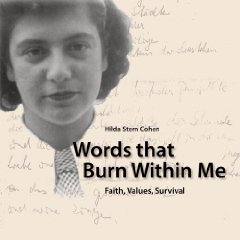
Hilda Stern Cohen’s Words That Burn Within Me is a collection of photographs, essays, stories, snippets of interviews, and poems detailing Cohen’s experiences during WWII and the Holocaust as a German resident.  (Please check out a recent reading from the book at The Writer’s Center).  Cohen’s husband, whom she married in Baltimore, Md., in 1948 following her release, discovered her notebooks after her death and set about his journey to have his wife’s writing translated from German and published.  In some cases, the poems are included both in English and in German.

“Our physiognomies were ageless.  There were wild, unfocused eyes, silent, indrawn lips, and haggardness around the cheek and neck . . . only defined and exaggerated by hunger.” (Page 49)

This harrowing story follows Hilda through her early years in Nieder-Ohmen, Germany, and her transfer to schools in Frankfurt as the Nazis gained power.  From Frankfurt, she is transported with her family and young beau Horst to Lodz, Poland, only to face devastating circumstances, the loss of Horst, and more and be transported to Auschwitz.  In a series of essays and interviews, Hilda talks about happier times in her village and with her sister, the trials of childhood and being bullied, but soon the reality of politics sets in and her family is forced to leave their ancestral home.

Forced Labor (Page 54)

My numbed brow drops on the machine,
I fold my captive, tired hands.

A dangling yellow bulb sheds smoky light,
Dusk falls, the day grows pale.

The harried working hours are almost done,
The evening mist is waiting to embrace us.

What binds us in our common chains
Will only hold us while we work —
Night will find each of us in separate gloom.

Cohen’s writing is sparse but detailed in its observations of those around her in the ghetto and the concentration camps.  Her keen eye examines the impact of starvation on her fellow neighbors and on her family members, and it also sheds light on how well her family and herself cope with their situation.  She eventually teaches herself Yiddish after joining a literary group because she only speaks and writes German, which is not what the majority of the Lodz Ghetto understands.  Readers, however, will note a sense of detachment in her writing, almost as if she is reporting the events as she observed them rather than as she felt them.  On the other hand, they will hear the anger and disappointment in her voice, especially when she speaks of the last words her father utters about her mother upon her death.

“There was a strange role reversal that took place psychologically, as it did also later in the camps.  Adults who had lived a life from which they had gained certain expectations were suddenly confronted with an abyss.  There were no signs, no gateposts, none of the usual milestones that one could follow.  Everything had fallen away.”  (Page 33)

Words That Burn Within Me is well assembled mixture of interviews with Hilda Stern Cohen’s essays, stories and poems.  While the collection does illustrate one Jewish woman’s journey during WWII and the Holocaust, it stands as a testament — a record — of how inexcusably these humans were treated and how their debasement impacted their lives, their relationships, their faith, and their souls.  Through well tuned description and controlled emotions, Cohen takes the time to record everything she saw during the war and the Holocaust to ensure that it becomes a warning to others.  A powerful collection and a must read for anyone learning about this time period and the horrors that should never have happened.
This is my 10th book for the WWII Reading Challenge at War Through the Generations!

I’m not sure if this will qualify for the Poetry Review Challenge, but if it does, this will be book #10.

 FTC Disclosure:  I purchased my copy of Words That Burn Within Me from The Writer’s Center following a reading by Hilda Stern Cohen’s husband and her interviewer Gail Rosen.  Clicking on image and title links will bring you to my Amazon Affiliate page; No purchases necessary.

Holocaust Poetry Complied by Hilda Schiff

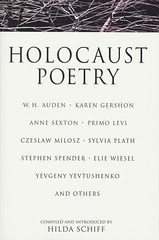
Holocaust Poetry compiled by and introduced by Hilda Schiff is a collection of poetry dealing with World War II and the Holocaust.  The compilation is divided into six sections:  Alienation; Persecution; Rescuers, Bystanders, Perpetrators; Afterwards; Second Generation; and Lessons.  There are well-known poems in this collection and poems from young children.  A few of the poems in this collection already have been featured on the blog as part of the Virtual Poetry Circle; check out “If” by Edward Bond and “The Butterfly” by Pavel Friedmann.

Each poem in the collection uses all-too-familiar images to demonstrate connections with family, friends, and strangers. and as each poem unfolds readers feel the devastation and hopelessness of each narrator.  Schiff says in the introduction, “The more or less contemporaneous literature of any period of history is not only an integral part of that period, but it also allows us to understand historical events and experiences better than the bare facts alone can do because they enable us to absorb them inwardly.”  More or less, readers of poetry will find these observations valid, as will readers of fiction.

However, there are moments of levity when narrators poke fun at the devastating events of Nazi Germany’s actions.

The Burning of the Books (Page 8)

When the Regime commanded that books with harmful knowledge
Should be publicly burned on all sides
Oxen were forced to drag cart loads of books
To the bonfires, a banished
Writer, one of the best, scanning the list of the
Burned, was shocked to find that his
Books had been passed over.  He rushed to his desk
On wings of wrath, and wrote a letter to those in power.
Burn me! he wrote with flying pen, burn me.  Haven’t my
  books
Always reported the truth? And here you are
Treating me like a liar! I command you:
Burn me!

Beyond the poems in the collection depicting the horrors and the losses of persecuted people in Germany, the poems of bystanders, perpetrators, and others are surprising.  They talk of how they stood by and did nothing, how they want to help even if they are too late.  Despite the time for help being long passed, these narrators express not guilt so much as regret — a deep regret at having been so paralyzed by fear that they did nothing or acted contrary to who they believed themselves to be.

I Did Not Manage to Save (page 86)

I did not manage to save
a single life

I did not know how to stop
a single bullet

and I wander round cemeteries
which are not there

I look for words
which are not there
I run

to help where no one called
to rescue after the event

I want to be on time
even if I am too late

The poems selected for the “Second Generation” section will tug at readers heart strings, deepening the sense of loss.  An emptiness is present in some of these poems.  Short biographies are included at the back of the book for readers interested in the poets’ lives and connections to WWII and the Holocaust.

Holocaust Poetry is a collection that should be read in chunks rather than all at once.  Readers may succumb to sorrow if they attempt to read the entire collection in once sitting, but even then, readers will fall into the darkness and emerge in the light.  Overall, the collection is a must have for anyone interested in this time period and learning more about how WWII and the Holocaust impacted individual lives and families.

This is the 9th book I’ve read that qualifies for the 2009 WWII Reading Challenge.  Though I officially met my goal of reading 5 WWII-related books some time ago, I’ve continued to find them on my shelves and review them here.

This also qualifies as my 9th book for the Poetry review challenge.

FTC Disclosure:  I purchased my copy of Holocaust Poetry compiled by Hilda Schiff at the local library sale.  Clicking on title links will bring you to my Amazon Affiliate page, no purchase necessary.

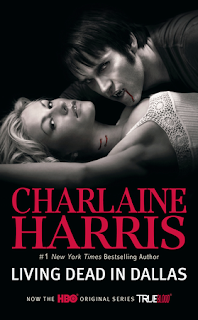
Living Dead in Dallas by Charlaine Harris

Charlaine Harris’ Living Dead in Dallas continues the Sookie Stackhouse series.  Sookie has agreed to use here telepathic powers to help the vampires when necessary so long as the interviewees go free.  The death of a co-worker and friend thrusts Sookie deep into the vampire world.

“‘Angelic Sookie, vision of love and beauty, I am prostrate that the wicked, evil maenad violated your smooth and voluptuous body, in an attempt to deliver a message to me.’

‘That’s more like it.'” (Page 40)

The Sookie Stackhouse series is full of vampires and other supernatural creatures, mystery, and witty dialogue.  Readers will find the vampire world created by Charlaine Harris dark, intricate, and mysterious.  As their world unravels to reveal its connections with other supernatural communities or its battles with other groups who wish vampires were back in the coffin, readers will be absorbed.

“I realized I’d been rented, like a chainsaw or backhoe.  I wondered if the vampires of Dallas had had to put down a deposit against damage.” (Page 47)

Sookie is soon sent to help vampires in Dallas where she is caught up in the community’s feud with the Fellowship of the Sun.  Some of the most interesting elements of this novel was learning about Anubis Air and its business of transporting vampires across state lines as cargo and offering them protection when they travel during the day.  Living Dead in Dallas is a quick read.

Living Dead in Dallas is a book I purchased from Borders and is in my personal library.  Also, clicking on images and text links to books will bring you to my Amazon Affiliate page.  No purchases are required.

This is the second book I’ve read for the Sookie Stackhouse Reading Challenge, which I read during the October 2009 24-Hour Read-a-Thon.  I’m hopeful I can read the rest and complete the challenge, though the deadline for this one escapes me at the moment.

Catching Fire by Suzanne Collins

Catching Fire (The Second Book of the Hunger Games) by Suzanne Collins follows up where The Hunger Games (Click here for my review) left off.

In this novel, Katniss discovers that her final act in the arena had unintended consequences and she must now decide whether to run and hide with her loved ones or face a new reality–rebellion.  However, readers may find that the final act in the hunger games is not necessarily the catalyst for the rebellion so much as the Capitol’s unwitting acceptance of her defiance for the rules.

“The smell of roses and blood has grown stronger now that only a desk separates us.  There’s a rose in President Snow’s lapel, which at least suggests a source of the flower perfume, but it must be genetically enhanced, because no real rose reeks like that.”  (Page 20-1)

Catching Fire (The Second Book of the Hunger Games), like The Hunger Games, is an excellent book club selection for adults given the regime that makes up Panem and the inner workings of the Capitol itself.  From democracy run amok in the Capitol to a dictatorship or totalitarian regime in control of Panem and its districts.  While the totalitarian/dictatorship of the Capitol may not be precise in that President Snow’s manipulative actions run contrary to traditional totalitarian/dictatorship reactions of crushing the enemy and rebellion with an iron fist, readers will have a number of issues to discuss.  However, Collins may not be intentionally shedding light on these political structures, but simply writing dystopian fiction.

“Desperate, yet no longer alone after that day, because we’d found each other.  I think of a hundred moments in the woods, lazy afternoons fishing, the day I taught him to swim, that time I twisted my knee and he carried me home.  Mutually counting on each other, watching each other’s backs, forcing each other to be brave.”  (Page 117)

Katniss, Peeta, Haymitch, and Gale find more action and intrigue in the sequel and must deftly navigate the twisted rules and procedures of their nation to find themselves and freedom.  Katniss, Peeta, and Gale are still in the midst of a young-love romantic triangle, but again the struggles they face against the government take precedence.  More is revealed about Haymitch in this book, which readers will find helpful given his past behavior, but still too little is known about the how the current government came to be and who President Snow really is and how he came to power.

If readers think the mockingjay on the cover is a nice touch, they may soon get sick of the symbol as Collins uses it repeatedly in her narration.  However, its use is not overly bothersome, just a bit overdone. 

Meanwhile, readers will be introduced to new characters, like suave Finnick, unintelligible Mags, and Nuts and Volts, rounding out the cast for some additional suspense, drama, and amusement.  The final scene in the book will leave many in shock, but anxious for the next installment.  Overall, Catching Fire (The Second Book of the Hunger Games) is a strong middle book to the trilogy.

***As an aside, there’s a quote from the book that should spark some recognition about current environmental concerns in readers, as we struggle to modify our behavior to preserve our resources***

“Where the sand ends, woods begin to rise sharply.  No, not really woods.  At least not the kind I know.  Jungle.  The foreign, almost obsolete word comes to mind.  Something I heard from another Hunger Games or learned from my father.”  (Page 274-5)

Also Reviewed By:
Lou’s Pages 
Dreadlock Girl 

The Lace Reader by Brunonia Barry

Brunonia Barry’s The Lace Reader takes place in Salem, Mass., with a still point and a spiral of events that take place during Sophya “Towner” Whitney’s journey from childhood to adulthood and inside her mind. Readers know from the beginning that Towner lies and is an unreliable narrator.

“The perfect line of the first-floor windows gleams back at me from the winter porch, I catch my reflection in the wavy glass, and I’m surprised by it. When I left here, I was seventeen. I haven’t bee back for fifteen years. I knew my reflection in the glass when I was seventeen, but today I don’t recognize the woman I see there.” (Page 12 of the hardcover)

The death of her sister weighs heavily on Towner’s mind, sends her to a mental hospital, and forces her to move to the Pacific coast. She only returns to Salem when she learns her Aunt Eva is missing. Barry weaves a psychological mystery for readers, leading them into the dark alleyways of Towner’s memories, seeking the truth about her past and her family. Who is her mother? What happened to her sister? Where is her father? And why in a family of lace readers is she the one that has shunned the practice?

“Sometimes, when you look back, you can point to a time when your world shifts and heads in another direction. In lace reading this is called the ‘still point.’ Eva says it’s the point around which everything pivots and real patterns start to emerge.” (Page 24 of the hardcover)

May, Towner’s mother, refuses to leave her island in Salem Harbor, even for funerals, but she helps abused women and those in need, helping them learn how to make Ipswich lace. Aunt Emma lives on the island, but remains detached from reality following her abusive relationship with Cal Boynton.

Barry’s characters are human in their frailties, passions, and reactions to traumatizing events. Parts of the novel are narrated by Rafferty, the police officer in town, and parts of the novel are narrated by May, Towner’s mother, which can cause readers to pause. However, readers will love the how the tunnels beneath Salem resemble the crevices of Towner’s mind, and when each page turns, readers and Towner will emerge from the darkness into the light of the bay.

About the Author:

Brunonia Barry was born and raised in Massachusetts. She made her literary debut with the critically acclaimed New York Times bestselling novel The Lace Reader (William Morrow). The book landed on international bestseller lists.

Check out Brunonia Barry’s blog and The Lace Reader Website.

Also, in the September issue of Book Page, there will be a sweepstakes in which the grand prize is a trip for two to Salem, two nights at The Hawthorne Hotel, and a guided Lace Reader tour of Salem with Brunonia.

For my loyal readers, I’ve got one paperback copy to give away! This giveaway will be international as usual.

1. Leave a comment on this post about a time when you went or thought about having your fortune read.

2. Blog, tweet, or spread the word about this giveaway and leave a comment and link here.

Deadline is Sept. 7, 2009, at 11:59 PM

THE GIVEAWAY IS CLOSED!!!


Also Reviewed By:
Books Lists Life 
Trish’s Reading Nook
Sam’s Book Blog
The Literate Housewife Review
Shh… I’m Reading

Hey Lady! Whatcha Readin’?
books i done read


The Art of Racing in the Rain by Garth Stein

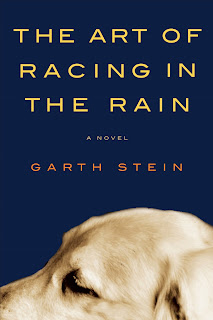
Garth Stein’s The Art of Racing in the Rain narrated by Enzo the dog shows us just how similar sentient beings can be in their emotions, connections, and reactions.

“I’ve always felt almost human. I’ve always known that there’s something about me that’s different than other dogs. Sure. I’m stuffed into a dog’s body, but that’s just the shell. It’s what’s inside that’s important. The soul. And my soul is very human.” (Page 3)

Enzo is just a pup when he meets his new owner and friend Denny, and his life is all about racing and being a companion. When Denny meets Eve, Enzo must make adjustments and learn to fit new people into his life. Denny and Eve have a daughter Zoe, and Denny makes his way in the racing world until things start to go awry.

Stein has a way with words that captures the essence of Enzo and his devotion to his family. Readers will enjoy Enzo’s theories about reincarnation, family life, human communication, and more. Enzo’s examination of why dogs do not have thumbs and how humans have bred them that way and why is humorous.

“George Clooney is my fourth favorite actor because he’s exceptionally clever at helping cure children of diseases on reruns of ER, and because he looks a little like me around the eyes.” (Page 125)

There is a great deal of racing jargon and discussion in the book, but readers will find these serve more to help Enzo explain his feelings about the events of his life and how his family dynamics work. Overall, The Art of Racing in the Rain is a fast-paced, enjoyable read, but be prepared for some tugging of the heart strings.


The Art of Racing in the Rain by Garth Stein was my selection for the Dog Days of Summer 2009, sponsored by The Literate Housewife.

DON’T FORGET:

You have until Aug. 28 to vote for Charlee in the Dog Days of Summer Photo Contest. Help a Hot Dog out!

Also Reviewed By:
Carolina Gal’s Literary Cafe
Books on the Brain
Jen’s Book Thoughts
The Literate Housewife
Fyrefly’s Blog

Dead Until Dark by Charlaine Harris

“I’d been waiting for the vampire for years when he walked into the bar.” (Page 1, sentence 1; yes, that’s my hook, how about you?)

In Dead Until Dark by Charlaine Harris, readers are introduced to Sookie Stackhouse, a resident telepath, waitress, and spunky young woman, her brother Jason who has a revolving door in his bedroom, her boss Sam Merlotte, and of course, her vampire, Bill Compton. They all live in Bon Temps, Louisiana.

(If you haven’t watched the HBO series True Blood based upon this series of books you better get watching. But I digress.)

“His voice was quiet and rustling, like feet through dry grass.” (Page 166)

Sookie and Bill meet at Merlotte’s and they quickly fall into bed after some initial posturing. Readers should know where this relationship was headed from the way Sookie looks at Bill and the way Bill reacts to her presence. The plot is thick with sexual tension and drama, from the way Bill silently stares at Sookie to the way she feels at ease because she cannot hear Bill’s thoughts and from the entrance of outrageous vampires from nearby Monroe to the murders of two fang-bangers.

“I got a tight feeling in my chest, a bitterness, at another thing I was denied. And I thought, Why not?

I stopped him by pulling gently on his hand. I stretched up and lay my lips on his shining cheek. I inhaled the scent of him, ordinary by faintly salty. He was wearing a trace of cologne.

I felt him shudder. He turned his head so his lips touched mine.” (Page 58)

Dead Until Dark will suck readers into the swampy, wooded south populated with vampires, telepaths, and more. Sookie is strong, hot tempered, loyal, and eager to help those in need, while Bill is her polar opposite, struggling to regain his humanity against his vampiric qualities. Like any good vampire story, there is a “love” triangle of sorts, murder, mayhem, and triumph. A good start to the series, which vampire/fantasy readers will love and other readers can enjoy as well.

Also Reviewed By:
Melancholy Musings
Well-Read Reviews
1morechapter.com
Bermudaonion
Rhapsody in Books 


Charlaine Harris’ Dead Until Dark is the first book in the Sookie Stackhouse series and my first book for the Sookie Stackhouse Reading Challenge.

Dirty Water: A Red Sox Mystery by Mary-Ann Tirone Smith and Jere Smith

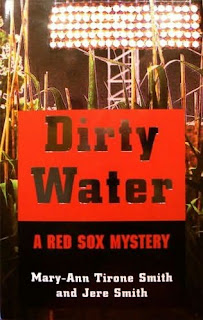
Mary-Ann Tirone Smith and Jere Smith‘s Dirty Water: A Red Sox Mystery is a unique murder mystery set against the backdrop of the 2007 Red Sox summer season. Fan favorites from Jason Varitek to David “Big Papi” Ortiz play minor to significant roles in uncovering the truth behind the death of Cinthia Sanchez, the abandonment of her child Arturo Sanchez (also known as Baby Ted Williams), and the Pestano Pipeline of illegal Cuban players making their way into Major League Baseball.

“Francona’s door opened just as the players, like statues come to life, moved at the same time. They spread out through the clubhouse, dashed through the shower room and bathrooms, rifled through the lockers, looked in the wastebaskets, under the trainers’ tables, rummaged through the equipment cases. Tito tried to make sense out of what Cochran was trying to tell him.” (Page 13)

Red Sox fans will love this novel, and those who read mysteries will enjoy this police procedural as well. Readers could take a few chapters to get into the novel with its story followed by blog posts and comments. What Dirty Water has that many other mystery novels don’t is a true feel for the city of Boston, Fenway, its fans, and the team. Smith and Smith are third and fourth generation Red Sox fans, and their knowledge shines through in every page as readers journey with Boston Police Detective Rocky Patel and Sargeant Marty Flanagan from Boston to Los Angeles to Florida and beyond.

“The sun is setting. The pock-marked ground is in shadows. The rookie thinks he sees a broken line–a groove; it cuts a faint four-foot-long path across the ground. His eyes follow the groove. He can make out more bits of that groove running toward Agassiz Road. Then he follows the groove in the other direction and not only makes out yet more bits and pieces heading into the reeds, he sees a second groove parallel to the first. He blinks. He leaps to his feet shouting to the two officers on patrol who have humored his hunt for “a clue.” They have actually seen far more behavior in unjaded rookies than what this guy was doing.” (Page 185-6)

Boston Police Detective Rocky Patel and Sargeant Marty Flanagan have different religions and methods, but each is dedicated to the job and justice. Beyond the mystery and the Red Sox trivia, Dirty Water uncovers the fear immigrants have of law enforcement authorities at the same time they struggle with the frustration of desiring justice from the same authorities. Overall, Dirty Water is a well crafted mystery, but readers may want a little more substance in terms of what motivates these characters, particularly those from immigrant families, to overcome their fears and join law enforcement.

My book club will be discussing this on August 29. I’ll keep everyone posted.

***Amended***

I forgot to provide you with Jere’s Blog A Red Sox Fan From Pinstripe Territory and the book’s blog, Dirty Water: A Red Sox Mystery. Check them out.


Giveaway Reminder:

1. Mr. Darcy, Vampyre (2 copies); Deadline August 14