Quantcast

10th Anniversary by James Patterson and Maxine Paetro

Source: My Mom
Hardcover, 395 pgs
I am an Amazon Affiliate

10th Anniversary by James Patterson and Maxine Paetro brings the ladies of the Women’s Murder Club together for a wedding that Lindsay Boxer, herself, didn’t think would happen.  But shortly after the wedding, the ladies are caught up in two mysteries — a missing baby and the death of Dr. Candace Martin’s husband.  Patterson and Paetro continue to build on this franchise, and while Patterson’s style is sparse, clipped sentences to ramp up the action, these books will have readers turning the pages quickly on a lazy, rainy afternoon.  Boxer, Washburn, Thomas, and Castellano are always up to their necks in some murder mystery, but each of them brings a unique talent to the table.

“Now, the warm, salty air embraced me.  The great lawns flowed around the shining white gazebo and down to the bluff.  The Pacific crashed against the cliff side, and the setting sun tinted the clouds a glowing whiskey pink that you could never capture on film.  I’d never seen a more beautiful place.

‘Take it easy, now,’ Jacobi said. ‘No sprinting down the aisle.  Just keep step with the music.'” (page 8)

Lindsay is a no-nonsense cop, and she’s always unraveling a mystery using her gut instincts, but Castellano often relies on the hard facts of a case to get the convictions she needs for the district attorney’s office in San Francisco.  Washburn brings heart to the cases and reminds the ladies that there is a human element to every story, while Thomas seeks out the sensational headlines among the mix.  I’ve been reading this series a long time, and while some of the novels are less stellar than others, I was captivated from the start by this one.  I can always rely on Patterson to give me some junk food for the mind when I need something less burdensome to focus on.

10th Anniversary by James Patterson and Maxine Paetro is a race against time to save a missing child and sheds light on what it means to be a mother and protect her children.  Is it an innate instinct a mother has, or is it something that can be learned and cultivated? And can a woman who is not a biological mother feel that instant connection with a child she never carried?  These are the questions explored, but Patterson and Paetro keep the focus on these strong women and how they can reach out and grab their dreams.

About the Author:

James Patterson is a prolific author of thrillers, mysteries, young adult novels and more. His first successful series featured psychologist Alex Cross.

About the Co-Author:

Maxine Paetro collaborates with best–selling author James Patterson, co–writing The 4th Of July, The 5th Horseman, The 6th Target, The 7th Heaven, The 8th Confession, The 9th Judgment, 10th Anniversary and The 11th Hour, just released in May 2012. All are New York Times #1 best–sellers in the Women’s Murder Club Series.
The Strange Library by Haruki Murakami

Source: Public Library
Paperback, 96 pgs
On Amazon and on Kobo

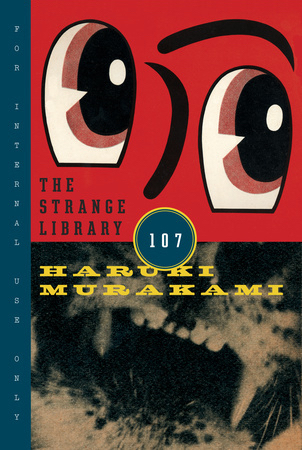
The Strange Library by Haruki Murakami, translated by Ted Goossen, is a novella and a dark fairy tale that brings a young teen into the depths of the library’s labyrinth.  The teenage boy loves to read and abides his mother, but the library seems to be his home on many levels until he enters room 107.  From there stranger things happen and the boy meets a sheep man and a mysterious and pretty girl.  Murakami has a wild imagination and it comes to life in these pages.  He’s created a world that is fantastical and odd, but the threats and tensions are real, leaving the reader sweating and despairing alongside his protagonist.

The text is accompanied by odd little drawings and magazine-like images, which add more of a creep factor to the story.  The copy from the library had an odd cover that had one flap flipping up and one flipping down, which could be used as a bookmark, but while reading, they tended to get in the way.  However, that wasn’t enough to detract from the creepy story that unfolded in these pages.  Murakami clearly has a vivid imagination in which animals and men can crossover into different planes of existence.  While many of us enjoy books, reading, and our libraries, The Strange Library by Haruki Murakami, translated by Ted Goossen, sure will give readers a reason to pause before entering their libraries again.

About the Author:

Haruki Murakami (Japanese: 村上 春樹) is a popular contemporary Japanese writer and translator. His work has been described as ‘easily accessible, yet profoundly complex’.  Since childhood, Murakami has been heavily influenced by Western culture, particularly Western music and literature. He grew up reading a range of works by American writers, such as Kurt Vonnegut and Richard Brautigan, and he is often distinguished from other Japanese writers by his Western influences.  Murakami studied drama at Waseda University in Tokyo, where he met his wife, Yoko.

The Truth is a Cave in the Black Mountains by Neil Gaiman, illustrated by Eddie Campbell

Source: Public Library
Hardcover, 74 pgs
I am an Amazon Affiliate

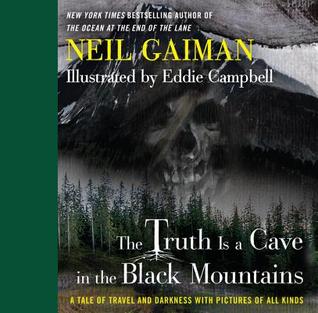
The Truth Is a Cave in the Black Mountains by Neil Gaiman, illustrated by Eddie Campbell, is a book that probably does very well on audio or read in person with the backdrop of images inside this book.  The story is a simple journey of one man, seeking a guide into the Black Mountains of Misty Isle.  In full-color illustrations, which mirror acrylic paintings, the book also contains comics and balloon conversations, and yet somehow it all comes together nicely with Neil Gaiman’s story.  The prose is simple, much like those tales told by campfires.

“‘You are wrong.  The truth is a cave in the black mountains.  There is one way there, and one way only, and that way is treacherous and hard.  And if you choose the wrong path you will die alone, on the mountainside.” (page 21)

Two men journey to the Misty Isle and the cave in the Black Mountains through the Scottish Highlands in search of the gold they can carry back with them.  Rather than merely be an adventure story in search of treasure, each man carries with him moments of regret and love.  The Truth Is a Cave in the Black Mountains by Neil Gaiman, illustrated by Eddie Campbell, should be read aloud and shared with others, perhaps in front of the fireplace on a cold winter’s evening.

About the Author:

Neil Gaiman’s work has been honoured with many awards internationally, including the Newbery and Carnegie Medals. His books and stories have also been honoured with 4 Hugos, 2 Nebulas, 1 World Fantasy Award, 4 Bram Stoker Awards, 6 Locus Awards, 2 British SF Awards, 1 British Fantasy Award, 3 Geffens, 1 International Horror Guild Award and 2 Mythopoeic Awards.

About the Illustrator:

Eddie Campbell is a Scottish comics artist and cartoonist who now lives in Australia. Probably best known as the illustrator and publisher of From Hell.

Blackout by Mira Grant

Source: Public Library
Paperback, 659 pgs
On Amazon and on Kobo

Blackout by Mira Grant (beware there could be spoilers for Feed or Deadline in this review) is the final installment in the Newsflesh series, and it is a stunning ride that will leave readers breathless to the final page.  It has been a long time since a zombie series has been this well developed and thought out.  Grant has created a masterful new world after the Rising of zombies in which bloggers have taken over as the trusted form of communication and information, and while the American populace continues to trust the CDC, the government is still considered sketchy at best.  Shaun Mason and his group of bloggers at After the End Times continue to dig into the death of one of their own, looking for someone to blame.  At the same time, Shaun is hardly coping, speaking with voices in his head, and his team is enabling his craziness.

“‘Shaun … ‘ There was a wary note in Alaric’s voice.  I could practically see him sitting at his console, knotting his hands in his hair and trying not to let his irritation come through the microphone.  I was his boss, after all, which meant he had to at least pretend to be respectful.  Once in a while.  ‘That’s your fourth catch of the night.  I think that’s enough, don’t you?’

‘I’m going for the record.’

There was a click as Becks plugged her own channel into the connection and snapped peevishly, ‘You’ve already got the record.  Four catches in a night is twice what anyone else has managed, ever.  Now please, please, come back to the lab.'”  (page 20)

As a tropical storm wreaks havoc on Florida and other southern states ad the dead begin to rise at a faster rate, Shaun and his team not only have to uncover what has happened, but have to find a way to get the word out when the government has effectively caused a media blackout.  While the team is still gathering information and poking zombies, the focus on higher ratings has fallen off the radar for the team.  Conspiracy theorists and zombie fiction lovers will love the ride Grant takes them on, and the series touches upon a number of issues, particularly medical ethics.

Blackout by Mira Grant wrapped up the series nicely, though there is an e-novella that follows this, and Grant has created characters who struggle with the truth — finding it and keeping it real for everyone else.  From experimenting on live subjects to creating clones, the Newsflesh series runs the gamut of medical ethics issues, but it also highlights the idea of journalistic ethics and objectivity.

About the Author:

Born and raised in Northern California, Mira Grant has made a lifelong study of horror movies, horrible viruses, and the inevitable threat of the living dead. In college, she was voted Most Likely to Summon Something Horrible in the Cornfield, and was a founding member of the Horror Movie Sleep-Away Survival Camp, where her record for time survived in the Swamp Cannibals scenario remains unchallenged.

Mira lives in a crumbling farmhouse with an assortment of cats, horror movies, comics, and books about horrible diseases. When not writing, she splits her time between travel, auditing college virology courses, and watching more horror movies than is strictly good for you. Favorite vacation spots include Seattle, London, and a large haunted corn maze just outside of Huntsville, Alabama.

Mira sleeps with a machete under her bed, and highly suggests that you do the same.

Relish: My Life in the Kitchen by Lucy Knisley

Source: Public Library
Paperback, 192 pgs
On Amazon and on Kobo

Relish: My Life in the Kitchen by Lucy Knisley is a journey in olfactory memory and the memories generated by tastes.  Memory is tricky, but recalling even our oldest memories can be difficult without a trigger, and many of those triggers are often related to food.  Whether its a first experience with food, a food we associated with a specific relative or friend, or just food that we loved, our taste, sight, and olfactory senses can bring those memories flooding back with just a hint of smell or taste, even color.  Knisley says in the opening pages, “Sometimes it’s frustrating, this selective memory.  I can remember exactly the look and taste of a precious honey stick, balanced between my berry-stained fingers, but my times tables are long gone, forgotten, in favor of better, tastier memories.”

What’s fresh about this book is that it includes recipes along with the memories and some of them should be just as delicious as the author remembers if prepared using her precise instructions, which do include the use of patience!  In graphic novel style, the images are fun and the memories are dispersed in a way that makes reading a memoir about food even more fun.  It even seems as though it is geared in a way that will entice younger readers to get interested in food and cooking.

Knisley not only explores the creativity of cooking, but also its precise science and measurement, which leads to the perfect recipe.  For an example, you’ll have to check out her memories of baking, particularly chocolate chip cookies and how she still strives and falls short of making the perfect cookie.  Her mother maintains a cool head with her baking, while Knisley bakes through emotion.  It’s an interesting contrast and demonstrates not only the power of baking as a way to soothe emotions, but also as a way to connect with family.  Relish: My Life in the Kitchen by Lucy Knisley is colorful and flavorful all at once — a travelogue of food memories — that readers will not soon forget.  And as the author would say, “Devour it with relish.”

About the Author:

Beginning with an love for Archie comics and Calvin and Hobbes, Lucy Knisley (pronounced “nigh-zlee”) has always thought of cartooning as the only profession she is suited for. A New York City kid raised by a family of foodies, Lucy is a graduate of the School of the Art Institute of Chicago currently pursuing an MFA at the Center for Cartoon Studies. While completing her BFA at the School of the Art Institute, she was comics editor for the award-winning student publication F News Magazine.

Lucy currently resides in New York City where she makes comics. She likes books, sewing, bicycles, food you can eat with a spoon, manatees, nice pens, costumes, baking and Oscar Wilde. She occasionally has been known to wear amazing hats.

78th book for 2014 New Author Reading Challenge.

Aristotle and Dante Discover the Secrets of the Universe by Benjamin Alire Saenz

Source: Public Library
Hardcover, 359 pgs
On Amazon and on Kobo

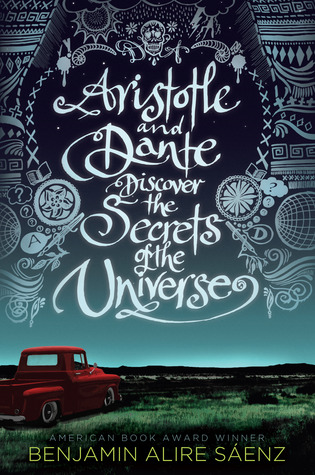
Aristotle and Dante Discover the Secrets of the Universe by Benjamin Alire Saenz is a brilliant coming of age story that examines not only how tough it is to be a young boy — a young Mexican American — but also how these boys struggle with cultural stereotypes of what becoming a man should be.  Dante is an optimistic boy who sees the beauty of the world all around him, while Aristotle (Ari) seems himself as a loner and a pessimist.  These boys meet one summer in 1987 in El Paso at a local pool, and Dante offers to teach Ari how to swim.  Dante loves the water and he wants to share that love with someone who could become his best friend.  These boys are exploring their lives, learning that their lives are not their own, but often dictated by the parents who care for them and they wonder when they will get to create and be in lives wholly their own.

“There is a famous painting, Nighthawks, by Edward Hopper.  I am in love with that painting.  Sometimes, I think everyone is like the people in that painting, everyone lost in their own private universes of pain or sorrow of guilt, everyone remote and unknowable.  The painting reminds me of you.  It breaks my heart.”  (page 185)


In Ari’s home, his brother is dead to them because he is in prison, but Ari knows that he must have loved him and doesn’t understand why there are no pictures of him in the house, why he is never spoken of, and why he doesn’t know what happened to him.  This void is huge and hard to fill, but he’s also impacted by the silence of his father, a Vietnam veteran forever changed by a horrifying war and other deeply felt losses.  Dante’s family is different, it is affectionate physically and emotionally, and his parents are well-educated intellectuals.  But there are secrets here too, secrets held close by Dante, who only wants to share them with someone who could understand — Ari.  Being 15, these are in between childhood and becoming men, and that is a tough time for any adolescent, but its even tougher when you are confused about who you are and who you want to be.  Dante and Ari’s friendship is far from easy, but the understand one another.

“‘Sometimes don’t you just want to stand up and yell out all the cuss words you’ve learned?’
‘Every day.’
‘Every day? You’re worse than me.’ He looked at the hail. ‘It’s like pissed off snow,’ he said.
That made me laugh.” (page 104)

Aristotle and Dante Discover the Secrets of the Universe by Benjamin Alire Saenz is an award winning book for great reasons. It is never forced, it is as easy as a friendship between two boys can be, but it also tackles that harder issues that we as a society continue to struggle with. At its heart, it is a beautiful love story, one that will stay with readers long after turning the last page. Another contender for the Best of 2014 list.

***I want to thank Beth Kephart for her review of this book in August.  She always has the best recommendations.***

About the Author:

Benjamin Alire Sáenz is an award-winning American poet, novelist and writer of children’s books.  He was born at Old Picacho, New Mexico, the fourth of seven children, and was raised on a small farm near Mesilla, New Mexico. He graduated from Las Cruces High School in 1972. That fall, he entered St. Thomas Seminary in Denver, Colorado where he received a B.A. degree in Humanities and Philosophy in 1977. He studied Theology at the University of Louvain in Leuven, Belgium from 1977 to 1981. He was a priest for a few years in El Paso, Texas before leaving the order.

In 1985, he returned to school, and studied English and Creative Writing at the University of Texas at El Paso where he earned an M.A. degree in Creative Writing. He then spent a year at the University of Iowa as a PhD student in American Literature. A year later, he was awarded a Wallace E. Stegner fellowship. While at Stanford University under the guidance of Denise Levertov, he completed his first book of poems, Calendar of Dust, which won an American Book Award in 1992. He entered the Ph.D. program at Stanford and continued his studies for two more years. Before completing his Ph.D., he moved back to the border and began teaching at the University of Texas at El Paso in the bilingual MFA program.

76th book for 2014 New Author Reading Challenge.

Something Wicked This Way Comes by Ray Bradbury

Source: Public Library
Paperback, 293 pgs
On Amazon and on Kobo

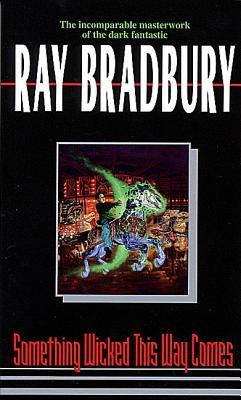
Something Wicked This Way Comes by Ray Bradbury, which I read as part of a read-a-long and for the RIP Challenge, is an odd little book about a strange carnival that enters a Midwestern town and silently creeps through the streets and feeds off of the people in that town.  Will and Jim are your typical boys, about 15-yrs-old, who look for fun and sometimes find it in the wrong places.  They stumble upon a lightning rod salesman who warns them of an upcoming, devastating storm — a storm that is likely to hit someone’s house and destroy it.  Is this foreshadowing of what is to come when the carnival arrives? Perhaps, but Bradbury’s prose is dense in places and cryptic, leaving many readers lost as to what is going on and which boy is which.  Perhaps the similarities are done on purpose to signify that it could have been any set of boys in the town targeted, but readers may want more to go on, a greater connection and an ability to differentiate between the two boys as the story moves forward.  Readers will get some of that when Will’s father enters the picture.

“Dad winked at Will.  Will winked back.  They stood now, a boy with corn-colored hair and a man with moon-white hair, a boy with summer-apple, a man with winter-apple face.”  (page 15)

“‘The library,’ said Will. ‘I’m even afraid of it, now.’  All the books, he thought, perched there, hundreds of years old, peeling skin, leaning on each other like ten million vultures.  Walk along the dark stacks and all the gold titles shine their eyes at you.  Between the old carnival, old library and his own father, everything old…well…” (pg. 188-9)

A lot of the fear permeating the pages is atmospheric from the dark carnival and its sinister cast of characters lurking in the dark, around corners, and popping up when least expected, but there also is a sense of psychological fear, particularly when it comes to the boys and those targeted by the carnival.  Despite the issues with the oddities in the prose and the dialogue, as well as the indistinguishable characteristics of the boys, this story is haunting in its use of spiritual lore and mythology, creating a deadly combination of foes who can be reborn and reconfigured.  There is a lack of detail about the boys’ relationships with their fathers and mothers, but it is the relationship between youth and old age that is the broader picture.

Something Wicked This Way Comes by Ray Bradbury is about a loss of innocence, the things we do as we age, the things we forget as we grow older and begin families of our own, and about the longing in us to recapture those carefree days and relationships.  What is the something wicked coming for you?  Only you can know the answer, and only you know how to fight it.

About the Author:

American novelist, short story writer, essayist, playwright, screenwriter and poet, was born August 22, 1920 in Waukegan, Illinois. He graduated from a Los Angeles high school in 1938. Although his formal education ended there, he became a “student of life,” selling newspapers on L.A. street corners from 1938 to 1942, spending his nights in the public library and his days at the typewriter. He became a full-time writer in 1943, and contributed numerous short stories to periodicals before publishing a collection of them, Dark Carnival, in 1947.

His reputation as a writer of courage and vision was established with the publication of The Martian Chronicles in 1950, which describes the first attempts of Earth people to conquer and colonize Mars, and the unintended consequences.

Deadline by Mira Grant

Source: Public Library
Paperback, 581 pgs
On Amazon and on Kobo

Deadline by Mira Grant is the second in the NewsFlesh series; see my review of Feed and be aware that could be spoilers in this review.  Following the presidential campaign of Peter Ryman, the news blog After the End Times has grown exponentially, and Shaun Mason hardly keeps track of the day to day administration of the site or who actually works for the business.  He’s still in mourning, but he knows that he has a team to lead, and he does it as best he can, while being mentally haunted by the dead.  No longer an Irwin who pokes zombies for ratings, Shaun has jumped to lead the Newsies and has no desire to return to the field.  Unfortunately, stumbling upon a larger-than-life conspiracy significantly changes his plans to hide in the background, pushing him and his team out into the field and on the run.

“‘Mahir, my main man! You sound a little harried.  Did I wake you?’
‘No, but I really do wish you’d stop calling so late at night.  You know Nandini gets upset when you do.’
‘There you go again, assuming that I’m not actually trying to piss of your wife.  I’m really a much nicer person inside your head, aren’t I? Do I give money to charity and help old-lady zombies across streets so that they can bite babies?’
Mahir sighed.  ‘My, you are in a mood today, aren’t you?'” (page 25)

Combining zombie infestations, anxiety, and conspiracy theories with humor, Mira Grant has built a world in which bloggers have replaced traditional news mediums and surviving zombie infestations is an everyday battle.  Kellis-Amberlee is the result of two bio-engineered viruses combining into something unexpected, and it it causes amplification in any mammal of 40 lbs or more to transform them into zombies.  Shaun and his team report on infestations, outbreaks, and other newsworthy items, as well as post fiction poems, stories, etc. on zombies and other things in their lives.  Generating ratings is a tough business following a successful president election.  Grant includes enough background in her second novel that it could be picked up without reading the first, but there could have been additional editing, as there was too much backstory included from the previous novel.

Deadline by Mira Grant is a fun romp in zombie infested waters, and will be a delight for those who love novels with government conspiracies.  While there is little that is resolved in this book, as there is a third book in the series, there is enough here to whet readers’ appetites for more.  Grant’s world is a unique post-apocalyptic rendering in which not only is surviving essential, but the world has irrecoverably changed from politics and media to how families cope and communities interact.

About the Author:

Born and raised in Northern California, Mira Grant has made a lifelong study of horror movies, horrible viruses, and the inevitable threat of the living dead. In college, she was voted Most Likely to Summon Something Horrible in the Cornfield, and was a founding member of the Horror Movie Sleep-Away Survival Camp, where her record for time survived in the Swamp Cannibals scenario remains unchallenged.

Mira lives in a crumbling farmhouse with an assortment of cats, horror movies, comics, and books about horrible diseases. When not writing, she splits her time between travel, auditing college virology courses, and watching more horror movies than is strictly good for you. Favorite vacation spots include Seattle, London, and a large haunted corn maze just outside of Huntsville, Alabama.

Mira sleeps with a machete under her bed, and highly suggests that you do the same.

Pen & Ink: Tattoos and the Stories Behind Them by Isaac Fitzgerald, illustrated by Wendy MacNaughton

Source: Public Library
Hardcover, 144 pgs
On Amazon and on Kobo

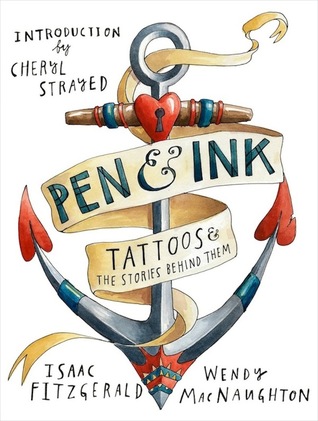
Pen & Ink: Tattoos and the Stories Behind Them by Isaac Fitzgerald, illustrated by Wendy MacNaughton and introduction by Cheryl Strayed, is fantastic for those who are interested in not only body art but personal stories.  Some of the stories behind the tattoos illustrated by Wendy MacNaughton are silly, while others are sad and some are inspiring.  The illustrations are colorful and fantastic, though readers may almost prefer to see photos of the stunning art work of the tattoos.  But that’s a minor complaint given the personal stories behind the tattoos.  It is not just that the tattoos tell a story but that these tattoos contain memories for their bearers.

Isaac Fitzgerald says in the preface, “My tales of driving trucks through small Massachusetts towns, drunk and with no license, made me who I was.  I learned that people define you by your stories.”  And in many ways, it is not just your stories that others use to define you, but it is also how you define yourself.  Tattoos are an expression of those stories and those memories you hold dear and choose to share, and those tattoos and memories also can define you.

From the introduction by Cheryl Strayed, “Each of the stories is like being let in on sixty-three secrets by sixty-three strangers who passed you on the street or sat across from you on the train.  They’re raw and real and funny and sweet.  They speak of lives you’ll never live and experiences you know precisely.  Together, they do the work of great literature — gathering a force so true they ultimately tell a story that includes us all.”

Pen & Ink: Tattoos and the Stories Behind Them by Isaac Fitzgerald, illustrated by Wendy MacNaughton and introduction by Cheryl Strayed, could become a series of books with other tattooed professionals, students, and non-professionals that provide a look into not only the variety of people who get tattoos but the various reasons that people get tattoos.  How these individuals feel about their tattoos now is irrelevant to why they were added to their bodies in the first place — whether a tribute to a loved one or a passion for an unwritten future.

About the Author:

Isaac Fitzgerald has been a firefighter, worked on a boat, and been given a sword by a king, thereby accomplishing three out of five of his childhood goals. He is co-founder of Pen & Ink, co-owner of The Rumpus, and the editor at BuzzFeed Books.

About the Illustrator:

Wendy MacNaughton is an illustrator and a graphic journalist based in San Francisco. Her documentary series Meanwhile tells the stories of communities through drawings and the subject’s own words, and is being published as an anthology by Chronicle Books in 2014. She’s illustrated two other forthcoming books: Lost Cat: A True Story of Love, Desperation, and GPS Technology, by Caroline Paul and Wendy MacNaughton (Bloomsbury, 2013) and The Essential Scratch & Sniff Guide to Wine, by Richard Betts (Houghton Mifflin, 2013).

She has degrees in fine art/advertising and social work from Art Center College of Design and Columbia University. When they let her, she likes to talk with students at Art Center College of Design, and she is an artist in residence at Intersection for the Arts.

About the Introduction Writer:

Cheryl Strayed’s memoir, Wild, will be published by Knopf in March 2012. It will also be published in Brazil, Germany, the Netherlands, the United Kingdom, and Italy. Her novel, Torch (Houghton Mifflin, 2006) was a finalist for the Great Lakes Book Award and was selected by The Oregonian as one of the top ten books of the year by writers from the Pacific Northwest. Strayed’s writing has appeared in the New York Times Magazine, the Washington Post Magazine, Allure, Self, The Missouri Review, Brain, Child, The Rumpus, The Sun and elsewhere. The winner of a Pushcart Prize as well as fellowships to the Bread Loaf Writers’ Conference and the Sewanee Writers’ Conference, her essays and stories have been published in The Best American Essays, The Best New American Voices, and other anthologies. She holds an MFA in fiction writing from Syracuse University and a bachelor’s degree from the University of Minnesota. She’s a founding member of VIDA: Women In Literary Arts, and serves on their board of directors. Raised in Minnesota, Strayed now lives in Portland, Oregon with her husband, the filmmaker Brian Lindstrom, and their two children.

74th book for 2014 New Author Reading Challenge.

Before I Go to Sleep by S.J. Watson

Source: Public Library
Audiobook, 11+ hours
On Amazon and on Kobo

Before I Go to Sleep by S.J. Watson, narrated by Orlagh Cassidy, chronicles the disjointed life of a woman who has lost her memory in an accident.  Each night, while she is sleeping, she loses all her memories of her present and past.  She remembers her life up until about her 20s, but only the journal she keeps helps her remain grounded in the life and the husband she no longer recognizes.  This is a fast-paced debut novel that examines the role that memory plays in how we identify ourselves and our own happiness.  Christine Lucas is a writer who is struggling each day to remember her life before an accident wiped out her memories, an accident she doesn’t even remember.  As she begins keeping a secret journal and meeting with Dr. Nash to try some treatments to regain her memory, dark secrets about her life, her past, and her current situation bubble to the surface.

Watson has carefully crafted a character adrift in her own life, and while some of the details are needlessly repeated as she wakes from sleep each morning and struggles to remember her life, readers are swept up in this mystery.  As the book is told from Christine’s point of view, the reader has only her knowledge to draw conclusions from, and this can be frustrating.  While the cues are there to unravel the mystery beforehand, readers will likely enjoy this crazy journey as well as become frustrated with the main character’s stupid decisions from time to time.  There are times when reading the journal should have taken much more time than it seems to, which would have left her little time to do much else in a day, especially for someone who wakes up with a blank slate every morning.

Before I Go to Sleep by S.J. Watson, which was out October book club selection, was an interesting debut, and it did mirror the feel of the movie Memento, but the ending was disappointing and some parts in the middle dragged a bit.  While this is fast-paced toward the end when everything starts to fall in place, there could have been further editing in the middle that would have tightened this up more and made it even more thrilling.

A note about the narrator, her voice really grated on my for some reason and she seemed to lose the tone when speaking as a male character, slipping back into Christine’s voice, which made it hard for me to follow along at certain points.

About the Author:

S J Watson was born in the UK, lives in London and worked in the NHS for a number of years.  In 2011 Watson’s debut novel, Before I Go to Sleep, was released to critical acclaim. It has now been published in over 40 languages, and has become an international bestseller, winning numerous awards.   The movie of Before I Go To Sleep, starring Nicole Kidman, Colin Firth and Mark Strong, is due for worldwide release in Autumn 2014. Watson’s second book is out in Spring 2015.

What Book Club Thought (Beware of spoilers):

Most of the book club felt that this was a quick and entertaining read, even though many of us didn’t think the mystery was much of one.  The writing was well done for the most part, and with it being made into a movie a few people expressed interest in seeing it, either on video or on Netflix, etc. I personally thought a better twist would have been to have Dr. Nash be her son. While one person couldn’t even get into the book at all.  There was quite a bit of repetition, which may have grated on people early on, but when a main character has no ability to make new memories, they tend to repeat things.

73rd book for 2014 New Author Reading Challenge.

Blue Moon Rising by Simon R. Green

Source: Public Library
Paperback, 480 pages
On Amazon and on Kobo

Blue Moon Rising by Simon R. Green is an adventure story of kings, castles, dragons, and unicorns whose hero, Rupert, is a second son in line for the throne and dedicated to his duty to the Land even at the expense of his own safety.  On his first quest he is sent to slay a dragon, but what he encounters runs contrary to everything he’s ever heard about quests from the minstrels.  Knowing that he can never rule as king, Rupert is aware that he isn’t meant to return from his quest or if he does, he’s to return with something of value that his bankrupt kingdom can use to fight off the Barons who wish to take control.  Unfortunately, he and his unicorn return with a live dragon, not jewels, and a difficult Princess Julia.

In typical adventure fashion, but with humor, Green creates a world in which the darkness threatens to overtake the Forest Kingdom.  Rupert is a reluctant hero and Princess Julia is the antithesis of feminine royals who care more about dresses and balls.  Harald, the prince next in line for the throne, is charismatic and wily, and he has a reputation with the ladies.  He and his brother are often at odds, though readers will wonder if they would get along better if their father didn’t show preference for Harald over Rupert at every turn or if the kingdom was not in such turmoil politically that factions are vying for their own favorite son to ascend to the throne.  Green populates his novel with a few too many quests when one would have sufficed before the kingdom was threatened by the Darkwood and the Demon Prince.

“For a long while the Court stood silent, shaken by the Astrologer’s dark vision.
‘There must be something we can do,’ said Rupert haltingly.
‘There is,’ said the Astrologer.  ‘Prince Rupert; you must journey to the Dark Tower, and there summon the High Warlock.’
Rupert stared at the Astrologer.
‘I should have volunteered to lead an army against the Demon Prince,’ he said finally.  ‘It would have been safer.'” (page 87)

The dragon doesn’t play much of a role here, but the unicorn seems to be the comic relief for the most part.  The debate between the privilege in royalty and being a peasant is consistent throughout the book, as is the tension between duty and desire.  Despite its wordiness, Blue Moon Rising by Simon R. Green is a keen adventure with humor and plot twists, though some may be predictable and less satisfying than expected.

Unfortunately, the book club discussion for this one was postponed do to some illnesses and other conflicts.

About the Author:

Simon was born in Bradford-on-Avon, Wiltshire, England (where he still resides), in 1955. He has obtained an M.A. in Modern English and American Literature from Leicester University and he also studied history and has a combined Humanities degree. His writing career started in 1973, when he was a student in London. His first actual sale was a story titled Manslayer, back in 1976, but it didn’t appear till much later; Awake, Awake…. was his first sale to a professional editor, in 1979. Furthermore he sold some six or seven stories to semi-pro magazines before that market disappeared practically overnight.

After years of publishers’ rejection letters, he sold an incredible seven novels in 1988, just two days after he started working at Bilbo’s bookshop in Bath (this after three and a half years of being unemployed!). This was followed in 1989 by two more, and a commission to write the bestselling novelization of the Kevin Costner film Robin Hood: Prince of Thieves, which has sold more than 370.000 copies.

62nd book for 2014 New Author Reading Challenge.

The Last Kabbalist of Lisbon by Richard Zimler

Source: Public Library
Paperback, 318 pages
On Amazon and on Kobo

The Last Kabbalist of Lisbon by Richard Zimler set during the 1500s at the time of the Lisbon Massacre of April 1506, in which about 2,000 Jews were killed.  Zimler breathes life into this time period and the Jewish Kabbalah, a time in which Jews were in hiding and many were converted to New Christians (Marranos) in 1497 — some after fleeing Spain — to remain safe from persecution. Even their conversion is not enough to satisfy Old Christians as they run rampant through the city killing Jews, putting their heads on spikes, throwing them on pyres, and more.  King Manuel I, while more tolerant of the Jewish community, allowed the massacre to rage on, and eventually, 30 years later, the inquisition was established in Portugal, just as it had been in Spain.  Berekiah Zarco, a young manuscript illuminator, becomes caught up in the search for a killer, after he discovers his uncle, the keeper of forbidden Hebrew texts, has been murdered.

“We are all of us deep and wide enough to welcome a river of paradoxes and riddles into our souls.” (page 21)

Berekiah, also known as Pedro as a New Christian, worked with his uncle illuminating texts for others that were hiding from the Christians and trying to keep their Jewish faith alive, but he is unaware of how his uncle smuggled precious texts out of the city and into Turkey so as to keep them from being lost.  Zimler demonstrates through Zarco’s search for his uncle’s killer how the Jews were forced to wear a great many masks to hide their religion, but at the same time, these masks could be false ones and even the most trustworthy in the community could be hiding nefarious deeds.  The tale is told as Zarco unravels the mystery of his uncle’s death, and while he becomes absorbed in vengeance and the search for justice, his Muslim friend, Farid, who cannot speak except with his hands, steers him in the right direction and reminding him of compassion and empathy along the way.

“Yet the wall tiles and window eyelets, desks and chairs returned my gaze without the slightest quiver of motion.  The room was empty, seemed hollow, like the rib cage of an animal whose heart had suddenly ceased beating.”  (page 57)

With a turncoat in the Jewish community, Zarco narrows the field to a few suspects and sets about finding the truth, even as the Old Christians continue to rage, pillage, and kill Jews in their wake.  While the dialogue is a bit comical after a time, with Zarco accusing elders in the community of being murderers and them immediately denying it and him accepting their answers, in the context of the time period in which elders were to be believed, the conversations make sense.  Zarco’s life is in endanger at every turn as he seeks the killer, but he relies on his Kabbalist faith to see him through and finds a strength through his uncle’s teachings.

The Last Kabbalist of Lisbon by Richard Zimler provides a window into the early 1500s when Jews were being pushed out of their homes, and much of the situations during this time mirrors the reasons reiterated during the time of the Nazis — that the Jews were taking all of the jobs and the money away from those who were true Portuguese.  Christian versus New Christian and Jew, Kabbalah was all the Jews had to cling to as a way to survive persecution and continue flourishing.  It is a harrowing story of evil, death, and perseverance, but it is also about the ties we have to our faith and family, even after much of our family has passed on.

About the Author:

Richard Zimler was born in Roslyn Heights, a suburb of New York City, in 1956. After earning a bachelor’s degree in comparative religion from Duke University (1977) and a master’s degree in journalism from Stanford University (1982), he worked for eight years as a journalist, mainly in the San Francisco Bay area. In 1990, he moved to Porto, Portugal, and he has taught journalism for the last sixteen years, first at the College of Journalism and now at the University of Porto. Richard has both American and Portuguese nationality.

1st book for the 2014 Portuguese HF Challenge.


16th book for 2014 European Reading Challenge(Set in Portugal)


26th book for 2014 Historical Fiction Reading Challenge.


51st book for 2014 New Author Challenge.