Quantcast

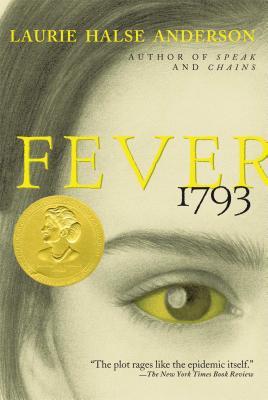
Fever 1793 by Laurie Halse Anderson

Source: Public Library
Paperback, 272 pages
I am an Amazon affiliate.

Fever 1793 by Laurie Halse Anderson is set during the epidemic of Yellow Fever that hit Philadelphia after the British lost to the Colonists in the U.S. Revolutionary War and a new government was taking root in the new country.  Mattie and her family run a local coffeehouse in the city for the politicians and businessmen, with help from Eliza, their freed black employee.  Mattie has big dream — expanding the family business and bringing French finery to America for sale — but her mother is busy keeping the shop running and saving in case of disaster, remaining cautious because she knows all too well that things can get worse like it did when her husband died.

“I tried not to listen to her.  I had not cleared the wax from my ears all summer, hoping it would soften her voice.  It had not worked.”  (page 6)

Anderson relies heavily on source material to provide authenticity to her story of Mattie and her family, and there’s a nice touch of quotes throughout the novel at the beginning of each chapter.  The characters are well drawn and feel like they’ve stepped out of history, with Mattie and her mother resembling any mother-daughter relationship influenced by teenage hormones and changing times.  The love Mattie has for her mother is tested in the worst possible way when the Yellow Fever strikes home, but the love for her grandfather and Eliza keeps her grounded, focused on what needs to be done.

“They told of terror: patients who had tried to jump out of windows when the fever robbed their reason, screams that pierced the night, people who were buried alive, parents praying to die after burying all their children.

I laid my pillow over my head to protect myself from visions of the dead, but I could not breathe.” (page 106)

Mattie’s fear becomes the reader’s fear as she no longer knows where she is or where her family has gone, and the city of Philadelphia and the surrounding towns become unrecognizable.  The city of brotherly love becomes more insulated and fearful, turning away neighbors to protect their own families and resorting to violence to take advantage of those who can no longer defend themselves.  Anderson pulls no punches in her portrayal of disease, competing medical theories, and the decline of a once prospering city struggling with pestilence.

Fever 1793 by Laurie Halse Anderson is a truncated look at the disease that spread through the city like wildfire, taking the lives of nearly 5,000 people or 10 percent of the population.  The author takes historical fact, including the mass burial of fever victims in Washington Square (old potter’s field), and breathes new life into the tragedies endured by a once bustling and budding city.  Mattie is strong-willed and carries herself forward even when all seems lost, relying on the love of those around her and her own gumption to pick up and start again.

About the Author:

Laurie Halse Anderson is the New York Times-bestselling author who writes for kids of all ages. Known for tackling tough subjects with humor and sensitivity, her work has earned numerous American Library Association and state awards. Two of her books, Speak and Chains, were National Book Award finalists. Chains also made the Carnegie Medal Shortlist in the United Kingdom.

Laurie was the proud recipient of the 2009 Margaret A. Edwards Award given by YALSA division of the American Library Association for her “significant and lasting contribution to young adult literature…”. She was also honored with the ALAN Award from the National Council of Teachers of English and the St. Katharine Drexel Award from the Catholic Librarian Association.

Also Reviewed:
9th book for 2014 Historical Fiction Reading Challenge.

Ten Thousand Sorrows: The Extraordinary Journey of a Korean War Orphan by Elizabeth Kim

Source: Public Library
Hardcover, 240 pages
I am an Amazon Affiliate

Ten Thousand Sorrows: The Extraordinary Journey of a Korean War Orphan by Elizabeth Kim is a memoir from a young Korean War orphan who never knew her father, was shunned as a non-person in Korea, and was subject to further psychological and physical abuse after her adoption.  This woman suffered greatly and mostly in silence for many years before and after her adoption by American, Christian fundamentalists.  The differences between her lush green Korean homeland and her new American desert home reflect the stark demarcations between her old life and being saved.

“There is no record of my birth, or of my name.  There is no record of my mother’s brief life.” (from the Prologue)

Born to a Korean mother, who left her tiny village for Seoul to sing, and an American soldier father, whom she never knew, Elizabeth has no notion of her birth name or date, nor her father’s name.  Her earliest memories are of life as a honhyol, a nonperson of mixed heritage shunned by the Korean culture, with her mother, Omma.  As outcasts in their village, they were subjected to shunning, stone throwing, and other abuses, but they were expected to bow to others and give way to the village leaders, Omma’s father and other family, when walking about.  Omma created a secluded and secure life for her child, though it was not without harsh work in the rice paddies or isolation.  The world they lived in may not have had a great deal of comforts and amenities, but it was certainly filled with calm and love.  In an honor killing, she is left alone in the world and dropped unceremoniously at an orphanage.

“Omma’s brother did all the talking.  He told her the family had discussed the matter again since presenting demands to her that afternoon in the field, and he, his father, and his wife were there to carry out the plan.  A family had offered to take the honhyol–me–into their home as a servant.”  (page 8)

“Sitting in the cage, nails dug deep into my skim, I tried to ameliorate grief by increasing my physical pain.  And just below the awareness of that misery, breathing rhythmically like a monster waiting to devour me, was the knowledge that it was because of me Omma died.  My face and my dishonorable blood had killed the only person I loved and the only person who loved me.” (page 33)

Like her Korean home where women are expected to be subservient to men and obey without question, Elizabeth is whisked across the ocean — to a land her mother described as full of promise — to America and new parents.  Her tiny life has begun again, but darkness descends upon her as she realizes that the American dream she’d thought was there is tarnished by a fundamentalism that snowballs into systematic abuse.  From her abusive parents to her physically abusive husband, Kim’s journey was rough and through it all, she struggled to survive, with the hope that there was freedom and something better in her future.

Ten Thousand Sorrows: The Extraordinary Journey of a Korean War Orphan by Elizabeth Kim demonstrates the clash of cultures between foreign adopted children and American homes, particularly homes with fervent religious beliefs, but also the continued discrimination she felt as a mixed race child, despite her father’s American heritage.  In Korea, she was a nonperson, and in America, she is treated in much the same way — leaving her with a battered and nearly non-existent self-esteem.  This dark memoir, however, does not focus on bitterness or resentment, but on how these events and abuses transformed her into a highly ambitious reporter and mother.  While still broken inside, she manages to give her daughter a loving home and stability as a single parent.  Although there are clearly moments of clear hatred of Christianity, particularly in its fundamental form, the novel is more about redemption and acceptance of oneself despite the outside forces that strive to strike us down.

About the Author:

Elizabeth Kim is a journalist and the author of the best selling novel “Ten Thousand Sorrows”, which has been chronicled in O, Oprah Winfrey’s magazine.

5th book (Korean War) for the 2014 War Challenge With a Twist.


9th book for 2014 New Author Challenge.

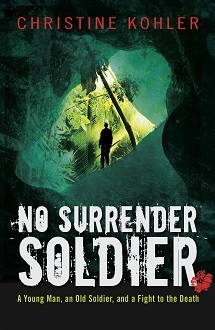
No Surrender Soldier by Christine Kohler

Source: Borrowed from Anna
Hardcover, 208 pages
I am an Amazon Affiliate

No Surrender Soldier by Christine Kohler is a well researched debut novel for young adults, though probably on the older end of the age range 11+ given the graphic pig slaughtering and mature themes.  Set in 1972 during the Vietnam War, it still has roots in WWII.  During WWII, the Japanese invaded and many of the inhabitants of Guam were used and abused by their captors, particularly the women.  Fifteen year-old Kiko Chargalauf inadvertently learns about his own family’s history with the Japanese invaders.  It’s more than he can take when he stumbles upon a straggler in the boonies on Guam behind his house, as he tries to separate reality from anger when he realizes the crimes Japanese soldiers committed against Guam’s residents.

“Stragglers are what we call Japanese soldiers who never surrendered after World War II.  As far as I was concerned, my parents used fear of stragglers as an excuse, like some people use the boogie man, when they didn’t want me to go into the boonies.  I shook my head.  ‘No straggler would last that long.'” (page 29 ARC)

At its heart, the novel is a coming of age story.  Kiko is struggling with his new responsibilities at the family tourist shop, as his brother is overseas fighting in Vietnam as a pilot.  But he also has become his grandfather’s babysitter as the old man’s dementia gets worse, transporting him to those terrifying days in WWII.  As Kiko struggles to become a man and still enjoy his childhood, he’s forced to grow up more quickly than he’d like — fighting every step of the way.

On the flip side, readers will see the internal struggles of Lance Corporal of the Japanese Imperial Army Isamu Seto as he not only scavenges for food, jumps at every noise, and tries to stay hidden from military forces that could imprison him.  Tenacity and courage bring Kiko, Seto, and the grandfather together as the past is forgiven and a mutual respect grows between them.  No Surrender Soldier by Christine Kohler is about perseverance, forgiveness, and growing up, but it’s also about how war threatens and shapes all of us, even those who are not directly fighting in it.

About the Author:

Christine Kohler is the author of NO SURRENDER SOLDIER. She is a former journalist, teacher and writing instructor for the Institute of Children’s Literature (ICL).

3rd book (WWII and Vietnam War) for the 2014 War Challenge With a Twist.


5th book for 2014 New Author Challenge.


3rd book for 2014 Historical Fiction Reading Challenge

Bad Intentions by Karin Fossum, translated by Charlotte Barslund

Source: Borrowed
Paperback, 184 pages
I am an Amazon Affiliate

Bad Intentions by Karin Fossum is the 9th book in the Inspector Konrad Sejer series and is set in Norway, but readers will get little sense of Norway other than the odd name here and there for places and people and the references to the bitter cold.  While Norway can be bitterly cold in the winter months, there has to be more to a country and its culture than that, but little of that comes across in this novel.  Additionally, the series stars Inspector Konrad Sejer, but readers will get little sense of him in this slim volume where he makes the rare appearance and the main focus of the book being on three young men — Jon, Reilly, and Axel.

“He disappeared into the kitchen and they heard him scrabbling.  Then he returned with the fireguard and placed it in front of the fire.  The cast-iron fireguard with two wolves baring their teeth.

Jon looked at the wolves and at his two friends.” (page 2)

Fossum has created a scenario that demonstrates the power that friends can have over one another, particularly when one of the friends is more dominant in the relationship than the others.  It is easier to agree to cover-up an accidental death than to call the emergency services, or is it.  These young men are like sketches of profiles that police would create following a crime, and while you uncover a little bit about their backgrounds and their pasts, you never really see them in full view, you cannot empathize with their decisions, and you cannot cheer for them to get away with their crimes.  The way in which Fossum has crafted these characters must be intentional, a cautionary tale against the pressures of friendship especially when it can lead to compromised principles.

“‘We’ve talked about the nature of truth before,’ he said.  ‘Many things are true, but they still need to be left alone.  Imaging if people always told the truth, it wouldn’t work.  Society would fall apart.  We need to start each day from scratch,’ he argued.  ‘Build something that people can see, that they can cope with and believe in.'” (page 10)

Bad Intentions by Karin Fossum could have been a stand alone novel without the inspector, as he plays a minimal role, but as it isn’t, the novel leaves readers with a desire for more — more characterization, so that the inspector and the young men become real.  Exploring the darker tendencies of peer pressure and how it tests our mettle when we are called upon to do what’s right is a tough subject to tackle.  Fossum explores a number of themes along this line, but with little background on the boys, it’s hard to keep up with their motivations.

***This experience hasn’t soured me on reading others in the series, but this one just fell short for me.

About the Author:

Karin Fossum is the author of the internationally successful Inspector Konrad Sejer crime series. Her recent honors include a Gumshoe Award and the Los Angeles Times Book Prize for mystery/thriller. She lives in a small town in southeastern Norway.

3rd book for 2014 European Reading Challenge; this is set in Norway.

Angela’s Ashes by Frank McCourt

Source: Borrowed from Diary of an Eccentric
Paperback, 460 pages
I am an Amazon Affiliate

Angela’s Ashes by Frank McCourt is a memoir about his young life and his coming of age.  The memoir does not gloss over the hardships he and his family face, nor does it leave out the bad things McCourt did as a child to survive.  It’s heartbreaking to see how a father can shun his responsibilities in favor of alcohol, while leaving his wife little recourse but to beg for charity on a weekly and daily basis just to feed her young children.  Angela, his mother, becomes a shadow of herself with the trials they face, especially as some of their youngest children perish from starvation and disease in America and even at home in Ireland.  Beginning in America, Angela meets a young man and falls in love, but he’s not the man she thinks he is and soon discovers that he is plagued by the need for drink.  Their hardships continue even as they are sent back to Ireland by relatives in the New World.

“When I look back on my childhood I wonder how I survived at all.  It was, of course, a miserable childhood: the happy childhood is hardly worth your while.  Worse than the ordinary miserable childhood is the miserable Irish childhood, and worse yet is the miserable Irish Catholic childhood.”  (page 9)

Living in a time when women were not allowed to work and when men were not expected to hand over their wages to their wives or to have their wives with them when they got paid — because his father takes the wages when he’s paid and eventually comes home with nothing — becomes a heavy burden on the family.  This leaves his wife to beg the grocer for credit so she can buy necessities for her family, and in Ireland it is worse because with a husband from the North, he’s unable to get a job in the first place.  Even when he does get a job, he often loses it by drinking late into the night and then sleeping in the next day.  These circumstances make it difficult for her and the family to stay healthy and even survive.

Although readers will be surprised at how long this family is able to survive in spite of the deaths and the starvation, they’ll also be surprised at the depth of their own loyalty and love for their father.  Rarely is anything said by the children about their father, though the mother surely speaks her mind about his penchant for the pint and his irresponsibility — to no avail.  McCourt pulls no punches about telling the darkest moments of his early life, including the beatings he took from teachers and family members.  There is still a sense of hope in him even in the most dire of circumstances.

Whether all of the things that happened in the memoir are fact or just his remembrances, there is clearly an atmosphere of struggle that has driven him to make the most of the circumstances he’s given.  He strives to do his best in school, to care for his family as best he can in the absence of his father, and to make something of himself in spite of all he must battle against.  Angela’s Ashes by Frank McCourt is dark and hopeless at times, but there is the light of humor and hope between the lines.  This is a memoir that reads more like a novel.

About the Author:

Frank McCourt (1930-2009) was born in Brooklyn, New York, to Irish immigrant parents, grew up in Limerick, Ireland, and returned to America in 1949. For thirty years he taught in New York City high schools. His first book, “Angela’s Ashes,” won the Pulitzer Prize, the National Book Critics Circle Award and the L.A. Times Book Award. In 2006, he won the prestigious Ellis Island Family Heritage Award for Exemplary Service in the Field of the Arts and the United Federation of Teachers John Dewey Award for Excellence in Education.

This is my 4th and final book for the Ireland Reading Challenge 2013.

The Cellist of Sarajevo by Steven Galloway

Source: Public Library
Paperback, 235 pages
I am an Amazon Affiliate

The Cellist of Sarajevo by Steven Galloway is a truncated look at the siege of Sarajevo in the early 1990s that lasted about three years, though in this novel, it is reduced to about 30 days.  While the cellist is a real individual, Galloway has crafted him into a larger-than-life character, who signifies the hope that the people of Sarajevo cling to even in the face of dead bodies left to rot in the streets.  In addition to the cellist, who is more of an abstraction than a character with his own perspective, there is Arrow, a young, female sniper, Kenan, who has a wife and three children to care for, and Dragan, an older man who works at the local bakery.  Through alternating chapters, the fear and angst felt by these characters becomes heightened for the reader as they watch people fall to their knees after snipers shoot them or as the shelling begins and their own lives are at the mercy of chance.  The novel has a heavy atmosphere, a gray smoldering that permeates through the pages, weighing down the characters, slumping their shoulders and pushing them into darker places.

“If this city is to die, it won’t be because of the men on the hills, it will be because of the people in the valley.” (page 213)

Arrow has joined the resistance to fight against those that wish to destroy her people and the city, but while she’s been given free rein to choose her own military targets, things are about to change for her, and the hatred she feels for “them” — who are never clearly defined — becomes a motivator and a detriment to her.  Her character is pushed to the limit and she’s forced to make a decision that could be detrimental — a move that was rather dramatic and a bit predictable.  Kenan, meanwhile, is merely striving to keep his family alive, running to the brewery with his water containers to ensure they have enough to get through the next couple of weeks.  He makes these trips trembling in fear, but the fear only momentarily paralyzes him as he remembers the life before the siege and what life would be like without it.  He holds onto his daydreams of a family engrossed in its daily chores and entertainments, and keeps moving.  Dragan has been traveling to the bakery in solitude, rarely speaking to strangers and nearly always avoiding conversation with those he knew before the siege, cutting himself off.  Readers spend a great deal of time with him at an intersection where people are forced to take chances with their lives when they cross — some running, some sauntering, and some zigzagging across.

“‘Give Raza my love,’ she says, leaning in and hugging him.  She feels warm and substantial, much larger than when he hugged her only a short time ago.  She has become real to him again.” (page 115-6)

Galloway’s novel is about what it means to be in the midst of war, without understanding the reasons behind it, and yet, still facing the violence on a daily basis.  Readers will be required to ask themselves what is important, and to draw their own conclusions about why the cellist sits at 4 p.m. for 22 days to play Albinoni’s Adagio — the site of a mortar shelling where 22 people were killed while waiting in line for bread. Although lacking actual political/sociological motivations and the time line of the siege, Galloway seems to have a handle on the range of emotions and reactions people can have in war — whether it be a focus on hatred and revenge or the dissociation people can feel from their own country men in the face of uncertainty and death. The Cellist of Sarajevo is a novel in simple prose that belies the complexity of the moral and emotional issues it addresses.

About the Author:

Steven Galloway was born in Vancouver, and raised in Kamloops, British Columbia. He attended the University College of the Cariboo and the University of British Columbia. His debut novel, Finnie Walsh, was nominated for the Amazon.ca/Books in Canada First Novel Award. His second novel, Ascension, was nominated for the BC Book Prizes’ Ethel Wilson Fiction Prize, and has been translated into numerous languages. His third novel, The Cellist of Sarajevo, was published in spring of 2008. It was heralded as “the work of an expert” by the Guardian, and has become an international bestseller with rights sold in 20 countries. Galloway has taught creative writing at the University of British Columbia.

What the Book Club Thought:

Even though three members were unable to make the meeting, those that were able to attend seemed to like the novel, with one member saying that it was an easy and short read. Two members liked the POV of Arrow best, while one seemed to like both Arrow and Dragan and another preferred Kenan. One member believed that Kenan was the most human of the characters because of his interactions with other people throughout his travels to get water, while another thought that Dragan was more realistic in his detachment from others because of the harshness of war and the constant fear the residents endured. Arrow’s POV was more active, and one member enjoyed the use of strategy she employed in her efforts to protect the cellist. It seems as though this book was well received among the members in attendance.

This is my 78th book for the 2013 New Authors Challenge.

Short Reviews of 3 Children’s Books

Over Dewey’s 24-hour read-a-thon, my daughter and read three books she picked out of the library since I really didn’t have that much time to participate, but I did want to share our impressions of these books.

Freight Train by Donald Crews is a Caldecott Honor Book with few words and vibrant pictures written in 1978, it’s amazing that the book is still so relevant today.  The freight trains still run, and the parts of the train are still the same.  But this book strives not only to teach young children about the parts of a train and how it gets from one place to another, moving on through the day and night, but it also teaches colors with each part of the train a different color.  My daughter was engaged while I read and repeated each color with me, but she loved watching the train go as I flipped the pages.

Where’s Walrus? by Stephen Savage is similar to the Where’s Waldo? books I remember, but with a goofy looking Walrus.  The trick of this book is that many of the other images are gray, similar to the walrus, making it harder for kids to discern the walrus from his surroundings.  It’s a book about observation and recognition.  My daughter and I had fun with this book, as did her daddy.  We made it two games in one  — the first pass we found walrus and on the second pass we found the zoo keeper who was trying to get him back into the zoo.  She liked this one so much she wanted to keep playing it several more times in a row…and she’s almost got the word walrus enunciated correctly.

Halloween Forest by Marion Dane Bauer, illustrated by John Shelley is a book of poetry, or at least that’s how it reads…like the children’s books of my childhood (i.e. Little Miss Muffet).  The illustrations are engaging and unique, and in many ways would seem scary to young kids, since it is a forest made of bones.  However, my daughter is fascinated by the pictures and not scared at all by the bone forest, which could be related to the empowering statements of the poem-like lines in which the child is not scared but demands her trick-or-treat dues.  The little one and I enjoy this one a lot, and it is perfect for the current season.  Our library actually has shelf sections based on holidays and seasons, which is where I found this one for her and I to read.  Really engaging visually and textually.


That’s it, what good children’s books have you shared with your kids that you both enjoyed?

These are my 65th, 66th, and 67th books for the 2013 New Authors Challenge.

Forge by Laurie Halse Anderson

Source: Public Library
Hardcover, 297 pages
I am an Amazon Affiliate

Forge by Laurie Halse Anderson is the second book in the Seeds of America series for young adults (see my review of Chains, the first book in the series; the third book is expected in 2014).  ***This review could contain spoilers***

Isabel and Curzon have fled New York and the Locktons to seek out Freedom, but when we again meet up with Curzon, Isabel has fled in search of her sister, Ruth, who is known to be in Charleston.  After taking all of the money they had earned, Curzon has little choice but to make it on his own, and in so doing, runs smack in the middle of a skirmish.  During a standoff between a rebel soldier and a British soldier, Curzon makes a fateful decision that has him enlisted as a soldier under General Washington’s command at Valley Forge.  As winter sets in for the long haul, Anderson deftly paints a picture of the desperate times and weather conditions the rebel forces faced, forcing some to go against army rules and steal food from neighboring farms.

“‘We can mine for iron here?’ Eben asked.

‘No, blunderhead,’ Silvenus said.  ‘This camp is a forge for the army; it’s testing our mettle.  Instead of heat and hammer, our trials are cold and hunger.  Question is, what are we made of?'”  (Page 121)

Curzon finds a home among the soldiers, but he still thinks about Isabel and her fate, wondering why she won’t leave his mind.  As the winter digs in, however, Curzon’s luck changes with it once he’s recognized by Bellingham, who thought him dead in Bridewell Prison.  He becomes again that insolent slave looking for freedom and even longing again for the companionship of the army.  He bristles at his new circumstances and even wages an unspoken war against Bellingham until he realizes that his fate is not all that he holds in his hands.  Anderson has created a believable slave seeking his freedom by any means within his grasp, and his ties to Isabel grow stronger as the battle with the British gets closer.

Forge has a dual meaning in that the army’s mettle, as well as Curzon and Isabel’s, are tested, and these characters must forge ahead and overcome the challenges they face.  In a literal sense, Curzon tries to create a counterfeit of himself and pass himself off as a free man to become a soldier, as well as a key’s likeness to turn the lock on freedom.  Anderson peppers the novel with a number of details (having seen Valley Forge recently, these places were fresh in my mind), and she firmly grasps the intrigue of the time, including the use of slaves as spies for the British, and the internal politicking among Congressmen and generals.  Forge by Laurie Halse Anderson is a solid second book in a series of young adult historical fiction novels about the American Revolution, and in some ways an even better book than the first for its multiple layers, including subplots and dynamic characters.

About the Author:

Laurie Halse Anderson is the New York Times-bestselling author who writes for kids of all ages. Known for tackling tough subjects with humor and sensitivity, her work has earned numerous American Library Association and state awards. Two of her books, Speak and Chains, were National Book Award finalists. Chains also made the Carnegie Medal Shortlist in the United Kingdom.

Laurie was the proud recipient of the 2009 Margaret A. Edwards Award given by YALSA division of the American Library Association for her “significant and lasting contribution to young adult literature…”. She was also honored with the ALAN Award from the National Council of Teachers of English and the St. Katharine Drexel Award from the Catholic Librarian Association.

This is my 5th book for the American Revolution Reading Challenge 2013

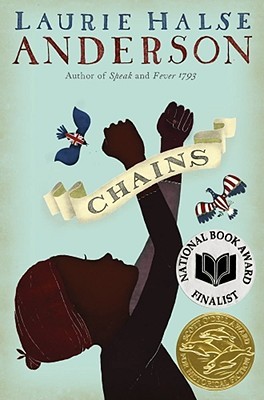
Chains by Laurie Halse Anderson

Source: Public Library
Hardcover, 316 pages
I am an Amazon Affiliate

Chains by Laurie Halse Anderson is the first in a series of books set during the American Revolution, and Isabel is a young slave who must care for herself and her sister, Ruth, after the death of their mother and their owner.  She quickly finds that the things she had been promised by their owner do not come to pass, and she must prepare herself for new and more harsh owners, the Locktons.  In her new household in New York, where the Locktons have settled from England, she finds that her chores are many and grueling, but that her sister has garnered the special attention of Mrs. Lockton, who dresses her as a doll and requires her to be silent at all times.  New York also is where she meets Curzon, a young black boy working on the side of the rebels, for whom he hopes she will provide intelligence from the Lockton household.

“The bees swarmed again behind my eyes, making the scene grow dim and distant.  The sun was nearing the horizon, casting long shadows across the wharf.  I was a ghost tied to the ground, not a living soul.”  (page 182)

Isabel soon learns that both the British and American rebels are willing to use slaves as they see fit and promise them freedom they have no intention of granting.  Anderson’s young adult novel deftly balances the cruelty of slavery with the sensibilities of young adults, ensuring that the abuse and cruelty is never more than young readers can handle. However, there are some instances that do become graphic, but it is essential to demonstrate the fates that faced a number of slaves, especially those who attempted or even thought about escaping their masters.  Moreover, she easily demonstrates the excess and perfidy of the war and its opposing sides, as the British throw balls in honor of the queen at the same time the rebels are struggling to feed themselves.

“And then, the final triumph.  She used a tiny brush to paint a thin line of glue above each eye.  Madam opened an envelope and shook out two gray strips of mouse fur, each cut into an arch.  Leaning toward the mirror, she glued the mouse fur onto her own eyebrows, making them bushy and thick as the fashion required.”  (page 207)

Chains by Laurie Halse Anderson is the first in a series, and it ends with a wide open ending in many ways, but at least some of the issues are resolved.  Anderson brings to life not only the issue of slavery, but also of the opposing sides in the revolution and the confusion it brought with it on the battlefield and in the cities not immediately touched by the war.  The confusing reports, the captured cities, the changing of power, all of it comes to life.

About the Author:

Laurie Halse Anderson is the New York Times-bestselling author who writes for kids of all ages. Known for tackling tough subjects with humor and sensitivity, her work has earned numerous American Library Association and state awards. Two of her books, Speak and Chains, were National Book Award finalists. Chains also made the Carnegie Medal Shortlist in the United Kingdom.

Laurie was the proud recipient of the 2009 Margaret A. Edwards Award given by YALSA division of the American Library Association for her “significant and lasting contribution to young adult literature…”. She was also honored with the ALAN Award from the National Council of Teachers of English and the St. Katharine Drexel Award from the Catholic Librarian Association.

This is my 4th book for the American Revolution Reading Challenge 2013


This is my 60th book for the 2013 New Authors Challenge.

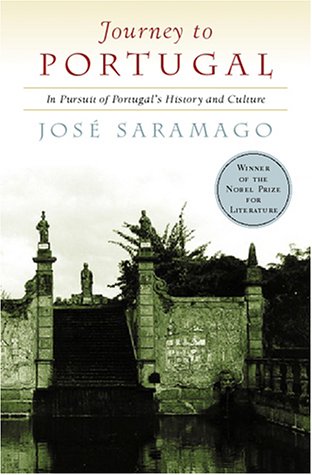
Journey to Portugal: In Pursuit of Portugal’s History and Culture by José Saramago, translated by Amanda Hopkinson and Nick Caistor

Source: Public Library
Hardcover, 464 pages
I am an Amazon Affiliate

Journey to Portugal: In Pursuit of Portugal’s History and Culture by José Saramago, translated by Amanda Hopkinson and Nick Caistor from Portuguese, is a travelogue, but not in a traditional sense of naming specific destinations, their locations, and offering impressions in a straightforward manner.  Readers looking for a travel guide would be best served looking for another book about Portugal.  Saramago refers to himself as the traveler, which can be wearisome throughout 400 pages of text, and many of the visits he makes throughout the country are to either museums or religious locations/buildings, which is odd given his atheism and tenuous relationship with the Catholic church after writing The Gospel According to Jesus Christ.  Moreover, this travelogue is as close to being a memoir as it can be given Saramago’s reflections, daydreams, and observances about the more modern Portugal around him.  (He exiled himself, a Communist, to the Spanish island of Lanzarote following The Carnation Revolution in 1974 where he remained until his death in 2010.)  However, he does say that he wishes these religious relics and pieces to be preserved as works made by human hands.

“The traveller thanks him, and sets off in the direction indicated.  There the palheiros survive, huge barracks made of wooden slats blackened by the wind and the sea, a few already stripped beams exposed to the gaze.  A few are still inhabited, others have lost their roofs to the wind.  It won’t be long before nothing will remain beyond a photographic record.” (page 146)

In many ways, Saramago is reflecting on the life he’s led, the perceptions he’s had and still has, and how as time moves on the ornaments of those memories and perceptions are stripped bare, leaving only the barest outline of the past — until the emotions and personal connections are lost and all that is left is a photo out of context.  “During the lengthy voyage that took nearly six months, the conviction was born in me that in every place I passed through there was a piece of old Portugal bidding farewell to the traveller I was, an ancient Portugal which was beginning, finally, while still doubting whether it wanted to or not, to move towards the twentieth century,” he says. (page xii)  He reconciles the past with the present, as seen through a melancholy perspective, and like the villages and people the traveller approaches slowly, he passes through one town to another, gets lost, and meditates on what he encounters.

Saramago reflects on stonework quite a bit and its ability to stand the test of time, and through his ruminations, readers are likely to see his struggle with the endurance or inability of workers and tributes to stand the test of time — there are some shrines and other edifices he finds hold stories that are no longer accessible.  Journey to Portugal: In Pursuit of Portugal’s History and Culture by José Saramago, translated by Amanda Hopkinson and Nick Caistor, may suffer from poor translation, but there are moments of great reflection and insight that shouldn’t be missed, even if they are mired in melancholia and dark moods, by patient readers.

About the Author:

José de Sousa Saramago is a Nobel-laureate Portuguese novelist, playwright and journalist. He was a member of the Portuguese Communist Party.  His works, some of which can be seen as allegories, commonly present subversive perspectives on historic events, emphasizing the human factor rather than the officially sanctioned story. Saramago was awarded the Nobel Prize for literature in 1998. He founded the National Front for the Defense of Culture (Lisbon, 1992) with among others Freitas-Magalhaes. He lived on Lanzarote in the Canary Islands, Spain, where he died in June 2010.

This is my 57th book for the 2013 New Authors Challenge.

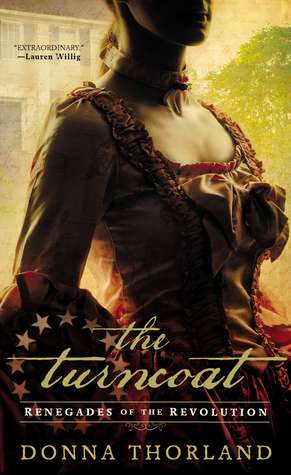
The Turncoat: Renegades of the Revolution by Donna Thorland

Source: Borrowed from Diary of an Eccentric
Paperback, 432 pages
I am an Amazon Affiliate

The Turncoat: Renegades of the Revolution by Donna Thorland is a steamy novel of espionage, spies, and cover-ups. Quaker daughter Kate Grey is swept up in a plot against the British by Mrs. Ferrars, who is tasked with watching over her while her father rides off with supplies for The Continental Army.  Riding away from the only home she’s known, she’s forced to hear and see the darker side of war as it comes to her neighbor’s farm.  From that moment of helplessness on, she’s made up her mind to fight against the British who have plundered her home and its women.  She establishes herself in Philadelphia as an heiress, with the help of Ferrars, and embarks on a journey she never expects would lead her back to the British officer, Peter Tremayne, whom Ferrars duped at the Grey farm.

“Only the barest sliver of light entered beneath the batten door, which was reinforced on both sides with iron plates.  He took care not to look directly at it; in this blackness it would blind him like the sun.  He stood soaking up the darkness, breathing in the chemical smells of old powder and fresh mold, and reining in the panic that threatened to overwhelm him.  It was like being underground, being buried.  The unseen vault must be at least three stories above him, and the emptiness held all the childhood terrors of the night, and the decidedly adult terror that came with the knowledge of all the ways a man might die in such a place.”  (page 207)

Secrets twist in on themselves as Kate becomes engaged to one of the most terrifying British soldiers campaigning with General Howe from Philadelphia.  Although Kate flourishes in her new role as beautiful spy, turning heads, she is ill prepared for the emotional attachment she feels for her mark and still has for the man she never expected to see again, Peter Tremayne.  The emotions that she keeps hidden driver her actions more than she realizes, and at times, they are what breaks down her facade, makes her stumble, and leaves her lying in traps set by more emotionally detached foes.

Thorland weaves fact with fiction seamlessly in this historical novel about the American Revolution, and readers will see the strategy and battle scenes play out with gruesome consequences.  She captivates her readers through the building of strong and flawed characters whose lives are not only torn apart by war, but also the loyalty they feel to their families and countries even as they see hope in the enemy.  Trust and loyalty are tested over and over again, but Kate is committed to her duty and risks everything she wants, especially with Peter, to save General Washington and the Rebel cause.  The Turncoat: Renegades of the Revolution by Donna Thorland is gripping and offers a more exciting look at the American Revolution from both the Rebel and Crown’s point of views.


About the Author:

Graduating from Yale with a degree in Classics and Art History, Donna Thorland managed architecture and interpretation at the Peabody Essex Museum in Salem for several years. She then earned an MFA in film production from the USC School of Cinematic Arts. She has been a Disney/ABC Television Writing Fellow and a WGA Writer’s Access Project Honoree, and has written for the TV shows Cupid and Tron: Uprising. The director of several award-winning short films, her most recent project aired on WNET Channel 13. Her fiction has appeared in Alfred Hitchcock’s Mystery Magazine. Donna is married with one cat and splits her time between Salem and Los Angeles.

This is my 56th book for the 2013 New Authors Challenge.


This is my 3rd book for the American Revolution Reading Challenge 2013

Jack Absolute by C.C. Humphreys

Source: Borrowed ARC from Diary of an Eccentric
Paperback, 320 pages
I am an Amazon Affiliate

Jack Absolute by C.C. Humphreys is a swashbuckling 007 tricked into rejoining the King’s military and the cause against the rebels (a.k.a. Colonials/Americans), to which he drags his Mohawk brother Ate.  Humphreys, who played Jack Absolute on stage before writing this novel, clearly has a love of cheeky dialogue and plot twists because the prose is filled with it.  Absolute wants to restore his family fortune and good name, but he’s soon embroiled in a spy’s game and turned around by pretty faces and dark blackguards.  Aboard the ship to America, he’s tasked with decoding messages by General Burgoyne and to observe his fellow shipmates to sniff out the traitor in their midst.

“He glanced around the circle of excited faces that turned to him.  No women, at least.  Not even the cause of this whole affair, that little minx, Elizabeth Farren.  The hour was too close to the lighting of the footlights at Drury Lane and her show must go on.  Yet how she would have loved playing this scene.” (page 3 ARC)

“And the strange new flag that floated over the ramparts–unseen til that day, concocted of stars and stripes obviously ripped from spare cloaks and petticoats–would soon be replaced by the Union Standard of Great Britain.” (page 67 ARC)

The novel gives readers a detailed glimpse into American Revolution battles — Saratoga and Stanwix –with Americans pulled between loyalty to the Crown and the desire for freedom.  At the same time, Absolute is torn between his duty to the Crown and his desire to protect his adopted brethren the Iroquois.  Humphreys mixes it up with Native Americans loyal to both England and Rebels, as well as those Native Americans that were schooled in Christianity and took on English names.  Like the U.S. Civil War, there is brother and cousin fighting against other family members, and friends and neighbors fighting each other.

The plot folds in on itself several times before it lengthens out to uncover some hidden mysteries, and while the big reveal is a bit predictable, the decision Absolute must make is emotional and heartbreaking.  It forces him to choose between duty and freedom and love and culpability.  In some ways, the novel reads more like a script for a movie or play, but the fast-paced nature of the plot makes for a fast and entertaining read.  Jack Absolute by C.C. Humphreys will entertain readers, while giving them an inside look into the tensions of battle, loyalty, and revolution.

About the Author:

Chris (C.C.) Humphreys was born in Toronto and grew up in the UK. All four grandparents were actors and since his father was an actor as well, it was inevitable he would follow the bloodline. He has acted all over the world and appeared on stages ranging from London’s West End to Hollywood’s Twentieth Century Fox. Favorite roles have included Hamlet, Caleb the Gladiator in NBC’s Biblical-Roman epic mini-series, ‘AD – Anno Domini’, Clive Parnell in ‘Coronation Street’, and Jack Absolute in Sheridan’s ‘The Rivals’.  Chris has written eight historical novels. The first, The French Executioner told the tale of the man who killed Anne Boleyn, was runner up for the CWA Steel Dagger for Thrillers 2002, and has been optioned for the screen.

This is my 2nd book for the American Revolution Reading Challenge 2013