
Quantcast

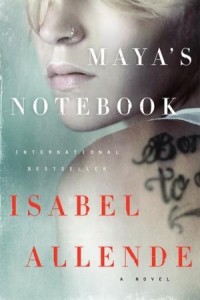
Maya’s Notebook by Isabel Allende

Book Source: HarperCollins and TLC Book Tours
Hardcover: 400 pgs
I am an Affiliate of Amazon.com

Maya’s Notebook by Isabel Allende is written in a notebook form without chapter breakdowns and is not a linear narrative.  Maya Vidal is a very troubled youth when tragedy strikes her very unconventional family of her pilot father who is rarely home, her grandparents Nidia and Popo, her absent mother Marta Otter, and the family friend Mike O’Kelly.  The novel is a departure from Allende’s typical historical fiction novels, but do not expect history to be absent from this coming-of-age novel — the takeover of Chile by Pinochet is present in the background, hanging over the Vidal family like a hazy cloud.  From her nose ring and tattoos to her goth clothes, Maya and her vampire friends set out on a path of self-destruction as a way to rebel against their family lives that they claim are very distasteful and harmful.  However, unlike Debbie and Sarah, Maya’s life is far from abusive and emotionally vacant, though it has changed significantly.

“I love some of the island’s customs, like truco, but there are others that bug me.  If a chucao, a tiny loudmouthed bird, chirps to the left of me, it’s bad luck, so I should take off a piece of clothing and put it back on inside out before going any farther; if I’m walking at night, I’m supposed to carry a clean knife and salt, because if I cross paths with a black dog with one ear lopped off, that’s a brujo, and in order to get away I have to trace a cross in the air with the knife and scatter salt.”  (Page 47 ARC)

Allende is a novelist that handles details with aplomb, weaving them in the disjointed narrative at just the right time, leading readers on an emotional journey that evokes not only frustration at Maya’s behavior, but also one of sympathy and sadness for the losses she feels.  She needs to hit rock bottom in order to climb up and rebuild her life, even though she falls off a high cliff into the abyss of drug dealers, mafia criminals, and the sex trade.  Allende does not sugarcoat anything that Maya experiences in her rehab stints or her escapes and drop off the map inside Las Vegas.  Unwittingly or willfully blind, Maya stumbles into a crime ring that is bigger than she ever thought it could be and it puts her life and the lives of her loved ones in danger as she never could have imagined. However, the end game with the conspiracy feels a bit contrived.

Maya’s past is never far behind, even as her life spirals out of control, chirping behind her ear at every turn.  Running is the only way she knows how to deal with her emotions, and its the way her family has dealt with the harsh struggles of their lives since the time of Pinochet. The ties that bind this family are stronger than ever, even as dynamics change between them and secrets of the past are uncovered. Love is the strongest tie, but fear also can be a great motivator as the walls close in. Maya’s Notebook by Isabel Allende is a modern marvel that will make a lasting impression on readers as a headstrong girl becomes unmoored and is forced to not only confront her own demons but the ghosts of the past.

About the Author:

Born in Peru and raised in Chile, Isabel Allende is the author of many bestselling novels, including, most recently, Island Beneath the SeaInes of My Soul, Zorro, Portrait in Sepia, and Daughter of Fortune. She has also written a collection of stories; three memoirs, The Sum of Our Days, My Invented Country, and Paula; and a trilogy of young adult novels. Her books have been translated into more than 27 languages and have become bestsellers across four continents. In 2004 she was inducted into the American Academy of Arts and Letters. Allende lives in California.  Find out more about Allende, her books, and her foundation at www.isabelallende.com, and connect with her on Facebook.

Pain, Parties, Work: Sylvia Plath in New York, Summer 1953 by Elizabeth Winder

Pain, Parties, Work: Sylvia Plath in New York, Summer 1953 by Elizabeth Winder is atmospheric and an indulgent retrospective of the lives of Mademoiselle‘s summer guest editors, who were hand picked from a bunch of college essays and pieces submitted by college women.  The magazine was not only known for its fashion and celebrities, but also for the writing it published from heavyweights like Dylan Thomas and Truman Capote.  Additionally, the magazine published its college issue.  “Sunday at the Mintons” by Sylvia Plath, a short story, earned her a guest editorship at the magazine, a summer that became the basis of her novel, The Bell Jar.  Winder bases her “loose” biography on interviews with those summer guest editors and others who had contact with Plath that summer, which are backed up by letters and journal entries from Plath herself as much as possible — though there is the pitfall that some memories may be nostalgic or missing certain truths about that time as memories fade.

From the moment she sets forth in New York, readers are introduced to a different Sylvia Plath from the moody and dark one they have come to know. This younger version of the writer is full of whimsy, loves fashion, and is eager to please.  Her Northeast upbringing probably instilled in her a deep sense of courteousness and decorum, but there were also inherent eccentricities already present in her character, especially during one luncheon in which she gobbles up all of the caviar appetizer without sharing.  A commune of young women was built at the Barbizon Hotel that summer, as many of the young women wanted careers and still to raise families in a period of history before the pill was available and before career women were considered part of the norm.

“A white enameled bowl bloomed out of one wall–useful for washing out white cotton gloves.  (Within days there would be little damp gloves hanging in each room like tiny white flags.)” (page 5 ARC)

While Winder provides a great many anecdotes about Sylvia from her fellow guest editors and roommates, there seems to be a disconnect between the Sylvia these women saw and the Sylvia that was.  At the outset, Winder tells the reader she wants to paint a different portrait of Sylvia Plath than the iconic one we all know of the suicidal poet.  And while she succeeds in showing a “good girl” that was Plath in her 20s, she also demonstrates how as a young woman free from the constraints of her own society, she was given more freedom to pursue men and other experiences, to which she might not otherwise have been exposed.  And like many young women — and even men — still finding their place in the world and how to accomplish their goals, they often suffer from the “grass is always greener” problem when the reality of their ideal opportunity is not as wonderful as it has seemed from afar.

There were some among the guest editors in 1953 who were given menial tasks and envied Plath’s work with Cyrilly Abels doing rejections and editorial work, but Plath languished in the role and her talents for graphics were cast aside in favor of her fiction-writing talents.  In many ways, those who believed in her talent had begun to stifle it.  While she may have looked the part of a professional interviewer and editor, Plath was chained to a makeshift desk that anchored down her spirit, while many of the other girls were enjoying their time as editors — meeting Plath’s hero writers and attending dinners and events.  It seems that this separation isolated her from the other guest editors, even though on the outside she was conversing with them and enjoying their company as well as the company of many strange men throughout New York.

It is too easy to suggest that Pain, Parties, Work: Sylvia Plath in New York, Summer 1953 by Elizabeth Winder aims to undo the iconic woman that is Sylvia Plath, but it does provide a wider view of her whole person.  Not just the mother, burdened artist, and ex-wife of Ted Hughes, but the spirited poet who was stifled by a dream job that she saw as a launching point who succumbed to her tendency to depression upon her return home after a series of unrelated rejections flooded in after that summer.  Plath was a woman plagued by her own dichotomies, who was unable to break free from the labels of society without the guilt that accompanied those actions, but she also was talented and burned brighter than many other women of her age.  What Winder succeeds in doing is providing an excellent look into 1950s New York and the pressures these young women faced as progressive ideals began to emerge.

About the Author:

Elizabeth Winder is also the author of a poetry collection. Her work has appeared in the Chicago Review, the Antioch Review, American Letters, and other publications. She is a graduate of the College of William and Mary and earned an MFA in creative writing from George Mason University.

This is my 20th book for the 2013 New Authors Challenge.


Please click the image below for today’s National Poetry Month Tour Post!

Ariel by Sylvia Plath


Click the image above for one National Poetry Month tour stop, and visit Life’s A Stage for a second today.

Ariel by Sylvia Plath is a collection that she crafted near the end of her life, before her suicide, according to the forward by Robert Lowell (Check out “Ariel“).  These poems are what Plath has been best know for, other than The Bell Jar, and these poems are by turns blunt and dark as she refers to death at nearly every turn and the fleeting nature of life.  Her poems are not only confessional in nature about her emotions and life, but they also examine the bittersweet nature of life and being a woman.

In “Elm,” the narrator speaks of having no fear, a fear of the unknown or a fear of loss, particularly in relation to love.  There is that fast movement forward, a moving onward to the next experience and next moment in time.  Many of her poems reflect this urgency to move forward and to stay in the moment — to enjoy it.  Her poetry, like many have said of her own personality, burns brightly and intensely, making no excuses for rawness there — like the predawn light on the horizon not marred by expectation or perception.

She talks of motherhood in a way that is unvarnished, speaking, “These children are after something, with hooks and cries,//And my heart too small to bandage their terrible faults./” in “Berck-Plage.”  In spite of the parasitic nature she ascribes to children, the title of the poem tells the tale of how joyous motherhood can be, with plage being a beach or a sunspot and the echo of France’s Berck-sur-Mer.  She also displays a bit of whimsy in her portrayal of “Gulliver” as he is over-run by the citizens of Lilliput.  Plath is hindered by the confines of society and expectation, and in these poems there is by turns the holding back or the tying down of narrators or images that dream of release or are released.  The push and pull of these images run throughout the book and probably echo the feelings Plath felt herself after her divorce and the onset of her single-motherhood.

Ariel by Sylvia Plath is a collection full of tension, explosions of release, and a search for balance between constraint and freedom.  Death is not necessarily death in the demise of the physical self, but a release and return to the freedom that is desired.

About the Poet:

Sylvia Plath was born in Boston, Massachusetts. Her mother, Aurelia Schober, was a master’s student at Boston University when she met Plath’s father, Otto Plath, who was her professor. They were married in January of 1932. Otto taught both German and biology, with a focus on apiology, the study of bees.

In 1940, when Sylvia was eight years old, her father died as a result of complications from diabetes. He had been a strict father, and both his authoritarian attitudes and his death drastically defined her relationships and her poems — especially “Daddy.” Photo Credit Rollie McKenna.

This is my 10th book for the Dive Into Poetry Challenge 2013.

The Best of PUNK Magazine by John Holmstrom and Bridget Hurd

The Best of PUNK Magazine by John Holmstrom and Bridget Hurd, with a foreward from Deborah Harry (yes, the singer from Blondie) and Chris Stein (co-founder of Blondie), is a compilation of the best articles and artwork from the magazine, and it opens with a fun depiction of New York City — “The PUNK Map of N.Y.C.: For jerks who just don’t know their way around.”  The drawings of the rivers and the streets and the realistic, and yet, out there cartoons are likely to generate smirks, if not genuine smiles.

As someone born in the late 1970s, but in love with punk music and Blondie, this collection is something that provides not only more background about the emergence of punk, but also the  whimsical fun and sort of not-a-care-in-the-world feel of the genre.  PUNK magazine had a lot to live up to as the voice of 1970s New York, but it also had a lot to break away from in terms of what was expected of a music magazine.  Clearly, PUNK was a magazine dedicated to snarkiness in all its forms — visual and textual — and it worked well.  It was gritty, it was real, and the glamor was no where in its photos or its comics, but that seems to be why the magazine stood out.  There was a whole lot of youthful exuberance in the beginning of this magazine as nicknames were handed out and spaces were renamed — like the PUNK Dump.

The opening interview with Lou Reed is just the tip of the mosh pit with this magazine.  Reed is so candid, it’s almost like he forgot he was being interviewed by a magazine, and it is unlikely anyone told him the interview would be turned into a comic strip.  The comics are filled with typical masculine and bathroom humor at times, but the drawings are enough to carry the jokes beyond their static line.  A really cool moment in the collection is the results of the Patti Smith Graffiti Contest, where some are so tasteful and others are just outrageous.

By the third issue, the magazine’s editors knew they were a hit when the Ramones snagged a record contract in part because of the magazine’s coverage of their band.  One particular gem in the collection is Holmstrom’s explanation of punk:  “sound — faster and louder; humor — like the novelty songs of the 1950s and 1960s; fashion — no glam, just the classics: shades, blue jeans, t-shirt, sneakers; minimalism — less is more.  No bombast; attitude — similar to the hippie ethos “Do your own thing but let me do mine,” but more like: “F**k you! I don’t care what you do, just leave me alone!”; do it yourself — publish your own ‘zine, make your own record; retro rock/conservatism — mining the tradition of rock ‘n’ roll from the 1950s and early 1960s, while rejecting everything after the hippies took over in 1967.”

The Best of PUNK Magazine by John Holmstrom and Bridget Hurd is a great compilation, but you may not want to leave it on the coffee table with conservative parents or in-laws around.  It’s got some bawdy humor, creative ideas, fantastically candid photos and interviews with punk rock stars of the time, and so much more.  Reminiscent of MAD Magazine and the like, but it really has a garage feel about it — a passion of the listener, the true fans of PUNK.

About the Author:

John Holmstrom is a cartoonist and writer and co-founder (with Legs McNeil) of Punk magazine. He illustrated the covers of the Ramones albums Rocket to Russia and Road to Ruin, and created the characters Bosko and Joe, which were published in Scholastic’s Bananas magazine from 1975-1984, as well as in Stop! Magazine, Comical Funnies, Twist, and High Times. Holmstrom’s work and unmistakable artistic style has become the key visual representation of the Punk era.

This is my 13th book for the 2013 New Authors Challenge.

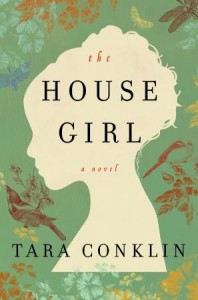
The House Girl by Tara Conklin

The House Girl by Tara Conklin is told mainly from two female points of view — Lina Sparrow and Josephine Bell — one is a white lawyer in New York City at a corporate law firm and the other is a slave/house girl in the southern Lynnhurst, Virginia.  Lina has lived with her artistic father most of her life as her artistic mother’s life was cut short.  Her story is compelling as she’s chosen the analytical and detached life of a lawyer over that of the emotional and less practical life of an artist.  Josephine, an equally if not more compelling story, is a slave on a tobacco farm caring for her dying mistress, who tries to sketch and paint in her upstairs studio.

“Mister hit Josephine with the palm of his hand across her left cheek and it was then she knew she would run.  She heard the whistle of the blow, felt the sting of skin against skin, her head spun and she was looking back over her right shoulder, down to the fields where the few men Mister had left were working the tobacco.”  (page 3 ARC)

Lina is a first-year associate at her law firm, and she works a mad number of hours as she tries to impress her boss and mentor, Dan, but at the same time, she seems to be beating her head against a wall.  There are some tenuous connections drawn between these two stories, the oppressive nature of working for a law firm and slavery, which may or may not be a fair comparison.  The narrative shifts from Josephine to Lina and between the past and present, and once Lina becomes involved with a slavery reparations case, she is wrapped up in innocuous research while all of her other cases are re-assigned.  She’s struggling with her role on the case, but also with the revelations about her mother and her father that have set her world askew.

“She couldn’t bear the thought of sharing.  This was where her mother had once slept, cooked, painted, breathed, and Lina’s memories of her seemed tethered to the physical space.  The way a wall curved away, a washboard of light thrown by the sun against the bare floor, the sharp clap of a kitchen drawer slamming shut — all these evoked flashes of her mother and early childhood that seemed cast in butter, soft and dreamy, lovely, rich.”  (page 21 ARC)

In the latter part of the novel, Lina comes across a biography of an abolitionist as she’s researching the life of Josephine Bell, but this section is overly long and could have been slimmed down a bit as Lina learns about the abolitionist’s connection to the Underground Railroad.  The strength of the novel is in Josephine’s story and her struggles with the Bell family, with her only release — the snatches of time she has to sketch and paint when her mistress is laid up in bed or asleep.  The mysterious life of Josephine is revealed in quick chapters, but early on these chapters are too focused on her desire to run and whether she should run.

In many ways, Lina’s story detracts from the whole, pulling readers into the present and into a case that seems more fantasy than reality.  However, Lina’s story with her father and mother — and the art world — is strong and could have been explored in a separate novel.  The artistic connection, more than the slavery reparations case, would have been a better angle for these stories, connecting the artists to one another through their craft and inspiration or something of that nature.

The House Girl by Tara Conklin showcases not only Conklin’s grasp of the Antebellum South, but also art and its craft.  The strongest parts of Lina’s story are those in her father’s art studio and in the galleries as the paintings are described and the ties between Josephine Bell and Lu Anne Bell are revealed.  Once the novel picks up speed, its tough to put down, and Conklin easily portrays the culture and atmosphere of the southern farm and the fear slaves felt daily.

About the Author:

Tara Conklin has worked as a litigator in the New York and London offices of a major corporate law firm but now devotes her time to writing fiction. She received a BA in history from Yale University, a JD from New York University School of Law, and a Master of Law and Diplomacy from the Fletcher School (Tufts University). Tara Conklin’s short fiction has appeared in the Bristol Prize Anthology and Pangea: An Anthology of Stories from Around the Globe. Born in St. Croix, she grew up in Massachusetts and now lives with her family in Seattle, Washington.  Check her out on Facebook and Twitter.  Also here’s a podcast about Conklin’s inspiration for the novel.  Photo credit Mary Grace Long.

tlc tour host

This is my 10th book for the 2013 New Authors Challenge.

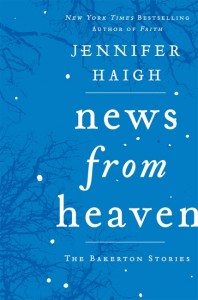
News From Heaven by Jennifer Haigh

News From Heaven by Jennifer Haigh is a collection of interconnected short stories about Bakerton, Pa., and while the characters in these stories all have roots in that former coal-mining town, the town itself is a character — matter of fact, it is the character — that holds these stories together.  Haigh has created a heartbreaking and hopeful story about the death and rebirth of a town and its people.  As the founding members, the Bakers, brought glory and industry to the town that ensured its prosperity, they also have a hand in its decline.

From WWI to the 1970s and 1990s, Haigh chronicles the rise and fall of a town tied closely to its founding family and the coal beneath its hills.  By the end, readers will be as connected to Bakerton as they are to their own hometowns and families.  From the coal hacked out of the mines to the black lungs carried by its resident miners, there is a deep sense of place and the people who inhabit it are as flawed and as memorable as the school teachers, mechanics, small business owners, and others of memory.

“The town lay before them in a deep valley, settled there like sediment:  the main street with its one traffic light, the rows of company houses, narrow and square — some brick-cased now, or disguised with porches and aluminum siding, but at this distance you could see how alike they all were.”  (page 166, “The Bottom of Things”)

Beautifully, each story builds upon the foundation of the last from the high flying days of the coal boom and the nepotism it wrought in the town to the ultimate crashing down of the town around the ears of the residents who relied too heavily on the Bakers to carry them through.  There are glimpses of how war can build up a town, while at the same time tear down its people, and there are other moments where the destruction of war is keenly felt at home when a soldier returns.  Haigh’s collection runs the emotional gamut, but the most striking passage comes in the final story, “Desiderata,” referencing the prose poem by Max Ehrmann.  She infuses the final story with a deep sadness of grief and the devastation of a secret revealed, but returns to the hopeful tone of rebirth and beginning anew amidst this unwanted baggage and knowledge.

In many ways, this collection depicts a slice of American history, with particular attention paid to how immigrant groups interacted with one another and to each other even in a new country.  Even as war is far away, many of the prejudices bred abroad continued in their new homes, and these interactions continued to reflect in future generations.  News From Heaven by Jennifer Haigh has a blasé title, but given the final moments of the collection and the reference to the prose poem, it is reflective of Haigh’s focus on faith.

About the Author:

Jennifer Haigh is the author of the New York Times bestseller Baker Towers, winner of the 2006 PEN/L. L. Winship Award for outstanding book by a New England author; Mrs. Kimble, which won the PEN/Hemingway Award for debut fiction and was a finalist for the Book Sense Book of the Year; and The Condition.

Her fiction has appeared in Granta, Ploughshares, Good Housekeeping, and elsewhere. She lives in the Boston area.

Find out more about Jennifer at her Website and connect with her on Facebook.  Also check out her Book Club Girl discussion.

This is my 7th book for the 2013 New Authors Challenge.

The Zombie Chasers by John Kloepfer, illustrated by Steve Wolfhard

The Zombie Chasers by John Kloepfer, illustrated by Steve Wolfhard is a graphic novel of sorts for kids age 8-12.  Zombies are flooding the quiet Arizona neighborhood while parents are at the school with teachers and Zack is being duct-taped to a chair by his big sister, Zoe, and her girlfriends, Madison, and Ryan.  Locked in his room, Zack scrambles for a way out and water to wash off the clown makeup his sister put on his face.  As he sneaks out into the kitchen to get the last piece of his his birthday cake, he spies his crush, Madison, forking bites of the cake into her own mouth.  As they argue about the cake, the zombies make their way into the house, forcing the two unlikely companions up into Zack’s room where they formulate an escape.

The illustrations are black and white and accompanying the events in the text as Zack, Madison, and Zack’s best friend, Rice, hack their way through town.  Rice thinks of himself as a zombie expert, and like typical kids, there’s arguing about who’s an ugly faced dork, and who’s a snotty brat.  There are funny moments, gross moments, and scary moments as the kids try to escape the zombies and find a solution.

“In the midst of her tantrum, she’d neglected to notice the huge pair of tighty-whities hanging around her neck.  She ripped them off her head quickly and threw them at Zack.”  (Page 58)

“Both his lips were gone, leaving a jagged bloodstained gash where the bottom half of his face should have been.  His gums had shriveled, exposing the roots of his teeth.  It looked like he had just won first place in a cherry pie-eating contest.”  (Page 101)

Kloepfer creates a group of kids that reminds me of the group in Steven King’s IT, a group of misfits banding together to fight or fly away from evil.  Only in this graphic novel, the kids are more comical than serious.  While there are moments of bullying and peer pressure, there is more zombie fun, grossness, and scrambling from place to place.  While the illustrations are fun, they are not necessary, but it would be better if they were more vivid with color.  The Zombie Chasers by John Kloepfer, illustrated by Steve Wolfhard is a fun start to a series of books, but be warned there is a major cliffhanger.

About the Author:

John Kloepfer first started writing at five with a short story of only one sentence. Now, he has authored many full length novels in The Zombie Chasers series. John is currently an official Zombie Chaser living in New York City.

About the Illustrator:

Steve Wolfhard is a Canadian with a knack for illustrations. His drawings can be seen in the Zombie Chaser series. Steve is also the creator of Cat Rackham and the beloved new cartoon character, Turtie.

This is my 6th book for the 2013 New Authors Challenge.

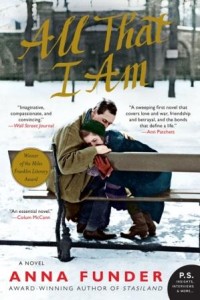
All That I Am by Anna Funder

All That I Am by Anna Funder is an unusual pre-WWII novel that takes into account not only the after effects of WWI, but also the politics that flooded Germany before the war.  Funder has crafted a psychological novel in some ways, but the characters who are most interesting and mysterious — Hans and Dora — also are the most distant.  Perhaps they are more interesting and mysterious because they are seen through the eyes of those who knew and loved them best — Ruth and Ernst Toller — which begs the question of whether we — ourselves — would be more interesting to others if seen through our closest connections.  Ruth, Ernst, Hans, and Dora, along with others, are forced to flee Germany for London after Hitler comes to power.  Funder admits that many of the elements of her novel are taken from history and from her friend Ruth’s actual life, but this novel is not just about the history and intrigue of German ex-pats seeking information from inside the regime about their friends and to warn other countries about Hitler’s expectations for war.

“Last week they loaded me into the MRI machine, horizontal in one of those verdammten gowns that do not close at the back: designed to remind one of the fragility of human dignity, to ensure obedience to instruction, and as a guarantee against last-minute flight.”  (page 7)

Ruth and Dora are cousins, and Ruth is easily swept up into the passion of the Socialist party Dora belongs to because she’s already fallen in love with the words of a young man, Hans.  Even at the beginning, there is a tension between Hans and Dora, and while Ruth first mistakes it for a lover’s intimacy, it is clear to the reader that the tension is born of jealousy and competition.  The beginnings of the movement hold close to their ideals for peace and workers’ rights — even equal rights for women — but those ideals are tested time and again.  These ideals are burdened and even broken, as seen through the eyes of the individuals tested.  Funder’s unraveling of the story in two perspectives — Toller and Ruth — can be frustrating, as Toller and Ruth tell their stories from different points in time, which calls into question whose memory is more reliable.  Both are looking to the past before WWII and their early days in exile, and Funder leaves enough clues along the way for readers to pick up on the essence of the outcome.

“From what Bev has told me, an addict can lose ten years of their life in a quest for exactly this:  the constant present tense.  Afterwards, those who do not die wake to a world that has moved on without them:  it is as if nothing happened to the fiend in those years, they did not age or grow and they must now pick up –”  (Page 201)

Whether the drug is an opiate, morphine, or memory, these activists, these friends, these compatriots become blind to the realities of their exile.  Rather than remember their past glories with fondness, Hans, in particular, and Toller become absorbed in the images of themselves — those they created or were created of them.  Funder is calling into question the image we have of ourselves and those that others have of us — are those perceptions mirrors of themselves or are they a bit distorted when compared.

All That I Am by Anna Funder sheds light on the lives of German ex-pats before WWII, and the secretive life some of them led as they tried to help those they left behind in Germany.  But at it’s heart, the novel is about how politics and ambitions can distort friendships or not matter at all.  It’s also about the enduring love for those we know and love, even those that are unworthy of that devotion and those who also offer more of themselves to the world and others than they do to themselves.  A novel of memory, love, devotion, and self-sacrifice worth reading.

About the Author:

Anna Funder’s international bestseller, Stasiland, won the Samuel Johnson Prize for nonfiction. Her debut novel, All That I Am, has won many prizes, including the prestigious Miles Franklin Literary Award. Anna Funder lives in Brooklyn, New York, with her husband and children.

Visit Anna at her Website and connect with her on Facebook.

This is my 5th book for the 2013 New Authors Challenge.

The Tell by Hester Kaplan

The Tell by Hester Kaplan unfolds like a stop-motion movie, one frame at a time, and in that movie there are flashes of the past.  Owen Brewer’s attention is easily swayed from one subject and one moment to another, breathing in both the past and present of his life, while at the same time observing the behaviors and ticks of others.  His marriage to Mira Thrasher is modern and telling, especially in how they introduce themselves to the new neighbor and former actor Wilton Deere.  Their marriage does not seem to be on solid ground, just from the way Owen watches the interaction of his wife and Wilton and thinks about reclaiming her in the most instinctual way.  Owen is tough to take and analyzes a great many things much more than other people would, while Mira is more a take-it-as-is girl and enjoys the moments, while not watching for the sky to fall.  Meanwhile, Wilton is trying to reconnect with his daughter, but in the process clings to this married couple next door because he longs to be loved and hated.

“Owen leaned into the sink and gulped water, leady and lethal, from the tap. Then some movement of white, gone before he could fully detect or confirm it, drew his eye past the unfurling pleasure of the lilacs to the empty house next door. Its windows were violet mirrors. In the year since the place had been on the market, Owen had sometimes used the house to animate wisps of his imagination they way people used empty battlefields. Where they saw the fuming charge across the hard-packed earth, the clash, the fallen in the grass, the victorious mob shaded by incoming clouds, he pictured his future children on the oak stairs, bodies passing in front of doorways, and the motion of family life he hoped to have here in this house, someday, with Mira.” (page 3 ARC)

Kaplan’s novel is psychologically complex.  Mira is an artist, struggling to keep her studio open and helping give direction to the elderly, young, and even homeless.  At the same time, she is hardly home when she is with Owen, and most nights, she’s off at the casino with Wilton, though she claims she does not have a gambling problem.  Kaplan explores the breakdown of trust between a husband and wife, the rebuilding of faith between an estranged daughter and father, and the power of addiction and obsession.  Each person has a “tell” — which in gambling is a change in a player’s behavior or demeanor that can give clues to other players about the truth of their hand — and in this case, Owen is trying to discern Mira’s tell, while navigating a new and untested friendship with a man he presumes is trying to get a little closer to his wife.  With Wilton, the task of determining the tell is more difficult as Owen cannot determine if he is telling the truth, acting, or a combination of both, though Owen in many cases errs on the side of Wilton telling lies.

“It was like standing still while a very fast train blew by you and lifted your hair.  What remained was what had been forgotten or abandoned:  a towel in the bushes, a single sneaker, a cat, a brightly colored plastic ring still drifting on the pond.”  (Page 100 ARC)

Kaplan’s novel unfolds with careful precision as she delves deeper into the spiraling vortex of Owen’s marriage with Mira, and his obsession with her family’s hording and her secret trips to the casino.  Each is scared to be alone, but not scared enough to stop their behavior from ruining everything.  Kaplan’s The Tell is dark and woeful, her characters are swimming in a dark pool and clinging to any hope they see, no matter how fleeting or false it may be.

About the Author:

Hester Kaplan is the author of The Edge of Marriage, which won the Flannery O’Connor Award for Short Fiction, and Kinship Theory, a novel. Her short stories have been included in The Best American Short Stories series. She teaches in Lesley University’s MFA Program in Creative Writing and lives in Rhode Island.

Find out more about Hester at her website. You can also follow her on Facebook and Pinterest.

tlc tour host This is my 2nd book for the 2013 New Authors Challenge.

Not Young, Still Restless by Jeanne Cooper, Lindsay Harrison

Not Young, Still Restless by Jeanne Cooper and Lindsay Harrison is a great memoir for the fans of The Young and the Restless soap opera and Katherine Chancellor.  She was born in 1928 to part-Cherokee parents, and was the youngest of three children.  My mother has watched the show since before I was born, and I remember the fateful episode in which Mrs. C. drove her husband off a cliff in a drunken stupor — I was one.  Yes, this show has been in my life for a very long time.

Cooper infuses her memoir with honesty, but also refuses to tell stories that are not her to tell.  She may be harsh on her ex-husband, but once you read about his antics, it’s hard not to see why she’d still not be his biggest fan.  However, she does admit that her relationship with her husband did beget her some wonderful and talented children — Corbin Bernsen, Collin, and Caren.

“I don’t care who you are, you don’t get more than one chance to betray me, and as this book should make apparent, I have a very long memory.”  (page 13)

There is some kissing and telling, but it’s not graphic, and its touching for the most part.  Cooper also offers some great insights into the soap opera business and movie/TV business.  One touching moment in the book is when she talks of her dear friend, Raymond Burr — a WWII veteran who survived the Battle of Okinawa and was awarded a Purple Heart!  She and Ray had a great friendship and there is a fun story about the time she “borrowed” his trophy just before he headed to Japan to meet with troops at an army base.

Cooper is frank in her stories and her memories — or lack there of — about events, and yes, there are moments where she doesn’t explain how she met certain famous actors and actresses, like Grace Kelly, but her open heart and charitable spirit shine through in how she cares for her family and others.  I loved the story of how she and her young daughter witnessed a car accident and stopped to help.  Her daughter was scared, but Cooper explained to her that they had to help if someone was in need.  It was their duty to do so.  We need more parents like this and more citizens who care!

Not Young, Still Restless by Jeanne Cooper and Lindsay Harrison shows that no matter your age, you are not done living yet and that there is more love, devotion, and duty to give.  Cooper’s memoir offers some great insight about the Y&R, Hollywood, and family.  Highly recommended for fans of the show and for those who are interested in learning about old Hollywood.

About the Author:

Jeanne Cooper has earned the love of soap-opera fans for her long-running role as Katherine Chancellor on CBS’s The Young and the Restless. She received back-to-back Daytime Emmy Award nominations as Outstanding Leading Actress in a Drama Series in 1989, 1990, and 1991. In 1993, she was awarded a star on the Hollywood Walk of Fame, in recognition of her many years in show business.

This is my 89th book for the New Authors Reading Challenge in 2012.


Judging a Book by Its Lover by Lauren Leto

Judging a Book by Its Lover by Lauren Leto is a guide to the mind of readers everywhere, and it offers some great tips on how to fake it for readers who may not have read some contemporary or classic authors that everyone else has been.  Leto is like many of us in that she says, “Considering yourself a serious reader doesn’t mean you can’t read light books.  Loving to read means you sometimes like to turn your head off.  Reading is not about being able to recite passages from Camus by memory.  Loving young adult novels well past adolescence isn’t a sign of stunted maturity or intelligence.  The most important thing about reading is not the level of sophistication of the books on your shelf.  There is no prerequisite reading regimen for being a bookworm” (page 8).  To that end, she discloses that she’s likely to be found with the latest Janet Evanovich in her hand when she has to fly anywhere.

The initial confessions read like that of any bookworm, with the boxes and boxes of books moved from apartment to apartment and from makeshift bookshelf to re-purposed material made into a bookshelf — in her case, a couple of old ladders (page 13).  Leto even offers a funny little bit about changing the readers’ mascot from a worm to a cat, but one of the most ironic reasons in the book is because cats hold grudges (page 63) — like many do against James Frey from A Million Little Pieces, who offers a witty quote about Leto’s book on the cover.

Through a series of chapters of advice on how to fake having read a particular book, using vague statements and comparisons to popular movies and other writers you may have read, Leto has created an unapologetic homage to reading as entertainment, education, enjoyment, escapism, and understanding.  She even includes a chapter on rules for the book club, which means talking about book club with others not in your club or about the books you are reading in the club as well as how best to end a disagreement over something that happens in one of the books read by the group.  Her observations on members of a book club and their roles from the leader to the quiet (usually girl) member are in line with many readers’ experiences, including those who might even fit those character types in one group or another.

Some of the best aspects of this book are the snarky comments about authors and readers of certain authors, like those who adore Chuck Palahniuk are boys who cannot read and those who love Chuck Klosterman are boys who don’t read.  Leto’s comments about the “Literati,” a chapter with an alternate title of “Why Ernest Hemingway Once Told John Updike Literary New York Is a Bottle Full of Tapeworms Trying to Feed on Each Other,” is hilarious and a warning for those would-be writers out there.  Judging a Book by Its Lover by Lauren Leto is not really about judging anyone, but it is about having fun with books and reading, making connections even with strangers, and finding happiness in a bent page — to paraphrase her (page 245).

About the Author:

Lauren Leto dropped out of law school to start the popular humor blog “Texts from Last Night.” She co-authored the book Texts from Last Night: All the Texts No One Remembers Sending. She lives in Brooklyn.

This is my 78th book for the New Authors Reading Challenge in 2012.

Thoughts on Some Remarks by Neal Stephenson

Some Remarks by Neal Stephenson is a collection of essays, one sentence from a novel that he never finished, and a few short stories.  I’m not the typical audience for this book as I don’t read a lot of non-fiction, nor science-y essays.  As a result, I read a bit of the most recent essays in the collection, the introduction, and the short fiction pieces, plus the one sentence to the novel.  I can say that I see why he never went further with his novel; it wasn’t very attention grabbing for me, but hey, it might have been a sentence from a future chapter and not the book opener for all I know.

To say this collection is weird is an understatement; readers only need to check out “Spew” with its tech-babble and sci-fi tongue-in-cheek feel as Profile Auditor 1 skulks around the big brother system that watches everyone’s lives for a living, looking for anomalies.  I found the overwrought tech language and mysteriousness too much; I was kept too much in the dark for the beginning part of the short story.  However, by the end, I was intrigued by the hotel clerk and her suspicious profile and wondered what the profiler’s interest in her was, but it is clear by the end of the story that she’s got more gumption than he does.  While Stephenson brings up issues of big brother and what it could mean from a marketing perspective, the story also gave me pause about my own buying habits and whether I’m that gullible in my purchases — seeing it on television or the Internet is enough to make me buy it — but I also realized that is not all that he is highlighting, but also the factors that play into buying decisions from friends, recommendations, advertisements, and finances.

“Patch this baby into your HDTV, and you can cruise the Metaverse, wander the Web and choose from among several user-friendly operating systems, each one rife with automatic help systems, customer-service hot lines and intelligent agents.  The theater’s subwoofer causes our silverware to buzz around like sheet-metal hockey players, and amplified explosions knock swirling nebulas of tiny bubbles loose from the insides of our champagne glasses.”  (page 288, “The Great Simoleon Caper”)

The second short story, “The Great Simoleon Caper,” relies on a similar notion of a man behind the technology who looks in on customers through their set top boxes, but instead of profiling their likes and dislikes and buying habits, he is their customer service representative to iron out their problems.  In this scenario — which began with a “innocent” brother’s request for how many jelly beans would fill up Soldier Field — the customer service rep brother is suddenly thrust into an underground plan to circumvent government controls.  Investing in Simoleons, an e-money, is a campaign his brother wants to succeed, but how will his brother ensure that the deal goes off without a hitch.  Do you sense a bit of paranoia in these stories?  A bit too much over-the-shoulder watching?  Perhaps that’s a good thing — keeping people honest and on their toes.

Stephenson’s fiction was livelier and more inventive to me than the nonfiction essays about the dangers of sitting at a desk for your job and other topics, which seemed to try to hard to be humorous or witty.  Some Remarks is an interesting collection of essays, but for someone that reads mostly fiction and poetry, this is not a good fit.

About the Author:

Neal Stephenson is the author of the three-volume historical epic “The Baroque Cycle” (Quicksilver, The Confusion, and The System of the World) and the novels Cryptonomicon, The Diamond Age, Snow Crash, and Zodiac. He lives in Seattle, Washington.

This is my 64th book for the New Authors Reading Challenge 2012.