Quantcast

Interview with Allison Markin Powell, Translator of Schoolgirl by Dazai Osamu

I recently read and reviewed Schoolgirl by Dazai Osamu, which was translated by Allison Markin Powell from the Japanese this month and enjoyed its look at a teenage girl in post-WWII Japan.  Check out my review here.

One of my personal goals this year is to read more works that are translated from their original language into English, and as part of that, I hope to learn and share with you what I learn about the translation process and what translators find so attractive about their work.  To that end, I’m happy to share with you my recent interview with the translator of Schoolgirl, Allison Markin Powell.

Please give Allison a warm welcome.

1. Schoolgirl was originally written in Japanese by Osamu Dazai; Is Japanese your first language? If not, what prompted you to learn the language and start translating Japanese books into English? Also, I’ve noticed the use of “obsequious” several times in the book, does this have a literal translation into the Japanese?

English is my first language; I didn’t start studying Japanese until I got to college. I had studied French since middle school, and liked learning a new language, so I wanted to try one that was quite different. Japanese was a rather arbitrary choice, and little did I know how challenging it would be. But I was fascinated–in particular with the beauty of the written language–and eventually learned enough to start practicing with translation.

The word ‘obsequious’ in the text is a translation of hikutsu (卑屈) in Japanese.

2. Do you translate books from other languages? If so, which of those books would you recommend to my readers?

I only translate books from Japanese. Next month a novel that I translated, The Briefcase by Hiromi Kawakami, will be published by Counterpoint Press. Kawakami is immensely popular in Japan, and The Briefcase was a huge bestseller. It’s a wonderful book.

3. Could you describe a little bit about the translation process and what surprised you most about translating Dazai’s work?

I imagine every translator has their own idiosyncratic process. I try to read the work at least a couple of times before I start translating it, and hope that I begin to hear the author’s voice in English develop in my mind. I think it’s very important for the translator to feel comfortable with the author’s style. There have certainly been writers with whose style I’ve been incompatible.

Dazai is one of Japan’s most beloved writers and his work is extremely challenging to translate, although I can’t say that was surprising. He expresses himself so clearly in Japanese, yet his syntax is incredibly complex when you break down his sentences, as a translator must do. Last year I also had the opportunity to translate a modern adaptation in manga form of Dazai’s most famous novel, No Longer Human. That book is supposedly somewhat autobiographical (and terribly dark) and it presents an interesting contrast to Schoolgirl.

If I had to name something surprising about this book, though, I suppose it’s the tender quality of the vein of sadness that permeates the girl’s story. The scene she recalls in her sister’s kitchen makes me catch my breath every time.

4. How did you get into the business of translating? Did you just pick up a book and start translating it into English and shop your translation around or was it through other means?

Many translators would probably laugh at the phrase, ‘the business of translating.’ I’ve been interested in literary translation ever since reading The Little Prince in French class, and so I worked in the publishing industry for years, in order to understand how it works and who makes decisions about what gets translated and published. I had translated some fiction when I was in graduate school (as yet unpublished), but my first paid translation project was a manga series, which is a great gig for a freelancer because it’s steady work. Now I translate all kinds of books from Japanese–fiction, of course, but I’ve also translated biography, art & architecture books, craft books, and so on–and I edit Japanese translations as well.

5. Have you ever thought of writing your own novel in English or another language? Why or why not?

I have no interest in writing my own novel. I find that the art of translation suits my creative impulses quite aptly.

6. Please tell us a little bit about your work with Words Without Borders?

Words Without Borders is such a vital organization. These days there are more and more people and publications paying attention to and promoting international literature and works in translation–especially online–but that wasn’t the case when WWB started. I went to college with Samantha Schnee, one of the founding editors, and I was immediately interested when I heard about their mission. I jumped at the chance to guest edit an issue focused on new writing from Japan, which came out in May 2009. Translating can be such solitary work, and that was an incredible opportunity to reach out to other translators–to solicit ideas, to hear what they were working on, and to see what their process was like. I still submit translations to WWB whenever I can, and I’m tremendously grateful to be a part of the community they support.

7. Are there specific steps that you could suggest for someone interested in translating works into English or particular degrees/career paths that they should consider as a stepping stone?

I wouldn’t say there are specific steps along this career path, although in literary translation, it seems the vast majority of translators are in academia, a setting that provides ample opportunity to read and learn about writing in other languages. However, since I am not in that world, I can’t really speak to whether or not that facilitates one’s career as a translator.

My best advice is to do everything possible to hone one’s translation skills, which not only involves practicing translation but also reading widely–both in English and the language to be translated. Research who publishes the kind of work you wish to translate, both in print and online, and reach out to them. A (savvy) idea might be to start reviewing books in translation for any of the sites that promote international literature.

Thanks, Allison, for sharing your work with us and for providing us some insight into the translation process.

Vampire Knits by Genevieve Miller

Vampire Knits by Genevieve Miller is a collection of knitting patterns from a diehard Twilight series fan, who was so inspired that she created a collection of patters for other fans of the series and vampires in general.  However, some of these patterns could just be knitted and worn by everyday, non-vampire fans and fans of werewolves/shapeshifters too.  The book’s font and design seem very appropriate for the vampire inspired knitting in these pages, which are broken down into sections:  Protect Me; Just Bitten; Vampire Style; Bloody Accents; and Who’s Afraid of the Big, Bad Wolf?

There is a glossary of knitting abbreviations, which could help beginning knitters and a metric conversion chart.  The book also includes credits for contributing designers and a special skills section outlining what cables, stranded knitting, short rows, 3-needle bind off, and other stitches are.  For someone that doesn’t knit, this book is just pretty to look at, and if you have a friend who knits, this might be a perfect gift for them, especially if they knit you things for birthdays and holidays.  Each pattern offers step by step directions and designate the proper skill level for each pattern from beginner to expert.  There are scarfs, sweaters, hats, bottle cozies, purses, and even jewelery.

Looking through this book, readers could easily see Alice, Edward, and Bella wearing some of these designs, but there are others that would be perfect for the Goth crowd, like this Prim Reaper’s Corset.  Some of my particular favorite designs in the book are The Black Veil Scarf, Vampire Diary Protector (which you could use for books too), and Sitio Stockings.  The Tourniquet Scarf looks like something men would wear, and there are sweaters for kids with vampire teeth.

Vampire Knits by Genevieve Miller is an excellent book for knitters looking for something a little different, and some of the patterns and stitches look lovely and fashionable — this is not your grandmother’s knitting.  If I could knit — which I can’t at all — I’d try out some of these patterns in a heartbeat.  I’ll definitely be passing this one along to a knitter, and maybe I can get a nice Black Veil Scarf out of the deal?!

About the Author:

Genevieve Miller was inspired to design her own patterns after reading Twilight. She is the mother of three and luckily married to a guy who doesn’t mind the house being taken over by a giant yarn stash. She lives in Pasadena, California.


This is my 4th book for the 2012 New Authors Challenge.

Stories for Nighttime and Some for the Day by Ben Loory

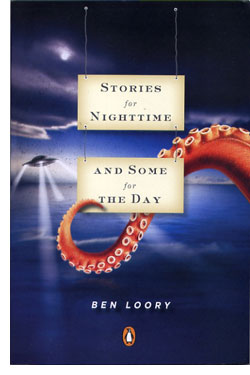
Stories for Nighttime and Some for the Day by Ben Loory brings back the parable, the allegory, and the fable in an absurdist manner — think Animal Farm meets the Myth of Sisyphus and Paul (particularly with its comedic attributes and alien encounters). Each story is about 20 pages long, but is utterly absorbing. Readers will fall head first over a cliff into these stories and as the waters of Loory’s prose wash over them, they will be in a new fantastical world where anything is possible no matter how impossible. At the end of each story, readers will have to either shake off the fantasy or simply continue delving into the worlds Loory has created without pause.  Coming back up to reality can be tough, but each story is worth the moments of initial fuzziness.

There are televisions and animals that talk quite animatedly with humans, as do aliens and trees.  And some of these characters have very set-in-stone opinions, and on more than one occasion, those opinions are proven wrong or even turned upside down in just a few lines.  Loory’s prose shies away from the poetic and flowery language used by other writers, but in his sparse lines, there is a depth of philosophical intent and even just a joking nature to be uncovered.   Readers will be giggling, smiling, and scratching their heads, but either way, these short stories will impact their thinking and mood for the better.  Do not be fooled, however, by the seemingly tongue-in-cheek style Loory uses because there are darker elements, which are nicely reflected in the deep, dark blue in the cover and the imposing octopus tentacle.

The Shadow

"ONCE THERE WAS A MAN WHO WAS AFRAID OF HIS shadow.
    Then he met it.
    Now he glows in the dark." (page 58)

The ominous feeling in some of these stories is haunting, like in the way that “The Tunnel” resembles the darkness that Stephen King easily creates as a gang of kids follows a killer clown into their town’s sewers in It.  The impossible becomes possible in these stories, and Loory’s words touch upon faith, love, loss, and the darkness within the human spirit — there is a logic to be found in absurdity.

In “The Poet,” the man writes a poem and becomes angered when it is rejected, but even before he sent it out, he knew it wasn’t that good.  Rather than revise it, he self-publishes it and posts and hands out his xeroxed copies to passersby.  Here Loory seems to be indicating the absurdity of demanding to be published even if the work is poorly written.  However, looking deeper, the story seems to be talking about the dedication it takes to become a good writer and that not being published shouldn’t matter if good writing is the goal.

Stories for Nighttime and Some for the Day by Ben Loory speaks to the inner child, coaxing it out from behind the adult into a fantastical world of monsters and talking animals only to slap that child back into place and point out the absurdity of blind categorization and conviction that many of us cling to steadfastly in adulthood.  There is a world of possibilities in this short story collection and readers will be blown away by Loory’s imagination and ability to create new myths to break down and rebuild.

Author Ben Loory

About the Author:

Ben Loory lives in Los Angeles, in a house on top of a hill. He was born in Dover, New Jersey, and is a graduate of Harvard College. In November 2008, his story “Photographs” was a finalist in the Glimmer Train Short Story Award for New Writers Contest. Since then his fables and tales have appeared online and in print in journals and magazines of all shapes and sizes, ranging from literary to fantasy, humor to horror, young adult to SF to sports-related and more.


***Thanks to Unabridged Chick for making me want to read this (check out her review)***

This is my 3rd book for the 2012 New Authors Challenge.

New Book Club, New Beginning

Anna and I have had bad luck with book clubs over the last several years, as we continue to seek like-minded individuals who are willing to give anything a try in their reading and not quit a book club simply because they hate one of the books they’ve read.

This past Saturday, we met with our new book club at Novel Places — my new favorite bookstore. Our meeting lasted about 2 hours as we browsed the books — used and new — and chatted about how we’d select the books we’d read. So far, we have all our books through August selected. A few of our members were not able to make the meeting, so I suspect their book nominations will fill out the rest of the year. We have an interesting mix of classic and contemporary fiction, historical fiction, scifi-like fiction, and nonfiction. I cannot wait until the February meeting where we’ll talk about our first book, The Picture of Dorian Gray by Oscar Wilde.

In case you’re interested in the rest of our list, here it is:

Feb.: The Picture of Dorian Gray by Oscar Wilde
March: Star Wars & Philosophy by Kevin Decker
April: A Lesson in Secrets by Jacqueline Winspear
May: City of Thieves by David Benioff
June: Wonderstruck by Brian Selznick
July: When She Woke by Hillary Jordan
Aug.: Ashes by Ilsa Bick

What will your book club be reading?

Mailbox Monday #161

Mailbox Mondays (click the icon to check out the new blog) has gone on tour since Marcia at A Girl and Her Books, formerly The Printed Page passed the torch. This month’s host is the At Home With Books.

Kristi of The Story Siren continues to sponsor her In My Mailbox meme.

Both of these memes allow bloggers to share what books they receive in the mail or through other means over the past week.

Just be warned that these posts can increase your TBR piles and wish lists.

Here’s what I received this week:

1.  The Baker’s Daughter by Sarah McCoy, which I received for my TLC Tour stop in March.

2.  Vampire Knits by Genevieve Miller, which came unsolicited from Random House.

These I won from BookHounds and some of these will find homes with my mother (who just loves mystery novels) and some other friends:

3. Fadeaway Girl by Martha Grimes

4. Day by Day Armageddon Beyond Exile by J.L. Bourne

5. The Rock Hole by Reavis Wortham

6. Bet Your Bones by Jeanne Matthews

7. Swift Justice by Laura DiSilverio

8. Electric Barracuda by Tim Dorsey

9. Heads You Lose by Lisa Lutz and David Hayward

10. Dracula in Love by Karen Essex

11. Knit Two by Kate Jacobs

BACK to the review copies and the book buys from the weekend:

12. The Unauthorized Biography of Michele Bachman by Ken Brosky

13. The Three Colonels by Jack Caldwell for review from Sourcebooks

14. Mr. Darcy Forever by Victoria Connelly for review from Sourcebooks

15. Catalina by Laurie Soriano for consideration in the Indie Lit Awards Poetry category

16. If I Die in a Combat Zone by Tim O’Brien, which I bought at the book club meeting at Novel Places for $1.50 to complete by collection of O’Brien books.

17. The Stupidest Angel by Christopher Moore, which I also bought at the book club meeting at Novel Places for $1.99 because I loved this book when I first read it and want my own copy.

18. Definitely Not Mr. Darcy by Karen Doornebos, which I also bought at the book club meeting, since Anna told me it was hilarious.

What did you receive this week?

The Gauntlet Has Been Dropped: Monthly Poetry Event

Lu, Kelly, and Eva have talked about reading more poetry in 2012, and they want us all to join in.  Stuck for a list of enjoyable poetry books, check out the Indie Lit Awards 2011 list and Lu’s list.

This challenge is open to everyone — from those who love poetry already to those just starting out or returning to poetry — and you don’t even have to read poetry, but post about poetry.  You could post about your favorite poet, why you hate poetry, why you want to read poetry, different poetic forms, something you remember about poetry from school, and anything else you can think of as long as it is about poetry.

This is the schedule for posting ONCE per month:

Poetry: Read More/Blog More – A Monthly Event!

January 31st
February 28th
March 27th
April 23rd
May 29th
June 26th
July 31st
August 28th
September 25th
October 30th
November 27th
December 18th

Once you’ve posted, visit Lu and Kelly’s blogs to put your link in the Mr. Linky!  Once you have your sign up post ready, link up here.

I’ve picked up the gauntlet, will you?!

133rd Virtual Poetry Circle

Welcome to the 133rd Virtual Poetry Circle!

Remember, this is just for fun and is not meant to be stressful.

Keep in mind what Molly Peacock’s books suggested. Look at a line, a stanza, sentences, and images; describe what you like or don’t like; and offer an opinion. If you missed my review of her book, check it out here.

Also, sign up for the 2012 Fearless Poetry Reading Challenge because its simple; you only need to read 1 book of poetry. Please visit the stops on the National Poetry Month Blog Tour from April 2011 and beginning again in April 2012.

Today’s poems is from Philip Levine:

A Story

Everyone loves a story. Let's begin with a house.
We can fill it with careful rooms and fill the rooms
with things—tables, chairs, cupboards, drawers
closed to hide tiny beds where children once slept
or big drawers that yawn open to reveal
precisely folded garments washed half to death,
unsoiled, stale, and waiting to be worn out.
There must be a kitchen, and the kitchen
must have a stove, perhaps a big iron one
with a fat black pipe that vanishes into the ceiling
to reach the sky and exhale its smells and collusions.
This was the center of whatever family life
was here, this and the sink gone yellow
around the drain where the water, dirty or pure, 
ran off with no explanation, somehow like the point
of this, the story we promised and may yet deliver.
Make no mistake, a family was here. You see
the path worn into the linoleum where the wood,
gray and certainly pine, shows through.
Father stood there in the middle of his life
to call to the heavens he imagined above the roof
must surely be listening. When no one answered
you can see where his heel came down again
and again, even though he'd been taught
never to demand. Not that life was especially cruel;
they had well water they pumped at first,
a stove that gave heat, a mother who stood
at the sink at all hours and gazed longingly
to where the woods once held the voices
of small bears—themselves a family—and the songs
of birds long fled once the deep woods surrendered
one tree at a time after the workmen arrived
with jugs of hot coffee. The worn spot on the sill
is where Mother rested her head when no one saw,
those two stained ridges were handholds
she relied on; they never let her down.
Where is she now? You think you have a right
to know everything? The children tiny enough
to inhabit cupboards, large enough to have rooms
of their own and to abandon them, the father
with his right hand raised against the sky?
If those questions are too personal, then tell us,
where are the woods? They had to have been
because the continent was clothed in trees.
We all read that in school and knew it to be true.
Yet all we see are houses, rows and rows
of houses as far as sight, and where sight vanishes
into nothing, into the new world no one has seen,
there has to be more than dust, wind-borne particles
of burning earth, the earth we lost, and nothing else.

What do you think?

Guest Interview: Rock Band Glossary’s Joey Knieser Gets Literary by Vicki Keire

While I often talk a lot about books, poetry, writing, and author and publishing events, I rarely talk about music here, even though it is one of my passions.  I could go on and on about the reasons I love certain bands and certain genres of music, and why I dislike other bands and other genres of music.  However, rather than listen to me ramble on about my tastes and thoughts, I thought I’d share with you an interview from Vicki Keire with Glossary‘s Joey Knieser and his thoughts on books.  (Click on the band name for a few YouTube videos of their songs)

Without further ado, please welcome Vicki and Joey.

The summer before I met Joey Knieser of the rock band Glossary, I was hundreds of miles from home writing the novel that would eventually become The Chronicles of Nowhere (volume one released today through Curiosity Quills Press.) I spent the weeks preceding our meeting wandering beaches bleached white as bone, watching as BP oil-choked kelp rolled in and strangled the shoreline.

Armed only with a battered laptop, I propped it open and listened to my modest music library while watching the waves, waiting for them to carry away the personal disaster that had driven me here. That’s when Glossary started to haunt me. One album in particular became a favorite, on almost constant repeat: their album Feral Fire, with the aptly named “Your Heart to Haunt” in heavy rotation. If the band hadn’t planned a stop in my hometown that summer, I’m not sure I would have come home. But come they did, and I had the genuine pleasure of both hosting them in my home and seeing them play one of the songs most influential to my writing. Naturally, Glossary is at the top of my list when I think about writing and music, and how, for me, the two often intersect.

I caught up with guitarist/ singer-songwriter Joey Knieser to find out if books had a reciprocal power with musicians. Joey, along with most of the band, lives in Murfreesboro, TN, just outside of Nashville. He graciously agreed to answer questions on everything from his favorites books to the impact of the digital revolution on books and music:

Q: What books are you reading now or want to read?

A: I am currently in the middle of reading Tom Franklin’s novel, Hell at the Breech. I’d like to read the rest of Tom Franklin’s stuff. There are a couple Walker Percy books that I haven’t read, and I hope that I will be able to some day.

Q: What are some of your all time favorite books?

A: My all-time favorite books are Twain’s Huckleberry Finn and Lee’s To Kill a Mockingbird.  Just like the music I seem to go back and listen to over and over again, these classic books just seem to have in them something that appeals to me. You could pick up these two books at any time and read a couple sentences, and before you know it, you’re back into reading it for the millionth time. Being a Southerner, these books have become really important to me.

Q: Do you prefer eReaders or “regular” books, and why?

A: I prefer eReaders because I’m legally blind, and before the eReader, I was limited in what I could read. I had to read only what I could find in large print. But now, with an eReader, I can read any book by just increasing the size of the font.

Q: Do you think the digital revolution will have similar effects on the book industry as it has had on the music industry?

A: Absolutely. It will have the same effect in that content is delivered directly to the customer, which, as a result, changes the current business model that both those industries have had up to this point. In the music industry, there seems to be less and less of an importance to have major labels. In the same way, in the book publishing industry, it seems that the major publishing companies have less and less importance. The digital revolution has put the power in the hands of the artist. The way an artist can connect with an audience is simple and direct. The only problem the artist will have now is to find their audience.

Q: Your album Feral Fire got its name from Cormac McCarthy’s The Road. What about the novel appealed to you?

A: The quote from the novel had little to do with the novel itself. I liked the novel, but they were two words that poked out to me. I thought the alliteration had a real sense of longing. I could never really get that title out of my head while I was writing the songs for the album. It seemed like “feral fire” had a sense of longing and desperation, and basically I felt the songs on the record reflected those emotions.

Q: Are any of your songs influenced by books, and if so, which ones?

A: There are several. In To Kill a Mockingbird, Calpurnia takes Scout and Jem to a church and they sing a hymn that talks of heaven being, “the sweet forever.” I thought that was a great way to describe eternity. I used that phrase to actually title one of my songs in Feral Fire. I did write “Adalina” after I read The Sun Also Rises, because the song deals with a man that can’t have the woman that he wants much like the narrator in The Sun Also Rises can’t have Lady Brett. I actually used a line in “Adalina” that is straight from the book: “of all the ways to be wounded.” I just used it in the same way that Hemingway does, that there are a million ways to be wounded in this world, but that one person you love so much doesn’t love you the same way, and that’s the deepest sort of pain you’ll ever experience.

Q: What particular genres interest you?

A: Being a Southerner, I’m always drawn to Southern writers. Southern goth, too. Anything that deals with the issues of Southern culture and identity, books that deal with the Southern culture and way of life.

About the Band:

Glossary just released its seventh album, Long Live All of Us, available from This Is American Music and Last Chance Records. Glossary has been featured on NPR’s World Café, mentioned in USA Today, Paste magazine, and numerous other acclaimed music publications while being routinely featured on too many “Best of” lists to count. The band consists of bassist Bingham Barnes, singer/percussionist Kelly Knieser, pedal steel/guitarist Todd Beene, drummer Eric Giles, and frontman/ guitarist Joey Knieser.


Vicki Keire

About the Interviewer:

Vicki Keire grew up in a 19th Century haunted house in the Deep South full of books, abandoned coal chutes, and plenty of places to get into trouble with her siblings. She has taught writing and literature at a large, football-obsessed university while slipping paranormal fiction in between the pages of her textbooks. She is the author of the bestselling Angel’s Edge series, which includes Gifts of the Blood and its sequel, Darkness in the Blood. She is included in the Dark Tomorrows anthology with J.L. Bryan and Amanda Hocking and now writes full time. You can find her online.


This post is part of the Curiosity Quills Blog Tour 2012.

Curiosity Quills is a gaggle of literary marauders with a bone to grind and not enough time for revisions – a collective, creating together, supporting each other, and putting out the best darn tootin’ words this side of Google.

Curiosity Quills also runs Curiosity Quills Press, an independent publisher committed to bringing top-quality fiction to the wider world. They publish in ebook, print, as well as serialising select works of their published authors for free on the press’s website.

Tracks by Eric D. Goodman

Tracks by Eric D. Goodman is a expressive and reflective novel told in stories or what some would call a short story collection published by Maryland-based publisher Atticus Books, and unlike other short story collections, there are very few weak stories, if any.  Each protagonist in the story is on the train headed somewhere and each of their lives is in transition, from a young woman on the verge of promotion who must decide between lover and career to a man and woman at the end of their years who must face their fears.  Goodman is adept at ensuring readers care about his characters in just a few pages, and even though the end of each story comes quickly, there is rarely a sense that there was more to the story that was not told.

“The train has a way of transforming a person.  Sometimes passengers become aware of things they didn’t know before boarding.  Something about the stillness on a moving train, being around people and alone at the same time.  They’re neither here not there — in transition.  That frees them up to do things or say things they might not ordinarily do or say.” (from the preface)

The Cardinal that rides between Baltimore, Md., and Chicago, Ill., carries all of these passengers on their way, and some of these passengers have been on the train in both directions, while others have traveled the rails between Chicago and Washington, D.C., and more than once.  It does not matter where these characters come from; what matters is that the rails provide them with hope and a time out from their hustle of their daily lives.  The train and the rails are an escape, a quiet place to contemplate their lives as the undulating sway of the cars lulls them into deep meditation.  Paralleling their actual lives, the trip on the train has each member making contact with strangers, and like the conscience that guides their decision making, the conductor on the train whispers advice and nuggets of observation/wisdom to those with whom he speaks.  Beyond the characters, the city of Baltimore and the rail line itself loom large in the story, almost becoming characters themselves, with the city representing an anchor weighing down certain characters and the rail a symbol of liberation.

“one station, joy; the next, grief
the soul pulled along
by the hope for peace
at the next junction.” (page 198)

Each story is tied together by the people the characters meet on the train, the conductor, and the railway itself.  The rails come to symbolize the journey life takes us on, with some of the moments in our lives speeding by us too quickly for us to pause and reflect, while others gently impress upon us the gravity of their meaning.  Readers spend time with each character, getting to know their reasons for being on the train, the events that have hammered them recently, and how they view their fellow passengers, but Goodman also sprinkles in a bit of mystery and mayhem into the narration with the introduction of Gene Silverman in “Reset” and Charlie in “One Last Hit.”  Several stories also delve into the detrimental effect of war on not only the victims who survive, but also the soldiers called to action.

Tracks by Eric D. Goodman demonstrates how we are all traveling the same line and how we have similar fears and failings, but also similar hopes and dreams.  In spite of that, we all end up in different places.  Even with the characters who seem unsavory or hard to like, they offer a lesson to readers — seize the moment because in the next, it could be gone.  Opportunity arises and disappears just as quickly, and life on the train ride of life is quick and unrelenting.  There’s not much time for reflection and a deeper examination of pros and cons when living life at full tilt, but stepping back for a few hours on a train ride can be enough to reassess and rejoin life’s journey with a new purpose.  Excellent novel in stories with a common theme, setting, and interacting characters tying them together.

About the Author:

Eric D. Goodman has been writing fiction since he was in the third grade, when a story assignment turned him on to the craft more than a quarter century ago. He regularly reads his fiction on Baltimore’s NPR station, WYPR, and at book festivals and literary events. His work has appeared in a number of publications, including The Baltimore Review, The Pedestal Magazine, Writers Weekly, The Potomac, Grub Street, Scribble Magazine, The Arabesques Review, and New Lines from the Old Line State: An Anthology of Maryland Writers. Eric is the author of Flightless Goose, a storybook for children. Check out this interview with Eric at Atticus Books.


This is my 2nd book for the 2012 New Authors Challenge.


This is a stop on The Literary Road Trip since a lot of the book Tracks focuses on Baltimore, Md., the author is a regular on Baltimore’s NPR, and the publisher is based in Maryland.
Guest Post: A Workspace and Inspiration by Jeanette Baker

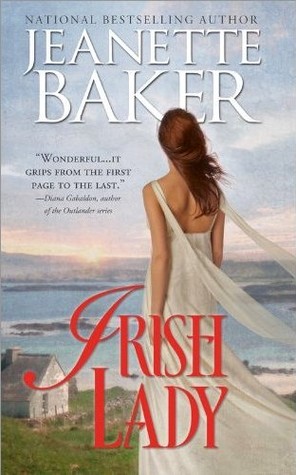
Irish Lady by Jeanette Baker is about Meghann McCarthy who had left Belfast behind until Michael Devlin re-emerges and needs her help.  He’s charged with murder, but as she attempts to uncover the truth, a history reveals itself through a series of linked histories back to the time of Queen Elizabeth.  This is an emotionally charged romance novel with intrigue and mystery.

Today, Jeanette Baker is offering to share her writing space with my readers and to share a little bit about what inspired her to write Irish Lady.  Please give her a warm welcome and stay tuned for a giveaway.

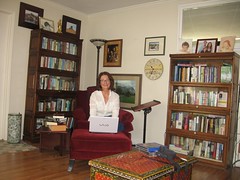
No one would ever call me a perfectionist. I’m more of a big-picture, good-enough kind of person, but my environment, both writing and living, has always been important to me. My personal space has changed over the course of my career, adapting with the changes in my family and my finances. At first, when my children were small, my “space” was a small computer table and steno chair in the family room. My children played games, watched television and invited friends to play while I created and typed away, oblivious to noise, music and, occasionally, minor wounds.

As my family grew and square footage increased through moves and room additions, I graduated to my own office complete with desk and chair, a comfortable couch and, the most wonderful of inventions, a laptop computer which allowed me to move between desk and couch as the mood struck. Over the years, I’ve done away with the desk and straight-backed chair, choosing to, at first, keep files in a cabinet and, eventually, in bookmarked pages on my computer. I’ve come full circle because, now that I’m an emptynester, my office has returned to the family room. I sit in a very deep, comfortable chair, usually cross-legged but, sometimes, with my legs stretched out in front of me on an equally comfortable ottoman.

I love color and my space reflects it. My chair and ottoman are a deep garnet-red. A chest hand painted in gold, black and more red serves as a coffee table for my tea habit and the shelves of my bookcases are painted a dark, lacquered green. Even more than writing, reading is my passion. I surround myself with books, hundreds and hundreds of books, written by authors who inspire me, as well as photos of my family to remind me of my focus, and prints of Ireland and Scotland, the settings for many of my novels.


The idea for IRISH LADY first came about after living for several years in Belfast, Northern Ireland. A country divided by religion and economics for 800 years has more than its share of conflict. Meghann McCarthy escaped the slums of Belfast to become a rich, successful attorney in London. Yet she can never quite banish Ireland from her heart, or forget Michael Devlin, the boy she once loved with a passion that nearly tore her apart. When Michael, a notorious Irish nationalist, is accused of a heinous crime, Meghann agrees to defend him. But even as she jeopardizes her hard-won success, she finds the true power and spirit of the Irish heritage she has too long denied…and the courage to face her love for Michael. Meanwhile, throughout her life, Meghann is regularly visited by visions of her direct ancestor, Nuala O’Donnell, a noblewoman from the 16th century who struggles to keep her husband, legendary hero, Rory O’Donnell, and their land free from English occupation.

The furniture changes, as well as the size of the space, but comfort, the perfect chair, access to a cozy pot of tea and a wall plug are consistent staples of writing space.

Thanks, Jeanette, for sharing your writing space with us.

To enter for 1 copy of Irish Lady, please leave a comment about how far you would go for love.

If you follow, tweet, Facebook, or otherwise share the giveaway, leave a comment with links for more entries (up to 4 additional entries)

Deadline is Jan. 25, 2012, at 11:59PM EST (US/CANADA)