Quantcast

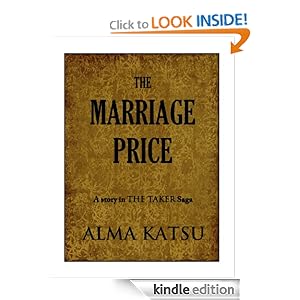
The Marriage Price by Alma Katsu

The Marriage Price by Alma Katsu is another short story from The Taker series and it reunites readers with Jonathan’s hometown just before he marries child-like Evangeline.  Told from Evangeline’s point of view, readers will get a taste of her less than innocent side as she talks of the finery and the house that will be hers once she is married to Jonathan.  There’s is clearly not a love match in more ways than one as Jonathan’s family chose her for him, and she clearly has ulterior motives of her own.

She’s a naive girl who is chosen by his family to become his wife as Jonathan’s father declines in health. While Lanore from The Taker and The Reckoning does not appear in the short story, her presence is clearly felt by Evangeline, who — while naive about the sexual relationships between men and women — is not blind to the emotional connection between Jonathan and Lanore.

Evangeline’s character becomes more nuanced through this short story. Although she is portrayed as innocent in The Taker and even child-like, she is more of a strategist in The Marriage Price. She’s looking forward to the big house and the finery she can obtain through her marriage, and while Jonathan is preternaturally gorgeous, his behavior toward her is forward and aggressive by her standards. Their relationship is more student-teacher, though Evangeline’s eyes are more on the prize than on the “love” they can share together.

“Now, it was all she could think about, those shameful things Jonathan had coerced her into doing. That was why she was certain a woman would come forward on her wedding day: it would be a punishment for what she did with Jonathan before they were legally wed.” (Kindle short story)

Katsu creates a dynamic subordinate character that can stand on her own and gets a taste of what her married life will become.  Evangeline may have thought she would gain a great deal through her marriage, but she may have fooled herself into believing that what happened between them in the marriage bed would stay there.  The short story raises questions about arranged marriages, marrying for money and position, and the dark secrets that spouses can hide about not only their pasts, but also their passions.

About the Author:

Alma Katsu is a 30-year DC veteran who lives in two worlds: on one hand, she’s a novelist and author of The Taker (Simon & Schuster/Gallery Books). On the other hand, she was a senior intelligence analyst for CIA and NSA, and former expert in multilateral affairs.  Check out this Interview With Alma.
This completes my first series for the Finishing the Series Reading Challenge 2012.

Alma Katsu’s Short Story Free on Kindle…

Alma Katsu is at it again with more of her Taker series to tide us over until the final book in the trilogy hits stores next year.  She’s released another short story, The Marriage Price, for Kindle, and it is being offered free on Aug. 7-8.

Previously, she’s released The Devil’s Scribe in which Edgar Allan Poe meets Lanore McIlvrae.  If you’ve missed my reviews of this series, you can start with The Taker, and then move onto my review of The Reckoning and The Devil’s Scribe.

Today is the last day that you can download The Marriage Price by Alma Katsu for free.  If you’re interested in my thoughts on the short story, check out my mini review at D.C. Literature Examiner.

Wayne of Gotham by Tracy Hickman

Wayne of Gotham by Tracy Hickman is an exploration into the Wayne legacy and its role in Gotham’s early days and its current influence on the city as Bruce Wayne dons a cape and cowl and chases criminals as Batman.  Through a series of flashbacks to the 1950s, Bruce and the reader learn about his father, Dr. Thomas Wayne, and the family secrets.  Bruce is clearly not the only Wayne who has kept big secrets from the rest of the family and the outside world.

The parallels Hickman draws between Bruce and his grandfather, Patrick, are intriguing as both men tend toward the aggressive nature of their personalities and are not afraid to meet violence with violence.  Thomas, on the other hand, wants no part of that violent world, even though his father believes he should be able to defend himself.  However, in Hickman’s novel Bruce Wayne is middle-aged and feeling the impact of his year’s saving Gotham from criminals as Batman, and his reliance on technological advances in his suits and cars tells a far greater tale of this aging hero.

“The garden was dead.  The roses had gone wild and died during the succession of winters without care.  Their gnarled limbs reached up like claws from the edges of the footpaths, which were covered in dead leaves decomposing into dirt.  The prize lilacs his mother had been so proud of now reached up menacingly over the walls.  The garden had gone native, weeds choking and obscuring the careful planning that now lay buried ad barely recognizable.”  (Page 35)

What’s interesting about Hickman’s take on the comic character and his family is that Batman uncovers a past that is not as rosy as he expects about his father.  Dr. Thomas Wayne and his work with Dr. Richter are more than his son can digest in one sitting, but Batman is hardly given the chance to do so as he’s being drawn deeper and deeper into a spider’s trap as ghosts from the past seek to right the wrongs of the past.  Through a series of surprising turns connected to the German Nazis, eugenics, and more, Batman is confronted with a father who is not as perfect as he thought and he must reconcile what he has learned with what he thought he knew about the man.

The criminal mastermind here is slightly obvious from early on, but that is not as bothersome as the incessant talk early on about Batman’s vehicles and gadgets, which don’t necessarily add to the plot especially when the narration focuses on the evolution of the Batmobile from its early incarnations to the present.  However, that’s a minor drawback that fades away once the novel gets going.  Hickman has clearly done his research into several incarnations of the Batman myth, but the plot movement with the entrance of criminals, like The Joker, is abrupt on occasion as their motivations are unclear and the catalyst of their involvement is murky until the end.

Wayne of Gotham by Tracy Hickman is a satisfying read for those interested in the past of the Wayne family and its role in the rise and potentially the degradation of Gotham City.  Warring within each of these men is the duty to do good and the desire to just be free and follow their passions.  The relationship between Thomas Wayne and his father is clear from the beginning, but the relationship between Thomas and his son Bruce is less clear as Bruce himself is unsure how to view his father in light of the secrets revealed.  In many ways, this novel may have worked better as a graphic novel, but Hickman does a good job sticking to the origins of the character and bringing in unique story lines to fill out the ancestry of Wayne family.  By the end of the novel, it would also seem that more needs to be said and uncovered, especially when the second son of Thomas and Martha Wayne is alluded to, but not seen.

About the Author:

Tracy Hickman is a best-selling fantasy author, best known for his work on Dragonlance as a game designer and co-author with Margaret Weis, while he worked for TSR. He married Laura Curtis in 1977, and together they have four children.

This is my 59th book for the New Authors Reading Challenge 2012.
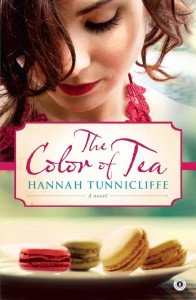

The Color of Tea by Hannah Tunnicliffe

Macau is a former Portuguese colony and is now a special administrative region of China and a hub of gambling and more.  The Color of Tea by Hannah Tunnicliffe is a woman’s journey into a strange land and the time of her life as she trails behind her husband, and their dreams of a new life change drastically.

“Macau: the bulbous nose of China, a peninsula and two islands strung together like a three-bead necklace, though by now the sand and silt have crept up and almost covered the silk of the ocean in between.  Gobbled up, like most everything in Macau, by Progress.  Progress and gambling.”  (Page 1)

Grace Miller is a woman who has lost her dream and builds another with tea and French pastries.  With the help of Leon, a French chef, Grace learns to make macarons and she opens a cafe, breathing new life into her days.  Although she doesn’t know Portuguese, Cantonese, or Mandarin, she finds the strength to become a businesswoman with little help from her husband, Pete.  She finds a new strength in her situation as she creates new kinds of macarons, serves coffee and tea, and provides a community with a little hope and connection.

“The day after the earthquake Lillian’s is packed to the rafters.  It is so crowded that those who can’t find their own tables join strangers and start to talk.  It is as if the catastrophe has brought out the community-minded side of people.  Conversations are hushed, and customers linger over their coffees.  Children are sent to the corner to play with our basket of toys, mutely constructing castles or ships out of LEGOs; even they must sense the need for regrouping and rebuilding.”  (Page 125)

It is the essence of Tunnicliffe’s novel — rebuilding and regrouping — to create something shiny and new out of the rubble . . . to begin again.  Lillian’s is a cafe born from the ashes of a Portuguese restaurant in a Chinese owned commonwealth by a British woman seeking a foothold in a spiraling out of control life, but what this cafe brings to her and to the community is more than she could have bargained for as cultures are bridged and friends are earned.

Grace is dedicated and strong, but she’s also naive about the cultural differences surrounding her, but those traits together make her more endearing.  Peter tries his best to cope with the loss of their dream, but throws himself more and more into his work when his wife withdraws.  His character is less well drawn, but the novel is told from Grace’s perspective, so that is to be expected.  Gigi, Leon, Celine, Rilla, Marjory, and Yok Lan are secondary characters who are full of life, teaching one another how to have patience with one another and grow.

Tunnicliffe’s debut novel is ripe with sugar and creamy pastry as each new relationship adds to the culinary masterpiece that is The Color of Tea.  It is Grace’s story.  Through her baking she comes alive, and subsequently comes into her own.  Tunnicliffe is talented and makes Macau come alive through food, relationships, and tea — creations that transcend sorrow and class.

About the Author:

Hannah Tunnicliffe was born in New Zealand but is a self-confessed nomad.  After finishing a degree in social sciences, she lived in Australia, England, and Macau.  A career in human resources temporarily put her dream of becoming a writer on the back burner.  The Color of Tea is her first novel.

This is my 58th book for the New Authors Reading Challenge 2012.


If you’d like to win a copy and live in the US or Canada, please leave a comment about your favorite tea or pastry.

Deadline is Aug. 16, 2012, at 11:59PM EST

Mailbox Monday #188

Mailbox Mondays (click the icon to check out the new blog) has gone on tour since Marcia at A Girl and Her Books, formerly The Printed Page passed the torch. This month’s host is 5 Minutes for Books.

The meme allows bloggers to share what books they receive in the mail or through other means over the past week.

Just be warned that these posts can increase your TBR piles and wish lists.

Here’s what I received:

1.  Monstrous Beauty by Elizabeth Fama, which I’m going to pass onto The Girl from Diary of an Eccentric.

Fierce, seductive mermaid Syrenka falls in love with Ezra, a young naturalist. When she abandons her life underwater for a chance at happiness on land, she is unaware that this decision comes with horrific and deadly consequences. Almost one hundred forty years later, seventeen-year-old Hester meets a mysterious stranger named Ezra and feels overwhelmingly, inexplicably drawn to him. For generations, love has resulted in death for the women in her family. Is it an undiagnosed genetic defect . . . or a curse? With Ezra’s help, Hester investigates her family’s strange, sad history. The answers she seeks are waiting in the graveyard, the crypt, and at the bottom of the ocean—but powerful forces will do anything to keep her from uncovering her connection to Syrenka and to the tragedy of so long ago.

2.  The Siren of Paris by David LeRoy, which I will review in September.

In war-torn Paris during the German occupation, a legion of fiercely patriotic men uses their wits and courage to resist the encroaching German army. One of those intrepid heroes happens to be American. The Siren of Paris, the debut work of historical fiction by David LeRoy, tells a searing story of love, betrayal, forgiveness, and war that brings to vivid life the shimmering City of Lights during its darkest hours during World War II. It’s 1939, and Marc Tolbert, the French-born son of a prominent American family, has taken off for Paris to follow his dream of becoming an artist. Marc’s life soon sparkles in the ex-pat scene in Paris, befriending the famous Sylvia Beach, owner of the bookstore Shakespeare & Company; and running across William Bullitt, US ambassador to France. At art school, he finds himself further enchanted by the alluring model Marie. Marc’s Parisian reverie, however, is soon clouded over by the increasing threat from Germany. As Americans scramble to escape Paris, he finds himself trapped by the war, and nearly meets his fate on the disastrous day of June 17, 1940, aboard the RMS Lancastria, only to then face an even more ominous fate at Buchenwald. Rigorously researched and vibrant in historical detail, The Siren of Paris reimagines one of history’s most turbulent times through the prism of an American abroad in Europe’s most harrowing days. Poignant, gripping, and thought-provoking, LeRoy’s work mines the human dilemma of revenge versus forgiveness, and vividly captures the conflicted state of survival.

What did you receive?

161st Virtual Poetry Cricle

Welcome to the 161st Virtual Poetry Circle!

Remember, this is just for fun and is not meant to be stressful.

Keep in mind what Molly Peacock’s books suggested. Look at a line, a stanza, sentences, and images; describe what you like or don’t like; and offer an opinion. If you missed my review of her book, check it out here.

Also, sign up for the 2012 Fearless Poetry Reading Challenge because its simple; you only need to read 1 book of poetry. Please visit the stops on the 2012 National Poetry Month Blog Tour.

Today’s poem is from Michael Blumenthal:

Night Baseball

[I] retrace by moonlight the roads where I used to play in the sun.
                                                 — Marcel Proust


At night, when I go out to the field
to listen to the birds sleep, the stars
hover like old umpires over the diamond,
and I think back upon the convergences
of bats and balls, of cowhide and the whacked
thumping of cork into its oiled pockets,
and I realize again that our lives pass
like the phased signals of that old coach,
the moon, passing over the pitcher's mound,
like the slowed stride of an aging shortstop
as he lopes over the infield or the stilled echo
of crowds in a wintered stadium. I see again
how all the old heroes have passed on to their
ranches and dealerships, that each new season
ushers in its crop of the promised and promising,
the highly touted and the sudden phenoms of the
unexpected, as if the hailed dispensation of gifts
had realigned itself into a new constellation,
as if the old passages of decrepitude and promise
had been altered into a new seeming. I remember
how once, sliding into second during a steal,
I watched the sun rest like a diadem against the
head of some spectator, and thought to myself
in the neat preutterance of all true feeling,
how even our thieveries, well-done, are blessed
with a certain luminousness, how a man rising
from a pilfered sanctity might still upright himself
and return, like Odysseus, to some plenitude
of feast and fidelity. It is why, even then, I loved
baseball: the fierce legitimacy of the neatly stolen,
the calm and illicit recklessness of the coaches
with their wet palms and arcane tongues of mimicry
and motion. It is why, even now, I steal away
from my wife's warm arms to watch the moon sail
like a well-hit fly over the stadium, then hump
my back high over the pitcher's mound and throw
that old curve of memory toward the plate
where I run for a swing at it—the moon
and the stars approving my middle-aged bravado,
that boy still rising from his theft to find the light.

What do you think?

Small Damages by Beth Kephart

There are books that pump your adrenaline for you and there are books, like Small Damages by Beth Kephart, that seep deep into your being, settle there, making their mark on your emotions, your perceptions about other cultures, and your own world view.  Kephart has a skill unlike other young adult authors in that she never sees her younger readers as incapable of understanding or of deep emotion.  She trusts them to follow her characters in their unusual circumstances and settings and garner a deeper understanding of what it means to mature from a child into an adult and the responsibilities that weigh on them even now when they are so young in this modern world.

Kenzie Spitzer is an 18-year-old pregnant girl who struggles with the loss of her father and the silence of her mother every day, and she keeps secrets from her friends, her family, and herself.  Kevin Sullivan, the boyfriend, is on his way to Yale in the fall, and she had planned to attend Newhouse film school after a summer on the New Jersey shore in a rented house with her boyfriend and friends.  To say the least, her life is turned upside down by the pregnancy news, but what’s worse is the decision to have the child and give it up for adoption is taken out of her hands when her mother makes arrangements for her to go to Los Nietos (the granchildren) ranch in Spain where she will be cared for by her mother’s friends Miguel and Estela until the baby is born.

“We scatter the herd, break the bulls out of the shade until they are near, running beside us — fast in a straight line, awkward on the turns, annoyed.” (Page 14 ARC)

Like the scattering of the bulls when she arrives, Kenzie’s life has been derailed and those of her friends and of Kevin are moving parallel to her and from her point of view cased in blissful ignorance as her life is the only one changed.  She even ruminates on how even though a child conceived is the doing of man and woman, it is the woman’s life that is changes irrevocably.  Kenzie’s thoughts are very similar to teenage girls, vacillating between the past and what the future could have been — analyzing each moment over and over.  Unlike other novels on this topic, Kephart’s kind hand guides the narration without judgment allowing the character to reveal her own maternal love for the child and her confusion without the harsh lens of blame and resentment.

“I stay where I am, halfway in, halfway out, the moon and the stars bright behind me.”  (Page 172 ARC)

Forced into a decision that is not her own — but is in a roundabout way a compromise with her mother — Kenzie is left adrift in a foreign land with people she doesn’t know or understand, wondering through silences and asking endless questions that are unanswered more often than not.  She meets Esteban with whom a connection is born as they share a tragic parental past, even though for a long while all Kenzie wants is to be someone else, somewhere else.  Like the birds in Seville and at Los Nietos, they are there guiding Kenzie, showing her the color as Kevin had done when her father died.  She is alive, and they remind her.  There is one passage in the novel in which Esteban talks of how one particular bird always comes, but that he brings the others with him — reminiscent of The Conference of the Birds (my review) and the faith they need to find what they seek.

“‘Only to the earth do I tell my troubles,’ Arcadio sings softly, ‘for nowhere in the world do I find anyone to trust.’

‘If my heart had windowpanes of glass,’ Bruno sings the next line, ‘you’d look inside and see it crying drops of blood.’

‘These Gypsies, they are the famous,’ Miguel says.  ‘They are starting very young; they played for Lorca.  They had duende. Have duende. ?'”  (Page 165-6 ARC)

Small Damages by Beth Kephart is about the courage we must find within ourselves to face the past, our tragedies and losses, and our fears about the future.  Kenzie is a young woman on the verge of her new life when it is turned upside down, and while the decision to go to Spain is not her own, she finds the courage to make her own decisions for herself, her baby, and her future.  Through the chords and melodies of gypsy music, Kenzie must peel the tough, bumpy rubber skin of the orange in her journey through Spain to reveal the prized juice and supple pulp beneath the skin.  While damages may seem large and insurmountable when they are first scored through our hearts and skin, they heal and become the small scars that make us who we are and how we learn to be better than we were.

About the Author:

Beth Kephart is the author of 14 books, including the National Book Award finalist A Slant of Sun; the Book Sense pick Ghosts in the Garden; the autobiography of Philadelphia’s Schuylkill River, Flow; the acclaimed business fable Zenobia; and the critically acclaimed novels for young adults, Undercover and House of Dance. A third YA novel, Nothing but Ghosts, is due out in June 2009. And a fourth young adult novel, The Heart Is Not a Size, will be released in March 2010. “The Longest Distance,” a short story, appears in the May 2009 HarperTeen anthology, No Such Thing as the Real World.

Kephart is a winner of the Pennsylvania Council on the Arts fiction grant, a National Endowment for the Arts grant, a Leeway grant, a Pew Fellowships in the Arts grant, and the Speakeasy Poetry Prize, among other honors. Kephart’s essays are frequently anthologized, she has judged numerous competitions, and she has taught workshops at many institutions, to all ages. Kephart teaches the advanced nonfiction workshop at the University of Pennsylvania. You can visit her blog and my interview with her.

My other Beth Kephart reviews:

Have you seen this book trailer?

What Would Entice Me to Attend BEA Bloggers Conference 2013

Following the July 30th announcement on The BEAN that feedback was mostly positive from the 2012 BEA Bloggers Conference and that the BEA folks are considering the creation of a book blogger advisory committee to oversee conference content, I’ve gone back to a list of stuff that I bounced off Anna after my first year at the Book Blogger Con (before it was sold to Reed).  I had hoped that a book blogger-wide survey would have been issued by Reed to garner more feedback than from a select few bloggers, but alas, that has not occurred.

Regardless, I’ve put together my thoughts for whatever that is worth.

I really think that although authors can make great speakers at a conference and are appreciated for their wit, they should not be keynote speakers at a book blogger conference!  A keynote should be someone from the industry the conference strives to reach — a book blogger.

I think to capture the attention of mature book bloggers and new book bloggers in the same conference, the conference should be broken down by hour or two for a particular topic and within that time period, two or more panels should be conducted on different aspects of that topic.  Each session also should allow for questions as well.

Here’s a sample with some topic offerings that may appeal to new and mature bloggers:

First 1-2 hours:

First Option — Technology Panel:

  • HTML coding basics
  • social and media use (effectiveness of Twitter, Facebook, vlogs, etc. and how to gauge it using analytics (and which ones)
  • domain names and best blogging platforms for which purposes

Second Option — Book Blogging Basics:

  • ARC Management vs. Read What You Want When You Want? (What’s your system?), including the management of e-galleys vs. paper copies
  • Reading Challenge and book blogging community participation
  • Scheduling blog posts and how to write a post
  • Finding your blogging voice or how do you change the course of your blog?

Second 1-2 hours:

Option One — Ethics Panel:

  • Positive and negative reviews (how to write them? or not?)
  • Disclosing friendships with authors and publicists
  • Disclosing affiliate links for book stores, etc.
  • What is the book blogger’s duty to readers of the blog vs. authors/publishers, etc.
  • What are the ethical issues of telling another blogger to stop harassing your readers or authors on your pages?

Option Two — Standardization

  • What is a book blogger? (how do we define ourselves?)
  • What should be included in a review (i.e. author, title, and what else?)
  • Who do you blog for? Why?
  • Do book bloggers need a professional organization?
  • Do you need advanced reader copies to be a book blogger?

Lunch break — networking with other bloggers (icebreakers and tidbits about all attending blogs on the table)

Third 1-2 hours:

Option One — Niche vs. Genre:

  • Should blogs have specialties?
  • What is the difference between having a niche and covering a genre?
  • Are there analytics to support the need for specialization?
  • Should you pass along ARCs outside your genre to another blogger that covers that area and should you let the publisher/publicist/author know?

Option Two — Stats vs. Blog Visibility

  • How do you gauge blog visibility?
  • Does it only entail blog stats?
  • Where do you find those statistics?
  • What tools are other blogging sectors using to gauge their influence and penetration into the market and how can they be adapted to book blogging?

Final 1-2 hours — Schmoozing cocktail hour with publicists, publishers, and authors

These are just some ideas that I’ve had kicking around, and in many ways, it would entail reaching beyond the book blogging community for some tech experts and possibly some others to fill in some gaps that book bloggers may be unable to address in terms of technical analytics, etc.  But I think that the conference should be about helping others grow and helping mature bloggers think and rethink about the role they play in the publishing world.

What are your thoughts?  What topics would you like to see or discussions would you like to have?

When She Woke by Hillary Jordan

When She Woke by Hillary Jordan has been compared to The Scarlet Letter by Nathaniel Hawthorne and The Handmaid’s Tale by Margaret Atwood, but it is really a combination of the two as Hannah Payne is not melachromed for adultery, but for another sin and she lives in a world where the separation between church and state has been broken.  Roe vs. Wade has been overturned once a scourge has rendered most women unable to have children and men who are carriers unwittingly have passed the disease onto unsuspecting partners.  Under the defense of saving the human race, society has outlawed abortion.  This idea parallels the notions of The Handmaid’s Tale, though the society in that novel is more severe in terms of limiting women’s rights and control over their bodies.

Punishment for breaking the laws of this society are no longer being thrown in jail, but being chromed and thrown back out into society to face ridicule and stigmatization.  Chroming takes place when a virus — which had unknown side effects for many years and often results in fragmentation of the brain if not re-administered every six months or reversed properly — turns the skin the color of the crime, such as red for violent offenders and blue for molesters.  Once back in society these men and women are looked upon as freaks and outsiders, and they are lucky if they are given jobs to survive on their own while their sentence is carried out.

“The virus no longer mutated the pigment of the eyes as it had in the early days of melachroming.  There’d been too many cases of blindness, and that, the courts had decided, constituted cruel and unusual punishment.”  (Page 6-7)

Aiden Dale in Jordan’s book is very reminiscent of Arthur Dimmesdale in The Scarlet Letter in that his character is very weak and he is forced by the pressures of guilt to confess.  Naturally, Hannah is a young women in a close knit community of religious communities and the injury of her father leaves the family in a precarious position until their pastor Aiden Dale comes to the rescue.  His character is only seen through Hannah’s eyes as she is the main point of view throughout the novel, which leaves a lot of his motivations in question, especially given the relationship he embarks upon as a pastor and married man.

Jordan’s novel is very fast-paced, and may even be too fast-paced as it seems that Hannah needs a moment to slow down, breathe, reflect but her character is very emotional, impulsive, and impatient.  Given her upbringing in a religious community, it is clear that she knows little of the outside world in Texas, which is cliche location for a novel about ultraconservative religious groups, etc.  Her actions are frustrating, but at least they are understandable given her upbringing, but there are other occasions where she seems superior in her perceptions of others’ personalities and actions and yet completely oblivious when others are plying her with food and a place to sleep after being chromed.

When She Woke by Hillary Jordan is ultimately a mesh of worlds that does not go to the extremes of the other nations created by Atwood and Hawthorne, and in that, the world building loses ground as it uses a heavy-handed nature in drawing parallels to today’s society, its punishments, and our own history of discrimination against certain groups.  However, this novel would make an excellent selection for a book club discussion given the issues it raises about the separation of religion and government, abortion, crime and punishment, and other topics.

About the Author:

Hillary Jordan received her BA in English and Political Science from Wellesley College and spent fifteen years working as an advertising copywriter before starting to write fiction. She has an MFA in Creative Writing from Columbia University.  (Photo by Michael Epstein)

What the Book Club Thought (beware of spoilers):

When She Woke by Hillary Jordan was one of the two books I nominated and the book club selected it for this month’s discussion.

Most members agreed that the character of Aiden was very weak and that we disliked him.  One member insisted that most of us had laid too much blame on Hannah for what happened to her, but the women of the group said that blame lied with both Aiden and Hannah.  Given that Hannah knew Aiden was not only her pastor, but also a married man, she should not have engaged in an illicit affair with him, and he knew he was married and a paragon of the community.  While this is billed as a love story, I didn’t see the depth I expect from love-based relationships and the relationship between Aiden and Hannah appeared to be more one of lust and passion than of love.

While some of the sci-fi elements worked best for one member of the book club, others of us were happy that unlike the Hunger Games series of books the back story as to why the society had changed so drastically was presented.  Some of the members thought that Jordan skewed some elements of the society such as making all of the religious figures and members mean or evil, except for the one female priest.  But one of us thought there was a balance in the casting as there were good and bad in both the religious community from the bad priest and his wife to Hannah’s father who was more tolerant and in the Novemberists (which reminded me of the V is for Vendetta movie with its focus on November and bombing, etc.) there were good and bad guys as well.

In terms of the books we’ve read so far, this one generated a great deal of discussion about what would happen in today’s society if Roe vs. Wade was overturned (which most of us don’t see happening), what punishments are considered cruel and unusual, what being a second-class citizen would entail if we were chromed, and how the women in the group felt about abortion.  One of our members also suggested that the book is focused on demonstrating that we should not judge others and their sins but worry about ourselves, even if we are devote Catholics, etc.

This is my 57th book for the New Authors Reading Challenge 2012.

Flight From Berlin by David John

With the London Olympic Games already under way, Flight From Berlin by David John is a novel that can demonstrate the political turmoil beneath even the most beloved sporting event across the globe.  It is set during the 1936 Olympic games in Germany just as Adolf Hitler is gaining more power, and British journalist Richard Denham is fully aware of the brutality the Nazis hope to hide behind the spectacle of the games.  Mrs. Eleanor Emerson is an Olympic hopeful whose father, a senator, is very much against the United States’ participation in the games and who eventually gets kicked off the team when her rebellious behavior aboard ship gets her into all kinds of trouble with her father’s nemesis.  Fate conspires to bring these two together as Emerson is offered a job as a reporter for William Randolph Hearst’s media empire given her connections with the team.

Embroiled unwittingly in a cloak-and-dagger search for a secret that could stop the rise of Hitler, Emerson and Denham run through the Berlin streets, attend society parties, and hide in back alleys as they seek to interview the only Jewish athlete on the German Olympic team.  The rebellious streak of Emerson draws Denham to her, but she’s intrigued by his passion to uncover the truth even without considering the consequences.  John’s prose is quick paced and appropriate for the old world espionage feel of the novel, and the relationship between Denham and Emerson is one of convenience and mutual respect.

“How strange, how small the things that change history, turn it from its darkened course, send it eddying off down new, sunlit streams.”  (Page 2 ARC)

However, the fast-paced nature of the story often takes over too much in that the relationship between Denham and Emerson is not fully realized and when declarations of love occur, it seems to be too soon.  While John does use the cliched oops moment of overhearing a conversation in the garden, the story is intriguing enough to keep the reader’s attention.  Meanwhile, the chapters on the Hindenburg are very well done and demonstrate the awe people at that time would have felt at seeing such ingenuity.

“It was like a film set built from an Erector set.  A gargantuan spider’s web of bracing wires and girders radiated out from the central axis, and looking along the corridor’s length was like seeing infinity reflected between two mirrors.  The air was much colder.

Together they walked along the corridor between towering gas cells, which hummed quietly with the vibration of the engines.”  (Page 66 ARC)

Flight From Berlin by David John provides the right mix of thrill and historical elements to anchor readers into the time between WWI and WWII when Germany was hosting the Olympic games and Hitler was hovering the line between diplomatic peace and alienating the entire world.  Denham, a former WWI soldier, is forced to recall his training and the tragic things he saw during the war, but it also enables him to remain sympathetic to the Jews and others he meets while working in Berlin on his journalistic stories.  Emerson is a socialite who is used to getting her way either through charm or her father’s connections, but she has to learn to be more observant of the world around her and that she has her own strength to get her through.  Another gem in the novel is the notes in the back about what characters were real and which were fictionalized.

About the Author:

DAVID JOHN was born in Wales. He trained as a lawyer but made his career in publishing, editing popular books on history and science. In 2009 he moved to Germany to write Flight from Berlin. He lives in Seoul, South Korea, where he is researching his second novel.

This is my 56th book for the New Authors Reading Challenge 2012.

Mailbox Monday #187

Mailbox Mondays (click the icon to check out the new blog) has gone on tour since Marcia at A Girl and Her Books, formerly The Printed Page passed the torch. This month’s host is Mrs. Q Book Addict.

The meme allows bloggers to share what books they receive in the mail or through other means over the past week.

Just be warned that these posts can increase your TBR piles and wish lists.

Here’s what I received:

1.  Some Remarks by Neal Stephenson from William Morrow.

2.  And When She Was Good by Laura Lippman from William Morrow.

3.  When My Brother Was an Aztec by Natalie Diaz, which I bought at Novel Places.

What did you receive?

160th Virtual Poetry Circle

Welcome to the 160th Virtual Poetry Circle!

Remember, this is just for fun and is not meant to be stressful.

Keep in mind what Molly Peacock’s books suggested. Look at a line, a stanza, sentences, and images; describe what you like or don’t like; and offer an opinion. If you missed my review of her book, check it out here.

Also, sign up for the 2012 Fearless Poetry Reading Challenge because its simple; you only need to read 1 book of poetry. Please visit the stops on the 2012 National Poetry Month Blog Tour.

Today’s poem is from Matt Hart in honor of the Olympics:

In This Light

nothing and nothing
gets by you, but I get
so distracted
that my notice
has been put on notice
for birds and for traffic
For instance,
the constant
slap of the sound
of waves
against gutters
gets by me
Grass stain on my hands
from falling down
at the hospital
gets by me     Physics
Sequined dresses
The Olympics get by me
Meanwhile,
the mountains are,
so far, only distant,
and some days
I am even making my way
through them
with my pants on,
which is lucky,
though at other junctures
sunflowers and pine tree
needles     my arms
in full blossom
as you appear
around a corner
kaleidoscopically
The day looking up
between us
pink clouds

What do you think?