Quantcast

185th Virtual Poetry Circle

Welcome to the 185th Virtual Poetry Circle!

Remember, this is just for fun and is not meant to be stressful.

Keep in mind what Molly Peacock’s books suggested. Look at a line, a stanza, sentences, and images; describe what you like or don’t like; and offer an opinion. If you missed my review of her book, check it out here.

Also, sign up for the 2013 Dive Into Poetry Challenge because its simple; you only need to read 1 book of poetry. Please visit the stops on the 2012 National Poetry Month Blog Tour.

Today’s poem is from Jehanne Dubrow from Red Army Red:

CHERNOBYL YEAR

We dreamed of glowing children,
their throats alive and cancerous, 
their eyes like lightning in the dark.  

We were uneasy in our skins,
sixth grade, a year for blowing up, 
for learning that nothing contains 

that heat which comes from growing, 
the way our parents seemed at once 
both tall as cooling towers and crushed

beneath the pressure of small things—
family dinners, the evening news,
the dead voice of the dial tone.

Even the ground was ticking.
The parts that grew grew poison.
Whatever we ate became a stone.

Whatever we said was love became 
plutonium, became a spark 
of panic in the buried world.

This poem was featured on American Life in Poetry and in West Branch.

What did you think?

Alien vs. Predator by Michael Robbins

Alien vs. Predator by Michael Robbins is a mixture of techno beats, pop culture references, and references to some of the greatest poets, including Robert Frost.  While many readers of poetry would find his flagrant use of lines from songs cheap or as a short-cut, Robbins seems to be saying something more with the lines he chooses.  He wants to comment on the superficiality of society; he wants to rip open the thin veil of complacency that we all hide behind to reveal the stark, dark, and painful reality beneath.

From "Welfare Mothers" (page 7):

Little Bo Mercy in heels and hose,
just under the water she usually goes.
She moves grams and ounces, prays for war.
She's not the droid you're looking for.
From "Appetite for Destruction" (page 10):

I want to watch you bleed.  My tongue
doesn't know its right from wrong.
I'm uninsured.  I ride the bus,
a loaded gun inside my purse.
My mouth's a roadside bomb.

However, not all of these poems are perfect, and read more like performance pieces than poems meant for the page.  In many ways, Robbins’ unconventional style loses something in the translation to the page and would probably benefit from an accompanying audio version.  Although there is a pervasive anger in the collection, the anger is not about violence so much as it is about frustration.  Robbins touches upon hot topics in the news, including the killer whales at Sea World, and the more mundane stories that don’t make the news, like the struggling mothers hit by terrorism or welfare.

Robbins not only showcases his knowledge of music, television, and movies, but also poets and poetry, philosophy, and more.  In many ways, these references and — dare I call them, odes — can be too esoteric.  A cautionary note at best, but readers will enjoy the rhythm, the playfulness, the frustration, and the pain Robbins reveals — a pain and frustration that many of us will turn a blind eye to on a daily basis as we go about work and caring for our families.  It begs the question as to when society became so self-absorbed that societal hardships and decline are ignored even when it is on the doorstep.

Alien vs. Predator by Michael Robbins is a hip, rhythmic collection that will challenge readers preconceptions of the world around them, pop culture, and even poetry.  Although some poems are more effective than others, Robbins has crafted a collection that screams: “Watch Out!”

About the Author:

Michael Robbins is the author of Alien vs. Predator (Penguin, 2012). His poems have appeared in the New Yorker, Poetry, Harper’s, Boston Review, and elsewhere. He reviews books regularly for the London Review of Books and several other publications, and music for The Daily and the Village Voice. He received his PhD in English from the University of Chicago.

I received this book from Necromancy Never Pays‘ Trivial Pursuit for Bloggers.

Check out these other reviews:

The New York Times
Necromancy Never Pays
Book Chatter

This is my 3rd book for the 2013 New Authors Challenge.

This is my 2nd book for the Dive Into Poetry Challenge 2013

New Year’s Winners

These commenters won Ruby Urlocker’s collection:

Beth Hoffman

Anna of Diary of an Eccentric

Rebecca of Lost in Books


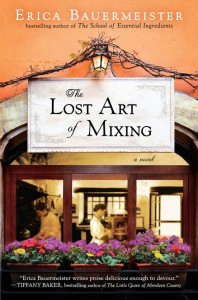
The winner of Erica Bauermeister’s book:

Janel Gradowski


The winner of The Jane Austen Handbook:

Tina from Novel Meals


The winner of Pride & Prejudice & Zombies:

KarenK

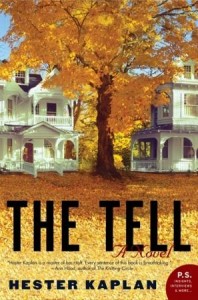
The Tell by Hester Kaplan

The Tell by Hester Kaplan unfolds like a stop-motion movie, one frame at a time, and in that movie there are flashes of the past.  Owen Brewer’s attention is easily swayed from one subject and one moment to another, breathing in both the past and present of his life, while at the same time observing the behaviors and ticks of others.  His marriage to Mira Thrasher is modern and telling, especially in how they introduce themselves to the new neighbor and former actor Wilton Deere.  Their marriage does not seem to be on solid ground, just from the way Owen watches the interaction of his wife and Wilton and thinks about reclaiming her in the most instinctual way.  Owen is tough to take and analyzes a great many things much more than other people would, while Mira is more a take-it-as-is girl and enjoys the moments, while not watching for the sky to fall.  Meanwhile, Wilton is trying to reconnect with his daughter, but in the process clings to this married couple next door because he longs to be loved and hated.

“Owen leaned into the sink and gulped water, leady and lethal, from the tap. Then some movement of white, gone before he could fully detect or confirm it, drew his eye past the unfurling pleasure of the lilacs to the empty house next door. Its windows were violet mirrors. In the year since the place had been on the market, Owen had sometimes used the house to animate wisps of his imagination they way people used empty battlefields. Where they saw the fuming charge across the hard-packed earth, the clash, the fallen in the grass, the victorious mob shaded by incoming clouds, he pictured his future children on the oak stairs, bodies passing in front of doorways, and the motion of family life he hoped to have here in this house, someday, with Mira.” (page 3 ARC)

Kaplan’s novel is psychologically complex.  Mira is an artist, struggling to keep her studio open and helping give direction to the elderly, young, and even homeless.  At the same time, she is hardly home when she is with Owen, and most nights, she’s off at the casino with Wilton, though she claims she does not have a gambling problem.  Kaplan explores the breakdown of trust between a husband and wife, the rebuilding of faith between an estranged daughter and father, and the power of addiction and obsession.  Each person has a “tell” — which in gambling is a change in a player’s behavior or demeanor that can give clues to other players about the truth of their hand — and in this case, Owen is trying to discern Mira’s tell, while navigating a new and untested friendship with a man he presumes is trying to get a little closer to his wife.  With Wilton, the task of determining the tell is more difficult as Owen cannot determine if he is telling the truth, acting, or a combination of both, though Owen in many cases errs on the side of Wilton telling lies.

“It was like standing still while a very fast train blew by you and lifted your hair.  What remained was what had been forgotten or abandoned:  a towel in the bushes, a single sneaker, a cat, a brightly colored plastic ring still drifting on the pond.”  (Page 100 ARC)

Kaplan’s novel unfolds with careful precision as she delves deeper into the spiraling vortex of Owen’s marriage with Mira, and his obsession with her family’s hording and her secret trips to the casino.  Each is scared to be alone, but not scared enough to stop their behavior from ruining everything.  Kaplan’s The Tell is dark and woeful, her characters are swimming in a dark pool and clinging to any hope they see, no matter how fleeting or false it may be.

About the Author:

Hester Kaplan is the author of The Edge of Marriage, which won the Flannery O’Connor Award for Short Fiction, and Kinship Theory, a novel. Her short stories have been included in The Best American Short Stories series. She teaches in Lesley University’s MFA Program in Creative Writing and lives in Rhode Island.

Find out more about Hester at her website. You can also follow her on Facebook and Pinterest.

tlc tour host This is my 2nd book for the 2013 New Authors Challenge.

Mailbox Monday #208

Mailbox Mondays (click the icon to check out the new blog) has gone on tour since Marcia at A Girl and Her Books, formerly The Printed Page passed the torch. This month’s host is Lori’s Reading Corner.

The meme allows bloggers to share what books they receive in the mail or through other means over the past week.

Just be warned that these posts can increase your TBR piles and wish lists.

Here’s what I receive:

1.  All That I Am by Anna Funder for a TLC Book Tour later this month.

When Hitler seizes power in 1933, a tight-knit group of friends and lovers suddenly become hunted outlaws overnight. Dora, liberated and fearless; her lover, the great playwright Ernst Toller; Ruth; and Ruth’s journalist husband, Hans find refuge in London. There, using secret contacts deep inside the Nazi regime, they take breathtaking risks to warn the world of Hitler’s plans for war. But England is not the safe haven they think it will be, and a single, chilling act of betrayal will tear them apart.

2.  The House Girl by Tara Conklin for a TLC Book Tour in February.

Two remarkable women, separated by more than a century, whose lives unexpectedly intertwine . . .

2004: Lina Sparrow is an ambitious young lawyer working on a historic class-action lawsuit seeking reparations for the descendants of American slaves.

1852: Josephine is a seventeen-year-old house slave who tends to the mistress of a Virginia tobacco farm—an aspiring artist named Lu Anne Bell.

It is through her father, renowned artist Oscar Sparrow, that Lina discovers a controversy rocking the art world: art historians now suspect that the revered paintings of Lu Anne Bell, an antebellum artist known for her humanizing portraits of the slaves who worked her Virginia tobacco farm, were actually the work of her house slave, Josephine.

3. The Ambassador’s Daughter by Pam Jenoff for review in February.

The world’s leaders have gathered to rebuild from the ashes of the Great War. But for one woman, the City of Light harbors dark secrets and dangerous liaisons, for which many could pay dearly.

Brought to the peace conference by her father, a German diplomat, Margot Rosenthal initially resents being trapped in the congested French capital, where she is still looked upon as the enemy. But as she contemplates returning to Berlin and a life with Stefan, the wounded fiancé she hardly knows anymore, she decides that being in Paris is not so bad after all.

Bored and torn between duty and the desire to be free, Margot strikes up unlikely alliances: with Krysia, an accomplished musician with radical acquaintances and a secret to protect; and with Georg, the handsome, damaged naval officer who gives Margot a job—and also a reason to question everything she thought she knew about where her true loyalties should lie.

Against the backdrop of one of the most significant events of the century, a delicate web of lies obscures the line between the casualties of war and of the heart, making trust a luxury that no one can afford.

4. Blood Gospel: The Order of the Sanguines Series by James Rollins and Rebecca Cantrell, which I received for review.

An earthquake in Masada, Israel, kills hundreds and reveals a tomb buried in the heart of the mountain. A trio of investigators—Sergeant Jordan Stone, a military forensic expert; Father Rhun Korza, a Vatican priest; and Dr. Erin Granger, a brilliant but disillusioned archaeologist—are sent to explore the macabre discovery, a subterranean temple holding the crucified body of a mummified girl.

But a brutal attack at the site sets the three on the run, thrusting them into a race to recover what was once preserved in the tomb’s sarcophagus: a book rumored to have been written by Christ’s own hand, a tome that is said to hold the secrets to His divinity. The enemy who hounds them is like no other, a force of ancient evil directed by a leader of impossible ambitions and incalculable cunning.

From crumbling tombs to splendorous churches, Erin and her two companions must confront a past that traces back thousands of years, to a time when ungodly beasts hunted the dark spaces of the world, to a moment in history when Christ made a miraculous offer, a pact of salvation for those who were damned for eternity.

5. Cassandra and Jane by Jill Pitkeathley, which I bought at the library sale for 50 cents.

They were beloved sisters and the best of friends. But Jane and Cassandra Austen suffered the same fate as many of the women of their era. Forced to spend their lives dependent on relatives, both financially and emotionally, the sisters spent their time together trading secrets, challenging each other’s opinions, and rehearsing in myriad other ways the domestic dramas that Jane would later bring to fruition in her popular novels. For each sister suffered through painful romantic disappointments—tasting passion, knowing great love, and then losing it—while the other stood witness. Upon Jane’s death, Cassandra deliberately destroyed her personal letters, thereby closing the door to the private life of the renowned novelist . . . until now.

6. The Secret Lives of People in Love by Simon Van Booy, which I purchased at the library sale for 50 cents.

The Secret Lives of People in Love is the first short story collection by award-winning writer Simon Van Booy. These stories, set in Kentucky, New York, Paris, Rome, and Greece, are a perfect synthesis of intensity and atmosphere. Love, loss, human contact, and isolation are Van Booy’s themes. In radiant prose he writes about the difficult choices we make in order to retain our humanity and about the redemptive power of love in a violent world. Included in this updated P.S. edition is the new story “The Mute Ventriloquist.”

7. Eight Silly Monkeys illustrated by Steven Haskamp, which I picked up for the girl in spite of her temper tantrum for 50 cents.

Get set for romping and rhyming fun! Young ones will love counting backwards as they watch eight monkeys disappear one by one with each turn of the page in this delightful tale. Eight Silly Monkeys features full-color illustrations, charming verse, and innovative die-cutting to reveal silly, touchable monkeys on each page. As fun to read as it is to listen to, this enjoyable rhyming adventure is a perfect read for ages 3 and up.

8. A Small Death in Lisbon by Robert Wilson, which I borrowed from the library since I’ve been inspired by this challenge to read more books about/set in Portugal, though I’m not limiting it to historical fiction or fiction — poetry works too.

In A Small Death in Lisbon, the narrative switches back and forth between 1941 and 1999, and Wilson’s wide knowledge of history and keen sense of place make the eras equally vibrant. In 1941 Germany, Klaus Felsen, an industrialist, is approached by the SS high command in a none-too-friendly manner and is “persuaded” to go to Lisbon and oversee the sale–or smuggling–of wolfram (also known as tungsten, used in the manufacture of tanks and airplanes). World War II Portugal is neutral where business is concerned, and too much of the precious metal is being sold to Britain when Germany needs it to insure that Hitler’s blitzkrieg is successful.

Cut to 1999 Lisbon, where the daughter of a prominent lawyer has been found dead on a beach. Ze Coehlo, a liberal police inspector who is a widower with a daughter of his own, must sift through the life of Catarina Oliviera and discover why she was so brutally murdered. Her father is enigmatic, her mother suicidal; her friends were rock musicians and drug addicts.

9. News from Heaven by Jennifer Haigh for a TLC Book Tour in February.

Now, in this collection of interconnected short stories, Jennifer Haigh returns to the vividly imagined world of Bakerton, Pennsylvania, a coal-mining town rocked by decades of painful transition. From its heyday during two world wars through its slow decline, Bakerton is a town that refuses to give up gracefully, binding—sometimes cruelly—succeeding generations to the place that made them. A young woman glimpses a world both strange and familiar when she becomes a live-in maid for a Jewish family in New York City. A long-absent brother makes a sudden and tragic homecoming. A solitary middle-aged woman tastes unexpected love when a young man returns to town. With a revolving cast of characters—many familiar to fans of Baker Towers—these stories explore how our roots, the families and places in which we are raised, shape the people we eventually become.

10. Baker Towers by Jennifer Haigh, which I received as part of the tour for the new book.

Bakerton is a community of company houses and church festivals, of union squabbles and firemen’s parades. Its neighborhoods include Little Italy, Swedetown, and Polish Hill. For its tight-knit citizens — and the five children of the Novak family — the 1940s will be a decade of excitement, tragedy, and stunning change. Baker Towers is a family saga and a love story, a hymn to a time and place long gone, to America’s industrial past, and to the men and women we now call the Greatest Generation. It is a feat of imagination from an extraordinary voice in American fiction, a writer of enormous power and skill.

Also, I’ve been remiss in talking about some of the Kindle books I’ve downloaded or gotten for review, and have reviewed one or two already without featuring them in Mailbox Monday.

11. Rules for Virgins by Amy Tan, downloaded for free.

12. Georgiana Darcy’s Diary: Jane Austen’s Pride and Prejudice continued (Pride and Prejudice Chronicles) by Anna Elliot, downloaded for free.

13. Becoming Elizabeth Darcy by Mary Lydon Simonsen, downloaded for free.

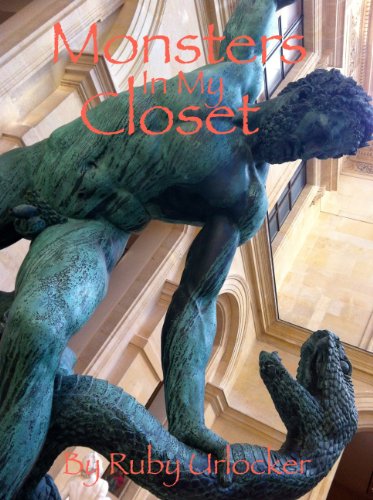
14. Monsters In My Closet by Ruby Urlocker, which I received for review and reviewed, here.

15. A Killing in Kensington (A Patrick Shea Mystery) by Mary Lydon Simonsen, which I downloaded for free.

16. Must Love Sandwiches (The Bartonville Series) by Janel Gradowski, which I got for review from the talented author.

17. Darcy Goes to War by Mary Lydon Simonsen, which I downloaded for free.

What did you receive?

184th Virtual Poetry Circle

Welcome to the 184th Virtual Poetry Circle!

Remember, this is just for fun and is not meant to be stressful.

Keep in mind what Molly Peacock’s books suggested. Look at a line, a stanza, sentences, and images; describe what you like or don’t like; and offer an opinion. If you missed my review of her book, check it out here.

Also, sign up for the 2013 Dive Into Poetry Challenge because its simple; you only need to read 1 book of poetry. Please visit the stops on the 2012 National Poetry Month Blog Tour.

Today’s poem is from Michael Robbins’ Alien vs. Predator:

To the Break of Dawn

I wandered lonely as Jay-Z
after the Fat Boys called it quits,
before the rapper from Mobb Deep
met up with the Alchemist.

I wandered lonely all along
The Watchtower's office front
in Dumbo, then across the bridge
that tempts the bedlamite to song.

From here you could've seen what planes
can do with luck and delta-v
as that fire-fangled morning
jingle-jangled helter-skelterly.

From your gravity fails to whoops
there goes gravity, from Celine
to Celan, from "Turn the Beat Around"
to And the Band Played On,

from the Live Free or Die
of plates from New Hampshire
to Musidora vamping
her way through Les Vampires,

from It Takes a Nation
of Millions to Hold Us Back
to Daydream Nation,
from Station to Station,

I take this cadence from the spinning plates
where the DJ plots the needle's fall.
I take it, and I give it back again
to the dollar dollar bill and the yes yes y'all.

What do you think?

D.C. Area Book News: Politics & Prose Icon Retires

Today’s inaugural post about Washington, D.C., area book news is something I hope will become an occasional blog feature in 2013. I hope you find these posts interesting and that you’ll feel free to contribute book news or tidbits from the D.C. area — of course, I’ll credit you in the post if you supply some news.

Local bookstore and icon of the D.C. book scene, Politics & Prose, was founded in 1984 by Carla Cohen and Barbara Meade, but the store was sold in 2011 to Bradley Graham and Lissa Muscatine after a failed sale in 2005. Barbara Meade has been serving as an advisor to the current owners since the sale, and her frequent presence in the store was welcomed by the store’s faithful patrons. Moreover, her advice helped foster a smooth transition to the new ownership and helped Muscatine and Graham establish their own foundations in the book business.

barbara meadeHowever, recently, Meade has told the staff and others that she was officially retiring to make more time for her own reading. In a letter to the book community, Meade said, “I’ve been so tightly wrapped up in Politics & Prose for the last 29 years that I’ll never be able to totally leave. . . . So I’ll continue my involvement in the store by hosting events, hanging out in the coffeehouse, and leisurely browsing what’s new on the bookshelves. You may even find me sitting in a chair somewhere in one of P&P’s inviting alcoves, trying out a chapter before I commit to a book purchase.” Her departure as an advisor means that the latest incarnation of Politics & Prose can spread its new wings and fly solo.

Monsters in My Closet by Ruby Urlocker

Ruby Urlocker’s Monsters in My Closet is a collection of poems and short stories by a talented young writer with a fresh voice who explores the uncertainty of her teenage years and the harsh realities of adolescence.  She explores themes of growing older, losing one’s innocence, and battling inner demons.  Even though she deals with harsh realities, her images are playful and sometimes whimsical, like her short story about a banana dreaming of becoming human — reminiscent of Kafka’s Metamorphosis but in reverse.

From "Walking Around the World":

I walked across the world today
in my old running shoes.
Because I was free on a Saturday
And wanted to beat my blues.
From "Fallen Angel":

My shadow, hanging onto the wall.
I watched it turn to meet my gaze,
My eyes, a desperate wish.
Those stares, those sugar coated liars
Stealing away who I am.
From "The Storm":

There's a gust of wind inside my throat,
Hands clutching it tightly so as not to hurt anyone.
But I grow sick and weary of choking myself

Urlocker has a childlike way of expressing emotions, but she also displays a mature grasp of the darkness that lurks within all of us. Alongside the shadows and ghosts her narrators chase around corners and into the darkness, religious verse and stories ground the reader in a belief that there is something more to this life — whether it is a reincarnation of the same soul until the goal is achieved or the passage of the soul into the afterlife. Unlike other teenage writings that are often full of angst and despair, Urlocker infuses her stories and poems with hope and color — a beacon in the darkness.

One of the most surprising and most developed pieces is “Hidden People,” which is more than a homage to Edgar Allan Poe’s The Cask of Amontillado. Urlocker talks about imaginary friends and growing up, which in some cases means leaving those beloved friends behind along with are more innocent selves. Even though this is a short piece, readers will become emotionally invested in the story the narrator weaves about her past and friends. There is a deep sense of regret and loss, but also the fondness of those memories.

Monsters in My Closet by Ruby Urlocker is a well crafted debut that explores themes of adolescence, lost innocence, and the hormonal battle that teens experience as they sort through friendships, memories, and love. The collection also includes illustrations, which merit a mention as they are unique and childlike, but also demonstrate a complexity that mirrors the work Urlocker does in prose and verse. She’s an up-and-comer with room to grow and surprise us.

If you’re interested in winning a copy of her book, enter the giveaway here.

About the Author:

Ruby Urlocker is a teenaged author, singer and songwriter. She has been writing and publishing stories since she was seven. Ruby lives with her family and dog, Rufus, a wheaten terrier.


This is my 1st book for the Dive Into Poetry Challenge 2013 and the 2013 New Authors Challenge.

The Painted Girls by Cathy Marie Buchanan

The Painted Girls by Cathy Marie Buchanan is about dreams, dreams that can raise you up out of the most dire circumstances, if only you are willing to work hard and do what you must to survive.  Antoinette and Marie, by turns, are ballet girls in the Paris Opera, with Antoinette learning too late that she cannot hold her tongue or bend her stubbornness.  Imagine a time in 1880’s France when Emile Zola publishes L’Assommoir, which becomes a play about a laundress and the dire consequences of poverty and alcoholism, and when Cesare Lombroso postulates that people who are born criminals can be identified by physical characteristics of the skull.  Buchanan has taken the real-life figures of Edgar Degas, Emile Zola, and Degas’ model for the statute Little Dancer of Fourteen Years — Marie van Goethem — and intertwined their stories with criminals Emile Abadie and Pierre Gille.  Tempted by different fates, Marie and Antoinette’s stories are told in alternating chapters, providing greater insight into certain situations and events as well as the complicated relationship between sisters, particularly those struggling to survive with a drunk mother, deceased father, and younger sister weighing heavily upon them.

“But then the next minute, my mind flipped back to thinking how a smear of greasepaint might hide her sallow skin.  Back and forth I went.  How to diminish.  How to boost up.  All I knew for sure was even if old Pluque saw his way to giving her a chance, even if she clawed her way up from the dance school to the corps de ballet, she was too skinny, too vulgar in her looks, too much like me to ever move up from second set of the quadrille, the bottom of the scale.”  (Page 13 ARC)

Even as each sister raises the other up with praise and support when times are tough, there are moments of doubt — that the love is not enough and that the support is somehow hollow.  Antoinette has fallen from her place with the ballet and is scrambling for walk-on parts in the opera before she meets Emile and gets a steady role in L’Assommoir, while Marie is just embarking upon her journey in the ballet with their sister Charlotte close behind.  There is the push and pull of these sisterly relationships as they compete to be the best in ballet and to earn the most, while still supporting one another and doing the little things that keep them spirited.  However, their world is about to fall apart when Antoinette falls in love and becomes tempted by that love to throw all that she knows away on the belief that her love is real and ever-lasting.

Buchanan also demonstrates through Marie the notion that believing something to be true can make it a self-fulfilling prophecy.  Marie says at one point, “Monstrous in face, monstrous in spirit.”  She does not see herself as the beauty others see, and her self-image is a faulty foundation for her to stand on when she enters the ballet as she compares herself not only to her sister, Charlotte, whom is considered a cherub, but also to the beauty and grace of the other ballet dancers.  Meanwhile, Antoinette does not have as many concerns about her beauty, relying on her wiles to capture the attentions of Emile and hold his rapt attention.  She sees him as her escape from poverty, despite his criminal-like behavior and greater commitment to his friends.

In many ways, The Painted Girls is about the bond between sisters and about the self-fulfilling traps that many of us fall into even when the support system is there to support us.  It is about taking things for granted, about being selfish, and about not giving into temptation.  Buchanan’s storytelling is captivating, and her characters, while rooted in history, are dynamic and flawed — like the criminals spotted by their physical characteristics, Antoinette and Marie are typecast by the law, theater members, ballet instructors and the wealthy sponsors who have designs on dancers.  Buchanan’s portrait of sisters in France during this period is gritty and emotional. Readers will immediately feel the dark, dank alleys of Paris and the heel of class distinctions upon their necks, just as the van Goethem sisters do.

The first contender for the 2013 best of list.

Credit: Nigel Dickson

About the Author:

CATHY MARIE BUCHANAN is the author of The Painted Girls, a novel set in belle époque Paris and inspired by the real-life model for Degas’s Little Dancer Aged 14 (forthcoming January 2013). Her debut novel, The Day the Falls Stood Still, was a New York Times bestseller, a Barnes & Noble Recommends selection, a Barnes & Noble Best of 2009 book, an American Booksellers Association IndieNext pick and a Canada Reads Top 40 Essential Canadian Novels of the Decade. Her stories have appeared in many of Canada’s most respected literary journals, and she has received awards from both the Toronto Arts Council and the Ontario Arts Council. She holds a BSc (Honours Biochemistry) and an MBA from Western University. Born and raised in Niagara Falls, Ontario, she now resides in Toronto.

Please check out the reading guide.

Giveaway: Jane Austen’s Pride & Prejudice Turns 200

Jane Austen is best know for her novels and her close-knit family, particularly her relationship with Cassandra, who painted a famous portrait of her sister and for burning a number of her sister’s letters following her death.  Following her first novel, Sense and Sensibility, Austen turned to her second novel, Pride & Prejudice, originally titled First Impressions.  Her second novel has been one of my favorites for many years, and I think I’ve read it at least five times or at least parts of it at any given moment.  Each time I read it, I learn or discover something new, and I think that is the mark of a successful author.

January 28, 2013 is the 200th anniversary of Jane Austen’s most beloved novel, Pride & Prejudice.  Austen’s novel examines the differences between social classes, elements of marriage and morality, and comments on the societal expectations regarding the manners and education of women in different circles.  It is often considered a great love story even as Elizabeth Bennet and Mr. Fitzwilliam Darcy spar with one another and must overcome great adversity and societal impediments to find their way back to one another. 

The novel and the author have become so popular in modern society that a number of spinoffs, continuations, and re-tellings have cropped up in recent years, and there are a number of blogs dedicated to her novels and those other novels and books.  Facebook even has a page dedicated to the 200th birthday of Pride & PrejudiceCheck it out.

As part of my Jane Austen celebration, check out the giveaway below.

Quirk Books is offering one copy of The Jane Austen Handbook by Margaret C. Sullivan to one winner in the United States, Canada, or United Kingdom.

I reviewed this in February of 2011, and said that it was “a great companion for the Jane Austen fanatic and fan because it offers guidance on how young men and women navigated a complex set of social rules and even broke them at times.  As each moment in life is addressed, Sullivan also offers moments in Austen’s work where traditions are bent.”

If you want to check out my interview with Sullivan, feel free.  She offers some great insights into her love of Austen and what books she recommends for fellow Austen lovers.

Quirk Books is offering one copy of Pride & Prejudice and Zombies by Jane Austen and Seth Grahame-Smith to one winner in the United States, Canada, or United Kingdom.

In my review from 2010, I called the novel “an exercise in revision and an examination of Austen’s characters in a new light.  Many readers will disagree with Grahame-Smith’s portrayal of Lizzy as a cutthroat assassin who is quickly turned by her own emotions or strict sense of duty and honor, particularly since she often talks of dispatching her peers for slighting her family, imagines beheading her own sister Lydia simply because she prattles on, and other unmentionable actions.”

To enter for one or both of these books, leave a comment about the first time you read Jane Austen and what you enjoyed about her work or the first time you read Pride & Prejudice and why you would reread it.  If you have never read Austen before, leave a comment about what book you’d be interested in reading and why.

Deadline to enter is Jan. 11, 2013, at 11:59 PM EST.

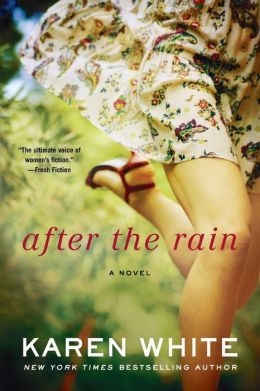
After the Rain by Karen White

After the Rain by Karen White is a republished and remastered novel that is full of twists and turns, touches lightly on the desolation of a broken family life and the darkness people can fall into as a result, and the hope that just might be around the corner.  Suzanne Paris is on a bus to Atlanta when she decides on a whim to get off in Walton, Ga., where she meets a large family and finds the home she’s been looking for all of her life.  But with the sun comes rain.  And there is a deluge of it in this book.

Suzanne has a past that is not far behind her, even as her freelance photography job takes her to many places.  She’s running from a life and for her life, and White has created a character who is both likeable and unlikeable.  She keeps secrets even from those know care for her, and her ability to trust others is very tenuous and easily broken by the wrong word or action, which White captures easily in her imagery.  From how she’s described by the muscular, hot mayor Joe Warner — who also teaches at the high school and coaches football — to how Suzanne pauses before answering questions about her past, readers will find a character who is taken in slowly by the small town and its residents but frightened of how her own past could harm them.

“Tides change.  So does the moon.  With the unfailing constancy of brittle autumn closing in on bright summer, things always changed.  If Suzanne had ever had faith in anything, it was in knowing that all things were fleeting.  And for good reason.  The highway of life was littered with the roadkill of those who didn’t know when to change lanes.”  (Page 1)

While things can be fleeting in life, there are things that are ever-lasting, and in this case, White talks about the support systems that we can have within our own families.  Whether those families are the ones we are born into or the ones we fall into or create out of friends and husbands and our own children, they are there to love and support us unconditionally.  Suzanne has a lot of lessons to learn, but the slow unraveling of her fears and her heart is endearing.  In many ways, though she’s an adult, she’s like a child being led into the life she’s always wanted.

“‘Amanda! You quit right now or I’m gonna jar your preserves!'”  (Page 5)

Photography plays a large role in the novel, and Suzanne not only takes photos of the people in Walton but also finds that she’s become a part of the town’s tapestry as she weaves parts of herself into the photos she takes.  Even more poignant, she connects with teenage Maddie when she shares with her the techniques a budding photographer needs to learn that are not necessarily taught in art classes.  After the Rain also offers readers that down-home southern feel that all of White’s novels have — from the caring strangers to the idioms that make the place its own.  There are moments when readers will want to strangle Suzanne for her decisions, and some events are easy to see coming, but the way White writes these characters and their story endears them to readers and ensures their love and struggles will never be forgotten.

183rd Virtual Poetry Circle

Welcome to the 183rd Virtual Poetry Circle!

Remember, this is just for fun and is not meant to be stressful.

Keep in mind what Molly Peacock’s books suggested. Look at a line, a stanza, sentences, and images; describe what you like or don’t like; and offer an opinion. If you missed my review of her book, check it out here.

Also, sign up for the 2013 Dive Into Poetry Challenge because its simple; you only need to read 1 book of poetry. Please visit the stops on the 2012 National Poetry Month Blog Tour.

Today’s poem is from Ruby Urlocker:

Hidden People

There’s a man between my bedroom floor
And the wooden kitchen ceiling.
I heard him once when I was younger,
Before the walls started peeling
And there I sat in the bedroom, reading
And I heard the sound of feet.
Loud echoing shoes from under me
In sync with my heart beat.

My mother told me it was nothing,
My father only scoffed
And as the rolling days went by
They eventually forgot.
One morning I combed my six year old hair
And my reflection made me cry
For instead of the freckled face I knew
With glimmering mischievous eyes
I saw a woman with skin like snow
And eyes, two empty sockets,
Grinning at me as I gasped in horror,
My little hands clutching my pockets.

Then she faded away and left me there,
Crying my eyes out in hopeless despair
And wondering why her long flowing hair
Was only strands of cobwebs.
When I was eight I became best friends
With a boy who I found in my closet.
He’d be there staring back at me
Each time I unhooked the locket
To my many clothes and things
Because I wanted to see him again.

We wrote down our hearts
In permanent pen
All across the closet wall
And laughed and whispered until the nightfall
When my mother would tuck me in.
His eyes were the twinkling midnight sky
As we talked of mystery
And I did not stop to wonder why
Nobody else could see him.

As I grew older I did not sense
As much of the secret world
The figures slowly disappeared
Along with the little girl.
But even now I’m afraid of the dark
And I wake up to somebody singing
So far away that it’s more like a whisper
That tingles and leaves my ears ringing.

I used to think I’d never see
My ghostly friends again
When the silence between us was so long
My conscience would pretend
They never existed and I’d only dreamed
Of the beautiful and horribleness
My family had never seen.
I put on makeup and watched more TV
And detached the shadowy part of me.
That playful and magical mystery
Was a figure that lost its way
In the sea of labels and one way traffic
And words we’re forbidden to say.

And I let my hair turn gray
And my face grew wrinkles across it.
The friendly spidery shadow of mine
Turned to mist and I thought I had lost it
Until last night when I turned on the light
Of my dingy old bedroom closet
And felt my questioning face turn white.
There was a boy with tear-stained cheeks
Who turned his head to me,
A sparkling fragment lost in the storm
And turned to a memory
And an ignorant woman, taken by surprise
Who met the gaze of his unforgiving eyes.

About the Poet:

Ruby Urlocker is a teenaged author, singer and songwriter. She has been writing and publishing stories since she was seven. Ruby lives with her family and dog, Rufus, a wheaten terrier. Monsters in my Closet is Ruby’s fourth book.

What do you think?

If you want to win a copy of Ruby’s book, please leave a comment below about the poem.  U.S./Canada residents only

Deadline to enter is Jan. 11, 2013, at 11:59 PM EST