Quantcast

Giveaway: The Realm of the Lost by Emma Eden Ramos

The Realm of the Lost by Emma Eden Ramos, a middle-grade fantasy novella about a 13-year-old girl, opens up a new world to readers, but also gives them pause about how they act and react in their own real lives, especially when angry or disappointed.  Ramos has an uncanny talent for creating a feisty young woman who is growing up and finding it hard to balance the changes that happen in her family life.

I reviewed Ramos’ novella in October 2012, and really enjoyed it, hoping the author would write more about these realms and the people Kat meets.  You can check out my review.

Today, I’ve got a treat for you, dear readers, a character interview and excerpt from Ramos’ novella, plus a giveaway of 2 e-copies; without further ado, please check out the interview and excerpt and enter the giveaway:

The Interview:

Today I am joined by The Realm of the Lost’s eight-year-old Mikey. Hey, Mikey, How’ve you been?

Pretty swell, I think.

You think?

Well, you know. I just…I still get into trouble sometimes.

Still? I know that was a big issue for you in the past.

Yea, I know. I guess I talk too much.

Let’s say you sometimes speak out of turn. Have you been in any trouble lately?

No, but I will be.

Really?

I shouldn’t even be talking to you. You know that!

Okay. We’ll make this quick then. I’m just checking in.

Alright. I just hope no one around here finds out.

In The Realm of the Lost, you are one of Kat’s guides, her realm brother. What was that like? A lot of responsibility, I bet.

Oh, yea! Realm brothers and sisters are very important. And I’m an old-timer, you know. Sure, I’m only eight, but I’ve been here a long time! I know this place better than anyone.

I don’t know if I’d go that far.

I would. I know this realm better than you do!

Mikey!

Sorry.

Can you briefly explain what a realm brother is?

Sure. Realm brothers and sisters are like regular brothers and sisters, only they’re not related to you. They were never part of your family on earth. In fact, you probably didn’t even know them when you were alive!

So when Kat came to The Realm of the Lost, did you immediately like having her as your realm sister?

No. Well, I did until she got bossy. Then I didn’t like her for a short time. But I got used to her.

When people read Kat’s story, they may have some questions about your past.

Why?

Because it’s interesting! You’re interesting. Still, The Realm of the Lost is mainly Kat’s story.

Does that mean she’ll get all the attention?

Well, yea. As I said, it’s her story. She tells the story.

Can I tell a story, too?

Maybe, if you want to. It’s a lot of work to tell a whole story.

I don’t think it’s that hard at all. I tell lots of stories.

Okay. We’ll have to talk about that a little later. Before I let you go, is there anything you’d like to tell those who will be reading The Ream of the Lost?

Yes. Tell them that I tell stories too! But not now. Darkness is on its way. I have to go!

Bye, Mikey. And thanks for chatting.

Goodbye. Don’t forget to tell them. I’ll see you all soon.

Yes, you sure will.

Emma Eden Ramos

Excerpt:

It was warm when I came to, and I felt no pain. Standing with ease, I bent over and inspected my pant-legs, searching for some remnant of dirt or ice. Nothing. Could this be a dream?

Then I noticed a bright orange ray reflecting off my necklace. The glare almost blinded me. I surveyed my surroundings.

Positioned atop solid dirt ground, I gasped in awe. Pine trees stood skyscraper high, haloed by dusty golden light. The sound of chirping birds echoed all around, and I spotted, to my left, what looked like a duck, but with a sharper and more pronounced beak. Bending down to inspect the creature as it waddled past, I heard a small voice from behind me.

“If you’re a poacher, you belong in the under realm.”

“What?” I asked, turning to face a boy who couldn’t be more than eight. He wore navy blue shorts that folded at the tips of his scrawny knees. His white-collared shirt, grey vest and checkered cap reminded me of something out of an old movie. I couldn’t help smiling as he stood, arms crossed, with an air of authority.

“If you’re a poacher, you are in the wrong realm,” the boy said.

“I’m not a poacher. I’ve been in an accident and–wrong realm?”

The boy sighed, twiddling his thumbs in a way that made me think of my brother.

“Okay,” he continued, after an awkward pause. “Well, first, do you know where you are?”

“Like I said, I was in an accident. I guess I passed out. I don’t–I’m not sure if my mother knows–”

“Oh. No. She wouldn’t know a thing like this.”

“A thing like what?” I demanded, stomping my foot.

“That you’ve come to the Realm of the Lost.”

Chapter two: First Journey

I opened my mouth to respond, to tell the odd boy I wasn’t in the mood for fantasy and games but I was cut off by a more grown-up sounding female voice. “Mikey! Mikey, how many times has Miss A told you? You’re not to explain anything to the newcomers!”

“She asked,” Mikey protested, fidgeting with his hands. “I can’t help if people ask me. And you can’t blame me this time because I was the first one here.”

“Shush!” the voice snapped, its owner walking out from behind one of the tall trees. She was in her mid-teens and had beautiful olive skin. Her thick black hair fell past her waist, and I immediately felt captivated by her deep-set brown eyes. “You can be such a pest.” She glared at Mikey. “And she didn’t ask. I know that be–”

“Excuse me,” I interrupted. “My mother is home with my brother. I should be with my sister Ellie. We were supposed to walk to school together, but we had a fight and Ellie–“

I have 2 e-copies of the novella up for grabs. For those interested, leave a comment here asking Mikey a question. Deadline to enter is Feb. 10, 2013, at 12 PM EST.

The Zombie Chasers by John Kloepfer, illustrated by Steve Wolfhard

The Zombie Chasers by John Kloepfer, illustrated by Steve Wolfhard is a graphic novel of sorts for kids age 8-12.  Zombies are flooding the quiet Arizona neighborhood while parents are at the school with teachers and Zack is being duct-taped to a chair by his big sister, Zoe, and her girlfriends, Madison, and Ryan.  Locked in his room, Zack scrambles for a way out and water to wash off the clown makeup his sister put on his face.  As he sneaks out into the kitchen to get the last piece of his his birthday cake, he spies his crush, Madison, forking bites of the cake into her own mouth.  As they argue about the cake, the zombies make their way into the house, forcing the two unlikely companions up into Zack’s room where they formulate an escape.

The illustrations are black and white and accompanying the events in the text as Zack, Madison, and Zack’s best friend, Rice, hack their way through town.  Rice thinks of himself as a zombie expert, and like typical kids, there’s arguing about who’s an ugly faced dork, and who’s a snotty brat.  There are funny moments, gross moments, and scary moments as the kids try to escape the zombies and find a solution.

“In the midst of her tantrum, she’d neglected to notice the huge pair of tighty-whities hanging around her neck.  She ripped them off her head quickly and threw them at Zack.”  (Page 58)

“Both his lips were gone, leaving a jagged bloodstained gash where the bottom half of his face should have been.  His gums had shriveled, exposing the roots of his teeth.  It looked like he had just won first place in a cherry pie-eating contest.”  (Page 101)

Kloepfer creates a group of kids that reminds me of the group in Steven King’s IT, a group of misfits banding together to fight or fly away from evil.  Only in this graphic novel, the kids are more comical than serious.  While there are moments of bullying and peer pressure, there is more zombie fun, grossness, and scrambling from place to place.  While the illustrations are fun, they are not necessary, but it would be better if they were more vivid with color.  The Zombie Chasers by John Kloepfer, illustrated by Steve Wolfhard is a fun start to a series of books, but be warned there is a major cliffhanger.

About the Author:

John Kloepfer first started writing at five with a short story of only one sentence. Now, he has authored many full length novels in The Zombie Chasers series. John is currently an official Zombie Chaser living in New York City.

About the Illustrator:

Steve Wolfhard is a Canadian with a knack for illustrations. His drawings can be seen in the Zombie Chaser series. Steve is also the creator of Cat Rackham and the beloved new cartoon character, Turtie.

This is my 6th book for the 2013 New Authors Challenge.

187th Virtual Poetry Circle

Welcome to the 187th Virtual Poetry Circle!

Remember, this is just for fun and is not meant to be stressful.

Keep in mind what Molly Peacock’s books suggested. Look at a line, a stanza, sentences, and images; describe what you like or don’t like; and offer an opinion. If you missed my review of her book, check it out here.

Also, sign up for the 2013 Dive Into Poetry Challenge because its simple; you only need to read 1 book of poetry. Please visit the stops on the 2012 National Poetry Month Blog Tour.

Today’s poem is from E.E. Cummings:

Spring is like a perhaps hand

III

Spring is like a perhaps hand 
(which comes carefully 
out of Nowhere)arranging 
a window,into which people look(while 
people stare
arranging and changing placing 
carefully there a strange 
thing and a known thing here)and

changing everything carefully

spring is like a perhaps 
Hand in a window 
(carefully to 
and fro moving New and 
Old things,while 
people stare carefully 
moving a perhaps 
fraction of flower here placing 
an inch of air there)and

without breaking anything.

What do you think?

Leaves by Michael Baron

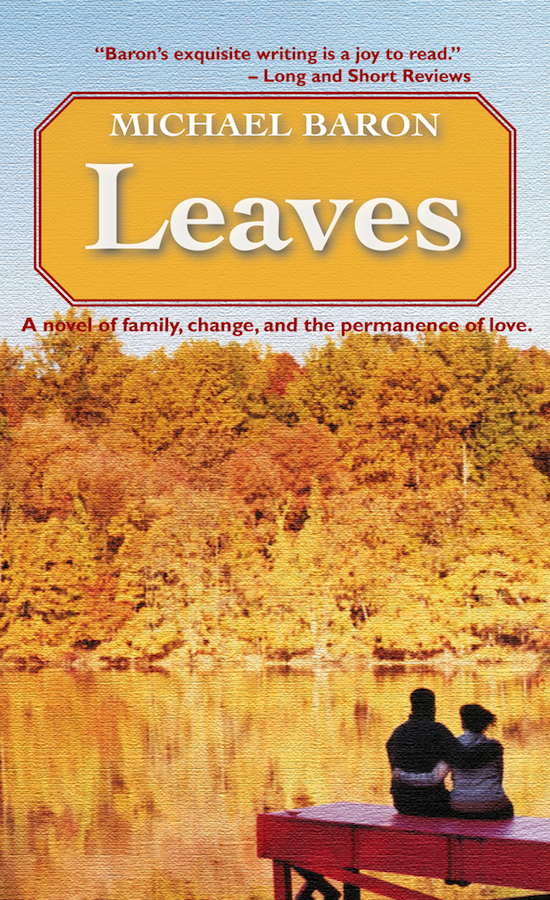
Leaves by Michael Baron has the makings of a family saga, with its large Gold family in Oldham, Ct.  Tyler, a budding nature photographer; Corrina, a controlling older sibling; Deborah, the resident foodie; Maxwell, who seems to have it all and leads the town’s Chamber of Commerce; and Maria, a young emptynester, must close a chapter in their lives and begin anew after deciding to sell the family business, the Sugar Maple Inn — a popular destination for “leaf-peepers.”  Baron alternates between characters throughout the novel, but the characters are dynamic enough and varied so they are easy to keep track of, even when the spouses and their individual family units are introduced.  Each of them is struggling with the close together loss of their parents, as well as the decision to sell the inn that is as much a part of the family as they are.  Each chapter signifies a day in their lives as they count down to the last Halloween bash they’ll ever throw for the residents of Oldham.

“The leaves were the reason that people came, whether it was for an overnight diversion or to settle for decades, rising generations of others who would remain nearby.”  (page 15)

Oldham is a place with many faces and facets from the ancestral families to the newcomers looking for a change or new adventure — particularly those that become small business owners.  Tyler and Maria were easy to connect with as their artistic sides have stagnated and need rejuvenation; Maxwell’s ambivalence about his place in town is easy to understand given the young age of his son and the adjustments he and his wife have made.  Meanwhile, Deborah is like many of us, comfortable in her current place and not quite ready to move on, and unsure of what direction to head in when change is inevitable.  Corrina is a tough nut to crack and hard to like with her domineering nature, but it’s easy to see why she wants to be in control — at least of her siblings and the last party at the inn — because her home life is not as picture perfect as it looks.

There are so many layers to Leaves, as the members navigate their new lives without the inn and their parents to anchor them, and the impact those changes have on their own relationships with one another.  Their moods and reactions change quickly, though the distance between them has been as gradual as the changing seasons.  However, while there are many depths to this novel, there also are moments where readers will want more, but the narrative suddenly changes to another sibling or situation.  Baron has established a foundation for a series of novels that are sure to come about the Gold family, and he’s crafted a family with strong bonds.  Even though each member is on the verge of breaking their family bonds for good, there are memories that creep in to pull them back to their roots and each other.  Baron’s novel is one that readers won’t want to end.  There is so much more in store for these characters and their relationships.

About the Author:

Michael Baron grew up in the New York area, has worked in retail and taught high school English.  Although he started writing nonfiction, he’s always loved fiction and love stories.  He has a deep passion for writing about relationships – family relationships, working relationships, friendships, and, of course, romantic relationships.  His wife and kids are the center of his life and his wife is the inspiration for all of his love stories.

Book News: Oprah’s ‘Super Soul Sunday’ on Feb. 3

Everyone knows how Oprah’s book club rejuvenated book sales across the country, but did you know that since moving to her new OWN network, she’s carried on with her book club.  Super Bowl Sunday, when husbands are preparing for the big game between the Baltimore Ravens and San Francisco 49ers, there’s more than just football on.

While I’m excited to say the Boston Celtics will be playing at 1 p.m., I’m equally excited that Oprah will have first-time author Ayana Mathis, who wrote The Twelve Tribes of Hattie, on her Super Soul Sunday show on Feb. 3, 2013, which will air 11 a.m. ET/PT on OWN. But readers and Oprah fans also can catch the interview on Oprah.com or Facebook.com/SuperSoulSunday.

About The Twelve Tribes of Hattie:

In 1923, fifteen-year-old Hattie Shepherd flees Georgia and settles in Philadelphia, hoping for a chance at a better life. Instead, she marries a man who will bring her nothing but disappointment and watches helplessly as her firstborn twins succumb to an illness a few pennies could have prevented.  Hattie gives birth to nine more children whom she raises with grit and mettle and not an ounce of the tenderness they crave.  She vows to prepare them for the calamitous difficulty they are sure to face in their later lives, to meet a world that will not love them, a world that will not be kind. Captured here in twelve luminous narrative threads, their lives tell the story of a mother’s monumental courage and the journey of a nation.

Mathis’ novel already has received praise from The New York Times, which said the novel “gracefully” tells of not only The Great Migration in the mid-1920s when 6 million African-Americans fled the Jim Crow South, but also the hardening of Hattie as she experiences loss.  As part of Oprah’s interview with Mathis, the women are expected to talk about the large soul-searching aspects of the novel, particularly the struggles experienced in parenting, loss, and survival.  Also, “in this revealing interview, Mathis shares how she overcame criticism and self-doubt, and went on to create her critically-acclaimed first novel.   She divulges who from her own life inspired the book’s heroine, Hattie Shepherd, and how she developed each supremely human character,” says HARPO studios.

Interested in a sneak peak?  Check it out.

For a sneak peek of “Oprah’s Book Club: Oprah and Ayana Mathis Author of ‘The 12 Tribes of Hattie’” below are the downloadable link:

URL (with embed code): http://www.oprah.com/own-supersoulsunday/blogs/Ayana-Mathis-Life-Today

Or check it out here:

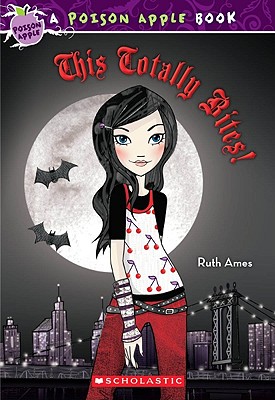
This Totally Bites! by Ruth Ames

This Totally Bites! by Ruth Ames, part of the Poison Apple series of books from Scholastic, is for children in grades 4-6, though it would more likely appeal to girls.  Emma-Rose Paley turns 12 and her life becomes something out of a fantasy novel, and readers will have to suspend disbelief, which shouldn’t be too hard with kids who haven’t lost touch with their imaginations.  Emma likes things dark and wears black, she likes the rain, and she loves rare meat, but her friend Gabby is her polar opposite, wearing pastels, always punctual, and a vegetarian.  In typical seventh grade fashion, there is gossip, hiding from the popular crowd, and navigating peer pressures, but Em’s mother is a curator at the New York Museum of Natural History and her great-aunt is staying with them while helping out with a museum exhibit on bats.

Despite her recurring nightmare of darkness and red eyes, Em tackles her homework and navigates the preteen world with a sense of self unlike most 12-year-old girls.  She’s got her small network of friends, but really only one strong girlfriend, Gabby, while her other two friends tend to waver at the first sign of peer pressure.  In many ways, this dynamic group resembles the truth of school-age kids.  Ames has created a believable world, and even the supernatural elements are believable as the girls research the truth of the matter.  It’s great to see Em come out of her shell, voice her opinion, and become a peer that others can look up to, even when she’s hoping to fade into the background.

There are school girl crushes, bickering, and boy gossip, but what makes Ames’ story memorable is the character of Em, who demonstrates a mature ability to think logically about her situation and at the same time remain vulnerable and stubborn when it comes to arguing her point with her friends.  This Totally Bites! by Ruth Ames is a fun story that younger girls will enjoy and learn about how to be themselves in a world that thrives on peer pressure and fitting in.

About the Author:

Ruth Ames is the author of This Totally Bites, one of the inaugural spine-tingling Poison Apple books. She has written several best-selling young adult novels under another name. Ruth loved reading spooky stories as a child. She now lives in Manhattan.

This is my 5th book for the 2013 New Authors Challenge.

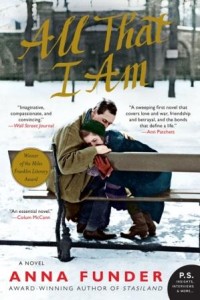
All That I Am by Anna Funder

All That I Am by Anna Funder is an unusual pre-WWII novel that takes into account not only the after effects of WWI, but also the politics that flooded Germany before the war.  Funder has crafted a psychological novel in some ways, but the characters who are most interesting and mysterious — Hans and Dora — also are the most distant.  Perhaps they are more interesting and mysterious because they are seen through the eyes of those who knew and loved them best — Ruth and Ernst Toller — which begs the question of whether we — ourselves — would be more interesting to others if seen through our closest connections.  Ruth, Ernst, Hans, and Dora, along with others, are forced to flee Germany for London after Hitler comes to power.  Funder admits that many of the elements of her novel are taken from history and from her friend Ruth’s actual life, but this novel is not just about the history and intrigue of German ex-pats seeking information from inside the regime about their friends and to warn other countries about Hitler’s expectations for war.

“Last week they loaded me into the MRI machine, horizontal in one of those verdammten gowns that do not close at the back: designed to remind one of the fragility of human dignity, to ensure obedience to instruction, and as a guarantee against last-minute flight.”  (page 7)

Ruth and Dora are cousins, and Ruth is easily swept up into the passion of the Socialist party Dora belongs to because she’s already fallen in love with the words of a young man, Hans.  Even at the beginning, there is a tension between Hans and Dora, and while Ruth first mistakes it for a lover’s intimacy, it is clear to the reader that the tension is born of jealousy and competition.  The beginnings of the movement hold close to their ideals for peace and workers’ rights — even equal rights for women — but those ideals are tested time and again.  These ideals are burdened and even broken, as seen through the eyes of the individuals tested.  Funder’s unraveling of the story in two perspectives — Toller and Ruth — can be frustrating, as Toller and Ruth tell their stories from different points in time, which calls into question whose memory is more reliable.  Both are looking to the past before WWII and their early days in exile, and Funder leaves enough clues along the way for readers to pick up on the essence of the outcome.

“From what Bev has told me, an addict can lose ten years of their life in a quest for exactly this:  the constant present tense.  Afterwards, those who do not die wake to a world that has moved on without them:  it is as if nothing happened to the fiend in those years, they did not age or grow and they must now pick up –”  (Page 201)

Whether the drug is an opiate, morphine, or memory, these activists, these friends, these compatriots become blind to the realities of their exile.  Rather than remember their past glories with fondness, Hans, in particular, and Toller become absorbed in the images of themselves — those they created or were created of them.  Funder is calling into question the image we have of ourselves and those that others have of us — are those perceptions mirrors of themselves or are they a bit distorted when compared.

All That I Am by Anna Funder sheds light on the lives of German ex-pats before WWII, and the secretive life some of them led as they tried to help those they left behind in Germany.  But at it’s heart, the novel is about how politics and ambitions can distort friendships or not matter at all.  It’s also about the enduring love for those we know and love, even those that are unworthy of that devotion and those who also offer more of themselves to the world and others than they do to themselves.  A novel of memory, love, devotion, and self-sacrifice worth reading.

About the Author:

Anna Funder’s international bestseller, Stasiland, won the Samuel Johnson Prize for nonfiction. Her debut novel, All That I Am, has won many prizes, including the prestigious Miles Franklin Literary Award. Anna Funder lives in Brooklyn, New York, with her husband and children.

Visit Anna at her Website and connect with her on Facebook.

This is my 5th book for the 2013 New Authors Challenge.

Mailbox Monday #210

Mailbox Mondays (click the icon to check out the new blog) has gone on tour since Marcia at A Girl and Her Books, formerly The Printed Page passed the torch. This month’s host is Lori’s Reading Corner.

The meme allows bloggers to share what books they receive in the mail or through other means over the past week.

Just be warned that these posts can increase your TBR piles and wish lists.

Here’s what I received:

1.  The End of the Point by Elizabeth Graver for review from Harper.

A place out of time, Ashaunt Point—a tiny finger of land jutting into Buzzards Bay, Massachusetts—has provided sanctuary and anchored life for generations of the Porter family, who summer along its remote, rocky shore. But in 1942, the U.S. Army arrives on the Point, bringing havoc and change. That summer, the two older Porter girls—teenagers Helen and Dossie—run wild. The children’s Scottish nurse, Bea, falls in love. And youngest daughter Janie is entangled in an incident that cuts the season short and haunts the family for years to come.

2.  Temple of a Thousand Faces by John Shors for review from the author.  Thanks, John, for mentioning me in the Acknowledgments.

When his land is taken by force, Prince Jayavar of the Khmer people narrowly escapes death at the hands of the conquering Cham king, Indravarman. Exiled from their homeland, he and his mystical wife Ajadevi set up a secret camp in the jungle with the intention of amassing an army bold enough to reclaim their kingdom and free their people. Meanwhile, Indravarman rules with an iron fist, pitting even his most trusted men against each other and quashing any hint of rebellion.

What did you receive?

186th Virtual Poetry Circle

Welcome to the 186th Virtual Poetry Circle!

Remember, this is just for fun and is not meant to be stressful.

Keep in mind what Molly Peacock’s books suggested. Look at a line, a stanza, sentences, and images; describe what you like or don’t like; and offer an opinion. If you missed my review of her book, check it out here.

Also, sign up for the 2013 Dive Into Poetry Challenge because its simple; you only need to read 1 book of poetry. Please visit the stops on the 2012 National Poetry Month Blog Tour.

Today’s poem is from Richard Blanco, (Click on his name to read an interview with him about the process) and it’s the inaugural poem for those who missed it on television — see the video below:

Also, see the full text:

One Today

 One sun rose on us today, kindled over our shores,
peeking over the Smokies, greeting the faces
of the Great Lakes, spreading a simple truth
across the Great Plains, then charging across the Rockies.
One light, waking up rooftops, under each one, a story
told by our silent gestures moving behind windows.

My face, your face, millions of faces in morning's mirrors,
each one yawning to life, crescendoing into our day:
pencil-yellow school buses, the rhythm of traffic lights,
fruit stands: apples, limes, and oranges arrayed like rainbows
begging our praise. Silver trucks heavy with oil or paper—
bricks or milk, teeming over highways alongside us,
on our way to clean tables, read ledgers, or save lives—
to teach geometry, or ring-up groceries as my mother did
for twenty years, so I could write this poem.

All of us as vital as the one light we move through,
the same light on blackboards with lessons for the day:
equations to solve, history to question, or atoms imagined,
the "I have a dream" we keep dreaming,
or the impossible vocabulary of sorrow that won't explain
the empty desks of twenty children marked absent
today, and forever. Many prayers, but one light
breathing color into stained glass windows,
life into the faces of bronze statues, warmth
onto the steps of our museums and park benches
as mothers watch children slide into the day. 

 One ground. Our ground, rooting us to every stalk
of corn, every head of wheat sown by sweat
and hands, hands gleaning coal or planting windmills
in deserts and hilltops that keep us warm, hands
digging trenches, routing pipes and cables, hands
as worn as my father's cutting sugarcane
so my brother and I could have books and shoes.

The dust of farms and deserts, cities and plains
mingled by one wind—our breath. Breathe. Hear it
through the day's gorgeous din of honking cabs,
buses launching down avenues, the symphony
of footsteps, guitars, and screeching subways,
the unexpected song bird on your clothes line.

Hear: squeaky playground swings, trains whistling,
or whispers across café tables, Hear: the doors we open
for each other all day, saying: hello, shalom,
buon giorno, howdy, namaste, or buenos días
in the language my mother taught me—in every language
spoken into one wind carrying our lives
without prejudice, as these words break from my lips.

One sky: since the Appalachians and Sierras claimed
their majesty, and the Mississippi and Colorado worked
their way to the sea. Thank the work of our hands:
weaving steel into bridges, finishing one more report
for the boss on time, stitching another wound
or uniform, the first brush stroke on a portrait,
or the last floor on the Freedom Tower
jutting into a sky that yields to our resilience. 

 One sky, toward which we sometimes lift our eyes
tired from work: some days guessing at the weather
of our lives, some days giving thanks for a love
that loves you back, sometimes praising a mother
who knew how to give, or forgiving a father
who couldn't give what you wanted.

We head home: through the gloss of rain or weight
of snow, or the plum blush of dusk, but always—home,
always under one sky, our sky. And always one moon
like a silent drum tapping on every rooftop
and every window, of one country—all of us—
facing the stars
hope—a new constellation
waiting for us to map it,
waiting for us to name it—together.

What do you think?

The Missing Manuscript of Jane Austen by Syrie James

Syrie James’ The Missing Manuscript of Jane Austen is a novel within a novel when librarian Samantha McDonough finds a letter in an old poetry book while on a trip to England with her boyfriend, Stephen.  Through this mystery letter, Sam begins an adventure through the countryside of England and enters the novel world of Jane Austen.  Through her travels she meets Anthony Whitaker, the heir of the former owner of Greenbrier, a small country estate in England.  He’s breathtakingly handsome and intelligent, but at times his dream of owning his own company can take over and make him arrogant and stubborn.

“Anthony and I had been taking turns reading aloud.  He was a quick study and had a marvelous gift for bringing characters to life.  Hearing Jane Austen’s words in his delectable British accent was divine.”  (page 127 ARC)

Like Austen’s characters, Sam and Anthony are flawed, but optimistic — and they lose their way, but eventually stumble onto the right path.  James has a way of capturing Austen’s style that belies the modernity of the story she’s telling, and in many ways, readers will get lost in the manuscript, just as Sam and Anthony do.  The missing manuscript not only captures everyone’s rapt attention, but highlights the enduring truth of Austen’s words in her own novels.  Mirroring the quirky characters Austen created and the hilarious proposals she used in her own novels, James’ missing manuscript echoes the great classics while continuing in the tradition of Austen’s fans by making them fresh and fun.

While the events in the manuscript regarding Miss Stanhope’s family and her love life are predictable, it is the journey that she takes to get to happiness that is worthy of Austen’s approval.  James’ character blossoms from a naive, country girl into a women who continues to have a strong mind, loyalty to her family, and dedication to those deserving of her compassion.  However, Sam and Anthony are more like tools to move the story along when — in this case — a frame story would have been sufficient.

Sam and Anthony’s relationship seems to blossom away from the reader’s vision, and this could hamper the reader’s ability to connect with them.  There are brief moments where they interact while reading the manuscript, but what goes on between them while they are reading — looks or brief touches — are not shown.  It’s also hard to interpret Sam’s feelings for Stephen when all we have is her comments about their relationship and rarely see them interact.  Additionally, the hunt for the manuscript seemed rushed, and should have had a bit more depth and twists and turns to make it more suspenseful and believable.

Overall, The Missing Manuscript of Jane Austen by Syrie James is an enjoyable work about Jane Austen, historian’s thoughts about her work, and the mysteries that remain.  But at the same time, it is about the interpretations of her novels in how the hero always must prove himself to the heroine to win her love and how change can sometimes be a blessing in disguise.

About the Author:

Syrie James is the bestselling author of eight critically acclaimed novels, including The Missing Manuscript of Jane Austen, The Lost Memoirs of Jane Austen, The Secret Diaries of Charlotte Bronte, Nocturne, Dracula My Love, Forbidden, and The Harrison Duet: Songbird and Propositions. Her books have been translated into eighteen foreign languages.

Eyes, Stones by Elana Bell

Eyes, Stones by Elana Bell, winner of the Walt Whitman Award, is a debut collection with two voices — two sides of the Palestinian-Israeli struggle — that demonstrates not only the pride of Palestinians, but also the pride of Israelis in their home.  The initial poem, “The Dream,” (which could be a preface to the following three sections) establishes the somber tone for the book, but it also cautions that choices must be made in dreams even as they must be made when awake.  A sentiment that is echoed again in “Notes from the Broken Notebook (part one):  “cover your mouth, you’ll still inhale the gas/dance in the shadow of the concrete wall/tell yourself the tiles are not bones/even in a dream you must still make choices.”  Bell is careful in her choice of language, but she does not shy away from the tumultuous moments in the region’s history, including the role of Arafat.

There is a great juxtaposition in the poem “Refugee,” which is about Ramla in 1948, between the new inhabitants of the house and the ones who have left.  The refugees are entering the house with hope, a feeling of belonging and settlement on their minds, but there is this observance of what has come before — the quick ejection of the former residents, leaving the cupboards full and a few cans rolling on the floor.  It is just one illustration of how something can symbolize hope and a new beginning to one person, but be the symbol of loss and an ending for another — much like the foreclosure can be for two different families.

There is a great reverence to the land and its cultivation, but there also is a reverence paid to the building of communities and the brokering of peace between the warring nations of Palestine, Jordan, and Israel.  In many ways, the poems open up an unsaid dialogue about the possibility of not only understanding but even co-existence, maybe even peace.  “You are not a place my love./You come from where/there are no names.  You enter/as breath and drop/onto our sleeping tongues//” from “Charter for the Over-Sung Country” should remind readers that they are more than just their home country or the place where they live.  In more than one poem, the narrator references the smell of dirt or soil after the rain, which could signify not only a cleansing of the past and a fresh future, but also the possibilities that the future holds.

There are a few poems that are letters to certain places in the region, and in “Letter to Jerusalem” the narrator talks of not crushing the bird too quickly, perhaps a reference to how the city grew out of the sand without regard to the consequences.  In “Letter to Hebron,” the narrator wants to illustrate the truth of the city not the dream of the city.  With its foul smells and the flies, but no matter how much or how long something is beat down into submission or sculpted one way, it can only be what it is — “That wooden doorway, hung without a house.”  Does this mean one town is better than another or that one is more beautiful?  No.  It simply shows that there are dreams for these cities, but oftentimes reality falls short of those dreams, leaving the inhabitants looking through a doorway into a rough landscape.

Eyes, Stones by Elana Bell connects the struggles of these two peoples not in the traditional opposing sides, but through their similar perspectives of loss and hope.   The collection also links the Holocaust survivors to the promise of Israel as the new homeland and incorporates biblical story with historical activists.

About the Author:

Elana Bell is a bridge builder, able to walk compassionately through this complex world where many things are true at once. Whether through her soul-stirring poetry, her dynamic performances on the stage, or through her inspiring talks & workshops, she creates a space where all people’s voices and stories are heard and deeply valued.

Elana’s first collection of poetry, Eyes, Stones was selected by Fanny Howe as the winner of the 2011 Walt Whitman Award and was published by Lousiana State University Press in April 2012. Elana is the recipient of grants and fellowships from the Jerome Foundation, the Edward Albee Foundation, the AROHO Foundation, and the Drisha Institute. Her work has recently appeared in Harvard Review, Massachusetts Review, CALYX Journal, and elsewhere. Elana has led creative writing workshops for women in prison, for educators, for high school students in Israel, Palestine and throughout the five boroughs of New York City, as well as for the pioneering peace building and leadership organization, Seeds of Peace. She currently serves as the writer-in-residence for the Bronx Academy of Letters and lives in Brooklyn, New York.

Photo by Rachel Eliza Griffiths


This is my 4th book for the 2013 New Authors Challenge.


This is my 3rd book for the Dive Into Poetry Challenge 2013.


What the book club thought:

There were mixed reactions to the book with one member not sure they understood many of the poems at all to one member that really loved the book.  Several members thought the narrator did a pretty good job of demonstrating both sides in the Israeli-Palestine conflict through the eyes of those who had lived there and tilled the land for centuries to the Israelis seeking refuge and a new home after WWII.  The poems of “Refugee,” “Visiting Auschwitz,” “Visiting Aide refugee camp,” and “On a Hilltop at the Nassar Farm” were among some of the poems talked about more in depth during the meeting, as well as the section of poems beginning with “God” and “What Else God Wanted.”  In particular, it was noted in the religious section of poems that the “God” poem demonstrated a bit of bitterness, that was followed by the story of “Ishmael,” which seemed like it was being told to Ishmael as his poem comes first before the story of his conception.  One poem that I found a bit cliche, but that touched something in the other members of the group was “In Another Country It Could Have Been Love.”

In terms of the book’s title, the members were not really thrilled about “Eyes, Stones.”  While we see the references in several poems, we felt that another title might have been better suited to the collection.  Perhaps, stones refers to the takeover of anger and other hard emotions that can shut out empathy, love, and understanding.

Later we had a discussion of how many of us read some or all of the poems aloud and whether that was helpful in understanding the poems, and I recommended that if we did do another poetry collection that it should be read aloud, at least the poems that do not generate an immediate impression.  Secondly, we discussed how to read poems, particularly poems in free verse and how much pause should be given to the end of the line and to punctuation.  Overall the discussion was all over the place, and some of us agreed that the collection was probably not the best selection for a beginning poetry reader or a group with little background knowledge on the Israeli-Palestine conflict and its beginnings, though Bell does offer some notations in the back to provide an anchor point for most of the poems.

Mailbox Monday #209

Mailbox Mondays (click the icon to check out the new blog) has gone on tour since Marcia at A Girl and Her Books, formerly The Printed Page passed the torch. This month’s host is Lori’s Reading Corner.

The meme allows bloggers to share what books they receive in the mail or through other means over the past week.

Just be warned that these posts can increase your TBR piles and wish lists.

Here’s what I receive:

1.  Survival Skills by Jean Ryan, which I received for review from the author.

The characters who inhabit Jean Ryan’s graceful, imaginative collection of stories are survivors of accidents and acts of nature, of injuries both physical and emotional. Ryan writes of beauty and aging, of love won and lost—with characters enveloped in the mysteries of the natural world and the animal kingdom.

In “Greyhound,” a woman brings home a rescued dog for her troubled partner in hopes that they might heal one another—while the dog in “What Gretel Knows” is the keeper of her owner’s deepest secrets. In “Migration,” a recently divorced woman retreats to a lakefront cabin where she is befriended by a mysterious Canada goose just as autumn begins to turn to winter. As a tornado ravages three towns in “The Spider in the Sink,” a storm chaser’s wife spares the life of a spider as she anxiously waits for her husband to return. And in “A Sea Change,” a relationship falls victim to a woman’s obsession with the world below the waves.

What did you receive?