Quantcast

Mailbox Monday #319

Mailbox Monday, created by Marcia at To Be Continued, formerly The Printed Page, has a permanent home at its own blog.

To check out what everyone has received over the last week, visit the blog and check out the links.  Leave yours too.

Also, each week, Leslie, Vicki, and I will share the Books that Caught Our Eye from everyone’s weekly links.

Here’s what I received:

1.  Young Jane Austen: Becoming a Writer by Lisa Pliscou from the author for review.

What was Jane Austen like as a child? What were her formative influences and experiences, her challenges and obstacles, that together set her on the path toward becoming a writer?

Drawing upon a wide array of sources, including Austen’s own books and correspondence, Lisa Pliscou has created a “speculative biography” that, along with 20 charming black-and-white illustrations, offers a fascinating glimpse into the world of young Jane Austen. Also included is a richly detailed, annotated version of the narrative and an overview of Austen’s life, legacy, and the era in which she lived, as well as a timeline of her key childhood events.

YOUNG JANE AUSTEN is sure to intrigue anyone interested in Jane Austen, in writing and the creative process, and in the triumph of the artistic spirit.
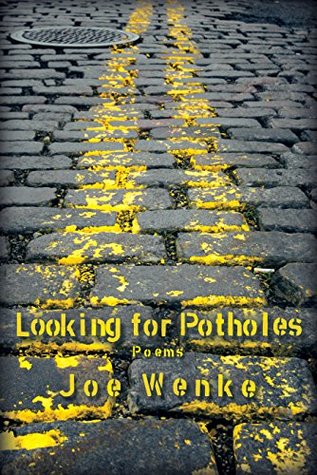
2.  Looking for Potholes by Joe Wenke from the publisher for review.

Poetry by Joe Wenke. Joe has written several books including: Human Agenda: Conversations about Sexual Orientation and Gender Identity (January 2015), The Talk Show: a Novel, Free Air: poems, Papal Bull: An Ex-Catholic Calls Out the Catholic Church, You Got Be Kidding! A Radical Satire of The Bible and Mailer’s America.


3.  The Sound of Glass by Karen White for review from the publisher.

It has been two years since the death of Merritt Heyward’s husband, Cal, when she receives unexpected news—Cal’s family home in Beaufort, South Carolina, bequeathed by Cal’s reclusive grandmother, now belongs to Merritt.

Charting the course of an uncertain life—and feeling guilt from her husband’s tragic death—Merritt travels from her home in Maine to Beaufort, where the secrets of Cal’s unspoken-of past reside among the pluff mud and jasmine of the ancestral Heyward home on the Bluff. This unknown legacy, now Merritt’s, will change and define her as she navigates her new life—a new life complicated by the arrival of her too young stepmother and ten-year-old half-brother.

Soon, in this house of strangers, Merritt is forced into unraveling the Heyward family past as she faces her own fears and finds the healing she needs in the salt air of the Low Country.

4.  The Mapmaker’s Children by Sarah McCoy for a TLC Book Tour.

When Sarah Brown, daughter of abolitionist John Brown, realizes that her artistic talents may be able to help save the lives of slaves fleeing north, she becomes one of the Underground Railroad’s leading mapmakers, taking her cues from the slave code quilts and hiding her maps within her paintings. She boldly embraces this calling after being told the shocking news that she can’t bear children, but as the country steers toward bloody civil war, Sarah faces difficult sacrifices that could put all she loves in peril.  Eden, a modern woman desperate to conceive a child with her husband, moves to an old house in the suburbs and discovers a porcelain head hidden in the root cellar—the remains of an Underground Railroad doll with an extraordinary past of secret messages, danger and deliverance.
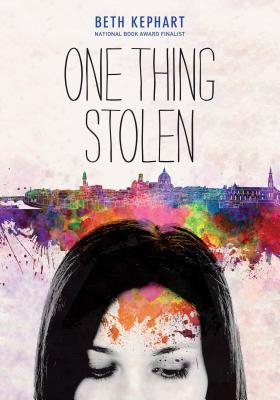
5.  One Thing Stolen by Beth Kephart, my pre-ordered hardcover finally arrived!

Set in Florence, Italy, One Thing Stolen follows Nadia Cara as she mysteriously begins to change. She’s become a thief, she has secrets she can’t tell, and when she tries to speak, the words seem far away.

What did you receive this week?
302nd Virtual Poetry Circle

Welcome to the 302nd Virtual Poetry Circle!

Remember, this is just for fun and is not meant to be stressful.

Keep in mind what Molly Peacock’s book suggested.

Look at a line, a stanza, sentences, and images; describe what you like or don’t like; and offer an opinion. If you missed my review of her book, check it out here.

Today’s poem is from Bruce Weigl:

Song of Napalm

After the storm, after the rain stopped pounding,
We stood in the doorway watching horses
Walk off lazily across the pasture’s hill.
We stared through the black screen,
Our vision altered by the distance
So I thought I saw a mist
Kicked up around their hooves when they faded
Like cut-out horses
Away from us.
The grass was never more blue in that light, more
Scarlet; beyond the pasture
Trees scraped their voices into the wind, branches
Crisscrossed the sky like barbed wire
But you said they were only branches.

Okay. The storm stopped pounding.
I am trying to say this straight: for once
I was sane enough to pause and breathe
Outside my wild plans and after the hard rain
I turned my back on the old curses. I believed
They swung finally away from me …

But still the branches are wire
And thunder is the pounding mortar,
Still I close my eyes and see the girl
Running from her village, napalm
Stuck to her dress like jelly,
Her hands reaching for the no one
Who waits in waves of heat before her.

So I can keep on living,
So I can stay here beside you,
I try to imagine she runs down the road and wings
Beat inside her until she rises
Above the stinking jungle and her pain
Eases, and your pain, and mine.

But the lie swings back again.
The lie works only as long as it takes to speak
And the girl runs only as far
As the napalm allows
Until her burning tendons and crackling
Muscles draw her up
into that final position

Burning bodies so perfectly assume. Nothing
Can change that; she is burned behind my eyes
And not your good love and not the rain-swept air
And not the jungle green
Pasture unfolding before us can deny it.

What do you think?

Haiku Friday #3

I’ve decided to write at least 30 haiku for National Poetry Month 2015.

I’ve been writing them if not daily, but in groups of three or more.  If you missed my first three haiku from this month, feel free to check them out.

For those of you who are wondering about haiku — beyond the 5-7-5 syllable count — please visit Parrish Lantern‘s post on the form.

Here’s Haiku Friday #1 and Haiku Friday #2.

If you’ve written or read any great poems this month, please feel free to share them in the comments.

Here are some of my most recent haiku pieces:

Long wait burns my legs
paused still, my video life
a curb of carbon.

Pushed aside, now.
Doors begin to close, sandwich —
I am the cheese.

Hyper-linked pic
shared widely out in space
echo, social media

Siren call, watch out
louder, softer, run away
toddle forward, fall

Cragged tripod feet
grown long, thick, gnarled
clutching tar and wire

Interview with Jeannine Hall Gailey, author of The Robot Scientist’s Daughter

2015PoetryMonthIn conjunction with Poetic Book Tours and the 2015 National Poetry Month Blog Tour, Jeannine Hall Gailey agreed to be interviewed about her poetry, including her new collection, The Robot Scientist’s Daughter.

I’ve read her poetry for several years, and I just cannot get enough.  I hope that you’ll not only check out her interview below, but also her April book tour.

A few of your collections — Becoming the Villainess and Unexplained Fevers — have reinvented and breathed new life into beloved heroines, myths, and fairy tales.  How do these stories inspire you to create the vivid and unusual narratives in your poems?  Which are some of your favorites?

At the time I was writing Becoming the Villainess, I was particularly interested in Ovid’s Metamorphoses and the story of Procne and Philomel, and more unusual fairy tales, such as the story of the French fairy Melusine, which I fell in love with after researching it after reading A.S. Byatt’s Possession, and the story of “the coat of thousand furs,” or Allerleirauh. I was not interested in the Disney versions of the fairy tales, as I knew even as a kid how much they differed from their Grimms’ origins, but I did enjoy sort of tweaking the clichés of those films.

Then of course I got really interested in Japanese folk tales a few years ago, when I was writing She Returns to the Floating World, and researched and found as many of them translated into English as I could. I loved the ones that focused on older sisters rescuing younger brothers, which is quite a common trope in Japanese folk tales, and of course the tales of transformations of women into foxes, cranes, peonies, etc. There are so many interesting tales out there. I also love Hans Christian Andersen’s “The Snow Queen” – it’s a fascinating, complicated, and unexpectedly feminist piece of work. I love re-working those characters.

Unexplained Fevers actually centers on the fairy tale characters I neglected in my first book, because I felt that they were too passive. But after reading the Snow White/Rose Red references in Haruki Murakami’s After Dark and the Rapunzel narratives in Osamu Dazai’s Blue Bamboo, I started thinking about how I could re-write characters like Sleeping Beauty, Rapunzel, and Snow White – and that’s how I started writing that book.

robotIn your new collection, The Robot Scientist’s Daughter, your subject matter is a little more concrete, including but not limited to the history of nuclear development, family, and nature. How did this collection come to be and did you find the process easier or more difficult compared to previous collections?

I think a seed for this collection was planted when I was working with Dorianne Laux at the Pacific University MFA program some years ago, and she encouraged me to write more about my own life. I considered my life too boring to write about. And Ilya Kaminsky, I remember, told me after reading my first couple of books that “now is the time for you to create your own fairy tale.” I held on to both of those things, but it took me a while to figure out how to incorporate my own experience into poetry.

The Robot Scientist’s Daughter was born in the series of “elemental” poems in the book—poems like “Cesium Burns Blue,” “Radon Daughters,” and “Elemental,” —and then I started thinking about ways to create a character that was like me but was not—and I came up with the Robot Scientist’s Daughter character. Those are more fantasy and sci-fi-based poems, and therefore more familiar to me and fun to write. The straight-up history/autobiography poems were probably the hardest to write—Oak Ridge’s history is fascinating—even the Wikipedia entry can sound like a weird prose poem—but making that history sound poetic was something I struggled with. I did include a series of poems about my childhood that were not as fun to write, but I wanted something that would give the reader sort of a child’s-eye view of the beautiful, mysterious nature of growing up on a farm in Tennessee, not just the “atomic history down the street” part.

Nuclear research, energy, and bombs are dangerous but yet humanity continues to engage in these activities despite the lasting risks. In “They Do Not Need Rescue”, the poem discusses the silence surrounding the consequences of these activities — that the people living nearby Oak Ridge National Laboratory signed away their family’s lives for a meager paycheck and a house — and it raises questions about why they would remain silent even years later and not speak out. Is it a question of fear vs. bravery, or something more?

I can’t really speak for the people who made those decisions, which are individual to each of them. But I do know that the contracts for people that work/worked at ORNL – a huge source of lucrative jobs in a region that even now doesn’t have a ton of great jobs – were pretty prohibitive and threatening, and people in that area signed a contract and stuck with that agreement. If they don’t feel comfortable speaking out today, it’s probably because of the wording of the contracts they signed. I don’t want anyone to get the impression that the people of Oak Ridge are victims – they certainly don’t think of themselves that way – and there’s a culture in Eastern Tennessee of individualism, hard work, patriotism, and a tendency towards the taciturn rather than the loquacious.

Also, the dangers of radiation were not really well known early on in the work of ORNL – as reading some of the memoir of one of Oak Ridge’s early “Safety Physicists”, The Angry Genie, would indicate. In the beginning, they were focused on winning World War II, getting the bomb before the Nazis, and not as worried about pollution and those kinds of “down the road” problems. There was a little bit about how they taped uranium to the wrists of some of the nurses there, to see the effect; I mean, they were very naive back then. The Chernobyl and Fukushima disasters, for instance, indicate that even today, how little prepared most companies and countries are for the kinds of problems that can happen with nuclear disaster, how little they understand the magnitude of something like nuclear pollution, how it stays around for multiple human lifetimes. It’s something to keep in mind as our nuclear power plants age here in the United States.

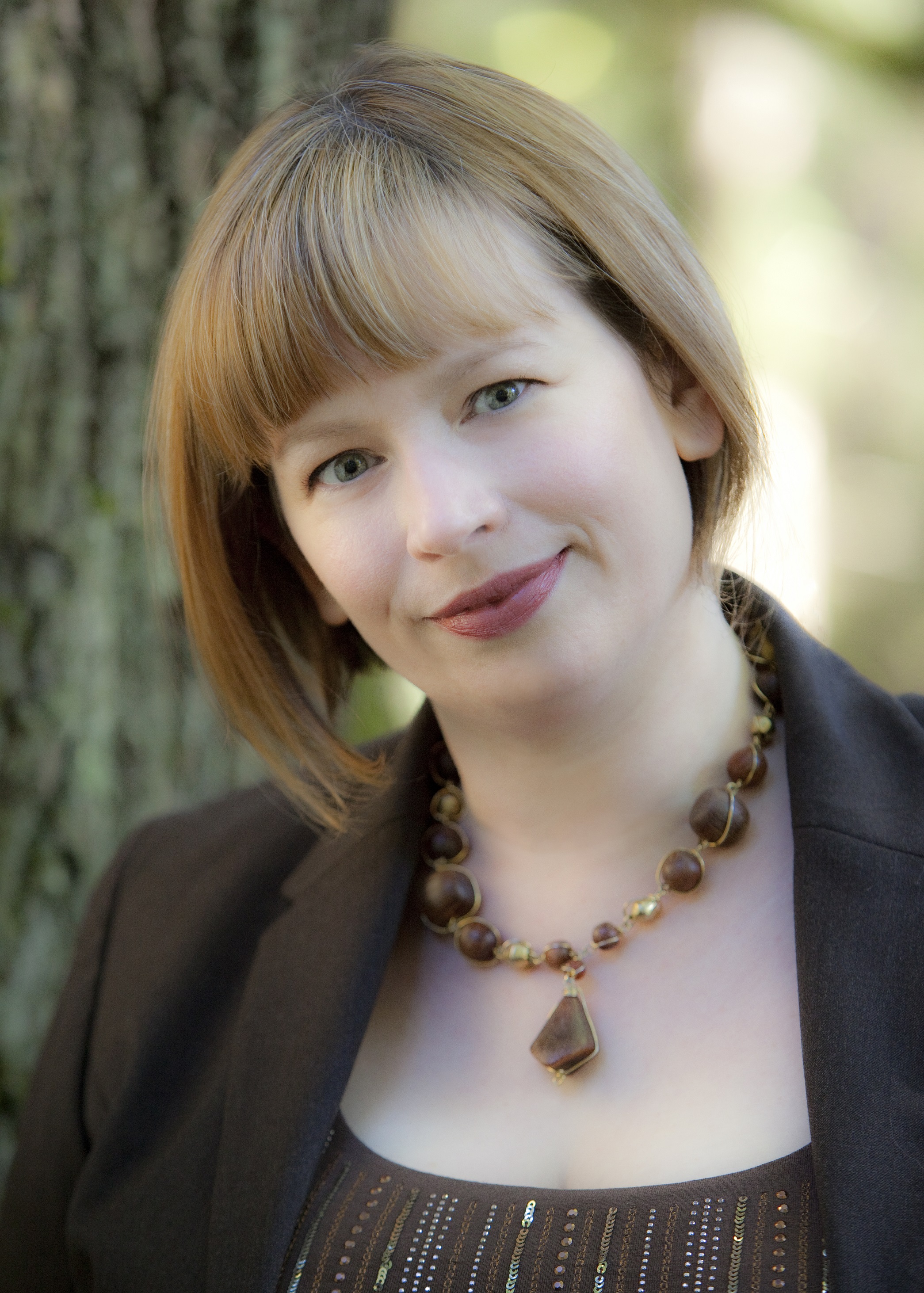
JeannineHighResHeadshotmediumWriting is a solitary endeavor for many authors. How do you maintain contact with the outside, and how does that differ from the experience of reading your work aloud for an audience?

I’ve belonged to a writing group for thirteen years, and that really helps. Also, Seattle and the surrounding cities have great writing communities. I volunteered with several terrific local journals for many years, which is also a great way to stay connected with the writing community—currently I’m on the Board at Crab Creek Review. Writing itself is work that must be done alone, but sharing it, getting it published, dealing with rejection, applying for grants or residencies—all those parts of the writing life really benefit from the help/encouragement of other writers. I also enjoying teaching, editing manuscripts, and a new venture—helping poets with PR for their books! I absolutely root for every single student and editing client to succeed!

I also think social media – Blogs, Facebook, Twitter, what have you – can really help you feel connected to the larger writing world in a way that just wasn’t possible when I was a younger writer. A lot of people hate them, but I absolutely think they are a gift (even if I haven’t exactly figured out how to be the greatest Twitter-er or anything yet.) You can see when different magazines have a call for submissions, or congratulate a friend on good publishing news, or follow writers you admire. I mean, you can’t spend all day on that stuff, but it’s great on a rainy Sunday to go to the Twitter #poetparty, for instance, and say hi to some writing friends and feel encouraged.

What poets you’ve read are making a difference with their poetry, either trying to influence societal, environmental, or political change? What other poets should we be reading?

For the first question: There are really so many! I think probably Carolyn Forché, Alicia Ostriker, Margaret Atwood, Pattiann Rogers, Sandra Alcosser, and llya Kaminsky have all been particularly influential in terms of the way they write their activism. But I am so excited about reading the younger generation’s take (do I sound super-old there? But it’s true!) on issues like racism, feminism, the environment, immigration—I feel that younger writers right now are unafraid of taking on big ambitious subjects than my generation was/is. Another few poets that I think tackle difficult and thought-provoking political subject matter with imagination and empathy: Jericho Brown, Eduardo C. Corral, Saeed Jones.

For the second question: There are so many good poets here in the Northwest that I think don’t get enough attention – in particular, I’d like to champion the first books by poets Annette Spaulding-Convy and Natasha K. Moni, which are both exceptional. And we have a wonderful group of female poets up here, people like Kelli Russell Agodon, Kathleen Flenniken, Kelly Davio, Elizabeth Austen, Martha Silano, Jenifer Lawrence, Marjorie Manwaring. They’re not just great poets, they’re great people who put time and energy into their poetry community. I love the work that my friends at local press Two Sylvias Press are putting out, too – definitely worth taking a look at. I discover great poets out here all the time, people I’ve never met that I’ll happen to hear at a reading. I try to highlight books I love in my reviews for places like The Rumpus, too. Reviewing is still something I try to do on a regular basis, especially for books that might otherwise get overlooked. Anything to bring more love to poetry!

Thanks, Jeannine, for sharing your thoughts with us and your poet recommendations.

Medic Against Bomb: A Doctor’s Poetry of War by Frederick Foote

Source: NetGalley & Grayson Books
eBook, 82 pgs
I am an Amazon Affiliate

Medic Against Bomb: A Doctor’s Poetry of War by Frederick Foote is a collection of poems from a retired U.S. Navy physician, who also is the director of the Warrior Poetry Project at Walter Reed National Military Medical Center.  Beneath the carnage depicted in many of these poems, there is a compassionate undercurrent.  Some of these poems are about the battle scars — physical and emotional — that shape today’s warriors, but they also are about sacrifice, discipline, and human comfort spawned from work on the hospital ship Comfort and the care of sick and wounded Americans.

From “Mountain Burial”

knowing we can’t retrieve
this well that’s now gone dry.
She lives in a field of green
whose thousand blades wave free,
scattered from us by war,
the ender of destinies.

From “Uncle Jim”

They say everything’s been written; it hasn’t.
Darkness and light are vast, and poets have barely begun.
Even when it hides, the hand knows when it’s writing a final death.

Foote’s narrator is a compassionate medic, but he is well aware of the carnage of war, facing it daily in surgeries and helping soldiers come to terms with the losses they have suffered. There is compassion for the soldiers as well as for the enemies, particularly those also marred by war. These poems are less trying to make sense of war, but geared toward demonstrating compassion and understanding. They pay homage to the dead, a way to honor their collective and individual sacrifices. Foote also includes some great notes about the different terms used, including Fedayeen, which refers to a generic fighter, and Mujahadeen, which refers to someone fighting for a religious cause. There also are great tidbits about events that occurred during the war that many may not know, including villagers who tossed unwanted children — particularly those with cognitive disabilities — onto Medevacs to get rid of them (“The War Child”).

Wife on the ICU

I watch at night and walk at dawn
forever in flight like the soul of a bird
the monitor shows a thin green line
I walk at night and watch at dawn
not knowing the end of the road I’m on
down which, possessed by a voice unheard
I watch at night and walk at dawn
forever in flight like the soul of a bird.

Medic Against Bomb: A Doctor’s Poetry of War by Frederick Foote is a collection of poems that is less focused on battles and who the enemy is and more on the compassion necessary to treat those men, women, and children who are scared by war — whether they are soldiers, bystanders, or the enemy. Some poems are better paced than others, but there are some gems that will have readers looking at war with a new perspective.

About the Author:

Frederick Foote is a poet and physician who lives in Bethesda, MD, USA. His work has appeared in Commonweal, JAMA, The Progressive, and many other journals. Click the tabs for a sample of these poems.


Vessel: Poems by Parneshia Jones

Source: Milkweed Editions
Paperback, 96 pgs
I am an Amazon Affiliate

Vessel: Poems by Parneshia Jones is a stunning collection that explores the vessels we are given to travel through the world in in a literal and figurative sense.  We are born and given a name, but what do those names come to mean to us and how is that different from the meaning of the name to our parents?  Jones explores the meaning of her own name in “Definition,” after the poetic narrator introduces the girl she believes herself to be at the beginning.  She effectively juxtaposes this carefree and fun-loving girl with the expectations of the name she is given.

From “Girl” (pg 3-4)

daydreaming, pretend out loud
Girl.

Singing off-key, flowing T-shirt hair,
microphone brush and missing front teeth.

From “Definition” (pg.7)

Parnassus …
2. (Literature/Poetry)
a. the world of poetry
b. a center of poetic or other creative activity

Parneshia …
I. 1980–daughter of high school sweethearts (prom queen and football captain).
2. (Woman/Poet)
a. rooted in her Midwest, in her poetry
b. growing up in Mama’s kitchen and stacks of dusty books
3. (Woman/Poet) twenty years later, the Poet searches the
definition of her name … who knew

While she is young, the narrator is content to just be, but as she grows older, she seeks a part of herself that she was unaware of, only to be surprised by how connected she already was.  And as the collection continues through its stages, so too does the evolution of the narrator from a child seeking a fair trade with her friend to switch names because her friend’s name is shorter, until she realizes that names often reflect who we are on the inside.  In this tale of growing up, the narrator becomes a young woman who fondly remembers those who helped her grow, like her grandmother who “lifts the quilt/sewn fifty years ago by her mother, signaling me to join her.”  And that girl slid “into the pocket of the quilt,/letting my grandmother’s hands/cradle me back to child,” ultimately “creating a human quilt.” (page 14-5)  These are the memories she can hold onto when the reality of life hits her hard, and she begins to realize that love and other things are not as they are in the movies.

Jones includes poems that explore what happens when we come of age, but also what we remember about our pasts and how important it is to keep the patchwork of our own family histories intact, just like those in a quilt.  While the larger world remembers the bigger stories of poets pushing the envelope and Blacks who became president, we have to be the ones to record our own histories and remember that we, as vessels, carry all of those stories inside of us and that they are part of who we were, are, and will be.  Vessel: Poems by Parneshia Jones is beautiful, nostalgic, questioning, and lyrical.  Like in “Legend of the Buffalo Poets,” “There is a rumble in his roaming./ Part bison, part thunder,/ he is a stampede of words,/ raising mountains from rooted earth.//” and we should “Love our delirious souls/running wild in this concrete jungle.”  (Litany: Chicago Summers, pg. 60-1)

One of the best poetry collections I’ve read in 2015.

About the Poet:

After studying creative writing at Chicago State University, earning an MFA from Spalding University, and studying publishing at Yale University, Parneshia Jones has been honored with the Gwendolyn Brooks Poetry Award, the Margaret Walker Short Story Award, and the Aquarius Press Legacy Award. Her work has also been anthologized in She Walks in Beauty: A Woman’s Journey Through Poems, edited by Caroline Kennedy and The Ringing Ear: Black Poets Lean South, edited by Nikky Finney. A member of the Affrilachian Poets, she serves on the board of Cave Canem and Global Writes. She currently holds positions as Sales and Subsidiary Rights Manager and Poetry Editor at Northwestern University Press. Parneshia Jones lives in Chicago.


Mailbox Monday #318

Mailbox Monday, created by Marcia at To Be Continued, formerly The Printed Page, has a permanent home at its own blog.

To check out what everyone has received over the last week, visit the blog and check out the links.  Leave yours too.

Also, each week, Leslie, Vicki, and I will share the Books that Caught Our Eye from everyone’s weekly links.

Here’s what I received:

1.  The Cherry Harvest by Lucy Sanna from William Morrow for review.

The war has taken a toll on the Christiansen family. With food rationed and money scarce, Charlotte struggles to keep her family well fed. Her teenage daughter, Kate, raises rabbits to earn money for college and dreams of becoming a writer. Her husband, Thomas, struggles to keep the farm going while their son, and most of the other local men, are fighting in Europe.

When their upcoming cherry harvest is threatened, strong-willed Charlotte helps persuade local authorities to allow German war prisoners from a nearby camp to pick the fruit.

But when Thomas befriends one of the prisoners, a teacher named Karl, and invites him to tutor Kate, the implications of Charlotte’s decision become apparent—especially when she finds herself unexpectedly drawn to Karl. So busy are they with the prisoners that Charlotte and Thomas fail to see that Kate is becoming a young woman, with dreams and temptations of her own—including a secret romance with the son of a wealthy, war-profiteering senator. And when their beloved Ben returns home, bitter and injured, bearing an intense hatred of Germans, Charlotte’s secrets threaten to explode their world.

2.  Dark Sparkler by Amber Tamblyn from Harper for review.

The lives of more than twenty-five actresses lost before their time—from Marilyn Monroe to Brittany Murphy—explored in haunting, provocative new work by an acclaimed poet and actress

Amber Tamblyn is both an award-winning film and television actress and an acclaimed poet. As such she is deeply fascinated-and intimately familiar—with the toll exacted from young women whose lives are offered in sacrifice as starlets. The stories of these actresses, both famous and obscure-tragic stories of suicide, murder, obscurity, and other forms of death—inspired this empathic and emotionally charged collection of new poetic work.

Featuring subjects from Marilyn Monroe and Frances Farmer to Dana Plato and Brittany Murphy—and paired with original artwork commissioned for the book by luminaries including David Lynch, Adrian Tome, Marilyn Manson, and Marcel Dzama—Dark Sparkler is a surprising and provocative collection from a young artist of wide-ranging talent, culminating in an extended, confessional epilogue of astonishing candor and poetic command.

3. Hiroshima by John Hersey from the library sale for 50 cents.

On August 6, 1945, Hiroshima was destroyed by the first atom bomb ever dropped on a city. This book, John Hersey’s journalistic masterpiece, tells what happened on that day. Told through the memories of survivors, this timeless, powerful and compassionate document has become a classic “that stirs the conscience of humanity” (The New York Times).


4.  Self-Reliance by Ralph Waldo Emerson, edited by Richard Whelan from the library sale for 50 cents.

A finely honed abridgement of Emerson’s principal essays with an introduction that clarifies the essence of Emerson’s ideas and establishes their relevance to our own troubled era. This is the first truly accessible edition of Emerson’s work, revealing him to be one of America’s wisest teachers.


5. Rachael Ray 2, 4, 6, 8 Great Meals for Couples or Crowds from the library sale for 50 cents.

If you’re like Rachael Ray, mealtime is a time to hang out and reconnect with family and friends. That means you could be making a late dinner for you and your sweetie one night and making brunch for your entire family the next day. No matter how many people join the party, Rachael firmly believes that cooking should be fun, easy–and done in 30 minutes or less.

Transforming recipes for four into recipes for two or eight can be a tricky guessing game. If you use twice the amount of chicken will you have to cook it twice as long? Is it possible to make a satisfying pot of soup for two without having to eat leftovers for a week? What’s the best–and most economical–way to feed a crowd of eight? With Rachael Ray: 2, 4, 6, 8 there’s no need to guess, because Rachael has designed right-sized menus for every occasion, with perfect meals for two, four, six, or eight.

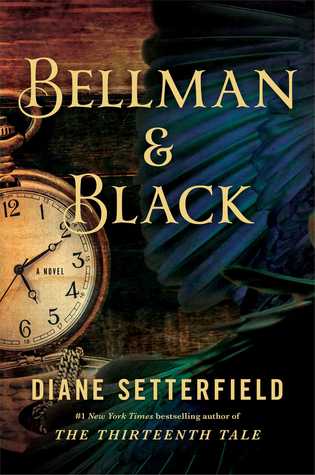
6. Bellman & Black by Diane Setterfield from a friend.

Bellman & Black is a heart-thumpingly perfect ghost story, beautifully and irresistibly written, its ratcheting tension exquisitely calibrated line by line. Its hero is William Bellman, who, as a boy of 11, killed a shiny black rook with a catapult, and who grew up to be someone, his neighbours think, who “could go to the good or the bad.” And indeed, although William Bellman’s life at first seems blessed—he has a happy marriage to a beautiful woman, becomes father to a brood of bright, strong children, and thrives in business—one by one, people around him die. And at each funeral, he is startled to see a strange man in black, smiling at him. At first, the dead are distant relatives, but eventually his own children die, and then his wife, leaving behind only one child, his favourite, Dora. Unhinged by grief, William gets drunk and stumbles to his wife’s fresh grave—and who should be there waiting, but the smiling stranger in black. The stranger has a proposition for William—a mysterious business called “Bellman & Black”.

What did you receive?

Guest Post: On Writing Sonnets by Rebecca Foust

Rebecca Foust‘s collection of sonnets, Paradise Drive, is very reminiscent of the journey taken by Dante in The Divine Comedy, but her pilgrim is taking a modern journey in a world that is focused on money and the superficial and she is in search of something more.

Paradise Drive won the 2015 Press 53 Award for Poetry and as of this date, has attained #1bestseller status at Amazon. About it, Molly Peacock says “Foust drives her Keatsian sensibility straight into the 21st century of terrorism and autism, divorce and yoga, soldiers and syringes, booze and valet parking, determined to prove that truth makes beauty,” and Thomas Lux says “There is great music in these poems, and sonnet after sonnet is masterful. Not since Berryman’s Henry have I been so engaged by a persona.”  Today, Foust has agreed to share with us her experience writing sonnets, one of the more traditional poetic forms and one that many find difficult to write.

Please give her a warm welcome.

I’ve loved sonnets since I was young, appreciating the compression and tension in poems of that form by Shakespeare, Herbert, Donne, Hopkins, Yeats, Milton, Rilke, and Frost. If that seems like a whole lot of dead-white-guy-poets, it’s because that’s what I was exposed to during my high school and college years, so thank God for the erosion of barriers to entry now shaping a new canon, and for organizations like VIDA that continue to keep those doors open.

Later, of course, I found a broader base of sonneteers, delighted to discover poets like Kim Addonizio, Robin Becker, Kim Bridgford, Elizabeth Bishop, Eavan Boland, Anne Bradford, Gwendolyn Brooks, Jehanne Dubrow, Rhina Espaillat, Anna Evans, Annie Finch, R.S. Gwynn, Marilyn Hacker, Robert Hayden, Julie Kane, Claude McKay, Mary Meriam, Molly Peacock, Sylvia Plath, Christina Rossetti, Edna St. Vincent Millay, A.E. Stallings, Ellen Bryant Voigt, and too many others to name here.

When I found myself, after a 30-year hiatus in my writing, in grad school pursuing an MFA, it was to those early sonnets I first returned, amazed that what had moved a moody, restless teenager in the 1970’s could still move a restless, moody woman in her fifties, several decades of marriage, children, and law practice later. As my syllabus expanded, I was amazed by something else: the sheer persistence of the form. Just about every poet I read, it seemed, had at least tried his or her hand at writing sonnets, and I was surprised to learn that edgy modernists and postmodernists like Ezra Pound, William Carlos Williams, e.e. cummings and John Ashbery had written at least a few. And, that contemporary poets like Tony Barnstone, Willis Barnstone, Mark Jarmon, Major Jackson, Troy Jollimore, and Julie Kane were still winning national awards with entire books of sonnets. I was also surprised to see sonnets popping up with regularity in contemporary journals and books, this in a time when “form” was coming to be viewed, first with suspicion and then as a thing to be avoided at all costs.

What accounts for the lasting fascination with a form invented as a sort of parlor game in a Sicilian court eight centuries ago, and why is it relevant now? I took the modern sonnet as the topic for the graduate class I had to teach in my last residency at Warren Wilson and then read sonnet after sonnet, in anthologies and anywhere else I could find them.

I quickly realized that one secret to the longevity of the form is the freedom with which its practitioners have felt to depart from it, so much so that the variations have, over time, become recognized as their own forms. Thus we have Petrarchan sonnets, Elizabethan (Shakespearian) sonnets, Miltonic sonnets, sonnets with more than 14 lines (caudal sonnets, arguably the poems in George Meredith’s Modern Love and John Berryman’s Dream Songs), sonnets with fewer than 14 lines (curtal sonnets like Hopkins’ “Pied Beauty”), and even wholly unrhymed and unmetered 14-liners some call “American Sonnets.” One can detect the shadow of the form in the work of poets as experimental as Brenda Hillman (see, e.g. her poem “Trance”).

What makes a sonnet a sonnet? What are the traditional indicia of the form, and just how many of them can be jettisoned before the thing loses its identity? That inquiry became the subject of my graduate class. In the end, I concluded that sonnet structure is more internal than external, kind of like those tremendous load forces working in opposition that keep a skyscraper standing or an airplane aloft. I hoped to inspire in my students my awe for the infinite elasticity of this deceptively “fixed” form, how you can infuse it with your own voice and subjects to, in the words of Monica Van Duyn, “make it your own.”

I tried to make it my own in my fifth book, Paradise Drive, which consists wholly of sonnets linked in a narrative and featuring a protagonist named Pilgrim on a journey, actual and metaphoric, from despair in rust-belt Pennsylvania to despair in the glittering, affluent suburbs of Marin County, California. I like to say that Pilgrim is six parts me and four parts wholly-made-up, and that the book is populated with composites of people I’ve met in my own life while living the life described by Pilgrim’s journey.

While writing the poems for Paradise Drive I was thinking about the idea that poetry should be for all people, not just academics or other poets, and that what occupies people universally is story, especially story rooted in structure. In my book, the scaffolding is provided by the sonnet form. Its core poems came in one great insomniac rush in 2008 when, just after having read James Cummins’ darkly funny book of narratively-linked sestinas, The Whole Truth, I wrote about 40 sonnets without stopping. They were terrible, of course, and the few that made it into Paradise Drive had to be revised maybe a hundred or more times.

But Cummins showed me a way to weave comedy and tragedy into the language of contemporary vernacular and pop culture, and in this, he seemed to me a modern Shakespeare. “It can be alive” is what I kept thinking. Poetry can be alive.” Another triggering factor was the recent series of suicides of three women in Marin County, all housewives and mothers like me. What was going on, I wondered, in this place—Marin County—that I and most people thought of as “Paradise?” Over the next few years the poems continued to pour out, always in sonnet form, and eventually aligned themselves along the arc that is Paradise Drive. I hope that readers of all kinds—from people like my mother who never went to college but loved poetry to people who have devoted their lives and educations to its study—will find points of entry and enjoy the book.

About the Poet:

Rebecca Foust’s other books include All That Gorgeous Pitiless Song (Many Mountains Moving Book Prize), God, Seed (2010 Foreword Book of the Year Award and Massachusetts Book Award finalist), and two chapbooks that won the Robert Phillips Poetry Chapbook Prize in 2007 and 2008. The 2014 Dartmouth Poet in Residence, Foust is the recipient of fellowships from The Frost Place and the MacDowell Arts Colony. Her essay, “Venn Diagram” won the 2014 Constance Rooke Creative Nonfiction Award and was published in The Malahat Review.

You can order Paradise Drive at Press53.

301st Virtual Poetry Circle

Welcome to the 301st Virtual Poetry Circle!

Remember, this is just for fun and is not meant to be stressful.

Keep in mind what Molly Peacock’s book suggested.

Look at a line, a stanza, sentences, and images; describe what you like or don’t like; and offer an opinion. If you missed my review of her book, check it out here.

Today’s poem is in honor of the new postage stamp for Maya Angelou, she recites it here below:

I have posted this poem’s text previously, but I found this powerful when she recites her own poem.

What are your thoughts?

Haiku Friday! #2

I’ve decided to write at least 30 haiku for National Poetry Month 2015.

I’ve been writing them if not daily, but in groups of three or more.  If you missed my first three haiku from this month, feel free to check them out.

For those of you who are wondering about haiku — beyond the 5-7-5 syllable count — please visit Parrish Lantern‘s post on the form.

If you’ve written or read any great poems this month, please feel free to share them in the comments.

Here are some of my most recent haiku pieces:

Feet tap concrete beat
platform dance, boogie ants
wait, pause, pulse nearby

My voice carries out
across the tunnel, aloud
silent in dark stillness.

Boxed cereal line
array of colors, contents
wait for cockroaches.

HOV fast lane
two or more, comfy seats
inflated, plastic girl

Guest Post: Poetry Begins with a Look Inside by Emma Eden Ramos

Emma Eden Ramos — the author of Still, At Your Door: A Fictional Memoir, The Realm of the Lost, and Three Women: A Poetic Triptych and Selected Poems — contacted me long before the start of National Poetry Month and asked me if I was organizing another blog tour.  I have been such a basket case about blog stuff and trying to keep on top of everyone and everything, but her reminder put me into full gear.  I want to thank her for that.

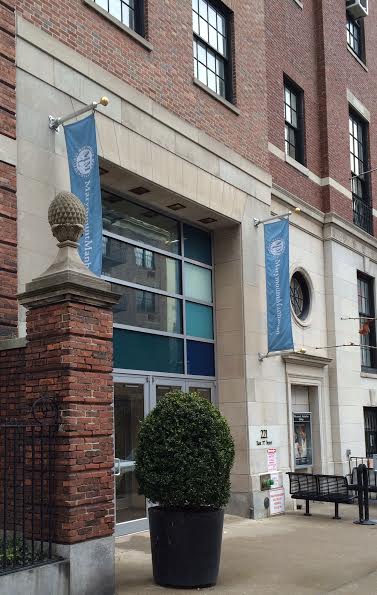
Please give her a warm welcome as she talks with members of her Alma Mater, Marymount Manhattan College.

“Studying poetry,” Cameron Kelsall explains, “expands and, in some cases, explodes your understanding of language.” Kelsall graduated from Marymount Manhattan College in 2010 with a major in English and a minor in creative writing. Kelsall went on to pursue an MFA in poetry, and now has his work published in a number of well-known periodicals such as The Eunoia Review, Octave Magazine, Drunken Boat and Foothill: A Journal of Poetry.

MMCMarymount Manhattan College—or MMC, as it’s affectionately called—has become a haven for aspiring poets who, like Cameron Kelsall, find their voices as undergraduates, then go on to thrive in the literary community. With guidance from Dr. Jerry Williams, Pushcart nominee and editor of It’s Not You, It’s Me: The Poetry of Breakup, students explore the craft of writing and, in many instances, gain insight into their own personal experiences. As Sally Stroud, a junior who minors in creative writing, writes, “I’ve learned a lot about myself as a person. Poetry forces you to look inside yourself. You might not like what you see, but in the end, a beautiful piece can be crafted.” Some undergraduate institutions offer creative writing as a major. While students at MMC cannot major in creative writing, they have the option, along with declaring the discipline as a minor, of writing and/or editing for The Marymount Manhattan Review.

MMCReviewAs NewPages.com points out on its page dedicated to undergraduate writing programs across America, Marymount Manhattan College has a campus literary magazine called The Marymount Manhattan Review. The review includes poems, short stories and short nonfiction pieces written by Marymount students. Below is a poem selected from last year’s issue of The Marymount Manhattan Review. This year’s issue will be released in early May.

Drawl
By Leisa Loan

The Southern Illinois state line made me feel
like I lived three separate lives,
all on separate lawns
as I drove to see Superman and return his library books.

The look on his face could shut the roads down,
empty like an impatient morning before a parade.
I’d put my house right on a flatbed,

Metropolis seems made for settling down,
buying groceries, and chaining up a swing over fried grass.
Let tourists pay money for magnets and museums while I live on water
and the comfort of hula hoops in the garage.

One life saw me poor and aware of it,
wanting to buy something nice for a summer birthday
everything around us colored gold and worth nothing
crop corn you can’t swallow.

But the other lives see envy from the tops of water towers,
watching sunsets like you’d never see anywhere else
thinking—the city is evil, stay here a while, forever.
Busy blood of a confused Yankee finally sitting down
and desperately thinking of space
and where to put a porch swing
in the middle of Manhattan.

*Leisa Loan is from Boston. She is a senior at Marymount Manhattan College. She will be attending graduate school for her MFA in poetry this fall.

Thanks, Emma.  This was a great look at a college that some may never have looked at before, and I think its good to know that there are more creative writing programs available than just the ones at the big schools.

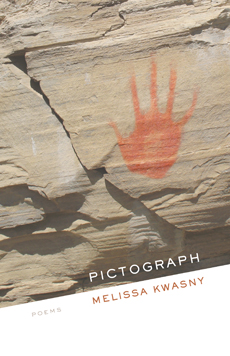
Pictograph: Poems by Melissa Kwasny

Source: Milkweed Editions
Paperback, 80 pgs
I am an Amazon Affiliate

Pictograph: Poems by Melissa Kwasny is a collection of prose poems in which cave drawings, pictographs, and petroglyphs the poet found in Montana come to life.  Readers are looking over her shoulder as she looks closely at these images while she wonders about the people who created them.  We begin near a cave in “Outside the Live Cave Spot” where we observe the opening as “lopsided, irregular dripping down like a lock of hair over someone’s eye.”  Things here are obscured from view, like the picture is not full.  It is just like the narrator of the poem, we get a glimpse of the life that was here, but something has been lost as humanity has moved away from pictorial communication to words on a page and online.  Many of these prose poems examine this sense of loss, a part of our culture that has disappeared into the ether, but it is still with us, as we can imagine and remind ourselves of what those lives must have been like.

From “Pictograph: Bird Site, Maze District” (pg 16)

“We recognize a figure, a brother, a twin, who is punished
for our disabilities, our own strangeness.  We are removed from
our families or we remove ourselves.”

From “Sign With Convergent Nested Elements” (pg 28)

“Sometimes things shine forth with their own
magnitude. Brushstroke of the mountain above the bank. As one ages,
it seems to me, one begins to separate from the body. One sees its frailties, it needs at a remove. Dimly lit, not important to return to.”

The narrator continues on this journey of discovery, which leads her to self-discovery. She examines not only the past, but also the faith it must have taken for those people to have lived and continue onward — a faith that she finds wobbles in herself.  The narrator is discovering more than she bargained for, making connections not only with the past but with the nature present before, like the mountain chickadee who wobbles before her in “The Wounded Bird.”  Here she is identifying with this bird’s struggle for life and noting her own inability to come to terms with god.

Pictograph: Poems by Melissa Kwasny contains some really stunning images and examinations of human evolution and struggle, but readers may connect with just a few poems in the collection at first.  “Kayak,” for instance, is the most removed from the idea of studying these ancient drawings in that the narrator is in the water surrounded by nature, but the effect is similar in that we have the power to blend in or to disturb or even to merely stand out by being ourselves, which can cause others to take flight.

About the Poet:

Melissa Kwasny is the author of the acclaimed poetry collections The Nine Senses (Milkweed Editions, 2011) Reading Novalis in Montana (Milkweed Editions, 2009), The Archival Birds (Bear Star Press, 2000), and Thistle (Lost Horse Press, 2006), which won the Idaho Prize in 2006. She is also the author of Pictograph, forthcoming in 2015. She is the editor of Toward the Open Field: Poets on the Art of Poetry 1800–1950 (Wesleyan University Press, 2004). Widely published in journals, including Willow Springs, Threepenny Review, Ploughshares, Poetry Northwest, Bellingham Review, Crab Orchard Review, and River Styx, she was recently the Richard Hugo Visiting Poet at the University of Montana and a Visiting Writer at the University of Wyoming. Kwasny received the Poetry Society of America’s 2009 Cecil Hemley Award for a series of poems that appears in The Nine Senses. She lives in Jefferson City, Montana.