Quantcast

370th Virtual Poetry Circle

Welcome to the 370th Virtual Poetry Circle!

Remember, this is just for fun and is not meant to be stressful.

Keep in mind what Molly Peacock’s book suggested.

Look at a line, a stanza, sentences, and images; describe what you like or don’t like; and offer an opinion. If you missed my review of her book, check it out here.

Today’s poem is from Mary Elizabeth Coleridge:

A Moment

The clouds had made a crimson crown
Above the mountains high.
The stormy sun was going down
In a stormy sky.
Why did you let your eyes so rest on me,
And hold your breath between?
In all the ages this can never be
As if it had not been.
What do you think?

Prince Noah and the School Pirates by Silke Schnee, illustrated by Heike Sistig

Source: Plough Publishing House
Hardcover, 32 pgs.
I am an Amazon Affiliate

Prince Noah and the School Pirates by Silke Schnee, illustrated by Heike Sistig, is a fun adventure about inclusion, working together, and having fun. In Prince Noah’s kingdom, the kids are sent off in separate ships to learn skills, such as girls learning to weave and boys learning to fence. Kids with disabilities are sent off in their own boats as well.

While the book has a lot of text for young kids, the adventure makes it a book to read with your child right before bed. You can break up the book into segments, making it easier for kids to follow along and enjoy the ride. When the kids are at sea, pirates swoop in and capture the children. What will happen to them as they are put into the pirate tower? Who will save them?

Prince Noah and the School Pirates by Silke Schnee, illustrated by Heike Sistig, is delightfully illustrated with so many things to look at; it’s almost like a Where’s Waldo? book.  My daughter enjoyed this story and told me we should read it again, and we probably will … many times.

RATING: Quatrain

About the Author:

Silke snow is a journalist and works as a TV program maker at a public broadcaster in Cologne . She is married and has three sons . Her youngest son Noah was born in July 2008 with Trisomy 21 ( Down syndrome ) .

“At first, when Noah was born, we were shocked and sad. And it wasn’t easy to see how some people look at children with special needs as strange or different. But the catalyst for this book was witnessing the effect he had on many people, despite being categorized as disabled. In fact, our little prince brings much love, joy, and sunshine not only to us, but to all around him. Children are a wonder, and we must see them with the eyes of our heart: each child just the way he or she is.”

Denial of Conscience by Cat Gardiner

Source: Giveaway win from JAFF Event
Paperback, 347 pgs.
I am an Amazon Affiliate

Denial of Conscience by Cat Gardiner is a hot, modern retelling of Pride & Prejudice by Jane Austen. Gardiner writes steamy romance really well, and the fire crackles between this Darcy and Elizabeth like a gunpowder trail to a pile of dynamite. Set in Virginia and Asheville, N.C., it was the perfect getaway novel for vacation, especially since we would be in the same area at the Biltmore estate! Gardiner knows the area well enough to write about the former plantations in a way that makes it believable that Darcy of Pemberley would be a wealthy landowner whose past has pushed him into the military and the world of black ops, while Lizzy has remained at Longbourn beneath the guilt of her mother’s exit from their lives.

Unlike Jane who left the home shortly after Mrs. Bennet to seek freedom, Lizzy stayed behind to care for their father and the repairs of an aging estate. Despite working for the Department of Defense, they are unable to keep up with the costs of the repairs, and without intervention soon, they’ll have to sell off some acreage to keep afloat. While Lizzy is forced to decide between her freedom and saving the ancestral home, her father has other ideas about how to save the place — and these ideas get them both into deep trouble.

“‘Carinatus? In English, Darcy. Our Latin is restricted to the dance floor here.’
‘It’s a snake, Medusa, like the ones writhing on your head.’ Darcy smirked.
‘Screw you.’
‘We tried that; it didn’t work. Remember?'” (pg. 28)

Darcy has become a hardened man since the death of his parents and his Iceman persona keeps him safe from emotional entanglements as his work takes him all over the world assassinating evildoers. He’s turned into a leather wearing, tattooed biker in Gardiner’s modern tale, and he’s hotter than ever. He oozes charm and danger, something that draws Lizzy in, revealing a woman who wants to be free to pursue her passions and take on new adventures. Both emerge from their chrysalises renewed and engaged with life. There’s no going back, and those who want to stop them from being together better look out.

Denial of Conscience by Cat Gardiner explores how people fall in love and why, how that relationship can encourage each partner to grow, and how mutual respect can spur them to greater things. Living a happier and fuller life is something we all should aspire to, and while assassinating evildoers might make the world a safer place, its toll can be devastating. Living for others and denying oneself even the simplest pleasures can also be draining. Gardiner explores all of these themes and more in her novel. This one is hot, hot, hot!

RATING: Quatrain

Other Reviews:

Guest Posts:

***Cat Gardiner’s new WWII romance, A Moment Forever, is touring with Poetic Book Tours.***

About the Author:

Born and bred in New York City, Cat Gardiner is a girl in love with the romance of an era once known as the Silent Generation, now referred to as the Greatest Generation. A member of the National League of American Pen Women, Romance Writers of America, and Tampa Area Romance Authors, she and her husband adore exploring the 1940s Home Front experience as living historians, wishing for a time machine to transport them back seventy years.

She loves to pull out her vintage frocks and attend U.S.O dances, swing clubs, and re-enactment camps as part of her research, believing that everyone should have an understanding of The 1940s Experience™. Inspired by those everyday young adults who changed the fate of the world, she writes about them, taking the reader on a romantic journey. Cat’s WWII-era novels always begin in her beloved Big Apple and surround you with the sights and sounds of a generation.

She is also the author of four Jane Austen-inspired contemporary novels, however, her greatest love is writing 20th Century Historical Fiction, WWII-era Romance. A Moment Forever is her debut novel in that genre.

For more on her book, visit A Moment Forever.

Follow her on Twitter
On Facebook
Follow her blog.

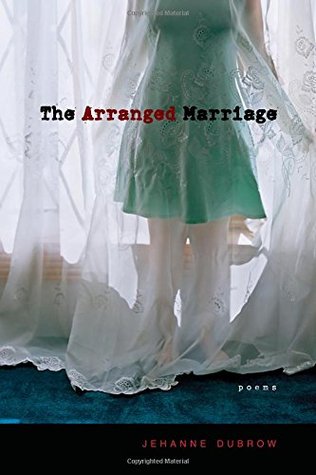
The Arranged Marriage by Jehanne Dubrow

Source: Gift
Paperback, 57 pgs.
I am an Amazon Affiliate

The Arranged Marriage by Jehanne Dubrow reads like mini-memoirs of marriages on the rocks, marriages marred by abuse, marriages that require covering up.  These arrangements are made consciously and sometimes with little say by the women engaged in them.  Much of the truth about these women is concealed, but even that concealer is thin and, in many cases, see-through.

“Wait long enough and anything takes on a
sheen of sharpness. Mustn’t leave her hands
untied. She could stare the whorl from
fingertips. Cut him with her eyes.” (from “All the Sharp Things”, pg. 7)

In “The Handbag,” the speaker examines the contents of a wife’s purse at the back of the closet and how it hides things from her husband.  She leaves to buy groceries, and while her husband may control what is purchased, there are so many possibilities outside that she can take advantage of if she so chooses.  Does this woman choose to go to the police station?  Does she read and improve her mind away from her husband? The possibilities are endless.

In “House of the Small Dictatorship”, cigars are clipped, pages of a newspaper are opened, and many other things get done without the husband lifting a finger. But the woman’s efforts are rarely mentioned. In “Domesticated Fowl of the Sula Valley”, birds fly away and the girls are given little explanation. Dubrow uses this poem to shed light on many of the missing girls and women and how their fates are never known. Even as these compact poems resemble the cloistered lives of these women — some controlled by their spouses — they also espouse a sense of hope in between the lines.  A freedom they can see but that they will need the courage to take ahold of it.

The Arranged Marriage by Jehanne Dubrow is harrowing and sad. The poems leave an indelible mark on the reader, and her verse is chock full of imagery that surprises. Many of these poems will be long remembered, a lasting testament to the women who have suffered — many in silence.

RATING: Cinquain

About the Poet:

Jehanne Dubrow is the author of five poetry collections, including most recently The Arranged Marriage (University of New Mexico Press, 2015), Red Army Red (Northwestern University Press, 2012) and Stateside (Northwestern University Press, 2010). She co-edited The Book of Scented Things: 100 Contemporary Poems about Perfume (Literary House Press, 2014) and the forthcoming Still Life with Poem: Contemporary Natures Mortes in Verse (Literary House Press, 2016). Dots & Dashes, her sixth book of poems, won the 2016 Crab Orchard Review Series in Poetry Open Competition Awards and will be published by Southern Illinois University Press in 2017.

In Remembrance of the Life by Jane Rosenberg LaForge

Source: Jane Rosenberg LaForge
Paperback, 44 pgs.
I am an Amazon Affiliate

In Remembrance of the Life by Jane Rosenberg LaForge is a chapbook of elegiac poems. While many deal with tough subjects from death to illness and loss, LaForge cautions that these things are inevitable and to deal with them is universal and part of the human condition. However, these moments should not stop us from living; they are a cause for reflection and transformation.

In “Ode to the Homeopathic” (pg. 1), the speaker talks about the awe of believing in lost cures for what ails you, but also warns how quickly those hopes can be dashed “as sickness moved from mass/to liquid…” Beauty is held as a virtue because it is created from something pure, unlike jealousy and other emotions that are reactive and cultivated in certain climates by actions of others and ourselves.

In “My Mother’s Skin” (pg. 5-6), the speaker wonders aloud at the state of skin and how it comes to get the look it does. Is it from illnesses, abuse, or just the simple process of aging. “I cannot write/about the pattern until I master it/” the speaker says. Discovering the pattern of a life can be difficult from the outside, and even as doctors argue “about what to put on the death certificate/”, readers are left wondering why must we pin down that pattern.

Many of LaForge’s poems require careful attention and could require readers to take second and even third looks, but this does not mean the poems are hard to understand. They are in fact packed fully with imagery and meaning that are interconnected to provide readers an overall sense of the inevitability of death. We should not focus on the end result, however, but on how we have lived and how others have lived — savoring each moment and memory.

“The past is never so long ago/that it cannot be refined … ” (from “I Learned It From a Mormon Girl” (pg. 10)

It also asks the question about medical intervention and whether it is for the patient or ourselves that we prolong lives with tubes and wires? “My father said a lot of things,/like how death took much longer when he/ was a child, not so many tubes in the patient/as the hospital floor covered in trunk lines,/more for show than purpose.” (from “How It Works For Others” pg. 21-22) In Remembrance of the Life by Jane Rosenberg LaForge is a slim and powerful collection remembering life in all its beautiful confusion and ugliness.

RATING: Quatrain

Other Reviews:

With Apologies to Mick Jagger, Other Gods, and All Women

About the Poet:

Jane Rosenberg LaForge’s poetry, fiction, critical, and personal essays have appeared in numerous publications, including Poetry Quarterly, Wilderness House Literary Review, Ottawa Arts Review, Boston Literary Magazine, THRUSH, Ne’er-Do-Well Literary Magazine, and The Western Journal of Black Studies. Her memoir-fantasy, An Unsuitable Princess, is available from Jaded Ibis Press. Her full-length collection of poetry, With Apologies to Mick Jagger, Other Gods, and All Women was published in fall 2012 by The Aldrich Press. She is also the author of the chapbooks After Voices, published by Burning River of Cleveland in 2009, and Half-Life, from Big Table Publishing of Boston in 2010. She is a poet and writer living in New York.

Follow her on Twitter: @JaneRLaForge. And see her author page on Facebook.

Guest Review: The Known World by Edward P. Jones

This week takes us to Virginia with The Known World by Edward P. Jones. Entertainment Weekly says, “This award-winning examination of man’s ownership of man refuses to succumb to the calcifying effect of history, presenting Virginia’s past as raw, urgent, and human.”

Synopsis from GoodReads:

One of the most acclaimed novels in recent memory, The Known World is a daring and ambitious work by Pulitzer Prize winner Edward P. Jones.

The Known World tells the story of Henry Townsend, a black farmer and former slave who falls under the tutelage of William Robbins, the most powerful man in Manchester County, Virginia. Making certain he never circumvents the law, Townsend runs his affairs with unusual discipline. But when death takes him unexpectedly, his widow, Caldonia, can’t uphold the estate’s order, and chaos ensues. Jones has woven a footnote of history into an epic that takes an unflinching look at slavery in all its moral complexities.

Review by Laura at 125Pages.

½ Star

EdwardPJones_TheKnownWorldThe Known World by Edward P. Jones is a read that made me question. It made me question if editors actually read the whole book. It made me question if the Pulitzer judges read the whole book. It made me question if I had picked up the wrong book, because this could not be the book with all of those rave reviews. This novel won a National Book Critics Circle Award and the Pulitzer Prize for Fiction in 2004. In 2005 it won the International IMPAC Dublin Literary Award and it was a finalist for the 2003 National Book Award. In 2009, the website The Millions polled 48 critics, writers, and editors; the panel voted The Known World the second best novel since 2000. The book I read was a disjointed mess. No seriously, I can read difficult books. I like non-linear time lines and twisty prose but this took it to a whole new level. The synopsis tells us that this is the tale of Manchester County in Virginia during the antebellum era and a black former slave who is now a slave owner himself. This sounds like a deep and thought provoking read right? It would have been if it was actually readable.

There were approximately 80 characters, so I had no idea who anyone was.

The white man at the front door was from the Atlas Life, Casualty and Assurance Company, based in Hartford, Connecticut. His talking to Calvin at the door was what kept Bennett so long. Calvin eventually came back with Bennett and when Moses told him, Calvin went back and returned with Caldonia, followed by Maude, and Fern Elston.

The time line skipped back and forth often times decades in the future to tell what happened to just one person or object and then skipped back.

This series was Anderson’s most successful, and nothing was more successful within that series than the 1883 pamphlet on free Negroes who had owned other Negroes before the War between the States. The pamphlet on slaveowning Negroes went through ten printings. Only seven of those particular pamphlets survived until the late twentieth century. Five of them were in the Library of Congress in 1994 when the remaining two pamphlets were sold as part of a collection of black memorabilia owned by a black man in Cleveland, Ohio. That collection, upon the man’s death in 1994, sold for $1.7 million to an automobile manufacturer in Germany.

There was so much unnecessary description.

Clarence sat beside his wife and after a time he put a hand, the one not stained with milk, to the back of his wife’s head and rubbed her hair. The cow swung its tail and chewed its cud. It farted.

His horse, Sir Guilderham, was idling two or so paces behind his master. And just as the horse began to wander away, Robbins turned and picked up the reins, mounted. ‘No more visits for a month,’ he said, picking one piece of lint from the horse’s ear.

Seriously, I do not care about lint on a horse and a cow farting. This really detracted from the story for me. The Known World by Edward P. Jones could have and should have been a powerful read. Instead I got bogged down in the minutia and was not able to process the tale.

I had originally picked this up at the library and then, when I found the style to be so odd, I got the Audible version. I really want my credit and the 14 hours I spent listing to this back.

USbooks Virginia

Mailbox Monday #387

Mailbox Monday, created by Marcia at To Be Continued, formerly The Printed Page, has a permanent home at its own blog.

To check out what everyone has received over the last week, visit the blog and check out the links. Leave yours too.

Also, each week, Leslie, Vicki, and I will share the Books that Caught Our Eye from everyone’s weekly links.

Here’s what I received:

SARIS AND A SINGLE MALTSaris and a Single Malt by Sweta Srivastava Vikram, which I purchased. Follow the blog tour with Poetic Book Tours.

Saris and a Single Malt is a moving collection of poems written by a daughter for and about her mother. The book spans the time from when the poet receives a phone call in New York City that her mother is in a hospital in New Delhi, to the time she carries out her mother’s last rites. The poems chronicle the author’s physical and emotional journey as she flies to India, tries to fight the inevitable, and succumbs to the grief of living in a motherless world. Divided into three sections, (Flight, Fire, and Grief), this collection will move you, astound you, and make you hug your loved ones.

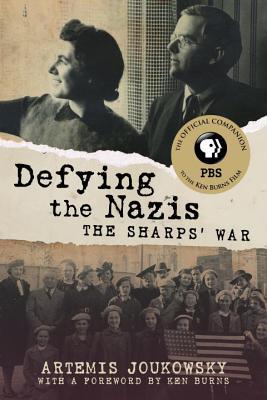
Defying the Nazis: The Sharps’ War by Artemis Joukowsky, Ken Burns, which I won from LibraryThing Early Reviewers.

Official companion to the Ken Burns film premiering September 20, 2016, on PBS tells the little-known story of the Sharps, an otherwise ordinary couple whose faith and commitment to social justice inspired them to undertake dangerous rescue and relief missions across war-torn Europe, saving the lives of countless refugees, political dissidents, and Jews on the eve of World War II.

In 1939, Rev. Waitstill Sharp, a young Unitarian minister, and his wife, Martha, a social worker, accepted a mission from the American Unitarian Association: they were to leave their home and young children in Wellesley, Massachusetts, and travel to Prague, Czechoslovakia, to help address the mounting refugee crisis. Armed with only $40,000, the Sharps quickly learned the art of spy craft and covertly sheltered political dissidents and Jews, and helped them escape the Nazis. After narrowly avoiding the Gestapo themselves, the Sharps returned to Europe in 1940 as representatives of the newly formed Unitarian Service Committee and continued their relief efforts in Vichy France. This compulsively readable true story offers readers a rare glimpse at high-stakes international relief efforts during WWII. Defying the Nazis is a fascinating portrait of resistance as told through the story of one courageous couple.

Mr. Darcy’s Journey by Abigail Reynolds for review from the author.

Mr. Darcy is at his wits’ end. Elizabeth Bennet, the woman he can’t live without, overhears him insulting her family. Now she won’t even listen to his apologies. Then his old friend Sir Anthony Duxbury tells him two of their friends are in terrible danger. If Darcy wants to help them, they have to leave for Yorkshire immediately.

But something doesn’t add up. Elizabeth claims to know Sir Anthony, too – but by a different name. What game is his old friend playing? And is it dangerous?

Even Sir Anthony says the trip is dangerous. The Luddite rebels are on the verge of armed revolt – and he should know, because he’s one of them. Darcy’s cousin Lady Frederica decides she’s going with them anyway, and insists on bringing Elizabeth. Could this be Darcy’s chance to earn Elizabeth’s forgiveness and her love?

Elizabeth would rather face a squad of Napoleon’s soldiers than spend three days trapped in a carriage with Darcy and his headstrong cousin, but she has her own reason for agreeing to come. If she can just manage to keep her temper, she may be able to rescue her uncle from financial ruin.

But when a Luddite riot erupts around them, it’s Darcy and Elizabeth who need rescuing – from each other.

What did you receive?

Save

369th Virtual Poetry Circle

Welcome to the 369th Virtual Poetry Circle!

Remember, this is just for fun and is not meant to be stressful.

Keep in mind what Molly Peacock’s book suggested.

Look at a line, a stanza, sentences, and images; describe what you like or don’t like; and offer an opinion. If you missed my review of her book, check it out here.

Today’s poem is from John Updike:

Ex-Basketball Player

Pearl Avenue runs past the high-school lot,
Bends with the trolley tracks, and stops, cut off
Before it has a chance to go two blocks,
At Colonel McComsky Plaza. Berth’s Garage
Is on the corner facing west, and there,
Most days, you’ll find Flick Webb, who helps Berth out.
Flick stands tall among the idiot pumps—
Five on a side, the old bubble-head style,
Their rubber elbows hanging loose and low.
One’s nostrils are two S’s, and his eyes
An E and O. And one is squat, without
A head at all—more of a football type.
Once Flick played for the high-school team, the Wizards.
He was good: in fact, the best. In ’46
He bucketed three hundred ninety points,
A county record still. The ball loved Flick.
I saw him rack up thirty-eight or forty
In one home game. His hands were like wild birds.
He never learned a trade, he just sells gas,
Checks oil, and changes flats. Once in a while,
As a gag, he dribbles an inner tube,
But most of us remember anyway.
His hands are fine and nervous on the lug wrench.
It makes no difference to the lug wrench, though.
Off work, he hangs around Mae’s Luncheonette.
Grease-gray and kind of coiled, he plays pinball,
Smokes those thin cigars, nurses lemon phosphates.
Flick seldom says a word to Mae, just nods
Beyond her face toward bright applauding tiers
Of Necco Wafers, Nibs, and Juju Beads.

What do you think?

The Great Smoky Mountains

great-smoky-mountains-national-park-126051297202143r9P

When you go on vacation, you need some good reading and a variety.  Fun books, books you can dip into and out of in a pinch, and books that can hold your attention before bed.

I haven’t had a vacation in a long while that wasn’t back to Massachusetts, so I’m really looking forward to seeing a new place — Tennessee — and enjoying some non-review copies…

Here’s a list of what I’m thinking of taking — any suggestions, should I nix any of these? Should I take only 2?

Too many, right?  Some are ebook, so they take up less room. What kinds of books do you take on vacation?  Do you read them?  Am I overly ambitious?

My other option is just to bring 1-2 books and write my own stuff.  What say you?

Save

Save

Save

Hidden Bodies by Caroline Kepnes

Source: Audible/Gift from Friend
Audiobook, 13+ hours;
Hardcover, 448 pgs.
I am an Amazon Affiliate

Hidden Bodies by Caroline Kepnes is the second in a series of books about Joe Goldberg, a serial killer who is no stranger to love, obsession, and death.  If you haven’t read You, you need to because without reading it, you miss way too much.  I read this in hardcover and listened to the audio — the narrator of the audio, Santino Fontana, owns the role of Joe Goldberg and that of Forty.

***Spoilers for previous book***

Goldberg loves books and considers himself a writer, and after killing his latest girlfriend, he finds himself in love with a new girl who loves books and is eager to play games, like he is.  However, when Amy, who met him through a fake credit card, screws him over, Joe has little choice but to leave his bookstore managerial post in New York to head out to California to take care of her.  Along the way he gets sucked into the California dream of fame and fortune and finds himself opening social media accounts, something he would never have done in New York.

He meets Love and falls in love, but she has a twin named Forty who sucks the life out of everything with his addictions and his tantrums. Then, there is Milo, the third twin. At the same time he’s living the high life, he sees Amy and tries to catch her and fails and gets tangled up with a star-struck actress wannabe. His tangled web nearly unravels several times, as the story gets more twisted up and the body count rises. Readers will want to check reality at the door, you just have to go along for the ride.

Written and Directed by Joe Goldberg
Love is laughing and clapping and I hug Forty and shake his hand and thank him but he tells me not to thank him. ‘This was all you, Old Sport!'”

Joe is a character you love to hate.  He is creepy, calculating, and scary, but he’s also logical and rational and makes you want to believe he’s doing the right thing and helping the larger world. Kepnes’ story is twisted and crazy, but there is some great humor in these encounters, particularly when Joe corners police officer Robin Fincher who has his own Rolodex of celebrity encounters. Joe is in a city where everyone is obsessive.

Hidden Bodies by Caroline Kepnes makes readers wonder just how many obsessive and self-obsessed people are in the world and how on Earth people like Joe don’t kill more of them for us. Joe has evolved — somewhat — in this book, but don’t expect him to become a Boy Scout or a hero.

RATING: Quatrain

Other Reviews:

About the Author:

Caroline Kepnes is the author of You and Hidden Bodies. She splits her time between Los Angeles, California and Cape Cod, Massachusetts.

Find her on Facebook.

The Diary of Emily Dickinson by Jamie Fuller

Source: Purchased
Paperback, 224 pgs.
I am an Amazon Affiliate

The Diary of Emily Dickinson by Jamie Fuller is an ambitious project that recreates the life of Emily Dickinson, a hermetic poet from Amherst, with her poetry and from the letters that remain from her life.  Fuller has done her research, which is clear from the annotations that accompany poems and diary entries.  But what’s disappointing is that Fuller’s diary entries — while they mirror Dickinson’s style — do little to extrapolate from the letters or poems to create something new.  Readers will want a fictionalized Emily to be more revealing, not more obscure than what she left behind.

“A captured bird mutes its tune.” (pg. 95)

There are gems in some of the diary entries that allude to Emily’s views on marriage and how it would interfere with her poetic work.  She has been called to write poetry, and while she does household chores, she clearly had greater leeway with her family than she would with a husband or children of her own.  In this way, Fuller has called attention to an age-old problem many women face when they marry — how do you balance the expectations of being a wife and mother with your own dreams and desires.  This would be particularly difficult in Emily’s time.

The prologue is the most creative bit about the book in which Fuller describes the how the diary came to be saved when so many letters were burned by Emily’s sister.  After reading through the poems you remember, you wonder what do the diary entries add.  Unfortunately, they add very little and leave readers wondering if they should have spent their time reading her poems, creating their own narratives for Emily alongside what facts are available from the letters that have survived.

The Diary of Emily Dickinson by Jamie Fuller had potential, and while readers know that Emily was a hermit for much of her life and lived with her family and her poetry, Fuller has not taken the creative leap to bring us into the mind of a poet.  The novel feels flat and two-dimensional.  The saving graces here are Emily’s own poems and the annotations from letters and facts discovered in the historical record.

RATING: Couplet


Guest Post: The Gifts of Memoir by Christine Hale

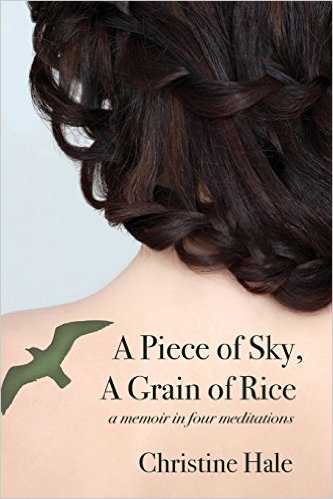
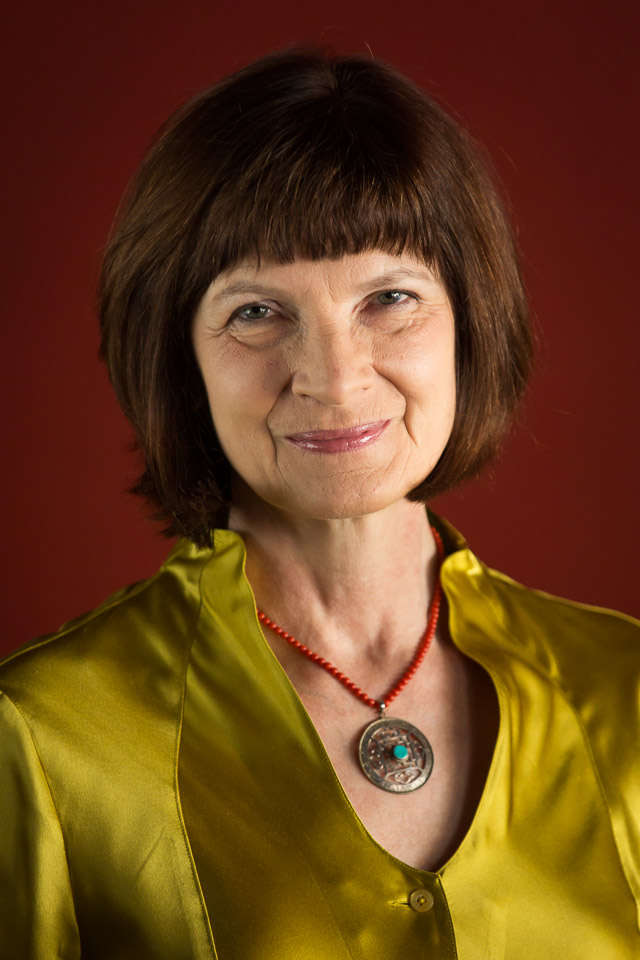
tlc tour hostChristine Hale, author of A Piece of Sky, A Grain of Rice: A Memoir in Four Meditations, is stopping by to talk about the gifts of memoir.  Please give her a warm welcome.

Readers often ask me why I wrote a memoir. I began as a fiction writer (my first book, Basil’s Dream, published in 2009, is a novel). But the year my mother passed away, 2000, the material that would become this memoir asserted itself. In fact, it hijacked me. I was granted a 10-day residency at an artists’ colony, precious time to work on a revision of the novel. But when my busy life dropped away from me, all I could do was grieve my mother: her death, her hard life, and the tangle of love and misery that had been our relationship. I spent the whole residency writing about her life and my childhood. When I went home and got busy again, I completely forgot what I’d written. A year or so later, my computer’s hard drive was failing. Pulling off the files I wanted to save, I found that material– almost 100 pages! I read it, realized it was memoir, gulped, felt sick, and put it aside.

But I couldn’t stop writing about my life. Only after my mother died did I begin to really get to know my father, so that revelation had to be explored on the page. The solitary Buddhist retreats I undertook every year or so were other-worldly I just had to write about them. And the together-tattoos with my teen children, that strange and funny tale had to be told.

Much of what now comprises A PIECE OF SKY, A GRAIN OF RICE was originally published as separate personal essays. I had a nagging feeling that these apparently separate threads all belonged together, but for the longest time– years– I couldn’t figure out how or why. Only in retrospect is the answer crystal clear: the stories belong together because they are all about reconciliation: me coming to terms with the path I’ve traveled– and the people I bruised and learned from and was bruised by along the way.

By the time I began pulling the separate threads together into a book, around 2007, I’d been writing and teaching writing for a long time. So I knew I faced quite a technical challenge. Ultimately I figured that the only structure that could handle so many memories from so many points in time was collage. Think of photos pasted to a poster board– layered, overlapping, some partially obscured, others fore-grounded. The placement appears random, but the creator of the collage has a sense, conscious or intuitive, of where each photo belongs.

I worked on the book by shaping each memory into a little story, with careful attention to sensory detail (this is the advice I give to every would-be memoirist). I cut the longer stories into pieces and arrayed them in the way that felt “right.” I let the tattoo stories, which were happening as I worked on the book, be the through-line, because I wanted the book to have some momentum– some narrative drive– through time. I revised and refined the collage many times, with input from a small group of writer friends I rely on as first readers. It’s very rewarding to discover that my readers do “get” that the book’s structure mimics the way our own processes of recollection and introspection work: seldom a straight line.

I came to understand myself more clearly through the process of creating the book. When I work with people writing memoir, I tell them this is the gift they can expect to receive, if they can be both unflinching– courageous enough to see themselves and others as they really are– and self-compassionate- -merciful enough to accept, forgive, and learn from their humanity.

I want my readers to take away a feeling that they are not alone in their doubts, fears, confusion, strivings, and hopes. That these feelings are the essence of being human. I often hear from readers that they identify with the struggles and the triumphs in the book, that they are reminded of their own sweetest memories, that they feel reconnected with people they’ve lost, or that they have new insight into someone who was a powerful and painful mystery in their life. It’s amazing and satisfying that readers can get from the book their own personal version of what I got from writing it: clarity and release.

About the Book:

Christine Hale grew up amid abuse, depression, dysfunction, alienation and isolation—her mother’s, but also, because her view was the lens that controlled the family—her own, her father’s and her two sisters’. She became a writer, a prodigal daughter, a single parent, a Buddhist disciple, and, late in midlife, a newlywed. In this non-linear memoir, she meditates upon the broken path she’s traveled: two divorces, an abandoned career, too much solitude, an unconventional and transformative relationship with a female spiritual teacher, and two children lost to young adulthood but recovered, in part, through an odd ritual of repeated tattooing.

About the Author:

Christine Hale’s prose has appeared in Hippocampus, Arts & Letters, Prime Number, Shadowgraph, and The Sun, among other literary journals. Her debut novel Basil’s Dream (Livingston Press 2009) received honorable mention in the 2010 Library of Virginia Literary Awards. Hale has been a finalist for the Glimmer Train Short Story Award for New Writers and the Rona Jaffe Foundation Writers’ Award. Presently, she teaches in the Antioch University-Los Angeles Low-Residency MFA Program as well as the Great Smokies Writing Program. She lives in Asheville, North Carolina.