Quantcast

Watch the Birdie! by Nancy Cote

Source: Sky Pony Press
Hardcover, 32 pgs.
I am an Amazon Affiliate

Watch the Birdie! by Nancy Cote tells the tale of a mouse who helps out a bird who has not yet learned to fly.  The young bird has fallen from the nest, and he’s a little to young to fly, but Mousey knows he has to get back into the nest and soon.  A cat is approaching, ready to pounce.  What’s endearing is that the mouse is so preoccupied with helping the bird, it never occurs to him that his own life might be in danger.

The mouse seeks the help of nearby animals, hoping to get the bird back into the tree, but each time the plan fails as the bird slips off backs and tumbles to the ground without ever getting very far.  My daughter loved watching the mouse come up with new ways and find new friends to help get the bird back into the tree.  She thought the mouse was brave as the cat hid in the tall grass and stood between him and the bird.

Watch the Birdie! by Nancy Cote is a tale of bravery and friendship.  My daughter applauded the mouse’s endeavors and she was relieved by the ending, and other young readers will be too.

RATING: Quatrain
Fingerprint Monsters and Dragons: Fun Art with Fingers Thumbs and Paint – And 100 Other Adventurous Creatures – Amazing Art for Hands-on Fun by Ilona Molnar

Source: Quarry Books
Paperback, 160 pgs.
I am an Amazon Affiliate

Fingerprint Monsters and Dragons: Fun Art with Fingers Thumbs and Paint – And 100 Other Adventurous Creatures – Amazing Art for Hands-on Fun by Ilona Molnar will keep the little artists in your family very busy in the book and outside of it making monsters, trolls, bandits, dinosaurs, and more all with just their fingers and paint.  The quick instructions at the beginning make it clear that this is a book to set kids on their creative way, although they can reference the book if they choose to make something specific and don’t know where to begin.

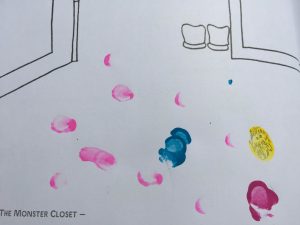
From one of the pages in the book: The Monster Closet

IMG_2653

Using an ink pad or finger paints, kids can color one or all of their fingers to make a multitude of characters in the scenes within the book or on their own art supplies.  Once the fingerprints are dried, they can then use their markers, pens, pencils, and stickers to create even more hilarious situations and actors.  My daughter loved creating these fingerprint monsters, but we had to make a number of them at one time so that the first ones would dry enough for her to decorate them.  It’s hard for kids her age to wait, but creating more makes it even more fun when they are all dry.

IMG_2652

In this one, you can see some of her faces are hilarious, and there’s even a disabled spider (her words, not mine).  My guess is that he had a run in with the person who owns this closet.

Fingerprint Monsters and Dragons: Fun Art with Fingers Thumbs and Paint – And 100 Other Adventurous Creatures – Amazing Art for Hands-on Fun by Ilona Molnar is a book that we’ll use more and more as she takes time over the summer to have fun before her fresh start in Kindergarten.  I cannot wait to see what creations she comes up with next.  These are even fun for adults, and would be a great addition to classrooms, preschools, and summer camps.

Calazaza’s Delicious Dereliction by Suzanne Dracius, translated by Nancy Naomi Carlson

Source: Tupelo Press
Paperback, 114 pgs.
I am an Amazon Affiliate

Calazaza’s Delicious Dereliction by Suzanne Dracius, translated by Nancy Naomi Carlson, is a collection of poems written in French and Creole that have been translated into English. Dracius’s poems are very musical, and that musicality is carried over from the French and Creole by Carlson’s English translations.  Looking at the poems sitting side-by-side, readers can see similar rhythmic patterns.  French and Creole are very similar languages, which probably makes translation a bit easier.

Carlson, who I had the privilege of introducing, was at the 2016 Gaithersburg Book Festival to talk about her work in translation.  She creates sound maps of the poems using her limited skills in French, and from these sound maps she seeks out the best English words to use for the translation, keeping with the subject matter and feel of each poem.  Listening to her speak about the translation process she uses was fascinating, and audience members were thrilled to learn more about it.

From "Pointe des Nègres" (pg. 13-17)

"... from my rod driven
deep in the depths of the sea,
Negroes in lots, in piles were born
over and over again,
cargoes of Negroes
for the auction block,
from my seed in the fizz
of the ocean's womb
when I raped, without shame,
the immense Caribbean expanse."

Dracius’ poems speak to the experience of Calazazas, people who are of mixed race and have read or blond hair.  Dracius, a Calazaza herself, is considered too light to fit in Martinique but in Paris, where she spends some of her time, she is considered too dark.  It is this displacement, a feeling of not fitting in that permeates each of her poems. Her poems also talk of history and mythology and relate those to the experience of displacement, living without a home or somewhere to fit in.

From "To Cendra's Ashes" (pg. 85-89)

Cendra, her name was Cendra.
When he had consumed her in fires of false criminal love, did he look at her face?
The only object of his thoughts was Cendra:
Reduce Cendra to ashes like one is reduced to a slave.

There is unbound love, there is obsessive love, and there is profound loss in these pages, but Dracius handles these with care, shedding light on the darkness and the hope. Calazaza’s Delicious Dereliction by Suzanne Dracius, translated by Nancy Naomi Carlson, is puzzle of emotions that will churn in the seas of the reader’s mind, only providing glimpses of hope in a stormy expanse.

RATING: Quatrain

About the Poet:

Born in Martinique, a writer and professor of Classics graduate of the Sorbonne, Suzanne Dracius published in 1989 her first novel, L’autre qui danse, finalist for the Prix du Premier Roman (Seghers ; Editions du Rocher 2007. English translation by Nancy Carlson, Seagull, London, 2015). Her stories, which feature strong, rebellious women characters, have been published in her collection of stories, Rue Monte au Ciel, Coup de coeur FNAC (Desnel, 2003 ; English translation by James Davis Climb to the Sky, UVA Press, USA, 2012). In 2008, Dracius published Exquise déréliction métisse, collection of poems who won the Prix Fetkann (English translation by Nancy Carlson, Tupelo Press, USA, 2015 and Spanish translation by Verónica Martínez Lira, Espejo de Viento, Mexico, 2013). In 2010, Dracius won a Prix de la Société des Poètes Français (Prize of the Society of the French Poets) for its whole work. In 2014, she published Déictique féminitude insulaire, poems.

In 1995, Dracius stayed in the USA as a Visiting Professor, lecturing about her own books at the University of Georgia, and in 2006, at Ohio University. In 2009, Dracius is invited to a writer’s residency at Cove Park (Scotland). Dracius is FFRI (France-Florida Research Institute) Visiting Professor in February 2012.

About the Translator:

Nancy Naomi Carlson, Ph.D. has won grants from the NEA, Maryland Arts Council, and Arts & Humanities Council of Montgomery County.  Poet, translator, and associate editor for Tupelo Press, her work has appeared over 350 times, including Poetry and Prairie Schooner, and forthcoming in APR,  The Georgia Review, and FIELD.  She is the author of three collections of poetry and three translations, including The Nomads, My Brothers, Go Out to Drink from the Big Dipper: Translations of Abdourahman Waberi (Seagull Books, distributed by U of Chicago Press).

National Geographic Kids: Farm Animals and Rascally Rabbits!

Source: Media Masters Publicity
Board Book, Paperback, 24 pgs., 112 pgs.
I am an Amazon Affiliate

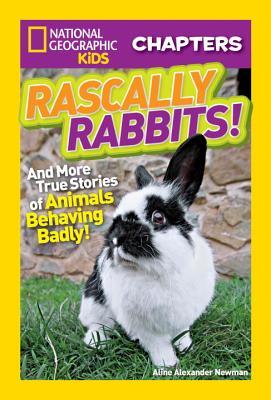
National Geographic Kids: Farm Animals Look & Learn and National Geographic Kids: Rascally Rabbits! are two books focused on animals. In the board book, the authors are teaching younger readers about animals, their sounds, and their habitats. In the paperback, chapter book, kids will learn about animal behaviors — some good, some not so good.

The Farm Animals book has photographs of real animals, like cows and chickens, and the text explains the sounds they make and what role they play.  Mostly that cows give us milk and stuff of that nature, and it tells you some interesting trivia facts about each.  What’s sad, however, is that these animals are only talked about in terms of what they are used for by humans.

Rascally Rabbits!, on the other hand, includes stories of rabbits that run away, escape to the great outdoors, leaving their owners — usually kids — wondering where their pets have gone.  Some have been found in the barnyard, while others are found by others and returned.  There are some great facts included about the animals, as well as how to protect them — such as the microchip system.

These books offer something for kids of all ages, and parents will enjoy reading the funny tales of escaping pets to their younger readers.

Rating for Farm Animals: Quatrain

Rating for Rascally Rabbits: Tercet

Tasa’s Song by Linda Kass

Source: Caitlin Hamilton Marketing & Publicity and She Writes Press
Paperback, 256 pgs.
I am an Amazon Affiliate

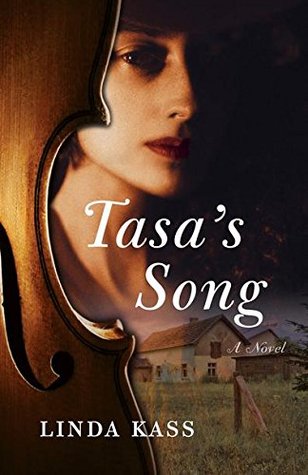
Tasa’s Song by Linda Kass, BRONZE WINNER, IPPY AWARD for HISTORICAL FICTION, is a concerto built on the jarring experiences of young violinist Tasa Rosinski in war-torn Poland during WWII.  Poland has changed hands many times before and does so again during the war, a war that many never expected to get as far as it did. As a young girl, she’s sent for additional schooling in Brody with her cousin Danik, but even as she enjoys school, she sees how the townspeople begin to treat their Jewish neighbors.  As fear creeps along the streets, Tasa softens the sharp edges with her violin, practicing music and losing herself in its timbres.

“In conveying the complicated history of Poland, Tasa’s schoolteacher used Podkamien as an example when she said you could live and die in one spot and occupy four different countries, because this part of Poland was constantly being invaded and carved up, then ‘liberated’ by somebody.” (pg. 15)

Tasa’s Jewish family is well liked by the townspeople of Podkamien because her father invested in the town, even as his family’s wealth grew.  He helped bring electricity and infrastructure to the village, making the lives of others better.  When the Nazis move on Poland and it is caught in between them and the Soviets, her family is able to escape for the most part with the help of non-Jewish families.  However, the tensions in the village are immediate, and the fear of being discovered can be difficult to live with.  Tasa, however, finds strength in her memories of her encouraging grandfather and her supportive mother, but also in her music, which provides her an escape from fear and loss.  She’s a strong young woman, and her strength helps others to keep going.

Tasa’s Song by Linda Kass demonstrates the tension within families at a time when there is so much uncertainty, and it illustrates the changing tides in just one nation during WWII.  Being Jewish in Europe during WWII was dangerous, and while luck can be with you, that luck also can turn out to be a bad omen.  This is a story of growing up in war, but also of learning to navigate uncertainty and reach into the future for something better without losing hope or the memory of those left behind, many in unmarked graves.

RATING: Quatrain

About the Author:

Linda Kass wrote for regional and national publications, including Columbus Monthly, TIME and The Detroit Free Press, early in her career as a journalist. TASA’S SONG, her debut novel, is inspired by her mother’s life in eastern Poland during the Second World War.

Linda lives in Columbus, Ohio, where she is a strong advocate of education, literacy, and the arts. Her past experience as a trustee and board chair of the Columbus Symphony Orchestra fed into much of the music that fills the pages of TASA’S SONG. Linda enjoys long distance road cycling and rides in an annual event to support cancer research.

Online Marketing for Busy Authors: A Step-by-Step Guide by Fauzia Burke

Source: FSB Associates
Paperback, 168 pgs.
I am an Amazon Affiliate

Online Marketing for Busy Authors: A Step-by-Step Guide by Fauzia Burke offers new authors and busy authors who know little about online marketing a step-by-step guide that will minimize missteps.  Like when plotting a story, authors will have to do some legwork, creating a marketing outline of sorts.  First of all, books are like an extension of an author’s brand; so an author will want to examine what their goals and dreams are, as well understand who the readers of a particular book are.  Are they young women? Are they older, college-educated men?  You get the idea.  Burke includes some worksheets to help authors get started outlining their personal and professional goals and dreams, and how their books play into that process.

Authors also can use this form to identify their audience, which will later help determine which social media channels will be the best marketing tools, cutting down on wasted efforts on channels that the identified audience doesn’t use as often or at all.  The goal is to be able to tell a room full of people in just a few sentences what their book is about and how it fits with the audience it targets.  With Facebook, Twitter, Instagram, Pinterest, and many other social networks to monitor in addition to traditional marketing techniques, authors may wonder when they’ll find time to write another book.  Burke’s no-nonsense style will speak to busy authors because she makes the task of online marketing seem less daunting, especially for those who feel overwhelmed by the process.

Burke also notes that the most successful authors are those that know their brand, their audience, and target their time toward those things, as well as their secondary goals, which may include building relationships with readers, helping a specific group, or calling attention to a specific cause.  In addition to the pre-marketing research, Burke offers a priority list for authors, and one of the items on the list may surprise some.

Online Marketing for Busy Authors: A Step-by-Step Guide by Fauzia Burke is a great place to start with learning how to market a book online.  It not only will educate authors about themselves and their books, but their audience as well.  When done right, these authors will build a fan base that will happily help them market their books to others, turn out for events, and more.  But it can’t just be about marketing.  She reminds authors that social networks are about building relationships that last.

**For bloggers looking to grow their presence on the Internet, there are some great tips that could translate really well.**

Rating: Quatrain

About the Author:

Fauzia Burke has been a leader in online marketing and digital branding for authors and others for nearly twenty years, now integrating publicity, branding, social media, and websites to establish clients online.


Normal Norman by Tara Lazar, illustrated by S. Britt

Source: Sterling Children’s Books
Hardcover, 40 pgs.
I am an Amazon Affiliate

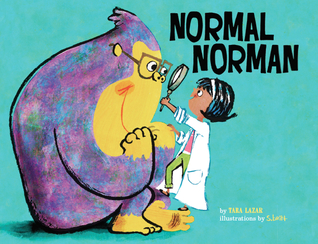
Normal Norman by Tara Lazar, illustrated by S. Britt, is a very colorful book about a junior scientist and Norman, a gorilla.  The junior scientist in a lab seeks to define what “normal” is, and in so doing, she comes to learn that normal is indefinable.  Norman is a gorilla who wears eye glasses and carries a stuffed aardvark.  Upon examining Norman, the junior scientist finds that his head size is normal, as are his paws and ears.  However, as the examination progresses, she learns that he doesn’t eat bananas or sleep on leaves in the jungle.

The junior scientist increasingly gets frustrated as she finds her subject does not fit what she deems to be normal.  Eventually throughout the book, she realizes that normal does not necessarily mean the same thing for everyone.  One person’s normal is not everyone’s normal.  The illustrations are engaging and colorful, and my daughter was intrigued about this use of the scientific method.  She giggled when Norman would do something outside the norm.

Normal Norman by Tara Lazar, illustrated by S. Britt, is a good book for parents and children to discuss individuality and what it means to be normal.  At the conclusion of the book, we talked about normal and what it means to us as individuals, and kids will find that Norman’s normal is just as fun and exciting as someone else’s normal.

Rating: Quatrain

About the Author:

Street magic performer. Award-winning ice sculptor. Hog-calling champion. These are all things Tara Lazar has never been. Instead, she prefers baking with her daughters, creating jewelry, and writing stories for children. THE MONSTORE is her first book, inspired by her pesky little brother (who is no longer so pesky). Tara has several picture books to be published in the coming years. I THOUGHT THIS WAS A BEAR BOOK and LITTLE RED GLIDING HOOD were both released in Fall 2015. Next up: NORMAL NORMAN on March 1, 2016.

Ghost Sick by Emily Pohl-Weary

Source: Tightrope Books
Paperback, 150 pgs.
I am an Amazon Affiliate

Ghost Sick by Emily Pohl-Weary is a collection of poems that witness. They are testimony, commentary, and emotional responses to the crime, drugs, loss of innocence and more in a Toronto neighborhood and other places where lives are wasted and lost too easily. In “World of Sorrow,” the narrator says, “I had no way of comprehending/it only takes a second to tear/the spirit from a young body//” More often than not, young people believe they are invincible, and it is this naivete that leaves them especially vulnerable to waste, decay, and death. Pohl-Weary laments these losses, and she struggles to come to terms with those who have been lost and the potential they may have had under different circumstances.

Her images are playful, but then turn sinister, like in “Falling Angel,” where the narrator says, “Our honey gigolo, haloed, wary/Smiling at women, the boy who would kill//Carried disaster in the tilt of his chin/tightness of his shoulders, heavy droop of eyelids//”  What causes this young man to become a murder, and what does it mean for those around him.  Growing up in this neighborhood, the young must be forever watchful of how they are perceived by others and ensure that their actions cannot be the cause of another’s death or harm.  As the narrator in “Never Say Goodbye” indicates, “life is a process of hardening//” and it can even happen when you’re young and having a good time.

Nearly a third of the way through the volume, the poet asks, “How many candlelight vigils/will it take to light the sky/with grief?” (“The Gentle Giant”)  But in the same section, the narrator says in “Those Who Died,” “Remember that you live where they did not./You are the survivor and the advocate./You must live for those who died.//”  It is the pressure many surviving family members and friends place on themselves — to advocate for those who can no longer speak for themselves.  In many ways, these are the people who are “ghost sick” because they are the most haunted by those they have lost, and they are unable to escape that pressure.

Craft Supplies (pg. 51)

a wise woman once told me
you can't expect miracles
from dollar store markers
though they're often realized
in the most unusual, tawdry places
like the bottom of a bin

Readers will find that not all is dreary in Pohl-Weary’s world, as hope remains an eternal spring even in the darkest places. It can be held by a child with potential, a community that listens and acts, or even in the depths of a dream resurfacing for someone who has been lost. We, the living, are the ones that are haunting the dead with our emptiness at their leaving. We need to fill those holes and move on, so that they may do the same, as the narrator in “Meaning” suggests.

Ghost Sick by Emily Pohl-Weary is a profound collection that will have readers looking at their own losses to determine if they have filled those empty holes.

Rating: Cinquain

About the Poet:

Award-winning author, editor, and creative writing instructor Emily Pohl-Weary has published seven books, a series of girl pirate comics, and her own literary magazine.

She was the 2015 writer-in-residence for Queen’s University, where she mentored students and facilitating a workshop for people affected by incarceration. She has also been the University of the Fraser Valley’s Kuldip Gill Writing Fellowship Writer in Residence in B.C., and the Toronto Public Library system’s eWriter-in-Residence for Young Voices. She was also fortunate to be Dawson City, Yukon’s writer-in-residence at the Pierre Berton House.

Her most recent book is a collection of poetry, Ghost Sick, which was released in February 2015. Her novel for teens, Not Your Ordinary Wolf Girl, was published by Penguin Razorbill (Canada) and Skyscape (U.S.A.) in fall 2013. Her five previous books include Strange Times at Western High, Girls Who Bite Back, A Girl Like Sugar, Iron-on Constellations, and Better to Have Loved: The Life of Judith Merril.

Emily is also a current creative writing instructor at the University of Dalhousie. For more than a decade she has also facilitated creative writing workshops that focus on advanced writing skills, learning tools for conflict-resolution and processing trauma, and finding your unique voice.


Mendeleev’s Mandala by Jessica Goodfellow

NPMBlogTour2016

Source: Mayapple Press
Paperback, 100 pgs.
I am an Amazon Affiliate

Mendeleev’s Mandala by Jessica Goodfellow is broken down into five sections, mixing in elements of mathematics, science, and various poetic styles.  Dmitri Mendeleev is considered the father of the periodic table, and like Mendeleev, Goodfellow carefully crafts each poem with a larger picture in mind, and in these poems, she strives to capture all the necessary elements for her own mandala to create a microcosm of her own struggles.

In part one, she lays down the foundation, uncovering hidden truths in a variety of stories from Iphigenia and Isaac to theories of gravity and continental drift. Each are treated similarly in that they are picked apart for their weaknesses, but also used to demonstrate the categorization and delineation that continues to occur now, as humans seek to understand the unknown.  Like in “Imagine No Apples,” the apples fall from the tree but never too far from the Omega, which in many ways is the end.  Even as we begin, we are never far from our ending, and the circle continues in a loop.  What would happen if there were no apples — no alpha, no beginning?  Would there be an omega?

“of what use is this thirst for things
resembling other things, this endless trying
to wring milk from a two-headed cow.” (pg. 26, “Burning Aunt Hisako”)

Humanity has a hard time reconciling reason with the unknown; and in many ways, we presume that because we reason that everything is knowable. This is not the case.  Section two of the collection is a rumination on time — time as it passes and our place in it.  It is the strongest part of the collection in terms of cohesion.  We want to be the candle flame, but we are more like the melting wax, the narrator notes in “In Praise of the Candle Clock.”  And as the narration continues regarding the development of the clock to its modern form, so too does its function and our perception of time.  Goodfellow has beautifully rendered this transformation from the shape-poem “Ode to the Hourglass” to “The Invention of the Clock Face.”  But most heart-wrenching is “Three Views of Mars” where perception is broken down by one who can see, one whose field of vision has narrowed considerably, and to one who is innocent and just beginning to see the world.

Mendeleev’s Mandala by Jessica Goodfellow is a look beyond the world of facts and science into the world of emotion, spirituality, faith, and more.  These poems remind us that even as we reason, we can view things completely wrong.  The mandala is larger than any one of us, but we all have roles to play, and we should do so to the best of our abilities, even if it all does seem rather random.

RATING: Quatrain

About the Poet:

Jessica Goodfellow grew up in the suburbs of Philadelphia, Pennsylvania, but has spent the last twenty years in California, Florida, and Japan. She received an MS degree from the California Institute of Technology and an MA in linguistics from the University of New England. Her first book of poetry, The Insomniac’s Weather Report (three candles press), won the Three Candles Press First Book Prize, and was reissued by Isobar Press in 2014. Her new book Mendeleev’s Mandala is available from Mayapple Press (2015). She is also the author of a poetry chapbook, A Pilgrim’s Guide to Chaos in the Heartland (Concerete Wolf, 2006), winner of the Concrete Wolf Chapbook Competition. Her work has appeared in the anthology Best New Poets 2006, on the website Verse Daily, and has been featured by Garrison Keillor on NPR”s “The Writer’s Almanac.” She was a recipient of the Chad Walsh Poetry Prize from the Beloit Poetry Journal, and her work has been honored with the Linda Julian Essay Award as well as the Sue Lile Inman Fiction Prize, both from the Emrys Foundation. Her work has appeared in Motionpoems Season 6. Jessica currently lives in Japan with her husband and sons.


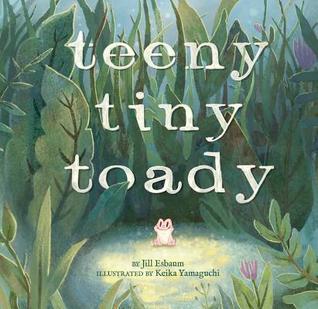
Teeny Tiny Toady by Jill Esbaum, illustrated by Keika Yamaguchi

Source: Sterling Children’s Books
Hardcover, 40 pgs.
I am an Amazon Affiliate

Teeny Tiny Toady by Jill Esbaum, illustrated by Keika Yamaguchi, is about using your own strengths to solve problems and not comparing yourself to others.  Teeny Tiny Toady is a baby sister to seven brothers, but when their mother is taken by hunters in the swamp, her suggestions are often ignored or usurped by one of her brothers.  Told in rhyming verse, teeny tiny toady follows her bigger brothers into the swamp to rescue their mom.  As they try to push the bucket, they can’t get it to tip over, even with Teeny’s help.  Teeny suggests the climb up and pull out their mother, but her brothers end up falling into the bucket too.  It’s up to Teeny to save the day.

After sobbing and wallowing in self-pity about her inability to push over the bucket or climb to the top on her own, Teeny devises a plan that will save them all.  My daughter and I have read this book several times, and she loves it every time.  We’re happy to see that Teeny is strong even with seven older brothers.  She’s smart and savvy.

Teeny Tiny Toady by Jill Esbaum, illustrated by Keika Yamaguchi, is adorably illustrated, and Teeny is the cutest toad ever.  She’s passionate and plucky, and even when her brothers ignore her, Teeny never gives up.  This picture book sends all the right messages to young kids about believing in themselves and taking a stand.

Rating: Cinquain

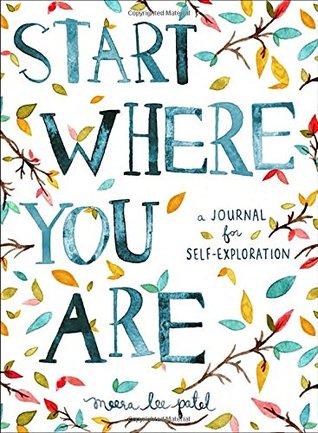
Start Where You Are: A Journal for Self-Exploration by Meera Lee Patel

Source: Penguin Random House
Paperback, 128 pgs.
I am an Amazon Affiliate

Start Where You Are: A Journal for Self-Exploration by Meera Lee Patel is an interactive book that will require its readers to use the pages, fill them in. From what 10 places you wish to visit to what things make you happy, Patel is asking us to look deeply into our dreams and desires. But this journal does not stop there. Readers also will have to delve into losses and failures to learn the lessons they teach. These are the lessons that guide us through life, keeping us aware of what we truly want out of life and what things we’ve tried that are not right for us.

“The hardest questions are the ones that open doors.  Every spread in this book features a universal life lesson paired with an exercise.  These exercises, often taking the form of a chart, list, or written prompt, are designed to help you apply the sentiments behind each lesson to your life.” (pg. 1)

Patel pairs famous quotes with a variety of activities for readers to dig deep into themselves.  Two of my favorites from the book: “Be yourself.  Everyone else is already taken” from Oscar Wilde and “Somewhere, something incredible is waiting to be known” from Carl Sagan.  If the activities do not inspire readers, the quotes surely will.  Readers will want to take a few moments to think about each activity, especially ones that require determine which four possessions they would be unable to do without.  Others may not require as much contemplation.

Start Where You Are: A Journal for Self-Exploration by Meera Lee Patel is a book that will require readers to interact with it and to engage in deeper thinking than when the next appointment in the day is or what they’re having for dinner.  In this modern world, it is often hard to look beyond the daily schedule of activities to think about one’s life without becoming distracted.

Rating: Quatrain

About the Author:

Meera Lee Patel is a self-taught artist raised by the New Jersey shore, where she swam the bright waters and climbed cherry blossom trees until she grew old enough to draw them. Her illustrations are inspired by the magical mysteries of nature, the quiet stories that lace through everyday life, and the bold colors of her native India. Her first book, DAILY ZEN, was published by Ulysses Press in October 2014. Her second book, START WHERE YOU ARE, will be published in Fall 2015 by Perigee (Penguin USA). Meera lives and works in Brooklyn, NY.

River House by Sally Keith

Source: Milkweed Editions
Paperback, 96 pgs.
I am an Amazon Affiliate

River House: Poems by Sally Keith is a collection where absence becomes palpable, and it is clear that this is a very personal collection as the narrator’s focal point is the loss of a mother.  Keith lost her mother and this collection will speak to those who are dealing with the depths of grief, or in fact, not dealing with it well.  Grief is one of the most devastating emotions, and it can take months and years to deal with, particularly if the loss is one so central to one’s identity and world.  The river house is a place the family vacationed with their mother, and it’s a place that even being shared with others would not have the same meaning because it was a place filled with the mother who is no longer living.

From 5.

That spring I was in France my mother spent alone
At the house on the river caring for her father who was dying.

At high tide the road in is swallowed, making the house an island.
Hard to describe, but the walls are thin, it isn’t easy getting through storms.

Grief is indeed a storm, with waves of anguish and loss hitting a person at varying intervals, leaving them awash in a sea that is unpredictable and hard to navigate, keeping one’s head up. Within the grief, the narrator is attending workshops and going through the day-to-day of a life without her mother. In “6.,” the poem speaks of life as a journey of “being in another,” and the narrator speaks to Inma about loss, and Inma’s response is that “life is not sad,” leaving the narrator to “feel the effort in her turning.” That effort is twofold, the effort of providing advice Inma knows not to be entirely true and the effort of hiding the grief that can still overwhelm her, even long after the loss has occurred.

Keith’s poems have a powerful quiet, a storm that lies beneath the surface, much like the storm many of us can sense beneath a person’s facade at funerals and wakes — like there is one word that could trigger the worst of it to burst forth in an uncontrollable torrent. In “17.,” the narrator views a collage sent from Inma, pondering how different it is to look at the storm of images, a near disarray made beautiful with life. In many ways, it is the nearest imitation of life that there can be, unlike a single photo or poem that depicts a paused moment of motion.

From 31.

“Between the way things used to be and the way
they were now was a void that couldn’t be crossed.”

River House: Poems by Sally Keith pays homage to the past and recognizes that life continues on past the traumatic moments of our lives. It doesn’t mean that those lives did not matter, it just means that how they mattered is not as visually present as it used to be.

Rating: Cinquain

About the Poet:

Sally Keith is the author of two previous collections of poetry: Design, winner of the 2000 Colorado Prize for Poetry, and Dwelling Song, winner of the University of Georgia’s Contemporary Poetry Series competition. Her poems have appeared in Colorado Review, A Public Space, Gulf Coast, New England Review, and elsewhere. Keith teaches at George Mason University and lives in Washington, DC.