Quantcast

Misguided Angel by Melissa de la Cruz (Book 5)

Misguided Angel by Melissa de la Cruz (book 5 in Blue Bloods series) is divided between Jack and Schuyler on the run from the coven and Mimi and Oliver back in New York seeking to uncover the perpetrators of vampire kidnappings.  The New York coven is crumbling beneath the weight of the Silver Blood attacks and the absence of its celestial leader Michael, known as Charles Force in this century.  The deaths of Blue Bloods are scaring the elders and the younger generations, and some are talking about retreating underground.  Meanwhile, Schuyler and Jack have sought refuge in the European Coven only to find that the protection is more like being held prisoner, preventing them from being able to fulfill the Van Alen Legacy of protecting the paths to the underworld from Lucifer.

“Deming wondered how much of that fit in with the Vampire Code to enlighten the human race.  It seemed in the present, many of the vampires were not interested in helping humanity as much as they were interested in helping themselves to as much as possible.”  (page 197)

Cruz’s characters are stretching their wings and coming into their full powers.  Even the confident Mimi Force is flailing in her new position as Regent, and her vulnerability makes her seem a little less abrasive than her celestial “Angel of Death” persona.  Forced to rely on Oliver, Schuyler’s former familiar and conduit, Mimi must learn that she is not infallible and that she can misjudge the scope of her powers, particularly in the modern world.  She also becomes more resourceful in that she calls on the Chinese coven for a skilled Venator to uncover the kidnappers of vampires.

In the Mediterranean, Jack and Schuyler are learning to be comforted in their shared space and experiences, even under the protection of the European Coven.  But in an attempt to kick their mission to find the hidden paths and ensure their protection into high gear, a fiery escape from a yacht leads them deep into the mountains to uncover a 15th Century mystery.  Cruz is easing readers further into the devotion between these two characters and showing how well they work together, in spite of their doubts about how long they will have together given that they are basically outlaws of two covens.

Misguided Angel by Melissa de la Cruz is about how the past can trick us into thinking that the future path is set and that there are few choices, but really the future is wide open and can change easily once a new decision and path is chosen.  The series is kicking into high gear and there are newer mysteries to solve and mazes to run through for these characters, and they’ll have your rooting for each of them to look beyond “destiny” to find the future they want most and can make them happiest.

About the Author:

Melissa de la Cruz is the New York Times and USA Today best-selling author of many critically acclaimed and award-winning novels for teens including The Au Pairs series, the Blue Bloods series, the Ashleys series, the Angels on Sunset Boulevard series and the semi-autobiographical novel Fresh off the Boat.

Photo © Denise Bovee

Keys to the Repository by Melissa de la Cruz (Book 4.5)

Keys to the Repository by Melissa de la Cruz is really a companion book to the series, rather than a continuation of the action. In the introductory letter from the author, Cruz says, “The Repository Files, which include character profiles, were written by rather crotchety historians who work for the humorless Committee, so you might find their estimation of the characters a little astringent.”  (page 5)

The book chronicles the series up to the fourth book, provides some additional short stories/chapters that may have been cut from those books or that provide additional background to the story.  In many ways, these short stories are the missing pieces or scenes that some readers may have wanted to see, like the big breakup scene between Jack and Schuyler or what happened to Dylan Ward when he disappeared.  One of the most endearing elements of Jack and Schuyler’s relationship is the books that they share with one another, and upon their first meeting, he gives her The Plague by Albert Camus and Pride & Prejudice by Jane Austen, two seemingly unrelated books, though both are about love and longing.

“Feeling reckless and giddy, and just a tad plucky — like the kind of girl who tramped around the marshes in the dark — she scribbled a note and slipped it under Jack’s door.

Mr. Darcy, I will be there as requested. — Elizabeth.”  (page 57)

“This was a boy who spoke through books:  longing and exile — The Plague — banter and obstacles — Pride and Prejudice.  He spoke her language.”  (page 59)

Cruz also creates an appendix of characters in the books and their role in the books, definitions of the secret language words and other events in the books.  In one chapter, she even more fully explains the hierarchy of the vampire world from the Order of the Seven to the Committee and the Conclave.  Finally, there is an additional chapter on Bliss Llewellyn and her adventures to find the Hounds of Hell, which Cruz apparently spun off into a series of its own (as if I need yet another series to read, though I’ll likely pick it up someday).

Keys to the Repository by Melissa de la Cruz is an companion book to the Blue Bloods series that can help remind readers what has happened in the past, shed additional light on the characters and relationships in the series, and offers a refresher course on the terms, history, and customs of the Blue Bloods.  It reads like the notebooks of a writer would, giving readers an inside peak into the characters as Cruz sees them and their story, though there are elements that are “redacted” by the recordkeepers, most likely because they are elements revealed in future books.

About the Author:

Melissa de la Cruz is the New York Times and USA Today best-selling author of many critically acclaimed and award-winning novels for teens including The Au Pairs series, the Blue Bloods series, the Ashleys series, the Angels on Sunset Boulevard series and the semi-autobiographical novel Fresh off the Boat.

Photo © Denise Bovee
The Van Alen Legacy by Melissa de la Cruz (Book 4)

The Van Alen Legacy by Melissa de la Cruz is the fourth book in the Blue Bloods series.  The pacing of this story is much better as each chapter is told from a different setting and set of characters, increasing the tension for readers looking to uncover the grand plan of the Silver Bloods.  Schuyler and Oliver, her human conduit, have been on the run since the end of the last book, and after more than a year of running from the Venators, they have done little to uncover the truth of her family’s legacy or the plans of the Silver Bloods.  In many ways, Schuyler has taken a backseat in these books to allow Mimi to come into her full powers and true destiny as she and her fellow Venators search the globe for the Watcher, who was taken from Bliss Llewellyn family.

Bliss, on the other hand, has her own set of problems as she fights to regain control over her life and uncover what her father, the senator Forsyth, has been up to behind closed doors.  Meanwhile, she realizes that even the people she has lost are carried with her always and are available to help her regain control and take appropriate action to prevent further devastation.

“Stepping into someone’s subconscious is like discovering a new planet.  Everyone’s internal world is different and unique.  Some are cluttered, stuffed with dark and kinky secrets pushed to the edge of their minds, like racy underwear and handcuffs shoved in the back of a closet.  Some are pristine and clear as a spring meadow:  all hopping bunnies and falling snowflakes.  Those are rare.”  (page 26)

“Memories were moving pictures in which meaning was constantly in flux.  They were stories people told themselves.  Using the glom — the netherworld of memory and shadow, a space the vampires could access at will in order to read and control minds — was like stepping into a darkroom, into a lab where photographers developed their prints, submerging them in shallow pans of chemicals, drying them on nylon racks.”  (page 70-1)

Meanwhile, the Forces begin to realize that the bond that they share may not be as unbreakable as they have been told it is.  But beyond that, they must don their previous lives and knowledge to battle the forces of evil and save not only their Blue Bloods society, but also humanity.  De la Cruz has stepped up the detail in this novel, carefully unfolding the layers of her vampire society’s past and the political machinations that continue even amidst the ominous threat of the Silver Bloods who may have infiltrated their community.

The Van Alen Legacy by Melissa de la Cruz renewed my faith in the series, even though little time is spent on the actual Van Alen legacy.  Cruz has further developed her characters, though the love triangles can be a little tiresome.  It is an action-packed guilty pleasure, looking for a novel to spend a few entertaining hours away from the television and the turkey.

About the Author:

Melissa de la Cruz is the New York Times and USA Today best-selling author of many critically acclaimed and award-winning novels for teens including The Au Pairs series, the Blue Bloods series, the Ashleys series, the Angels on Sunset Boulevard series and the semi-autobiographical novel Fresh off the Boat.

Photo © Denise Bovee

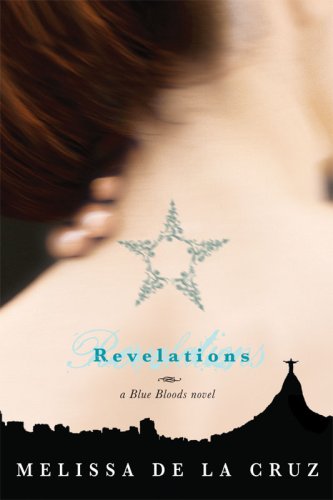
Revelations by Melissa De La Cruz (Book 3)

Revelations by Melissa De La Cruz is the third book in the Blue Bloods series in which an upper crust society of vampires, mostly teens in a private New York City school is on the verge of battle with dark forces.  As this is the third book in the series, readers should read the first two novels before tackling this one as without the background of those novels readers could find themselves adrift.  Secondly, even those who have read the previous two novels, should consider rereading them and even with that could find themselves a bit lost in this one.  De La Cruz has a lot going on with her Blue Blood vampires and there is quite a bit of cloak and dagger going on that keeps the readers in the dark up until the end chapters.

The novel opens shortly after a major even in the second book in which an attack on one of the elder vampires by a Silver Blood is successful, and the beginning of this one is set up as though it will be a solvable mystery.  In some ways it is, but not to a satisfying conclusion as more questions about the feud between Blue Bloods and Silver Bloods are raised than answered.  Schulyer, who is referred to as a half-blood (think Harry Potter and the similar connotations apply here, though in a vampire world), is still wandering around, not doing her “lessons” to learn about vampire history, and pining for Jack Force, the twin of Mimi (think soul mate, not sibling).

These vampire characters are supposed to be the earthbound representations of the archangels, and while it creates a unique line of lore for vampires, not much of this history is revealed to the reader as Schuyler refuses to take part in the lessons.  The high-school struggles of vampires among mortals is completely forgotten in favor of a secret conclave-directed set of lessons to help these teen vampires, who have been reincarnated again, to come into their full power.  But even so, the author fails to demonstrate these powers outside of the classroom without explanation.  For example, Mimi suspects her soul mate Jack is seeing someone else, and rather than turn into fog or mist to follow him, she trails him in a Bentley.  Readers will find this disconnect disappointing since half the point of reading vampire novels is for the lore and world building.

Although the novel is full of name drops in the fashion world and in terms of locales in Rio rather than actual descriptions to transport readers to these locations, De La Cruz has created a novel that is a quick read when you want to just turn your brain off for a while — it’s candy for the mind.  Revelations by Melissa De La Cruz was a bit cliched in places and disappointing when vampire powers were not used, but overall, its a quick read that doesn’t require too much thinking and provides a source of entertainment.

About the Author:

Melissa de la Cruz is the New York Times and USA Today best-selling author of many critically acclaimed and award-winning novels for teens including The Au Pairs series, the Blue Bloods series, the Ashleys series, the Angels on Sunset Boulevard series and the semi-autobiographical novel Fresh off the Boat.

Photo © Denise Bovee

Thrall by Natasha Trethewey

Thrall by Natasha Trethewey examines the lines between father and daughter and the African-American experience through a set of personal and analytical poems focused on race and culture.  In “Miracle of the Black Leg,” Trethewey examines the juxtaposition of white and black men in paintings and other artwork in which the leg of one man is taken and attached to the thigh of another man.  There are similarities in pain stricken faces in some images, paralleling their similar situations, but there are also clear disparities in how each man is treated, even if the leg is taken from a newly deceased person.  The imagery she chooses in this poem is particularly haunting, especially when taken in the historical context of how the images are presented throughout the years — with the black donor swept to the side and only the black leg as a representation of the whole.

"See how the story changes:  in one painting
     the Ethiop is merely a body, featureless in a coffin,
so black he has no face.  In another, the patient --
     at the top of the frame -- seems to writhe in pain,
the black leg grafted to his thigh.  Below him
     a mirror of suffering:  the blackamoor --" (page 11)
". . . The black man, on the floor,
holds his stump.  Above him, the doctor restrains
    the patient's arm as if to prevent him touching
the dark amendment of flesh.  How not to see it -- 
    the men bound one to the other, symbiotic --
one man rendered expendable, the other worthy
    of this sacrifice?  In version after version, even
when the Ethiopian isn't there, the leg is a stand-in,
    a black modifier against the white body," (page 12)

The title of the collection tells readers all they need to know about the topics covered, including the moral, mental, and physical slavery or servitude as well as the complete emotional absorption that can happen in relationships. As Trethewey examines works of art through a lens of racial demarcation, she also looks at daughters’ relationships with their fathers, which can sometimes be congenial and at other times turbulent. In “Knowledge,” she is looking at the dissection of a woman and the men who stand around her as the cut is made into her flesh, and Trethewey’s narrator concludes that her father was not just one type of man, but each of the men in the room — all at once contemplative, scientific, and artistic, even though at times she felt he were just one of those men.

It is easy to see why Thrall by Natasha Trethewey could captivate a packed audience at the Library of Congress when she was inducted as the newest U.S. Poet Laureate, and hearing a poet read their own work can be the best gift.  While her reading can enthrall you and bring you near tears, her careful word selection in each poem will ensure that you reflect on the meaning of each line in each verse before you even think about the overarching themes of separation and connection as well as their juxtaposition.  A collection that will be on the best of list for sure.

Check out the recap of the U.S. Poet Laureate Event.

This is the 22nd book for my 2012 Fearless Poetry Exploration Reading Challenge.

King Solomon’s Ring by Konrad Z. Lorenz

King Solomon’s Ring by Konrad Lorenz, an Austrian ethologist, is not your typical science book in that it is written with a less-scientific audience in mind.  Complete with minimal illustrations from Lorenz, the book does not read like a scientific experiment that can be precisely duplicated, but more like a series of observations and anecdotes from a man who invited the wild into his home.  Unlike King Solomon, Lorenz claims not to need a magic ring to learn the language of animals and to communicate with them.  While there are discussions of domesticated and wild dogs, among other animals, Lorenz mainly focuses on the behaviors of the water shrew, his aquarium fish, and the Jackdaw.

While considered a premier examination of animal behavior and discussing in detail the phenomenon of imprinting, on some occasions he appears to anthropomorphize these animals, making them seem more human than they are, particularly when discussing their mating rituals.  Lorenz also is very descriptive of the animals and their interactions with one another and with the humans who lived in the home and surrounding neighborhood.  These descriptions, while interesting to a scientist, may border on tedium for others.

“The whole charm of childhood still lingers, for me, in such a fishing net.”  (page 12)

“I intend to develop further this mixed breed, now that it has happily survived the war, and to continue with my plan to evolve a dog of ideal character.”  (page 142)

He raises some interesting questions about the parallels between certain species and humans in that some species, like humans, share their experiential knowledge of dangers and enemies with their young, rather than their young having an instinctual knowledge of what animals are their natural enemies.  Lorenz also discuss language and how body language is a lost art among humans, but is alive and well among animals, like yawning and smiling in humans to signify an emotion.

His wife must have had enormous levels of patience, though the bit about leaving their own child in a cage while the animals roamed free in the house and outside was hopefully a joke.  King Solomon’s Ring by Konrad Lorenz is light on scientific method and heavy on observation, but at times the descriptions get bogged down with too much detail even for a general audience.  For those who have studied imprinting and other aspects of animal behavior before, the book could seem very repetitive and far from engaging.  Additionally, there are moments where he pats himself on the back or the backs of his friends who achieve some interesting feats with animals, which can seem a bit self-serving.

About the Author:

Konrad Z. Lorenz ForMemRS was an Austrian zoologist, ethologist, and ornithologist. He shared the 1973 Nobel Prize with Nikolaas Tinbergen and Karl von Frisch.


This is my 81st book for the New Authors Reading Challenge in 2012.


What Book Club Thought:

This book, which was our November pick, really wowed one member of the book club, who said he learned a great deal from Lorenz and his theories about animals in his care, while most of us seemed to think that we’d learned all of the things he talked about in the book already through other sources — most likely in school or the animal channel.  The rest of us either thought it was an OK book or didn’t like it very much at all.  Our youngest member said that there should have been more about Penguins, though Lorenz lived in a place where Jackdaws were the most prevalent bird it seemed.  Two members found the chapter about dog ancestry and behavior the most interesting, particularly about the relationship to masters and one another in a pack versus the dog that prefers to be alone.

One heated discussion was about whether animals are intelligent or not, with one member playing devil’s advocate and insisting that animals act on pure instinct and are not problem-solving beings with intelligence.  In one scenario, the member suggested the lion would simply die in the arctic and be unable to problem-solve their way out of the situation or find food, but it was argued that there are different levels of intelligence in the animal kingdom and that some things can be learned by animals and other things cannot.  Additionally, there was a discussion about adaptability versus intelligence as well as the teaching of danger to young animals by their parents, much like humans teach their own children about dangers.

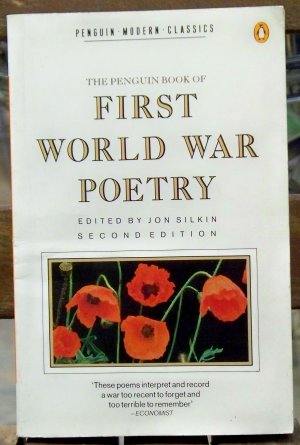
The Penguin Book of First World War Poetry (Second Edition) edited by Jon Silkin, David McDuff

The Penguin Book of First World War Poetry (Second edition) edited by Jon Silkin and David McDuff is a collection of poetry from and about the WWI.  Silkin and McDuff  increased the number of poems in translation included in the collection.  There are poems translated from German, French, Italian, Russian, and Hebrew, and Silkin was a poet himself.  As expressed in the not at the beginning, “For some, war was moral athletics; others looked forward to the experience of war as a ‘vacation from life’ — a vacation from a society disjoined by class and constrained by the rigid structures of labour.”  (page 12)

***However, I’m not one for long introductions so I skipped over it this time around and got straight to the poetry. ***

The anthology includes some of the more well known WWI poets, Thomas Hardy and Robert Graves, but also some who are not as well known.  One of the most well known WWI poems is “Anthem for Doomed Youth” by Wilfred Owen, which seeks to command a respect for the thousands who died in a cause for freedom and defense.  Steeped in religious allusions Owen makes reference to the candles lit where bodies lie and to the drawing of blinds in those same rooms as well as the prayers that often accompany the mourning process, but there also is an underlying celebration for their sacrifice as the bells are rung and anthems are sung.

Each of these poems brings with it a different perspective on war in the trenches, love, life, and loss, but above all patriotism.  Isaac Rosenberg’s “Dead Man’s Dump” (page 211) is particularly haunting:

"The wheels lurched over sprawled dead
But pained them not, though their bones crunched,
Their shut mouths made no moan.
They lie there huddled, friend and foeman,"

Meanwhile, there is a true sense of fear in Ivor Gurney’s “The Silent One,” (page 116):

"Who died on the wires, and hung there, one of two --
Who for his hours of life had clattered through
Infinite lovely chatter of Bucks accent:
Yet faced unbroken wires; stepped over, and went
A noble fool, faithful to his stripes -- and ended
But I weak, hungry, and willing only for the chance
Of line -- to fight in the line, lay down under unbroken
Wires, and saw the flashes and kept unshaken
Till the politest voice -- a finicking accent, said:
'Do you think you might crawl through there: there's a hole'
Darkness, shot at:  I smiled, as politely replied --
'I'm afraid not, Sir.' There was no hole no way to be seen
Nothing but chance of death, after tearing of clothes."

Each poet in the collection bring their own perspective to war, but there seems to be a pervading reverence to the fight these soldiers’ waged and all that they sacrificed.  There were certain translated poems in the book that didn’t resonate as well as some others, including Benjamin Peret’s “Little Song of the Maimed,” but it was good to revisit an old WWI poet, Osip Mandelstam (check out my earlier review of Stolen Air).  The Penguin Book of First World War Poetry (Second edition) edited by Jon Silkin and David McDuff offers a collection of poems that provide a wide perspective on war from the patriotism the soldiers felt to their fear and horror at the experiences they had.

About the Editors:

Jon Silkin was born in London, in a Jewish immigrant family and named after Jon Forsyte in The Forsyte Saga, and attended Wycliffe College and Dulwich College. During the Second World War, he was one of the children evacuated from London, and for a period of about six years in the 1950s, after National Service, he supported himself by manual labour and other menial jobs. He wrote a number of works on the war poetry of World War I. He was known also as editor of the literary magazine Stand, which he founded in 1952, and which he continued to edit (with a hiatus from 1957 to 1960) until his death.

David McDuff is a British translator, editor and literary critic. He attended the University of Edinburgh, where he studied Russian and German. After living for some time in the Soviet Union, Denmark, Iceland, and the United States, he eventually settled in the United Kingdom, where he worked for several years as a co-editor and reviewer on the literary magazine Stand. He then moved to London, where he began his career as a literary translator.


This review first appeared on Historical Tapestry for WWI Week.


This is my 14th book for the WWI Reading Challenge.


This is the 21st book for my 2012 Fearless Poetry Exploration Reading Challenge.

The Help by Kathryn Stockett

The Help by Kathryn Stockett, which was my book club’s October selection, has been celebrated and made into a movie already.  Aibileen, Minny, and Skeeter share the narration for the 1960s segregated Jackson, Mississippi, as the lines blur between the races and to social classes.  While Skeeter’s social class is not as pure as it seems, the Black maids are struggling to make ends meet and hold their tongues even as others are engaged in sit-ins at the local Woolworth’s and marches.  Stockett carefully illustrates the social and color lines in the South, while also paying careful attention to the harsh realities of Black maids in white households.  This is not just a story about Black maids, but also about where stigma comes from, how it is perpetuated, and how it can be overcome.

“And I know there are plenty of other ‘colored’ things I could do besides telling my stories or going to Shirley Boon’s meetings — the mass meetings in town, the marches in Birmingham, the voting rallies upstate.  But truth is, I don’t care that much about voting.  I don’t care about eating at a counter with white people.  What I care about is, if in ten years, a white lady will call my girls dirty and accuse them of stealing the silver.”  (page 256)

Stockett has created a novel that gets readers thinking about their own environment and what they tolerate on a daily basis, even though they do not agree with certain things that happen or continue to be spoken in anger or prejudice toward others.  Like she notes in her “Too Little, Too Late” essay at the back of the paperback, no one in her white family who had a Black maid even thought about asking the maid what it was like to be Black in the deep south.  How many things that go on daily do we disagree with and dislike, but allow to happen without so much as a criticism or objection?

On one hand, readers are introduced to the Black maids and the prejudice they put up with from their white employers, and on the other hand, Stockett introduces Skeeter, a young woman returned from college to find that she is vastly different from her childhood friends, Hilly and Elizabeth.  While the parallel is lightly drawn and clearly not the same kind of prejudice on both sides, it does raise the question about what it means to create groups within a larger society to the exclusion of others.  Both avenues lead to great isolation and emotional pain, but the consequences of speaking out against that oppression are potentially more violent and devastating for the maids than for Skeeter.

The Help by Kathryn Stockett provides a balanced look at the love and disdain in the relationship between white women and families and Black maids, but it also tends to play it safer than one would expect given the volatile time period being discussed.  Yes, there are occasions of devastating tragedy, spousal abuse, and hints of other violent behavior, but truly the focus is less on the consequences of speaking out and more on the ties that bind each group to one another.  Stockett has chosen to show the complex relationships between these women given the societal constructs that constrain their actions and behaviors, even if they would wish it not so.

About the Author:

Kathryn Stockett was born and raised in Jackson, Mississippi. After graduating from the University of Alabama with a degree in English and Creative Writing, she moved to New York City where she worked in magazine publishing and marketing for nine years. She currently lives in Atlanta with her family. The Help is her first novel.


This is my 77th book for the New Authors Reading Challenge in 2012.


What the Eclectic Bookworms Thought (Beware of Spoilers):

Overall, we all enjoyed The Help and determined that it accurately portrayed the South, particularly the conflicted emotions of the Black maids and the children they raised.  It also demonstrated the poor logic that many white families used to determine what Blacks were good enough to do for them, but not good enough to share with.  For instance, Blacks cannot use the same bathrooms as whites because they are diseased, but at the same time, those maids can cook their families’ food and raise their children.

The group seemed split about which character they liked best, with some of us in favor of Minny, while others liked Skeeter and Aibileen best.  One of our female members said that Aibileen’s voice was the most balanced, and that’s why she liked her best, while our youngest member said that she enjoyed Skeeter best because she was an aspiring writer.  Personally, Minny’s kick ass attitude and yet vulnerability when it came to her husband and children made her both frightening and endearing — as well as a little bit vulnerable.

The club also discussed whether we would go as far as Minny to get revenge on Hilly, with only a few of saying that we would and a couple of us indicating we would have gone further.  At one point the discussion of slavery came up and whether the maids would have considered themselves still slaves or something more than that, but we all seemed to be on the fence about that question.  A discussion of other cultures’ use of slavery and how slaves could earn their way out was also mentioned, though none of us had any concrete sources on hand to discuss that too much in depth.

Other topics touched upon during the discussion include the friendship dynamics in Hilly’s group and how most of the women were subservient to Hilly and her approval, while others like Skeeter seemed to see that cow-towing to Hilly was wrong as well as how Minny and her family seemed to get by more easily than Aibileen who was on her own without any children.  We all enjoyed the book, though some of us would have preferred less about Stuart and Skeeter’s relationship and that other sections were trimmed down.  I personally enjoyed the additional insight into Skeeter and Stuart’s relationship after having watched the movie and found that part lacking in the film.

From the Land of the Moon by Milena Agus, translated by Ann Goldstein

From the Land of the Moon by Milena Agus, translated from the Italian by Ann Goldstein, is the story of a young unnamed woman’s grandmother just at the end of WWII in Italy after the 1943 American bombing of Cagliari.  Despite the namelessness of the main characters, there are named secondary characters in the slim novel that provide it depth and the main characters some roots.  The granddaughter is telling the story of her grandmother after her death, reminiscing about the growth and change in family.

The life of this family has seem good times and bad times, with some members experiencing greater hardships than others.  The grandmother in particular has a number of suitors that fail to come back after several weeks due to rumors about her sanity.  Her own family keeps her at arms length and often hidden from public view unless necessary.  She’s the black sheep of the family, though from what we learn about her she has normal urges of a young woman and a desire for freedom.  More than that, she’s got a creative mind and a penchant for writing.

“One day my great-grandmother waited for her in the courtyard with the whip, made of ox sinew, and began to hit her until even her head was bleeding and she had a high fever.”  (Page 14)

After a number of miscarriages and failed pregnancies, the grandmother has little recourse but to take action and find away to rid herself of at least one health problem.  On a trip to take care of her kidney stones in the healing waters, the grandmother meets a young man, known only as the Veteran.  In many ways, they are the same, but they also have different tragedies to overcome.  He was a concentration camp survivor after being captured during the war, while she is an escapee from her family.  Like the many times destroyed home on Via Manno, families are built and rebuilt as the darkness is torn out of the house and light once again filters in through its large windows with new hope.

From the Land of the Moon by Milena Agus, translated from the Italian by Ann Goldstein, is about family and how it can be ripped apart and held together by secrets.  But it also is about dreams and love, and the sacrifices we must make to live into the future.  In many ways, its about the perseverance of our ancestors and how they can shape us in the future, even without our knowledge.

About the Author:

Milena Agus was a finalist for the Strega and Campiello prizes, and was awarded the prestigious Zerilli-Marimò prize for Mal di petra (From the Land of the Moon). It is her first novel. Agus lives in Cagliari, Sardinia.

About the Translator:

Ann Goldstein is an editor at The New Yorker. For Europa Editions, she has translated three novels by Elena Ferrante—The Days of Abandonment, Troubling Love, The Lost Daughter—Clash of Civilizations Over an Elevator in Piazza Vittorio, The Chill by Romano Bilenchi, The Father and the Stranger by Giancarlo de Cataldo, and The Worst Intentions by Alessandro Piperno. Her translation of Linda Ferri’s Cecilia is forthcoming in May 2010. She received a PEN Renato Poggioli Translation Award and was a visiting scholar at the American Academy in Rome. She is currently editing the complete works of Primo Levi, for which she received a Guggenheim Translation fellowship. She lives in New York.

This is my 74th book for the New Authors Reading Challenge in 2012.

The Caller by Karin Fossum, translated by K.E. Semmel

The Caller by Karin Fossum, translated by K.E. Semmel from the Norwegian, is the eighth book in her Inspector Konrad Sejer series of books.  It is not only a mystery with a adrenaline rush, but also a psychological examination of the criminal and victims minds.  Rather than a mystery that needs to be unraveled, Fossum creates an unsettling atmosphere that keeps readers on the edge.  What will happen next, how will the criminal again strike fear into those around him — neighbors, family, strangers.

And yes, this is a book about fear — the fear of death — the fear of death when it calls.  Death is always unexpected when it arrives, but what if you are lulled into an artificial sense of security by your own contented perceptions of your home and neighborhood?  What if something occurs that simply disrupts your preconceived notions of security?  Fossum asks these questions with each new prank and situation, and she ramps up the anxiety with each page turned.  From the very first pages, readers become aware that the Norwegian landscape will darken and tranquility will become tentative.

“Poor little thing, she thought, and tore its thighs off.  She liked the cracking sound the cartilage made when tearing from the bone.  Light and tender, the meat let go easily, and she succumbed to the temptation to stick a piece in her mouth.  It’s good, she thought, it has just enough seasoning, and it’s lean too.  She filled the pie dish and sprinkled on Cheddar cheese.  The she checked the time.  She didn’t worry about Margrete.  If the child sneezed she would know it immediately.  If she coughed or hiccuped, or began to cry, she would know.  Because there was a bond between them, a bond as thick as a mooring line.  Even the slightest tug would reach her like a vibration.”  (page 2)

However, it is the undercurrent under the surface plot that ripples beneath, providing just enough suspicion to keep readers wondering who the true criminal is.  Readers get a sense of Inspector Konrad Sejer as an honest man whose seen it all, but continues to work for the police as a way to ensure justice.  But readers also get to know how much his life has changed over the years and where his strength comes from — his family and young nephew Matteus.  His health may be failing, but the case is always important, pulling him away from his own misery into that of the victims and even the possible perpetrator.

When death calls, even in its mistiest form, The Caller by Karin Fossum, translated by K.E. Semmel tackles the what ifs and the inevitability that comes with that visit, including the reassessment of behavior and routine, love, and perseverance.  The atmosphere of the novel is by turns complacent and topsy-turvy, and Fossum’s characters must navigate the new world into which they are thrust.

About the Author:

Karin Fossum is the author of the internationally successful Inspector Konrad Sejer crime series. Her recent honors include a Gumshoe Award and the Los Angeles Times Book Prize for mystery/thriller. She lives in a small town in southeastern Norway.

About the Translator:

K.E. Semmel is a writer and translator whose work has appeared in Ontario Review, the Washington Post, Aufgabe, The Brooklyn Review, The Bitter Oleander, and elsewhere. He has worked as the Publications & Communications Manager of The Writer’s Center, an independent nonprofit literary organization based in Bethesda, MD that offers over 300 workshops in writing annually and hosts around 50 literary events a year.  He is known for his work translating Simon Fruelund’s fiction, and he has received a translation grant from the Danish Arts Council.

This is my 71st book for the New Authors Reading Challenge in 2012.

What It Is Like to Go to War by Karl Marlantes

What It Is Like to Go to War by Karl Marlantes (I reviewed his novel Matterhorn) reads less like a linear memoir than it does a measured stream of consciousness attempting to explain the role of a soldier, the best way to protect that soldier and his family from the guilt and trauma experienced in war, and the possible consequences of using more technology to wage war and remove ourselves from the actual acts of war.  As well as how that removal changes the psyche’s view of war — making it more impersonal and thus more damaging.

Marlantes goes back in forth in time and purpose, but the key is to follow the chapter headings, like “Guilt,” to understand what the focus of the chapter will be no matter what time period in his life he is speaking of.  He’s clearly studied Carl Jung and other philosophies, including those of eastern nations, on his journey to find out how to best deal with his conflicting emotions of triumph and horror as a Marine who fought in Vietnam, and he often warns that without guidance when soldiers come home, they can spiral out of control as they lose the boundaries between the war life and their normal life.

“Death becomes an abstraction, except for those at the receiving end.  We must come to grips with consciously trying to set straight this imbalance of modern warfare.  What is at stake is not only the psyche of each young fighter but our humanity.”  (page 19)

“To be effective and moral fighters, we must not lose our individuality, our ability to stand alone, and yet, at the same time, we must owe our allegiance not to ourselves alone but to an entity so large as to be incomprehensible, namely humanity or God.”  (page 144)

Using examples from his own combat experiences, which are eerily similar to those presented in Matterhorn‘s fictional account, Marlantes outlines possible differences in loyalty and how high that loyalty must be in order for “right” decisions to be made in war, but he also acknowledges that all humans lie and that lying can serve many purposes, especially in a war that applauds achievement only through body counts.  The dichotomy of humans is pronounced in war as they attempt to navigate through the jungle or the foreign terrain to complete missions without laying unnecessary waste to themselves or the enemy.  Ethical warriors are just one part of the discussion, but mostly Marlantes is concerned with preparing today’s soldiers for the psychic and emotional break they will experience with their spirituality and their ties to society.

Mixed with philosophical discussions and examples from such texts as The Odyssey and the Bhagavad Gita, Marlantes strives to pinpoint the natural inclination of the warrior spirit in men and women and the dire consequences of suppressing that spirit or denying its existence.  While he suggests that the spirit should be tempered and praised, it also should not be allowed to spiral out of control — with a focus on creating balance.  In many ways, there is a deep Buddhist sense in his memoir about creating balance and eliminating ego’s perspective on justice in favor of what is truly right for humanity not just a particular nation or belief system.

What It Is Like to Go to War by Karl Marlantes is one man’s perspective on his experiences in Vietnam and what those experiences taught him.  He talks about what he thinks could improve soldiers in the field as well as when the fighting is over, helping them to integrate back into society with less bumps along the way — less suicides, less drug and alcohol abuse, and less violence.  For those looking for a memoir that offers more than just war stories about missions and lost friends, Marlantes provides an introspective analysis of the pride he felt in killing the enemy as well as the deep sorrow.

About the Author:

A graduate of Yale University and a Rhodes Scholar at Oxford University, Karl Marlantes served as a Marine in Vietnam, where he was awarded the Navy Cross, the Bronze Star, two Navy Commendation Medals for valor, two Purple Hearts, and ten air medals. His debut novel, Matterhorn, will be published in April 2010 by Grove/Atlantic.

Ashes by Ilsa J. Bick

Ashes by Ilsa J. Bick is part one in a trilogy of dystopian young adult books in which an EMP (electromagnetic pulse) wipes out all electronics, including pacemakers and other devices inside people’s bodies.  Alex is a 17-year-old girl with a brain tumor, who also has lost her parents in a horrific accident and has undergone numerous traditional radiation and experimental treatments.  She decides to leave her Aunt Hannah’s house near Northwestern University and head to the Waucamaw Wilderness of Michigan to determine what to do next — whether to go on fighting the tumor or move on.

While in the woods, she meets Ellie, her grandfather, and their dog Mina.  The 8-year-old Ellie is sarcastic and bit angry since her father’s passing in Iraq, but when the EMP hits, the only one left to rely on is a stranger and her dog, a dog that reminds her of all she’s lost.  Granted, she has a right to be angry and sad, but she whines just a bit too much and readers may find that they would be glad if Alex were to ditch her in the woods alone.

“The buzz on the plane faded and the quiet descended again like a bell jar over the forest.”  (Page 13)

Bick’s writing is suspenseful and clear, but the end of each chapter reads like a cliffhanger.  After 30 chapters, readers will be singing the equivalent of DUN DUN DUN.  Not every chapter ending needs to be this dramatic especially when there are no major plot twists revealed.  In addition to the EMP and the dramatic chapter endings, Bick introduces the Changed (aka the zombies/cannibals), those who survived the EMP, but turned primal and become cannibals.  This being a trilogy, there was no explanation of what changed these people into cannibals, nor why some kids, like Alex, Ellie, and Tom, do not change.

“She didn’t know if the tightness in her throat or the fullness in her heart meant that he was there; that they were connected somehow.  Maybe all that she saw and felt was the sensual fullness of memory:  that which abided and was nothing but the ghost of a touch, the whisper of a word, the lingering of a scent.”  (Page 374)

Ashes by Ilsa J. Bick is an action packed novel that reads like horror with all the graphic details about the killings and eating, but what it lacks is a cohesive story.  In one half of the book, Alex seems like a strong young lady interested in taking charge, but in the latter half of the book, she becomes mush.  Once in Rule, she no longer physically tries to fight or escape her captors once they’ve set her up in a house and she begins work in the hospice, and of course, meets a kind boy her own age.  The novel becomes less about the EMP and the zombies than it is about the cult-like settlement of Rule in which surviving women are passed off like chattle and are only good for propagating the species.  In many ways, it is like the author could not decide what story to tell, and whether the character was to be strong and a main catalyst or merely a weak pawn in a larger chess board.  At more than 400 pages, readers may find that editing could have compacted the story more and maybe the plot could have been tied up a little better, with fewer loose ends — even for a trilogy this has too many.  However, if you are looking for something entertaining and fast-paced, this is for you.

About the Author:

Ilsa J. Bick is an award-winning, best-selling author of short stories, e-books and novels. She has written for several long-running science fiction series, most notably Star Trek, Battletech, and Mechwarrior:Dark Age. She’s taken both Grand and Second Prize in the Strange New Worlds anthology series (1999 and 2001, respectively), while her story, “The Quality of Wetness,” took Second Prize in the prestigious Writers of the Future contest in 2000. Her first Star Trek novel, Well of Souls, was a 2003 Barnes & Noble bestseller.


This is my 62nd book for the New Authors Reading Challenge 2012.


Book Club Thoughts (Beware of Spoilers):

This selection was from one of the male members in the group who reads a great deal of young adult dystopian fiction.

Most members enjoyed the book for what it was, a fast-paced thrilling dystopian novel, but two of us disliked it because the zombies were implausible and the main character was too weak by the end.  One member said that the portion of the book in Rule was “bungled.”  While I felt that Chris in Rule was a cardboard cutout of a “good guy,” one other member liked him more than Tom, the earlier love interest for Alex.  The youngest member of the group hopes that Tom is still alive in book two, Shadows, because as of now, his fate is unknown.

Most of us agreed that should the world end as we know it that a marshal law would be necessary to keep people civil to one another and that controlling information — even about super senses — is an essential part of that.  However, I disagreed that Alex would have become as complacent as she did and merely though about squirreling away supplies; I wanted more from her — maybe more recon or attempting to find out how the town of Rule operated and why.  The information that she does glean is told to her by some rather chatty members of the town, and she learns the information with little effort on her part or very little help from her super smell.

In the final cliffhanger of the book, Alex learns that the town of Rule has been feeding the teen cannibals, but she doesn’t know why.  One of our female members suggested that maybe the teen cannibals were once some of the town’s own children that became the Changed and the members could not bring themselves to kill their own kids.  Another member said that feeding the enemy is incredibly stupid and that the town should be cutting off the food supply; at this point the town is merely aiding in their own doom.  There also are quite a few loose ends in the book that some of us noticed, and it would have been nice if some of them were tied up by the end of book one so that new mysteries could be revealed and unraveled in book two.

Five of us, which is a majority, said they would read the second book to find out what happens, but three of us were not interested in reading book two at all for a variety of reasons.  However, looks as though we’ll all be reading Shadows as it was selected from the nominations by the member who selected Ashes.