Quantcast

When All My Disappointments Came at Once by Todd Swift

When All My Disappointments Came at Once by Todd Swift, published by Tightrope Books, are poems about a series of mid-life crisis in literature and throughout history, with some less grandiose crises in the mix.  There are new takes on the midlife crisis, with the narrator in “The Shelf” trying to take on the life of another through their writing, only to find the words fit falsely and do not ring true.  But in others, like “Michael Kohlhaas,” reference the vengeful exploits that go off of the deep end to the point that the narrator cannot be brought back from the brink.  With a wide breadth of topics, Swift covers a lot of historic and emotional ground in his poems, though clearly some of these poems will require additional research into some of the historic and literary elements referenced, especially if they are not familiar.

From "In Memory of F.T. Prince" (page 15)

Desire ages, ages hardly at all,
Edges, like those of a book,
Curled at the beach, where waves,
Sent by the summer, brush

The salt away, finely-combed,
And it is homosexual love
That holds us in its palm,
That cuts and dries the hair

Beautifully rendered, Swift harkens to the original poem written by Prince about soldiers bathing in a river during World War II, but he also takes a new twist on the scene, pinpointing the desire that can rise up when all that surrounds you is death. Where is the beauty, where is the love — you find it where you can, at least to a certain extent. While some of these poems are dark and harrowing, others are sad, suspenseful, and heart-pounding as Swift takes readers on a journey through several devastating events in history and literature.

However, there are moments in the collection where Swift shows his humor, like using two rhyming lines in “Hunting Party” to make the celebratory scene after the hunt more comical, poking fun at the midlife crisis aspect depicted in the poem. In others, there is a ray of hope even as the narrator loses faith in God. These poems have a wide range of perspectives to offer, and Swift is masterful in some poems and cryptic in others. When All My Disappointments Came at Once by Todd Swift is an interesting examination of midlife crises, the emotions tied to that, and the rays of hope and comedy that can emerge from those incidents.

About the Poet:

Dr. Todd Swift is Lecturer in English Literature and Creative Writing, at Kingston University, London. He is Director and Editor of new small press Eyewear Publishing. Published by the age of 18 in The Fiddlehead, Swift is the prolific author of eight collections of poetry and many more pamphlets. He is editor or co-editor of a dozen anthologies, most recently Lung Jazz: Young British Poets for Oxfam, with a preamble from David Lehman. His poems have appeared in numerous international publications, such as Poetry (Chicago), Poetry Review (London), and The Globe and Mail (Toronto). He has been Oxfam’s poet-in-residence, based in Marylebone, since 2004. His widely-read blog, Eyewear, has been archived by The British Library.

Please click on the National Poetry Month Blog Tour image for today’s tour stop:

This is my 7th book for the Dive Into Poetry Challenge 2013.


This is my 18th book for the 2013 New Authors Challenge.

No Ocean Here by Sweta Srivastava Vikram

No Ocean Here by Sweta Srivastava Vikram, published by Modern History Press, is a collection of poems about the subjugation of women and all of its forms, across not only the Middle East and Africa, but also throughout the various parts of Asia and South Asia.  These poetic portraits are often prefaced by some facts about a particular woman’s story encapsulated in the poem or about statistics of crimes against women in various countries.  Not all of the poems are prefaced, but even those that are could stand on their own and speak for the women they represent.  Beyond the violence and inequality women deal with on a daily basis, these poems also shed light on the women-on-women violence and the silent acceptance among older women of continuing these traditions with the younger generations.

From War (page 12; which is related to Sri Lankan battles)

The sun was shining on shells
of burnt-out houses in their neighborhood.
Her mother, sister, and she were drinking

coffee, thanking bees for leaving them alone
when three men in uniforms entered

their house under the pretense of search.

All cavities of the women's trust were emptied out
when each man selected a victim:

Vikram’s poetry not only provides a story that is easily accessible on the surface, but she also provides themes and hardships that call for closer inspection.  In this way, her collection would make an excellent book club pick, which could be even further enhanced by additional materials on the subjugation of women across the globe even today. Her poetry speaks of social injustice in a way that shocks the reader, but also pays homage to those who have suffered with the deft strokes of her imagery.  Some poems are stronger than others in terms of theme and imagery, while others are more in-your-face and full of surface meaning.

No Ocean Here by Sweta Srivastava Vikram is a vast ocean of pain, discomfort, and horror that should make women in the modern world, including those inside and outside the United States, stand up for themselves and others. Beyond that, it should make men stand up and take notice that their actions and those of other males in societies across the world should not be tolerated — and ended.

About the Author:

Sweta Srivastava Vikram is an award-winning poet, writer, novelist, author, essayist, columnist, and educator. She is the author of four chapbooks of poetry, two collaborative collections of poetry, a novel, a nonfiction book, and a book-length collection of poems (upcoming). Her work has also appeared in several anthologies, literary journals, and online publications across six countries in three continents. Sweta has won two Pushcart Prize nominations, an International Poetry Award, Best of the Net Nomination, Nomination for Asian American Members’ Choice Awards 2011, and writing fellowships. A graduate of Columbia University, she lives in New York City.

This is my 6th book for the Dive Into Poetry Challenge 2013.


Click on the image below for today’s National Poetry Month Blog Tour post:

Survival Skills: Stories by Jean Ryan

Survival Skills: Stories by Jean Ryan is stunning, absorbing the reader into the lives of her characters — animal and human — and forcing them to contemplate wider questions of what it means to love, change, and grow.  The collection melds nature and human nature flawlessly as Ryan explores the parallels between the natural world and the human world.  For an example of this, please check out my short story spotlight of the story “Greyhound.”

There are moments when characters connect with animals in ways that are astonishing, like a goose that follows a human who never feeds it in “Migration,” and the love between a woman and an an octopus in “A Sea Change.”  But each of these stories is more than a moment in time, and in some cases, they examine a lifetime in just a dozen or so pages.  Ryan has a gift for creating characters and relationships that are realistic, without leaving the reader wondering what’s next by the end of the story.  Encapsulating the right moments and memories, she demonstrates her short story creating skills in a way that ensures readers remember her characters vividly.

“She had read that many Canada geese were no longer bothering to migrate, particularly those in populated areas.  The margins between people and wildlife were beginning to blur, and there was something unnerving about the intersection:  pigeons living on dropped French fries; raptors nesting on sooty skyscrapers; geese, sated and lazy staggering through city parks.  How many generations would pass before their wings grew stunted and useless?  Fly, she thought, staring at the flock.  Fly before it’s too late.”  (page 69 ARC)

There are so many well written and emotional stories in this collection, and it’s clear that Ryan is a observer of not only nature and how it operates, but also how humans have shown similar attributes and skills.  But these characters are more than just studies in how they interact and resemble other animals in the wild, they live and breath the calm experiences of the world around them, sometimes without even realizing its influence.  There are subtle messages about slowing down, enjoying the moment and loved ones while they are here, but there are also calls to action.  Act on that love or that need for change, do more than just survive, which is interesting given that one of the stories is called “Survival Skills.”

Survival Skills: Stories by Jean Ryan, which will be published in April 2013 by Ashland Creek Press on paper from Sustainable Forestry Initiative Certified sources, is a highly enjoyable collection that will get readers thinking about their own lives, the nature around them, and even their own pets, but most of all, readers will be entranced by these stories.

***If you haven’t read novels or short stories from Ashland Creek Press, you are missing out on some really great finds.  Might I suggest you start with Ryan’s collection?***

About the Author:

Jean Ryan, a native Vermonter, lives in Napa, California.  A horticultural enthusiast and chef of many years, Jean’s writing has always been her favorite pursuit. Her stories and essays have appeared in a variety of journals, including Other Voices, Pleiades, The Summerset Review, The Massachusetts Review, The Blue Lake Review, Damselfly, and Earthspeak. Nominated twice for a Pushcart Prize, she has also published a novel, Lost Sister.  Visit her Website.

This is my 17th book for the 2013 New Authors Challenge.

Every Man Dies Alone by Hans Fallada, translated by Michael Hofmann

Every Man Dies Alone by Hans Fallada, translated by Michael Hofmann, is not an epic love story of triumph over evil, but a psychologically and emotionally jarring, dramatized examination of German society as Hitler garnered more and more power, conquered more nations, and turned his own people against themselves.  Otto and Anna Quangel have one son and he was taken from them when he went to the front for the Fatherland.  This event changes everything for them, and their journey begins anew even as they strive to maintain some normalcy.

Meanwhile, Eva Kluge has made a decision to kick her husband out of her life for good and to sever all ties.  He’s a drunkard, a gambler, and a womanizer, and he deserves nothing less than to be kicked to the curb.  However, Enno Kluge only becomes more debased when he encounters Emil Borkhausen — another drunken criminal, but one with a focus on how to best screw the next person over for his own benefit.  There are the Nazi Party members, the Persicke’s and Judge Fromm, as well as Frau Rosenthal, and Inspector Escherich, who all come into contact with many of these characters at times when fates are decided.

“No, it wasn’t a letter, it was silly, useless chatter, and not even true at that.  She wasn’t safe at all.  Never in the last ghastly months had she felt herself in such danger as in this quiet room.  She knew she would have to change here, she wouldn’t be able to escape herself.  And she was afraid of who she might turn into.  Perhaps she would have to endure even more terrible things to come, she who had already changed from Lore to a Sara.”  (page 80)

Early on, readers will find Fallada’s style unusual, especially when the author interjects himself into the story to explain the fate’s of minor characters and because each chapter is given a heading, which are unnecessary and mostly give away the contents of those chapters — even those chapters that are a mere three pages and major plot points occur.  There also are moments in the narrative where points of view are switched without a break in the text or a new section beginning, which can leave some readers feeling a little lost or frustrated.  However, later on, these transitions smooth out a bit more and fade away as chapters begin to designate points of view switch.  With that said, Fallada has created a world as close to the real Germany under the Third Reich as can be fictionalized without readers having to read a nonfiction book or having to live through the torture and constant fear themselves.  Although some aspects are overly melodramatic on some occasions and some of the minor characters were a bit superfluous, readers will be swept up in the fear, the pain, and all of the other emotions tied to the Gestapo’s investigations, German residents’ spying, and death of loved ones and dreams.

“‘Who wants to die?’ he asked.  ‘Everyone wants to live, everyone–even the most miserable worm is screaming for life! I want to live, too.  But maybe it’s a good thing, Anna, even in the midst of life to think of a wretched death, and to get ready for it.  So that you know you’ll be able to die properly, without moaning and whimpering.  That would be disgusting to me…'” (page 294)

Fallada throws in hiding a Jewish woman, the spying neighbors, the conspirator cells against the Third Reich, and the high-and-mighty Nazi members.  What’s great is how well all of these subplots, characters, and themes mesh together to highlight the struggle of coping with loneliness, the possibility of death, and the hopelessness of fighting something bigger than oneself because it is right and decent.  While readers may not agree with everything that these characters do, the fear that pervades the German Reich effectively influences each character differently.  Every Man Dies Alone by Hans Fallada, translated by Michael Hofmann, is a wide ranging look at how small actions can lead to either small changes in others or spur wider change.  But it also demonstrates the strength of love that may not be as obvious on the surface or to outsiders.

This is my 16th book for the 2013 New Authors Challenge.


About the Author:

Born on July 21, 1893, Hans Fallada was one of the famous writers in the first half of the 20th century. Most of his novels were written in German and only 11 of them were translated in English, one of them was “Every Man Dies Alone.” The said novel was first published in 1947. But it was only in 2009 that it was translated in the English language by Michael Hoffman.

Shortly after Fallada completed it, he died in Berlin due to heart failure on the 5th of February 1947.

What the Book Club Thought: (Beware of spoilers)

Every Man Dies Alone by Hans Fallada was our March book club pick, thanks to our resident WWII expert Anna from Diary of an Eccentric.  Anna and one other member loved the book and planned to give it five stars, while one member was unsure whether he would rate it three or four stars.  As I had not finished the novel prior to discussion, I had not made up my mind, but was leaning toward four stars, which is where I finally landed.  Two other members did not read the book and one did not finish.  Our youngest member did not participate in this discussion or read due to the content of the novel.

Most of the members enjoyed Fallada’s characters Otto and Anna Quangel and their work with the postcards to open the eyes of fellow Germans to the atrocities of the Reich, while one member vehemently hated Enno Kluge and another member thought Borkhausen was comical.  I agree that Borkhausen was a bit comical, especially given his outrageous decision-making and the events that befell him.  Some members agreed that the writing style was tough to get used to, and that the beginning half was slower than the latter third of the book, which was a fast-paced wrap up of the events and more.  One member did not think the final chapter was necessary, while Anna said that maybe the final chapter was to end the novel on a good note.  I have to agree with Anna that I liked the final chapter in the novel because it wrapped up some loose ends and really ended the novel on a more hopeful note.

One aspect of the novel that was brought up was the role of the cyanide pill in providing solace to one character and torture to another.  It was interesting to see how someone could feel free knowing that the cyanide pill was available, while another character could only feel free once the pill was eliminated from the equation.  I was intrigued by Inspector Escherich, and found him to be one of the most dynamic and complex secondary characters in the book.  It almost would have been more interesting to have seen more of him, but not totally necessary.

Overall, there seemed to be a mixed reaction to the writing style, but overall about half of the members enjoyed the novel.  I did wonder about how prepared one could make himself or herself for death given the circumstances these characters find themselves in, and I also wonder how much of Fallada’s experiences with loneliness and persecution are infused in the novel as well, particularly in the case of Rosenthal and the Quangels.

The Yellow Birds by Kevin Powers

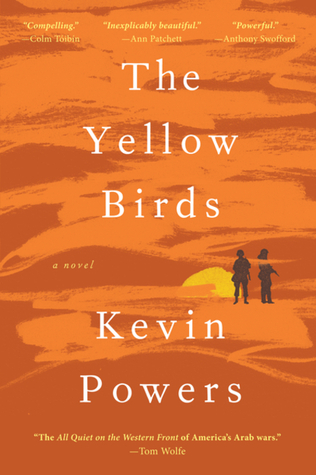
The Yellow Birds, a debut novel by Kevin Powers, is a powerful look at the confusion soldiers experience while abroad during the Iraq War between 2004-2005.  Private Bartle and Murphy become connected and friendly, but their friendship is tenuous at best as it relies on the anxiety and adrenaline of war to sustain it.  What do these two men really know of each other than their age, the fact that one has a girlfriend and mother back home and that the other has only a mother, and that they both joined up with the promise of a new future ahead.

“I couldn’t have articulated it then, but I’d been trained to think war was a great unifier, that it brought people closer together than any other activity on earth.  Bullshit.  War is the great maker of solipsists:”  (page 12)

Powers attempts to examine the ideas of “freedom” and “free will,” especially through the actions of the soldiers, with Murph seeking out time in his day to watch a female medic from afar without interacting — creating memories that are not beyond his control.  But what does this control say about the notion of freedom, particularly since Murph is attempting to take, at least partially, control of his own memories.  At one point early in the novel, meanwhile, Bartle says, “I remember feeling relief in basic while everyone else was frantic with fear.  It had dawned on me that I’d never have to make a decision again.  That seemed freeing . . . ” (page 35)  Does freedom from decision-making mean that soldiers are free and that their will is free to act as it pleases?  It’s a catch-22 for without will, there are no decisions.

Beyond the calls to assess freedom and its consequences, Powers is asking the reader to question the ideas of right and wrong, miracles, and circumstance.  What does it mean when a bullet strays from you and hits another?  In Bartle’s case, he sees no meaning; it just happens.  In this way, Powers illustrates how far removed Bartle has become from morality and emotion, something that many soldiers experience.  Even his attempts to reconnect with Murph are faulty, and while many may view Murph as fragile, there is something more human and less robotic about him than Bartle.  One is the foil of the other as the war has worn them both down, and their differences — no matter how pronounced — are a testament to the ability of Powers to demonstrate the ways in which war can take its toll on the human psyche.

The Yellow Birds by Kevin Powers is less an emotional book than it is a psychological one, though the shift between years is well documented, it can be distracting to pinpoint where the events fall in a time line.  However, while the style is something that takes a bit of getting used to, it does showcase the mind of soldiers when they return from war — as trauma makes it harder to think of events in a linear fashion.  Powers includes not only the gruesome details, but also the beauty of the foreign land in which these soldiers find themselves battling the enemy.  The juxtaposed images make the horrors of war even more heartbreaking and tough to take.

About the Author:

Kevin Powers was born and raised in Richmond, VA. In 2004 and 2005 he served with the U.S. Army in Mosul and Tal Afar, Iraq. He studied English at Virginia Commonwealth University after his honorable discharge and received an M.F.A. in Poetry from the Michener Center for Writers at the University of Texas at Austin in 2012.


This is my 15th book for the 2013 New Authors Challenge

LEVEL 2 by Lenore Appelhans

LEVEL 2 by Lenore Appelhans (aka Presenting Lenore, a blogger I’ve read for a long time and even met a few times in person) is part one of three in the Memory Chronicles.  Appelhans is creating an alternate afterlife to the one many current religions teach, but her afterlife has roots in mythology and a modern twist.  Felicia Ward’s life is cut short, but readers are kept in the dark about that aspect until the end, which really doesn’t impede the story.  Dipping in and out of her memories with her family, friends, and boyfriend, Felicia remains connected with her earth life and to the emotions she felt there.  In many ways, the chamber in which she relives and calls up these memories is her life line to the past, preventing her from examining her surroundings more fully and questioning the new reality she finds herself in.

“And now I can’t sleep.  Except, that is, when I access my memories of sleeping.  You wouldn’t believe how many times I’ve combed through the seventeen years and 364 days of my life, searching for those rate uninterrupted, nightmare-free stretches of slumber.  Because sleep is my only real break from this endless reel of memories, both mine and those I’ve rented.”  (page 1-2)

Felicia’s experiences are guarded and her memories of the traumatic events in her life are revealed slowly in this first-person point of view novel, which provides a sense of suspense that becomes a bit overwrought toward the end as the reader is anxious to learn how she died and what happened between her, Autumn, and Julian, as well as how she met Neil and what happened to him.  However, a lot of the story is focused on Level 2, its structure, and its purpose as it is revealed to her through someone she already had trust issues with on Earth, so information from him is highly suspect from the beginning, which should lead readers to expect or suspect the twists at the end of the novel.

“In moments like this I wonder whether we are bound together by true feelings of kinship or if we’ve merely clung to each other these past ten years out of obligation, fear, or lack of other prospects.  Her huge doll collection made her the ideal friend back when we first met at out post in Ecuador and at our subsequent stint back in D.C., but since we both got to Frankfurt a year ago last summer, after four years apart, I’m starting to think maybe I’ve outgrown her.  That’s what moving so often can do to you.  It makes you continually question your place in the world, and seek out those few who understand what you’re going through.”  (page 120-1)

The hives in Level 2 are reminiscent of the Matrix movies (as well as the elements of a rebellion), which makes them lack some originality, but there is a back story to its creation that was more imaginative and unfortunately is less detailed than some readers may want, though there are more books planned for this series, which could lead to additional description and better world building.  Meanwhile, Appelhans does raise some questions about the reliability of memory and whether it can be manipulated by others or by the owner of those memories to change the outcome or modify the perception of certain events.  This aspect of the story is very unique and psychological, a part of the story that should be expanded.

Felicia is a strong character at some points and weak at others.  She’s especially weak when navigating the Level 2 environs with someone she does not trust, and says more than once that she is too weak to go off on her own, even when she really isn’t as weak as when she first woke.  However, her fear of the unknown is something that propelled her on Earth and still seems to propel her in this new environment, so it is at least understandable and will hopefully be explored/overcome in future books.  Autumn is a bit one-dimensional, which makes it hard to see why Felicia is so torn about the friendship, though that could be attributed to the memories Felicia reveals to the reader.  Felicia’s relationship with Julian and Neil are both explored, though there really isn’t a love triangle.  LEVEL 2 by Lenore Appelhans is a solid debut, young adult fiction novel that hovers around bigger issues of memory and anchoring oneself with self-confidence without overtly addressing them.  It is fast-paced and suspenseful, but some readers may prefer a deeper exploration of these themes and/or a more linear story line than the dipping in and out of Felicia’s memories.

About the Author:

Lenore Appelhans’ novel, LEVEL 2, will be published by Simon & Schuster in fall 2012.  She blogs at Presenting Lenore about books and loves to travel.  She’s been to 55 countries so far, and she currently lives in Frankfurt, Germany, with her 3 fancy Sacred Birman cats and her husband.  Check out her interview during Dystopian August, a video discussion, the Reader’s Guide.

This is my 14th book for the 2013 New Authors Challenge.

The Best of PUNK Magazine by John Holmstrom and Bridget Hurd

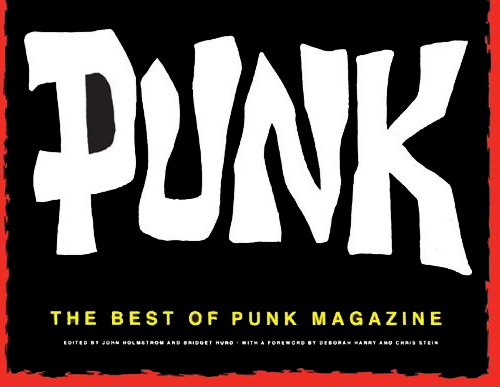
The Best of PUNK Magazine by John Holmstrom and Bridget Hurd, with a foreward from Deborah Harry (yes, the singer from Blondie) and Chris Stein (co-founder of Blondie), is a compilation of the best articles and artwork from the magazine, and it opens with a fun depiction of New York City — “The PUNK Map of N.Y.C.: For jerks who just don’t know their way around.”  The drawings of the rivers and the streets and the realistic, and yet, out there cartoons are likely to generate smirks, if not genuine smiles.

As someone born in the late 1970s, but in love with punk music and Blondie, this collection is something that provides not only more background about the emergence of punk, but also the  whimsical fun and sort of not-a-care-in-the-world feel of the genre.  PUNK magazine had a lot to live up to as the voice of 1970s New York, but it also had a lot to break away from in terms of what was expected of a music magazine.  Clearly, PUNK was a magazine dedicated to snarkiness in all its forms — visual and textual — and it worked well.  It was gritty, it was real, and the glamor was no where in its photos or its comics, but that seems to be why the magazine stood out.  There was a whole lot of youthful exuberance in the beginning of this magazine as nicknames were handed out and spaces were renamed — like the PUNK Dump.

The opening interview with Lou Reed is just the tip of the mosh pit with this magazine.  Reed is so candid, it’s almost like he forgot he was being interviewed by a magazine, and it is unlikely anyone told him the interview would be turned into a comic strip.  The comics are filled with typical masculine and bathroom humor at times, but the drawings are enough to carry the jokes beyond their static line.  A really cool moment in the collection is the results of the Patti Smith Graffiti Contest, where some are so tasteful and others are just outrageous.

By the third issue, the magazine’s editors knew they were a hit when the Ramones snagged a record contract in part because of the magazine’s coverage of their band.  One particular gem in the collection is Holmstrom’s explanation of punk:  “sound — faster and louder; humor — like the novelty songs of the 1950s and 1960s; fashion — no glam, just the classics: shades, blue jeans, t-shirt, sneakers; minimalism — less is more.  No bombast; attitude — similar to the hippie ethos “Do your own thing but let me do mine,” but more like: “F**k you! I don’t care what you do, just leave me alone!”; do it yourself — publish your own ‘zine, make your own record; retro rock/conservatism — mining the tradition of rock ‘n’ roll from the 1950s and early 1960s, while rejecting everything after the hippies took over in 1967.”

The Best of PUNK Magazine by John Holmstrom and Bridget Hurd is a great compilation, but you may not want to leave it on the coffee table with conservative parents or in-laws around.  It’s got some bawdy humor, creative ideas, fantastically candid photos and interviews with punk rock stars of the time, and so much more.  Reminiscent of MAD Magazine and the like, but it really has a garage feel about it — a passion of the listener, the true fans of PUNK.

About the Author:

John Holmstrom is a cartoonist and writer and co-founder (with Legs McNeil) of Punk magazine. He illustrated the covers of the Ramones albums Rocket to Russia and Road to Ruin, and created the characters Bosko and Joe, which were published in Scholastic’s Bananas magazine from 1975-1984, as well as in Stop! Magazine, Comical Funnies, Twist, and High Times. Holmstrom’s work and unmistakable artistic style has become the key visual representation of the Punk era.

This is my 13th book for the 2013 New Authors Challenge.

Six Sisters’ Stuff: Family Recipes, Fun Crafts, and Much More & 4×4 Dinner Giveaway/Challenge

Six Sisters’ Stuff:  Family Recipes, Fun Crafts, and So Much More! is a flexible paperback cookbook that not only includes gorgeous photos of entrees, appetizers, and desserts, but also a variety of crafts to keep your kids occupied and to dress up the table.  Camille, Kristen, Elyse, Stephanie, Lauren, and Kendra are biological sisters and know what it means to have a busy life, but they still make time for family dinners and this book includes 100 easy-to-follow recipes using ingredients commonly found in your pantry.

The full-color photos in this cookbook will make your mouth water even if you’ve just eaten dinner.  From the main meals to the slow cooker meals, these women have made cooking for a family incredibly easy and simple with these recipes.  There are salads, sides, and breads, plus dessert — oh, the dessert.  (I made one for book club, see photos and reaction below)  But this book is not only about the food and having family meals together, but it also is about spending time with family whether it’s on a road trip or inside on a rainy day (I’ll be testing these out in the coming weeks).

There are projects ranging from creating simple decorations like a snowman out of blocks and felt bows to more complex projects like bookshelves made out of pallets.  These projects are sure to occupy family members and make the house look more beautiful.  The sisters also offer advice on spring cleaning, which may seem like common sense but for a first time homeowner with a new kid the task can be overwhelming.  There also are healthy snack ideas, fun date ideas to keep the romance alive, and a weekly breakdown on how to build a 72-hour emergency kit for the entire family.

Six Sisters’ Stuff:  Family Recipes, Fun Crafts, and So Much More! is appealing to look at, create from, and learn.  It’s not only about cooking a healthy meal in a short amount of time with the ingredients on hand, but it’s also focused on ensuring that family time becomes a priority.  Readers will have no choice but to dig in and start creating.  Delicious family recipes ready to fill watering mouths and simple crafts to spruce up any busy home.

My baking experience with Mom’s Chocolate Marshmallow Brownies:

As is usual with me, I was pulled in a hundred different directions and had to improvise the recipe, though I do plan to make this recipe the way it is written at some point.  I wanted to make these for book club in February, but with little time, I turned to my favorite box brownie mix, Ghirardelli Dark Chocolate Brownie mix, which never fails me.  And I quickly found the brownie pan I chose would require me to use 2 boxes, which met the hubby had to run out and get a second box.

But then I made the Chocolate frosting from the recipe for on top of the marshmallows.  The recipe called for 2-3 cups of powdered sugar, but I found out quickly that 2 cups was too little because the frosting was soupy, so I had to make it 3 cups for the right consistency.  Once I got the frosting made, i spread it on top of the marshmallows (which I really didn’t need the whole bag of).

The pan must have still been a bit warm because the frosting melted a little too much over the marshmallows, making it an even gooier mess than I expected, but it didn’t seem to matter to the book club members who were eager to try it.  I just had to have the first piece, and one of the corners, since those are my favorite!  I took a close up of one piece to share with everyone.  YUM!

Six Sisters photoAbout the Six Sisters:

In February 2011, we started our blog SixSistersStuff.com. After years of living close to one another, we were being pulled in many different directions- one sister moved to the West coast, another sister followed her husband to medical school, one moved away to college, and another sister had just lost a baby. We needed each other now more than ever and we used our blog as a way to stay in touch.

Before we started blogging, we were constantly calling each other for recipe ideas, craft projects, and ways to keep our children entertained during those long winter days. The blog was the perfect way for us to share those ideas with each other and we were having so much fun doing it. We are all busy, whether it’s with our kids, jobs, school, husbands, community involvement, or something else eating up our time, so all the recipes and projects you will find on this blog are quick and easy! Our recipes are family favorites that use ingredients that can commonly be found in your pantry and our crafts and home decor projects can be made with little or no money. We don’t claim to be amazing chefs- we just know the importance of feeding your family a home-cooked meal and sitting down to eat it together.


This is my 12th book for the 2013 New Authors Challenge.


About the 4×4 Dinner Challenge:

4X4 dinner challenge

  • Pledging to accept the 4×4 Dinner Challenge means the family will eat together at least four times per week for four weeks.
  • Families are encouraged to register online, and they will receive meal tips, ideas for family activities, and helpful recipes to make meeting the challenge easy.

To win a copy of this colorful cook book, do the following:

  1. Like the Six Sister’s STUFF Facebook page and join the 4×4 Dinner Challenge
  2. Click the 4×4 Family dinner banner on the Website (on the right sidebar) and leave a comment joining the challenge.
  3. Come back here and leave a comment on this post about what you’d like to check out in Six Sisters’ Stuff.

Deadline to enter is March 10, 2013, at 11:59 PM EST.

The Heart of Haiku by Jane Hirshfield

The Heart of Haiku by Jane Hirshfield, which I first read about it on Beth Kephart’s blog, is lyrical, meandering, and informative not only about Haiku — the art, its origination, and its longevity — but also about one of the greatest poets, Bashō, who lived and breathed Haiku.  Knowing very little about this Japanese poet from the 17th century doesn’t mean you don’t know him because as Hirshfield points out, he infuses every Haiku with his soul and experiences.  Not only can readers live his moments alongside him, but they also can create their own experiences within the Haiku.

“To read a haiku is to become its co-author, to place yourself inside its words until they reveal one of the proteus-shapes of your own life.  The resulting experience may well differ widely between readers:  haiku’s image-based language invites an almost limitless freedom of interpretation.”

Like many poets, verse comes naturally and is less like a job or profession than it is like breathing.  With elements of Zen and Shinto’s spiritual traditions, the poet led a contemplative life focused on not only the natural world, but his experiences with it and as part of it.  At many points in his life, he is affected by events beyond his control, but his poetry never fails to account for these moments or to push him through those hardships — even though it doesn’t seem as though Bashō considered them hardships.  Hirshfield says, “He wanted to renovate human vision by putting what he saw into a bare handful of mostly ordinary words, and he wanted to renovate language by what he asked it to see.”

“Zen is less the study of doctrine than a set of tools for discovering what can be known when the world is looked at with open eyes.  Poetry can be thought of in much the same way, and the recognition of impermanence, ceaseless alteration, and interdependence–the connection of each person, creature, event, and object with every other–need not be “Buddhist.”  These elements permeate the poetry of every tradition. . .”

What is most beautiful about Hirshfield’s examination of Bashō is the reverence she pays to him and her passion for not only his work, but also his dedication to improving it even when near death.  And like many others, he remained focused on pushing his students to strive for more than even he could achieve, urging them not to be the “other half of the split melon” by mirroring his own work.  Hirshfield not only provides history and poetry in this essay, but she also pinpoints the evolution of Haiku and discusses its beauty and its endurance through the ages, even as a teaching tool.

The Heart of Haiku by Jane Hirshfield is a stunning examination of one Japanese poet’s work and his love of life and poetry.  Her narration provides a unique way of stepping into the life and thoughts of Bashō as writer, poet, teacher, and human being.

About the Author:

Jane Hirshfield was born in New York City in 1953. After receiving her B.A. from Princeton University in their first graduating class to include women, she went on to study at the San Francisco Zen Center. Her books of poetry include Come, Thief (Alfred A. Knopf, 2011), After (HarperCollins, 2006); Given Sugar, Given Salt (2001), which was a finalist for the National Book Critics Circle Award, The Lives of the Heart (1997), The October Palace (1994), Of Gravity & Angels (1988), and Alaya (1982).

This is my 11th book for the 2013 New Authors Challenge.

Red Army Red by Jehanne Dubrow

Red Army Red by Jehanne Dubrow is a collection that is broken down into three, clear sections — Cold War, Velvet Revolution, and Laissez-Faire — with a preface section — Red Army Red — and one poem, “Chernobyl Year.”  Dubrow’s narrator recalls the lives of American Diplomats in Communist-controlled Poland during the Cold War and pays homage to the Velvet Revolution in Czechoslovakia and the rebellion of youth before concluding in the commercialized freedom and excess of capitalism.  Her poems are all at once playful, somber, and achingly real.

From "Aubade": (page 9)

Often I lay awake to listen for
my parents returning from the embassy,
a key toothing the lock, the front door

opening to let them in, its rusty
hinges a metal warning.  Every
evening the same.  I drank the words cold war

from the water glass on my nightstand.

Her words echo even after the end of each line, and sometimes even in the middle of a line, leaving a haunting impression on the reader. In “Vinegar Aphrodisiac,” the narrator asks, “What’s sweet//without the wanting, the queue around the block/when even you are out of stock?” The lines for food in a communist society even when there is no more left, and the hope that there will be something there for them when they get to the front of the line. The wanting or the hope is palpable and heartbreaking. The poems in the first section eerily reflect the realities of the time, and there is a juxtaposition of the diplomat life with that of the Poles — “Each morning my mother’s velvet purse/wilted on a chair, empty of its midnight contents:/ruby lipstick, tiny lake of a pocket mirror./My father’s tie lay crumpled on the bed./The romance of objects–both their costumes/on hangers again, still clasping the scent/” (from “Fancy,” page 12)

There is unrest in the second section — the upheaval of adolescence marked by the rising up of workers and society against a communist society that fails to live up to expectation, a theme prominent in “Five-Year Plan.” A deep, unbidden want bursts forth in Dubrow’s lines as the communist Poles want release from their worker chains, so does the diplomat’s daughter want escape from the “crystal” world in which she lives just outside reality, yet feeling that reality keenly. Not entirely part of the communist world, but not completely outside of its empty promises. Always beneath the austere exterior in these poems, there is a burning passion waiting to explode onto the page, and while it may not happen in the same poem, explosions of light, sex, and want emerge of their own volition and when least expected.

Red Army Red by Jehanne Dubrow is a phenomenal collection that is bound to generate much discussion from book clubs, but it also speaks to the truths of ideals and realities and how they never meet expectations.  In many ways, the collection comments overall on the “grass is always greener” idiom, but it also highlights the separation felt by a young woman growing up in a foreign land and having the freedom her country provides, but at the same time feeling the constraints of her host nation.  Amazing use of imagery, politics, real events, and more.

About the Poet:

Jehanne Dubrow is the author of four poetry collections, including most recently Red Army Red and Stateside (Northwestern UP, 2012 and 2010). Her first book, The Hardship Post (2009), won the Three Candles Press Open Book Award, and her second collection From the Fever-World, won the Washington Writers’ Publishing House Poetry Competition (2009). Finishing Line Press published her chapbook, The Promised Bride, in 2007.

Her poetry, creative nonfiction, and book reviews have appeared in journals such as Southern Review, The New Republic, Poetry, Ploughshares, The Hudson Review, The New England Review, West Branch, Gulf Coast, Blackbird, Copper Nickel, Prairie Schooner, as well as on Poetry Daily and Verse Daily.

If you’re going to be in Boston for the AWP conference in March, you might catch Dubrow at a couple of panels.

This is my 5th book for the Dive Into Poetry Challenge 2013.

The House Girl by Tara Conklin

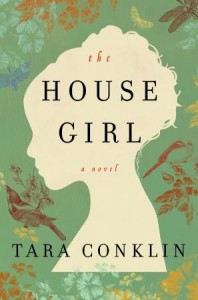
The House Girl by Tara Conklin is told mainly from two female points of view — Lina Sparrow and Josephine Bell — one is a white lawyer in New York City at a corporate law firm and the other is a slave/house girl in the southern Lynnhurst, Virginia.  Lina has lived with her artistic father most of her life as her artistic mother’s life was cut short.  Her story is compelling as she’s chosen the analytical and detached life of a lawyer over that of the emotional and less practical life of an artist.  Josephine, an equally if not more compelling story, is a slave on a tobacco farm caring for her dying mistress, who tries to sketch and paint in her upstairs studio.

“Mister hit Josephine with the palm of his hand across her left cheek and it was then she knew she would run.  She heard the whistle of the blow, felt the sting of skin against skin, her head spun and she was looking back over her right shoulder, down to the fields where the few men Mister had left were working the tobacco.”  (page 3 ARC)

Lina is a first-year associate at her law firm, and she works a mad number of hours as she tries to impress her boss and mentor, Dan, but at the same time, she seems to be beating her head against a wall.  There are some tenuous connections drawn between these two stories, the oppressive nature of working for a law firm and slavery, which may or may not be a fair comparison.  The narrative shifts from Josephine to Lina and between the past and present, and once Lina becomes involved with a slavery reparations case, she is wrapped up in innocuous research while all of her other cases are re-assigned.  She’s struggling with her role on the case, but also with the revelations about her mother and her father that have set her world askew.

“She couldn’t bear the thought of sharing.  This was where her mother had once slept, cooked, painted, breathed, and Lina’s memories of her seemed tethered to the physical space.  The way a wall curved away, a washboard of light thrown by the sun against the bare floor, the sharp clap of a kitchen drawer slamming shut — all these evoked flashes of her mother and early childhood that seemed cast in butter, soft and dreamy, lovely, rich.”  (page 21 ARC)

In the latter part of the novel, Lina comes across a biography of an abolitionist as she’s researching the life of Josephine Bell, but this section is overly long and could have been slimmed down a bit as Lina learns about the abolitionist’s connection to the Underground Railroad.  The strength of the novel is in Josephine’s story and her struggles with the Bell family, with her only release — the snatches of time she has to sketch and paint when her mistress is laid up in bed or asleep.  The mysterious life of Josephine is revealed in quick chapters, but early on these chapters are too focused on her desire to run and whether she should run.

In many ways, Lina’s story detracts from the whole, pulling readers into the present and into a case that seems more fantasy than reality.  However, Lina’s story with her father and mother — and the art world — is strong and could have been explored in a separate novel.  The artistic connection, more than the slavery reparations case, would have been a better angle for these stories, connecting the artists to one another through their craft and inspiration or something of that nature.

The House Girl by Tara Conklin showcases not only Conklin’s grasp of the Antebellum South, but also art and its craft.  The strongest parts of Lina’s story are those in her father’s art studio and in the galleries as the paintings are described and the ties between Josephine Bell and Lu Anne Bell are revealed.  Once the novel picks up speed, its tough to put down, and Conklin easily portrays the culture and atmosphere of the southern farm and the fear slaves felt daily.

About the Author:

Tara Conklin has worked as a litigator in the New York and London offices of a major corporate law firm but now devotes her time to writing fiction. She received a BA in history from Yale University, a JD from New York University School of Law, and a Master of Law and Diplomacy from the Fletcher School (Tufts University). Tara Conklin’s short fiction has appeared in the Bristol Prize Anthology and Pangea: An Anthology of Stories from Around the Globe. Born in St. Croix, she grew up in Massachusetts and now lives with her family in Seattle, Washington.  Check her out on Facebook and Twitter.  Also here’s a podcast about Conklin’s inspiration for the novel.  Photo credit Mary Grace Long.

tlc tour host

This is my 10th book for the 2013 New Authors Challenge.

A Thousand Mornings by Mary Oliver

A Thousand Mornings by Mary Oliver is meditative observance, but also a collection of poems full of praise not only of the natural order but of humanity’s place in that order.  In “And Bob Dylan Too,” she talks of how the shepherds sing as the sheep praise the grass by eating it and how the bees’ hum signals the opening of spring blossoms.  And in many ways, nature comes to life, becomes anthropomorphized in conversation with a narrator, allowing for the unspoken rules to be broken and/or expanded.  Oliver has a deep sense of connection to the natural world that shines through in each line of each poem, and yet, there is a bit of rebellion in her poems that points to a time when breaking free of the natural order is not only OK, but unexpected and inspiring.

From "Lines Written in the Days of Growing Darkness" (page 27):

to the petals on the ground
to stay,
knowing as we must,
how the vivacity of what was is married

to the vitality of what will be?
I don't say
it's easy, but
what else will do

What readers will love about Oliver’s poetry is the homage she pays to the natural world in all its beauty, but also the connect we have to it. In “The Moth, the Mountains, the Rivers,” the narrator of the poems asks that we each take the time to live in awe of the wonders around us, to truly sit without worry about the busy schedule and to just be and observe. It is almost a plea of sorts.  In other poems, the narrator simply marvels at nature and even decides to take her home to a mountaintop for silence and reflection and invites the reader along.  But one of the most descriptive and captivating poems in the collection was “Tides,” about the movement of the ocean and the only purpose it has: to be.  Unlike those who talk of its erosion of beaches and its awesome power, Oliver focuses in on its rhythmic movement, its constancy, and its beauty and in this way draws a parallel to how the narrator casually, calmly walks the beach.

A Thousand Mornings by Mary Oliver is reflective of the past, of youth, and of wilder days, but it also is about recapturing that youth, if only in the mind, remembrance, and observance of nature.  But there are moments of distinct action and conviction that the past can be recaptured even if it is at the end of life.  For those looking for Oliver’s traditional poetry, this collection is ripe with observation of the natural world, but it also offers a deeper look at aging and longing for things that have passed.

About the Poet:

Mary Oliver was in Maple Heights, Ohio.  As a teenager, she lived briefly in the home of Edna St. Vincent Millay, where she helped Millay’s family sort through the papers the poet left behind.  In the mid-1950s, Oliver attended both Ohio State University and Vassar College, though she did not receive a degree.

Her first collection of poems, No Voyage, and Other Poems, was published in 1963. Since then, she has published numerous books, including Thirst (Beacon Press, 2006); Why I Wake Early (2004); Owls and Other Fantasies : Poems and Essays (2003); Winter Hours: Prose, Prose Poems, and Poems (1999); West Wind (1997); White Pine (1994); New and Selected Poems (1992), which won the National Book award; House of Light (1990), which won the Christopher Award and the L. L. Winship/PEN New England Award; and American Primitive (1983), for which she won the Pulitzer Prize.

This is my 4th book for the Dive Into Poetry Challenge 2013.