Quantcast

Ergon by George HS Singer

Source: George HS Singer
Paperback, 86 pgs.
I am an Amazon Affiliate

Ergon by George HS Singer, who is on tour this fall with Poetic Book Tours, is a debut with subtle power.  The collection is broken down into four sections — Visiting, Ergon, Our Quotidian, and Immensity — and each reveals a keen observer in Singer and each is infused with Buddhist sensibilities, but not overtly so.  In “Slipping Out,” Singer draws lines of connection between the Korean lady on the freeway and ourselves, as well as the bits of ourselves we find behind the eyes of our children. But there is so much more being said in this poem – we must savor our moments of connection because they could slip away before we realize it.

From “Slipping Out” (pg. 15-16)

But don’t be so sure the bell
won’t crack and the mind slip out
to meet itself in another’s face.

In this first section of poems, the lines call to mind the section title. We’re just visiting, our time is limited here and in these moments we have, and we must make the most of them while we can. For those moments we wish did not happen as they do, we can be comforted by their transient nature. We must learn to let go of the harmful memories and events and cherish those that imbue us with strength.

Throughout the collection, there are poems that recall wars and battles of the past, which can affect people and shape who they are. How do we deal with these changes? How do they? These are questions that only individuals can answer for themselves, and they must accept the choices they have made. Singer uses nature to illustrate his themes, including the movement of tides.

In the title poem, “Ergon”, the narrator concludes, “The ergon of strangeness in a household is silence.” The line is haunting and makes us wonder what exactly is strangeness? Is it the memories we do not vocalize, the traumas that we bury? Those are not really strange, but many often feel that they are set apart because of them. To stay silent is to deny the truth. It is these events that shape us and those around us, and they should also be what connects us and draws us closer to one another.

Ergon by George HS Singer is a collection that will push readers to think about their lives, their place in it, and those who have influenced them. Those who have inspired us, and those we have feared — all have left their indelible mark.

RATING: Quatrain

About the Poet:

George HS Singer, a former Zen Buddhist monk and student of Rev. Master Jiyu Kennett, lives with his wife of forty-two years in Santa Barbara, Calif., where he works as a professor at University of California, Santa Barbara. He was educated at Yale, Southern Oregon University, and the University of Oregon. He wrote poetry in college but took a twenty-year break before taking it up as a regular discipline. He has been a long term student of Molly Peacock and has had the opportunity to work with other marvelous poets through the Frost Place in Franconia, N.H. He writes about life in and out of a Zen monastery, trying to live mindfully in a busy and troubled world, his love of nature and of his wife. The arts have become more central to his life. Singer’s poems were published in the Massachusetts Review, Prairie Schooner, and Tar River Poetry

The Secrets of Nanreath Hall by Alix Rickloff

tlc tour hostSource: TLC Book Tours
Paperback, 416 pgs.
I am an Amazon Affiliate

Secrets of Nanreath Hall by Alix Rickloff is an epic debut in the historical fiction genre in which both strong women — Lady Katherine Trenowyth and Anna Trenowyth — are challenged. Katherine, a budding artist, bucks societal expectations to follow her heart, but her actions have ramifications. Nurse Anna closes herself off from others following a tragic sinking of a ship and deaths that rock her world. These women choose hard, lonely paths, but their strength carries them through the good and bad. While Katherine knows when to accept help, Anna must learn this lesson on her own, which can be tough during a WWII when many things are uncertain and tragedy can strike at any moment.

Panicked like a wild thing caught and frozen by the hunter’s lamp. (pg. 293 ARC)

As Rickloff shifts between the points of view and the time periods, readers may expect to lose their place in these stories, but she does such a wonderful job integrating them, readers are bound to fall in love with both characters. Although we may want the best for them, the realities of war and circumstance will intervene. When Anna shows up to tend to the patients at Nanreath Hall, an ancestral home she’s never seen, her curiosity takes over, forcing her to uncover the secrets of her mother, where she comes from, and the family she never knew as a child.

Secrets of Nanreath Hall by Alix Rickloff is a carefully woven tapestry of generations of Trenowyths, whose lives are upended by the decisions they make, the passions they follow, and the wars they cannot control. This is historical fiction at its best with elements of romance, artistry, romance, and mystery. Get swept away by the mysterious ruins of lives past and learn to make a new path from the old.

RATING: Cinquain

About the Author:

Alix Rickloff is a critically acclaimed author of historical and paranormal romance. Her previous novels include the Bligh Family series (Kensington, 2009), the Heirs of Kilronan trilogy (Pocket, 2011), and, as Alexa Egan, the Imnada Brotherhood series (Pocket, 2014). She lives in Chestertown, Maryland, with her husband and three children.  Find out more about Alix at her website, and connect with her on Facebook and Twitter. You can also follow her on Pinterest.

Saris and a Single Malt by Sweta Srivastava Vikram

Source: Purchased
Paperback, 46 pgs.
I am an Amazon Affiliate

***I consider Sweta a friend and her book is on tour with Poetic Book Tours.***

Saris and a Single Malt by Sweta Srivastava Vikram is highly emotional and raw.  It is clear that her mother’s sudden passing left a void in her life, and she was adrift with anger, despair, and confusion.  She spent time with family in India, people who she viewed as vampires (sucking the life from those around them for gossip), but respected her mother enough not to say anything.  There is a delicate balance in grief — when we want to cry out and shout out despair, we must be respectful that others are grieving in their own way as well.  At the same time, there are those who continue to lack compassion or empathy, making the grieving process even more difficult.

This collection made me cry on more than one occasion as I thought about those who have left my life — some suddenly, some after long illness — and each time the grieving process was different and difficult. My nana passed at a critical time in my life as a college student, and I carried a lot of guilt about her passing before I could make it to the hospital to see her after my classes. I procrastinated that day, wanting to eat dinner and rest after a trying week of classes and wanting to avoid the sadness of seeing her with tubes everywhere in an ICU where germs were kept at bay as much as possible. When I arrived just after she left this world, I was tormented by guilt. I wanted to know why she left before I got there. Sweta’s poem, “Why Didn’t You Wait for Me?” struck a chord. Can they see us after they have passed? Can they send us signs? I think it’s possible, and whenever I see a ladybug, I think of her.

From: JFK: Terminal 4 Airport Lounge (pg. 4)

At first I try to hide the fact,
but any passerby could look inside me
and tell it was fake calm that I was drinking
at the airport lounge in a wine glass.
But, inside that one glass,
I could become invisible.
Inside one sip of wine,
I could whisper my fears.

Like love, grief is an emotion that bonds us. Through these poems and mini essays, Vikram show us the entire grieving process and how it tears us down so we can rebuild ourselves. Saris and a Single Malt by Sweta Srivastava Vikram is a tribute to a wonderful woman, who may have lived differently than her daughter, and while it comes after her passing, it signals to us to cherish those we have. We need to pay closer attention to our now and less to the past. We need to be better about showing our appreciation in the now, rather than when it is too late.

RATING: Quatrain

Other reviews:

Guest Posts and Interviews:

About the Poet:

Sweta Srivastava Vikram, featured by Asian Fusion as “one of the most influential Asians of our time,” is an award-winning writer, five-time Pushcart Prize nominee, Amazon bestselling author of 11 books, writing coach, columnist, marketing consultant, and wellness practitioner who currently lives in New York City. A graduate of Columbia University, she also teaches the power of yoga, Ayurveda, & mindful living to female trauma survivors, creative types, entrepreneurs, and business professionals. Sweta is also the CEO-Founder of NimmiLife, which helps you attain your goals by elevating your creativity & productivity while paying attention to your wellness.

United States of Books: Independence Day by Richard Ford (audio)

Source: Public Library
Audiobook, 17 CDs
I am an Amazon Affiliate

Entertainment Weekly said, “The second of four books to feature Frank Basscombe, a sportswriter-turned-Realtor who’s the perfect sarcastic resident of that great big suburb called New Jersey.”

Independence Day by Richard Ford, narrated by Richard Poe, is one of those novels in which readers can be frustrated, as the main character, Frank Basscombe, often scurries along tangents just when the narration appears to be going somewhere relevant.  Poe does a good job of narrating this character.  He’s a divorced man who lives alone in his former wife’s house in Haddam, N.J., and he’s entered the real-estate game.  He barely sees his children, still wants to hang onto his newly married ex-wife, but also says that he loves his girlfriend.

Basscombe tells the truth as he sees it in that moment, but from moment-to-moment that truth can change.  He’s not steady in his beliefs, and much of that is because he’s clearly in the midst of a crisis.  He’s unsure of his own direction and his own place in life and in his family.  On a trip with his son to the Basketball and Baseball Halls of Fame, Basscombe makes a concerted effort to be someone to at least one somebody — his son.  However, like him, his son is going through a period of unease, as he’s unsure how to be and act, and he’s trying on different hats — some of which raise concern with his mother about his mental stability.

In many ways, Basscombe and his son’s inability to stand firm and find their own peace in the world mirror the wishy-washy perception of New Jersey — which ET calls a suburb.  The view of New Jersey can be its industrial gas and oil farms or the fact that it is the neighbor of New York, a place where those who work in the city come to escape the fast-paced life and find some green.

It’s hard to believe that there are four books about this character, given his disinterest and disdain for everything.  Independence Day by Richard Ford, narrated by Richard Poe, is one man’s search for a final independence — he’s looking to free himself from the ties that bind him to his ex-wife, trying to carve out a new career, and to find some direction for his own life without being hampered by the past.

RATING: Tercet

About the Author:

Richard Ford is a Pulitzer Prize-winning American novelist and short story writer. His best-known works are the novel The Sportswriter and its sequels, Independence Day and The Lay of the Land, and the short story collection Rock Springs, which contains several widely anthologized stories.


USbooks New Jersey

Prince Noah and the School Pirates by Silke Schnee, illustrated by Heike Sistig

Source: Plough Publishing House
Hardcover, 32 pgs.
I am an Amazon Affiliate

Prince Noah and the School Pirates by Silke Schnee, illustrated by Heike Sistig, is a fun adventure about inclusion, working together, and having fun. In Prince Noah’s kingdom, the kids are sent off in separate ships to learn skills, such as girls learning to weave and boys learning to fence. Kids with disabilities are sent off in their own boats as well.

While the book has a lot of text for young kids, the adventure makes it a book to read with your child right before bed. You can break up the book into segments, making it easier for kids to follow along and enjoy the ride. When the kids are at sea, pirates swoop in and capture the children. What will happen to them as they are put into the pirate tower? Who will save them?

Prince Noah and the School Pirates by Silke Schnee, illustrated by Heike Sistig, is delightfully illustrated with so many things to look at; it’s almost like a Where’s Waldo? book.  My daughter enjoyed this story and told me we should read it again, and we probably will … many times.

RATING: Quatrain

About the Author:

Silke snow is a journalist and works as a TV program maker at a public broadcaster in Cologne . She is married and has three sons . Her youngest son Noah was born in July 2008 with Trisomy 21 ( Down syndrome ) .

“At first, when Noah was born, we were shocked and sad. And it wasn’t easy to see how some people look at children with special needs as strange or different. But the catalyst for this book was witnessing the effect he had on many people, despite being categorized as disabled. In fact, our little prince brings much love, joy, and sunshine not only to us, but to all around him. Children are a wonder, and we must see them with the eyes of our heart: each child just the way he or she is.”

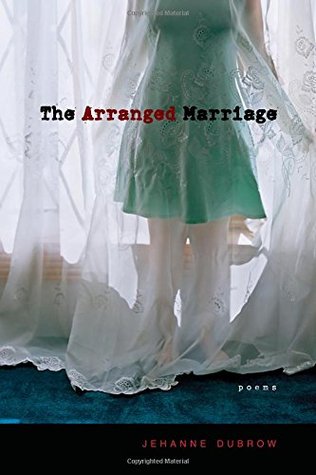
The Arranged Marriage by Jehanne Dubrow

Source: Gift
Paperback, 57 pgs.
I am an Amazon Affiliate

The Arranged Marriage by Jehanne Dubrow reads like mini-memoirs of marriages on the rocks, marriages marred by abuse, marriages that require covering up.  These arrangements are made consciously and sometimes with little say by the women engaged in them.  Much of the truth about these women is concealed, but even that concealer is thin and, in many cases, see-through.

“Wait long enough and anything takes on a
sheen of sharpness. Mustn’t leave her hands
untied. She could stare the whorl from
fingertips. Cut him with her eyes.” (from “All the Sharp Things”, pg. 7)

In “The Handbag,” the speaker examines the contents of a wife’s purse at the back of the closet and how it hides things from her husband.  She leaves to buy groceries, and while her husband may control what is purchased, there are so many possibilities outside that she can take advantage of if she so chooses.  Does this woman choose to go to the police station?  Does she read and improve her mind away from her husband? The possibilities are endless.

In “House of the Small Dictatorship”, cigars are clipped, pages of a newspaper are opened, and many other things get done without the husband lifting a finger. But the woman’s efforts are rarely mentioned. In “Domesticated Fowl of the Sula Valley”, birds fly away and the girls are given little explanation. Dubrow uses this poem to shed light on many of the missing girls and women and how their fates are never known. Even as these compact poems resemble the cloistered lives of these women — some controlled by their spouses — they also espouse a sense of hope in between the lines.  A freedom they can see but that they will need the courage to take ahold of it.

The Arranged Marriage by Jehanne Dubrow is harrowing and sad. The poems leave an indelible mark on the reader, and her verse is chock full of imagery that surprises. Many of these poems will be long remembered, a lasting testament to the women who have suffered — many in silence.

RATING: Cinquain

About the Poet:

Jehanne Dubrow is the author of five poetry collections, including most recently The Arranged Marriage (University of New Mexico Press, 2015), Red Army Red (Northwestern University Press, 2012) and Stateside (Northwestern University Press, 2010). She co-edited The Book of Scented Things: 100 Contemporary Poems about Perfume (Literary House Press, 2014) and the forthcoming Still Life with Poem: Contemporary Natures Mortes in Verse (Literary House Press, 2016). Dots & Dashes, her sixth book of poems, won the 2016 Crab Orchard Review Series in Poetry Open Competition Awards and will be published by Southern Illinois University Press in 2017.

In Remembrance of the Life by Jane Rosenberg LaForge

Source: Jane Rosenberg LaForge
Paperback, 44 pgs.
I am an Amazon Affiliate

In Remembrance of the Life by Jane Rosenberg LaForge is a chapbook of elegiac poems. While many deal with tough subjects from death to illness and loss, LaForge cautions that these things are inevitable and to deal with them is universal and part of the human condition. However, these moments should not stop us from living; they are a cause for reflection and transformation.

In “Ode to the Homeopathic” (pg. 1), the speaker talks about the awe of believing in lost cures for what ails you, but also warns how quickly those hopes can be dashed “as sickness moved from mass/to liquid…” Beauty is held as a virtue because it is created from something pure, unlike jealousy and other emotions that are reactive and cultivated in certain climates by actions of others and ourselves.

In “My Mother’s Skin” (pg. 5-6), the speaker wonders aloud at the state of skin and how it comes to get the look it does. Is it from illnesses, abuse, or just the simple process of aging. “I cannot write/about the pattern until I master it/” the speaker says. Discovering the pattern of a life can be difficult from the outside, and even as doctors argue “about what to put on the death certificate/”, readers are left wondering why must we pin down that pattern.

Many of LaForge’s poems require careful attention and could require readers to take second and even third looks, but this does not mean the poems are hard to understand. They are in fact packed fully with imagery and meaning that are interconnected to provide readers an overall sense of the inevitability of death. We should not focus on the end result, however, but on how we have lived and how others have lived — savoring each moment and memory.

“The past is never so long ago/that it cannot be refined … ” (from “I Learned It From a Mormon Girl” (pg. 10)

It also asks the question about medical intervention and whether it is for the patient or ourselves that we prolong lives with tubes and wires? “My father said a lot of things,/like how death took much longer when he/ was a child, not so many tubes in the patient/as the hospital floor covered in trunk lines,/more for show than purpose.” (from “How It Works For Others” pg. 21-22) In Remembrance of the Life by Jane Rosenberg LaForge is a slim and powerful collection remembering life in all its beautiful confusion and ugliness.

RATING: Quatrain

Other Reviews:

With Apologies to Mick Jagger, Other Gods, and All Women

About the Poet:

Jane Rosenberg LaForge’s poetry, fiction, critical, and personal essays have appeared in numerous publications, including Poetry Quarterly, Wilderness House Literary Review, Ottawa Arts Review, Boston Literary Magazine, THRUSH, Ne’er-Do-Well Literary Magazine, and The Western Journal of Black Studies. Her memoir-fantasy, An Unsuitable Princess, is available from Jaded Ibis Press. Her full-length collection of poetry, With Apologies to Mick Jagger, Other Gods, and All Women was published in fall 2012 by The Aldrich Press. She is also the author of the chapbooks After Voices, published by Burning River of Cleveland in 2009, and Half-Life, from Big Table Publishing of Boston in 2010. She is a poet and writer living in New York.

Follow her on Twitter: @JaneRLaForge. And see her author page on Facebook.

The Diary of Emily Dickinson by Jamie Fuller

Source: Purchased
Paperback, 224 pgs.
I am an Amazon Affiliate

The Diary of Emily Dickinson by Jamie Fuller is an ambitious project that recreates the life of Emily Dickinson, a hermetic poet from Amherst, with her poetry and from the letters that remain from her life.  Fuller has done her research, which is clear from the annotations that accompany poems and diary entries.  But what’s disappointing is that Fuller’s diary entries — while they mirror Dickinson’s style — do little to extrapolate from the letters or poems to create something new.  Readers will want a fictionalized Emily to be more revealing, not more obscure than what she left behind.

“A captured bird mutes its tune.” (pg. 95)

There are gems in some of the diary entries that allude to Emily’s views on marriage and how it would interfere with her poetic work.  She has been called to write poetry, and while she does household chores, she clearly had greater leeway with her family than she would with a husband or children of her own.  In this way, Fuller has called attention to an age-old problem many women face when they marry — how do you balance the expectations of being a wife and mother with your own dreams and desires.  This would be particularly difficult in Emily’s time.

The prologue is the most creative bit about the book in which Fuller describes the how the diary came to be saved when so many letters were burned by Emily’s sister.  After reading through the poems you remember, you wonder what do the diary entries add.  Unfortunately, they add very little and leave readers wondering if they should have spent their time reading her poems, creating their own narratives for Emily alongside what facts are available from the letters that have survived.

The Diary of Emily Dickinson by Jamie Fuller had potential, and while readers know that Emily was a hermit for much of her life and lived with her family and her poetry, Fuller has not taken the creative leap to bring us into the mind of a poet.  The novel feels flat and two-dimensional.  The saving graces here are Emily’s own poems and the annotations from letters and facts discovered in the historical record.

RATING: Couplet


Make Your Own Zoo by Tracey Radford

Source: Cico Books
Paperback, 128 pgs.
I am an Amazon Affiliate

Make Your Own Zoo: 35 Projects for Kids Using Everyday Cardboard Packaging by Tracey Radford helps parents and kids turn recyclable materials into fun jungle animals and habitats.  My daughter had a babysitter, Anna‘s daughter, for a week, and they attempted to do more of these than the sad-looking lion that she and I did before or the unfinished animal she started with daddy.

IMG_2969

Our sad lion, who is apparently missing his tail.

When my daughter and the girl were working on their projects, we discovered that I somehow missed a step…I forgot to cut out the templates for the lion parts that are included in the back of the book. So the poor looking parts are my poor drawing skills at work. They decided not to cut out the templates either, but their stuff looks better than mine — probably because my daughter used some old stencils my parents gave her from my attic savings at their house.

IMG_2919

Hard a work on their own version of a jellyfish

Trying to make her own animal.

Trying to make her own animal.

You need the templates unless you’re more confident in your drawing skills, glue, scissors, paint, pens, cardboard tubes, egg cartons (cardboard and Styrofoam), old newspaper, and cereal boxes. Animals range from giraffes to parrots, and you can made ice floes, tree houses, and more.

Their giraffe without paint

Their giraffe without paint

The girl's jellyfish in water.

The girl’s jellyfish in water.

Make Your Own Zoo: 35 Projects for Kids Using Everyday Cardboard Packaging by Tracey Radford is an adaptable book that can be used by all ages to create animals and fun dioramas on a rainy afternoon. Some of the directions are a bit complicated for the age 5 group, but with a little help, they can have fun putting these animals together. Make it a group activity and see their creativity become unleashed.

RATING: Quatrain

Obliterations by Heather Aimee O’Neill and Jessica Piazza

Source: Jessica Piazza
Paperback, 80 pgs.
I am an Amazon Affiliate

With the media overload of the 21st Century, poets are bound to ask: How much of this information sticks and is it absorbed in the way that is expected? Obliterations: Erasures from the New York Times by Heather Aimee O’Neill and Jessica Piazza, one of the best new authors according to CBS Los Angeles, explores that process by taking articles found in a variety of sections of The New York Times, including real estate and obituaries, and erasing words until a poem emerges from the detritus. Neither poet knew what the other created, and what has emerged is a collection that speaks not to ephemeral constructs but to concrete concerns and connections.

Most of us know that people who hear or read it at the same time never absorb information in exactly the same way, but what’s most fascinating about this collection is how many of the poems seem to respond to one another when placed side by side. Piazza and O’Neill’s poems for Education use the article “Varied Paths Toward Healing for Sites of Terrorized Schools” by Winnie Hu for inspiration, exploring the aftermath of school shootings. “Healing” provides a sharp, zeroed in image of red, a shade that cannot be forgotten because the memory of that violence is seared into the mind’s eye. In answer, “Toward Healing” takes a look at the broken pieces of the school, the touch of violence only to reclaim those terrifying memories to create a “shrine” of hope. Both poems parallel Hu’s article. Violence of this nature is deeply affecting, and people internalize it in different ways, taking from it a sense of hope for the future in those who survive or feeling that deep pessimism that comes from loss of young potential.

In these poems, Piazza and O’Neill are not only looking at how information is internalized and processed, but they are commenting on the information’s presentation by the journalists who wrote the articles. In most of these poems, it is clear that journalists no longer just report facts and data, but also offer a personal perspective on their subject matter.

For instance, the obituary of J. Robert Oppenheimer, the technical director of the Manhattan Project, explores the man’s career and his regret over how the atom bomb was used, but it also discusses the disconnect he saw between what scientists create and how it is used. “Bomb” and “Atom Bomb Pioneer” both pay homage to the creation of science but never shy away from the connection – both good and bad — between its development and its use.

From “Bomb”, “Art was delicate work. Sciences,/a celebrated ivory-tower, almost/wholly divorced from its gravity.// A change of direction that added/sinister overtones to the awakening/world.// A love affair, now dead.// A continuing fury that unified/the immense, tension-filled world.” But in “Atom Bomb Pioneer,” we see Oppenheimer in a different way with the telling end line, “I have known sin,/ he offered.//” Piazza and O’Neill bring the full weight of that creation to the fore, asking us to consider the consequences not in retrospect but in the present. They also take up that mantle of perspective to show readers a new outlook on the subject at hand.

In the words of Pablo Picasso, “Every act of creation is first an act of destruction.” Obliterations: Erasures from the New York Times by Heather Aimee O’Neill and Jessica Piazza leaves us with the digestible pieces that can be easily swallowed and endured. But within these pieces, we realize that the whole is not destroyed but enhanced in this innovative poetry collection.

RATING: Cinquain

About the Poet:

Jessica Piazza is the author of three poetry collections: “Interrobang” (Red Hen Press), “This is not a sky” (Black Lawrence Press) and, with Heather Aimee O’Neill, “Obliterations” (Red Hen Press, forthcoming). Originally from Brooklyn, NY, she holds a Ph.D. in Creative Writing and English Literature from the University of Southern California, an M.A. in English Literature /Creative Writing from the University of Texas at Austin and a B.S. in Journalism from Boston University. She is co-founder of Gold Line Press and Bat City Review, and curates the Poetry Has Value blog, which explores the intersections of poetry, money and worth. You can learn more and read her work at www.jessicapiazza.com and www.poetryhasvalue.com.

About the Poet:

Heather Aimee O’Neill is the Assistant Director of the Sackett Street Writers’ Workshop, and teaches creative writing at CUNY Hunter College. An excerpt from her novel When The Lights Go On Again was published as a chapbook by Wallflower Press in April 2013. Her poetry chapbook, Memory Future, won the University of Southern California’s 2011 Gold Line Press Award, chosen by judge Carol Muske-Dukes. Her work was shortlisted for the 2011 Pirate’s Alley Faulkner-Wisdom Writing Award and has appeared in numerous literary journals. She is a freelance writer for publications such as Time Out New York, Parents Magazine and Salon.com, and is a regular book columnist at MTV’s AfterEllen.com.


Science Verse by Jon Scieszka, illustrated by Lane Smith

Source: Public Library
Hardcover, 40 pgs.
I am an Amazon Affiliate

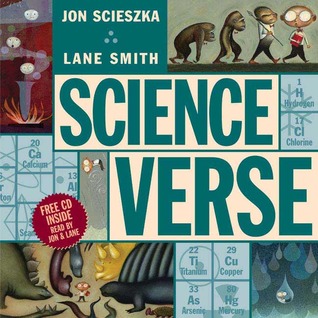
Science Verse by Jon Scieszka, illustrated by Lane Smith, is a delightful children’s book that meshes poetry and science.  Although some of these concepts may be tough for kids in kindergarten to understand, kids will enjoy the delightful illustrations and the fun verses that poke fun of critters and teachers.  My daughter particularly liked that the teachers are the reason dinosaurs died — of boredom, naturally — and not meteors.  She doesn’t really understand that dinosaurs are gone over in several grades or that they died because of meteors, etc., but she like the idea of the dinosaurs falling dead at the feet of teachers with their tongues hanging out.

My favorites were about the water cycle and amoebas, as well as the poems about evolution from apes and black holes.  Scieszka is creative and his verse is witty.  The rhymes make it easy for younger kids to follow along, and parents have something to work with when explaining the science concepts to younger children.

Science Verse by Jon Scieszka, illustrated by Lane Smith, is delightful and fun for kids and adults.  It’s a great way to introduce kids to science concepts from evolution to the water cycle.  Now all it needs is some experiments to get kids interacting, something parents could look into as supplements to the text.

RATING: Cinquain

About the Author:

Jon Scieszka is a writer and teacher. He lives in Brooklyn, New York, with his wife and two children. Occasionally he has been known to howl at the full moon. –from the dust jacket of “The True Story of the 3 Little Pigs”

Jon Scieszka is also the author of the best-selling ALA Notable Book, The True Story of the Three Little Pigs, as well as Knights of the Kitchen Table, and The Not-So-Jolly Roger. He teaches as The Day School in Manhattan where he is known as Mr. Scieszka. He lives with his wife, and two children in Brooklyn where he is known as Dad. –from the dust jacket of “The Frog Prince Continued”.

About the Illustrator:

Smith was born in Tulsa, Oklahoma, but moved to Corona, California at a young age. He spent summers in Tulsa, however, and cites experiences there as inspirations for his work, saying that “[o]nce you’ve seen a 100-foot cement buffalo on top of a donut-stand (sic) in the middle of nowhere, you’re never the same.”

He studied art in college at the encouragement of his high school art teacher, helping to pay for it by working as a janitor at Disneyland. He graduated with a Bachelor of Fine Arts in illustration, and moved to New York City, where he was hired to do illustrations for various publications including Time, Mother Jones, and Ms..

Smith is married to Molly Leach, who is a book designer and designed the Smith/Scieszka collaboration.


Bukowski in a Sundress by Kim Addonizio

Source: Penguin
Paperback, 224 pgs.
I am an Amazon Affiliate

Bukowski in a Sundress by Kim Addonizio is a memoir written as a series of personal essays that’s not only about the writing life, but also loving what you do so much that no matter how on the outside you are, you keep plugging away. Addonizio never shies away from her less than sober moments or her self-doubt.  She takes life on full force, and she makes no excuses for that.  It’s what life is for — living.  In “Plan D,” she talks about having a plan to give you some sense of control, but in all honesty, those plans don’t always work out.

As many of you know, I’ve written poems and submitted them and received a ton of rejection of late.  This book hit my bookshelf at the right time.  “How to Succeed in Po Biz” brings to light the difficulty with being a poet, what it takes is determination and a will to struggle through it all to achieve even just a modicum of success.  Royalties are small and many poets find other sources of steady income or work toward small awards and fellowships to keep working on their craft without the drudgery of a full-time job, or at least only requiring a part-time job.

Addonizio has always been a fresh poet to me, and as she writes in her essays she remembers those very low moments when she met failure, thought about giving up, and went forward anyway.  This perseverance, sheer will is what poets need.  She’s by turns vulnerable and well shielded from the barbs that come with writing poetry — the title of the book stems from one critic’s comment about how she was Bukowski in a sundress.

Bukowski in a Sundress by Kim Addonizio is utterly absorbing.  I read it in a day, and I’m still thinking about everything she said and how it applies to my current struggles with poetry and the publishing industry, especially as someone outside academia.

RATING: Cinquain

About the Poet:

She’s the author of several poetry collections including Tell Me, A National Book Award Finalist. My latest, My Black Angel, is a book of blues poems with woodcuts by Charles D. Jones, from SFA Press. I published The Palace of Illusions, a story collection, with Counterpoint/Soft Skull in 2014. A New & Selected, Wild Nights, is out in the UK from Bloodaxe Books.

Due summer 2016: Mortal Trash, a new poetry book, from Norton. And a memoir, Bukowski in a Sundress: Confessions from a Writing Life, from Penguin.

I’ve written two instructional books on writing poetry: The Poet’s Companion (with Dorianne Laux), and Ordinary Genius: A Guide for the Poet Within. Visit her website.


Save

Save

Save

Save

Save

Save