Quantcast

Let the Great World Spin by Colum McCann

What do you do when your world spins out of control and changes so drastically that you begin to feel adrift?  Colum McCann‘s Let the Great World Spin examines these issues, while at the same time demonstrating how individuals can be connected to one another without even realizing it.

“But it struck me, as I sketched, that all I wanted to do was to walk out into a clean elsewhere.” (page 153)

“No newspapers big enough to paste him back together in Saigon.” (page 81)

McCann focuses his story in 1974, mostly in New York City, where a tenuous thread is stretched between a series of characters from an Irish monk and a grieving mother who lost her son in the Vietnam War to a young artistic couple and a black prostitute. That thread is the a tightrope walker, Philippe Petit who traversed the still under construction World Trade Center towers.

“It was the dilemma of the watchers:  they didn’t want to wait around for nothing at all, some idiot standing on the precipice of the towers, but they didn’t want to miss the moment either, if he slipped, or got arrested, or dove, arms stretched.” (page 3)

In a way, the tightrope walker is all of us, teetering on the edge of every decision we make, but what we often do not have is the courage to enjoy the moment or revel in the thrill of each step we take in our lives.  McCann is a gifted storyteller, but some readers may find the shifts between story lines hamper their ability to become emotionally tethered to the characters.  There are some moments where the prose takes on a list making quality, which is a bit overdone and jambs up the narrative.

The Vietnam War plays a significant role in the novel, touching lives in immediate ways and peripherally.   In many ways the tightrope walker symbolizes the perceived precariousness of the world at large in the 1970s, with the threat of communism and the deteriorating situation in Vietnam.  Overall, Let the Great World Spin by Colum McCann is a satisfying examination of the 1970s, the Vietnam War, and modern society, and would be a good selection for book club discussions.

About the Author:

Colum McCann, a Dublin born writer, is the internationally bestselling author of the novels Let the Great World Spin, Zoli, Dancer, This Side of Brightness, and Songdogs, as well as two critically acclaimed story collections. His fiction has been published in thirty languages. He has been a finalist for the International IMPAC Dublin Literary Award and was the inaugural winner of the Ireland Fund of Monaco Literary Award in Memory of Princess Grace. He has been named one of Esquire’s “Best and Brightest,” and his short film Everything in This Country Must was nominated for an Oscar in 2005. A contributor to The New Yorker, The New York Times Magazine, The Atlantic Monthly, and The Paris Review, he teaches in the Hunter College MFA Creative Writing Program. He lives in New York City with his wife and their three children.

Check out the other tour stops.  Thanks to TLC Book Tours and Random House for sending me a free copy of Let the Great World Spin by Colum McCann for review.


This is my 5th book for the 2010 Vietnam War Reading Challenge
This is my 31st book for the 2010 New Authors Challenge.
This is my 2nd and final book for the 2010 Ireland Reading Challenge.


Letter to My Daughter by George Bishop Jr.

George Bishop Jr.’s Letter to My Daughter is narrated by a Louisiana mother whose daughter has just run away from home after a typical fight with her parents.  To cope with the anxiety, the mother writes a demonstrative history of her own teenage angst to provide them some common ground from which to begin anew.

“But believe it or not, I was your age once, and I had the same ugly fights with my parents.  And I promised myself that if I ever had a daughter, I would be a better parent to her than mine were to me.  My daughter, I told myself, would never have to endure the same inept upbringing that I did.”  (Page 4 of ARC)

Laura Jenkins takes her daughter back in time to when she is a young high school girl during the 1970s and the Vietnam War.  She falls in love with a young man, Tim Prejean, but he’s the wrong kind of man in her parent’s eyes.  How can she make them see that he’s exactly the man they should want her to be with and love.  But it all hits the fan one night and she’s sent away to Catholic school even though her family is Baptist.  Charity runs deep at Sacred Heart Academy, but Laura’s love still burns for her sweetheart, Tim.

Bishop’s prose is conversational as Laura continues to write her letter to Elizabeth, whom she named after the poet Elizabeth Barrett Browning.  Browning’s Sonnets from the Portuguese #43 says, “I shall but love thee better after death,” and her poems would complement this novel well.  There is a great sadness and love in this letter.  Laura wants to make amends to her daughter and to generate the closeness she always dreamed would be between them.

“Up until that day I had known her only as a pale older nun who seemed unnaturally preoccupied with grammar; she smelled musty, like a library, and she rustled when she walked, like her very insides were made of parchment.”  (page 35 of ARC)

“And then there was silence:  black silence, that in the moments as I gripped the phone seemed to grow deeper and deeper until it was black as the dark spaces between the stars.” (page 59 of ARC)

Bishop’s prose is poetic and easily absorbing, transporting readers to a tumultuous time in U.S. history when the country was divided about war.  But as young men and women engaged one another in high school, how would these larger issues have impacted them?  Letter to My Daughter answers these questions in a way that will tear into the hearts of readers, generate a profound sympathy and confusion about what motivates humans to make war, and how teens handle not only the typical struggles they face of which boy to date and which dress to wear, but also the larger issues that permeate their lives.

About the Author:

George Bishop, Jr. graduated with degrees in English Literature and Communications from Loyola University in New Orleans before moving to Los Angeles to become an actor. He later traveled overseas as an English teacher to Czechoslovakia, Turkey and Indonesia before returning to the States to earn his MFA in Creative Writing at the University of North Carolina in Wilmington, where he studied under Clyde Edgerton, Wendy Brenner, and Rebecca Lee.

Giveaway; I have one copy of the book for U.S./Canada only:

1.  Leave a comment about whether you think a male can do justice to the mother-daughter relationship.

2.  Blog, Tweet, Facebook, etc. the giveaway and leave me a link.

Deadline is May 11, 2010, 11:59 PM EST.

Check the other stops on the tour.


This is my 4th book for the 2010 Vietnam War Reading Challenge.

This is my 30th book for the 2010 New Authors Challenge.

Song of Napalm by Bruce Weigl

Bruce Weigl’s Song of Napalm is another collection of poems dealing with the impact of the Vietnam War.  Robert Stone says in the introduction, “Bruce Weigl’s poetry is a refusal to forget.  It is an angry assertion of the youth and life that was spent in Vietnam with such vast prodigality, as though youth and life were infinite.  Through his honesty and toughmindedness, he undertakes the traditional duty of the poet:  in the face of randomness and terror to subject things themselves to the power of art and thus bring them within the compass of moral comprehension.”

Weigl takes readers on a journey to Vietnam in the late 1960s and explores the anxiety he feels as a soldier in a strange nation.  Each poem’s narrator carefully observes his surroundings, detailing the corner laundry, the hotel, the jungle, and his fellow soldiers.

“Who would’ve thought the world stops
turning in the war, the tropical heat like hate
and your platoon moves out without you,
your wet clothes piled
at the feet of the girl at the laundry,
beautiful with her facts.”  (from “Girl at the Chu Lai Laundry,” page 4)

Song of Napalm chronicles the narrator’s transformation from boy to soldier to terrified man in the jungle and recovering killer.  In a way some of these poems contain a dark sense of humor about the war, which probably kept the narrator sane.

Temple Near Quang Tri, Not on the Map (page 7-8)

Dusk, the ivy thick with sparrows
squawking for more room
is all we hear; we see
birds move on the walls of the temple
shaping their calligraphy of wings.
Ivy is thick in the grottoes,
on the moon-watching platform
and ivy keeps the door from fully closing.

The point man leads us and we are
inside, lifting
the white washbowl, the smaller bowl
for rice, the stone lanterns
and carved stone heads that open
above the carved faces for incense.
But even the bamboo sleeping mat
rolled in the corner,
even the place of prayer, is clean.
And a small man

sits legs askew in the shadow
the farthest wall casts
halfway across the room.
He is bent over, his head
rests on the floor and he is speaking something
as though to us and not to us.
The CO wants to ignore him;
he locks and loads and fires a clip into the walls
which are not packed with rice this time
and tells us to move out.

But one of us moves towards the man,
curious about what he is saying.
We bend him to sit straight
and when he’s nearly peaked
at the top of his slow uncurling
his face becomes visible, his eyes
roll down to the charge
wired between his teeth and the floor.
The sparrows
burst off the walls into the jungle.

Weigl’s dark humor permeates these pages, but it is more than the humor that will engage readers.  It is his frank lines and how the narrator tells readers the truth about the situation.  From “Elegy,” Weigl says, “The words would not let themselves be spoken./ Some of them died./ Some of them were not allowed to.”  There are just unspeakable atrocities that happen in war, and soldiers who return home may not actually return home resembling who they were before they left.  Song of Napalm is a frank discussion about becoming a man in a time of war, dealing with the horrors of killing and worrying about being killed, and returning home to a world you don’t recognize and trying to reinsert yourself into the society that sent you to war in the first place.

This is my 3rd book for the 2010 Vietnam War Reading Challenge.

This is my 17th book for the contemporary poetry challenge.

This is my 5th book for the Clover Bee & Reverie Poetry Challenge.

***

Please also remember to check out the next stops on the National Poetry Month Blog Tour at Online Publicist and Boston Bibliophile.

TODAY is Poem in Your Pocket Day! What poem will you be reading?

Full Moon Boat by Fred Marchant

Fred Marchant’s Full Moon Boat, published by Graywolf Press, is a poetry collection from my shelves that has been dipped into on many occasions.  The collection not only contains original poems by Marchant, a Suffolk University professor, but also translations of Vietnamese poets.  Many of these poems not only examine deep emotional turmoil through nature, but also the theme of war, particularly the Vietnam War.

“In 1970, Georgette, Harry’s war bride,
wrote to me on Okinawa, pleading that
I not leave the service as a conscientious
objector.  She said Jesus could not approve,”  (From “The Return,” page 3)

“From the steps of the pagoda where Thich Quang Duc
left to burn himself in Sai Gon, I took a photograph

which centered on a dragon boat
drifting on the Perfume River, framed by a full-leafed
banana tree.  An image of mourning.
Another photograph:  this one in front of the Marine insignia,

my right hand raised, joining.  I am flanked
by my parents, their eyes odd and empty too.
It was 1968, and none of us knew what we were doing. (from “Thirty Obligatory Bows,” page 28)

Unlike other poetry collections with a focus on the Vietnam War, Marchant’s collection zeroes in on the deep emotional states of families sending their sons overseas to war, ranging from pride to shame and even confusion.  In many ways the lines of these poems are deceiving in their simplicity, releasing their power only after the reader has read the lines aloud or for the second time.  In “A Reading During Time of War,” readers may miss the turning point in the poem on the first read through, but sense that something has changed in the last lines, prompting another read and the realization that the realities of war will always rear their ugly heads.

A Reading During Time of War (page 54)

It is the moment just before,
with no intent to punish,

a wish for all to be air
and scrubbed by rain,

filled with eagerness to learn
and be if not a child

then openhearted, at ease,
never to have heard

of the bending river
that stretches to the delta

where a bloated corpse
bumps softly,

snags on a tree stump
and, waterlogged,

rolls slowly, just below.

Additionally, these poems touch upon the beauty and emotional anchor deep within the chests of the Vietnamese.  In “Letter,” by Tran Dang Khoa and translated by Marchant with Nguyen Ba Chung, readers will find that Vietnamese families and soldiers had the same trepidations as American soldiers and their families.

“Mother, I may well fall in this war,
fall in the line of duty–as will so many others–
just like straw for the village thatch.
And one morning you may–as many others–
hold in your hand apiece of paper,
a flimsy little sheaf of paper
heavier than a thousand-pound bomb,
one that will destroy the years you have left.”   (from “Letter,” page 36)

Overall, Full Moon Boat by Fred Marchant examines the nuances of the human condition during times of crisis, including The Vietnam War, and heartbreaking decisions that soldiers and families make when conflicts begin or continue to rage even in strange lands.  Through translations of Vietnamese poems, Marchant explores the similarities between each side of the conflict in how they react and deal with war.  Other poems in the collection examine the dynamics of families through natural imagery.  Both beginning readers of poetry and those who have read other poetry collections will find Marchant’s comments on the human condition and how that condition is altered by war poignant and true.

About the Poet:

Fred Marchant is the author of Tipping Point, which won the Washington Prize in poetry. He is a professor of English and the director of creative writing at Suffolk University in Boston, and he is a teaching affiliate of the William Joiner Center for the Study of War and Social Consequences at the University of Massachusetts, Boston.

This is my 2nd book for the 2010 Vietnam War Reading Challenge.

This is my 16th book for the contemporary poetry challenge.

This is my 4th book for the Clover Bee & Reverie Poetry Challenge.

***

Please also remember to check out the next stops on the National Poetry Month Blog Tour at Ooh Books and Estrella Azul.


I, Alex Cross by James Patterson (Joint Review With Mom)

James Patterson’s I, Alex Cross is the latest book in the Alex Cross series, and it will shock readers.  Cross must face a death in the family, a health crisis with another family member, and a horrific series of murders that involve call girls, an exclusive gentleman’s club, and a wood chipper.

“I brought home the files I’d gathered and took them to my office in the attic after dinner.  I cleared off one entire wall and started tacking up everything — pictures of the missing, index cards with case vitals that I’d written up, plus  a DC street map, flagged everywhere that victims had last been seen.”  (Page 48)

Each book in the Alex Cross series can be read alone, though readers will miss the evolution of his character if they don’t read them in order.  Patterson is skilled at building tension and suspense in these novels through short chapters, changing points of view, and clipped sentences.  Readers will be running alongside Cross as he uncovers the true identity of the killer, known only as Zeus.

“This was the kind of homicide that used to make me wonder why I keep coming back for more, year after year.  I knew that on some level I was addicted to the chase, but I used to think that if I figured out why, then I’d stop needing it so much, maybe even turn in my badge.  That hadn’t happened.  Just the opposite.”  (Page 48-9)

Cross is a deeper character than most main characters in crime novels, with his psychology degrees, his intense organization during cases, his family, the loss of his wife, and the face offs he has with a variety of criminal masterminds.  Patterson has kept this character fresh even after 16 books, and he still has room to grow.  I, Alex Cross is a welcome addition to the series.

I’m going to turn over the reins to my mom, Pat, for her review of I, Alex Cross.

One of the best books written by James Patterson.  All of his books are exciting and suspenseful and make fast reads.  In I, Alex Cross, Detective Alex Cross is at his birthday party when he gets the phone call about a brutal murder.  He finds out that his niece Carolyn isn’t who she pretends to be and has a life that nobody knows about.  Cross is called in to work on the case.  A five-star read!

Thanks to Hachette Group for sending myself and my mom a free review copy of I, Alex Cross for review.

Don’t forget about the Alex Cross giveaway going on now through April 24th at 11:59PM EST.

***

Please stop by the next stops on the National Poetry Month Blog Tour at Everything Distils Into Reading and In Bed With Books.


This is my 8th book for the 2010 Thriller & Suspense Reading Challenge.

SOS! The Six O’Clock Scramble to the Rescue by Aviva Goldfarb (Earth Day Celebration)

Happy Earth Day, everyone!  I try my best to celebrate Earth Day and its 40th anniversary.  What better way to take action in our homes to save the environment and become healthier than by heeding the advice in Aviva Goldfarb‘s SOS! The Six O’Clock Scramble to the Rescue.

Before we get the actual cookbook, I wanted to let you know that each copy purchased includes a one-month subscription to the Scramble and a portion of the proceeds will be donated to the Environmental Working Group, which works to use public information’s power to help consumers improve their health and save the environment by offering resources to make better decisions and to affect policy change.

Goldfarb’s cookbook expands upon her popular Web site with its seasonal weekly meal planner subscription for busy families.  The introduction discusses how the organization of the Scramble and its weekly meal planning enables families to reduce their carbon footprint by:

  • limiting trips to the grocery store to once per week
  • reducing the use of takeout containers
  • limiting food waste
  • using highly sustainable fish
  • and reducing the heavy use of meat in our diets.

Following the introduction, Goldfarb outlines the items you need in your pantry at all times, with indicators next to those that you should consider buying in bulk (among others):

  • nonstick cooking spray
  • minced garlic
  • olive oil
  • reduced sodium soy sauce

Once the staples are purchased and available to you, you should check out the break down of fruits and vegetables by season so that you shop for those items when they are in season.  Shopping for veggies and fruits in season reduces your carbon footprint, according to Goldfarb, because it reduces the need to truck those foods across the country or from another nation where they are in season.

The rest of the cookbook is broken down by season and includes a weekly plan of menus for families to try out and advice for keeping the menu plan on schedule, using canvas bags or reusing plastic and paper bags, creating healthy and tasty lunches for school, picking healthy snacks, and more.  However, the book does not include photos of the recipes, which novice cooks might want to check out to see how well they are doing with their own attempts at the recipes.

For busy, book blogger and other moms, SOS! The Six O’Clock Scramble to the Rescue is an excellent edition to your cookbooks.  Goldfarb’s book is more than a cookbook, it is full of advice on how to make healthy choices for families, how to reduce carbon footprints, shop locally, and more.

About the Author:

Aviva Goldfarb (Photo credit: Rachael Spiegel) is author and founder of The Six O’Clock Scramble®, a seasonal online weekly menu planner and cookbook (St. Martin’s Press, 2006) who lives in Chevy Chase, Md.  She has just released a new cookbook, SOS! The Six O’Clock Scramble to the Rescue: Earth-Friendly, Kid-Pleasing Dinners for Busy Families.  Aviva is regularly quoted in popular online and print Family and Health publications. She is an advocate for healthy families, actively working with national nonprofit organizations and with parents to improve nutrition.

Thanks to Diane Saarinen and St. Martin’s Press for sending me a free copy of SOS! The Six O’Clock Scramble to the Rescue by Aviva Goldfarb for review.

The giveaway details:  (I’m buying 1 copy and giveaway is open internationally)

1.  Leave a comment about what you are doing to celebrate Earth Day.

2.  Leave a second comment with a tip about how you live greenly.

3.  Blog, Tweet, Facebook, Stumble, spread the word about the giveaway and leave me a link.

Deadline April 29, 2010, at 11:59 PM EST

This is my 29th book for the 2010 New Authors Challenge.

I hope you enjoyed this latest Literary Road Trip with Chevy Chase, Md., author Aviva Goldfarb.

***

Also check out today’s stop on the National Poetry Month Blog Tour at Necromancy Never Pays!

Shutter Island by Dennis Lehane (audio)

Dennis Lehane‘s Shutter Island is a creepy novel about a U.S. Marshal with a tragic past who saw dark sides of humanity that many have never seen.  U.S. Marshal Teddy Daniels is a former intelligence officer during WWII called to Ashecliffe Hospital for the Criminally Insane to find a patient who has gone missing even though she was locked behind doors.

Chuck Aule is Teddy’s partner on this escapade, and they scour the island looking for the missing patient, who has left them a code to crack — the Law of 4.  The code is simplistic and easily cracked by Teddy, who believes he’s stumbled upon island of horrors in which doctors experiment on patients much like the Nazis and Soviets did during the war.

Lehane’s narrative gets a little bogged down in inane details about the origins of names and other details that are extraneous.  However, his descriptions of the island, the patients, and the water are vivid.  Characters from orderlies to doctors and patients are unique and easily discernible from one another, which is a testament to Lehane’s skill as a writer.  The characters could have easily been similar or stereotypical for a mental-prison hospital.

However, readers may find that they’ve heard this story before, that there are too many clues left for the reader to unravel the mystery long before the main character, Teddy Daniels.  The narrator, Tom Stechschulte does an excellent job changing his voice for each character and reacting to the fast moving dialogue.  Overall, Shutter Island is an entertaining mystery with a twist that may not be as surprising as expected.

***

Please stop by the next stops on the National Poetry Month Blog Tour at Bermudaonion and 32 Poems Blog.


This is my 28th book for the 2010 New Authors Challenge.

This is my 7th book for the 2010 Thriller & Suspense Reading Challenge.

Chow Hounds by Ernie Ward, DVM

Chow Hounds by Ernie Ward DVM is an excellent reference guide for those dog owners seeking the best nutrition for their pets.  The number of dogs considered obese or overweight in 2007 was 43 percent, but that figure increased to 45 percent in 2009, according to the Association for Pet Obesity Prevention.  Dr. Ernie Ward discusses how Americans have not only impacted their own health and well being, but that of their pets.

He says that following his prescriptive plan can restore any dog back to health within about six months.  The book begins with information about how to read through the fluff on food labels to get to the real composition of the meals being fed to pets across America.  There are complicated breakdowns that the average pet owner may not take the time to complete.  Beyond that, the book offers some some simple common sense pointers for pet owners, including making sure that animals are given enough exercise and playtime.

Like eating healthy as a human, pet owners should ensure they watch their dog’s calorie intake and do not give in to the “puppy” eyes of their animals and overfeed them.  Rather than simply discuss how owners can make dog food from scratch, Ward also discusses how to rotate in healthy, organic foods throughout the week in addition to commercial dog food.  However, owners should throw away their dog treats, bones and others, and replace them with healthy treats like carrots, broccoli, and apples.  Included in the book are recipes for creating healthy treats for your pet from sweet potato cookies to quiche bites.

With more Americans living in urban areas and in apartments, yard space is at a minimum, which reduces opportunities for exercise in fenced yards, according to Ward.  But Ward reminds readers that they should take the time to exercise with their canines to strengthen their familial bonds and keep healthy habits on track for both dog and human.  To ensure owners are taking ideal care of their pets, Ward includes a chart with breed information and ideal weight and weight and the corresponding pace for walking 1 mile with your dog.

Overall, Chow Hounds is an excellent source of advice for pet owners with overweight dogs and who may be in need of a push to get healthy themselves.  Many of these activities can translate into changes for human behavior and eating as well.

Giveaway details:

2 copies for US/Canada, 1 copy for international reader (be sure to let me know if you are outside the US/Canada) —

1.  Leave a comment about why you want this book and email address.

2.  Spread the word via Twitter, Facebook, etc., and leave me a link.

Deadline is April 26, 2010, at 11:59 PM EST

About the Author:

Dr. Ernest Ward, DVM, or “Dr. Ernie,” author of Chow Hounds, is a practicing veterinarian who is dedicated to helping pets and their humans live healthier lives. He appears regularly on the Rachael Ray Show, and has been featured on Animal Planet, NBC Nightly News, and CNN.

Check the rest of the tour stops on TLC Book Tours.


This is my 27th book for the 2010 New Authors Reading Challenge.

***

Don’t forget about today’s stops for National Poetry Month at New Century Reading and 1330V.

Alex Cross’s Trial by James Patterson and Richard DiLallo

Alex Cross’s Trial by James Patterson and Richard DiLallo is a book within a book in which the introduction is written by the character Alex Cross and sets up the impending story of his ancestors.  Abraham Cross lives in Eudora, Miss., and he helps the narrator, Attorney Ben Corbett uncover the truth behind the alleged lynchings in Mississippi and the rest of the South and to collect evidence for President Theodore Roosevelt.

“On the front lawn two adorable white children in a little pink-painted cart were driving a pony in circles.  On the wide front veranda I could see the children’s mother observing their play and a small army of black servants hovering there.

This was a vision of the old South and the new South, all wrapped into one.  There, gleaming in the drive, was a handsome new motorcar, brass fittings shining in the sun.  And there, rushing across the yard in pursuit of a hen, was an ink-black woman  with a red dotted kerchief wrapped around her head.”  (Page 136)

Ben Corbett is a progressive attorney who moved from Eudora, Miss., joined the military, became an attorney at Harvard University, and moved to Washington, D.C., with his young wife and twin girls.  He’s asked by Roosevelt to investigate the lynchings in the South and bring back evidence so that he can deal with the problem.  Patterson and DiLallo offer up an authentic step back in time for this mystery, with appearances by W.E.B. Dubois and other historical figures.

Alex Cross’s Trial is a well-written off-the-beaten path novel in the Alex Cross series.  Abraham Cross, a former baseball player with the Philadelphia Pythians, is an unassuming Black man living in the South, who has struggled against racism, but is willing to stake his life to make a real change in the nation.  Readers will enjoy the quick page of the novel, the historical setting, and examination of issues that still exist today.  Patterson and DiLallo have done a fantastic job in making a unique addition to the Alex Cross series.

For a couple takes on Cross Country, visit my mom’s review and my review.  Also take a look at Washington, D.C., and my Alex Cross poem.  Check out the other bloggers posting for Detectives Around the World Week. Thanks to Hachette Books for sending me a free copy of Alex Cross’s Trial to review.

Giveaway Details:

For those who have been following the Detectives Around the World Week, anywhere in the world, please answer the following question in the comments and leave me your email:

What has been your favorite post during the week and why?

Those who do not answer the question will not be entered, and I will select a random winner for the three latest Alex Cross novels, Cross Country, Alex Cross’s Trial, and I, Alex Cross through Randomizer.

Deadline is May 2, 2010, at 11:59 PM EST.

***

Please also stop by today’s National Poetry Month Blog Tour stop at She Is Too Fond of Books and A Circle of Books.

This is my 6th book for the 2010 Thriller & Suspense Reading Challenge.

Cross Country by James Patterson

James Patterson’s Cross Country is full of action, conspiracies, and danger.  Detective Dr. Alex Cross is called to the scene of a horrific murder of an entire family when Cross realizes that Ellie Cox was his first love in college.  Her death and that of her family tug at his heartstrings and strengthen his resolve to find her killers.

As he investigates the crime, he discovers a gang of boys led by a man calling himself the Tiger is behind the murders and much more.

“The boy was eleven years old and fearless as a crocodile in a muddy river.  He raised his pistol much larger than his own hand and fired it into the shivering father’s forehead.”  (Page 5)

Through short chapters and quick action scenes, Patterson builds the tension in Cross Country, leaving readers on the edge of their chairs as Cross hunts down another vile criminal who recruits boys as young as ten who have been orphaned in a number of African nations to become killers.  Traveling to Nigeria, where it is clear Cross has not seen as much horror as he thought he had, the detective lands in hot water with local police and a swath of criminals.

“I shook off whoever was on my right arm and swung at whoever had my left.  None of them was stronger than me, but collectively they were like fly paper covering every inch of my body.  I fought even harder, fighting for my life, I knew.”  (Page 183)

Patterson is an excellent story teller, and Cross Country has more violence in it than the previous Cross novels.  Readers may be disturbed by the sexual violence and blatant murders committed by the criminals in this novel.  Additionally, the resolution of this novel comes about more because of luck or circumstance than because of Dr. Cross’s deductive skills, which readers traditionally look forward to in these novels.  However, those looking for a great police procedural with a mix of nearly impossible overseas intrigue, Cross Country is for them.

For another take on Cross Country, visit my mom’s review. Also take a look at Washington, D.C., and my Alex Cross poem.  Check out the other bloggers posting for Detectives Around the World Week.  Thanks to Hachette Books for providing me with a free review copy.

***

Also don’t forget about today’s stops on the National Poetry Month Blog Tour at the life (and lies) of an inanimate flying object, her giveaway, and Evelyn Alfred.

This is my 5th book for the 2010 Thriller & Suspense Reading Challenge.


Your Ten Favorite Words by Reb Livingston (That’s How I Blog)

When I was asked by Nicole at Linus’s Blanket to join her on That’s How I Blog on BlogTalk Radio, I knew I wanted my book club selection to be a volume of poetry, especially since I would be on the show during National Poetry Month.  So Nicole and I agreed on Your Ten Favorite Words by Reb Livingston.
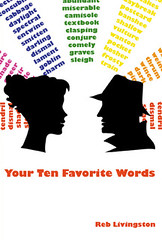
I hope everyone will join me and Nicole at 6:30 PM EST this evening in the chat room and on the phone for the show and the book club discussion. OK, this is me begging! 🙂

Reb Livingston’s Your Ten Favorite Words is a collection of poems that examines the battle between the sexes in a new way, creating caricatures of men and women.  Livingston has a way with imagery, alliteration, and riddles.  A number of poems roll into a rhythm, twist the tongue, and require readers to assess each line carefully.

The collection is broken down into three parts:  Our Rascal Asses; Unsweet and Looking for a Fix; Burgers and Pitchforks.  Readers are introduced to three caricatures Smitten Girl, The Man With the Pretty Chin, and The Heart Specter.  And each section begins with a mini-conversation or set of statements between the characters.  These set up each section, allowing them to unfold.

“The Smitten Girl [to The Man with the Pretty Chin]:  Will you be using your charm for good or injury?

The Heart Specter [murmuring]: (C)harm for G(o)od!” (Page 8 )

Livingston’s collection turns conventional expectations about female perspectives on relationships with men upside down.  Each narrator celebrates female sexuality and desire, but also questions the confusion that comes with that base emotion and need.  At the same time, there is a sense of the comedic in these lines, which pokes fun at the awkwardness of sex and interactions and expectations between men and women.

“He was dark brilliance and moans

(his moans, girlish and dusk, yet I gushed)”  (From Almost Took a Lover Once, page 12)

Livingston’s Your Ten Favorite Words is a collection with a title that will cause confusion among readers and leave them scratching their heads.  The title’s meaning and purpose to the collection could remain obscure for some time, but this is a collection readers will want to return to again and again to unravel the riddles and relish the inner truth of these frank discussions.

About the Poet:

Reb Livingston is a poet and editor of No Tell Books, a press devoted to poetry, and No Tell Motel, an online poetry magazine.  She also is the author of Your Ten Favorite Words (Coconut Books, October 2007) and Pterodactyls Soar Again (Whole Coconut Chapbook Series, 2006). Her poems have appeared in Best American Poetry 2006 and literary magazines.

This is my 26th book for the 2010 New Authors Challenge.

This is my 15th book for the contemporary poetry challenge.


This is my 3rd book for the Clover Bee & Reverie Poetry Challenge.

Since Reb Livingston is a local D.C. area poet, this is a great look at her work as part of The Literary Road Trip, which has moved to Jenn’s Bookshelves from GalleySmith.

***

Please don’t forget to check out the next stop on the National Poetry Month Blog Tour Life Is a Patchwork Quilt.

The Lotus Eaters by Tatjana Soli

The Lotus Eaters by Tatjana Soli takes place in Vietnam between 1963 and 1975 and becomes a journal of Helen Adams’ evolution into a photojournalist from a young woman chasing the ghosts of her father and brother.  The Vietnam War was one of the most controversial in American history, and journalists were on the front lines of the battles — political and physical.

“When they were fired on, the advisers called down airpower, but it dropped short, falling on them and civilians.  A free-for-all clusterfuck.  The SVA panicked and started firing on their own people, on civilians instead of the enemy, who had probably long retreated.”  (Page 55 of ARC)

The Vietnam War thrust Americans in Asia at a time when Communism was considered one of the biggest threats to democracy.  Americans entered the war following the failure of the French to colonize Vietnam and keep Ho Chi Minh out.  Journalists flooded the nation, took some of the most raw and vivid shots of death, life, and struggle, but many of these were men.  Women were not expected to last long in country, particularly with the SVA, corruption, American bungling in the jungle, and the NVA.  Helen tags along with Sam Darrow to learn the ropes, but quickly finds that he’s not a mentor but a kindred soul.  They connect on more than one level, but the war has ravaged him, leaving a shell of man who is unable to reconcile his role in the war with the ideals he once held about changing the world.

“Helen’s Saigon had always been about selling — chickens, information, or lovely young women — it didn’t matter.  It had once been called the Pearl of the Orient, but by people who had not been there in a very long time.  Saigon had never been Paris, but now it was a garrison town, unlovely, a stinking refugee shantyville filled with the angry, the betrayed, the dispossessed, but she made it her home, and she couldn’t bear that soon she would have to leave.”  (Page 4 of the ARC)

Soli’s multi-layered tale unveils not only the horrors of war and the toll they take on individuals and the nation, but on the relationships cultivated in the most dire circumstances.  Linh, Darrow’s photography assistant and ex-NVA and ex-SVA soldier, adds another complication to the mix when he falls for Helen, but seeks to protect her from harm in honor of his friend, Darrow.

“Darrow moved forward with the rest of the men, entering the waist-high marsh.  She saw him as if for the first time, the truest image she would ever have:  a dozen men moving out single file, visible only from the waist up, only packs, helmets, and upraised weapons to identify them; a lone bare head, an upraised camera.”  (Page 91 of ARC)

Soli has a gift; she crafts a scene filled with heavy, conflicted emotion like a painter uses oil on canvas.  Her characters are multi-faceted, evolving, and devolving at the same time, and like the lotus eaters in the Homer quote at the beginning of the novel, they lose sight of their home, their pasts, and themselves as they are absorbed by the beauty and the terror of the Vietnamese and their nation.  The Lotus Eaters is an excellent selection for readers interested in the Vietnam War and a perspective beyond that of the soldiers.  Another book for the best of list this year.

About the Author:

Tatjana Soli is a novelist and short story writer. Born in Salzburg, Austria, she attended Stanford University and the Warren Wilson MFA Program.

Her work has been twice listed in the 100 Distinguished Stories in Best American Short Stories and nominated for the Pushcart Prize. She was awarded the Pirate’s Alley Faulkner Prize, teh Dana Award, finalist for the Bellwether Prize, and received scholarships to the Sewanee Writers’ Conference and Bread Loaf Writers’ Conference.

She lives with her husband in Orange County, California, and teaches through the Gotham Writers’ Workshop. @TatjanaSoli


Check out the rest of the TLC Book Tour.


This is my 25th book for the 2010 New Authors Challenge.


This is my first book for the 2010 Vietnam War Reading Challenge.

***

Please also remember to check out the next stops on the National Poetry Month Blog Tour at Monniblog and Ernie Wormwood.

FTC Disclosure: Thanks to St. Martin’s Press for sending me a free copy of The Lotus Eaters for review.