Quantcast

Silver Lining to the Sookie Stackhouse Reading Challenge Failure

Although Beth Fish Reads‘  Sookie Stackhouse Reading Challenge officially ends today and I’ve only read 3 books, I’m going to make a deadline extension for myself.

I’m in the midst of reading book 4 in the series, and because I am enjoying the books and time simply slipped too quickly for this challenge, I’m extending my personal deadline through Dec. 31, 2010.

So I vow to finish up this series by the end of the year, and start by completing book 4, Dead to the World by Charlaine Harris.

These are the ones I have left in the series, which I plan to finish this year:

  1. Dead as a Doornail by Charlaine Harris
  2. Definitely Dead by Charlaine Harris
  3. All Together Dead by Charlaine Harris
  4. From Dead to Worse by Charlaine Harris
  5. Dead and Gone by Charlaine Harris
  6. Dead in the Family by Charlaine Harris

What challenges have you finished or are you struggling with?

Join the Paco’s Story Read-a-long

I’ll be participating in the War Through the Generations Vietnam War Reading Challenge read-a-long of Paco’s Story by Larry Heinemann in July.

For those outside of the Vietnam War Reading Challenge who are interested in joining the Paco’s Story read-a-long, you are more than welcome to join us.

How it will work: You read the designated chapter(s) and visit War Through the Generations on the Wednesday for the discussion questions

What you do: You read and then talk about what you’ve read so far and answer the discussion questions provided either in the comments on that Wednesday or on your own blog.

Here’s the schedule:

Week 1: Chapters 1 and 2
Discussion Questions posted on July 7

Week 2: Chapters 3 and 4
Discussion Questions posted on July 14

Week 3: Chapter 5
Discussion Questions posted on July 21

Week 4: Chapter 6 and 7
Discussion Questions posted on July 28

For discussions on twitter use the hashtag #Paco

***Oh, and here’s the button for the read-a-long: (link to image is http://farm2.static.flickr.com/1303/4679014202_5351e02497_o.jpg)

WarThruGen_readalong

Thanks for making the button Monica!

The Guilt Gene by Diana M. Raab

Diana M. Raab‘s The Guilt Gene is a collection steeped in nostalgia that fails to glorify the past.  The collection is broken down into six sections:  “Cherry Blossoms, Book Tour, Two Evils, The Devil Wears a Poem, Yad Vashem, and California Roll.”  Additionally, “guilt” is defined in the pages preceding the table of contents, although most readers are aware of its definition and uses.
In “Cherry Blossoms,” Raab revisits the bloom of her youth when she was just beginning to discover boys and realize that she wasn’t popular with her classmates.  Hindsight is 20-20 in these poems as she examines how the behavior of her mother impacted her adolescence, particularly in “Moth Balls.”

The “Book Tour” section of the book is amazing in its raw honesty about never taking advantage of friendships because they are incredibly loyal and the emotional toll writing books, publishing them, and marketing them to the general public.  Raab discusses how writing is a reflection of who authors and poets actually are, the depression that follows the completion of a book, and many other scenarios.

Author Blues (page 26)

If women after delivering a baby

suffer post-partum,

why can’t writers

after delivering a book

suffer post-ISBN?

Raab’s frank perspective is like a hammer hitting readers with a deep sense of loss in “Two Evils.”  Her personal struggle with breast cancer is vivid and pulsates with anger, but also with confusion and a child-like wonder about the world around her.  Like her previous collection, Dear Anais (my review), some of the poems take on the tone of a diarist, an observer of life.  The Guilt Gene covers a range of events and emotions, and Raab will draw in readers through her casual tone, witty turn of phrase, and images that anchor readers to a time and place.  One of the best collections I’ve read this year. 

Thanks to Bostick Communications and Shirley at Newman Communications for sending along The Guilt Gene by Diana M. Raab for review.

This is my 7th book for the Clover Bee & Reverie Poetry Challenge.

Raven Stole the Moon by Garth Stein

Garth Stein’s Raven Stole the Moon was originally printed in 1998, but was recently republished by Harper following Stein’s success with The Art of Racing in the Rain (my review). The Tlingit legend — including that of Raven — that becomes Jenna Rosen’s life is absorbing, blurring the lines of reality and folklore.  Jenna’s life fell apart upon the death of her son in an accident, and she spirals out of control, seeing psychiatrists and taking addictive pharmacological substances.  After emerging from a drug haze, she and her husband Robert go through the motions until Jenna makes a definitive move to change her life.

“The two options were mutually exclusive.  There was no middle ground.  Maybe I’m a little crazy and there are some spirits.  No.  It was either/or.  And Jenna was determined to find out which.”  (Page 199)

Set in the 1990s in Alaska and Washington State where it’s about “recapturing the glory of the eighties at a discount,” Stein crafts a surreal tale where reality blends with the past, the present, and folklore turning men into beasts and soul robbers and generating three dimensional characters ready to deal with the unknown and irreparable grief.

“Digging deep down into the crust of the earth, pumping black goo up to the surface, cooking it in aluminum containers so it can be used in a BMW.  The evolution of Man smells like gasoline.”  (Page 35)

Despite the tragedy in these pages, readers are on the edge of their seats as they ride with Jenna through the Alaskan wilderness to unravel the mystery behind her son’s death and uncover her heritage as a descendant of the Tlingit tribe.  Along the way, Jenna is joined by a lonely young man and a wild dog, while being pursued by a private investigator hired by her husband to find her.  Just as Jenna relaxes, the unknown creeps up on her alongside the harsh reality of the life she left behind, which all threatens to impinge on her life suspended in limbo.

Stein not only create dynamic characters; Dr. David Livingstone, the shaman who is consulted during the construction of Thunder Bay, resembles the original from Joseph Conrad‘s Heart of Darkness who was based upon a real missionary and explorer of Africa.  Stein’s Livingstone undergoes a transformation to take on the visage of evil, but he is also a presence that hovers over the story, like Conrad’s character.

Readers will be surprised by how much is packed into Raven Stole the Moon and by how quickly the story unravels and carries them along down river with Jenna and her compatriots.  The only possible nit-picky thing to point out is that the time line gets a bit muddled when jumping between the story of how Thunder Bay came to be and Jenna’s current journey, which could have been rectified by revealing the story of Thunder Bay as Jenna makes her way through the wilderness.  However, that is a minor complaint in an otherwise captivating, suspenseful story that readers will be hard pressed to forget when the final page is turned.

This is my 10th book for the 2010 Thriller & Suspense Reading Challenge.
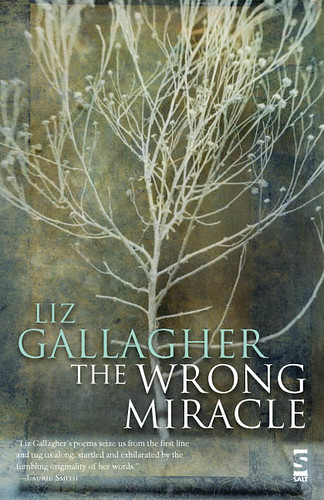
The Wrong Miracle by Liz Gallagher

The Wrong Miracle by Liz Gallagher uses tongue twisting phrases and juxtaposition to shed light on and deal with the expectations of family and society.  Wrong miracles occur everyday in Gallagher’s world from the cat that drags in a poem it found to a breeze that cracks the narrator open.  Gallagher’s playful phrases will have readers smiling in amusement, and she enjoys turning cliches upside down.
“I still have not

bought the doghouse — a real one, not

the metaphorical one where husbands some

times hang out while wives are belt loosening

or just simply giving things a twirl.”  (From “Prelude to Getting One’s Act Together,” Page 15)

In many cases, Gallagher is whimsical with her imagery even when her poems deal with serious events, such as paying for the best and getting something unexpected and disappointing.  In “Woman in a Redhead,” she seeks a new look, cappuccino hair that ends up being red and having to deal with the result.

“On my way home, I fake a swagger and ants

in my pants.  I am singularly impressed by the rife

humour that is making its way down the broad of my

back.  I will be back to get my cappuccino-chocolate hair,

I think.  Sometimes we don’t get what we pay for and blood

does curdle.”  (Page 3)

But beneath the whimsy of her verse lies a dark anger and disappointment that simmers and bursts forth. Can you talk yourself into doing anything?  Can you justify waterboarding like you can justify jumping out of an airplane with a parachute as a hobby?  Is the unthinkable a norm that we haven’t gotten used to yet?  Gallagher asks these questions and more, but she also examines fatherly love and forgiveness.

A Poem That Thinks It Has Joined a Circus (Page 10)

A handkerchief is not an emotional holdall.

A cup of tea does not eradicate all-smothering sensations.

A hands-on approach is not the same as a hand-on-a-shoulder

willing a chin to lift and an upper lip to stiffen.

A forehead resting on fingers does not imply that the grains

of sand in an hourglass have filtered through.

A set of eyes staring into space is not an indictment that the sun

came crashing down in the middle of the night.

A sigh that causes trembling and wobbly knees should be

henceforth and without warning trapped in a bell jar and retrained

to come out tinkling ivories with every gasp.

A poem trying to turn a sad feeling on its head does not constitute

a real poem, it is a cancan poem, dancing on a pinhead

and walking a tightrope with arms pressed tightly by its sides.

Readers just starting out with poetry will find this collection needs to be read aloud and more than once because some of the lines are dense with imagery, double-speak, and juxtapositions.  However, the poems do exude a song-like quality as tongue-twisters roll off the tongue, which will have readers repeating Gallagher’s lines over and over again.  The Wrong Miracle by Liz Gallagher is a buzz worthy collection.

***Please check out my previous two-part interview with Liz Gallagher.  Also, proceeds from the sale of her book, The Wrong Miracle, will go to support Sands, the stillbirth and neonatal death society.***

Thanks to Liz for sending me a copy of her book for review.

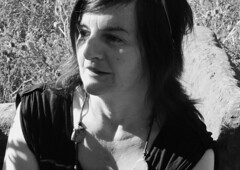
About the Poet: (Photo Credit: Vladi Valido)
Liz Gallagher was born and brought up in Donegal, Ireland. She has been living in Gran Canary Island for the past 14 years. She has an Education degree where she specialised in Irish language. She also has a Computer Science degree. She is at present doing research into online debating for her PhD. She began writing about 5 years ago and has won a variety of awards in both Ireland and the US: Best New Poet 2007 (Meridian Press, Virginia University) First Prize in The Listowel Writers’ Single Poem Competition 2009 and she was selected by Poetry Ireland for their 2009 Introductions Series in recognition of her status as an emerging poet.

This is my 6th book for the Clover Bee & Reverie Poetry Challenge.

This is my 35th book for the 2010 New Authors Reading Challenge.

Challenges Completed! Others Not so Much!

I joined this challenge a bit late last year, but it ran from May 2009 through May 2010 (click on the image for more information).  I completed the deep end of the challenge, which required me to read and review 11-15 books of contemporary poetry and poetics.

See the books I reviewed here.

I joined the 2010 Ireland Reading Challenge (click on the image for more information) at the Shamrock Level for 2 books.

Check out my book reviews here.

I’ve completed this challenge by reading 3 books.  Check them out here.

Ok, that’s it for the completed challenges.  For the other challenges and my progress, here you go:

I’ve read 34 out of 50 books for this challenge.  Check them out here.

I’ve read 3 out of 10 books for this challenge.  Check them out here.

I’ve read 5 out of 11 books for this challenge.  Check them out here.

I’ve read 9 out of 12 books for this challenge.  Check them out here.

I haven’t even started this challenge.  It ends June 30 and you have to read, listen or watch between 3 and 6 items.

I’ve read 4 out of 5 spinoffs/rewrites and 0 out of 6 Jane Austen originals.  Check them out here.

I’ve met the requirement to read 2 books of poetry, but I’m not sure I’ve finished a badge yet.  I’ve read 5 contemporary poetry books, which I think qualifies for a badge.  Check them out here.

I’ve read 2 out of 6 vampire books from any series.  Check them out here.

I have not started this challenge either.  I think this one is perpetual, so I may be good on this front.

Everything Austen Challenge Is Back

Stephanie’s Written Word has resurrected the Everything Austen Challenge for another go around.  The challenge runs from July 1, 2010 through January 1, 2011.  Check out last year’s list of Austen reads.

All you have to do to join is pick 6 Austen-themed things, which can be books, movies, crafts, etc.

I know what you are saying; I’ve already signed up to do the Jane Austen Challenge 2010.  Check out my selections for that challenge.  I haven’t finished it yet, but I have time (until Dec. 31) and books from Everything Austen can count for the other challenge.  Is that enough incentive?  For me, it is.

Here’s my list of books for this challenge, though it is subject to change due to my mood:

1.  To Conquer Mr. Darcy by Abigail Reynolds

2.  Emma and the Vampires by Wayne Josephson

3.  Persuasion by Jane Austen

4.  Love & Friendship by Jane Austen

5.  Mr. Darcy’s Little Sister by C. Allyn Pierson

6.  Mr. Darcy’s Obsession by Abigail Reynolds

One Amazing Thing by Chitra Banerjee Divakaruni

Chitra Banerjee Divakaruni‘s One Amazing Thing is brilliant in its ability to capture reader’s attention and hold it throughout the narrative as the points of view change and characters share a life-changing moment.  Divakaruni’s writing places readers in the room with her characters and traps them there, making the terror of their impending doom real.  Each character is at the visa office seeking papers to travel back to India when something happens and causes the building to partially collapse upon them.

“I am Cameron, he said to himself.  With the words, the world as it was formed around him:  piles of rubble, shapes that might be broken furniture.  Some of the shapes moaned.  The voices — no, it was only one voice — fell into an inexorable rhythm, repeating a name over and over.”  (Page 11)

Uma is among the first of the characters introduced and she’s a college student who enjoys observing others and creating stories for them, which is why she suggests that each of the survivors — in an unknown disaster — tells the group about one amazing moment that changed their lives.  Many of the stories are heartbreaking, but all of them serve as a basis of understanding.  They create a place from which these different people, with their various prejudices and perspectives brought together by circumstances beyond their control, can begin to accept one another.

“Farah.  She had entered Tariq’s life innocuously, the way a letter opener slides under the flap of an envelope, cutting through things that had been glued shut, spilling secret contents.  Her name was like a yearning poet”s sigh, but even Tariq was forced to admit that it didn’t match the rest of her.”  (Page 30)

Book clubs will have a lot to discuss, including what makes life worthwhile to what moments in life would you revisit if you were trapped.  Imagine seeing one amazing thing before you die.  Then recall your memories.  Yes, you have seen one amazing thing though it may have seemed ordinary at the time, but it becomes extraordinary to you.  Divakaruni’s prose is frank and her characters are dynamic and flawed.  One Amazing Thing is just that.

Thanks to Divakaruni for sending me a review copy of her novel.

***I also appreciated that One Amazing Thing is printed on Certified Fiber Sourcing as part of the Sustainable Forestry Initiative.***

About the Author:

Chitra Banerjee Divakaruni is an award-winning author and poet. Her themes include women, immigration, the South Asian experience, history, myth, magic and celebrating diversity.

She writes both for adults and children. Her books have been translated into 20 languages, including Dutch, Hebrew, Russian and Japanese. Two novels, The Mistress of Spices and Sister of My Heart, have been made into films. Her short stories, Arranged Marriage, won an American Book Award. She teaches Creative Writing at the University of Houston.

This is my 3rd book for the 2010 South Asian Author Reading Challenge.

This is my 34th book for the 2010 New Authors Reading Challenge.

This is my 9th book for the 2010 Thriller & Suspense Reading Challenge.

Club Dead by Charlaine Harris

Charlaine Harris‘s Club Dead is the third book in the southern vampire series, which I’m reading for the Sookie Stackhouse Reading Challenge and the Vampire Series Reading Challenge that I’m incredibly behind on.  In this installment, Sookie’s new boyfriend/vampire Bill has become distant and has informed her that he will be taking a “business” trip to Seattle to complete a project for the Queen of Louisiana.  Unfortunately, Sookie soon finds out that after Bill leaves town that her boyfriend’s project places her in the cross hairs of the vampire kingdoms.
“Mama and Daddy died nearly twenty years before vampires had appeared on network television to announce the fact that they were actually present among us, an announcement that had followed on the Japanese development of synthetic blood that actually maintained a vampire’s life without the necessity of drinking from humans.”  (Page 4-5)

Thrown into a new mystery that leads her to Mississippi and a whole new set of vampires with their werewolf and were-animal minions, Sookie has to navigate not only her mixed feelings about Bill and his distance from her, but also the inner politics of the vampire kingdoms.  Harris does an incredible job of weaving in the Southern charm and manners that many readers enjoy in southern fiction with the darker side of vampires and all things supernatural.

“I have never seen one before, but the word ‘goblin’ popped into my mind as if I had a supernatural dictionary printed on the inside of my eyeballs.”  (Page 94)

“‘Bill,’ I said coldly.  Something was Up, with a capital U.  And it wasn’t Bill’s libido.  (Libido had just been on my Word-A-Day calendar.)”  (Page 3)

Club Dead will take readers into the exclusive vampire clubs where humans are merely accessories and into the compounds that resemble the cults on television that are raided by the FBI.  Looking for a fun, suspenseful summer read, check out Charlaine Harris’s Sookie Stackhouse books.

I purchased my copy of Club Dead.

This is the 3rd book I’ve read for the Sookie Stackhouse Reading Challenge.

This is my 2nd book for the 2010 Vampire Series Challenge.
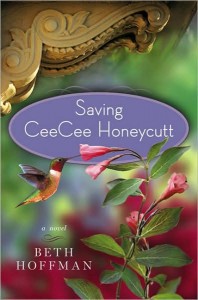
Saving CeeCee Honeycutt by Beth Hoffman

Beth Hoffman‘s debut novel, Saving CeeCee Honeycutt, has become a New York Times bestseller, and what a debut it is.  Her novel is a prime example of what’s great about southern fiction from the enveloping summer heat of Georgia to the fragrant aroma of orchids and other flowers.  CeeCee Honeycutt is a young girl living in Ohio mainly with her mother as her father travels weekly for his job, but she’s got more worries than just school and peer pressure — her mother is slowly losing her grip.

“‘Oysters are a lot like women.  It’s how we survive the hurts in life that brings us strength and gives us our beauty.’  She fell silent for a moment and gazed out the window.  ‘They say there’s no such thing as a perfect pearl — that nothing from nature can ever be truly perfect.'”  (page 255)

Eventually, CeeCee comes to live with her great aunt Tallulah “Tootie” Caldwell, who is a busy society woman interested in preserving the historical structures in Savannah.  In many ways the restoration of these homes resembles the rebuilding CeeCee must accomplish after her life is irrevocably altered.  At the young age of 12, CeeCee must contend with tragedy, being an outcast, the confusing emotions about her parents, and fitting in with a society that is foreign to her.

“Momma left her red satin shoes in the middle of the road.  That’s what three eyewitnesses told the police.”  (Page 1)

Hoffman creates dynamic characters in CeeCee, Mrs. Odell, Oletta, and Tootie, but she also has crafted a supporting cast of eccentric older women who are neighbors and have their own problems and tensions with one another.  Picture large hats, garden parties, and soirees, and you’ll be transported in CeeCee’s Georgia, away from her hometown in Ohio.

“The bedsheets were damp with humidity and sleep, and from the pillowcase I detected a familiar scent:  it was just like the lavender sachets Mrs. Odell made every year as Christmas gifts.  I rubbed my eyes and tried to sit up, but I was nestled deep in the feather bed, like a baby bird in a nest.”  (page 57)

“Though she’d long since passed the zenith of youth, unmistakable remnants of a mysterious beauty oozed from the pores of her porcelain-white skin.  Swirling around her ankles, as light as smoke and the color of midnight, was a silk caftan splashed with bits of silver glitter.”  (page 81)

Readers will be absorbed in CeeCee’s evolution from young, responsible woman caring for her mother to a mischievous child lashing out and back to a young lady becoming content in her own skin.  Hoffman does an excellent job of painting Georgia and its traditional society in a nostalgic hue that enables readers to grasp that CeeCee is remembering this period of her life fondly and with greater clarity than she probably did as a child.  Saving CeeCee Honeycutt is captivating debut novel and coming-of-age story about a young lady who has lost her way, only to find a new chapter has begun.

About the Author:

Beth Hoffman was the president and owner of a major interior design studio in Cincinnati, Ohio, before turning to writing full time. She lives with her husband and two cats in a quaint historic district in Newport, Kentucky. Saving CeeCee Honeycutt is her first novel.

Thanks to Penguin and Inkwell Management for sending me a free copy of Saving CeeCee Honeycutt for review.

Check out the other tour stops:

5/17 & 5/18 – Devourer of Books

5/19 & 5/20 – Diary of an Eccentric

5/21 – Savvy Verse & Wit

5/22 – Medieval Bookworm

5/23 – lit*chick

5/24 – A Novel Menagerie

5/25 – The Tome Traveller’s Weblog

5/26 – Peeking Between the Pages

5/27 – Steph Su Reads

5/28 – Galleysmith

5/29 – The Literate Housewife Review

Giveaway details — three copies for US/Canada readers and one copy for an international reader:

1.  Leave a comment about why you want to read this book; don’t forget to let me know if you are living outside the United States or Canada.

2.  Leave a comment on the guest post.

3.  Blog, Tweet, Facebook, or otherwise spread the word about the giveaway and leave a comment on this post.

4.  Become a Facebook fan of the blog and leave a comment.

Deadline is June 2, 2010, at 11:59 PM EST.

This is my 33rd book for the 2010 New Authors Challenge.

College in a Nutskull by Professor Anders Henriksson

Professor Anders Henriksson has compiled a list of mistakes made by students in higher education in College in a Nutskull.  The spiral bound notebook with lined pages with doodles in the margin is filled with mistakes, misinformation, wrong facts, and spelling errors.  These answers are taken from essay tests all over the world, which were sent to Henriksson.

“Cast aside all worry and savor this text as an opportunity to visit a world remarkably different from the reality we think we inhabit.” (page viii)

The blunders, malapropisms, spoonerisms, and poor facts are arranged by subject, ranging from religious studies to all kinds of history and science and technology.  Many of these examples could be attributed to test-taking jitters as students rush to finish their timed essays, but it makes them no less amusing.  However, some of these lines read more like a “smart ass” spouting off “witty” comments, such as “Descartes began this by stating, ‘I think, therefore I’m Sam.'” (page 11) and “Some of these ideas are unfortunately too long for my attention spam.” (page 69)

Here are a couple malapropisms and spoonerisms:

“A vassal was a kind of servant, only rounder.” (page 63)

“Slavery was the big issue in the Anti-Bedlam South.” (page 76)

Beyond the unintentional word usage, there are just some major factual errors, from “The executive branch exists because Congress allows it to exist” to “Laws are invented by the courts.” (page 90-1)  What is likely to trouble readers, including me, is that the mistakes made are a sad commentary on the state of public education and its ability to prepare students for college.  Terrible grammar, improper word usage, Freudian slips, and other factual mistakes merely demonstrate how ill-prepared students are for college or a career, especially since they cannot communicate clearly.

Overall, College in a Nutskull by Professor Anders Henriksson is a humorous compilation of mistakes by college students that may make an unintentional commentary on public education and student preparedness.  For those who find student errors amusing or for those that enjoy malapropisms, this collection will have you chuckling, shaking your head, and spitting out your coffee.

Check out this article on Henriksson.

FTC Disclosure:  Thanks to Workman Publishing for sending me a free review copy of College in a Nutskull for review.

About the Author:

Photo credit: Kevin G. Gilbert

Dr. Henriksson is a professor at Shepherd University is located in historic Shepherdstown, West Virginia, and the author of Vassals and Citizens: The Baltic Germans in Constitutional Russia, 1905-1914, and The Tsar’s Loyal Germans. The Riga German Community: Social Change and the Nationality Question, 1855-1905. He is co-author of The City in Late Imperial Russia and has published articles in Russian Review, Canadian Slavonic Papers, the Wilson Quarterly, the Journal of Baltic Studies, and the Modern Encyclopedia of Russian, Soviet, and Eurasian History. His research interests focus on the role of class, ethnicity, and gender in the development of civil society in Russia and Eastern Europe. He is currently at work translating and editing the memoir of a Russian nurse in the Russo-Japanese War. Also a chronicler of the humorous side of campus life, Dr. Henriksson is compiler of Non Campus Mentis: World History According to College Students. A second humor book, College in a Nutskull, is due to appear in 2010.

This is my 32nd book for the 2010 New Authors Challenge.

Bite Me: A Love Story by Christopher Moore

Christopher Moore‘s Bite Me: A Love Story continues to the trials of the Countess Jody, Lord Flood, and their minion Abby Normal.  It is the third book in the series set in San Francisco and focuses mainly on Goth teenager Abby Normal, her boy-toy and ultra-nerd Foo Dog (aka Steve), and her gay BFF Jared as they battle a city of vampyre cats . . . and rats.  The Emperor of San Francisco and Detectives Cavuto and Rivera return along with the Animals, Flood’s former colleagues of the Safeway stocking crew.

“I am Nosferatu, bee-yotch.”  (page 176)

“It just goes to show you, like Lord Byron says in the poem:  ‘Given enough weed and explosives, even a creature of most sophisticated and ancient dark power can be undone by a few stoners.’

I’m paraphrasing.  It may have been Shelley.”  (page 6-7)

Moore’s writing is crass and humorous and will have readers laughing out loud about how thick Abby is and yet so smart about the magical.  He has a way with language and creating and adopting slang for his characters, like booticuity, ownage, Mombot, va-jay-jay, and Skankenstein boots.   The vampyres are equally good and bad in this novel, but Abby and her friends are all that stand between San Francisco and total annihilation.  From katanas to LED sunlight jackets and UV lamps to flame throwers and Grandma’s special tea, these kids have tricked out rides and kung-fu skills like no one else.

“The outside city people live on, like, a different plane of existence, like they don’t even see the inside people either.  But when you’re a vampyre, the two cities are all lit up.  You can hear the people talking and eating and watching TV in their houses, and you can see and feel the people in the streets, behind the garbage cans, under the stairs.  All these auras show, sometimes right through walls.  Like life, glowing.” (page 226)

Even more enjoyable is how Moore intertwines other story lines from his previous books, particularly Dirty Job.  It is fun for readers to see how characters from other novels pop in and add spice to the vampyre mayhem.  Moore is a very talented writer with a gift for making readers laugh.  Those who love vampire novels should read the entire series — Bloodsucking Fiends and You SuckBite Me is another laugh-out-loud novel from Moore for those of us who need to step into another world, destress, and laugh intelligently.

This is my 1st book for the 2010 Vampire Series Challenge.

***

Don’t forget to vote for your favorite National Poetry Month Blog Tour post.

FTC Disclosure:  I got my copy of the book from the local library!