Quantcast

Married at Fourteen by Lucille Lang Day

Married at Fourteen by Lucille Lang Day is a memoir about a young girl who wants to grow up fast in the late 1960s, that she seriously starts looking for a husband at age 12.  She’s completely unhappy with her family life, particularly her mother, and with school.  The story spends a great deal of time in the first section examining the numerous boys that Day dated and tried to have sex with, but it also spends a lot of time on her frame of mind for this behavior.  She believes that marriage will set her free from the confines of her own family, allowing her not only to become a mother, but also make her own decisions.  In addition to love and finding a way out of the home, Day is a typical teen in her need to break out of conformity and make her mark, which in her case meant breaking up the monotonous school uniform with her own style and obtaining a switchblade to make her feel more adult-like.

“Nevertheless, I kept mine, which was tucked safely behind my math and history books in my locker.  I wasn’t about to hand it over to any cop.  It was a symbol of who I was.  It meant I didn’t play by the rules; it meant I made up my own rules.  It meant I was a rebel.  It meant I was bad.”  (Page 4 ARC)

When Day finally marries, she finds it is not all romance and roses, but she has to think about more than herself now that she has a daughter, Liana.  In a way the first portion of the book is a good illustration of why teens need observant parents in their lives — to teach them what is right and what is wrong, but also to guide them down the best path.  Day seems to have learned some lessons in love the hard way.  She also learned some lessons about motherhood and how far she was willing to go for money.

Part one looks back at Day’s teenage years, while the second portion of the memoir is a series of self-contained stories from her life as an adult, struggling to gain a college education after her struggle for a high school diploma as well as her struggle to keep a job and be treated fairly by her employers.  Married at Fourteen by Lucille Lang Day is an engaging look at what it was like for a young woman with big dreams of equality to live in the 1960s.  Day’s memoir is a stark look at family life, alcoholism, rebellion among teens, and so much more.  There is a cultural shift, but also an evolution within Day as she takes on her self-imposed struggles in love and motherhood.

About the Author:

Lucille Lang Day has published creative nonfiction in The Hudson Review, the Istanbul Literary Review, Passages North, the River Oak Review, the Willow Review, and many other journals. She is the recipient of the Willow Review Award in Creative Nonfiction and a Notable Essay citation in Best American Essays. She is also the author of a children’s book, Chain Letter, and eight poetry collections and chapbooks, including The Curvature of Blue, Infinities, and The Book of Answers. Her first poetry collection, Self-Portrait with Hand Microscope, received the Joseph Henry Jackson Award. She received an M.A. in English and an M.F.A. in creative writing at San Francisco State University, and then an M.A. in zoology and a Ph.D. in science and mathematics education at the University of California, Berkeley. The founder and director of a small press, Scarlet Tanager Books, she also served for seventeen years as the director of the Hall of Health, an interactive children’s museum in Berkeley.

This is my 72nd book for the New Authors Reading Challenge in 2012.
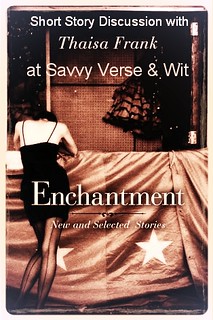
Enchantment Short Story Discussion of ‘Night Visions’ by Thaisa Frank

Welcome to today’s discussion of “Night Visions” from Thaisa Frank’s collection of short stories in Enchantment.

After the last discussion in October for “The Mapmaker,” Thaisa Frank mentioned that a companion set of stories was “Night Visions.”  As a group, we decided to visit again with Frank’s family of characters.

This short story is broken down into several sections as well:

“Afternoon in Kansas”
“My Face”
“Origins”
“The Kiss”
“The Enchanted Man”
“The Store”
“My Mother’s Voice”
“Door into Dark”
“Country Boy”

I hope everyone has had a chance to read all of the sections for today’s discussion. I wanted to start everyone off with a few things to talk about.  Please be aware there could be spoilers.

1.  Night is referenced in “Night Visions” in reference to the mother and the night’s inability to recapture her.  Does this reference to night say something in particular about the narrator’s feelings toward her mother or more about the mother’s personality and behavior.

2.  In “Origins,” how does the absence of a past for the family present itself in the narrative and what impact does this have on the narrator?  Why do you think the past is so absent from the present?

3.  Brueghel’s picture is mentioned several times — a reference to a family of Flemish renaissance painters — one is of a wedding feast and another seems to be of a snowy landscape.  What theories do you have about their significance?

OK, that’s enough from me.  Let’s get this discussion started…

Also, if you want to discuss another short story in November, let’s pick a date that we’re all available and see what story we all want to discuss.

Bowling Avenue by Ann Shayne

Bowling Avenue by Ann Shayne follows Delia Ballenger’s re-acquaintance with all things Nashville, including her absentee mother, statuesque brother-in-law, and two nieces she barely knows when she’s given her sister Ginna’s house, 603 Bowling Avenue.  Bowling Avenue has a culture all its own, with the in-your-business neighbors and the families of doctors from the Vanderbilt.  Delia has lived her life on her own terms, but has rarely returned home for family gatherings or holidays, spending her time alone in Chicago catering to the needs of the super rich on holiday in a variety of countries.  She’s lived an isolated life, and because of that her sister’s death is even more shocking as are the revelations that come with her passing.

“I don’t believe in ghosts, I really don’t.  So the prospect of staying at my dead sister’s house is not daunting in terms of worrying that I’m going to run into a spectral Ginna wandering the hall in her Lanz of Salzburg nightgown.  Actually, that would be really terrifying.  She wore those things all her life:  eyelet trimmed, flannel, hot as fiberglass insulation.”  (Page 10)

Death can change family dynamics in many ways, and Shayne examines how the death of a loved one can either tear a family further apart or bring them closer.  In the Ballenger family, communication is practically non-existent unless you are looking for sarcastic comebacks or blame.  Delia has a lot to learn not only about dealing with grief, but also about what it means to find a home and a family.  Shayne has a unique style and deftly wields the first person point of view through which readers learn the Ballenger family secrets.  The secrets unfold bit by bit as Delia attempts to get her sister’s house ready for sale, and as she deals with her mother’s interference and her brother-in-law’s hands-off approach to fatherhood and family.

Nashville has more than the music business, and Shayne has some of the quirkiest characters.  They are by turns fun and infuriating, but that’s what makes the story so engaging.  Bowling Avenue by Ann Shayne is a fun read with a tender heart.  Delia and her family will make you feel at home and wrap you up in their arms.  Readers will be cheering her on as she examines her past, her present, and her future.

***I want to thank Alma Katsu for recommending this book to me.***

About the Author:

Ann Shayne lives in Nashville with her husband and two sons. She is the co-author, with Kay Gardiner, of Mason-Dixon Knitting: The Curious Knitter’s Guide and Mason-Dixon Knitting Outside the Lines. Their blog, Mason-Dixon Knitting, has persevered since 2003 despite constant begging for them to shut up.

This is my 73rd book for the New Authors Reading Challenge in 2012.

Mailbox Monday #197

Mailbox Mondays (click the icon to check out the new blog) has gone on tour since Marcia at A Girl and Her Books, formerly The Printed Page passed the torch. This month’s host is the Mailbox Monday blog.

The meme allows bloggers to share what books they receive in the mail or through other means over the past week.

Just be warned that these posts can increase your TBR piles and wish lists.

Here’s what I received:

1.  The New Arcana by John Amen and Daniel Y. Harris, which I received for review from the poets.

THE NEW ARCANA is a multi-genre extravaganza featuring verse, fiction, mock journalism and academic writing, drama, and art. Both referencing and transcending various literary precedents, the book is a pronouncement for the 21st Century, an exploration of and commentary on the fast-paced and mercurial nature of life in the 2000s. Co-written by poets John Amen and Daniel Y. Harris, the book presents a compelling, jazz-like, and satirical style, a third voice born from the mingling of two distinct individual voices. THE NEW ARCANA is a memorable literary statement—a manifesto for our time—as well as a proclamation regarding the transformative qualities of true collaboration.

2.  Judging a Book by its Lover by Lauren Leto, which I received for review from HarperCollins.

Want to impress the hot stranger at the bar who asks for your take on Infinite Jest? Dying to shut up the blowhard in front of you who’s pontificating on Cormac McCarthy’s “recurring road narratives”? Having difficulty keeping Francine Prose and Annie Proulx straight?

For all those overwhelmed readers who need to get a firm grip on the relentless onslaught of must-read books to stay on top of the inevitable conversations that swirl around them, Lauren Leto’s Judging a Book by Its Lover is manna from literary heaven! A hilarious send-up of—and inspired homage to—the passionate and peculiar world of book culture, this guide to literary debate leaves no reader or author unscathed, at once adoring and skewering everyone from Jonathan Franzen to Ayn Rand to Dostoyevsky and the people who read them.

3.  When All My Disappointments Came at Once by Todd Swift for review from Tightrope Books.

This poetry collection explores the journey of recovery from depression after a man’s diagnosis for extreme male infertility. Dreams are destroyed and slowly rebuilt with the help of a loving wife and the healing force of the poetic art. As it touches on the topics of childlessness and mental health from a male perspective, this compilation will appeal to a wide readership.

What did you receive?

170th Virtual Poetry Circle

Welcome to the 170th Virtual Poetry Circle!

Remember, this is just for fun and is not meant to be stressful.

Keep in mind what Molly Peacock’s books suggested. Look at a line, a stanza, sentences, and images; describe what you like or don’t like; and offer an opinion. If you missed my review of her book, check it out here.

Also, sign up for the 2012 Fearless Poetry Reading Challenge because its simple; you only need to read 1 book of poetry. Please visit the stops on the 2012 National Poetry Month Blog Tour.

Today’s poem is from Carsten René Nielsen from House Inspections:

Mail (page 61)

After an acquaintance remarked that a certain, newly erected building
looks like a piece of set design, the mailman, more and more, has
entertained the possibility that there's nothing on the other side of the
house fronts, no floors either, but that the letters, as soon as they have
disappeared through the letter flaps, continue their fall downwards,
whirling through an all-engulfing darkness.

What do you think?

Interview with Emma Eden Ramos

Emma Eden Ramos is a relatively new-to-me voice in poetry and short fiction, but she’s got such a unique perspective on her stories that make it fresh and memorable.  Her poetry, particularly in Three Women that I reviewed last year, offers well drawn voices and perspectives, and her poems are memorable in the images that they create.  It is no wonder that she brings these same talents to her fiction, including the recently published The Realm of the Lost, which I reviewed earlier this week.

Today, she’s agreed to answer a few questions about her middle-grade fantasy novella, The Realm of the Lost.

1.  The Realm of the Lost is a novella for middle grade readers, and you’ve published poetry in a collection, Three Women.  How was the writing process different for these two genres?  Did one take longer than the other? Was there more editing involved with the novella versus the poetry collection, etc.?

Because Three Women: A Poetic Triptych is prose-like and tells a story, I approached it and The Realm of the Lost in much the same way. When I began writing Three Woman, however, I gave myself permission to be reckless and experimental. While the idea for The Realm of the Lost cycled through my head for about a year before I was able to go anywhere with it, Three Women took two months from start to finish.

Initially, with Three Women, I found myself saying, “This could be a giant failure, but so what? Why not try it out? Be messy!” That frame of mind turned out to be crucial because, while it shifted once I got deep into the writing, it gave me the starting point I needed. I consider myself more prose-writer than poet, so I was reserved about letting go and playing with The Realm of the Lost. Once I allowed myself room to be adventurous (and perhaps even silly at times), The Realm of the Lost began to take shape.

The Realm of the Lost certainly required more editing than Three Women. Whether that has more to do with genre or length (The Realm of the Lost being four times as long as Three Women), I don’t know. I do know that, in both cases, giving myself ample space to experiment helped the story morph into something tangible and, hopefully, soulful.

2.  Mikey, the eight-year-old boy in Realm of the Lost, is exuberant and often acts without thinking, like most little brothers.  Do you have any siblings?  If not, where did the inspiration for Mikey come from? And are their plans to write his own story?

While I do have a younger sibling (a sister), she wasn’t the inspiration for Mikey. Let’s just say that she isn’t the one known for being “overly exuberant” and acting thoughtlessly.

When I first met Mikey, I thought of him as a cross between Dickey from Dickens’ Oliver Twist and the little brother from the 1944 film National Velvet, whose signature line, “I was sick all night!” seemed to fit in with Mikey’s usual impishness.

There will be another Realm story. I can’t say for sure if it will center around Mikey. He is, nevertheless, bound to make an appearance.

3.  Rosario is a mysterious character, but she sort of takes on a big sisterly role with Kat, which is a bit of a role reversal for the protagonist.  Was this intentional and what do you think this relationship teaches Kat about her own life?

While Kat sees herself as “the patient one, the one who takes care of everyone,” she has a tendency to be quick-tempered and judgmental. As is true of many first children, Kat views her younger siblings–her sister Ellie in particular–as a burden. She is too preoccupied with being the bossy grown-up to give herself space to be a kid. When Rosario steps in and not only chastises Kat for being unkind to Mikey but takes on the role of Big Sister, Kat begins to have experiences that allow her to identify with the people she has been so quick to snub.

4.  Tell us a little bit about your process in finding a publisher for your poetry and short stories.  Do you have an organized method? How do you find the right publishers or do you have a network of writers that offer their advice?

Finding the right publisher for one’s work can be a bit like finding the right college. There is an enormous amount of research involved. With Three Women, I was asked by the editor to write a poetry chapbook, so I didn’t end up doing the research that is typically required. With The Realm of the Lost, I kept an eye out for different publishers the moment I had the idea. Stories for Children Magazine, a journal for children’s literature that published one of my stories, had a monthly newsletter that included publishing houses accepting middle grade and juvenile fiction. MuseItUp Publishing was on that list.

There are some fantastic resources out there for writers. Many genre-specific journals have a newsletter or an affiliations page on their website. It is always a good idea to search through names and visit different publishing houses’ websites. I have a list on my computer that I revisit regularly.

5.  Will your next project be middle grade readers, poetry, or something else?  Care to share some tidbits or a title to whet readers’ appetites?

My next book will be for middle grade readers. If I had a title, I’d happily share it. That is still in the works. This book, however, will be a full-length novel. I love novellas and read them regularly, and I plan to continue writing them. But yes, a novel is on its way, so please stay tuned.

Thanks, Emma, for sharing your thoughts with us about your novella, your characters, and the writing and publishing process.

About the Author:

Emma Eden Ramos is a writer and student from New York City. Her short stories have appeared in Stories for Children Magazine, The Storyteller Tymes, BlazeVOX Journal, and others. Emma’s novelette, Where the Children Play, is included in Resilience: Stories, Poems, Essays, Words for LGBT Teens, edited by Eric Nguyen. Three Women: A Poetic Triptych and Selected Poems (Heavy Hands Ink, 2011), Ramos’ first poetry chapbook, was shortlisted for the 2011 Independent Literary Award in Poetry. Emma studies psychology at Marymount Manhattan College.

The Caller by Karin Fossum, translated by K.E. Semmel

The Caller by Karin Fossum, translated by K.E. Semmel from the Norwegian, is the eighth book in her Inspector Konrad Sejer series of books.  It is not only a mystery with a adrenaline rush, but also a psychological examination of the criminal and victims minds.  Rather than a mystery that needs to be unraveled, Fossum creates an unsettling atmosphere that keeps readers on the edge.  What will happen next, how will the criminal again strike fear into those around him — neighbors, family, strangers.

And yes, this is a book about fear — the fear of death — the fear of death when it calls.  Death is always unexpected when it arrives, but what if you are lulled into an artificial sense of security by your own contented perceptions of your home and neighborhood?  What if something occurs that simply disrupts your preconceived notions of security?  Fossum asks these questions with each new prank and situation, and she ramps up the anxiety with each page turned.  From the very first pages, readers become aware that the Norwegian landscape will darken and tranquility will become tentative.

“Poor little thing, she thought, and tore its thighs off.  She liked the cracking sound the cartilage made when tearing from the bone.  Light and tender, the meat let go easily, and she succumbed to the temptation to stick a piece in her mouth.  It’s good, she thought, it has just enough seasoning, and it’s lean too.  She filled the pie dish and sprinkled on Cheddar cheese.  The she checked the time.  She didn’t worry about Margrete.  If the child sneezed she would know it immediately.  If she coughed or hiccuped, or began to cry, she would know.  Because there was a bond between them, a bond as thick as a mooring line.  Even the slightest tug would reach her like a vibration.”  (page 2)

However, it is the undercurrent under the surface plot that ripples beneath, providing just enough suspicion to keep readers wondering who the true criminal is.  Readers get a sense of Inspector Konrad Sejer as an honest man whose seen it all, but continues to work for the police as a way to ensure justice.  But readers also get to know how much his life has changed over the years and where his strength comes from — his family and young nephew Matteus.  His health may be failing, but the case is always important, pulling him away from his own misery into that of the victims and even the possible perpetrator.

When death calls, even in its mistiest form, The Caller by Karin Fossum, translated by K.E. Semmel tackles the what ifs and the inevitability that comes with that visit, including the reassessment of behavior and routine, love, and perseverance.  The atmosphere of the novel is by turns complacent and topsy-turvy, and Fossum’s characters must navigate the new world into which they are thrust.

About the Author:

Karin Fossum is the author of the internationally successful Inspector Konrad Sejer crime series. Her recent honors include a Gumshoe Award and the Los Angeles Times Book Prize for mystery/thriller. She lives in a small town in southeastern Norway.

About the Translator:

K.E. Semmel is a writer and translator whose work has appeared in Ontario Review, the Washington Post, Aufgabe, The Brooklyn Review, The Bitter Oleander, and elsewhere. He has worked as the Publications & Communications Manager of The Writer’s Center, an independent nonprofit literary organization based in Bethesda, MD that offers over 300 workshops in writing annually and hosts around 50 literary events a year.  He is known for his work translating Simon Fruelund’s fiction, and he has received a translation grant from the Danish Arts Council.

This is my 71st book for the New Authors Reading Challenge in 2012.

The Realm of the Lost by Emma Eden Ramos

The Realm of the Lost by Emma Eden Ramos is a middle-grade fantasy novel about a 13-year-old girl, named Kat Gallagher, who is feisty and responsible.  She’s got younger siblings, Ellie and Colm, and a home life that is not what it once was, but she takes it on her own shoulders to care for her little brother whose sick a lot of the time.  Her and Ellie, on the other hand, act as sisters should, especially sisters who share a room.  They bicker over space, and one day on the way to school, all of the tension boils over on the streets of New York City.

An accident changes everything for Kat, and she finds herself in a place that is disconcerting to say the least.  Here, she meets Rosario and Mikey, her brother and sister in the realm, and she must contend with Miss A, her realm mother.  Between the Tallyman, the mysterious forests, and the creepy dark mists that come out at night with Apate, Kat must navigate a strange and frightening world.  What makes this world believable is Ramos’ ability to ground her characters in a place and time, despite their strange surroundings.

“Before she died, Grandma Rose gave me a sterling silver necklace bearing the Celtic triskele.  ‘This,’ she explained, pointing to each swirl that extended from the symbol’s triangular middle, ‘will bring you knowledge, power, and, someday, a safe passage.'” (from ebook, location 27)

Grandma Rose is like Kat, a feisty Irish woman who immigrated to the United States, and she is reminiscent of the grandmothers who tell tall tales from the past and generally dote on their grandchildren.  Unfortunately, we don’t see much of this relationship, but a glimpse is enough to get the gist that she’s an important part of Kat’s upbringing.  The relationship between Ellie and Kat is clear, though the relationship with their mother is a little less developed.  However, Ramos offers the right balance of plot and description to see where Kat is and when, allowing the suspense and tension to build to the twist.

The four realms and what they signify are interesting, and could bring additional inspiration for a series of novellas, if Ramos is so inclined — the possibilities are endless.  But what is truly engaging is the parallels between The Realm of the Lost and Kat’s real life, only in the lost realm, Kat is forced to take on the role of younger sibling.  The Realm of the Lost by Emma Eden Ramos is an adventure that teachers Kat that there are more important things than just whether you have your own room.

***I wanted this to be longer!***

About the Author:

Emma Eden Ramos is a writer and student from New York City. Her short stories have appeared in Stories for Children Magazine, The Storyteller Tymes, BlazeVOX Journal, and others. Emma’s novelette, Where the Children Play, is included in Resilience: Stories, Poems, Essays, Words for LGBT Teens, edited by Eric Nguyen. Three Women: A Poetic Triptych and Selected Poems (Heavy Hands Ink, 2011), Ramos’ first poetry chapbook, was shortlisted for the 2011 Independent Literary Award in Poetry. Emma studies psychology at Marymount Manhattan College.  Please visit her Website.

This is my 5th book for the 2012 Ireland Reading Challenge.

Mailbox Monday #196

Mailbox Mondays (click the icon to check out the new blog) has gone on tour since Marcia at A Girl and Her Books, formerly The Printed Page passed the torch. This month’s host is the Mailbox Monday blog.

The meme allows bloggers to share what books they receive in the mail or through other means over the past week.

Just be warned that these posts can increase your TBR piles and wish lists.

Here’s what I received:

1.  The Lost Art of Mixing and The School of Essential Ingredients by Erica Bauermeister for TLC Book Tour.

Lillian and her restaurant have a way of drawing people together. There’s Al, the accountant who finds meaning in numbers and ritual; Chloe, a budding chef who hasn’t learned to trust after heartbreak; Finnegan, quiet and steady as a tree, who can disappear into the background despite his massive height; Louise, Al’s wife, whose anger simmers just below the boiling point; and Isabelle, whose memories are slowly slipping from her grasp. And there’s Lillian herself, whose life has taken a turn she didn’t expect. . . .

Their lives collide and mix with those around them, sometimes joining in effortless connections, at other times sifting together and separating again, creating a family that is chosen, not given. A beautifully imagined novel about the ties that bind—and links that break—The Lost Art of Mixing is a captivating meditation on the power of love, food, and companionship.

2.  The Hopkins Touch by David Roll for review in January from LibraryThing’s Early Reviewer Program.

David Roll shows how Harry Hopkins, an Iowa-born social worker who had been an integral part of the New Deal’s implementation, became the linchpin in FDR’s–and America’s–relationships with Churchill and Stalin, and spoke with an authority second only to the president’s. Gaunt, nearly spectral, and malnourished following an operation to remove part of his stomach, the newly widowed Hopkins accepted the president’s invitation to move into the White House in 1940 and remained Roosevelt’s closest advisor, speechwriter, sounding board, and friend nearly to the end. Between 1940 and 1945, with incomparable skill and indefatigable determination, Hopkins organized the Lend-Lease program and steered the president to prepare the public for war with Germany. He became FDR’s problem-solver and fixer, helping to smooth over crises, such as when the British refused to allow an invasion of Europe in 1943, enraging Stalin, who felt that the Soviet Union was carrying the military effort against the Nazis. Lacking an official title or a clear executive branch portfolio, Hopkins could take the political risks his boss could not, and proved crucial to maintaining personal relations among the Big Three. Beloved by some–such as Churchill, who believed that Hopkins “always went to the root of the matter”–and trusted by most–including the paranoid Stalin–there were nevertheless those who resented the influence of “the White House Rasputin.”

3.  Ardor: Poems of Life by Janine Canan for review.

4.  Carnival by Jason Bredle for review.

Jason Bredle’s poems approach the world like a haunted cat approaches a glacier, curious and itchy with strangeness. In Carnival, he skates paratactically between states of being: levity, heart-holes, licks of darkness, lovesickness and werewolfishness. Bredle’s gift as a poet is to traverse and re-traverse one looking glass in ten different moods. When he goes through it, we are taken. -Melissa Broder

5. Leaves by Michael Baron for review with Providence Book Promotions in February.

Welcome to Oldham, CT, a small town rich in Colonial heritage while being utterly contemporary. Situated along the Connecticut River Valley, Oldham bursts with color every fall, as the leaves on its trees evolve into an unmatched palette of scarlet, orange, purple, yellow, and bronze. For more than three decades, the Gold family has been a central part of Oldham in the fall, its Sugar Maple Inn a destination for “leaf-peepers” from all over the country, and its annual Halloween party a stirring way to punctuate the town’s most active month.

But this year, more than just the leaves are changing. With the death of their parents, the Gold siblings, Maria, Maxwell, Deborah, Corrina, and Tyler, have decided to sell the Sugar Maple Inn, and this year’s Halloween party will be the last. As October begins, the Golds contend with the finality that faces them, and the implications it has for a family that has always been so close. For some, it means embracing new challenges and new love. For others, it means taking on unimagined roles. And for others, it means considering the inconceivable. Complicating it all is a series of “hauntings” that touch each of the Gold siblings, a series of benign interventions that will remain a mystery until October draws to a close.

What did you receive?

169th Virtual Poetry Circle

Welcome to the 169th Virtual Poetry Circle!

Remember, this is just for fun and is not meant to be stressful.

Keep in mind what Molly Peacock’s books suggested. Look at a line, a stanza, sentences, and images; describe what you like or don’t like; and offer an opinion. If you missed my review of her book, check it out here.

Also, sign up for the 2012 Fearless Poetry Reading Challenge because its simple; you only need to read 1 book of poetry. Please visit the stops on the 2012 National Poetry Month Blog Tour.

Today’s poem is from Jason Bredle from Carnival:

Epilogue (page 53)

I walked to 7-11 just to say hi.
I saw a group of men
arguing about the definition of modernism.

I fell asleep.
I had a dream about a farm.
The dream frightened me.

I'm trying to enjoy the last few years
before the impending
fall of civilization.

I've learned many lessons, among them,
never put your hands into a jaguar's mouth,
even if it's just a statue.

What do you think?