Quantcast

Three Souls by Janie Chang

Source: William Morrow and TLC Book Tours
Paperback, 502 pages
I am an Amazon Affiliate

Three Souls by Janie Chang — a stunning debut — is a sweeping novel set in late 1920s China when factions were battling for supremacy over land, wealth, the people, and politics — the Nationalists versus the Communists.  Song Leiyin is the third daughter in a large and wealthy family, and she loves pleasing her father with her good grades and is dutiful to her sisters and her father’s concubine, known as Stepmother.  She’s young and impetuous, and like her father often acts without taking a breath and thinking before she acts.  When she’s introduced to Yen Hanchin, a poet, her heart is captured by his intelligence and charm, and it doesn’t hurt that he’s translated Anna Karenina, which has been banned by her school but that she’s reading anyway.  Leiyin soon discovers that while her father had a Western education he’s still a very traditional man and not as liberal as some of their social peers, and when she pushes his limits of tradition too far, she has to live with the consequences.

“We have three souls, or so I’d been told.
But only in death could I confirm this.” (page 1)

Chang’s approach to story-telling is not unique, but how it is presented is. We know at the start that Leiyin is dead, but like her we learn through her memories — siphoned through her three souls: yin, yang, and hun — how she came to be in limbo and how she lived her life. She was a young, headstrong girl in love with a Communist leader of sorts, who was also a poet and an editor of China Millennium. While he filled her head with new ideas about what China could become, he also filled her naive head with longing and lust. Her infatuation with him led her to defy her father, and while the consequences were overly harsh, they were in line with traditional Chinese thinking and practices.

Chang’s story unfolds slowly and Leiyin is forced to think about her actions without hindsight, but as an observer of her own life — reminiscent of one’s life flashing before one’s eyes before death. However, her struggle is only beginning as she learns how her actions had farther reaching consequences than she ever imagined.  She must come to terms with her behavior, life choices, and learn that things are beyond her control.

With allusions to the Leo Tolstoy novel, Chang brings to life the class struggles in China, the inspiration the Communist movement strove to ignite, and the tangled web of lies that many leaders on both sides pursued to craft future China.  Three Souls by Janie Chang is epic, heart-warming, and multi-layered, incorporating Chinese tradition, class struggle, and the burden of a life cut too short.

About the Author:

Born in Taiwan, Janie Chang spent part of her childhood in the Philippines, Iran, and Thailand. She holds a degree in computer science and is a graduate of the Writer’s Studio Program at Simon Fraser University. Three Souls is her first novel.

Find out more about Janie at her website, follow her on Twitter, and connect with her on Facebook.
12th book for 2014 New Author Challenge.


8th book for 2014 Historical Fiction Reading Challenge.

Mailbox Monday #262

Mailbox Monday, created by Marcia at To Be Continued, formerly The Printed Page, has gone through a few incarnations from a permanent home with Marcia to a tour of other blogs.

Now, it has its own permanent home at its own blog.

To check out what everyone has received over the last week, visit the blog and check out the links.  Leave yours too.

Also, each week, Leslie, Vicki, and I will share the Books that Caught Our Eye from everyone’s weekly links.

Here’s what I received:

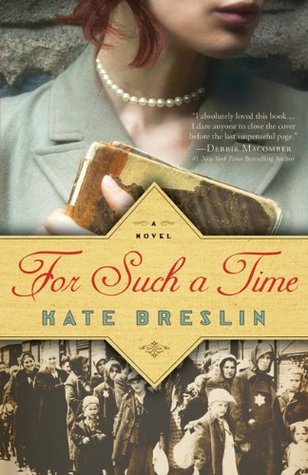
1. For Such a Time by Kate Breslin for review in May with TLC Book Tours.

In 1944, blonde and blue-eyed Jewess Hadassah Benjamin feels abandoned by God when she is saved from a firing squad only to be handed over to a new enemy. Pressed into service by SS-Kommandant Colonel Aric von Schmidt at the transit camp of Theresienstadt in Czechoslovakia, she is able to hide behind the false identity of Stella Muller. However, in order to survive and maintain her cover as Aric’s secretary, she is forced to stand by as her own people are sent to Auschwitz. Suspecting her employer is a man of hidden depths and sympathies, Stella cautiously appeals to him on behalf of those in the camp. Aric’s compassion gives her hope, and she finds herself battling a growing attraction for this man she knows she should despise as an enemy. Stella pours herself into her efforts to keep even some of the camp’s prisoners safe, but she risks the revelation of her true identity with every attempt. When her bravery brings her to the point of the ultimate sacrifice, she has only her faith to lean upon.

2.  A Dangerous Age by Ellen Gilchrist from Algonquin unexpectedly.

“A Dangerous Age” tells the story of the women of the Hand family, three cousins in a Southern dynasty rich with history and tradition who are no strangers to either controversy or sadness. By turns humorous and heartbreaking, the novel is a celebration of the strength of these women, and of others like them. In her characteristically clear and direct prose, with its wry, no-nonsense approach to the world and the people who inhabit it, Gilchrist gives voice to women on a collision course with a distant war that, in truth, is never more than a breath away.

3.  Acts of God by Ellen Gilchrist from Algonquin unexpectedly.

Critically acclaimed writer Ellen Gilchrist, winner of the National Book Award, returns with her first story collection in eight years.In Acts of God, master short story writer Ellen Gilchrist has crafted a collection that takes us into eleven scenarios in which people dealing with forces beyond their control somehow manage to survive, persevere, and even triumph.For Marie James, a teenager from Fayetteville, Arkansas, the future changes when she joins a group of friends in their effort to find survivors among the debris left when a tornado destroys a neighboring town. For Philipa, taking control of her own fate is the greatest act of courage she can imagine, and the most difficult. For Eli Naylor, left orphaned by a flood, there arrives the understanding that out of tragedy can come the greatest good. In one way or another, all of these people are survivors who find the strength to go on when confronted with their own mortality, and they come alive in these stories, told with clear-eyed optimism and a salty sense of humor.

4. The Girl Who Came Home by Hazel Gaynor from HarperCollins’ William Morrow for review.

Inspired by true events surrounding a group of Irish emigrants who sailed on the maiden voyage of R.M.S Titanic, The Girl Who Came Home is a story of enduring love and forgiveness, spanning seventy years. It is also the story of the world’s most famous ship, whose tragic legacy continues to captivate our hearts and imaginations one hundred years after she sank to the bottom of the Atlantic ocean with such a devastating loss of life.

In a rural Irish village in April 1912, seventeen-year-old Maggie Murphy is anxious about the trip to America. While the thirteen others she will travel with from her Parish anticipate a life of prosperity and opportunity – including her strict Aunt Kathleen who will be her chaperon for the journey – Maggie is distraught to be leaving Séamus, the man she loves with all her heart. As the carts rumble out of the village, she clutches a packet of love letters in her coat pocket and hopes that Séamus will be able to join her in America soon.

What did you receive?

245th Virtual Poetry Circle

Welcome to the 245th Virtual Poetry Circle!

Remember, this is just for fun and is not meant to be stressful.

Keep in mind what Molly Peacock’s book suggested.

Look at a line, a stanza, sentences, and images; describe what you like or don’t like; and offer an opinion. If you missed my review of her book, check it out here.

Also, sign up for the 2014 Dive Into Poetry Reading Challenge because there are several levels of participation for your comfort level.

For more poetry, check out the stops on the 2013 National Poetry Month Blog Tour and the 2012 National Poetry Month Blog Tour.

Signup for the 2014 National Poetry Month Blog Tour: Reach for the Horizon

Today’s poem is from W. D. Snodgrass:

Who Steals My Good Name

                  For the person who obtained my debit card number and spent $11,000 in five days.

My pale stepdaughter, just off the school bus,   
Scowled, "Well, that's the last time I say my name's   
Snodgrass!" Just so, may that anonymous   
Mexican male who prodigally claims   

My clan lines, identity and the sixteen   
Digits that unlock my bank account,   
Think twice. That less than proper name's been   
Taken by three ex-wives, each for an amount   

Past all you've squandered, each more than pleased   
To change it back. That surname you affect   
May have more consequence than getting teased   
By dumb kids or tracked down by bank detectives.   

Don't underrate its history: one of ours played   
Piano on his prison's weekly broadcast;   
One got rich on a scammed quiz show; one made   
A bungle costing the World Series. My own past   

Could subject you to guilt by association:   
If you write anything more than false checks,   
Abandon all hope of large press publication   
Or prizes—critics shun the name like sex

Without a condom. Whoever steals my purse   
Helps chain me to my writing desk again   
For fun and profit. So take thanks with my curse:   
May your pen name help send you to your pen.

What do you think?

Persuasion, A Tearoom Chat Week 2

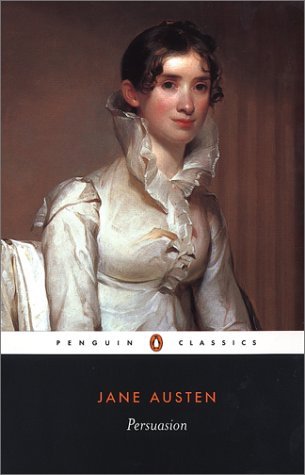
Anna and I are chatting about Persuasion by Jane Austen this month.  We hope that you’ll join us. 

Click the here for our first discussion post of Vol. 1, Ch. 1-6.

Please see below for part 2 of our discussion for Vol. 1, Ch. 7-12

Today, I’m sipping a Mint herbal tea blend tea, accompanied by 2 Samoa Girl Scout cookies.  Anna had some lemonade.

Serena: Anne assumes that Wentworth has been avoiding her as plans change between the Musgroves and him for where and when they meet.  Do you think that’s the guilt and shame she feels or do you suspect his avoiding her?

Anna: Maybe he was avoiding her, but I noticed more that she was avoiding him, being happy to take care of little Charles so his parents could go to dinner with Wentworth at the Great House. I did get a sense of her anxiety about their initial meeting, and at least when it happened, it was over fairly quickly for her.

Serena: I found it ironic that she thought that he was avoiding her, but in point of fact, it was really the other way around. She wanted to nurse Charles or feign a headache more than she wanted to meet with Wentworth among company. I wonder if she was afraid of her reaction or his?

Anna: I think Anne has a good grasp of holding in her feelings, having lived with Sir Walter, Elizabeth, and Mary for so long and being neglected and isolated. I wonder after their initial meeting and learning that Wentworth barely recognized her, her having lost the “bloom” of youth and all, that it was his reaction she feared. It’s not long before she’s lamenting that they used to mean so much to one another, and now nothing.

Those passages really tugged at me. And throughout this section, as Anne meets Wentworth’s Navy friends, for instance, she’s struck by all that she’s lost. Do you remember anywhere else in Austen being so moved, or do you think this is a sign of Persuasion being a more mature novel, as it was written toward the end of her life?

Serena: I agree that Anne’s avoidance of Wentworth seems to be borne of the fear that he will react in a way that will unease her, and in fact, she does. And meeting those friends and seeing how in love the Crofts are, I think that too weighs heavily on her. As if she didn’t feel bad enough about her decision. I can’t recall anything so blatantly depressing as this in Austen’s other novels. Those still seemed to have a bit of the youthful play in them; this novel is not only more mature in feeling, but also in dramatization.

Anne is still in the background of most everything that happens plot-wise here, but she is in the middle of it just the same. She the observer, but she doesn’t merely observe because everything that happens affects her in some way, particularly when Wentworth enters the picture.

What did you think of her when she says that she could take no revenge because he was the same?

Anna: I think the Musgrove sisters are the youthfulness in this novel. A more elegant and better behaved Kitty and Lydia, even if they do get a little excitable over Captain Wentworth.

I agree that she is an observer and deeply affected as well. Of course, while we see all the emotions and sadness going through her mind, everyone else is oblivious to her pain. Austen does let readers into Wentworth’s head, if only a moment, early on when he’s first introduced, and then there are a few actions here and there that make you see his opinion of her is slowly changing. It’s obvious to us because we know their past, but it’s very subtle when you think that their companions have no clue.

I loved Anne for saying she could take no revenge because I know that I personally, even if just internally, would not have been that nice. That really emphasizes her strength of character and her kindness toward others. After Louisa’s accident, when they’re deciding which of the women will stay at the Harville’s, there’s a passage that indicates that she would care for Louisa for his sake. Imagine watching the only man you ever loved, whom you could have married, seemingly falling in love with another woman, and you would do that for him. Of course, she’s pretty much part of the Musgrove family, so that plays into it as well, but still.

These are things that make it obvious why Wentworth has never found another woman better than Anne. What do you think about him showing attention to both Henrietta and Louisa, without even really caring for either of them? Part of it must surely be his desire to make Anne jealous to an extent, but in that day and age, he was playing a dangerous game.

Serena: I’m not really sure that he was paying attention to them consciously. I think he was baffled by Anne’s presence there and really didn’t want to be rude to the Musgroves. But his attentions never seem overtly in favor of either girl, except when it comes to the incident at the Cobb. There is that one intimate conversation that Anne overhears between Louisa and Wentworth, but I think that was more Louisa’s machinations than his.

While maybe he enjoyed having the attention of two young women and his intentions may be to find a wife, I feel like he was still sorting through his feelings for Anne and not intentionally partial or even aware that he was demonstrating affinity for either of the Musgroves — in some ways, the perception that he is in favor of one or the other or even interested in either seems to be the ideas put forth by Mary, Charles and the Crofts without any real indication on his part.

Speaking of the Cobb, what do you think motivated Louisa to jump from such a height? Was she trying to prove something or was that merely youthful folly on her part?

Anna: Having been so long at sea, he may also just enjoy the sisters’ attention. But he does spend an awful lot of time at Uppercross, so it’s not wrong of those around him to wonder what he’s about, even if he’s not completely conscious of it. There are some things in that conversation he has with Louisa — and he doesn’t know that Anne’s listening — that if I were Louisa, I would’ve thought he liked me.

As for Louisa’s jump, there are several places in the narrative where it shows Louisa being more determined about doing things since that conversation with Wentworth, where he talks about strength of character and not being easily persuaded. So I think that played into it somewhat, but mostly, I think she was being flirty and playful and thought it would be fun. Even when I shake my head at Louisa’s folly, I actually do admire her high spirits.

Now I’ve been dying to know, my dear poetess, what do you think of Captain Benwick’s fondness for melancholy poetry? And what do you think about Anne telling him he should read more prose?

Serena: I knew you would ask me that question.

I think that Captain Benwick is wallowing in his melancholy and poetry — certain kinds of it — can help you do that. Perpetuate a state that you either find yourself in, helping you to see that its a universal feeling, but it also could be perpetuating a mood that he feels obligated to remain in given that he lives with the Harville family. He feels that his mourning should be palpable to them and that while he may be over his “fiance’s” death, he does not want to hurt the feelings of those he is staying with.

Anne’s remedy of prose could be her way of telling him that it has been long enough and that it is ok not to mourn anymore and to think about moving on with life. Whether prose would produce that effect, is another questions. I suppose if he were determined, he could find prose that would help him wallow too.

I find it interesting that Anne thinks about continuing her acquaintance with Benwick even as she’s still feeling saddened by Wentworth’s dismissive attitude toward her. What do you make of that? Is she becoming resigned? What does that say about her character?

Anna: I noticed that his grief seems overplayed, and he was excited to talk with Anne about something I’m sure no one else cares to talk about with him. He seems to want to get out and about more with people, which I thought was evident when the group leaves the Harvilles behind before taking one last walk on the Cobb, and Benwick goes with them.

I didn’t think Anne’s thoughts about Benwick meant she was resigning herself to anything. I thought maybe it was the first time in a long time that someone merely wanted to talk to her in a real discussion. Her sister and the Musgroves want her to just agree with them or to vent their frustrations about one another. She also understands Benwick in a way; they’ve both suffered a deep loss. One might argue that losing one’s fiance to death is more serious than a broken engagement, but he has the chance to find happiness again, and her prospects are dim on that front.

What were your feelings at the end of this section about how things had changed between Anne and Frederick? Do you think Anne has any reason to hope at this point?

Serena: I think that Austen wants us to think that all is lost for Anne, but I think there are enough glimmers — which Anne can see given how well she knows him — that she can still hope for some form of reconciliation. Perhaps a romantic reunification is a bit far-fetched given all that’s transpired with Louisa, up to this point, but I think she should have reason to hope that they could be friends again.

He clearly esteems her, and she clearly still admires him. While I think there are still obstacles to be overcome, many of these — like in most of Austen’s novels — of their own making. His abrupt departure of at the end of volume one seems to be very telling — like he’s now got a lot more to think about with regard to his future and about Anne. I think he’s seeing a more mature woman than he remembers.

What are your final thoughts about his exit? Seems a little like the end of an act in a play, doesn’t it?

Anna: Well, if Louisa’s carelessness was good for something, it was for Wentworth to see Anne take charge and show some of that strength of character he thought she didn’t have way back when. Austen also shows two extremes — Anne being persuaded to break their engagement and Louisa being determined to do something foolish and refusing to be persuaded otherwise.

Yes, it does seem sort of like the end of act. The characters showed some alterations, then of course they’re going to be separated for a time with everything still uncertain, and then the curtain closes.

I must say that I’m loving this book even more the second time around!

Serena: I cannot wait to see what happens in the next section, though I have seen the movies. There is a bit of a flare of the dramatic in this one, that I think was not as prevalent in her other novels. I do like that the characters are changing slowly, and that they have time to think about all that has come to pass.

We hope you’ll help us continue the discussion in the comments!

And please join us next Friday, March 21st, at Anna’s blog, Diary of an Eccentric, to discuss Volume II, Chapters 1-6! Grab a cup of tea!

The Rebel Pirate by Donna Thorland

Source: Berkley/NAL, Penguin Group USA
Paperback, 416 pages
I am an Amazon Affiliate

The Rebel Pirate by Donna Thorland, the second book in the Renegades of the Revolution series, set during the Revolutionary War uncovers the double-dealing spying that occurred on both sides of the war, as well as the privateering that local businessmen resorted to when the British cut the colonies off from trade and banned them from trading with other countries, while levying extraordinary taxes.  Sarah Ward finds her ship, the Sally, boarded by the British crew of the Wasp, and she has little recourse but to dress as a boy to protect her younger brother Ned from being pressed into military service.  Despite being loyalists, she takes the only action she can in expelling the threat and taking the Wasp’s Captain James Sparhawk prisoner.

“Boston’s North Shore had been the haunt of pirates for a hundred years, almost every inlet and harbor a supposed hiding place for their loot.  Blackbeard’s silver was rumored to be buried somewhere in the Isles of Shoals; the hoard of Quelch in a cave at Marblehead; that of Veal in the Lynn Woods.  The American Main was the stuff of pirate legend.” (page 201)

Readers will be captivated by the headstrong and stubborn Sarah Ward as she navigates the town of Salem, which considers her the jilted lover of Micah Wild, a savvy businessman looking out for himself, and her loyalties to her family.  Her father, a pardoned pirate, is captive in his own body, while Mr. Cheap is a loyal shipman who is protective of the family and its interests.  Enter Sparhawk and his reputation as a rake, who is charmed beyond reason by Sarah.  He cannot think straight around her, and against his better principles and naval code, agrees to follow along in her scheme to keep her safe from Wild’s wrath regarding the demolished Sally and the lost French gold.

Thorland’s series is detailed in its history, is trussed up in mystery and romance, and unfolds like a spy thriller as all of the characters become embroiled with one another’s affairs.  These are the kinds of Revolutionary War books readers will love because they are rich in history and imagination.  The Rebel Pirate by Donna Thorland is a captivating book that will have readers up late at night rushing through the pages to finish.  The midnight candles will be burning with this sexy read.

Thorland answered a few questions for the blog tour today:

Q: Sarah and James have such intense chemistry. Is that easy to write? How do you make two characters seem so attracted to each other?

A: I’m interested in love stories where two people meet who have the potential to become true partners in life, and who will challenge one another to become their best selves. That begins with the ability of the hero and heroine to see through the masks they’re both wearing. And I think that’s where chemistry comes from—the process of the hero and heroine stripping each other down to their essential selves. Seeing and accepting each other, as Rainer Maria Rilke put, “whole against the sky.”

Q: What is your favorite thing about writing historical romance?

A: There’s so much to love in this category. But let’s boil it down to its essentials: my favorite thing is going on an adventure with a heroine—a heroine who will be rewarded with love at the end of the story.

About the Author:

Graduating from Yale with a degree in Classics and Art History, Donna Thorland managed architecture and interpretation at the Peabody Essex Museum in Salem for several years. She then earned an MFA in film production from the USC School of Cinematic Arts. She has been a Disney/ABC Television Writing Fellow and a WGA Writer’s Access Project Honoree, and has written for the TV shows Cupid and Tron: Uprising. The director of several award-winning short films, her most recent project aired on WNET Channel 13. Her fiction has appeared in Alfred Hitchcock’s Mystery Magazine. Donna is married with one cat and splits her time between Salem and Los Angeles.

Check out my other reviews for this series:

The Turncoat by Donna Thorland

7th book for 2014 Historical Fiction Reading Challenge.


ENTER TO WIN — The Rebel Pirate by Donna Thorland

U.S. addresses only.  Leave a comment by March 17, 2014, at 11:59 PM EST

William Shakespeare’s The Empire Striketh Back by Ian Doescher

Source: Quirk Books
Hardcover, 176 pages
I am an Amazon Affiliate

William Shakespeare’s The Empire Striketh Back by Ian Doescher is the second installment in this series and combines the longevity of Shakespeare’s plays with that of George Lucas’ iconic science fiction movie franchise, Star Wars.  Like in the first of this series, Doescher uses the chorus to describe action, but he also uses characters to describe some of the action.  Moreover, he provides the inner thoughts to characters who do not have them in the movies, such as Lando, and in that way, he provides greater depth to their characters.  Even the animals and creatures, such as the Wampa on Hoth, have voices that are heard, though that can be a bit silly — though likely meant in fun.  Yoda of the movies may sound Shakespearean, but here there is an added twist in that he speaks in modified Haiku.

“Hath not a Sith eyes?
Hath not a Sith such feelings, heart, and soul,
As any Jedi Knight did e’er possess?
If you prick us, do we not bleed? If you
Blast us, shall we not injur’d be?” (page 34)

Readers will find homage to the classic plays, including The Merchant of Venice, and many of the asides, monologues, and soliloquys provide much greater depth to the story and characters.  While these books follow the movies, Doescher also uses his imagination to make the story reminiscent of Shakespeare’s tragedies and histories — with this book in the series reflecting the betrayal, love, and duals prevalent in the classic plays.  William Shakespeare’s The Empire Striketh Back by Ian Doescher is refreshingly fun, and while it does offer some deeper characters than those in the movies, it is not meant to be taken too seriously.

Also Reviewed:

William Shakespeare’s Star Wars: Verily, A New Hope

)

About the Author:

Ian Doescher has loved Shakespeare since eighth grade and was born 45 days after Star Wars Episode IV was released. He has a B.A. in Music from Yale University, a Master of Divinity from Yale Divinity School, and a Ph.D. in Ethics from Union Theological Seminary. Ian lives in Portland, Oregon, with his spouse Jennifer and two sons. William Shakespeare’s Star Wars is his first book. Visit Ian online at www.iandoescher.com. [Photo by Shan Applegate]

Never Too Little to Love by Jeanne Willis, illustrated by Jan Fearnley

Source: Gift from Nana
Hardcover, 32 pages
I am an Amazon Affiliate

Never Too Little to Love by Jeanne Willis, illustrated by Jan Fearnley is the cutest little Valentine’s Day gift for a silly little toddler who loves books with peek-a-boos and flaps.  Tiny Too-Little is in love, but to reach his love, he must collect a bunch of things to reach new heights to profess his love.  As each page is flipped, he stands upon small items, taller items, and they stack up and up, until finally, he reaches his goal.  But on the way there, he meets with a big fall and mess, leaving him sad that he cannot give his love a kiss.  But Topsy Too-Tall has other ideas on how they can reach each other.  This cute little book provides a big lesson in love and how it knows no bounds.

Wiggles loves this book so much you can hear her reading it in her own way and she squeals when the mouse and the giraffe reach each other for a nice kiss.

About the Author:

Jeanne Willis was born in St Albans and trained as an advertising copywriter at Watford College. She worked for various agencies creating press adverts and TV, cinema and radio commercials. She is now a full-time writer and has published over 80 books. Her hobbies include gardening, reading (non-fiction), natural history and collecting caterpillars. Jeanne has also worked on scripts for TV, including POLLY POCKET and THE SLOW NORRIS, and a pilot TV series for DR XARGLE. She lives in North London with her husband and two children.

11th book for 2014 New Author Challenge.

Mailbox Monday #261

Mailbox Monday, created by Marcia at To Be Continued, formerly The Printed Page, has gone through a few incarnations from a permanent home with Marcia to a tour of other blogs.

Now, it has its own permanent home at its own blog.

To check out what everyone has received over the last week, visit the blog and check out the links.  Leave yours too.

Also, each week, Leslie, Vicki, and I will share the Books that Caught Our Eye from everyone’s weekly links.

Here’s what I received:

1. The Other Half by Sarah Rayner, which came unexpectedly from St. Martin’s Press.

Maggie appears to have it all.  She’s beautiful, a talented writer, and has a gorgeous husband. But something’s not quite right: his job as a magazine publisher is keeping him in the city until late most evenings, and some nights he doesn’t come home at all…

Told in the alternating voices of the mistress and the wife, this story of an affair is a sharp, seductive take on modern love.

Who, if anyone, comes out unscathed?

2.  Incendiary Girls by Kodi Scheer for a TLC Book Tour in May.

“Incendiary Girls” explores our baser instincts with vivid imagination and humor. In these stories, our bodies become strange and unfamiliar terrain, a medium for transformation. In “Fundamental Laws of Nature,” a doctor considers her legacy, both good and bad, when she discovers that her mother has been reincarnated as a thoroughbred mare. In the title story, a mischievous angel chronicles the remarkable life of a girl just beyond death’s reach.

In Scheer’s hands, empathy and attachment are illuminated by the absurdity of life. When our bodies betray us, when we begin to feel our minds slip, how much can we embrace without going insane? How much can we detach ourselves before losing our humanity? Scheer’s stories grapple with these questions in each throbbing, choking, heartbreaking moment.

3. Born and Bred by Peter Murphy from Story Plant for review in May.

Danny Boyle was a born angel.

At least that’s what his granny used to say, and she should know she raised him after his parents proved incapable. When she becomes ill, Danny is reunited with his parents but they do not get to live happily ever after, as the ghosts of the past haunt their days. And when the old woman dies, all of her secrets come to light and shatter everything Danny believes in.

In the turmoil of 1970’s Ireland, an alienated Danny gets into drugs and is involved in a gangland killing. Duped by the killers into leaving his prints on the gun, Danny needs all the help his friends and family can muster. Calling in favors from bishops and priests, police and paramilitaries, God and the devil, the living and the dead, they do all that they can. But even that might not be enough.

What did you receive?

Persuasion, A Tearoom Chat

Anna and I are chatting about Persuasion by Jane Austen this month.  We hope that you’ll join us.  Click the button below for our first discussion post of Vol. 1, Ch. 1-6.

244th Virtual Poetry Circle

Welcome to the 244th Virtual Poetry Circle!

Remember, this is just for fun and is not meant to be stressful.

Keep in mind what Molly Peacock’s book suggested.

Look at a line, a stanza, sentences, and images; describe what you like or don’t like; and offer an opinion. If you missed my review of her book, check it out here.

Also, sign up for the 2014 Dive Into Poetry Reading Challenge because there are several levels of participation for your comfort level.

For more poetry, check out the stops on the 2013 National Poetry Month Blog Tour and the 2012 National Poetry Month Blog Tour.

Signup for the 2014 National Poetry Month Blog Tour: Reach for the Horizon


Today’s poem is from Calef Brown from Flamingos on the roof: poems and paintings in honor of Wiggles’ birthday!

Birthday Lights

Light bulbs on a birthday cake.
What a difference that would make!
     Plug it in and make a wish,
     then relax and flip a switch!
No more smoke
      or waxy mess
      to bother any birthday guests.
But Grampa says, “it’s not the same!
      Where’s the magic?
       Where’s the flame?
To get your wish without a doubt,
You need to blow some candles out!”

What do you think?