Quantcast

Mailbox Monday #259

Mailbox Monday, created by Marcia at To Be Continued, formerly The Printed Page, has gone through a few incarnations from a permanent home with Marcia to a tour of other blogs.

Now, it has its own permanent home at its own blog.

To check out what everyone has received over the last week, visit the blog and check out the links.  Leave yours too.

Also, each week, Leslie, Vicki, and I will share the Books that Caught Our Eye from everyone’s weekly links.

Here’s what I received:

1.  A Year With Six Sisters’ Stuff for review in March.

With more than 150 new recipes, complete with individual pictures, shopping lists, and easy-to-follow instructions. Six Sisters’ Stuff transforms an overwhelming list of recipes and ingredients into a no-hassle, tasty meal schedule the whole family will enjoy. You will learn how the Sis Sisters bring their families to the table with fun family traditions and kid-friendly meals. SixSistersStuff.com continues to be an online phenomenon: More than 5 million page views per month More than 170,000 Facebook followers Nearly 10,000 followers on Twitter More than 280,000 followers on Pinterest.

2.  She Likes it Rough by GVR Corcillo for review in April/May.

Can daring adventures with an outdoor extremist give a daydreaming pushover the courage to make her life count for something? Lisa Flyte needs a backbone. For thirty-four years, she’s let life plow right over her – and that humiliating freak fast-food accident was the last straw! Time to get tough and start living out loud. But…how? When Lisa learns that adrenaline junkie Jack Hawkins needs a clueless urbanite to test his top-secret line of beginner adventure gear, they strike a deal: she’ll be his undercover test dummy if he helps her get brave during their adventures in the wild. But can the moxie Lisa discovers in the great outdoors help her pursue a career she really wants or stand up to her bullying family? And can it make her gutsy enough to go after Jack? He’s a man who’s not afraid of anything…except maybe of falling for Lisa.

3.  Never Too Little to Love by Jeanne Willis, illustrated by Jen Fearnley from the little one’s Nana.

Tiny Too-Little loves someone who’s very, very tall, and Tiny wants a kiss. What if he stands on his tiptoes on top of a thimble? What if he stands on his tiptoes on top of a matchbox on top of a thimble? Clever cut-away pages show Tiny’s precarious pile growing higher and higher, while the object of his affection stays just out of reach. When the teetering stack finally falls with a crash, will his hopes be dashed? How can a tiny mouse get the kiss he needs?
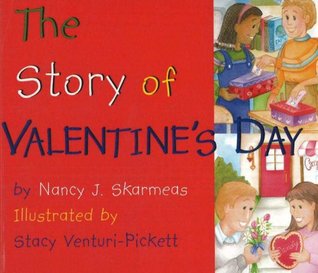
 

4.  The Story of Valentine’s Day by Nancy J. Skarmeas, illustrated by Stacy Venturi-Pickett from the little one’s Nana.

Here is a little board book that explains in simple terms the story of the origin of Valentine’s Day. From today’s celebrations to their link to the day’s beginnings, the holiday of valentines and candy hearts is explained so that even the youngest reader will understand. A new, convenient size and vibrant art make this board book a wonderful Valentine’s Day gift for little hands to grasp. Ages 2-5.

5.  William Shakespeare’s The Empire Striketh Back by Ian Doescher for review.

Hot on the heels of the New York Times best seller William Shakespeare’s Star Wars comes the next two installments of the original trilogy: William Shakespeare’s The Empire Striketh Back and William Shakespeare’s The Jedi Doth Return. Return to the star-crossed galaxy far, far away as the brooding young hero, a power-mad emperor, and their jesting droids match wits, struggle for power, and soliloquize in elegant and impeccable iambic pentameter. Illustrated with beautiful black-and-white Elizabethan-style artwork, these two plays offer essential reading for all ages. Something Wookiee this way comes!

What did you receive?
242nd Virtual Poetry Circle

Welcome to the 242nd Virtual Poetry Circle!

Remember, this is just for fun and is not meant to be stressful.

Keep in mind what Molly Peacock’s book suggested.

Look at a line, a stanza, sentences, and images; describe what you like or don’t like; and offer an opinion. If you missed my review of her book, check it out here.

Also, sign up for the 2014 Dive Into Poetry Reading Challenge because there are several levels of participation for your comfort level.

For more poetry, check out the stops on the 2013 National Poetry Month Blog Tour and the 2012 National Poetry Month Blog Tour.  And think about participating in the 2014 National Poetry Month Blog Tour — signups will begin in March.

Today’s poem is from Farnoosh Fathi from Great Guns:

Brasil

Left a hole on fire agony or was it the sun
on the banks and near duets?
Eagles with the white wine of the sun
clink and spill, tall
grass over head and heels
. . . Space of hell: shy, inscribed already
but alone— I think I can be that

again, a new hole in the ongoing flute.
In a leap, the country glows— to hone
the fate that wonder exacts,
to go netted through that much,
so heavy as paperweights angels land
square on chaparral nerves.
And since names must give in spades,
out of sorts like these, your reactions
may swell great fountain lips—
a promise that a wish will purge
or pennies caravan the safe
return hearts cross.

What do you think?

Sunrise Over Fallujah Read-a-Long Week 3

Today is the third week in the February read-a-long for Sunrise Over Fallujah by Walter Dean Myers at the War Through the Generations blog for the 2014 War Challenge With a Twist.

The questions are up, please stop by and offer your thoughts on pages 153-214 of the novel.

Click here for this week’s questions. 

For the first week’s questions, go here.

For the second week’s questions, go here.

Also if you have reviews for the Gulf Wars, you can link them here.

Ten Thousand Sorrows: The Extraordinary Journey of a Korean War Orphan by Elizabeth Kim

Source: Public Library
Hardcover, 240 pages
I am an Amazon Affiliate

Ten Thousand Sorrows: The Extraordinary Journey of a Korean War Orphan by Elizabeth Kim is a memoir from a young Korean War orphan who never knew her father, was shunned as a non-person in Korea, and was subject to further psychological and physical abuse after her adoption.  This woman suffered greatly and mostly in silence for many years before and after her adoption by American, Christian fundamentalists.  The differences between her lush green Korean homeland and her new American desert home reflect the stark demarcations between her old life and being saved.

“There is no record of my birth, or of my name.  There is no record of my mother’s brief life.” (from the Prologue)

Born to a Korean mother, who left her tiny village for Seoul to sing, and an American soldier father, whom she never knew, Elizabeth has no notion of her birth name or date, nor her father’s name.  Her earliest memories are of life as a honhyol, a nonperson of mixed heritage shunned by the Korean culture, with her mother, Omma.  As outcasts in their village, they were subjected to shunning, stone throwing, and other abuses, but they were expected to bow to others and give way to the village leaders, Omma’s father and other family, when walking about.  Omma created a secluded and secure life for her child, though it was not without harsh work in the rice paddies or isolation.  The world they lived in may not have had a great deal of comforts and amenities, but it was certainly filled with calm and love.  In an honor killing, she is left alone in the world and dropped unceremoniously at an orphanage.

“Omma’s brother did all the talking.  He told her the family had discussed the matter again since presenting demands to her that afternoon in the field, and he, his father, and his wife were there to carry out the plan.  A family had offered to take the honhyol–me–into their home as a servant.”  (page 8)

“Sitting in the cage, nails dug deep into my skim, I tried to ameliorate grief by increasing my physical pain.  And just below the awareness of that misery, breathing rhythmically like a monster waiting to devour me, was the knowledge that it was because of me Omma died.  My face and my dishonorable blood had killed the only person I loved and the only person who loved me.” (page 33)

Like her Korean home where women are expected to be subservient to men and obey without question, Elizabeth is whisked across the ocean — to a land her mother described as full of promise — to America and new parents.  Her tiny life has begun again, but darkness descends upon her as she realizes that the American dream she’d thought was there is tarnished by a fundamentalism that snowballs into systematic abuse.  From her abusive parents to her physically abusive husband, Kim’s journey was rough and through it all, she struggled to survive, with the hope that there was freedom and something better in her future.

Ten Thousand Sorrows: The Extraordinary Journey of a Korean War Orphan by Elizabeth Kim demonstrates the clash of cultures between foreign adopted children and American homes, particularly homes with fervent religious beliefs, but also the continued discrimination she felt as a mixed race child, despite her father’s American heritage.  In Korea, she was a nonperson, and in America, she is treated in much the same way — leaving her with a battered and nearly non-existent self-esteem.  This dark memoir, however, does not focus on bitterness or resentment, but on how these events and abuses transformed her into a highly ambitious reporter and mother.  While still broken inside, she manages to give her daughter a loving home and stability as a single parent.  Although there are clearly moments of clear hatred of Christianity, particularly in its fundamental form, the novel is more about redemption and acceptance of oneself despite the outside forces that strive to strike us down.

About the Author:

Elizabeth Kim is a journalist and the author of the best selling novel “Ten Thousand Sorrows”, which has been chronicled in O, Oprah Winfrey’s magazine.

5th book (Korean War) for the 2014 War Challenge With a Twist.


9th book for 2014 New Author Challenge.

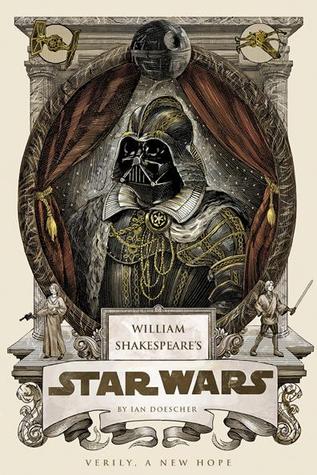
William Shakespeare’s Star Wars: Verily, A New Hope by Ian Doescher

Source: Quirk Books
Hardcover, 174 pages
I am an Amazon Affiliate

William Shakespeare’s Star Wars: Verily, A New Hope by Ian Doescher is another entertaining mix of classics and modern pop culture, combining the iambic pentameter and language of Shakespeare with the modern pomp of science fiction movies by George Lucas.  Doescher uses the plot and characters of the original Star Wars movie with an inventive and lyrical play format from Shakespeare.  He combines his knowledge of Shakespeare’s Julius Caesar, Hamlet, and other plays with the pop culture of space travel.

“”O gods above, why have I once again
Been short with R2, sending him away?
I trust he knoweth well I hold him dear,
Though in his presence oft my speech is cruel.
‘Tis words that do betray my better self
When harshly they express my droidly rage.'” (page 21)

What’s most interesting is how he translates R2-D2’s beeps and ticks into thoughts and statements to C-3PO and the other characters.  These droids garner more human-like qualities through the Shakespearean language. Complete with asides and soliloquy, Doescher clearly has studied not only Star Wars but also Shakespeare’s plays and methods. In the back of the book, he talks about the similarities between the two greats and the influence of classic myths and archetypes that came before them.  And like any mesh of pop culture and classics, this novel includes more modern language and drawings to illustrate what would occur on stage.  In some cases, a Greek play-like chorus is used to narrate the action.  One of the best scenes happens when Luke Skywalker, like Hamlet, speaks to the helmet of a stormtrooper as if it were Poor Yorick.

“Forsooth, a great disturbance in the Force
Have I just felt. ‘Twas like a million mouths
Cried out in fear at once, and then were gone,
All hush’d and quiet–silent to the last.
I fear a stroke of evil hath occurr’d.” (page 88-9)

William Shakespeare’s Star Wars: Verily, A New Hope by Ian Doescher is just the first installment in another line of Quirk Books that is bound to find a willing audience.  This action-packed retelling does not stray far from George Lucas’ creation, but what’s intriguing is how Doescher uses Shakespearean language to spice up the drama.  It’s witty and fun, though the term “verily” seems a bit overused.  At any rate, an entertaining novel to spend a rainy afternoon or snowed in evening with.

About the Author:

Ian Doescher has loved Shakespeare since eighth grade and was born 45 days after Star Wars Episode IV was released. He has a B.A. in Music from Yale University, a Master of Divinity from Yale Divinity School, and a Ph.D. in Ethics from Union Theological Seminary. Ian lives in Portland, Oregon, with his spouse Jennifer and two sons. William Shakespeare’s Star Wars is his first book. Visit Ian online at www.iandoescher.com. [Photo by Shan Applegate]

8th book for 2014 New Author Challenge.

Still Love in Strange Places by Beth Kephart

Source: Gift from LibraryThing SantaThing
Paperback, 240 pages
I am an Amazon Affiliate

Still Love in Strange Places by Beth Kephart is part travel, cultural immersion, and marital memoir.  El Salvador, the country of her husband’s birth, is seismologically and politically volatile, much like a marriage can be as we seek similarities and rarely understand the differences between us when we first begin a life together.  Kephart speaks of her husband’s country as someone who has never traveled to Central America before and only knows about the country from the horrific political turmoil and devastating earthquakes she has seen on the news.  She begins the novel very much on the outside of her husband’s life before he went to the United States for college and married her, living a suburban, quiet, American life.

“When I married my husband, I married into all of this.  I married a legacy, traditions, danger.  I married a man who is not at home unless he’s standing in the shadows of his grandfather’s land or asserting the privileges of a jeep on jungle roads.  My husband isn’t home here, where we together live, and yet years would go by before I could begin to understand, before my imagination would let me close to where he’d come from.”  (page 10-11)

For a woman that has lived a very privileged American life — for that’s what she says — her experiences traveling were limited to very advanced economies, rather than the more emerging markets in Central America, which have had a harder time coming together and staying together socially and politically.  Speaking only English, as many Americans do, arriving in a country where Spanish is spoken in rapid, unending bursts with little time to pause and translate, Kephart illustrates her loneliness and her separateness when she perches in a tree and merely watches from afar as her husband reconnects with his home and his family.  This separateness is partly her own making because of her almost desperate need to be part of his family in all ways, but also her desire to pull him back into the world of their American life so that she can be more comfortable.

However, this is not just a memoir about a marriage; it is also a memoir about coming to love a country and a culture that at first seems so foreign and incomprehensible to her.  As she sets out to tell her son about his father’s life before America and his heritage, Kephart learns that there is love in the strangest of places — places that were once alien, places that made her feel separate and foreign herself.

What’s beautiful about the memoir is that it doesn’t focus on the rifts or the arguments or the silences these differences between her and her husband may have caused, it is focused on a woman immersing herself in the culture, a history, a people and its coffee.  Through its history — political and otherwise — Kephart paints a picture of a country that struggles with its own land and its own people to find itself.  El Salvador comes alive in her hands, becomes a living, breathing being with its beauty and darkness, and while there are frightening times of civil unrest and bandits, Kephart is huddled in the family bubble — cradled in their acceptance of her.

“It was an accident, Bill’s falling in love with me.  It was a risk, binding himself up in a marriage to an American girl, a suburban girl so entirely naive that she thought she’d be somehow big enough to hold him.”  (page 127)

Still Love in Strange Places by Beth Kephart is about love and learning to love even the strangest parts of ourselves and our spouses, it’s a love that embraces everything despite our initial fears and misgivings and misunderstandings.  Love should be big enough not only to conquer all, but also to breed acceptance for what we do not understand or know about ourselves and those we love.  Love is an expansion of who and what we are; it is the exploration and embracing of what is outside of us and bringing that into ourselves.

About the Author:

Beth Kephart is the author of 10 books, including the National Book Award finalist A Slant of Sun; the Book Sense pick Ghosts in the Garden; the autobiography of Philadelphia’s Schuylkill River, Flow; the acclaimed business fable Zenobia; and the critically acclaimed novels for young adults, Undercover and House of Dance. A third YA novel, Nothing but Ghosts, published in June 2009, and a fourth young adult novel, The Heart Is Not a Size, released in March 2010.

Kephart is a winner of the Pennsylvania Council on the Arts fiction grant, a National Endowment for the Arts grant, a Leeway grant, a Pew Fellowships in the Arts grant, and the Speakeasy Poetry Prize, among other honors. Kephart’s essays are frequently anthologized, she has judged numerous competitions, and she has taught workshops at many institutions, to all ages. She teaches the advanced nonfiction workshop at the University of Pennsylvania.

Mailbox Monday #258

Mailbox Monday, created by Marcia at To Be Continued, formerly The Printed Page, has gone through a few incarnations from a permanent home with Marcia to a tour of other blogs.

Now, it has its own permanent home at its own blog.

To check out what everyone has received over the last week, visit the blog and check out the links.  Leave yours too.

Also, each week, Leslie, Vicki, and I will share the Books that Caught Our Eye from everyone’s weekly links.

Here’s what I received:

1.  Going Over by Beth Kephart from Chronicle Books for review before the April 1 publication.

In the early 1980s Ada and Stefan are young, would-be lovers living on opposite sides of the Berlin Wall–Ada lives with her mother and grandmother and paints graffiti on the Wall, and Stefan lives with his grandmother in the East and dreams of escaping to the West.


2.  The Rebel Pirate by Donna Thorland for review in March.

1775, Boston Harbor. James Sparhawk, Master and Commander in the British Navy, knows trouble when he sees it. The ship he’s boarded is carrying ammunition and gold…into a country on the knife’s edge of war. Sparhawk’s duty is clear: confiscate the cargo, impound the vessel and seize the crew. But when one of the ship’s boys turns out to be a lovely girl, with a loaded pistol and dead-shot aim, Sparhawk finds himself held hostage aboard a Rebel privateer.

Sarah Ward never set out to break the law. Before Boston became a powder keg, she was poised to escape the stigma of being a notorious pirate’s daughter by wedding Micah Wild, one of Salem’s most successful merchants. Then a Patriot mob destroyed her fortune and Wild played her false by marrying her best friend and smuggling a chest of Rebel gold aboard her family’s ship.

What did you receive?

Sunrise Over Fallujah Read-a-Long Week 2

This past Friday was the second week in the February read-a-long for Sunrise Over Fallujah by Walter Dean Myers at the War Through the Generations blog for the 2014 War Challenge With a Twist.

The questions are up, please stop by and offer your thoughts on pages 87-152 of the novel.

Click here for this week’s questions. 

For the first week’s questions, go here.

Also if you have reviews for the Gulf Wars, you can link them here.

241st Virtual Poetry Circle

Welcome to the 241st Virtual Poetry Circle!

Remember, this is just for fun and is not meant to be stressful.

Keep in mind what Molly Peacock’s book suggested.

Look at a line, a stanza, sentences, and images; describe what you like or don’t like; and offer an opinion. If you missed my review of her book, check it out here.

Also, sign up for the 2014 Dive Into Poetry Reading Challenge because there are several levels of participation for your comfort level.

For more poetry, check out the stops on the 2013 National Poetry Month Blog Tour and the 2012 National Poetry Month Blog Tour.  And think about participating in the 2014 National Poetry Month Blog Tour — signups will begin in March.

Today’s poem is from Christina Rossetti:

"I loved you first: but afterwards your love"

Poca favilla gran fiamma seconda. – Dante
Ogni altra cosa, ogni pensier va fore,
E sol ivi con voi rimansi amore. – Petrarca

I loved you first: but afterwards your love
    Outsoaring mine, sang such a loftier song
As drowned the friendly cooings of my dove.
    Which owes the other most? my love was long,
    And yours one moment seemed to wax more strong;
I loved and guessed at you, you construed me
And loved me for what might or might not be –
    Nay, weights and measures do us both a wrong.
For verily love knows not ‘mine’ or ‘thine;’
    With separate ‘I’ and ‘thou’ free love has done,
         For one is both and both are one in love:
Rich love knows nought of ‘thine that is not mine;’
         Both have the strength and both the length thereof,
Both of us, of the love which makes us one.

What do you think? Do you read poetry to your Valentine?

Happy Valentine’s Day!

I want to wish a Happy Valentine’s Day for my #1 Miami Dolphins fan, my husband Cris. He’s been a rock over the last couple years while I’ve adjusted to motherhood and my new work schedule, etc. I love you and hope we have many more wonderful years together.