Quantcast

Sense & Sensibiliy by Joanna Trollope

Source: TLC Book Tours and Harper
Hardcover, 368 pages
I am an Amazon Affiliate

Sense & Sensibility by Joanna Trollope is the first of the books in Harper’s Austen Project in which six bestselling contemporary authors use Jane Austen’s famous novels as a basis for their own modern versions.  With so many modern day versions, spin-offs, and continuations of Austen’s classic books, the expectations for the project are likely high, but this first rendition is a mixed bag.  While sticking very close to the original plots, Trollope’s main contribution to the original is an exaggeration of the characters — Elinor has too much sense (even more than Austen’s version) and Marianne is overly dramatic at every turn — and the introduction of modern technology, like Twitter, YouTube, iPods, and Facebook.  Although the exaggerated characters could be considered parody in a way, in some scenes they come off as merely annoying.

“It had been made plain to Sir John, from a young age, that the luxury of making choices in life simply did not exist without money.  Money was not an evil.” (page 42 ARC)

The social conventions of Austen’s time continue to play a role here, with characters motivated to find matches with money because without them, they will be destitute.  But in this modern society, it is hard to see that women would have just this option open to them, unless they are as shallow as Lucy Steele.  In fact, Elinor takes a job, at least part time until she completes her degree, but most everyone else seems content to sponge off their richer relatives, without much gratitude — though with relatives like these, it would be hard to muster gratitude.  Trollope clearly understands the foils that Marianne and Elinor play in the novel, and her exaggerations of their character in a modern society of social media may seem a bit much, but for young women constantly surrounded by their faults and mistakes, it might be believable.  Elinor, here, seems to represent a need in society for privacy, a greater need than society seems willing to allow unless people completely withdraw from society.  She’s strong, but at the same time, she’s vulnerable, as she pines for Edward.

Trollope has done a superb job with the youngest sister, Margaret, a young girl struggling with her emotions after her father’s death, being pushed out of the only home she’s ever known (Norland), and moving to a new school without her friends.  Bill Brandon is still reserved and quietly watching in the background, still considered boring by Marianne, and still caring, but there is a dynamic Trollope adds that will have readers cheering for something that was not in the original.  Meanwhile, John “Wills” Willoughby is even more dastardly in Trollope’s novel, yet he is still partially redeemable if you can buy that marrying for money is still a motivator in society, which it might still be among the more wealthy families.  Sense & Sensibility by Joanna Trollope is more focused on the excess in modern society as seen through her take on Marianne, Margaret, Elinor and the other characters, which can be extrapolated from their reactions to events and relationships.  Although readers would expect a more cohesive melding of the modern world with Austen, Trollope has created a new commentary on society that applies more easily to the modern world’s emphasis on excess and self-promotion.

About the Author:

Joanna Trollope is the #1 bestselling author of eighteen novels, including The Soldier’s Wife, Daughters-in-Law, Friday Nights, The Other Family, Marrying the Mistress, and The Rector’s Wife. Her works have been translated into more than twenty-five languages and several have been adapted for television. She was appointed to the Order of the British Empire in 1996 for her services to literature, and served as the Chair of Judges for the Orange Prize for Fiction 2012. She lives in London and Gloucestershire.  Find out more about Joanna on her website.  Photo credit: Barker Evans.
This is my 74th book for the 2013 New Authors Challenge.
Halloween Sleepwalker by Thomas Freese, illustrated by Fran Riddell

Source: Schiffer Publishing Ltd.
Hardcover, 64 pages
I am an Amazon Affiliate

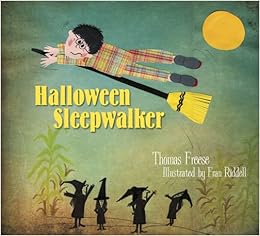
Halloween Sleepwalker by Thomas Freese, illustrated by Fran Riddell will be an instant hit with kids from the colorful images that are American Gothic with a pop culture twist in style to the story that will have their imaginations zooming. The images are crisp and at times resemble scrapbooked pages with cut out designs and stickers, but they’re so engaging, there’s never a wasted moment.  The illustrations match very well with the dialogue and the plot, and kids will be excited to see where Shelby Sanford’s adventures take him in the night.

Shelby Sanford has a family who fears things that go bump in the night, but he’s not afraid of anything, not even on Halloween.  He wants to roam the streets and greet the witches, beasts, and ghouls, but most of all its the stories his family tells that sets his wheels turning.  My daughter and I read this book together the day it came in — she could hardly wait to get the plastic wrapping off of it before we began.  She just loved the cover, and was delighted as we read the adventure together.  She pointed to the scary Halloween things she recognized and watched as Shelby met every test.

Halloween Sleepwalker by Thomas Freese, illustrated by Fran Riddell is so well done, I’m sure that this will become a traditional favorite in our house every Halloween — at least until our daughter is too old for trick-or-treating.  I know my daughter would recommend it, and I certainly do too.

About the Author:

Thomas Freese is an author, storyteller, and artist. He has written 10 books and performs over 20 educational and entertaining story programs.

About the Illustrator:

Fran Riddell is a teacher, artist, cartoonist, and illustrator living in Lexington, Kentucky.

This is my 73rd book for the 2013 New Authors Challenge.

Leviathan by Scott Westerfeld

Source: Purchased
Paperback, 440 pages
I am an Amazon Affiliate

Leviathan by Scott Westerfeld — our October book club selection — is a steampunk novel set during the onset of WWI.  Alek is whisked away in the middle of the night by his two teachers on a midnight run with one of their Austrian walkers, which they claim is practice for the coming battles.  Meanwhile, in England, Deryn is hoping to join the British military service as a boy even though she has very feminine features and is very light compared to other boys in their young teens who are signing up.  There is fact mixed with fiction, creating a fanciful landscape of genetically engineered animal ships and weapons alongside the mechanized beasts of gears and metal.  Alek is learning to run the walker at night, while Deryn is learning the ropes as a midshipman.  While things take a turn for the worse for both of these young people, both find their gumption to push through and find solutions, though not always the best or most satisfying.

When the story lines converge, it’s interesting to see how Deryn reacts to Alek’s self-importance and how timid Alek becomes in the presence of a science he’s only read about and never come in contact with.  Westerfeld has melded these modern ideas with the past in a way that makes the world he’s created seem like an alternate to the real past.  While the characters are coming of age in the time of war, there is still an innocence about this boy and girl that clings to them, and it’s clear that neither of them truly has a sense of fear when it comes to war — perhaps because of their sheltered lives and that the war they’ve encountered thus far has been minimal.  Both seem to believe that they are invincible, throwing themselves blindly into action.

The subordinate characters are not as well developed, except for Dr. Barlow who is a Darwinist engaged in the science of weaving together living beings.  The interplay between Barlow and the young teens is fun at times, but also enigmatic as each is hiding secrets from and about each other.  Count Volger is an interesting caricature who shines the most in his one-on-one fencing session with Alek.  The real stars of the novel are the Clankers’ machines and the beasts created by the Darwinists.  Westerfeld does weave in some facts, but it’s unlikely that younger readers would see which is fact versus which is fiction without reading the Afterword.  Leviathan by Scott Westerfeld is an adventure that young adults will enjoy for its fast-paced action and teenage bantering.

What the Book Club Thought:

Most of the book club enjoyed the book and seemed to prefer Deryn’s character more at first than Alek, but the ways in which the stories converged was well done.  One member even indicated they would give it five stars because they couldn’t see how Westerfeld could have made it better, at least in structure.  Most of the club said they would be interested in reading the second part of the series.  The mixing of the facts with the fanciful seemed to work with everyone in the book club, though two members had not finished reading at the time of the meeting.  The machines versus the genetically engineered beasts was an interesting angle, but the way in which the story is told demonstrated both sides so well that it enabled readers to see both sides of the story, rather than just see one as the enemy of the other.  This book was well balanced, adventurous, and touched on WWI, though a modified version of it.  Westerfeld also includes notes in the back about what facts were changed and which were maintained, which we felt was a good addition for those not as familiar with the time period.

About the Author:

Scott Westerfeld’s teen novels include the Uglies series, the Midnighters trilogy, The Last Days, an ALA Best Book for Young Adults and the sequel to Peeps. Scott was born in Texas, and alternates summers between Sydney, Australia, and New York City.


This is my 72nd book for the 2013 New Authors Challenge.

Half Popped by Jeff Feuerstein, illustrated by Dayna Brandoff and Alex Miller

Source: Burger Night Publishing Partners
Paperback, 44 pages
I am an Amazon Affiliate

Half Popped by Jeff Feuerstein, illustrated by Dayna Brandoff and Alex Miller is a cute little story about Kenny the Kernel who is not a fully popped piece of popcorn and feels alone.  He’s stuck at the bottom of a bowl of fully popped popcorn, and he feels as though he’s an outcast.  However, on his journey through the fridge and pantry, he comes to discover that those who are different have something to offer and that their uniqueness makes them just as desirable.  Kenny takes a long time to realize that he’s not alone and he’s not an outcast, and it doesn’t happen until he returns to the bowl to be eaten.

The story has a good message, but there are moments in the text, which tries to hard to rhyme at certain points, that lose the natural rhythm of the story, making readers stumble reading aloud to younger kids.  The combination of photography and illustration gave the impression of images with stick-figure faces stuck on like stickers.  My daughter didn’t find these images engaging enough to sit still to read the book, but she’s also more into books with flaps and hidden things for her to interact with than she is with books that are read to her.   She may not be the target audience for this book — perhaps someone who is age three and older.  Half Popped by Jeff Feuerstein, illustrated by Dayna Brandoff and Alex Miller has a great story about learning to see the good in yourself and the good in others who are different, but the images could have been better and the text tweaked a bit to make it less awkward in places for those reading aloud.

About the Author:

Jeff Feuerstein has been writing since he was strong enough to hold a pencil. However, none of it was legible until much later. A New York sports fanatic with an affinity for Chinese take out and vintage t-shirts, he fills the time between by walking, thinking and dreaming up new characters. Jeff has worked in the film business since graduating from the Syracuse University S.I. Newhouse School of Public Communications.

About the Illustrators:

Dayna Brandoff just loves a good art project. As a mother, she was eager to create a children’s book that parents would actually want to read “again!” (and again. and again.) As an entrepreneur and all around “do-er,” she was thrilled to be able to help make it happen. Dayna is a Brooklyn-based professional organizer. She founded Chaos Theory Inc in 2007.

Alex Miller is an artist, imagineer, and creative individual that is passionate about what he does. When he is not elbow-deep in his sketchbook he is still thinking of fun and fantastic ideas for his next project. Inspired by everything around him, Alex is on a life long journey to inspire others with his art. With a line here, dash of color there, Alex just wants his work to bring a smile to anyone that views it.

This is my 71st book for the 2013 New Authors Challenge.

Mailbox Monday #242

Mailbox Monday (click the icon to check out the new blog) has gone on tour since Marcia at To Be Continued, formerly The Printed Page passed the torch.  September’s host is Book Dragon’s Lair.

The meme allows bloggers to share what books they receive in the mail or through other means over the past week.

Just be warned that these posts can increase your TBR piles and wish lists.

Here’s what I received:

1.  Halloween Sleepwalker by Thomas Freese and Fran Riddell for review.

Are ghosts, witches, and scary creatures real? Around the fireside, Shelby Sherman Sanford’s family is talking about their Halloween fears. Mother, father, and older sister confess their frights, but Shelby says he is not afraid of anything he wants to go out for a walk! Later that night, when the clock strikes twelve, it seems Shelby gets his chance to prove himself, as he finds himself outside in the neighbor’s corn field. A young witch welcomes him with an enchanted apple and one bite gives him the second sight of ghosts and monsters. A ride on the witch’s broom carries Shelby over the graveyard, past the church, and crashing into a tree to begin his adventure. But is it real or a dream?

What did you receive?

225th Virtual Poetry Circle

Welcome to the 225th Virtual Poetry Circle!

Remember, this is just for fun and is not meant to be stressful.

Keep in mind what Molly Peacock’s books suggested. Look at a line, a stanza, sentences, and images; describe what you like or don’t like; and offer an opinion. If you missed my review of her book, check it out here.

Also, sign up for the 2013 Dive Into Poetry Challenge because its simple; you only need to read 1 book of poetry. Check out the stops on the 2013 National Poetry Month Blog Tour and the 2012 National Poetry Month Blog Tour.

Today’s poem is from Juan Delgado from A Rush of Hands:

Diapers

INS officers raided a building, taking twelve illegal aliens
into custody. The owner was cited for employing workers
without proper identification.

1. RAID

Ernesto’s boot heels are wild hooves
Being roped in, left bound in the air.
Carmen, slow-footed, nauseous with child,
Fights them off by swinging her purse.
“Pinche cabrones saben hablar español
Cuando nos van a arrestar,” she says
As her voice is drowned out by a row
Of washing machines on their rinse cycle.
Like a cat spooked out of a trash bin,
Sal runs into the street.

Chorus: ¡Chingado!

2. A GIRL AND HER FATHER

We were driving through town, Mama,
Right by where people pick up the bus
When this man jumps out right in front of us.
Dad hit the brakes. His eyes got this big, Mama.

He was running from the law, that’s for sure.
Just be glad no one got hurt, mija.
Try not to think about it anymore, mija.
We won’t go that way again, that’s for sure.

3. THE FACTORY

Two of the old-timers talked about unions:
“A trabajar, porque hablar de las uniones
Sólo trae la migra de nuevo.”

4. A YOUNG MOTHER

Can you imagine how many diapers
We went through with the twins?
The disposable ones were way too expensive,
So we switched to cloth. They were great. No,
We didn’t wash them. Thank God, we had a service.
We just put the dirty ones in plastic bags,
And they picked them up and dropped off clean ones
Right on our porch every two weeks.
It made things so much easier. And you know,
We didn’t have to worry about those summer rashes
Because their little bottoms could breathe better.
If you can afford the service, just do it.
Or at least do it for the first six months.
It’s even good for the environment.

5. JEFE

No son gallinas
Esperando un huevo.
¡A trabajar!

Chorus: ¡Chingado!

What do you think?

Polarity Bear Tours the Zoo: A Central Park Adventure by Sue de Cuevas, illustrated by Wendy Rasmussen

Source: STRATEGIES Literary Public Relations
Hardcover, 36 pages
I am an Amazon Affiliate

Polarity Bear Tours the Zoo: A Central Park Adventure by Sue de Cuevas, illustrated by Wendy Rasmussen has such realistic illustrations, the people and animals in the zoo pop out from the page.  Polarity is a polar bear who yearns for adventure, and she does have one in the Central Park Zoo after it closes and she finds her bars broken down.  The images are bright and the poem is well rhymed, which is tough to do well.  From visiting the sea lions to trying to dance with carousel horses and clock animals, Polarity finds that the adventure she’s on has its pros and cons.   She wanders about enjoying herself at first, but soon her bubble is burst…again and again.

The crux of the story resembles the grass is always greener on the other side mantra that things that we don’t have are always better than what we do have, but like Polarity bear, most of us find that what we have is just what we need and we should be happy and content.  It also seems like there could be a series of adventures in store for this bear in other books.  Polarity Bear Tours the Zoo: A Central Park Adventure by Sue de Cuevas, illustrated by Wendy Rasmussen, is well illustrated and written, though the verses are a bit long for my daughter (age 2) to sit through without much interaction.  However, crafty parents can find things for kids to locate in the pictures and name if their child’s mind starts to wander.

About the Author:

Sue de Cuevas has been telling children’s stories all her life, but this is the first one she wrote down. As Sue Lonoff, she spent thirty years as a teacher and administrator at Harvard University, retiring in 2011. She also writes scholarly books and articles and is a specialist on the Brontë sisters.

About the Illustrator:

Wendy Rasmussen developed a passion for drawing people and animals as a child growing up in rural New Jersey. After graduating from Drew University with a B.A. in biology and art, she worked as an art director in the advertising industry for 14 years. In 1989 she became a full-time freelance illustrator and established Mill Race Studio. She has illustrated over 25 books, most of which involve animals.

This is my 70th book for the 2013 New Authors Challenge.

The Artist’s Way for Parents by Julia Cameron

Source: Finn Partners and Penguin
Hardcover, 288 pages
I am an Amazon Affiliate

The Artist’s Way for Parents: Raising Creative Children by Julia Cameron with Emma Lively and foreword by Domenica Cameron-Scorsese is less a how-to manual of creative activities for parents to engage in with their children, and more of a series of situations to emphasize the advice Cameron gives about how to cultivate creativity in children and ourselves.  From providing children with simple tools like paper and colored pencils to paints and free time on their own, rather than televisions, computers and video games, Cameron says that parents must adjust to new routines that incorporate their children, but also must remain open to creating a safe place in which children and parents can act creatively.

Each parent should begin by writing three pages per day of their thoughts and feelings before their child gets up for the day or even during snatches of quiet time, just to clear the decks.  Secondly, parents and children (depending on their age) embark on a once-weekly dual adventure, something that can be looked forward to, such as going to the zoo or a museum.  The final tool she offers is creating a bedtime ritual, which can either be reading a bedtime story together, singing songs, sharing the day’s highlights, and many other ways of unwinding.  Some great activities that can be done together including sharing the creation of meals with children through simple recipes, cutting out holiday decorations each season, visiting a florist or pet store to talk about each species and its requirements, and learning how to make instruments out of household objects.

Another part of the process is to create a creativity corner for both parent and child, which is where projects can be worked on together or in the same room but separately.  Cameron also talks about the benefit of allowing children to explore their own creativity without parents over-directing or re-directing their children’s activities.  One great aspect of the book is the discussion on reading together but separate books, and how that it is still considered sharing quality time together even if the parent and child are doing separate activity.  Separate activities in the same space are just as good as working together on projects, so long as the parent and child share their experiences with one another through discussion.

There are moments that come off preachy about faith and God, but overall the message is about nurturing children and their creativity without neglecting the well being of the parent or their own creativity.  It’s about seeing the possibilities in ourselves and our children without hindering growth and exploration.  The Artist’s Way for Parents: Raising Creative Children by Julia Cameron with Emma Lively and foreword by Domenica Cameron-Scorsese is a solid book that helps parents create the right mindset for themselves and their children, but only offers a few activities to consider.

About the Author:

Julia Cameron has been an active artist for more than thirty years. She is the author of more than thirty books, fiction and nonfiction, including her bestselling works on the creative process: The Artist’s Way, Walking in This World, Finding Water, and The Writing Diet. A novelist, playwright, songwriter, and poet, she has multiple credits in theater, film, and television.

Latest endeavor: Julia Cameron Live, an online course and artists’ community led by Julia. It is the most comprehensive discussion she has ever done on The Artist’s Way, and the first time she has allowed cameras in her home.

These are my 69th book for the 2013 New Authors Challenge.

Guest Post: Voice of the Moon by Erica Goss

Erica Goss, the poet who wrote Wild Place, continues to keep us up to date on her 12 Moons project with vocal talents of Nic S. and the musical talents of Kathy McTavish. We’ll be sure to keep everyone in the look on this collaborative project.  Check out the first guest post and her second guest post.

Please give Erica a warm welcome:

The desire that woke you
full and constant,
flickers like antennae.

            from “Corn Moon” by Erica Goss

If the moon had a voice, what would it sound like? As “12 Moons” took shape, I began to hear a narrator in my head, a speaker with distinct qualities. The voice of the moon, I decided, must be a woman’s, full of emotional depth and mystery. I was delighted when Nic S. agreed to be the narrator of “12 Moons.”

I was already familiar with Nic’s work as a narrator, poet and video artist (read my interview with Nic at Connotation Press. Nic’s talents extend into alternative and creative paths to increasing the audience for poetry, which include the nanopress. (The nanopress delivers poetry to readers, listeners and viewers via a variety of media: website, PDF download, e-book, print version and CD. Read the details here.)

The choice of a narrator for a recorded poem is vitally important. Recordings of poetry often disappoint; they serve as documentation of a reader’s voice, perhaps, but don’t do much for the poem. This is sadly true of many recordings of poets reading their own work. I never considered using my own voice for this project, although I’ve made recordings before, nor did I contemplate using multiple voices. I wanted one distinct narrator to form a consistent link between all twelve poems. Nic is that link: her interpretation of each poem creates an individual experience while enabling the connection to the next poem.

I wrote most of the poems in “12 Moons” in either the first or second person. This facilitates intimacy between the narrator and the listener, perhaps even a brief relationship that exists within the context of the project. With that expectation, the vocal qualities of the narrator had to be those of someone whose voice is subtle, distinctive, and able to impart the overtones of a story told in poetry.

I asked Nic how it felt to be the reader of these poems. What was it like to interpret these words?

“Creating a recording of someone else’s work is always exploration, always adventure. I feel it as a beautiful way of both honoring and connecting with others. For me, voice is more than just a transmittal mechanism, more than just simple emission. As I always say, it’s an instrument of active investigation, and brings me information to process in the same way my eyes and ears and nose do. So that engaging only visually and intellectually with someone’s poems on the page is a qualitatively different (and poorer) experience for me than engaging with the same poems through the voicing, recording and editing process.

I will usually make two or three recordings of the same poem, then listen to them in sequence. As this process unfolds, it is often accompanied by little bursts of new understanding, new illuminations and new insights. It’s rare that I will use any single version for the final product – usually there is splicing between the versions, as I gain a better understanding of what the poem is saying to me. With Erica’s poem series, each poem was for me a little universe, a short trip into Erica’s mind, and the series itself was a larger universe, a longer trip, made up of her themes, her images, her metaphors and her word choices. I enjoyed Erica’s rather spare and unadorned diction and loved the imaginative way it engaged with the exotic moon theme in this series.”

As the reader of many poems that other people have written, is there a technique to making the words your own? Are there poems you haven’t wanted to read, or felt uncomfortable with? Why?

“Yes, in the past there were poems I felt I could not read. But a big part of that was an early conviction I had that the poem-on-the-page (the visual artifact) was necessarily tightly and irrevocably married to the poem-as-voice (the aural artifact). Here is a dialogue I had in 2010 with poet David Tomaloff, which convinced me that insisting on such tight linkage impoverished the poem’s potential, and that in fact each type of artefact (visual and aural) has a legitimate stand-alone artistic existence. Now, as long as the basic tradecraft in a poem is good, I am not sure I would say there are any poems I would not read. Any poem represents a dimension of human experience and, as such, no poem can at root be really alien to any of us.”

When did you realize that your voice was something special, a gift perhaps?

“I don’t know just when I realized that I had this ability to enter into poems using my voice and to reproduce them in ways that many poets have appreciated, but it was fairly recently – in the last five years or so. I have been both humbled by and grateful for the gift. I think as a community we fail to pay attention to the art of reading poetry for an audience (see discussion at this post and see Voice Alpha) and for the most part, when we do read for an audience, we unfortunately focus on reading our own poems.

I believe we are the worst readers of our poems, because we bring our entire universe into the reading of the poem and can therefore convey little new to ourselves or others in our reading. The revelations tend to come when you hear others reading your work, when you hear what they have made of your universe. I think the most frequent comment I heard when I was reading at Whale Sound was to the effect that the reading showed them aspects of and connections within the poem of which they had been unaware. It gives me great happiness to contribute in this small way to the poetry community.”

12 Moons will appear beginning January 2014 at Atticus Review.

More about the process of making 12 Moons in the next post. Here are links to the artists involved in 12 Moons:

  • Swoon’s website
  • Kathy McTavish’s website
  • Erica Goss’s website
  • Erica Goss’s column on video poetry.

I really enjoyed what Nic had to say about the universes that came alive for her when reading Goss’ poems.  I also love what she says about poets being the worst readers of their own poems. 

What are your thoughts so far on this project coming to us in January?

Save

Camelot’s Court by Robert Dallek

Source: Harper Collins
Hardcover, 512 pages
I am an Amazon Affiliate

Camelot’s Court by Robert Dallek (who was inspired to write the book after a poll similar to a recent one in Politico) is a highly detailed account of the Kennedy White House, but it also provides an inside look at the political machine the United States has become — from the bureaucrats with aspirations to rise above their stations to the military with its tunnel-vision to stop Communism at all costs.  One of the big takeaways from this book is JFK’s ambition to become president even when he won his first House seat — it was clear that he was bored with “small time” politics and merely cared about big picture issues, particularly foreign policy.  Dallek repeats most of what people already knew about Kennedy — that he liked the ladies, had an illness he hid from the press, and came from a rich family with some skeletons in the closet.  However, what Dallek provides is a comprehensive look at how dysfunctional an executive branch can be, particularly one with a young president at the helm who surrounds himself with the smartest of men (those that accepted the positions) and is forced to keep on less-than-desirable men for political reasons.  The interplay between the groups, the president, and even the brothers Kennedy is contentious, but it also becomes paralyzing.  However, it was not beneath Kennedy to use underhanded tricks or to dupe the press to get what he wanted.

“As Rusk sat in Kennedy’s living room, waiting to see the president-elect, he noticed a copy of the Washington Post sitting prominently on a coffee-table — it announced Rusk as secretary of state.  When Kennedy entered and saw the headline, he ‘blew his top,’ asking Rusk if he was the source of the leak.  Told no, Kennedy called Post publisher Philip Graham to chide him for printing the story.  After Graham explained that Kennedy was the one who had told him, Kennedy said, ‘But that was off the record.’  Hardly, since it was exactly what Kennedy wanted; Kennedy had no interest in giving Rusk a choice of accepting;”  (page 99 ARC)

Dallek carefully demonstrates his statements through dialogue from the men in the room with Kennedy when foreign policy issues were discussed, citing their own books, statements, diaries, and/or notes — not to mention the declassified government documents.  There are even quotes from Jackie Kennedy about private conversations she had with her husband or from conversations she overheard.  What’s telling about the situation when Kennedy was president is that he had the book knowledge from FDR and other presidents to guide him in building the best team, but that circumstances outside his control and his inability to ignore advice and go with his gut instinct often landed his administration in political hot water, like after the Bay of Pigs invasion of Cuba.  The defeat left a bad taste in the administration’s mouth, which may have fueled the military’s fire to win anywhere at any cost against Communism — hence the entry into the Vietnam War.

For those interested in Kennedy the man, this is not the book; but for those interested in how an idealist with big aspirations and big ideas about solving foreign policy issues gets caught up in the political machine and essentially worn down, this is the book for you.  Camelot’s Court by Robert Dallek is not a linear tale, but does touch upon the forces at work against the Kennedy Administration and how the administration pulled the wool over its own eyes when it came to foreign policy issues.  In many ways, the book chronicles a young president’s dream of greatness that fell short of its goals, not because of an assassination, but because of inexperience and failing to ask the right questions.

About the Author:

Robert Dallek is an American historian specializing in American presidents. He is a recently retired Professor of History at Boston University and has previously taught at Columbia University, UCLA, and Oxford.

These are my 68th book for the 2013 New Authors Challenge.

Mailbox Monday #241

Mailbox Monday (click the icon to check out the new blog) has gone on tour since Marcia at To Be Continued, formerly The Printed Page passed the torch.  September’s host is Book Dragon’s Lair.

The meme allows bloggers to share what books they receive in the mail or through other means over the past week.

Just be warned that these posts can increase your TBR piles and wish lists.

Here’s what I received:

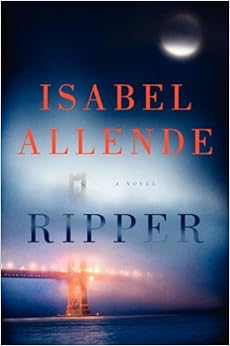
1. Ripper by Isabel Allende for review.

The Jackson women, Indiana and Amanda, have always had each other. Yet, while their bond is strong, mother and daughter are as different as night and day. Indiana, a beautiful holistic healer, is a free-spirited bohemian. Long divorced from Amanda’s father, she’s reluctant to settle down with either of the men who want her—Alan, the wealthy scion of one of San Francisco’s elite families, and Ryan, an enigmatic, scarred former Navy SEAL.

While her mom looks for the good in people, Amanda is fascinated by the dark side of human nature, like her father, the SFPD’s Deputy Chief of Homicide. Brilliant and introverted, the MIT-bound high school senior is a natural-born sleuth addicted to crime novels and Ripper, the online mystery game she plays with her beloved grandfather and friends around the world.

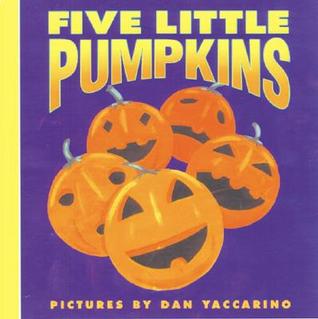
2.  Five Little Pumpkins by Dan Yaccarino, which my mom sent to the little one.

Five little pumpkins sitting on a gate.The first one said, “Oh my, it’s getting late.”Get ready for some wicked fun as these five pumpkins run and roll! Toddlers will want to chant along with this popular rhyme again and again. Dan Yaccarino’s vibrant and bold illustrations bring these pumpkins to life with personality and style. Toddlers are sure to laugh out loud as these pumpkins roll out of sight!

3.  Polarity Bear Tours the Zoo by Sue de Cuevas, illustrated by Wendy Rasmussen, which I received for review.

Polarity Bear Tours the Zoo is a beautifully illustrated book (suitable for ages 3-8) about an imaginary polar bear’s adventures in New York’s Central Park Zoo. Set at the time when the zoo made the transformation from cages to more natural habitats, it also celebrates three leading Central Park attractions: the sea lion pool, the Delacorte Clock, and the carousel.


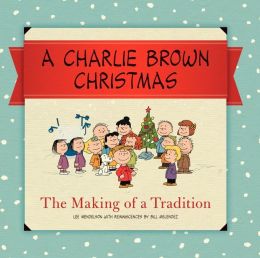
4.  A Charlie Brown Christmas: The Making of a Tradition by Charles M. Schultz for review.

Charles M. Schulz’s A Charlie Brown Christmas: The Making of a Tradition is a lushly illustrated tribute to the beloved television classic that takes readers behind-the-scenes of the Peanuts holiday special that has aired each year since December 1965.

A Charlie Brown Christmas: The Making of a Tradition includes the script of the Emmy Award–winning A Charlie Brown Christmas, more than two hundred full-color pieces of original animation art, Vince Guaraldi’s original score and publication notes for the songs “Christmas Time Is Here” and “Linus and Lucy,” and a look at the making of the feature from producer Lee Mendelson and original animator, the late Bill Melendez.

No holiday season is complete without Charlie Brown, Linus, Lucy, Snoopy, and the rest of the Peanuts gang giving a forgotten tree a little love, reciting the Christmas story, and singing “Silent Night.”

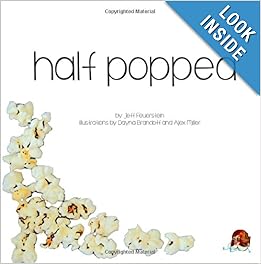
5.  Half Popped by Jeff Feuerstein, Dayna Brandoff, Alex Miller for review.

Half Popped is the heart-warming and whimsical story of Kenny the Kernel, a discouraged but friendly popcorn kernel who believes he never reached his full potential. As Kenny journeys through the kitchen, he helps cheer up other down-on-their-luck snacks by pointing out the bright side to their situations, all the while harboring a half-empty view of himself. Until…. With a silly, story-telling rhyme evocative of Shel Silverstein poetry and unique artwork that combines photography and illustration, the charming tale serves as a lesson in self-confidence and reminds young readers that a genuine compliment has the power to make a friend’s day. Sometimes it takes an outside perspective to see it, but there’s a place and a purpose in this world for everyone – even Kenny the Kernel, who was only half popped, and turned out that way when the microwave stopped.

6.  Robert Plant: A Life by Paul Rees for review.

Robert Plant by Paul Rees is the definitive biography of Led Zeppelin’s legendary frontman. As lead singer for one of the biggest and most influential rock bands of all time—whose song “Stairway to Heaven” has been played more times on American radio than any other track—Robert Plant defined what it means to be a rock god.

Over the course of his twenty-year career, British music journalist and editor Paul Rees has interviewed such greats as Sir Paul McCartney, Bruce Springsteen, Madonna, Bono, and AC/DC. Rees now offers a full portrait of Robert Plant for the first time, exploring the forces that shaped him, the ravaging highs and lows of the Zeppelin years—including his relationship with Jimmy Page and John Bonham—and his life as a solo artist today.

What did you receive?

224th Virtual Poetry Circle

Welcome to the 224th Virtual Poetry Circle!

Remember, this is just for fun and is not meant to be stressful.

Keep in mind what Molly Peacock’s books suggested. Look at a line, a stanza, sentences, and images; describe what you like or don’t like; and offer an opinion. If you missed my review of her book, check it out here.

Also, sign up for the 2013 Dive Into Poetry Challenge because its simple; you only need to read 1 book of poetry. Check out the stops on the 2013 National Poetry Month Blog Tour and the 2012 National Poetry Month Blog Tour.

Today’s poem is from Anne Brontë:

Last Lines

I hoped, that with the brave and strong,
      My portioned task might lie;
To toil amid the busy throng,
      With purpose pure and high.

But God has fixed another part,
      And He has fixed it well;
I said so with my bleeding heart,
      When first the anguish fell.

A dreadful darkness closes in
      On my bewildered mind;
Oh, let me suffer and not sin,
      Be tortured, yet resigned.

Shall I with joy thy blessings share
      And not endure their loss?
Or hope the martyr's crown to wear
      And cast away the cross?

Thou, God, hast taken our delight,
      Our treasured hope away;
Thou bidst us now weep through the night
      And sorrow through the day.

These weary hours will not be lost,
      These days of misery,
These nights of darkness, anguish-tost,
      Can I but turn to Thee.

Weak and weary though I lie,
      Crushed with sorrow, worn with pain,
I may lift to Heaven mine eye,
      And strive to labour not in vain;

That inward strife against the sins
      That ever wait on suffering
To strike whatever first begins:
      Each ill that would corruption bring;

That secret labour to sustain
      With humble patience every blow;
To gather fortitude from pain,
      And hope and holiness from woe.

Thus let me serve Thee from my heart,
      Whate'er may be my written fate:
Whether thus early to depart,
      Or yet a while to wait.

If thou shouldst bring me back to life,
      More humbled I should be;
More wise, more strengthened for the strife,
      More apt to lean on Thee.

Should death be standing at the gate,
      Thus should I keep my vow;
But, Lord! whatever be my fate,
      Oh, let me serve Thee now!

What do you think?