Quantcast

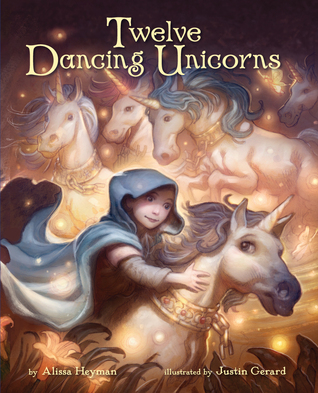
Twelve Dancing Unicorns by Alissa Heyman

Source: Sterling Children’s Books
Hardcover, 32 pages
I am an Amazon Affiliate

Twelve Dancing Unicorns by Alissa Heyman, illustrated by Justin Gerard, is gorgeously illustrated. Like paintings that leap off the page by some magical power, these unicorns will dance into the hearts and dreams of any little girl.  Heyman adapts her fairytale from Grimm’s “Twelve Dancing Princesses,” and here the little girl loves the unicorns so much that she is willing to help them in any way she can.  When the King says that he will grant any wish to the person who finds out how the chains are broken each night by the unicorns in his corral, she is determined to do just that.  While there are few obstacles in the girl’s way and the text can be in huge paragraphs for little kids, Heyman does a great job of showing the girl’s determination and love for the unicorns in a few pages.

The illustrations are fantastic; it’s like stepping into another world, but the unicorns look as if they could be real animals.  The book is clearly for older learning readers probably ages 6+, as some of the words will require assistance from parents and older readers and the paragraphs are longer than in other picture books.  While the story has little that’s new to offer and is not in the poetry-like prose my daughter enjoys most, the story will seem new to younger readers and engage them with its fantastic world popping off the pages.  Twelve Dancing Unicorns by Alissa Heyman, illustrated by Justin Gerard, is visually stunning and shows that young girls can not only solve problems but achieve their goals, no matter how overwhelming they may seem.

Follow the Twelve Dancing Unicorns blog tour tomorrow on Kindred Spirit Mommy.

About the Author:

Alissa Heyman is a freelance writer who edited The Best Poems of the English Language (Mud Puddle Books). Her poems have appeared in the St. Petersburg Review, Lyric, and Quarto, and she has adapted The Big Book of… series for Sterling Publishing, which includes The Big Book of Horror, The Big Book of Fairies, and The Big Book of Pirates. Alissa lives in New York City where she also curates the Perfect Sense poetry reading series at the Cornelia Street Café.

About the Illustrator:

Justin Gerard has done illustration for DreamWorks, Warner Brothers, Disney, HarperCollins, Penguin, Little, Brown, and others. The Society of Illustrators featured his illustration “Beowulf and Grendel” in the 50th Annual of American Illustration, from his IPPY Award-winning book, Beowulf, Book I: Grendel the Ghastly. Justin lives in Greenville, SC.
54th book for 2014 New Author Reading Challenge.

Stella Bain by Anita Shreve

Source: Gift from Anna
Hardcover, 272 pgs
On Amazon and on Kobo

Stella Bain by Anita Shreve, which was the War Through the Generations August read-a-long book, is set during WWI.  When the novel opens, a woman who has been wounded finds herself in a field hospital in Marne, France, in 1916.  She was found in the uniform of a British nurse’s aide, but has an American accent and cannot remember her own name.  As she grapples with her lost memory and identity, she plucks Stella Bain from her mind and begins to call herself such, even though she knows it may not be her real name.  Stella continues to work alongside the French women near the front and eventually volunteers as an ambulance driver.  Her jumbled mind takes a back seat to her duties at the front, but eventually, she feels drawn to England and the Admiralty, though she’s not sure what she’ll find there or if she will uncover anything about who she was.

“‘No.  Nothing is normal.  How can it be? I don’t yet know who I am.  I may discover, when I know my identity, that I’m not a good person at all.  I fear that I’m not.  I seek my identity, and yet I’m afraid of it.  But I’m more afraid of never knowing.'” (page 75)

Stella learns her true identity, and her true name is a near-anagram of the one she had chosen for herself.  When she learns of her identity and all that she frantically left behind in the United States, she must make passage home.  While Dr. Bridge and his wife, Lily, helped her to be calm and recover her name and identity, they are left behind in England without so much as a goodbye from her.  However, she never forgets their kindness and through letters, readers are given insight into her gratitude.  Shreve’s prose in this novel is distant.  While we see Stella’s point of view, readers are still distanced from her, which could be intentional given the absence of her memories and true identity.  In many ways, as the mystery unravels and readers learn more about the woman without a name, she becomes an everywoman for those women leaving during the early 1900s — caged in by marriage and family, but yet yearning for something outside of their home and legally allowed to own their own property.

Stella Bain by Anita Shreve is not just about a woman with shell shock or a lost memory, but a woman in an era where the modern world was just beginning to take shape.  A world in which women were fighting for independence from their families and husbands, to live lives as they wished to without seeking permission or approval.  Overall, while the ending could leave some readers wanting more, the novel would make for an excellent book club discussion.

About the Author:

Anita Shreve is an American writer. The daughter of an airline pilot and a homemaker, she graduated from Dedham High School in Massachusetts, attended Tufts University and began writing while working as a high school teacher in Reading, MA.

Interested in the read-a-long discussions at War Through the Generations, go here; though there will be spoilers.

17th book for 2014 European Reading Challenge(Set in France, England)


27th book for 2014 Historical Fiction Reading Challenge.


22nd book (WWI) for the 2014 War Challenge With a Twist.

The Story Hour by Thrity Umrigar

Source: Harper
Hardcover, 336 pages
On Amazon and on Kobo

The Story Hour by Thrity Umrigar is told from two points of view; in Lakshmi Patil’s broken English we see all sides of her marriage to a man she doesn’t love in a country that is unfamiliar and in her Africa-American therapist Maggie Bose’s voice readers are exposed to the cultural dissonance that occurs between multicultural couples and friends.  Stories take on a life of their own in Umrigar’s latest novel, and it is the weaving and unweaving of these stories that brings to the forefront the struggles Americans continue to have with those from other countries.  There is a lack of understanding for cultural norms and often judgments that come with that lack of understanding.  In Lakshmi’s hour-long therapy sessions, Maggie see the differences and similarities between them come alive, but cultural dissonance is not just one-sided here.  Lakshmi also struggles to understand her therapist’s choices when it comes to her marriage to Sudhir and own happiness.

“He turns around and his face look surprise as I rush toward him like the Rajdhani Express.  He take a steps back, as if he thinking I will run into him, like train derailment.  But I stops just in front of him and now my mouth feels dry and no wordings are coming to my mind.”  (page 7 ARC)

Maggie’s life was far from perfect before she met her husband, and while at college, surrounded by similarly minded people, she felt at home and respected.  But when she ventured outside of the campus, it was clear that others perceived her based on appearance or their own cultural experiences.  While these are the experiences that shaped her, she continued her schooling to become a therapist, one so well liked by her colleagues that they often referred to her the most difficult of cases.  But her school and work experiences are not all of her, and there are secrets that she hasn’t even told her husband about, at least not completely.  She has created a narrative that she is comfortable with, even though she knows that it is not the truth of her.  Lakshmi also lives a life clouded by lies, but her lies are to those outside her marriage and to herself.  She must also learn to move beyond the story she has created for herself and others to get at the truth of her being.

Through these ladies’ points of view, questions of identity, culture, and isolation are explored, and ultimately, these characters need to learn to break down the barriers between themselves and others if they wish to find happiness and freedom.  The Story Hour by Thrity Umrigar is seductive in its multilayered approach, leading readers to be sucked into the isolated life of Lakshmi and the idyllic American life of Maggie, only to discover that assumptions and first impressions are not the truth.  We create our own stories for ourselves and for others, but it is only when we tell the truth of who we are that we can be set free from perception and judgment.

About the Author:

Thrity Umrigar is the author of three other novels—The Space Between UsIf Today Be Sweet, and Bombay Time—and the memoir First Darling of the Morning. A journalist for 17 years, she is the winner of the Nieman Fellowship to Harvard University and a 2006 finalist for the PEN/Beyond Margins Award. An associate professor of English at Case Western Reserve University, Umrigar lives in Cleveland.  Please visit her Website.

Other reviews of this author’s books:

Mailbox Monday #286

Happy Labor Day, everyone!

Mailbox Monday, created by Marcia at To Be Continued, formerly The Printed Page, has a permanent home at its own blog.

To check out what everyone has received over the last week, visit the blog and check out the links.  Leave yours too.

Also, each week, Leslie, Vicki, and I will share the Books that Caught Our Eye from everyone’s weekly links.

Here’s what I received:


1.  My Jane Austen Prize pack, with tote bag, bookplates, etc. from Syrie James’ Facebook giveaway!

2.  Bone Map by Sara Eliza Johnson for review from Milkweed Editions.

Sara Eliza Johnson’s stunning, deeply visceral first collection, Bone Map (2013 National Poetry Series Winner), pulls shards of tenderness from a world on the verge of collapse, where violence and terror infuse the body, the landscape, and dreams: a handful of blackberries offered from bloodied arms, bee stings likened to pulses of sunlight, a honeycomb of marrow exposed. “All moments will shine if you cut them open. / Will glisten like entrails in the sun.” With figurative language that makes long, associative leaps, and with metaphors and images that continually resurrect themselves across poems, the collection builds and transforms its world through a locomotive echo—a regenerative force—that comes to parallel the psychic quest for redemption that unfolds in its second half. The result is a deeply affecting composition that will establish the already decorated young author as an important and vital new voice in American poetry.

3.  The Fever by Megan Abbott on audio from LibraryThing Early Reviewers.

The panic unleashed by a mysterious contagion threatens the bonds of family and community in a seemingly idyllic suburban community.

The Nash family is close-knit. Tom is a popular teacher and the father of two teens: Eli, a hocky star and girl magnet, and his sister Deenie, a diligent student. Their seeming stability, however, is thrown into chaos when Deenie s best friend is struck by a terrifying, unexplained seizure in class. Rumors of a hazardous outbreak spread through the family, school, and community.

As hysteria and contagion swell, a series of tightly held secrets emerges, threatening to unravel friendships, families, and the town s fragile idea of security.

4.  Those Who Wish Me Dead by Michael Koryta on audio from LibraryThing Early Reviewers.

When thirteen-year-old Jace Wilson witnesses a brutal murder, he’s plunged into a new life, issued a false identity, and hidden in a wilderness skills program for troubled teens. The plan is to get Jace off the grid while police find the two killers. The result is the start of a nightmare.

The killers, known as the Blackwell Brothers, are slaughtering anyone who gets in their way in a methodical quest to reach him. Now all that remains between them and the boy are Ethan and Allison Serbin, who run the wilderness survival program; Hannah Faber, who occupies a lonely fire lookout tower; and endless miles of desolate Montana mountains.

The clock is ticking, the mountains are burning, and those who wish Jace Wilson dead are no longer far behind.

5.  The Last Mile by Blair Richmond for review from Ashland Creek Press in October.

In the final book in the acclaimed Lithia Trilogy, Kat has new losses to mourn but also new reasons to live. On the brink of new beginnings, she is back together with Roman, their relationship deepening more and more even as she wonders whether she may still harbor feelings for Alex.

Yet Kat finds it difficult to focus on such things as college and romance, with terror still haunting the hills of Lithia and threatening the entire town. As several recent earthquakes baffle scientists and put residents on edge, it seems that something more dangerous may be looming in Lithia’s future.

6.  The Moonlight Palace by Liz Rosenberg for review from TLC Book Tours in October.

Agnes Hussein, descendant of the last sultan of Singapore and the last surviving member of her immediate family, has grown up among her eccentric relatives in the crumbling Kampong Glam palace, a once-opulent relic given to her family in exchange for handing over Singapore to the British.

Now Agnes is seventeen and her family has fallen into genteel poverty, surviving on her grandfather’s pension and the meager income they receive from a varied cast of boarders. As outside forces conspire to steal the palace out from under them, Agnes struggles to save her family and finds bravery, love, and loyalty in the most unexpected places. The Moonlight Palace is a coming-of-age tale rich with historical detail and unforgettable characters set against the backdrop of dazzling 1920s Singapore.


7.  Madame X by William Logan purchased from Novel Books.

One of the most technically gifted poets of his generation, William Logan here presents four sequences, each of which is haunted by the battered history of the enchanted city of Venice: two refugees from Nazi Germany replay a version of the Aeneid that shadows their lives in and out of Venice; the comedy of Tiepolo’s Punchinello drawings are given mocking narrative; a modern traveler finds in Venice’s insects, birds, and fish a nature that endures within an unnatural city; and, in a formal sequence reminiscent of W. H. Auden’s “The Sea and the Mirror,” King James commissions a revision of Macbeth in order to impress the chief magistrate. These new poems showcase Logan’s trademark refinement and erudition.

The poems here delve into what William Logan calls the “ill-lit kingdom of the past.” The book is haunted by the dead but equally penitent toward the rich insinuations of the living: the lost floral paradise of the Florida outlands, the steamy Gatsby summers of a Long Island childhood, the frozen stones of a colonial burying ground. This new collection of seventy-two poems will allow readers to delight in the richness of Logan’s language and the boldness of his vision.

8.  A Hero for the People by Arthur Powers for review for Book Junkie Promotions in September.

“Set in the vast and sometimes violent landscape of contemporary Brazil, this is a gorgeous collection of stories-wise, hopeful, and forgiving, but clear-eyed in its exploration of the toll taken on the human heart by greed, malice, and the lust for land.” -Debra Murphy, Publisher of Idyll’s Press, Founder of CatholicFiction.net


9.  Crow-Work by Eric Pankey for review from Milkweed Editions.

“What is a song but a snare to capture the moment?” Eric Pankey asks in his new collection, Crow-Work. This central question drives Pankey’s ekphrastic exploration of the moment where emotion and energy flood a work of art. Through subjects as diverse as Brueghel’s Procession to Calvary, Anish Kapoor’s Healing of Saint Thomas, Caravaggio’s series of severed heads, and James Turrell’s experimentation with light and color, the author travels to an impossible past, despite being firmly rooted in the present, to seek out “the songbird in every thorn thicket” of the artist’s work. Short bursts of lyrical beauty burn away “like coils of incense ash,” bodies in the light of a cave flicker, coalesce and disappear. By capturing the ephemeral beauty of life in these poems, Crow-Work seeks not only to explain great art, but also to embody it.

What did you receive?

269th Virtual Poetry Circle

Welcome to the 269th Virtual Poetry Circle!

Remember, this is just for fun and is not meant to be stressful.

Keep in mind what Molly Peacock’s book suggested.

Look at a line, a stanza, sentences, and images; describe what you like or don’t like; and offer an opinion. If you missed my review of her book, check it out here.

Today’s poem is from Elizabeth Bishop, recited by Kareem Sayegh:

The Man-Moth

Man-Moth: Newspaper misprint for “mammoth.”

Here, above,
cracks in the buildings are filled with battered moonlight.
The whole shadow of Man is only as big as his hat.
It lies at his feet like a circle for a doll to stand on,
and he makes an inverted pin, the point magnetized to the moon.
He does not see the moon; he observes only her vast properties,
feeling the queer light on his hands, neither warm nor cold,
of a temperature impossible to record in thermometers.

But when the Man-Moth
pays his rare, although occasional, visits to the surface,
the moon looks rather different to him. He emerges
from an opening under the edge of one of the sidewalks
and nervously begins to scale the faces of the buildings.
He thinks the moon is a small hole at the top of the sky,
proving the sky quite useless for protection.
He trembles, but must investigate as high as he can climb.

Up the façades,
his shadow dragging like a photographer’s cloth behind him
he climbs fearfully, thinking that this time he will manage
to push his small head through that round clean opening
and be forced through, as from a tube, in black scrolls on the light.
(Man, standing below him, has no such illusions.)
But what the Man-Moth fears most he must do, although
he fails, of course, and falls back scared but quite unhurt.

Then he returns
to the pale subways of cement he calls his home. He flits,
he flutters, and cannot get aboard the silent trains
fast enough to suit him. The doors close swiftly.
The Man-Moth always seats himself facing the wrong way
and the train starts at once at its full, terrible speed,
without a shift in gears or a gradation of any sort.
He cannot tell the rate at which he travels backwards.

Each night he must
be carried through artificial tunnels and dream recurrent dreams.
Just as the ties recur beneath his train, these underlie
his rushing brain. He does not dare look out the window,
for the third rail, the unbroken draught of poison,
runs there beside him. He regards it as a disease
he has inherited the susceptibility to. He has to keep
his hands in his pockets, as others must wear mufflers.

If you catch him,
hold up a flashlight to his eye. It’s all dark pupil,
an entire night itself, whose haired horizon tightens
as he stares back, and closes up the eye. Then from the lids
one tear, his only possession, like the bee’s sting, slips.
Slyly he palms it, and if you’re not paying attention
he’ll swallow it. However, if you watch, he’ll hand it over,
cool as from underground springs and pure enough to drink.

What do you think?

Final Week: Read-a-long of Stella Bain

This year at War Through the Generations we’ve been hosting a read-a-long specific to one of the 6 wars we are covering.

As this year marks the 100th anniversary of WWI, we’ve decided to select one of our favorite authors — Anita Shreve — to honor the war.

Stella Bain is our selection for August. Synopsis from GoodReads:

When an American woman, Stella Bain, is found suffering from severe shell shock in an exclusive garden in London, surgeon August Bridge and his wife selflessly agree to take her in.

A gesture of goodwill turns into something more as Bridge quickly develops a clinical interest in his house guest. Stella had been working as a nurse’s aide near the front, but she can’t remember anything prior to four months earlier when she was found wounded on a French battlefield.

In a narrative that takes us from London to America and back again, Shreve has created an engrossing and wrenching tale about love and the meaning of memory, set against the haunting backdrop of a war that destroyed an entire generation.

Beware of spoilers.

Discussions will be posted on Friday for the designated chapters. Here’s the reading schedule and discussion dates:

Friday, Aug. 8: Pages 1-70
Friday, Aug. 15: Pages 71-138
Friday, Aug. 22: Pages 139-207
Friday, Aug. 29: Pages 208-end

We hope that you’ll join us for the read-a-long and discussions at War Through the Generations.

Art from Dreams: My Jungian Journey in Collage, Assemblage, and Poetry by Susan Levin

Source: MBM Book Publicity and Susan Levin
Paperback, 48 pages
Purchase on Levin’s Website.

Art from Dreams: My Jungian Journey in Collage, Assemblage, and Poetry by Susan Levin combines poetry, collage, and assemblage into two parts — “My Jungian Dreams” and “Nocturnes” — but the poetry only appears in the first section to accompany the dream-inspired collages.  When it comes to Jungian dream interpretation, there are several archetypes — including the persona, the shadow, the animus, the divine child, the wise one, the great mother, and the trickster — and the archetypal events like birth, death, separation from one’s parents, marriage, and the union of opposites.  The poems are very lyrical in the first half, though almost as enigmatic as some of the images produced from Levin’s dreams.  The collage or assemblage pieces came first, but the poems were written later.  In the foreword, Shana Nys Dambrot said that Levin embraces the role of the unconscious mind as a creative force in her work, which is clear.

Alchemy (page 14)

Nobody sees us-
the Archeologist and me-
as we excavate the night
searching for beginnings,
unearthing symbols, images.
Everything is held to the fire
We get close to truth,
to what is known and unknown.
We awaken to re-imagine our lives

Think about those dreams you remember and how we try to make sense of them, looking for symbols and hidden meanings; we’re much like the archeologists digging in the dirt, looking at bones to re-create the past and create a history that can be understood. Levin uses the poems to enhance her collage, and in many ways, she reminds us that art merely imitates life. In her poem, “Picasso Dream” and the accompanying collage is clearly inspired by the artist and his work. In the second session, Levin is exploring the darker underbelly of her dreams. There is a darkness inside us all, it nibbles just below the surface.

Art from Dreams: My Jungian Journey in Collage, Assemblage, and Poetry by Susan Levin is an exploration in art and dreamscapes, as well as everything that makes us human. These images she’s created through collage, sculpture and found objects will make a deep impression and stay with readers long after they have closed the last page.

About the Artist:

Susan Levin is a multi-media artist. She works in landscapes, portraits, works on paper, collage, collage/assemblage, found object, and sculptural art. For the past 2 years, she has focused on dream imagery and expressing the connections she has had with Carl Jung’s theories on dream imagery and how art therapy can help individuals express their own subconscious thoughts.

Book 21 for the Dive Into Poetry Reading Challenge 2014.


53rd book for 2014 New Author Challenge.

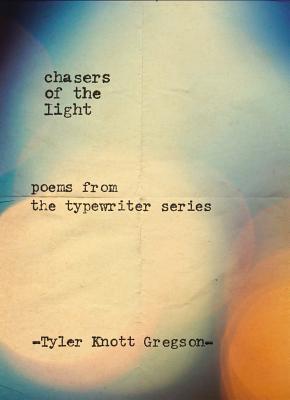
Chasers of the Light: Poems from the Typewriter Series by Tyler Knott Gregson

Source: Perigee/Penguin Random House
Hardcover, 144 pages
I am an Amazon Affiliate

Chasers of the Light: Poems from the Typewriter Series by Tyler Knott Gregson is a collection of poems written on a typewriter Gregson found in an antique store in Montana.  He wrote the first poem in this collection in the store on a page from a broken book he was buying for $2.  A chance find in a store turned into a mission to bring light to readers and viewers of photography alike.  In the introduction, he says, “In all I write and all I say, I am trying to chase the light that I cannot help but see around me.  This book, in the simplest of terms, is a map my wandering feet have taken in that pursuit.  It is simple words on random pieces of paper that snuck into my along the way.  There will always be light, and I will never stop chasing it.”

"The oars and the compass, the anchor and the wheel,
have long since abandoned me.
Can you hear what I've longed to tell you,
that I go where the waves wish to deliver me
and you, my love, are the tide."

Many of these poems are about love and love that is lost.  There are poems in which he asks to be haunted by his lost love and that he wishes to love every scrap of her that remains.  In a poem early in the collection, he compares himself to a ship without a rudder and the lover is compared to a hurricane.  In undulating rhythm, Gregson is a ship at sea carried away by waves — the waves of the tide, his lover.  It is an unnamed poem, like all of them, that is beautiful in its simplicity.  The love experienced in this poem is grand and overpowering.  Each of these poems are typed on scraps of paper, pieces of books, napkins, and receipts.   He also includes some gorgeous photographs, with accompanying poems.

In one gorgeous compilation piece, Gregson pairs a poem about being broken and healed with a photo of a dilapidated roof through which one shaft of bright light shines through.  Like many of the poems in this collection, they are beautiful in their simplicity.  He sheds light on the smallest of moments, like a flowering weed growing out of a bullet shell.  We carry our loves and losses inside each of us, and they become part of who we are.  What would we be without those past emotions and experiences.  Chasers of the Light: Poems from the Typewriter Series by Tyler Knott Gregson is gorgeous from cover to cover,

About the Poet:

Tyler Knott Gregson is a poet, author, professional photographer, and artist who lives in the mountains of Helena, Montana. When he is not writing, he operates his photography company, Treehouse Photography, with his talented partner, Sarah Linden.  Visit him on Twitter, Facebook, Instagram, and Pinterest.  Check out his Website.


Book 20 for the Dive Into Poetry Reading Challenge 2014.


52nd book for 2014 New Author Challenge.

The Last Kabbalist of Lisbon by Richard Zimler

Source: Public Library
Paperback, 318 pages
On Amazon and on Kobo

The Last Kabbalist of Lisbon by Richard Zimler set during the 1500s at the time of the Lisbon Massacre of April 1506, in which about 2,000 Jews were killed.  Zimler breathes life into this time period and the Jewish Kabbalah, a time in which Jews were in hiding and many were converted to New Christians (Marranos) in 1497 — some after fleeing Spain — to remain safe from persecution. Even their conversion is not enough to satisfy Old Christians as they run rampant through the city killing Jews, putting their heads on spikes, throwing them on pyres, and more.  King Manuel I, while more tolerant of the Jewish community, allowed the massacre to rage on, and eventually, 30 years later, the inquisition was established in Portugal, just as it had been in Spain.  Berekiah Zarco, a young manuscript illuminator, becomes caught up in the search for a killer, after he discovers his uncle, the keeper of forbidden Hebrew texts, has been murdered.

“We are all of us deep and wide enough to welcome a river of paradoxes and riddles into our souls.” (page 21)

Berekiah, also known as Pedro as a New Christian, worked with his uncle illuminating texts for others that were hiding from the Christians and trying to keep their Jewish faith alive, but he is unaware of how his uncle smuggled precious texts out of the city and into Turkey so as to keep them from being lost.  Zimler demonstrates through Zarco’s search for his uncle’s killer how the Jews were forced to wear a great many masks to hide their religion, but at the same time, these masks could be false ones and even the most trustworthy in the community could be hiding nefarious deeds.  The tale is told as Zarco unravels the mystery of his uncle’s death, and while he becomes absorbed in vengeance and the search for justice, his Muslim friend, Farid, who cannot speak except with his hands, steers him in the right direction and reminding him of compassion and empathy along the way.

“Yet the wall tiles and window eyelets, desks and chairs returned my gaze without the slightest quiver of motion.  The room was empty, seemed hollow, like the rib cage of an animal whose heart had suddenly ceased beating.”  (page 57)

With a turncoat in the Jewish community, Zarco narrows the field to a few suspects and sets about finding the truth, even as the Old Christians continue to rage, pillage, and kill Jews in their wake.  While the dialogue is a bit comical after a time, with Zarco accusing elders in the community of being murderers and them immediately denying it and him accepting their answers, in the context of the time period in which elders were to be believed, the conversations make sense.  Zarco’s life is in endanger at every turn as he seeks the killer, but he relies on his Kabbalist faith to see him through and finds a strength through his uncle’s teachings.

The Last Kabbalist of Lisbon by Richard Zimler provides a window into the early 1500s when Jews were being pushed out of their homes, and much of the situations during this time mirrors the reasons reiterated during the time of the Nazis — that the Jews were taking all of the jobs and the money away from those who were true Portuguese.  Christian versus New Christian and Jew, Kabbalah was all the Jews had to cling to as a way to survive persecution and continue flourishing.  It is a harrowing story of evil, death, and perseverance, but it is also about the ties we have to our faith and family, even after much of our family has passed on.

About the Author:

Richard Zimler was born in Roslyn Heights, a suburb of New York City, in 1956. After earning a bachelor’s degree in comparative religion from Duke University (1977) and a master’s degree in journalism from Stanford University (1982), he worked for eight years as a journalist, mainly in the San Francisco Bay area. In 1990, he moved to Porto, Portugal, and he has taught journalism for the last sixteen years, first at the College of Journalism and now at the University of Porto. Richard has both American and Portuguese nationality.

1st book for the 2014 Portuguese HF Challenge.


16th book for 2014 European Reading Challenge(Set in Portugal)


26th book for 2014 Historical Fiction Reading Challenge.


51st book for 2014 New Author Challenge.

Mailbox Monday #285

Mailbox Monday, created by Marcia at To Be Continued, formerly The Printed Page, has a permanent home at its own blog.

To check out what everyone has received over the last week, visit the blog and check out the links.  Leave yours too.

Also, each week, Leslie, Vicki, and I will share the Books that Caught Our Eye from everyone’s weekly links.

Here’s what I received:

1.  Twelve Dancing Unicorns by Alissa Heyman for review.

Once upon a time, a king owned twelve enchanting unicorns that he locked up with golden chains. But every morning, he’d find the beautiful creatures peacefully asleep in their corral—with their chains shattered. Puzzled, he promised a reward to anyone who could reveal the unicorns’ secret. With the help of a magic cloak, a little girl sets out to discover the truth . . . and help the special unicorn that she loves the most. This charming variation on “The Twelve Dancing Princesses,” stars a delightfully spirited heroine and twelve magical unicorns.

What did you receive?

268th Virtual Poetry Circle

Welcome to the 268th Virtual Poetry Circle!

Remember, this is just for fun and is not meant to be stressful.

Keep in mind what Molly Peacock’s book suggested.

Look at a line, a stanza, sentences, and images; describe what you like or don’t like; and offer an opinion. If you missed my review of her book, check it out here.

Today’s poem is from Wilfred Owen, recited by Claude Mumbere:

Strange Meeting

It seemed that out of battle I escaped
Down some profound dull tunnel, long since scooped
Through granites which titanic wars had groined.

Yet also there encumbered sleepers groaned,
Too fast in thought or death to be bestirred.
Then, as I probed them, one sprang up, and stared
With piteous recognition in fixed eyes,
Lifting distressful hands, as if to bless.
And by his smile, I knew that sullen hall,— 
By his dead smile I knew we stood in Hell.

With a thousand fears that vision's face was grained;
Yet no blood reached there from the upper ground,
And no guns thumped, or down the flues made moan.
“Strange friend,” I said, “here is no cause to mourn.” 
“None,” said that other, “save the undone years,
The hopelessness. Whatever hope is yours,
Was my life also; I went hunting wild
After the wildest beauty in the world,
Which lies not calm in eyes, or braided hair,
But mocks the steady running of the hour,
And if it grieves, grieves richlier than here.
For by my glee might many men have laughed,
And of my weeping something had been left,
Which must die now. I mean the truth untold,
The pity of war, the pity war distilled.
Now men will go content with what we spoiled.
Or, discontent, boil bloody, and be spilled.
They will be swift with swiftness of the tigress. 
None will break ranks, though nations trek from progress.
Courage was mine, and I had mystery;
Wisdom was mine, and I had mastery: 
To miss the march of this retreating world
Into vain citadels that are not walled.
Then, when much blood had clogged their chariot-wheels, 
I would go up and wash them from sweet wells,
Even with truths that lie too deep for taint.
I would have poured my spirit without stint
But not through wounds; not on the cess of war.
Foreheads of men have bled where no wounds were.

“I am the enemy you killed, my friend.
I knew you in this dark: for so you frowned
Yesterday through me as you jabbed and killed.
I parried; but my hands were loath and cold.
Let us sleep now. . . .”

What do you think?

Week 3 of the Stella Bain Read-a-Long

This year at War Through the Generations we’ve been hosting a read-a-long specific to one of the 6 wars we are covering.

As this year marks the 100th anniversary of WWI, we’ve decided to select one of our favorite authors — Anita Shreve — to honor the war.

Stella Bain is our selection for August. Synopsis from GoodReads:

When an American woman, Stella Bain, is found suffering from severe shell shock in an exclusive garden in London, surgeon August Bridge and his wife selflessly agree to take her in.

A gesture of goodwill turns into something more as Bridge quickly develops a clinical interest in his house guest. Stella had been working as a nurse’s aide near the front, but she can’t remember anything prior to four months earlier when she was found wounded on a French battlefield.

In a narrative that takes us from London to America and back again, Shreve has created an engrossing and wrenching tale about love and the meaning of memory, set against the haunting backdrop of a war that destroyed an entire generation.

Beware of spoilers.

Discussions will be posted on Friday for the designated chapters. Here’s the reading schedule and discussion dates:

Friday, Aug. 8: Pages 1-70
Friday, Aug. 15: Pages 71-138
Friday, Aug. 22: Pages 139-207
Friday, Aug. 29: Pages 208-end

We hope that you’ll join us for the read-a-long and discussions at War Through the Generations.