Quantcast

A Day at Grandma’s by Mi-ae Lee, illustrated by Yang-sook Choi

Source: Independent Publishers Group
Hardcover, 34 pgs
I am an Amazon Affiliate

A Day at Grandma’s by Mi-ae Lee, illustrated by Yang-sook Choi, is part of a series of math concepts books that teach basic math concepts through story-telling.  This book has a focus on time of day — dawn, morning, noon, afternoon, dusk, and night — and the difference between today, yesterday, and tomorrow.  The young girl spends an entire day with her grandmother, while her mother goes about her day, missing her daughter.  The mother talks about what she and her daughter would do at each time of day together and the daughter at her grandmother’s explains how she spends her day with her grandmother and compares it to life at home.

This simple story, children can learn how long an actual day is and can create a pie chart filled with their own activities, like the one in the back of the book.  Children that love art projects could turn this pie chart into something really visual with cut outs from magazines and newspapers, as well as drawings.  Parents should explain the different times of day and what accomplishments and activities they do as a family during those time periods.

A Day at Grandma’s by Mi-ae Lee, illustrated by Yang-sook Choi, is a cute story on its own about spending time away from our parents, even as young kids and how that can be an adventure filled with stories to be shared, rather than something that’s scary.  It also can help teach children about different times of day, and allow them to look at their own lives and routines in new ways.
The Great War: Stories Inspired by Items from the First World War illustrated by Jim Kay


Source: LibraryThing Early Reviewers
Hardcover, 304 pgs
I am an Amazon Affiliate

The Great War: Stories Inspired by Items from the First World War illustrated by Jim Kay is an engaging way for young readers (age 10+) to learn about World War I through the touchstones and artifacts left behind by soldiers, their families, and the war itself.  From a writing case to a toy soldier, these stories draw inspiration from these objects, building a world in the past that could be as real today as it was then.  There are stories from Michael Morpurgo and Tracy Chevalier, and like many short story collections some stories shine brighter than others, with “Captain Rosalie” being bitter sweet and “Our Jacko” inspiring.  These stories will evoke deep emotions in readers, as they learn not only about the realities of war and loss, but also the connections we have to objects that come from our ancestors.

“I keep the compass shined up and the safety catch on so the little needle doesn’t swing and break.  When I hold it and let it go and hunt out north, it bobs around like anything, like something on water, and it’s hard to tell where you are or what it’s saying.  That’s because I can’t keep my hands still enough.  But my dad could.  He kept his hands steady all the way, and he found home.” (“Another Kind of Missing,” pg 27)

“For in order for a story to work, it has to have a purpose, a structure, a journey, and a resolution.  And in reality, war has none of these things.  War is simply a near-random sequence of horrors, and so to make a story out of war is to lie.”  (“Don’t Call It Glory,” pg 65)

“But for music, I might have just stayed there,
keeping time with the
swoosh, swoosh, swoosh
of my push broom
for always.

Maybe making something of yourself is about
not
just keeping time
but doing something of substance,
something risky,
something you couldn’t fathom having the
skill
guts
nuts
to do until
you
do it. (“A Harlem Hellfighter and His Horn,” pg. 153)

Beyond the short stories told in this collection, there is one, long narrative poem, “A Harlem Hellfighter and His Horn,” which mirrored the rhythm and blues played by the main character.  But it also highlights the desire to seize the moment when it comes, rather than wait until its gone to desire it.

“So I won’t waste it:
War can break a man.
Slam him down on his back in the
dark.” (“A Harlem Hellfighter and His Horn,” pg. 166)

Each of these pieces brings forth some of the hidden feelings of those left behind by soldiers and those who are less than eager to fight, but they also illustrate the complexity of war and its allure.  Kay’s illustrations are in black and white and give the collection just the right amount of gruesome horror, but these are accompanied by facts about the war from women entering the workforce and the types of jobs they assumed to the conditions of the trenches.

The Great War: Stories Inspired by Items from the First World War illustrated by Jim Kay would be a great addition to any classroom willing and able to go beyond the traditional teachings of just WWII and other wars.  WWI was an important part of history that should not be forgotten, as it illustrates not only the brutality of ambitious people, but also the realities of bravery and cowardice, particularly through the eyes of children who are left behind.


Interview with Carolina De Robertis, author of The Gods of Tango

If you’ve missed out on Carolina De Robertis’ books before, you need to check out Perla, which was one of my favorites. She has a new book due out in July, The Gods of Tango.

About the Book from GoodReads:

February 1913: seventeen-year-old Leda, carrying only a small trunk and her father’s cherished violin, leaves her Italian village for a new home, and a new husband, in Argentina. Arriving in Buenos Aires, she discovers that he has been killed, but she remains: living in a tenement, without friends or family, on the brink of destitution. Still, she is seduced by the music that underscores life in the city: tango, born from lower-class immigrant voices, now the illicit, scandalous dance of brothels and cabarets. Leda eventually acts on a long-held desire to master the violin, knowing that she can never play in public as a woman. She cuts off her hair, binds her breasts, and becomes “Dante,” a young man who joins a troupe of tango musicians bent on conquering the salons of high society. Now, gradually, the lines between Leda and Dante begin to blur, and feelings that she has long kept suppressed reveal themselves, jeopardizing not only her musical career, but her life.

Please give Carolina De Robertis a warm welcome.

1. In addition to writing your own fiction, you also translate books. Could you explain a little bit about the process of translating books and share what languages you translate?

I translate Latin American writing from Spanish into English—and I’m incredibly passionate about the world of translation, not only because it’s crucial to ensuring access to international literatures, but also because I find it to be an exhilarating process. There is nothing quite like taking a beautiful piece of writing and striving to render it in a different language. For me, it’s a bit like transposing a piece of music from one instrument to the other, like taking a work written for piano, say, and adapting it for the violin. There are things that the piano can do that the violin can’t do, and vice versa. The same is true for English, Spanish, and the other languages I speak (though not so well!). You have to be true to the original, and yet limber enough to ensure that the piece’s soul will sing out on your new instrument.

2. In The Gods of Tango, Leda finds herself alone in an unfamiliar country, Argentina, did you draw on any of your own personal experiences to flesh out the challenges she faced?

I feel deeply at home in writing the experiences of immigrants, even when their circumstances differ from the ones I’ve known. The way I see it, I was born an immigrant; I left South America in my mother’s womb, and then grew up in three different countries. I have always been an “other;” I don’t know any other way of moving through the world.

When I made my first extended trip to Uruguay and Argentina, my nations of origin, I was sixteen years old, and the experience was a dizzying blend of intense familiarity and desire for something that had long felt far away. And so, I am perennially drawn to writing stories of crossing borders, of belonging and not-belonging, of what it means to hold multiple cultures in your skin.

3. Tango is a very sensual and rhythmic dance, how did that music and dance inspire your writing for the book? And did you listen to such music while writing?

Absolutely! Once I knew that this novel was going to portray the early years of the tango’s evolution, and explore the communities that gave birth to it, it was obvious that I’d have to empaparme del tango, as we’d say in Uruguayan Spanish—drench myself in it. The tango had always been familiar to me, of course; I come from the land of tango, my own grandfather was a tango composer, and the music was present in my childhood home, from tape recordings to my parents’ absent singing to themselves.

In the research for this book, I took private dance lessons with an incredible teacher in Uruguay; studied the violin with a professional tango musician; interviewed tango musicians and dancers about their intimate relationships with the art form; studied a mountain of scholarly texts; and, of course, listened and listened to the music. All of it, from classic giants such as De Caro and Canaro to Piazzolla’s bold innovations, from the immortal Carlos Gardel to the twenty-first century fusions of Gotan Project. Happily, I am listening to tango as I write these very words.

4. Women dressing as men to live the lives they want is a theme in many historical fiction works and there are women in history who have done such things. What about this life inspired your story and how did it take on a life of its own when writing the novel?

I knew that I wanted to write about the wave of migrants that came to Buenos Aires in the early twentieth century, mainly from Europe, and the tremendous impact they had on the culture in their quest to survive. My great-grandmother was part of that wave, leaving her tiny Italian village alone, at the age of 17, to go marry her cousin.

But I also knew that I wanted this book to dive right into the heart of the birth of the tango, which was happening in those very tenements where those immigrants landed, a music born from poor people, working people, blending their cultures and sounds. The tango world was extremely gendered in the 1910s. It was a seedy underworld, the domain of men, where the only women welcome were prostitutes. How would a female character be able to penetrate that world on her own terms?

There was only one answer. An answer that many women have found throughout history—far more women than recorded history shows. Though I can’t prove it, I am absolutely positive that there were plenty of real women in 1910s Buenos Aires doing exactly what Leda did. Sadly, their histories have been lost. That’s what we need fiction for: to dramatically repair the silences of history.

5. Do you tango? And who are your favorite tango dancers?

As I mentioned, the tango is in my culture and in my skin, and I have danced at Buenos Aires milongas with my relatives, and studied the dance. But I’m not much of a natural dancer, myself. What I do have is something of a musician’s ear so I relate to it that way—and, like many ríoplatenses (people from Argentina and Uruguay), I don’t think of the tango as just a dance, but as much more than that: as a music, as a culture, as a way of relating to the world. This is a lens that is missing in the U.S. and beyond; I hope to offer it to readers.

That said, there are many marvelous tango performers, both dancers and musicians, here in the U.S., and I am in awe of what they do.

6. How important do you think it is to highlight the history of Latin American nations both good and bad, and what pieces of that history do you think should be told that haven’t?

Just as with any region of the world, I think it’s crucial to tell the whole truth, however complex or potentially uncomfortable. In The Gods of Tango, I strove to portray both the harsh and beautiful aspects of early tango culture.

There are so very, very many threads of Latin American history that are still undertold, and these, not surprisingly, are the narratives of those whose stories have been historically marginalized, including women, queers, and people of African descent. Very few people know that the tango has African as well as European roots, and that, at the turn of the twentieth century, Buenos Aires was one-third black. It was very important to me to include those voices in this novel. That said, there is still so much more tremendously rich Afro-Argentinean and Afro-Uruguayan history to be told.

7. Finally, how has your journey as an author evolved? Any tricks or tips you’d like to share?

Now that I’m working on my fourth novel, the arc of the whole experience is more familiar, so that, when I feel like I’m walking right into a moonless night without a flashlight and I can’t tell where I’m going next, it’s easier to stay calm and think, oh, look, here’s the part where I’m lost in the dark, that must be progress. There’s no trick, really, except this one open secret: persist, persist, persist.

Stencil Craft: Techniques for Fashion, Art & Home by Margaret Peot

tlc tour host

Source: TLC Book Tours
Paperback, 128 pgs
I am an Amazon Affiliate

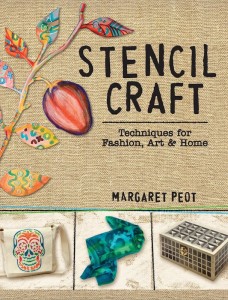
Stencil Craft: Techniques for Fashion, Art & Home by Margaret Peot is a gloriously laid out how-to guide for stenciling on fabric and other materials, and Peot outlines what tools work best and how to choose the best brushes and materials for making stencils.  She says in the introduction, “In this book you will make your mark literally — using stencil techniques to paint on clothes, paper, and home furnishings for fashion, interior design, art, and crafting.”  However, she does warn, “while experimenting with the projects in this book, you will make some beautiful things and some ugly things.”  (page 7)

My husband is the more crafty one when it comes to art, though I’ve done some pastel drawings and some collage in scrapbooks previously, but this book was a way that our family could create something together.  With the gorgeous examples in the book, it was very hard to decide, but we ultimately chose to do a project with found items, which can be those found outside, like feathers and leaves, or just stuff from around the house like ribbon, lace trim, or other items. Then, after rummaging around the house and looking at the stuff we had, we changed our minds. Obviously, this is a book that can generate a ton of ideas.

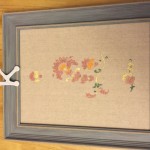
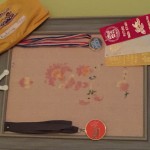
Finally, we decided to create a board that our daughter could use for her achievements, like her swim ribbons and her medals from soccer, etc. We wanted to create something with stencils and acrylic that she could use. However, rather than cut out our own stencils, we bought some we liked to try out; we’ll probably be more adventurous later when we redo the kitchen cabinets.

You can see the progression and results we had for our first time. We thought that the instructions about picking out brushes and paints was pretty straightforward. The techniques for brushing on the paint was relatively easy to follow, though it seems that we were both using different techniques on the same project. The overall result is good, but I think we’ll need a little more practice before we tackle a larger project. Stencil Craft: Techniques for Fashion, Art & Home by Margaret Peot will have us busy for some time, and I think theses are some great projects for families to do together or even to teach little ones. I’ll be sharing this book with both my husband and daughter for sure.

There are two giveaways with this review, one through Rafflecopter, and one for a single copy of the book to a U.S. resident.

So please do enter both. Leave a comment about what kinds of stencil projects you’d be interested in doing in the comments for your chance to win a copy of the book.  Enter by July 12, 2015, 11:59 PM EST


About the Author:

Margaret is an artist, writer and costume painter. Margaret’s book Inkblot: Drip, Splat and Squish Your Way to Creativity (Boyds Mills 2011) was awarded a Eureka! Silver Medal for non-fiction children’s books. She is also the author of The Successful Artist’s Career Guide (F&W 2012), Alternative Art Journals (F&W 2012), and Make Your Mark (Chronicle Books, 2004), voted one of Library Journal’s best how-to books of 2004. She is looking forward to the publication of two new books in 2015, Stencil Craft (F&W) and an early reader picture book, Crow Makes a Friend (Holiday House).

Margaret has painted costumes at Parsons-Meares, LTD for more than twenty years. Projects include Broadway (Aladdin, The Lion King, Wicked, Turn Off the Dark, Will Rogers Follies, Shrek the Musical, Phantom of the Opera, Mary Poppins, among many others), dance (ABT, Joffrey Ballet, Pilobolus, Feld Ballet, Nevada Ballet), film (Bram Stoker’s Dracula), as well as for circuses, arena shows and ice shows. For more information, please visit her websites: MargaretPeot.com and TheInkBlot.com.

Enter the Rafflecopter Giveaway:

a Rafflecopter giveaway

Mailbox Monday #330

Mailbox Monday, created by Marcia at To Be Continued, formerly The Printed Page, has a permanent home at its own blog.

To check out what everyone has received over the last week, visit the blog and check out the links.  Leave yours too.

Also, each week, Leslie, Vicki, and I will share the Books that Caught Our Eye from everyone’s weekly links.

Here’s what I received:

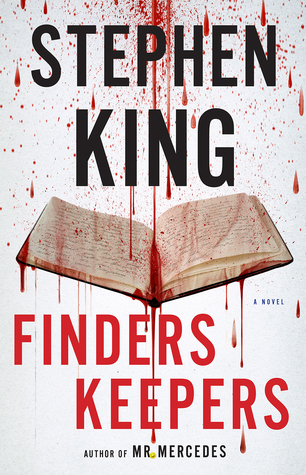
1.  Finders Keepers by Stephen King from my mom for my birthday, which came a couple months early for me.

Wake up, genius.” So begins King’s instantly riveting story about a vengeful reader. The genius is John Rothstein, an iconic author who created a famous character, Jimmy Gold, but who hasn’t published a book for decades. Morris Bellamy is livid, not just because Rothstein has stopped providing books, but because the nonconformist Jimmy Gold has sold out for a career in advertising. Morris kills Rothstein and empties his safe of cash, yes, but the real treasure is a trove of notebooks containing at least one more Gold novel.

Morris hides the money and the notebooks, and then he is locked away for another crime. Decades later, a boy named Pete Saubers finds the treasure, and now it is Pete and his family that Bill Hodges, Holly Gibney, and Jerome Robinson must rescue from the ever-more deranged and vengeful Morris when he’s released from prison after thirty-five years.

2.  Too Big to Fail by Andrew Ross Sorkin from my husband whose office was throwing the books out.

Andrew Ross Sorkin delivers the first true behind-the-scenes, moment-by-moment account of how the greatest financial crisis since the Great Depression developed into a global tsunami. From inside the corner office at Lehman Brothers to secret meetings in South Korea, and the corridors of Washington, Too Big to Fail is the definitive story of the most powerful men and women in finance and politics grappling with success and failure, ego and greed, and, ultimately, the fate of the world’s economy.

“We’ve got to get some foam down on the runway!” a sleepless Timothy Geithner, the then-president of the Federal Reserve of New York, would tell Henry M. Paulson, the Treasury secretary, about the catastrophic crash the world’s financial system would experience.

Through unprecedented access to the players involved, Too Big to Fail re-creates all the drama and turmoil, revealing never disclosed details and elucidating how decisions made on Wall Street over the past decade sowed the seeds of the debacle. This true story is not just a look at banks that were “too big to fail,” it is a real-life thriller with a cast of bold-faced names who themselves thought they were too big to fail.

3.  Rome in Love by Anita Hughes from the author for review.

When Amelia Tate is cast to play the Audrey Hepburn role in a remake of Roman Holiday, she feels as if all her dreams have come true. She has a handsome boyfriend, is portraying her idol in a major motion picture, and gets to live in beautiful Rome for the next two months.

Once there, she befriends a young woman named Sophie with whom she begins to explore the city. Together, they discover all the amazing riches that Rome has to offer. But when Amelia’s boyfriend breaks up with her over her acting career, her perfect world begins to crumble.

While moping in her hotel suite, Amelia discovers a stack of letters written by Audrey Hepburn that start to put her own life into perspective. Then, she meets Philip, a handsome journalist who is under the impression that she is a hotel maid, and it appears as if things are finally looking up. The problem is she can never find the right time to tell Philip her true identity. Not to mention that Philip has a few secrets of his own. Can Amelia finally have both the career and love that she’s always wanted, or will she be forced to choose again?

With her sensory descriptions of the beautiful sites, decadent food, and high fashion of Rome, Hughes draws readers into this fast-paced and superbly written novel. Rome in Love will capture the hearts of readers everywhere.

What did you receive?

312th Virtual Poetry Circle

Welcome to the 312th Virtual Poetry Circle!

Remember, this is just for fun and is not meant to be stressful.

Keep in mind what Molly Peacock’s book suggested.

Look at a line, a stanza, sentences, and images; describe what you like or don’t like; and offer an opinion. If you missed my review of her book, check it out here.

Today’s poem is from Jimmy Santiago Baca:

I Am Offering This Poem

I am offering this poem to you,
since I have nothing else to give.
Keep it like a warm coat
when winter comes to cover you,
or like a pair of thick socks
the cold cannot bite through,

                         I love you,

I have nothing else to give you,
so it is a pot full of yellow corn
to warm your belly in winter,
it is a scarf for your head, to wear
over your hair, to tie up around your face,

                         I love you,

Keep it, treasure this as you would
if you were lost, needing direction,
in the wilderness life becomes when mature;
and in the corner of your drawer,
tucked away like a cabin or hogan
in dense trees, come knocking,
and I will answer, give you directions,
and let you warm yourself by this fire,
rest by this fire, and make you feel safe

                         I love you,

It’s all I have to give,
and all anyone needs to live,
and to go on living inside,
when the world outside
no longer cares if you live or die;
remember,

                         I love you.

What do you think?

Happy Independence Day!

I hope that everyone is remembering that freedom often comes with a price, and that many of our ancestors and current family members have paid that price.

I hope that you are spending with your families and enjoying yourselves.

Happy Independence Day!

Urban Art Berlin: Version 2.0 by Kai Jakob

Source: A gift from Emma Eden Ramos
Hardcover
I am an Amazon Affiliate

Urban Art Berlin: Version 2.0 by Kai Jakob does have words, but words as rendered in urban art, also called graffiti.  This collection is of art in Berlin, and what’s interesting is how artists have set their work on top of others.  Art here has no boundaries, nothing to pin it in.  The introduction and foreword are in both German and English, which is helpful for those who don’t know German, and in it, Jakob says that public space is in actuality free space.  Berlin is the home to many artists, including those engaged in graffiti.  Jakob says that as urban landscapes become very monotone and similar, it is a splash of color and an unexpected image that can provide visitors with a glimpse into the true heart of the city.

The photos in this book bring to life not only spray painted images, but those made of paper stuck on walls, stickers on street signs, and more.  I’d recommend this book for those interested in other cultures, graffiti, photography, and art.  Jakob has collected a wide variety of images from the streets of Berlin, and some are comical, while others are downright bizarre.

About the Author:

Check out the Street Art in Berlin Facebook page.

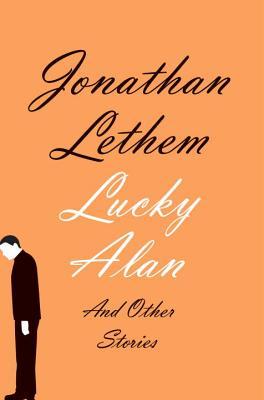
Lucky Alan and Other Stories by Jonathan Lethem

Source: Random House
Hardcover, 157 pgs
I am an Amazon Affiliate

Lucky Alan and Other Stories by Jonathan Lethem is an eclectic collection of short stories that range from the experimental to the surreal and traditional, but many of these stories lack the final punch readers make expect from short stories. While characters in these stories may experience smaller revelations, they often fall a little flat in the telling as the prose tends to be overly flowery or down-right boring. Of the collections that should be engaging to the reader given the title alone, they often lack the glitter readers will expect, such as “The Porn Critic.” And even these stories with catchy titles are some of the best in the collection, despite their flaws.

The first story, “Lucky Alan,” chronicles a neighbor who is obsessed with a reclusive Alan in his building and upon his marriage and later his growing family, the neighbor feels less important and pushed aside. In reality, he learns that this friend he tried so hard to win, was not who he thought him to be at all. And after the entire building sides with Alan, it is hard for him to continue living in a place that is unaware of Alan’s true nature. There are more nuances in the story, but they often get lost in the strange dialogue between friends and the situations that seem outlandish even in a large city of eclectic people.

In “The King of Sentences,” Lethem takes a look at the other side of fame, not so much the emphasis on the crazed fan, though there are some here, but on the perceptions we have of these famous people and how they may be very far from reality. In fact, the reality presented here is very scary for those of us who wish to meet those famous stars and writers we love. Meanwhile, “Their Back Pages,” seemed to be riffing off of Survivor and Lord of the Flies, but there are some pieces within the story that worked better than others, which made the overall effect of the story muted and confused.

Lucky Alan and Other Stories by Jonathan Lethem was a collection of stories with a lot to recommend it, but unfortunately, I can’t. I was disappointed with the individual stories and those that worked for the most part just didn’t wow me. Others might have a different view, but when reading short stories, I shouldn’t be falling asleep.

About the Author:

Jonathan Allen Lethem is an American novelist, essayist and short story writer. His first novel, Gun, with Occasional Music, a genre work that mixed elements of science fiction and detective fiction, was published in 1994. It was followed by three more science fiction novels. In 1999, Lethem published Motherless Brooklyn, a National Book Critics Circle Award-winning novel that achieved mainstream success. In 2003, he published The Fortress of Solitude, which became a New York Times Best Seller. In 2005, he received a MacArthur Fellowship.

Ally-Saurus & the First Day of School by Richard Torrey

Source: Sterling Children’s Books
Hardcover, 32 pgs.
I am an Amazon Affiliate

Ally-Saurus & the First Day of School by Richard Torrey is a carefully crafted story about an imaginative young lady who leaves home to attend school for the first time.  Her mother assures her that she will make friends once she gets there, buoyed by this, Ally heads off to school.  She loves dinosaurs and imagines herself as one not only at home but at her new classroom as well.  She greets her teacher as a dinosaur would and eats her lunch as a dino would.  She’s not as odd as adults might think because the other students in her class act in similar ways, though none act as dinos.  From princesses to lions and astronauts, these kids have vivid imaginations.  Initially, they are wary of those who are different from one another, but eventually, their perceptions of one another are broken down and they learn to play with one another.  There is even one classmate who does not have an over-active imagination, and he’s accepted too.

My daughter and I loved this book and roared with Ally as she entered the classroom and played with her new friends.  We loved the adventures she took with her friends on the playground and hope that there are more books with Ally to come.  The illustrations are reminiscent of chalk drawings for the most part, which goes well with the theme — the first day of school.  Parents can use this tale to help ease the fears of their own kids before they enter school for the first time.

Ally-Saurus & the First Day of School by Richard Torrey is fantastic, inventive, and we loved it.  We’ll likely read this many more times before my daughter enters Kindergarten, so may by by then, she’ll be ready for her own new adventure.

About the Author:

Richard Torrey is the author and illustrator of a number of well-loved children’s books, including Almost, Why?, and the popular Beans Baker series. Mr. Torrey lives in Shoreham, New York.

Mailbox Monday #329

Mailbox Monday, created by Marcia at To Be Continued, formerly The Printed Page, has a permanent home at its own blog.

To check out what everyone has received over the last week, visit the blog and check out the links.  Leave yours too.

Also, each week, Leslie, Vicki, and I will share the Books that Caught Our Eye from everyone’s weekly links.

Here’s what I received:

1.  The Cake Therapist by Judith Fertig, which I received for review in July from Tandem Literary.

Claire “Neely” O’Neil is a pastry chef of extraordinary talent. Every great chef can taste shimmering, elusive flavors that most of us miss, but Neely can “taste” feelings—cinnamon makes you remember; plum is pleased with itself; orange is a wake-up call. When flavor and feeling give Neely a glimpse of someone’s inner self, she can customize her creations to help that person celebrate love, overcome fear, even mourn a devastating loss.

Maybe that’s why she feels the need to go home to Millcreek Valley at a time when her life seems about to fall apart. The bakery she opens in her hometown is perfect, intimate, just what she’s always dreamed of—and yet, as she meets her new customers, Neely has a sense of secrets, some dark, some perhaps with tempting possibilities. A recurring flavor of alarming intensity signals to her perfect palate a long-ago story that must be told.

Neely has always been able to help everyone else. Getting to the end of this story may be just what she needs to help herself.

2.  Crooked Heart by Lissa Evans from Harper Collins for review for TLC Book Tours.

When Noel Bostock – aged ten, no family – is evacuated from London to escape the Blitz, he ends up living in St Albans with Vera Sedge – thirty-six and drowning in debts and dependents. Always desperate for money, she’s unscrupulous about how she gets it.

Noel’s mourning his godmother, Mattie, a former suffragette. Brought up to share her disdain for authority and eclectic approach to education, he has little in common with other children and even less with Vee, who hurtles impulsively from one self-made crisis to the next. The war’s thrown up new opportunities for making money but what Vee needs (and what she’s never had) is a cool head and the ability to make a plan.

On her own, she’s a disaster. With Noel, she’s a team.

Together they cook up an idea. Criss-crossing the bombed suburbs of London, Vee starts to make a profit and Noel begins to regain his interest in life.

But there are plenty of other people making money out of the war and some of them are dangerous. Noel may have been moved to safety, but he isn’t actually safe at all…

What did you receive?

311th Virtual Poetry Circle

Welcome to the 311th Virtual Poetry Circle!

Remember, this is just for fun and is not meant to be stressful.

Keep in mind what Molly Peacock’s book suggested.

Look at a line, a stanza, sentences, and images; describe what you like or don’t like; and offer an opinion. If you missed my review of her book, check it out here.

Today’s poem is from Dylan Thomas:

Poem on His Birthday

In the mustardseed sun,
By full tilt river and switchback sea
Where the cormorants scud,
In his house on stilts high among beaks
And palavers of birds
This sandgrain day in the bent bay's grave
He celebrates and spurns
His driftwood thirty-fifth wind turned age;
Herons spire and spear.

Under and round him go
Flounders, gulls, on their cold, dying trails,
Doing what they are told,
Curlews aloud in the congered waves
Work at their ways to death,
And the rhymer in the long tongued room,
Who tolls his birthday bell,
Toesl towards the ambush of his wounds;
Herons, stepple stemmed, bless.

In the thistledown fall,
He sings towards anguish; finches fly
In the claw tracks of hawks
On a seizing sky; small fishes glide
Through wynds and shells of drowned
Ship towns to pastures of otters. He
In his slant, racking house
And the hewn coils of his trade perceives
Herons walk in their shroud,

The livelong river's robe
Of minnows wreathing around their prayer;
And far at sea he knows,
Who slaves to his crouched, eternal end
Under a serpent cloud,
Dolphins dyive in their turnturtle dust,
The rippled seals streak down
To kill and their own tide daubing blood
Slides good in the sleek mouth.

In a cavernous, swung
Wave's silence, wept white angelus knells.
Thirty-five bells sing struck
On skull and scar where his lovews lie wrecked,
Steered by the falling stars.
And to-morrow weeps in a blind cage
Terror will rage apart
Before chains break to a hammer flame
And love unbolts the dark

And freely he goes lost
In the unknown, famous light of great
And fabulous, dear God.
Dark is a way and light is a place,
Heaven that never was
Nor will be ever is alwas true,
And, in that brambled void,
Plenty as blackberries in the woods
The dead grow for His joy.

There he might wander bare
With the spirits of the horseshoe bay
Or the stars' seashore dead,
Marrow of eagles, the roots of whales
And wishbones of wild geese,
With blessed, unborn God and His Ghost,
And every soul His priest,
Gulled and chanter in youg Heaven's fold
Be at cloud quaking peace,

But dark is a long way.
He, on the earth of the night, alone
With all the living, prays,
Who knows the rocketing wind will blow
The bones out of the hills,
And the scythed boulders bleed, and the last
Rage shattered waters kick
Masts and fishes to the still quick stars,
Faithlessly unto Him

Who is the light of old
And air shaped Heaven where souls grow wild
As horses in the foam:
Oh, let me midlife mourn by the shrined
And druid herons' vows
The voyage to ruin I must run,
Dawn ships clouted aground,
Yet, though I cry with tumbledown tongue,
Count my blessings aloud:

Four elements and five
Senses, and man a spirit in love
Thangling through this spun slime
To his nimbus bell cool kingdom come
And the lost, moonshine domes,
And the sea that hides his secret selves
Deep in its black, base bones,
Lulling of spheres in the seashell flesh,
And this last blessing most,

That the closer I move
To death, one man through his sundered hulks,
The louder the sun blooms
And the tusked, ramshackling sea exults;
And every wave of the way
And gale I tackle, the whole world then,
With more triumphant faith
That ever was since the world was said,
Spins its morning of praise,

I hear the bouncing hills
Grow larked and greener at berry brown
Fall and the dew larks sing
Taller this thuderclap spring, and how
More spanned with angles ride
The mansouled fiery islands! Oh,
Holier then their eyes,
And my shining men no more alone
As I sail out to die

What do you think?