Quantcast

331st Virtual Poetry Circle

Welcome to the 331st Virtual Poetry Circle!

Remember, this is just for fun and is not meant to be stressful.

Keep in mind what Molly Peacock’s book suggested.

Look at a line, a stanza, sentences, and images; describe what you like or don’t like; and offer an opinion. If you missed my review of her book, check it out here.

This poem is from T.S. Eliot:

Silence

Along the city streets,
It is still high tide,
Yet the garrulous waves of life
Shrink and divide
With a thousand incidents
Vexed and debated:—
This is the hour for which we waited—

This is the ultimate hour
When life is justified.
The seas of experience
That were so broad and deep,
So immediate and steep,
Are suddenly still.
You may say what you will,
At such peace I am terrified.
There is nothing else beside.

What do you think?

Over the River & Through the Wood by Linda Ashman, illustrated by Kim Smith

Source: Sterling Children’s Books
Hardcover, 32 pgs.
I am an Amazon Affiliate

Over the River & Through the Wood by Linda Ashman, illustrated by Kim Smith, is a modern story of the Thanksgiving trip to grandmother’s house over the river and through the woods.  Rather than merely travel by sleigh, these family members take cars that run out of gas, trains to cities to find rental cars are all gone, and other modes of transportation when grandmother invites them over for dinner.

The way is paved with snow and these families are eagerly picked up by a horse and sleigh. Even the families are updated from the traditional mother and father with two kids to include not only mixed race families, but also a gay couple with children.  It was a lovely, inclusive touch.  What was a little disappointing was the text, as it didn’t rhyme as well as younger readers would expect.  They are unaware of slant rhyme and for little readers it could be hard to modify a word to make the rhyme work.

Over the River & Through the Wood by Linda Ashman, illustrated by Kim Smith, is a cute book about what it means to spend time together as a family, even with your extended family.  It’s especially wonderful when you not only have memories to share over the holidays, but when you come from different places and backgrounds.

Locke & Key: Crown of Shadows Vol. 3 by Joe Hill, illustrated by Gabriel Rodriguez

Source: Public Library
Paperback, 152 pgs.
I am an Amazon Affiliate

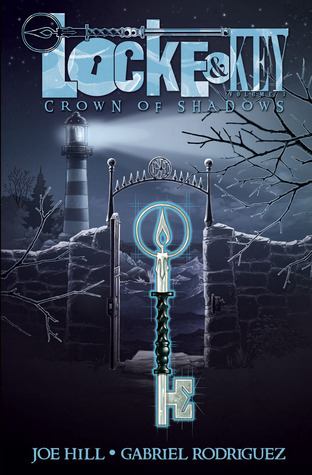
Locke & Key: Crown of Shadows Vol. 3 by Joe Hill, illustrated by Gabriel Rodriguez, introduces more keys and more trouble for the Locke family.  As their mother spirals further into her depression and strives to fix things while still drinking herself into oblivion, the kids continue to rebel against her.  Even as they strive to be more like adults where she is concerned, they are still mixed up teenagers, failing to deal with their grief about the loss of their father in volume 1.  As Kinsey continues to operate without her fears and sadness, Tyler continues to feel his guilt, which only gets stronger.  Bode is still the curious boy who finds the keys accidentally, but in this case, one key saves them from certain death, while another nearly pushes their mother over the edge when it fails to fix the one thing that cannot be fixed — the death of her husband.

There are more than just magical keys in this house, as the kids soon find that a crown of shadows can be used to move dark forces in the house.  They are still unaware of the wellhouse woman’s true identity, but she makes a reappearance in this volume to terrify even the youngest Locke, Bode.  Light is their only weapon until the breakers in the house are shut off and the house is plunged into darkness — a darkness that comes alive with the crown of shadows.

Locke & Key: Crown of Shadows Vol. 3 by Joe Hill, illustrated by Gabriel Rodriguez, is a strong third volume in the series and definitely reveals a lot more about the mysteries behind the keys, the wellhouse woman, and the Locke children’s father.  The illustrations are as engaging as ever, and readers will look forward to each horrifying installment.

Other Reviews:

About the Author:

Joseph Hillstrom King is an American writer of fiction, writing under the pen name of Joe Hill.  Hill is the the second child of authors Stephen King and Tabitha King. His younger brother Owen King is also a writer. He has three children.

Hill’s first book, the limited edition collection 20th Century Ghosts published in 2005 by PS Publishing, showcases fourteen of his short stories and won the Bram Stoker Award for Best Fiction Collection, together with the British Fantasy Award for Best Collection and Best Short Story for “Best New Horror”. In October 2007, Hill’s mainstream US and UK publishers reprinted 20th Century Ghosts, without the extras published in the 2005 slipcased versions, but including one new story.

About the Illustrator:

Architect, artist and illustrator. He started his career with myth based illustrations for card games, and then jumped into the world of professional comics working with IDW Publishing. In addition to his current work in Locke & Key, his collaborations with IDW include Clive Barker’s The Great and Secret Show, Beowulf, George Romero’s Land Of The Dead, as well as several CSI comics and some covers for Angel and Transformers.

Locke & Key: Head Games Vol. 2 by Joe Hill, illustrated by Gabriel Rodriguez

Source: Public Library
Paperback, 144 pgs.
I am an Amazon Affiliate

Locke & Key: Head Games Vol. 2 by Joe Hill, illustrated by Gabriel Rodriguez, continues the story and reveals even more of the house’s secrets.  There are more keys, even ones that can crack open your head — what’s inside some of these kids’ brains will unsettle you.  Memory and imagination meld together in their minds to create even more gruesome threats.  Tyler, Bode, and Kinsey are excited to find the key that opens their minds, and like many teens, they abuse the magical key.

Without fear Kinsey becomes less emotional and eager to face danger, but will that lead to her death? Tyler is happily using the magic to get ahead with girls and schools, while Bode is left on the sidelines.  But sharing these secrets of the house and its keys could be the most detrimental of all.  The illustrations are fantastic, realistic, and engaging.  There is so much to take in visually, as well as through the text.

Locke & Key: Head Games Vol. 2 by Joe Hill, illustrated by Gabriel Rodriguez, is a solid series with many secrets yet to be revealed.  The dark forces are still making their way out of the depths of the well and the house, but these kids are blissfully unaware that the keys they find can be used for evil.  While they believe the danger has subsided, readers will soon realize that this is only the beginning and that these kids may be left on their own in the battle of their lives.

Other Reviews:

About the Author:

Joseph Hillstrom King is an American writer of fiction, writing under the pen name of Joe Hill.  Hill is the the second child of authors Stephen King and Tabitha King. His younger brother Owen King is also a writer. He has three children.

Hill’s first book, the limited edition collection 20th Century Ghosts published in 2005 by PS Publishing, showcases fourteen of his short stories and won the Bram Stoker Award for Best Fiction Collection, together with the British Fantasy Award for Best Collection and Best Short Story for “Best New Horror”. In October 2007, Hill’s mainstream US and UK publishers reprinted 20th Century Ghosts, without the extras published in the 2005 slipcased versions, but including one new story.

About the Illustrator:

Architect, artist and illustrator. He started his career with myth based illustrations for card games, and then jumped into the world of professional comics working with IDW Publishing. In addition to his current work in Locke & Key, his collaborations with IDW include Clive Barker’s The Great and Secret Show, Beowulf, George Romero’s Land Of The Dead, as well as several CSI comics and some covers for Angel and Transformers.

Water on the Moon by Jean P. Moore

tlc tour host

Source: TLC Book Tours
Paperback, 244 pgs.
I am an Amazon Affiliate

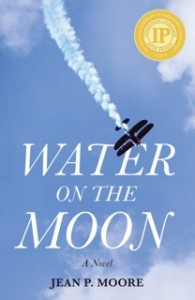
Water on the Moon by Jean P. Moore is a spiral of mystery in which Lidia Raven, the mother of teenage twin girls, has her life upended by a pane that crashes into her family home.  Raven’s life already had jolted off track when her husband left her for another man, and she chose to parent her children on her own, leaving a prosperous career for the suburbs.  Behind the home, the apple orchards stand guard, watching over the new generations as the previous generations’ secrets remain hidden in passages beneath the house and among the surviving generations.  With nods to Byron’s poetry and to the bravery and passion of Amelia Earhart, Moore’s prose is winding, meandering through Lidia’s concerns about her daughters, her obsessions with the flyer who crashed into her home, and her difficulty in letting go of her past life with her husband.  Her neighbor, Polly, takes the Raven family in as the house is restored and the FBI investigation wraps up, and this woman is a sage, offering sound advice to those willing to listen.

Since the breakup of her ideal family, Lidia has spent a lot of hours worrying about when the next shoe would drop and upend her world again.  She’s been in protectionist mode for far too long, and with help from Polly, she learns to be more open and more flexible, but she also has to face some of the ghosts in her family’s past.  While the intricacies of the family mystery are interesting and the pilot’s obsession with Earhart are engaging, the main story often gets lost in the references to Byron and to Earhart.  The story would have felt less distant if the reader could have connected closer with Lidia and her heartbreak.

Water on the Moon by Jean P. Moore offers tidbits of conflict that are resolved either too quickly or barely resolved.  Lidia is a character that seems underdeveloped emotionally, and while the daughters are on the periphery, they have greater depth.  Lidia’s character falls in love too quickly, is easily spooked, and has a stubborn streak when her heart is broken.  Without Polly, Lidia would have plugged along in her life without making any real changes, and in this way, she redeems the novel for this reader.  Polly’s life is fascinating, and her sage advice will remind readers of those grandmothers who carefully steer loved ones in the right direction.

About the Author:

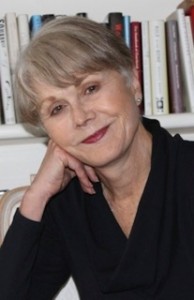
Jean P. Moore began her professional life as an English teacher, later becoming a telecommunications executive. She and her husband, Steve, and Sly, their black Lab, divide their time between Greenwich, Connecticut and the Berkshires in Massachusetts, where Jean teaches yoga in the summers.

Her work has appeared in newspapers, magazines, and literary journals such as upstreet, SN Review, Adanna, Distillery, Skirt, Long Island Woman, the Hartford Courant, Greenwich Time, and the Philadelphia Inquirer. Water on the Moon was published in June of 2014 and won the 2015 Independent Publishers Book Award for Contemporary Fiction. Visit her on her website, on her blog, and Twitter.

Mailbox Monday #348

Mailbox Monday, created by Marcia at To Be Continued, formerly The Printed Page, has a permanent home at its own blog.

To check out what everyone has received over the last week, visit the blog and check out the links.  Leave yours too.

Also, each week, Leslie, Vicki, and I will share the Books that Caught Our Eye from everyone’s weekly links.

Here’s what I received:

Dickey Chapelle Under Fire: Photographs by the First American Female War Correspondent Killed in Action by John Garofolo, which I won from LibraryThing Early Reviewers.

In 1965, Wisconsin native Georgette “Dickey” Chapelle became the first female American war correspondent to be killed in action. Now, “Dickey Chapelle Under Fire” shares her remarkable story and offers readers the chance to experience Dickey’s wide-ranging photography, including several photographs taken during her final patrol in Vietnam.

Dickey Chapelle fought to be taken seriously as a war correspondent and broke down gender barriers for future generations of female journalists. She embedded herself with military units on front lines around the globe, including Iwo Jima and Okinawa, the Dominican Republic, and Vietnam. Dickey sometimes risked her life to tell the story–after smuggling aid to refugees fleeing Hungary, she spent almost two months in a Hungarian prison. For twenty-five years, Dickey’s photographs graced the pages of “National Geographic,” the “National Observer,” “Life,” and others. Her tenacity, courage, and compassion shine through in her work, highlighting the human impact of war while telling the bigger story beyond the battlefield.

What did you receive?

330th Virtual Poetry Circle

Welcome to the 330th Virtual Poetry Circle!

Remember, this is just for fun and is not meant to be stressful.

Keep in mind what Molly Peacock’s book suggested.

Look at a line, a stanza, sentences, and images; describe what you like or don’t like; and offer an opinion. If you missed my review of her book, check it out here.

This poem is from Leo Marks, a code poem for the French Resistance during WWII:

The Life That I Have

The life that I have
Is all that I have
And the life that I have
Is yours

The love that I have
Of the life that I have
Is yours and yours and yours.

A sleep I shall have
A rest I shall have
Yet death will be but a pause
For the peace of my years
In the long green grass
Will be yours and yours and yours.

What did you think?

Seriously, You Have to Eat by Adam Mansbach, illustrated by Owen Brozman

Source: LibraryThing Early Reviewers
Hardcover, 32 pgs.
I am an Amazon Affiliate

Seriously, You Have to Eat by Adam Mansbach, illustrated by Owen Brozman, is similar to his previous book about the struggles of parenting, though this one is a little more kid friendly.  Rather than rely on the outrageous language and profanity, this book focuses on the food asked for an not eaten, the animals that eat no matter what is given to them by their parents, and the astonishing amount of energy that kids seem to have even if they do not eat their meals throughout the day.  My daughter was not as tickled by this book as I would have thought.  The illustrations are fine and the rhymes are pretty good for the most part, but she may not have seen the sarcastic humor in this one.  It may still be a little more geared to those struggling parents, than their kids.

Beyond the struggles with getting kids to eat, this one also touches on the little battles over what kids want to wear versus what they should be wearing to school.  There is one moment in the book in which the child is given milk to drink and the “kitchen” is closed, but the parent grabs a drink that smells like “peat.”  As a parent of a young child — we glossed over this part — I’m leery of introducing the idea that alcohol is a way to “solve” or deal with problems.  Yes, parenting is stressful, and yes, parents may take a drink to unwind, I’m just not sure that’s a message kids should be learning.

Seriously, You Have to Eat by Adam Mansbach, illustrated by Owen Brozman, is a book more fore parents than children, even though the language is less profane.  Even if parents share this book with their kids, they may want to gloss over certain things or change them up a bit.

Other Reviews:

Go the F**k to Sleep

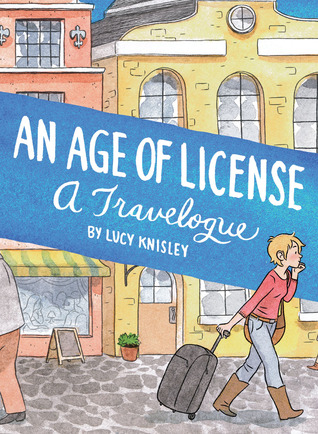
An Age of License by Lucy Knisley

Source: Public Library
Paperback, 195 pgs.
I am an Amazon Affiliate

An Age of License by Lucy Knisley is another graphic memoir of a young artist who has a compulsion to draw those around her, no matter how creepy that may appear in a crowded restaurant.  These graphic memoirs are a great way to quickly get a look inside someone’s life, their fears, and their happy moments without feeling like you’re prying.  The comics provide just the right amount of distance to the narrative, and Knisley’s style is very conversational and intimate, but there are moments she keeps to herself — that’s ok too.

Knisley is someone many of us were in our twenties — adventurous in spite of the anxiety — beginning the lives we’ll lead into the future either alone or with a family of our own.  We explore; we get to know who we are as people; what we’re looking for; and sometimes finding things we didn’t know we wanted.  While we often find that we are jealous of our friends who find themselves, their callings, or the families they desire before we do, we still love them and hope that we’ll find those things too.

Knisley’s graphic memoirs seem to be written as she goes along, but it is clear that more thought goes on and further work takes place after her adventures are done.  These memoirs have their own conversational quality and she clearly digs deep into her experiences.  In this memoir she takes a trip to Norway for a comics convention, which turns into a whirlwind of visits in other countries throughout Europe — Germany, France, and Sweden.  She questions the direction of her life and career, she questions her inability to find stability in relationships, but most of all, she questions her perspective, which comes from a relative place of privilege compared to others.

An Age of License by Lucy Knisley is a realistic look at traveling abroad as someone who does not know a language other than English, and who is still struggling to find her place and become grounded.  It is often good to get away from the daily grind to think about life as it is and determine if that’s what you want it to be for the rest of your life, and Knisley asks and somewhat answers these questions for herself.  One point in the memoir was a bit ironic in that lovers go to Paris, engrave their names on locks, and add those locks to a bridge as a sign of undying devotion, only for those locks to be eventually torn off by authorities and thrown away.  Even those things that we find permanent may not be.

***Another shout out to Bermudaonion for pointing me in Knisley’s direction.  I’ve loved these books.***

Other reviews:

About the Author:

Beginning with an love for Archie comics and Calvin and Hobbes, Lucy Knisley (pronounced “nigh-zlee”) has always thought of cartooning as the only profession she is suited for. A New York City kid raised by a family of foodies, Lucy is a graduate of the School of the Art Institute of Chicago currently pursuing an MFA at the Center for Cartoon Studies. While completing her BFA at the School of the Art Institute, she was comics editor for the award-winning student publication F News Magazine.

Lucy currently resides in New York City where she makes comics. She likes books, sewing, bicycles, food you can eat with a spoon, manatees, nice pens, costumes, baking and Oscar Wilde. She occasionally has been known to wear amazing hats.

Shiver by Maggie Stiefvater (audio)

Source: Public Library
Audiobook, 9 CDs
I am an Amazon Affiliate

Shiver by Maggie Stiefvater, narrated by Jenna Lamia and David Ledoux, is one of those young adult novels that adults who can engage in magical worlds will enjoy.  Boundary wood in Mercy Falls, Minn., is populated with wolves, and while most of the time they keep to themselves, there are those incidents of attacks and the inevitable backlash by hunters with guns.  Sam Roth and Grace Brisbane have lingered just on the outskirts of one another for six years, and while Grace was bitten by wolves as a child, she barely remembers what happened, other than the beautiful white-gray wolf who was their rescuing her and his piercing yellow eyes.  The woods near Grace’s house are where she sees the wolves in the winter, but never in the summer, and she’s fascinated by their grace and beauty.

Her obsession with the wolves does distance her from her friends, but she doesn’t seem to mind until they begin disappearing.  Sam is a boy with a dark family history, who was “saved” by Beck as a young boy.  Grace and he instantly connect, and only his glittering yellow eyes reveal who he truly is.  Grace is then swept up into a world she marginally knew existed, and her first love consumes her.  Jenna Lamia is a believable teenage girl, and she has the right timber and pace for Grace’s character, and David Ledoux provides fantastic depth to Sam’s character in the narration.  On audio, this book shines in the darkness of the snow-lit woods.

Shiver by Maggie Stiefvater, narrated by Jenna Lamia and David Ledoux, is a stunning opener to a paranormal series of books for young adults.  Stiefvater creates dynamic characters who are forced to deal with tough issues in unreal situations, and these characters are unforgettable.  Like many books in this category, there is a series, but this one has a lot of potential.  I’m looking forward to the next audio installment.

About the Author:

New York Times bestselling author of The Shiver Trilogy, The Raven Cycle, and The Scorpio Races. Artist. Driver of things with wheels. Avid reader.  All of Maggie Stiefvater’s life decisions have been based around her inability to be gainfully employed. Talking to yourself, staring into space, and coming to work in your pajamas are frowned upon when you’re a waitress, calligraphy instructor, or technical editor (all of which she’s tried), but are highly prized traits in novelists and artists. She’s made her living as one or the other since she was 22. She now lives an eccentric life in the middle of nowhere, Virginia with her charmingly straight-laced husband, two kids, two neurotic dogs, and a 1973 Camaro named Loki.

Interview with Kate Kerrigan

Kate Kerrigan is the author of Ellis Island, City of Hope, and Land of Dreams — a series of books I loved! She has two new books coming out The Miracle of Grace and Recipes for a Perfect Marriage.  Please give her a warm welcome today.

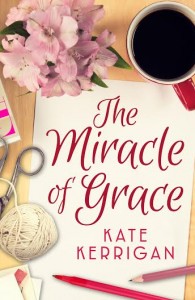
KerriganMiracleAbout The Miracle of Grace:

Grace’s mother Eileen is a great list maker, so when Grace walks into Eileen’s kitchen to drop off a postal package and sees her garish ‘To Do’ pad on the counter, she thinks nothing of it, until she sneaks a look. There, at No 8, ranked in importance well below bread, telephone bill and bins is ‘Tell G I have ovarian cancer, probably terminal’. Grace goes into shock, primarily at the thought that her mother is dying, but also at the fact that her mother simply couldn’t tell her to her face. Is their relationship really so bad?

Eileen has been brought up in rural Ireland in the 1950s, in thrall to the rules of her community – church first, then husband, then children. So she’s had little time for herself and even now finds it impossible to put her own problems and desires to the fore. It is only when Grace confronts her, that she is able to go back over her past, to her own childhood, her early marriage, and the birth of her cherished only daughter to find memories of happiness and unbearable tragedy that have coloured her life forever.

kerriganRecipesAbout Recipes for a Perfect Marriage:

Successful New York food writer Tressa Nolan has a great life — wonderful friends, a gorgeous apartment, and of course fabulous food — but the idea of turning forty alone scares her, so she marries the next man who asks: Dan, her building’s super. He’s handsome and he adores her, but soon after the wedding Tressa regrets her decision. Everything from Dan’s unsophisticated interests to his enormous (and intrusive) Irish-American family sets her teeth on edge. Why couldn’t she have the perfect marriage her grandparents had? What Tressa doesn’t know — what she only discovers when she reads her Grandma Bernadine’s journal-cum- recipe book — is that she’s following in Bernadine’s footsteps, and like all the best recipes, a perfect marriage calls for a long, slow simmer.

How do you come up with your ideas? Are they character or concept driven?

A bit of both. The concept comes first – but then once the characters present themselves and start to develop depth as they do in those early chapters, the story becomes theirs and they drive the narrative absolutely.

You often have dual timelines. Why is that? What is it about historical fiction that interests you so much?

I am fascinated by how the differences in our historical circumstances shape who we are and how we behave — especially in the way it affects our emotional landscapes. Stoicism, for instance, has gone way out of fashion as a way of being — yet it was a way of life for so many women, for so long — forced into unhappy marriages by religion for or utterly financially dependent on men they did not love. Yet — so much of what was good about value systems in the past: loyalty, a strong sense of identity, and place — still hold true today. I love drawing comparisons between how things were and how they are now and showing how while history may alter our circumstances, in the most real, important sense human beings never fundamentally change.

For all the freedom and money history has given us women in the western world — are we any happier now than our grandmothers were?

What’s your favorite part of the writing process?

Starting and finishing: one week at either end. Finishing is best. Honestly? The rest is pretty much just hard work: I write out of a compulsion to tell the story not because I enjoy the act of writing itself. The longer I do it – the less I feel I know about writing and the harder it gets! I get very close to my characters and I cry a lot. It’s an emotional rollercoaster — and I am always a bit sad to get off at the end — but relieved too.

Describe a typical day as a writer.

On a good day, I go into my accountants office, work from 9-5 and get 1,500 words written — this is what I intend every working day to be. However most days, I go into my accountants office, work from 9-5 and get 500 words written and know it’s not enough. On a bad day I get distracted by life. I chase around shopping, collecting kids, doing hideous admin., having lunch with my mother – I get nothing written and get whipped up into a state of blind panic at not having written anything. I have a lot of bad days.

Which authors inspire you?

People who write from the heart: Marian Keyes, Patrick McCabe – a lesser known but brilliant Irish writer called Frank Ronan. Probably the biggest influences over my lifetime as a reader and writer have been Agatha Christie for plot and PG Wodehouse for his vocabulary and use of language.  I never read historical fiction — I don’t have the confidence! However — for pleasure and relaxation I rarely read anything other than contemporary thrillers — David Balducci is my current thrill!

Do you have any advice for aspiring authors?

Just write, write, write – don’t be discouraged and keep going. Writing is 1% talent and 99% hard work and tenacity. I found writing groups and courses fantastic in my pre-published days. It’s not always easy to motivate yourself and a good writing group can really give you the encouragement and support you need.

What do you hope readers will take away from your books?

Identification with the characters and at least one lesson they can relate to their own lives.

Thanks so much, Kate, for stopping by and sharing your thoughts on dual narratives, your favorite authors, and writing.

Mailbox Monday #347

Mailbox Monday, created by Marcia at To Be Continued, formerly The Printed Page, has a permanent home at its own blog.

To check out what everyone has received over the last week, visit the blog and check out the links.  Leave yours too.

Also, each week, Leslie, Vicki, and I will share the Books that Caught Our Eye from everyone’s weekly links.

Here’s what I received:

National Geographic Book of Nature Poetry: More than 200 Poems With Photographs That Float, Zoom, and Bloom! by J. Patrick Lewis for review from Media Masters Publicity.

When words in verse are paired with the awesomeness of nature, something magical happens! Beloved former U.S. Poet Laureate J. Patrick Lewis curates an exhuberant poetic celebration of the natural world in this stellar collection of nature poems. From trickling streams to deafening thrunderstorms to soaring mountains, discover majestic photography perfectly paired with contemporary (such as Billy Collins), classics (such as Robert Frost), and never-before-published works.

What did you receive?