Quantcast

The Bambino and Me by Zachary Hyman

Source: Tundra Books and LibraryThing Early Reviewers
Hardcover, 48 pages
On Amazon and on Kobo

The Bambino and Me by Zachary Hyman, illustrated by Zachary Pullen and audio narration by Jason Alexander, is a great little book about baseball and the heroes we have as children.  While this story is completely fictionalized, the author used some of Babe Ruth’s own words to inspire the story.  A young boy, named George, receives a baseball jersey for his birthday, but its for the wrong team.  George is a New York Yankees fan, but his uncle just buys him a nice jersey to wear to his first baseball game with his father.  George’s dream to see Babe Ruth play for the Yankees is about the come true, but there’s only one catch, his mother is going to make him wear his present, a Red Sox Jersey.  And if you know anything about baseball, that’s not a good situation.

George also has another problem, he’s not very good at bat when he plays with his friends, but Babe Ruth has some great advice about that.  For ages 6-9, this book is geared mostly toward boys who struggle with their sports abilities and fitting in just as much as girls.  However, my daughter really enjoyed the audio version narrated by Jason Alexander as we followed along with the book.  She liked it so much we read it twice in a row.  When I asked her what her favorite part of the book was, she said, “The Bambino.”

The Bambino and Me by Zachary Hyman, illustrated by Zachary Pullen and audio narration by Jason Alexander, is a great story for young readers about heroes and the bravery it takes to be an individual and keep trying no matter how much we fail.  There are great messages here about perseverance, respecting the gifts we’re given, and the respect we need to show to our families and others. Jason Alexander is superb as he breathes life into the main protagonist, his mother, and the Babe. He’s a great actor and it shines through in his vibrant narration.

About the Author:

Zachary Hyman is one of North America’s top young hockey prospects and was drafted by the Florida Panthers in the 2010 NHL Entry Draft. In 2011, Hockey Canada named Zachary Hyman the Canadian Junior A Player of the Year and his sweater hung in the Hockey Hall of Fame. His love of baseball and his passion for history inspired Zachary to pen The Bambino and Me. Hyman studies and plays hockey at the University of Michigan, where in 2012 he received the Freshman Academic Achievement Award.

About the Illustrator:

Zachary Pullen’s character-oriented illustrations have been seen in numerous publications including The New York Times Book Review, Sports Illustrated, Esquire, and The Wall Street Journal to name a few. He has been honored several times through the prestigious Society of Illustrators juried shows and Communication Arts Illustration Annual of the best in current illustration. Pullen lives with his wife and son in Wyoming. To see more of his work, please visit www.zacharypullen.com.

About the Narrator:

Jason Alexander is best known for his role as George Costanza on the TV series Seinfeld, but his acting credits span from the Broadway stage to film to music videos. His list of awards is long and varied, and includes a Tony Award and Magician of the Year at the esteemed Magic Castle in Los Angeles. He’s also an award-winning author, librettist and director; a noted cabaret artist and comedian; and a poker enthusiast. A true renaissance man, he lives in Los Angeles with his wife and sons.
37th book for 2014 New Author Challenge.


20th book for 2014 Historical Fiction Reading Challenge.

Disney Princess: Fairy Tale Moments and Disney Junior Sofia the First: Practice Makes Princess

DisneyPrincesses_SC_Hi_Res_FrntDisneyJR_PracticeMakesPrincess_SC_Hi_Res_Frnt

Source: Goodman Media
Paperbacks, 128 pages (each)
I am an Amazon Affiliate

Disney Princess: Fairy Tale Moments and Disney Junior Sofia the First: Practice Makes Princess are being issued by Time Home Entertainment Inc. as part of a Poster-A-Page book series for kids ages 4-12.  These thick books are chock full of posters to hang on the walls, though you’ll want to mete out which posters are added to the walls if you have small rooms or just want to make the fun last with your kids.  One poster in each book allows youngsters to color their favorite princesses.  Obviously, these two are geared more toward female children ages 4-12, but they also have wonderful messages about kindness and teamwork that could apply to all kids.  There are posters on every page and nine super-size posters that can be used as door signs or room decorations.

Disney Sofia Please Knock Poster

The perforations in the books make it easy to tear out the posters and pages.  In Sophia The First, young readers not only get colorful pictures of the characters from the cartoon, but they also get to see her beginnings as a princess unfold and what she learns along the way.  In the Disney Princess book, provides snapshots of each fairy tale princess — Rapunzel, Ariel, Cinderella, Merida, Tiana, and Jasmine, etc.  And these posters are more about making kids rooms their own sanctuaries.

Disney Fairy Tale Moments Slipper Poster (2)

Disney Princess: Fairy Tale Moments and Disney Junior Sofia the First: Practice Makes Princess were well received by my daughter who promptly had me help her tear out the posters she could color.  While she is still filling them in with color slowly, she was thrilled to see that the other pages came out too.  Right now, she wants to keep the books in tact, but that will change as the days move forward and she realizes she can redecorate her room and replace the Dr. Seuss with the princesses she loves.  The one thing she wanted in the books, however, were stickers.  She’s big into her own art and loves adding new stickers to her collections.  Princess stickers would have knocked this out of the park for her, but she still loves them.

36th book for 2014 New Author Challenge.

Muse by Dawn Marie Kresan

Source: Tightrope Books
Paperback, 80 pages
I am an Amazon Affiliate

Muse by Dawn Marie Kresan is a powerful poetry collection in which inspiration takes center stage as the narrator examines the relationship between the muse and an artist.  The collection begins with a biographical note about Dante Gabriel Rossetti’s muse, Elizabeth Siddal, who also became an artist herself after modeling for only one artist.  Kresan examines her role as Rossetti’s muse, an inspiration for a great many paintings, and how the artist must have seen her and how there is now a disconnect between the woman she was and the woman that patrons of the arts now see in those paintings.  She establishes the tone in the beginning with the poem “Found” when he gazes upon her beauty and is stunned, but the tone quickly devolves into something sadder with “Housebroken,” as the muse is compared to a dog and the trade-offs that are inherent when someone is dependent upon the good will of another.

From: "John Ruskin: The Patron" (page 21)

Your hair a canopy that blazes, feverish,
around the pallor of sunken cheeks.
He decides you have genius, and for this reason
must be saved, as one would save a beautiful tree
from being cut down.

Kresan has mastered the use of imagery in her poems; they convey so much in so few words.  The loss of a child and one’s sanity becomes palatable, like bile rising in the throat, threatening to burn the reader, providing just a taste of that loss.  Kresan’s collection is searing and emotional, but also contemplative.  It asks the questions: what do we give up to be artists?  what do our inspirations/muses (even spouses) give up to be with artists?  How does this relationship challenge us … change us?

From "Brides with Plots: A Three-Act Play" (page 37)

Each time he paints you, you die again.  His signature, a bold
slash, enacts your vanishing.  The role
of muse requires

many deaths. ...

In the final part of the collection, there are a series of conversations and interactions between Siddal and other famous women — women who were considered muses in their own right, though maybe not to artists. She speaks with Princess Diana, Sylvia Plath, and others. Muse by Dawn Marie Kresan is well paced for a poetry collection, evolving over and over, creating a more complex look at the relationship between muse and artist, muse and reader/viewer, and muse to oneself.

Book 18 for the Dive Into Poetry Reading Challenge 2014.


35th book for 2014 New Author Challenge.

Tangle by Julie Cameron Gray

Source: Tightrope Books
Paperback, 96 pages
I am an Amazon Affiliate

Tangle by Julie Cameron Gray is a collection of poems that weave in and out of one another, exploring the twisted up relationships between family and between lovers.  These poems are a tangled web that must be read and re-read, read out of order, in order, at random.  The themes vacillate from obsession to the breaking free of obsession to find yet another.  Section two is witty and sad in its emphasis on the mundane working life of workaholics everywhere.  This hodgepodge of poems works to tangle and untangle the complexity of our lives and to point out the most mundane.

From "Never: Red Fable" (page 15)

Never for a mouth crushed with roses.
Never wolf, never red cape, have and having
to which I want to say, hoodless,
again and again and again, lick
the edges of red absence from your lips,
and you'll want twice,
and then--
gently if you can.
You will never be this red again.

Gray’s lines roll out and back in, onto themselves, creating lyrical puzzles that lull readers into a song … losing themselves in the mystery of her words.  Whether it is “Haiku for Penguins in a Box” that surprise the reader with its content or the illustrated nature of “The Commuter’s Elimination Dance” (a personal favorite of mine), Gray is imaginative and innovative in her poetry, pushing the envelope as far as it will go.  Sometimes, she even breaks free of that envelope to set her imagery free.

Tangle by Julie Cameron Gray explores the gap between human experiences and the understanding of those experiences, she tackles the relationships humans have to one another and to their own work lives, and she juxtaposes the wild lives of animals with that of urbanity.  While these poems are glorious in imagery and verse, they may be a little tougher for beginning readers to understand upon first reading.

Book 17 for the Dive Into Poetry Reading Challenge 2014.


34th book for 2014 New Author Challenge.

A Long Time Gone by Karen White

Source: Penguin
Hardcover, 432 pages
On Amazon, on Kobo

A Long Time Gone by Karen White is the quintessential novel with a multigenerational family saga, southern  charm, and mystery wrapped up in one package.  Vivien Walker is the latest generation of Walker women to chase ghosts and leave the Mississippi Delta for parts unknown, but she’s also a lot more like her mother Carol Lynne than she thinks.  Love is boundless among these women who care for vegetables and family with the same careful hands, nurturing them until they are ready to take to their own journeys.  Vivien comes back to Mississippi after her marriage to a plastic surgeon fails miserably, but she’s hopeful that her grandmother, Bootsie, can help pick up the pieces.

“I was born in the same bed that my mama was born in, and her mama before her, and even further back than anybody alive could still remember.  It was as if the black wood of the bedposts were meant to root us Walker women to this place of flat fields and fertile soil carved from the Great Mississippi.  But like the levees built to control the mighty river, it never held us for long.”  (page 1)

Vivien’s childhood was peppered with short visits from her mother, as she left on another adventure in the 1960s.  She grew to resent her mother’s absences and when she left her childhood home for California, she didn’t look back for nine years.  Upon her return, Vivien is unsure how she feels about her mother’s presence and the loss of so much, including a beloved family member.  Vivien must learn to reach out of the fog that keeps her docile and deal not only with her past, but the future as well.  White’s characters are always complex, and while not without faults, nearly always easy to cheer for.  Vivien has lived too much in the past, and she must realize that she cannot go back and change things, but move forward with greater purpose and conviction.

“I wonder how far from Mississippi I have to get before I forget about the place I came from.  My memories of home are like a river, and I spend a lot of time fighting the current that’s always trying to take me back.”  (page 189)

Told in shifting point of views between the 2000s and the 1920s, plus the 1960s diary entries of Carol Lynne, White builds the past through the eyes that saw it happen, peppering it with parallels to the future in Vivien’s life path.  Weaving in elements of history from hidden genealogy of mixed race children, bootleggers, KKK, and the 1960s freedom rides and hippie days, White has created an engaging and informative novel about the trials each of us faces in our own families and how even outside forces can influence those lives in unforeseen and unexpected ways.  A Long Time Gone by Karen White is about the long road some of us can take to find our homes and feel our family connections deeply even when we’re away.  It’s about forgiveness and love, and how it can tether us together even miles from home.

About the Author:

Known for award-winning novels such as Learning to Breathe, the Southern Independent Booksellers Alliance 2009 Book of the Year Award finalist The House on Tradd Street, the highly praised The Memory of Water, the four-week SIBA bestseller The Lost Hours, Pieces of the Heart, and her IndieBound national bestseller The Color of Light, Karen has shared her appreciation of the coastal Low country with readers in four of her last six novels.

Italian and French by ancestry, a southerner and a storyteller by birth, Karen has made her home in many different places.  Visit the author at her website, and become a fan on Facebook.

19th book for 2014 Historical Fiction Reading Challenge.

Goodnight Songs by Margaret Wise Brown

Source: Sterling Children’s Books
Hardcover, 28 pages
I am an Amazon Affiliate

Goodnight Songs by Margaret Wise Brown is beautifully illustrated by 12 award-winning artists and has a great CD of songs to accompany it.  My daughter loves listening to the songs nightly these days — replacing the other goodnight songs, which were mostly nature sounds or easy-listening Eagles and Eric Clapton.  We’ve only ever read 2 other books by Brown, Goodnight Moon and The Runaway Bunny.  She’s loved that one, and the calm way I read it, but the verse in this collection does not seem as polished, which could be attributed to the fact that these lullabies were found in a chest of unpublished manuscripts.  However, what rings true is that these songs resemble those that children often sing to themselves when they are playing or picking up their things — spur-of-the-moment made-up lyrics — as said in the book’s introduction.

From The Mouse's Prayer (page 25)

Close my eyes and go to sleep.
Bugs no more on grass blades creep.
Bugs no more and birds no more,
In the woods will come no more

Dream of a weed growing from a seed,
Quietly, quietly from a seed.
In a garden
A slim green weed,
Quietly, quietly from a seed.

Each of these songs is repetitive in nature, like the songs children sing, and they are catchy when set to music.  My daughter is already singing them as she goes to sleep and takes her naps.  She’s engaged with the vivid drawings, which are fanciful and other worldly.  Goodnight Songsby Margaret Wise Brown is gorgeous, playful, and calming in words, illustration, and song — a delightful addition to anyone’s collection.

About the Author:

Margaret Wise Brown wrote hundreds of books and stories during her life, but she is best known for Goodnight Moon and Runaway Bunny. Even though she died over 45 years ago, her books still sell very well. Margaret loved animals. Most of her books have animals as characters in the story. She liked to write books that had a rhythm to them. Sometimes she would put a hard word into the story or poem. She thought this made children think harder when they are reading. She wrote all the time. There are many scraps of paper where she quickly wrote down a story idea or a poem. She said she dreamed stories and then had to write them down in the morning before she forgot them. She tried to write the way children wanted to hear a story, which often isn’t the same way an adult would tell a story. She also taught illustrators to draw the way a child saw things.

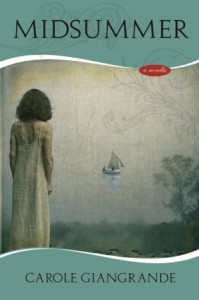
Midsummer by Carole Giangrande

Source: Inanna Poetry and Fiction Series and TLC Book Tours
Paperback, 150 pages
I am an Amazon Affiliate

Midsummer by Carole Giangrande is a poetic novella that settles the reader into the complexities of an immigrant family from Italy — a brother who chooses to stay in America and make his way in finance and a sister who returns to Italy to begin a life with her successful husband.  Nonno Lorenzo came to America and dug the New York City subway tunnels, only to land his pickaxe on the hull of a missing ship — Tijger — that was caught on an old shoreline.  Beneath his working class roots in America, the man was a visionary artist who never became famous, but he begets a number of dreamers, including a granddaughter who has suffered the most along the way — losing family and friendship.

“‘One day,’ said my aunt, ‘I would like you to hear my stories in Italian.’
‘But you grew up in America,’ I said.
‘The stories grew up somewhere else,’ she replied.”  (page 14)

Giangrande navigates memory and emotion carefully, guiding the reader outside the prime maritime routes into the deepest seas of human connection, with one’s family.  The intersection of Joy’s family and that of her husband, Adrian, comes together just as her grandfather discovered a lost Dutch ship beneath the Twin Towers in New York City.  Through family legends and a shared language, Giangrande weaves a story steeped in myth and love, despite tragedy.

“A creature trapped in a pretty, long necked bottle, a frantic beating of wings against glass, waiting for deft fingers, the touch of his hand to release her.  I sensed she enjoyed her entrapment for the moment of release it brought.” (page 53)

Joy and her family are caught in their own silences, unable to utter apologies even though they exist without being uttered.  Lorenzo’s ability to see into the future through his painting has left the family with a haunted legacy, but it is clear that the legacy will be ever-lasting.  Like a painting that comes to life, Midsummer by Carole Giangrande is like the longest-day of summer in families when tragedy saddens everyone in different ways, regrets threaten to bring members to their knees, and forgiveness is a shining beacon that can save them all.

About the Author:

Born and raised in the New York City area, Carole Giangrande now resides in Toronto, Canada. Her novella, A Gardener On The Moon was co-winner of the 2010 Ken Klonsky Novella Contest, and is published by Quattro Books. She’s the author of two novels (An Ordinary Star and A Forest Burning), a short story collection (Missing Persons), all published by Cormorant, and two non-fiction books. Her new novella, Midsummer, will be published in April 2014 by Inanna. She’s worked as a broadcast journalist for CBC Radio (Canada’s public broadcaster), and her fiction, articles and reviews have appeared in Canada’s major journals and newspapers. Her 50-part literary podcast Words to Go has been downloaded over 20,000 times in 30 countries. She comments as The Thoughtful Blogger, and she’s recently completed a novel. She’s a dual citizen of the United States and Canada.

Find out more about Carole at her website, connect with her on Facebook, follow her on Twitter, and find her on Goodreads.

30th book for 2014 New Author Challenge.

Bosley Builds a Tree House – Portuguese-English by Tim Johnson

Source: Tim Johnson, author
Paperback, 34 pages
I am an Amazon Affiliate

Bosley Builds a Tree House – Portuguese-English by Tim Johnson is a story that emphasizes teamwork with cartoonish images on one page and text on the other.  Each page of text includes English and Portuguese, with highlighted vocabulary words.  The corresponding vocabulary words in English are highlighted in Portuguese as well.  On certain pages, there are vocabulary words to teach readers the Portuguese names for the animals in the book, such as rabbit and coelho.

Although the images are the right kind for children, these books are for older readers interested in learning a language or for parents interested in teaching their younger children another language.  As a Portuguese descendent with little to no experience in the written language, it would be difficult to speak the Portuguese translations without consulting another source for pronunciation.  My daughter’s grandfather speaks the language and struggled with the translated text, as his experience with the words he knows instinctively sometimes did not match up with how the words were written on the page.  Bosley Builds a Tree House – Portuguese-English by Tim Johnson doesn’t really work with native English speakers because of the lack of pronunciation key, but it could work as an audio book or with help from a native speaker.

About the Author:

Tim Johnson is an author in a variety of fields, most notably dual-language children’s illustrated picture books and martial arts non-fiction.

Tim discovered the power of bilingual books while visiting Japan as a teenager. In 2011 he published his first dual language children’s book in 7 different foreign languages as a tool for increasing cultural awareness and gaining new perspectives. Bosley Bear has since become popular among U.S. and international readers, providing a fantastic way for children to learn a second language in a fun, easy and natural way.

26th book for 2014 New Author Challenge.

Pansy in Paris: A Mystery in the Museum by Cynthia Bardes, Illustrated by Virginia Best

Source: Octobre Press
Hardcover, 30 pages
I am an Amazon Affiliate

Pansy in Paris: A Mystery in the Museum by Cynthia Bardes, illustrated by Virginia Best, is the second book in which Pansy, a toy poodle, solves mysteries.  Pansy and Avery (the little girl who owns her) are high class with moral sensibilities about right and wrong.  When an inspector from Paris calls on Pansy to solve another museum mystery, Avery and Pansy have little choice but to get Avery’s mother to agree to a trip to Paris.  The illustrations are bright and resemble paintings, which is a testament to Best’s background as a painter.  The illustrations look like water color paintings, and go perfectly with the charming story of Pansy and her owner.

Pansy and Avery even have the time to take in the sights in Paris, while solving the mystery.  My daughter loves dogs, and we have a shelter dog of our own.  Pansy is intelligent and quick-witted.  My daughter loves animals and it was great seeing her react to the pictures and listening to the story.  There is conflict, an adorable dog, and tourist sights in the book, but there’s also a museum full of doggie portraits and famous doggie artists.   Pansy in Paris: A Mystery in the Museum by Cynthia Bardes, illustrated by Virginia Best, is adorable and fun, but there’s a little too much text for my little reader, but it does make a good book to read together.

About the Author:
Cynthia Bardes and her husband, David, spend each fall at a Beverly Hills hotel with their toy poodle, Pansy. Inspiration for this story was born out of random misfortune. One day, when crossing Wilshire Blvd., Cynthia was struck by a car. Her injuries required surgery and a lengthy recuperation at the hotel. While bedridden, Cynthia’s vivid imagination and Pansy’s popularity with employees and guests of the hotel made for a perfect story.

A graduate of Sarah Lawrence College, Cynthia is a former dress designer and interior decorator. When not in Los Angeles, Cynthia and her husband live with Pansy in Vero Beach, Florida.


25th book for 2014 New Author Challenge.

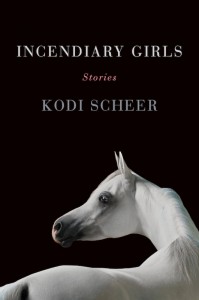
Incendiary Girls By Kodi Scheer

Source: Little A/New Harvest and TLC Book Tours
Paperback, 192 pages
I am an Amazon Affiliate

Incendiary Girls: Stories by Kodi Scheer (on Kobo) mixes dark humor — really dark humor — with scientific and anatomical knowledge that makes some of these stories even more creepy.  Like the title suggests, a spark is lit in each of these stories that leads these protagonists to re-examine their lives, relationships, and their perceptions of reality.  From a woman whose Muslim boyfriend turns into a camel to a mother who believes her daughter’s horse is her own mother reincarnated, Scheer expects her readers to be open-minded and willing to think outside the box.  While she explores the notion that the body betrays us, she also sneaks in some sly sympathy and humor at our own inevitable fates, which could be missed upon first reading.

“‘Pose for me,’ you say.  Not that he’s moving much anyway.  Pull out a sketch pad and charcoal, then sit across from him.  Forming the shapes first, the underlying structure, is difficult.  This body is unfamiliar. A cylinder, no, an oval for the main part.  Then there is the question of the hump.  Should you add a half sphere on top?

The sketch looks like a cross between a horse and a llama.” (page 70 from “When a Camel Breaks Your Heart”)

Readers will never forget these stories, like the peeling back of skin to reveal muscles in “Gross Anatomy.” But there is more here than the detailed images that will be etched forever in the mind; Scheer raises questions about identity, genetics, family secrets and more.  When tragedy strikes, people spend an inordinate amount of time making things as good as they can for their own children while burying the hurt of the past, and there are those that prepare for the worst before it even strikes through a series innocuous habits and rituals.

Incendiary Girls: Stories by Kodi Scheer is a small, powerful collection of short stories that hits like a sucker punch in the gut, leaving readers questioning their own emotions and world views.  Like the surgeon cutting along the skin to reveal the muscles below, Scheer sheds light on the disembodiment of humanity by war and science amid the absurdity of our conventional lives.  Unsettling, inventive, grotesque, but ever thought-provoking in her use of magical realism.  Something readers are unlikely to forget by a young, female Kafka that even Gregor Samsa should fear.

About the Author:

Kodi Scheer teaches writing at the University of Michigan.  For her work as a writer-in-residence at the Comprehensive Cancer Center, she was awarded the Dzanc Prize for Excellence in Literary Fiction and Community Service.  Her stories have appeared in the Chicago Tribune, the Iowa review, and other publications.


23rd book for 2014 New Author Challenge.

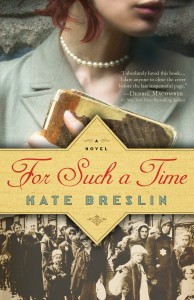
For Such a Time by Kate Breslin

Source: Bethany House and TLC Book Tours
Paperback, 432 pages
I am an Amazon Affiliate


For Such a Time by Kate Breslin is a WWII novel set in 1944 Czechoslovakia at the Theresienstadt concentration camp, a Jew work camp where many died from malnutrition, disease, or beatings, that acted as a stopgap for some Jews before reaching Auschwitz.  A miracle saves the life of Hadassah Benjamin from a Nazi firing squad, but the once blue-eyed, blonde finds herself in the middle of a hornet’s nest and forced to live under the assumed name of Stella Muller.  With her shorn locks, she ends up wearing a red wig and is given luxurious clothes, a warm bed, and food as SS-Kommandant Colonel Aric von Schmidt’s secretary.  With biblical quotes of Esther’s story, the parallels are unmistakeable between Stella’s struggles and that of Esther, with even Stella’s uncle bearing the same name as Esther’s cousin, Mordecai.  While the short quotes before each chapter are not strictly necessary to the story, it does offer some basis for the story Breslin is telling and for the strict moral grounds that Stella attempts to adhere to.  As a Jew who feels abandoned by God, it is interesting that she would turn to the bible and the tales a school friend of hers once told her, but her ability to connect with the bible demonstrates the transcendence that good morality can have no matter what religion, especially when she forces herself to break with Jewish traditions in order to remain concealed.

“Stella forced herself to look in the mirror.  Hadassah Benjamin, a Mischling, half Jew, bursting with a young woman’s exuberance, had ceased to exist.  In her place stood Stella Muller, subdued Austrian bookkeeper and suitable stock for the Third Reich.  A frail disguise comprised of no more than a scrap of official-looking paper, a red wig, and beneath her bruises the inherent fair features of a Dutch grandmother.”  (page 49-50)

Aric von Schmidt is the real enigma in this novel — a Nazi that does not hesitate to follow orders, but who still feels affection for Jews in his household.  He’s a man broken by WWI — literally, emotionally, and physically — and although he begins to see the devastation around him, of which he has played a significant part, it is hard for him to reconnect with his humanity without seeing how it would hamper his duties and possibly result in his own death or punishment.  Although he softens with Stella’s guidance, he’s still torn inside as he struggles to balance what he knows is right and what his orders are under the government he serves.

As the war nears its end and the final solution is called for by the Reich, the pressure is on for Stella, her uncle, and young boy named Joseph.  Breslin has crafted a poignant novel about the end of a war that had everyone concerned about their own safety, even the Nazi officers carrying out horrific orders.  She manages to humanize some of these monsters, and while we are not expected to completely forgive these men, it is clear that their decisions were based on their own demons and inabilities to sacrifice themselves for the good of others — a strength that few can muster in times of crisis when saving their own skin is a viable option.  For Such a Time by Kate Breslin is a stunning debut and would make a great book club selection given the moral issues and the emotional impact of the decisions these characters face.

About the Author:

A Florida girl who migrated to the Pacific Northwest, Kate Breslin was a bookseller for many years. Author of several travel articles, award-winning poet, and RWA Golden Heart finalist, Kate now writes inspiring stories about the healing power of God’s love. For Such a Time is her first book. She lives with her husband and cat in Seattle, WA.

Connect with Kate on her website and on Facebook.

10th book (WWII) for the 2014 War Challenge With a Twist.


8th book for 2014 European Reading Challenge; It is set in Czechoslovakia.


13th book for 2014 Historical Fiction Reading Challenge.



21st book for 2014 New Author Challenge.

Walking Home: A Poet’s Journey by Simon Armitage

Source: Liveright, W.W. Norton
Paperback, 285 pages
I am an Amazon Affiliate

Walking Home: A Poet’s Journey by Simon Armitage is part memoir and part travelogue, and the path he chooses to walk — while contrary to what is outlined in the guidebooks for the Pennine Way in England and part of Scotland — is literally a walk home for him.  He begins in Kirk Yethom, Scotland, and ends more or less in Edale, England, which is in the Peak District.  As a poet, readers may expect a deeper analysis of the journey or the travails he experiences, but as Armitage is nearly constantly accompanied by strangers, friends, fellow poets, and even his family, he has little time to contemplate more than the scant passerby or the physical obstacles in his path.  Much of the travelogue is focused on Armitage re-orienting himself by map or landscape or simply following someone who has offered to guide him over a particular leg of the 267 miles.  The first poem included in the book doesn’t come until he has pass nearly a third of the way through the trail — whether that is when inspiration hit him to write a poem during the journey or whether it was written afterward about that section of the trail is unclear.

“Prose fills a space, like a liquid poured in from the top, but poetry occupies it, arrays itself in formation, sets up camp and refuses to budge.  It is a dissenting and willful art form, and most of its practitioners are signed-up members of the awkward squad.” (page 5)

Armitage has help in coordinating his journey, which includes readings held at the end of each leg either in an inn, a home, a bar, or other venues, and he passes a sock about the room for collections, which he uses to fund his continued journey along the way.  He says that he sets out on the journey to get “out there,” rather than write about far-off places from his desk chair.  In a way, he sees it as a way to “clear his head.”  The path does not seem to clear his head so much as clutter it with more concerns and worries about himself and the physical health of others.

There is a point early on in which he gains a “regular” pace of walking and he feels as though he’s reached his stride, but he’s clearly not reached the most arduous parts of the journey.  Those parts of the journey clearly weigh on his psyche, as does his part of the journey when he is lost in the mist.  He nearly loses his sense of identity, but he continues onward.  Perhaps this is the crux of the prose, that poets lose themselves in the journey and that loss of self can be frightening unless the poet can plod forward.

Walking Home: A Poet’s Journey by Simon Armitage is a journey at the arm of a poet who does not find himself all that interesting and cannot seem to understand the reason why anyone would volunteer to go on the journey with him or even come to listen to him read his poems.  The one interesting moment in the memoir where he talks of spare rooms as the keepers of “family lore” and “memory vaults,” is grossly under-explored, as he seems to want to keep out of the private moments of the people who open their homes to him.  While the landscape is varied and the hardships he faces could be a cautionary tale against these kinds of treks, the journey does not live up to reader’s expectations about what a poet would write about, experience, or explore.

About the Poet:

Simon Armitage was born in 1963 in the village of Marsden and lives in West Yorkshire. He is a graduate of Portsmouth University, where he studied Geography. As a post-graduate student at Manchester University his MA thesis concerned the effects of television violence on young offenders. Until 1994 he worked as Probation Officer in Greater Manchester.

His first full-length collection of poems, Zoom!, was published in 1989 by Bloodaxe Books. Further collections are Xanadu (1992, Bloodaxe Books), Kid (1992, Faber & Faber), Book of Matches (1993, Faber & Faber), The Dead Sea Poems (1995, Faber & Faber), Moon Country (with Glyn Maxwell, 1996, Faber & Faber), CloudCuckooLand (1997 Faber and Faber), Killing Time (1999 Faber & Faber), Selected Poems (2001, Faber & Faber), Travelling Songs (2002, Faber & Faber), The Universal Home Doctor (2002, Faber & Faber), Tyrannosaurus Rex Versus the Corduroy Kid (2006, Faber & Faber, Knopf 2008), and Seeing Stars (2010, Faber & Faber, Knopf 2011).

Armitage’s 2012 nonfiction book Walking Home, an account of his troubadour journey along the Pennine Way, was a Sunday Times best-seller for over a month and is shortlisted for the 2012 Portico Prize.

Book 12 for the Dive Into Poetry Reading Challenge 2014.


6th book for 2014 European Reading Challenge; this memoir/travelogue takes place in England and Scotland.


18th book for 2014 New Author Challenge.


For today’s 2014 National Poetry Month: Reach for the Horizon tour stop, click the image below: