Quantcast

Go Set a Watchman by Harper Lee (audio)

Source: Public Library
Audio, 6 CDs
I am an Amazon Affiliate

Go Set a Watchman by Harper Lee, narrated by Reese Witherspoon, was a book that was anticipated by many and vilified by others, and I honestly had no desire to read it because of the hype.  (I only picked up this audio because it was available at the library and I needed a new one.)  Jean Louise Finch, known as Scout in To Kill a Mockingbird, has returned to Maycomb, Ala., and her aging father, Atticus.  As the civil rights movement gains speed and the NAACP continues to push for rights, the South balks at integration and federal government interference.

Witherspoon is the perfect choice in a narrator for the story, and it is not just about her ability to play Southern characters.  She provides the right amount of empathy, emotion, and detachment needed by each of the characters to make them wholly different from one another, and yet still share similar experiences but view them differently.  There are differences between this novel (which is said to be Lee’s first) and the previously published book (TKAM), and those differences can be stark, especially when there are outcomes in the previously published book that go very differently here. Those are things an editor should have attended to before publishing, but are not the main crux of this story.

This is not about the rape case that Atticus defended, this is about us as children and how we generally worship our parents in one way or another, only to be disappointed that they are humans and not gods.  It’s a book about a young girl who worshiped her father, took in everything he said with little examination, and continued to apply it to her daily living.  Scout has held her father to an impossible standard, and when she returns to find him at a council meeting — one in which she would expect him to protest not take part in — her images are shattered, and she is forced to not only reconcile what she thought she knew about her father but what she knew about herself.

Go Set a Watchman by Harper Lee, narrated by Reese Witherspoon, is a novel about finding the courage and strength to change and to help those around you do the same. The south was in the midst of heavy transitions when Scout returns, and while she was “blind” to the hearts of those around her, even when her eyes are opened to their motivations, it is clear she still has a lot to learn.  The end seems to leave things wide open and unresolved in a way, like Scout’s journey is not finished.

About the Author:

Harper Lee, known as Nelle, was born in the Alabama town of Monroeville, the youngest of four children of Amasa Coleman Lee and Frances Cunningham Finch Lee. Her father, a former newspaper editor and proprietor, was a lawyer who served on the state legislature from 1926 to 1938. As a child, Lee was a tomboy and a precocious reader, and enjoyed the friendship of her schoolmate and neighbor, the young Truman Capote.

After graduating from high school in Monroeville, Lee enrolled at the all-female Huntingdon College in Montgomery (1944-45), and then pursued a law degree at the University of Alabama (1945-50), pledging the Chi Omega sorority. While there, she wrote for several student publications and spent a year as editor of the campus humor magazine, “Ramma-Jamma”. Though she did not complete the law degree, she studied for a summer in Oxford, England, before moving to New York in 1950, where she worked as a reservation clerk with Eastern Air Lines and BOAC. Lee continued as a reservation clerk until the late 50s, when she devoted herself to writing. She lived a frugal life, traveling between her cold-water-only apartment in New York to her family home in Alabama to care for her father.

Having written several long stories, Harper Lee located an agent in November 1956. The following month at the East 50th townhouse of her friends Michael Brown and Joy Williams Brown, she received a gift of a year’s wages with a note: “You have one year off from your job to write whatever you please. Merry Christmas.” Within a year, she had a first draft. Working with J. B. Lippincott & Co. editor Tay Hohoff, she completed To Kill a Mockingbird in the summer of 1959. Published July 11, 1960, the novel was an immediate bestseller and won great critical acclaim, including the Pulitzer Prize for Fiction in 1961. It remains a bestseller with more than 30 million copies in print. In 1999, it was voted “Best Novel of the Century” in a poll by the Library Journal.

About the Narrator:

Laura Jeanne Reese Witherspoon, known professionally as Reese Witherspoon, is an American actress and producer. She began her career as a child actress, starring in The Man in the Moon in 1991. Witherspoon quickly established herself as a talented actress in films such as Pleasantville (1998), Election (1999) and Cruel Intentions (1999). While filming Cruel Intentions. Behind the camera, Witherspoon launched her own production company Pacific Standard in 2012, which was behind the 2014 films Gone Girl and Wild. The latter, based on the memoir by Cheryl Strayed, stars Witherspoon as a woman who takes to the road after the death of her mother. Witherspoon has earned raves for the role, receiving Oscar, Golden Globe, and SAG Awards nominations.

Close Quarters by Larry Heinemann

Source: Public Library
Hardcover, 335 pgs.
I am an Amazon Affiliate

Close Quarters by Larry Heinemann provides a stark view of the life of draftees, like Philip Dosier (Flip), and he pulls no punches in his account of this young man’s life in war.  He’s too young at home to buy alcohol or to vote, but in Nam, he can kill, swear, smoke pot, drink, and die for his country all without explanation or understanding.  Troops are to follow orders, and not to question, but in Flip’s case, and those around him, ignoring, circumventing, or blatantly disregarding orders can be a sign of brotherhood or stupidity.  Close quarters is a fine-tuned look at soldiering, the interactions between grunts and officers, and the friendships fired in the kiln of war.

“I can never go home.  I just want to see it.  I won’t say a thing, cross my heart.  I just want to see it one more time.  I want to smell it, touch it ever so lightly, put my ear to it and hear it tap, tap, tap.” (pg. 279)

“When I first came into the platoon, that was what struck me about the tracks.  They were huge and lumbering, stunted animations of some slow and wild thing.  Noisy and fat, grunting cartoons, smelling of thirty-weight oil and gunpowder and beer piss, … And I am filthy all the time.  I feel that grit, that crawl of the skin, something itching all the time, and greasy.” (pg. 280)

As these men run on adrenaline and beer — one to get through the fear and the other to numb the horror — they are unaware that they have changed.  In the lulls between ambushes, missions, and unexpected firefights, these men are like friends who hang out drinking beers and becoming sounding boards.  To become a sounding board for someone else is far easier than dealing with the war’s affect on yourself in some cases, but there are some images that cannot be shaken.

Close Quarters by Larry Heinemann is claustrophobic in its graphic violence, its frank spoken dialogue between male soldiers, and the threat of war that surrounds them all — it’s that unexploded bomb in the next room.  It ranges from lull moments of camaraderie and R&R with a prostitute in Tokyo to the small round hole left in the head of the man next to you.  Heinemann expresses the complexities of war in one soldier’s account, and he examines post-traumatic stress disorder (PTSD) so that readers realize just how real the war still is even when veterans arrive home.

About the Author:

Larry Heinemann (born 1944) is an American novelist born and raised in Chicago. His body of work is primarily concerned with the Vietnam War. Mr. Heinemann served a combat tour in Vietnam from 1967 to 1968 with the 25th Infantry Division, and has described himself as the most ordinary of soldiers. Mr. Heinemann’s military experience is documented in his most recent work, Black Virgin Mountain (2005), his only nonfiction piece. Black Virgin Mountain also chronicles his return trips to Vietnam and his blunt personal and political views concerning the country and the war. He has often referred to his books about Vietnam as an accidental trilogy.

While serving in Vietnam, Mr. Heinemann fought in a battle near the Cambodian border in which filmmaker Oliver Stone also participated. Mr. Heinemann writes of the battle in his first novel, Close Quarters (1977), and in Black Virgin Mountain, and it also forms the basis for the climactic battle scene in Stone’s Platoon.

His fictional prose style is uncompromisingly harsh and honest, and reflects his working class background. His second and critically acclaimed novel is Paco’s Story (1986), which won the 1987 National Book Award for Fiction, topping Toni Morrison’s Beloved in a decision that some thought controversial.[1] At the time, Mr. Heinemann’s only response to the controversy was that the prize, a check for $10,000, was already cashed, and that the Louise Nevelson sculpture, a gift from the National Book Foundation, was not likely to be returned. Paco’s Story relates the quasi-picaresque postwar experiences of its titular protagonist, who is haunted by the ghosts of his dead comrades from the war. These ghosts provide the novel’s narrative voice. The story deals with the role of the American GI as both victim and victimizer. It is interesting to note that ghost stories are common in both American and Vietnamese literature about the war.

His third novel, Cooler by the Lake (1992), departed from the topic of Vietnam and was not very successful, either critically and commercially.

Longbourn’s Songbird by Beau North

Source: Meryton Press
ebook, 300 pgs.
I am an Amazon Affiliate

Longbourn’s Songbird by Beau North, set in post-WWII America, touches upon the Deep South’s continued segregation, and the desire to maintain the old ways where women are concerned even though they stepped up in may cases to fill men’s jobs when they were away at war.  North has created a complex novel through which Will Darcy and Elizabeth Bennet have very different lives and expectations.  Lizzie has locked her heart away after her time away at school in Charleston, while Darcy has struggled to keep his own passions in check as he builds his textile empire.  North has focused less on the class expectations and differences, and more on the societal changes and the implications of those changes on the Deep South.

Lizzie is as strong-willed and teasing as ever, and Darcy is as mysterious and aloof, bumbling around in society. However, dark secrets lay beneath Mr. Collins piousness, Charlotte’s practical nature, and Bingley’s ever-sunny disposition.  North goes deeper into these characters motivations, pulling out the truth behind the facade.

While there were things that seemed a little out of place — maybe just by a few years — they did not detract from the story.  Lizzie is a songstress with a captivating voice, and Darcy is at a disadvantage and is captured in her nest before either realizes how things have changed between them.  But North knows how to keep readers interested by blowing up the Austen world, rearranging it satisfactorily, and making it her own.  Longbourn’s Songbird by Beau North is a wonderful addition to the Austen world, but it’s also much more than that.  It delves into the issues of segregation, women’s place in society, the rights of minorities, and post-traumatic stress disorder that accompanies so many soldiers home from war.

About the Author:

Beau North is a native southerner who now calls Portland, Oregon home with her husband and two cats. She attended the University of South Carolina where she began a lifelong obsession with English Literature. In her spare time, Beau is the brains behind Rhymes With Nerdy, an internet collective focused on pop culture. This is her first novel.  You can connect with Beau on Twitter, Facebook, or via http://beaunorth.merytonpress.com. If you’ve enjoyed this book, we welcome your fair and honest review on Goodreads and Amazon.

LShorizbanner


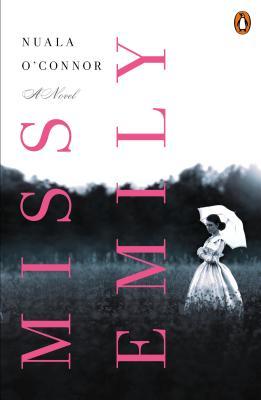
Miss Emily by Nuala O’Connor

Source: Penguin
Paperback, 256 pgs.
I am an Amazon Affiliate

Miss Emily by Nuala O’Connor is told from two points of view, including that of poet Emily Dickinson, and the reader is given a glimpse into the secluded life of the poet through her own eyes as well as those of the new maid and Irish immigrant, Ada Concannon.  Concannon has had wanderlust for some time, and her daydreams have pushed her out of favor with the family her siblings and mother work for, pushing her into a new life in America.  Although she will miss her sisters and family very much, she’s eager to see the world beyond her home.

“‘You cultivate possessiveness,’ Vinnie once told me.  ‘You smother Sue, and every other acquaintance, with friendship.'” (pg. 27 ARC)

“Oh, chimerical, perplexing, beautiful words! I love to use the pretty ones like blades and the ugly ones to console.  I use dark ones to illuminate and bright ones to mourn.  And when I feel as if a tomahawk has scalped me, I know it is poetry then and I leave it be.”  (pg. 40 ARC)

The Dickinson’s are well respected in Amherst, though Emily’s recent withdrawal from society has become part of the town’s gossip.  As a maid in the Dickinson household, she is privy to the inner workings of the family but is also expected to maintain its secrets.  O’Connor has created a believable Emily in terms of action and manner, and her portrayal of immigrants, particularly the Irish, rings true.  O’Connor adopts Dickinson’s style of economical word use to tell her story and it works really well.  These foil characters work well together, as a mutual respect blossoms and friendship emerges between these women.

“But how can I explain that each time I get to the threshold, my need for seclusion stops me? The quarantine of my room–its peace and the words I conjure there–call me back from the doorway.  Ada could not truly appreciate that the pull on me of words, and the retreat needed to write them, is stronger than the pull of people.”  (pg. 52-3 ARC)

“From now on I shall be candle-white.  Dove-, bread-, swan-, shroud-, ice-, extraordinary-white.  I shall be blanched, bleached and bloodless to look at; my very whiteness will be my mark.  But inside, of course, I will roar and soar and flash with color.” (pg. 121 ARC)

Readers will be thoroughly taken in by this novel about Dickinson and the Irish immigrant’s life, and O’Connor provides a real motivating factor for Emily’s seclusion from the outside world.  As Ada’s life is threatened, Emily is forced to act and in so doing, she must leave the home in which she finds solace.  Miss Emily by Nuala O’Connor is stunning and one that should not be missed.  A definite best book of the year.

About the Author:

Born in Dublin, Ireland, in 1970, Nuala O’Connor is a fiction writer and poet. Writing as Nuala Ní Chonchúir she has published two novels, four collections of short fiction, a chapbook of flash fiction and three full poetry collections – one in an anthology. Nuala’s third novel, Miss Emily will be published in 2015.

Nuala holds a BA in Irish from Trinity College Dublin and a Masters in Translation Studies (Irish/English) from Dublin City University. She has worked as an arts administrator in theatre and in a writers’ centre; as a translator, as a bookseller and also in a university library.

Nuala teaches occasional creative writing courses. For the last four years she has been fiction mentor to third year students on the BA in Writing at NUI Galway. She lives in County Galway with her husband and three children.

The Small Backs of Children by Lidia Yuknavitch

Source: Public Library
Hardcover, 240 pgs
I am an Amazon Affiliate

The Small Backs of Children by Lidia Yuknavitch is carnal and grotesque in ways that are vastly unsettling and may be tough to read for many.  Told from a variety of artistic points of view, the story begins with a young girl whose world is literally atomized in war-torn Eastern Europe and the photograph of her that makes the career of one narrator.  While the girl and the photo play a major role in the story, they are not the crux of Yuknavitch’s story.  They are merely a vehicle through which she explores the selfish need for artistic expression and the distortions that emerge.

“We are who we imagine we are.
Every self is a novel in progress.
Every novel a lie that hides the self.
This, reader, is a mother-daughter story.” (pg. 11)

The narration is urgent, like a slapshot in the gut at nearly every turn. While the writer’s friends and family seek to save the girl from the life she has been thrown into after the death of her family, it is clear that a birth has happened. It is the birth of art within the gruesome world the girl inhabits, and it is the birth of connection beyond art and family ties.  The girl reaches from within and from without to recreate her life to be reborn — not as a victim, but as a warrior.

Pity the small backs of children, he heard her saying.  They carry death for us the second they are born.” (pg. 59)

The stories that begin at the heart of this girl, like the spokes in a wheel, turn and turn, spiraling out of control on a wagon that is hurtling toward a cliff, unless someone can stop it or redirect it. Will these players be destroyed? Will they be saved? Can this “blast particle … looking for form” endure the weight of these stories and their implications?

The Small Backs of Children by Lidia Yuknavitch pushed the envelope repeatedly, searching for the edge and spilling over it with its haunting images, desperate characters, and narcissistic art-making. It is the crucible of pain and suffering that molds us and pushes us to become, to move beyond the child of mere potential into something more tangible that can be criticized and critical. This crucible does not define us, however, unless we allow it to, and Yuknavitch is shoving readers toward a greater understanding of art and themselves.

**Beth Kephart reviewed this book, and I just had to get it from the library.***

About the Author:

Lidia Yuknavitch is the author of the widely acclaimed memoir The Chronology of Water and the novel Dora: A Headcase. Her writing has appeared in the Atlantic, the Iowa Review, Mother Jones, Ms., the Sun, the Rumpus, PANK, Zyzzyva, Fiction International, and other publications. She writes, teaches and lives in Portland, Oregon with the filmmaker Andy Mingo and their renaissance man son Miles. She is the recipient of the Oregon Book Award – Reader’s Choice, a PNBA award, and was a finalist for the 2012 Pen Center creative nonfiction award. She is a very good swimmer.


The Race for Paris by Meg Waite Clayton

tlc tour host

Source: TLC Book Tours
Hardcover, 336 pgs.
I am an Amazon Affiliate

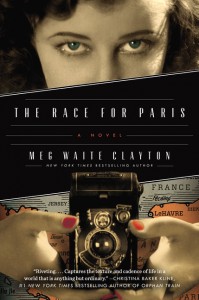
The Race for Paris by Meg Waite Clayton is riveting from the start and a careful blend of fact and fiction about WWII and the female reporters and photographers who were often relegated to the field hospitals and sidelines while their male counterparts were allowed closer to the front and on reconnaissance missions.  Clayton’s characters tough cookies, and they have to be as they face the possibility of death once they’ve ignored their orders to remain at the field hospital.  Liv Harper, an Associated Press photographer know for her blurred faces, and Jane, a reporter for the Nashville Banner, find themselves accompanied by Fletcher, Liv’s husband’s friend.  Fletcher is a British military photographer who often goes it alone in the field to gather intelligence with his photos for the Allied forces, but he’s had a flame burning for Liv ever since he met her.  This unlikely trio is determine to make it to Paris before the other reporters to photograph and tell the tale of its liberation.

“That was the way it was, covering war.  The little bits of detail you could get on paper or on film were just that, little bits that didn’t tell the whole story.  And you couldn’t possibly capture the whole of it no matter how far back you stepped.” (pg. 217 ARC)

Liv has secrets too, and only Jane is aware of some of them.  While Fletcher and Liv are striving toward the front as if chased by ghosts, Jane is tagging along, not so much for the good of her career as someone who cushions the blows that they receive along the way.  She becomes the sounding board for each of them, while she keeps her own council.  Jane is a strong woman, though timid, while Liv is a wild wire set to explode.  Fletcher has taken it upon himself to protect them both, though his desire for Liv often steers him into danger.  While Clayton’s triangle here could be construed merely as a romantic tug-of-war, it is isn’t.  There are more nuanced dynamics at play here, as WWII has touched Fletcher and Liv in very different ways and Jane is observing it as it plays out.

The Race for Paris by Meg Waite Clayton looks through the lens of journalists during one of the most sweeping, horrifying, and tense wars in our world history to provide an encapsulated view of the fighting, the discrimination against female journalists, and the battles dedicated people had to endure to achieve their goals.

About the Author:

Meg Waite Clayton is the New York Times bestselling author of four previous novels: The Four Ms. Bradwells; The Wednesday Sisters; The Language of Light, a finalist for the Bellwether Prize; and The Wednesday Daughters. She’s written for the Los Angeles Times, the New York Times, the Washington Post, the San Jose Mercury News, Forbes, Writer’s Digest, Runner’s World, and public radio. A graduate of the University of Michigan Law School, she lives in Palo Alto, California.

Find out more about Meg at her website, and connect with her on Facebook and Twitter.


11/22/63 by Stephen King (audio)

Source: Public Library
Audiobook, 30.75 hours
I am an Amazon Affiliate

11/22/63 by Stephen King, narrated by Craig Wasson, is a time travel novel in which teacher Jake Epping is tasked with the impossible — stop the assassination of President John F. Kennedy.  The local diner owner Al has the cheapest prices in town, but the town continues to speculate that his hamburgers are made from local cats and other pets.  After reading a brilliant essay from a GED student, Epping finds himself embroiled in a secret that is almost too fantastical to be real.  A bubble in the time line has enabled Al to return to 1958 repeatedly and buy the same cheap meat over and over.  Although Epping — who begins to write a novel that’s eerily similar to that of King’s IT set in Derry, N.H. — agrees to check things out and try to determine if Oswald had worked alone in assassinating the president, he finds himself swept up in a life he could be happy in, even though there is no Internet.

Although this book takes on the larger question of how one man could have impacted history had JFK lived and what would have happened had he not been killed and the country forced to mourn alongside his wife and child, King’s talent is in the small town experiences of that time period and the connections that seemed prevalent then that are not as present now.  Epping is skeptical about his task and even as he makes changes to the lives he knows about in the now and some for the better, he’s still not convinced that he can accomplish the bigger task of stopping the assassination.  And like many of us, Epping loses himself in the past — only in his case he literally loses himself.

11/22/63 by Stephen King is chock full of side stories, deeply sketched characters, and small town nuance.  Although there are a number of characters, readers can follow along from time line to time line because the “past harmonizes,” and readers are likely to be swept up into the story with little issue.  King is a master storyteller, which is a statement that I probably have beaten into your heads by now, so don’t miss out on his books any longer.  They’re an investment worth making.

About the Author:

Stephen King is the author of more than fifty books, all of them worldwide bestsellers. His recent work includes Doctor Sleep and Under the Dome, now a major TV miniseries on CBS. His novel 11/22/63 was named a top ten book of 2011 by The New York Times Book Review and won the Los Angeles Times Book Prize for Mystery/Thriller as well as the Best Hardcover Book Award from the International Thriller Writers Association. He is the recipient of the 2003 National Book Foundation Medal for Distinguished Contribution to American Letters. He lives in Bangor, Maine, with his wife, novelist Tabitha King. (Photo Credit: Denver Post)

The Last Summer at Chelsea Beach by Pam Jenoff & Giveaway

tlc tour host

Source: Pam Jenoff
Paperback, 384 pgs
I am an Amazon Affiliate

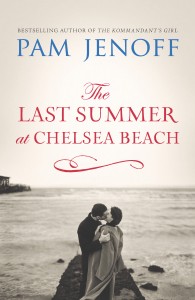
The Last Summer at Chelsea Beach by Pam Jenoff is a sweeping tale set during World War II, as a sixteen year old Adelia Monteforte comes to America to live with her aunt and uncle in Philadelphia without her Jewish parents, who stayed behind in Trieste, Italy.  She feels like an outsider with the relatives she’s never met before, and she realizes that her limited English and mostly secular upbringing is not what they expected.  While she speaks English, she still feels as though she’s an outsider, until she becomes like a sister to the Connally brothers.  Despite their perceived differences in religion and upbringing, Adelia becomes Addie, molding herself in the cracks of the local family she meets at Chelsea Beach.

“Robbie turned to his mother.  ‘Can we keep her?’
‘Robbie, she isn’t a puppy. But I do hope you’ll join us often,’ she added.
‘Because we really need more kids, ‘ Liam said wryly.” (pg. 38)

Jenoff’s World War II novels are always captivating, full of missed chances and second chances, moments of horror and tragedy, but also moments of hope and happiness. These snippets of time are those that her characters treasure, and they provide that kernel of hope that readers hold onto until they reach the end. Addie is a young displaced woman looking for a home, and she thinks that she’s found it with the Connallys until tragedy strikes close to home and she’s left in the breeze. She has to decide what to do for herself for the first time since coming to America, and while she chooses to go to Washington, D.C., with a half buried hope of finding her childhood crush, she also wants to do something more.

The Last Summer at Chelsea Beach by Pam Jenoff is an addicting read with its twists and turns and the realities of rationing and the closeness of war.  Jenoff is a master at characterization and romance in a way that is both fanciful, but realistic.  Her characters often have to struggle with more than the things that keep them apart, and for that, readers will be grateful.  Her books are not to be missed, and this summer read should be at the top of your lists.

About the Author:

Pam Jenoff is the Quill-nominated internationally bestselling author of The Kommadant’s Girl. She holds a bachelor’s degree in international affairs from George Washington University and a master’s degree in history from Cambridge, and she received her Juris Doctor from the University of Pennsylvania. Jenoff’s novels are based on her experiences working at the Pentagon and also as a diplomat for the State Department handling Holocaust issues in Poland. She lives with her husband and three children near Philadelphia where, in addition to writing, she teaches law school.

U.S. residents, leave a comment below about your favorite beach activity by Aug. 26, 2015, at 11:59 PM EST.  Win a bag and book!

ChelseaBeach


Crooked Heart by Lissa Evans

tlc tour host

Source: TLC Book Tours
Hardcover, 288 pgs.
I am an Amazon Affiliate

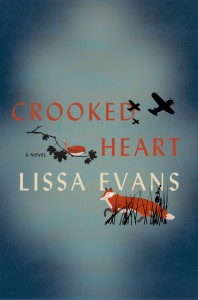
Crooked Heart by Lissa Evans is an odd narrative in that it is disjointed at times and features a number of eccentric characters, including 10-year-old Noel, Vee, and Donald.  Noel is a young orphan evacuee who is sent to live with Vee, Donald, and Vee’s mother during WWII.  Noel’s a quiet boy who loves detective novels and is incredibly heart-broken by the time he reaches their home.  Vee, on the other hand, is struggling to make ends meet only to have a son who does little more than expect her to wait on him and barely goes to his job.  Evans captures the essence of these struggling residents during rationing and bombardments by the Nazis.  Readers will be fully engaged by the historical setting, but the pairing of this intelligent boy and this woman who is looking for the next get rich quick scheme, is unlikely and tough to take at face value until more than halfway through the novel.

“His teeth were regular and well-spaced, like battlements.  Noel liked to imagine tiny soldiers popping up between them, firing arrows across the room or pouring molten lead down Uncle Geoffrey’s chin.” (pg. 10 ARC)

“The day after that, all the children disappeared, as if London had shrugged and the small people had fallen off the edge.” (pg. 15 ARC)

Vee is impulsive and Noel is level-headed, and like Vee, Donald, makes impulsive decisions that often land him into trouble.  Evans has a way with imagery and she captures the tumultuous times deftly, but often the disjointed narrative can pull readers out of the story, especially when she moves from one perspective to another with little to no transition.  However, as the relationship develops between Vee and Noel, moving from a business relationship to a more familial relationship, readers will become invested in their struggles.  The story of Donald, her son, however, fades in importance, and by the end almost feels as though it was an add-on, not really integral to the story.

Crooked Heart by Lissa Evans provides a realistic look at life in London and elsewhere in England at the time of WWII when rationing was in full swing and bombings were a real concerns, especially for residents of London.  Vee and Noel are able to find a home among the wreckage, and while not everyone’s stories are wrapped up neatly, Evans develops a realistic picture of wartime England.

About the Author:

Lissa Evans, a former radio and television producer, is the author of three previous novels, including Their Finest Hour and a Half, which was longlisted for the Orange Prize. Crooked Heart was also longlisted for the Baileys Women’s Prize for Fiction (formerly known as the Orange Prize); it is her first novel to be published in the US. Evans lives in London with her family.  Find out more about Evans at her website, and follow her on Twitter.


Mireille by Molly Cochran

tlc tour hostSource: TLC Book Tours
Paperback, 619 pgs
I am an Amazon Affiliate

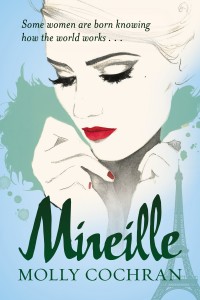
Mireille by Molly Cochran is a sweeping novel that takes place near the end of WWII through the 1960s, and the title character is forced from her home at the same time she is forced to realize that her life must become an illusion in order for her to survive.  Mireille is an unusual beauty who finds herself caught in the web of her own lies later in life, and while she’s desperate to escape, she’s also careful to protect her family from harm, even if that means paying a heavy price.  Following the end of WWII, she makes the trek on foot to Paris and finds herself in even worse health and shape than when she ran from her home.  She learns quickly that kindness is hard to come by and that the only way she can provide for herself and survive is the become the best prostitute in all of Paris.

Cochran has dove deep into the world of Paris escorts, and the depravity Mireille finds there is something that she can only deal with by severing her actions from her true 17-year-old self.  She soon meets Oliver Jordan, a famous movie producer from Hollywood, but he’s darker than she ever could imagine.  He will remind readers of the Marquis de Sade driven by his baser instincts and clearly someone who knows nothing about love or emotional attachment.  He only understands manipulation, physical release, and ownership.

Mireille by Molly Cochran is a page turner that is neatly wrapped up by the end of the novel, and as long as readers can ignore the historical issues — such as actresses unable to earn a great deal because they were owned by their respective studios at the time in the novel and Mireille’s apparent wealth — the book will take them on a dark journey that will leave their stomachs turning.  However, as a book about perseverance, Mireille does have a will that will rival many — as she strives onward even in the most dire circumstances.  A solid read full of sex, profane events, and more.

***My apologies to Molly Cochran and TLC Book Tours for failing to review this in June.***

About the Author:

Molly Cochran is the author of more than twenty novels and nonfiction books, including the New York Times bestseller GrandmasterThe Forever KingThe Broken Sword, and The Temple Dogs, all cowritten with Warren Murphy. She is also the author of The Third Magic, and she cowrote the nonfiction bestseller Dressing Thin with Dale Goday. Cochran has received numerous awards, including the Mystery Writers of America’s Edgar Award, the Romance Writers of America’s “Best Thriller” award, and an “Outstanding” classification by the New York Public Library. Recently she published a series of young adult novels, LegacyPoison, and Seduction, and two novellas, Wishes and RevelsLegacy won a 2013 Westchester Fiction Award.


Mistaking Her Character by Maria Grace

Source: the author
Paperback, 378 pgs
I am an Amazon Affiliate

Mistaking Her Character by Maria Grace is a phenomenal Pride & Prejudice rendering, and this series is shaping up to be one of the best in the market.  Grace has a firm grasp of Jane Austen’s characters, but she also is not afraid to make them her own.  As she explores the conditions brought about by emotional abuse, readers will see a darker side to the hints of neglect in Austen’s original novel.

Lady Catherine de Bourgh will stop at nothing to save her daughter Anne from her ailments, but her patronage comes with a price — sometimes too high of a price.  Dr. Thomas Bennet gives up his London practice and moves his family to Rosings so he can care for Anne, and Elizabeth dutifully helps him in his ministrations.  Lady Catherine does not stop at telling people who to court and who to seek out as husbands and wives, but she offers her advice in all things from draperies to clothes.  Those who presume to know more, have more experience, or contradict her current statements with her own previous advice best watch out for her unfettered wrath.

“She pushed the window open and gulped in fresh air.  Anyone who saw her would believe her half drowned, and she was — suffocating in pretense and overbearing interference.  At Rosings, she could hardly draw breath without instruction on how to carry it out more properly, more elegantly, more to her satisfaction.” (pg. 66)

Mistaking Her Character by Maria Grace is stunning and emotional, and readers will be blown away by the uniqueness of her plot and characterization.  While some may say they deviate too far from Austen’s original characters in some cases, isn’t that the fruit of creativity.  She has taken these characters and made them her own, and in many ways, they are even more nuanced and dynamic that they were in the original, especially those who were more minor characters.  There are some tough emotional issues tackled in this one, beyond the romantic entanglements. It’s the first P&P rendering I’ve given 5 stars to in a long time.

***Giveaway for 2 ebooks***

Open internationally, comment by Aug. 5, 2015, at 11:59 pm EST, about your favorite Jane Austen spin-off, retelling, or continuation.

About the Author:

Though Maria Grace has been writing fiction since she was ten years old, those early efforts happily reside in a file drawer and are unlikely to see the light of day again, for which many are grateful. After penning five file-drawer novels in high school, she took a break from writing to pursue college and earn her doctorate in Educational Psychology. After 16 years of university teaching, she returned to her first love, fiction writing.

She has one husband, two graduate degrees and two black belts, three sons, four undergraduate majors, five nieces, sewn six Regency era costumes, written seven Regency-era fiction projects, and designed eight websites. To round out the list, she cooks for nine in order to accommodate the growing boys and usually makes ten meals at a time so she only cooks twice a month.

The Great War: Stories Inspired by Items from the First World War illustrated by Jim Kay


Source: LibraryThing Early Reviewers
Hardcover, 304 pgs
I am an Amazon Affiliate

The Great War: Stories Inspired by Items from the First World War illustrated by Jim Kay is an engaging way for young readers (age 10+) to learn about World War I through the touchstones and artifacts left behind by soldiers, their families, and the war itself.  From a writing case to a toy soldier, these stories draw inspiration from these objects, building a world in the past that could be as real today as it was then.  There are stories from Michael Morpurgo and Tracy Chevalier, and like many short story collections some stories shine brighter than others, with “Captain Rosalie” being bitter sweet and “Our Jacko” inspiring.  These stories will evoke deep emotions in readers, as they learn not only about the realities of war and loss, but also the connections we have to objects that come from our ancestors.

“I keep the compass shined up and the safety catch on so the little needle doesn’t swing and break.  When I hold it and let it go and hunt out north, it bobs around like anything, like something on water, and it’s hard to tell where you are or what it’s saying.  That’s because I can’t keep my hands still enough.  But my dad could.  He kept his hands steady all the way, and he found home.” (“Another Kind of Missing,” pg 27)

“For in order for a story to work, it has to have a purpose, a structure, a journey, and a resolution.  And in reality, war has none of these things.  War is simply a near-random sequence of horrors, and so to make a story out of war is to lie.”  (“Don’t Call It Glory,” pg 65)

“But for music, I might have just stayed there,
keeping time with the
swoosh, swoosh, swoosh
of my push broom
for always.

Maybe making something of yourself is about
not
just keeping time
but doing something of substance,
something risky,
something you couldn’t fathom having the
skill
guts
nuts
to do until
you
do it. (“A Harlem Hellfighter and His Horn,” pg. 153)

Beyond the short stories told in this collection, there is one, long narrative poem, “A Harlem Hellfighter and His Horn,” which mirrored the rhythm and blues played by the main character.  But it also highlights the desire to seize the moment when it comes, rather than wait until its gone to desire it.

“So I won’t waste it:
War can break a man.
Slam him down on his back in the
dark.” (“A Harlem Hellfighter and His Horn,” pg. 166)

Each of these pieces brings forth some of the hidden feelings of those left behind by soldiers and those who are less than eager to fight, but they also illustrate the complexity of war and its allure.  Kay’s illustrations are in black and white and give the collection just the right amount of gruesome horror, but these are accompanied by facts about the war from women entering the workforce and the types of jobs they assumed to the conditions of the trenches.

The Great War: Stories Inspired by Items from the First World War illustrated by Jim Kay would be a great addition to any classroom willing and able to go beyond the traditional teachings of just WWII and other wars.  WWI was an important part of history that should not be forgotten, as it illustrates not only the brutality of ambitious people, but also the realities of bravery and cowardice, particularly through the eyes of children who are left behind.