Quantcast

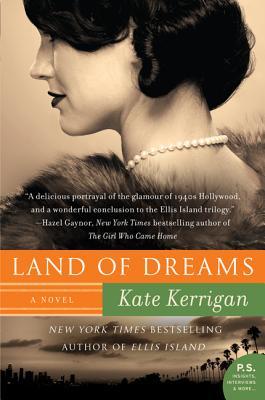
Land of Dreams by Kate Kerrigan

tlc tour host

Source: William Morrow and TLC Book Tours
Paperback, 336 pages
On Amazon and on Kobo

Land of Dreams by Kate Kerrigan, the third book in the Ellis Island trilogy (Ellis Island and City of Hope), could be read alone as Kerrigan provides enough background on Ellie Hogan that new readers could pick this one up without a problem, but readers may find a richer reading experience when they read all three.

(If you haven’t read the other 2 books, this review could contain spoilers for those books)

Ellie Hogan has come into her own as a wife, mother, and artist, only to have her life disrupted when her oldest adopted son Leo runs away from his upstate New York boarding school.  Ellie is a first generation Irish immigrant who has lost a lot to the Irish war against the English, but she’s also gained a sense of purpose in America, learning to make her own way.  Her artist’s life is very isolated on Fire Island, and with her son, Tom, she has a quiet existence among the people who have become like family.  But when her son, Leo, runs away to Hollywood, she has to make a choice — send the police or go after him herself.  Making her away across the United States, Ellie tries to keep her fears at bay while being thankful that her youngest son is in the care of good friends while she makes the journey.  Along the way, she meets Stan, a composer who escaped from Poland before the Nazis took over.

“Yet surely the desire for fame was not so different from the desire to be loved, and everyone in the world wants to be loved.  The desire for fame and love is born from a deep human need to be seen, and I felt as if I could really see this young woman now, beyond the mules and the dye and her ridiculous ideas and affectations.  So I started to draw her.”  (pg. 122)

Ellie may have been a quintessential landscape painter with her own signature for delivering paintings to her clients, but in Los Angeles, she’s a mother in search of a star-struck son.  She must decide whether at 16 he should pursue his dream or return to New York and school, and it is a tough decision for any mother with a son who has finally found something to be passionate about.  Ellie’s experiences in a restrictive Catholic home in Ireland inform her ultimate decisions, as she decides that she would rather be more open-minded than her parents had been with her.  Kerrigan easily tackles the ideas of nature versus nurture in Ellie’s parenting, touches upon the seedier side of Hollywood — though not as much as some readers would expect — and incorporates significant details about World War II and the internment of Japanese-Americans.

Land of Dreams by Kate Kerrigan is a satisfying conclusion to this trilogy about seeking out a home and family, but also stability.  But it is also about the realization of dreams across generations and having the gumption to take the leap.  While everything is not as it appears in Hollywood, the facades of the city also mirror those of Ellie’s own adopted country — a land of freedom and opportunity that still oppresses certain minorities and immigrants seeking a better life.

About the Author:

Kate Kerrigan is the author of three previous novels. She lives in Ireland with her husband and their two sons.  Visit Kate’s website at www.katekerrigan.ie and follow her on Twitter: @katekerrigan.


35th book for 2014 Historical Fiction Reading Challenge.


29th book (WWII) for the 2014 War Challenge With a Twist.



4th Book for the Ireland Reading Challenge 2014.

The Moonlight Palace by Liz Rosenberg

Source: Lake Union Publishing and TLC Book Tours
Paperback, 174 pgs
I am an Amazon Affiliate

The Moonlight Palace by Liz Rosenberg is set in 1920s Singapore, and Agnes Hussein is a teenager living in a rundown family palace, known as Kampong Glam.  The palace is a symbol of the cooperation of among the British and her long dead ancestors, but some view the palace as symbol of bribery by the British.  She is not Singaporean only, but also part British and part Chinese.  Her family is eccentric, and to make ends meet, the family relies on her British grandfather’s pension and the small sum they earn from their equally eccentric borders.  Rosenberg has created a character in Agnes who is a bit all over the place in her thoughts and in her actions, much like real teens, and she’s the strongest part of the novel.

“Perhaps, in order to start afresh, we needed to do away with all the old structures, the old assumptions.  Would these precious old things need to be torn down in order to make way for the new? I had to admit to myself in all honesty that I did not know the answer.” (page 146 ARC)

While there are elements of the 1920s in the novel such as Agnes’ comments on her own hairstyle and clothes, there is little else to suggest the time period, other than her grandfather’s triumphs in the Great War.  Agnes is naive in many ways about men and the political workings of her home nation.  She is like most teens; she falls quickly in love, is blind to the loyalty right in front of her, and is oblivious to the plights and machinations of those around her.  While a quick and easy read, the reader could feel separate from the characters and the main action of the novel, and the novel may have been better served with a focus on the grandfather or her uncle.

The Moonlight Palace by Liz Rosenberg is a coming of age novel that draws in some elements of Singapore and the 1920s, and Agnes is a typical teenager trying to make her own way in the world without offending tradition and without giving up her own dreams.  While she is naive about the larger world around her, she remains loyal to her family and her ancestry as she strives to earn money enough to help keep up their home.  With a little more background on the 1920s and the relationship between Britain and Singapore, this novel could have been fantastic, but as it is, it was just a good read about a young teen growing up.

About the Author:

Liz Rosenberg is the author of more than thirty award-winning books, including novels and nonfiction for adults, poetry collections, and books for young readers. She has been the recipient of numerous prizes, including the Paterson Prize, the Bank Street Award, the Center for the Book Award, and a Fulbright fellowship in Northern Ireland in 2014. She is a professor of English and creative writing at Binghamton University, in upstate New York, where she has received the Chancellor’s Award for Excellence in Teaching. She has guest-taught all over the United States and abroad, and has written a book column for the Boston Globe for the past twenty-five years. Her previous novels, Home Repair and The Laws of Gravity, have been bestsellers in the United States, Europe, and Canada. She and her husband, David, were raised on Long Island, and went to the same summer camp at ages seven and eight, respectively.

34th book for 2014 Historical Fiction Reading Challenge.


67th book for 2014 New Author Reading Challenge.

The Paradise Tree by Elena Maria Vidal

Source: Historical Fiction Virtual Book Tours
Paperback, 252 pgs
I am an Amazon Affiliate

The Paradise Tree by Elena Marie Vidal recounts the real life of Daniel O’Connor, the author’s great-great-great-grandfather, based upon his own letters and writing and family lore and woven into a work of historical fiction.  Daniel O’Connor was a young man during the potato famine in Ireland, and watched as his parents struggled against starvation, political wills, and bigotry.  Even as he had dreams of becoming a doctor, laws in the land of his birth forbade his ascension in the profession, despite his skill in setting bones and working as an apprentice with other non-Catholic physicians.  After running out of the funds to attend medical school, he set his sights on a new life — one that would take him across the Atlantic into the harsh wilderness of Ontario, Canada, in the late 1880s.

Vidal has crafted a tale based on fact, and although it is fictionalized, the prose has a very non-fiction feel, which leaves readers at a distance from the characters.  The factual feel of the novel can fall flat for readers looking to connect with the characters, especially as the years pass along and the interactions are few in dialogue and often seem more like a recounting of the past.  Daniel and his family are separated from one another for a long time as he makes his way in a new country and builds his own family, but eventually, he is reunited with some of his kin as they follow him to the new world.  Vidal does an excellent job of demonstrating the lifeline that the Catholic faith becomes for the O’Connor family and how it binds them together in the toughest of circumstances.

The Paradise Tree by Elena Marie Vidal is about the perseverance of family and faith in the face of a number of struggles, though at times the prose is a bit too dry.  The O’Connor family not only faces hardships in Ireland, but in Ontario as they literally cut out a life for themselves from the wilderness.  They must battle against prejudices toward Catholics in both settings and strive to be their own guidance in their faith, as there are few churches close enough to them to tend to their religious needs.

About the Author:

Elena Maria Vidal grew up in the countryside outside of Frederick, Maryland, “fair as the garden of the Lord” as the poet Whittier said of it. As a child she read so many books that her mother had to put restrictions on her hours of reading. During her teenage years, she spent a great deal of her free time writing stories and short novels.

Elena graduated in 1984 from Hood College in Frederick with a BA in Psychology, and in 1985 from the State University of New York at Albany with an MA in Modern European History. In 1986, she joined the Secular Order of Our Lady of Mt. Carmel. Elena taught at the Frederick Visitation Academy and worked as a private tutor as well as teaching children’s etiquette classes. During a trip to Austria in 1995 she visited the tomb of Empress Maria Theresa in the Capuchin crypt in Vienna. Afterwords she decided to finish a novel about Marie-Antoinette she had started writing ten years before but had put aside. In 1997 her first historical novel TRIANON was published by St. Michaels Press. In 2000, the sequel MADAME ROYALE was published, as well as the second edition of TRIANON, by The Neumann Press. Both books quickly found an international following which continues to this day. In 2010, the third edition of TRIANON and the second edition of MADAME ROYALE were released.

In November 2009, THE NIGHT’S DARK SHADE: A NOVEL OF THE CATHARS was published by Mayapple Books. The new historical novel deals with the controversial Albigensian Crusade in thirteenth century France. Elena has been a contributor to Canticle Magazine, Touchstone Magazine, The National Observer, and The American Conservative. In April 2009 she was a speaker at the Eucharistic Convention in Auckland, New Zealand. In August 2010 Elena spoke at The Catholc Writers Conference in Valley Forge, PA. She is a member of the Catholic Writers Guild and the Eastern Shore Writers Association. She currently lives in Maryland with her family.  For more information please visit Elena’s website and blog.  You can also connect with her on Facebook, Twitter, and Goodreads.


23rd book for 2014 European Reading Challenge; (Set in Ireland)


33rd book for 2014 Historical Fiction Reading Challenge.


65th book for 2014 New Author Reading Challenge.


3rd book for the Ireland Reading Challenge.

The Other Girl by Pam Jenoff

Source: NetGalley/Kindle
ebook, 21 pages
I am an Amazon Affiliate

The Other Girl by Pam Jenoff is a complementary story to her new novel, The Winter Guest (my review), in which Maria finds herself married and estranged from her father in rural Biekowice, Poland, during WWII.  Maria, who is married to Piotr, finds that she is an outsider at her in-laws home, and is unable to share even her sense of loss with them after he was conscripted by the Germans.  She fills her days avoiding the scrutiny of her mother-in-law, and dreaming about what life will be like when her husband returns.  She feels alone now that she’s severed herself from her father, whom she caught selling information to the Nazis.  However, her father’s betrayal is the least of the secrets she will uncover.

“War had nipped at the edges of their tiny village, Biekowice, changing little things first, like the requirement of registration cards.  Later had come the food requisitioning that left the market so bare.  Piotr’s family had not been affected as badly as most — the farm produced enough simple fare to keep their stomachs full.”

While she lives in relative comfort, Maria must remain strong for herself and a young Jewish girls she discovers hiding in the family barn.  Maria is a young wife who is still finding her place in her new family, while at the same time trying to make sense of the families around her who turn in their neighbors or make other deals with the Nazis to survive.  When she is faced with the dilemma of a little Jewish girl, it is clear that her father’s betrayal propels her to take a different action.  The Other Girl by Pam Jenoff expounds upon a minor character in her novel, The Winter Guest, giving readers a glimpse into how much the paranoia and fear had begun to permeate even the smallest villages as Nazis traipsed through the city squares and fought through the countryside.  It’s too bad that this story is so short; it would make a good novel.

About the Author:

Pam Jenoff was born in Maryland and raised outside Philadelphia. She attended George Washington University in Washington, D.C., and Cambridge University in England. Upon receiving her master’s in history from Cambridge, she accepted an appointment as Special Assistant to the Secretary of the Army. The position provided a unique opportunity to witness and participate in operations at the most senior levels of government, including helping the families of the Pan Am Flight 103 victims secure their memorial at Arlington National Cemetery, observing recovery efforts at the site of the Oklahoma City bombing and attending ceremonies to commemorate the fiftieth anniversary of World War II at sites such as Bastogne and Corregidor.  Visit her Website and Facebook page.

22nd book for 2014 European Reading Challenge; (Set in Poland)


32nd book for 2014 Historical Fiction Reading Challenge.


27th book (WWII) for the 2014 War Challenge With a Twist.

The Winter Guest by Pam Jenoff

Source: Diary of an Eccentric
Paperback, 352 pages
On Amazon and on Kobo

The Winter Guest by Pam Jenoff explores the bonds between sisters, particularly twins, and how those bonds can be tested and crack beneath the pressures of war and persecution.  The Nowak twins live in a small fictitious town in Poland, Biekowice, and are charged with raising their two younger sisters and brother after the death of their father.  Ruth is considered the more feminine and nurturing of the sisters, while Helena was adventurous, gathering wood and setting animal traps with their father from a young age.  Ruth was the first to fall in love and have her heart broken, and this heartbreak helped to define her views on family and loyalty, while Helena has yet to fall in love and does the best she can to provide for the family as the Nazis move across Poland and take over not only Krakow, but smaller villages along the way.

“As I stroll beneath the timeless canopy of clouds, the noises of the highway and the planes overhead fade.  I am no longer shuffling and bent, but a young woman striding upward through the woods, surrounded by those who once walked with me.”  (page 8 ARC)

Jenoff is a talented story-teller and her ability to transport readers into the harsh conditions of a rural town in Poland during WWII is nothing short of miraculous.  Readers will feel the biting cold, the harsh stares of neighbors looking for information to sell to the Nazis to get ahead, and feel the warmth of the Nowak family even as it struggles to stay together.  Ruth weighs loyalty above everything, while Helena places her family’s happiness above her own for so long that when she sees happiness for herself within her grasp, she wants to hold it close and not have to share it.  Like all sisters, Ruth and Helena share the burdens of bringing up their siblings alone, keeping food on the table and checking on their mother who is in a Krakow hospital.

Helena stumbles upon an American paratrooper in the woods and the Nowak family’s trajectory becomes skewed.  Jenoff has created twin sisters who are connected but seeking their own individuality while keeping their family together.  These dynamic women must face their own fears, as well as the reality of the WWII knocks on their door, literally.  The Winter Guest by Pam Jenoff demonstrates how the unexpected can be a blessing and a curse, how families can pull together even when they don’t really like one another at that moment, and how guilt can compel us forward to make things right.

This book was phenomenal, well told, and would be a great pick for book clubs — also it is likely to make the 2014 Best of list.

About the Author:

Pam Jenoff was born in Maryland and raised outside Philadelphia. She attended George Washington University in Washington, D.C., and Cambridge University in England. Upon receiving her master’s in history from Cambridge, she accepted an appointment as Special Assistant to the Secretary of the Army. The position provided a unique opportunity to witness and participate in operations at the most senior levels of government, including helping the families of the Pan Am Flight 103 victims secure their memorial at Arlington National Cemetery, observing recovery efforts at the site of the Oklahoma City bombing and attending ceremonies to commemorate the fiftieth anniversary of World War II at sites such as Bastogne and Corregidor.  Visit her Website and Facebook page.

21st book for 2014 European Reading Challenge; (Set in Poland)


31st book for 2014 Historical Fiction Reading Challenge.


26th book (WWII) for the 2014 War Challenge With a Twist.

This Is How I’d Love You by Hazel Woods

Source: Penguin
Paperback, 320 pages
On Amazon and on Kobo

This Is How I’d Love You by Hazel Woods is a WWI novel set in 1917 that demonstrates the power of the written word.  New York Times columnist Sacha Dench, who graciously agrees to be a pen-pal and chess opponent to Charles Reid, is forced to resign from his position as sentiment in the United States leans more toward entering the war than remaining isolated from it.  He and his daughter, Hensley, leave quickly for Hillsboro, New Mexico, to take up the residence of a former mine supervisor.  Dench’s letters to Reid are philosophical debates about the justice of the war and its final outcome, but they are also a test of wills on a chess board that mirror those tensions.  Hensley is intrigued by the letter and utterly infatuated with a play director in New York City, but when she’s forced to decide between staying in New York with her brother or go to New Mexico, she chooses to leave.  Like the notes in the margins of her father’s letters, her life is lived on the outskirts of the proper role she is meant to play as a young 17-year-old woman without a mother.

“Mr. Dench has taken one of Charles’s pawns in the third move of the game, their bishops facing one another and the next move of utter importance.  Charles must be wary of the temptation to play too aggressively, putting his own pieces at risk in the next turn, which, he senses, is probably his opponent’s strategy.  A classic lure.  But playing like this, without body language or eye contact, is a new challenge.” (page 5 ARC)

It is striking how Woods uses the game of chase to depict the art of war on many levels, from the war between Dench and Reid’s competing philosophies to the difficulties in playing chess without the social cues to guide him as they would in hand-to-hand combat.  Reid is not so much a soldier as an ambulance driver from the United States who signed up to make something of his life, rather than live the life expected of him by his rich parents.  While he finds his actions independent, he is also aware as the war goes on just how foolhardy the decision may have been.  Feeling adrift on foreign fronts, Reid holds onto Dench’s letters and later the secret correspondence he has with Hensley as a lifeline.  But her life is far from as simple as she would like him to believe in their forced exile.

“By the end, the lead had become so dull that his signature is hardly more than a thick looping smudge.  Even so, Hennie moves her index finger across the page, mimicking the script, slowing especially over his name, until she can trace his signature perfectly.  Inhabiting his body, exiting her own, she crouches down under the table, imaging the cramped feel of the cellar, the roughness of chapped lips, the stale smell of urine on her clothes, the sound of artillery just outside.”  (page 71 ARC)

Hensley is living in the world of their letters as much as he is, but soon she is forced to make a choice — not once, but twice — that could change the course of her life forever.  This Is How I’d Love You by Hazel Woods explores the power of letters, the devastation of war and grief, and the societal pressures to which we can succumb or fight against.  Woods has made WWI vivid and gruesome as it must have been, demonstrating the irreparable harm that soldiers may face but also the inner strength it requires for them to move forward and to continue doing so even when they return home.  Expectations should be their own and not imposed upon by others, and only through compassion and love can these men soldier onward.

About the Author:

HAZEL WOODS lives in New Mexico with her husband and two children.

30th book for 2014 Historical Fiction Reading Challenge.


20th book for 2014 European Reading Challenge; (Set in France)


25th book (WWI) for the 2014 War Challenge With a Twist.


63rd book for 2014 New Author Reading Challenge.

My Mother’s Secret by J.L. Witterick and Giveaway

Source: Penguin Random House
Paperback, 180 pages
On Amazon and on Kobo

My Mother’s Secret by J.L. Witterick is inspired by the real-life story of Franciszka and Helena Halamajowa who in Nazi-occupied Poland were able to save several families and a German soldier from being killed by the Nazis.  Told in understated, spare prose, the novel travels through the perspectives of Helena who grows up in Poland with her mother and brother without a father; Bronek, the head of one of the Jewish families; Mikolaj, the son of a premiere Jewish doctor before the Nazi occupation; and Vilheim, the German soldier who is vegetarian and does not want to kill.

“In all of us, there is a child that exists while we have our parents.

With my mother gone, I feel a sadness for the loss of the child within myself.” (page 68)

Helena’s perspective is the most developed of the four, in that readers garner a deeper understanding of her family and the losses they endure. Despite those hardships, she admires her mother’s commitment to doing the right thing. Her relationship with her brother is heart-warming from the beginning as they struggle to keep their stomachs full and steer clear of their father’s rage. Her mother’s secret is not so much that she begins hiding families from the Nazis but that she has the strength and conviction to do so no matter how much it could cost her personally. And while Helena sees herself differently, she carries with her that same strength, especially when her way of life changes drastically under Nazi occupation.

My Mother’s Secret by J.L. Witterick covers the range of reasons people were in hiding during WWII, and examines the perseverance of those hiding them. But it also takes a look at how keeping up appearances and going unnoticed can be the key to survival, as is showing love to fellow man with no expectation of getting anything in return.

About the Author:

Originally from Taiwan, J.L. Witterick has been living in Canada since her family’s arrival in 1968. She attended the University of Western Ontario, graduating from the Richard Ivey School of Business. My Mother’s Secret is her debut novel. It is a bestseller in Canada and has been published in several countries around the world. Witterick lives in Toronto with her husband and son.

Giveaway:

U.S./Canada residents 18+ can leave a comment below to be entered; list a WWII book that you’ve loved. Deadline to enter is Sept. 22, 2014, 11:59 PM EST.

58th book for 2014 New Author Reading Challenge.


18th book for 2014 European Reading Challenge; (Set in Germany/Poland)


29th book for 2014 Historical Fiction Reading Challenge.


23rd book (WWII) for the 2014 War Challenge With a Twist.

The Vintner’s Daughter by Kristen Harnisch

Source: Caitlin Hamilton Marketing and She Writes Press
Paperback, 368 pgs
On Amazon and on Kobo

The Vintner’s Daughter by Kristen Harnisch is set in Loire, France, in 1895 on the Thibault vineyards, as a family struggles to revive their grapes after a blight rocked the industry.  Sara has dreams of becoming a vintner like her father, and he has cultivated those dreams, allowing her to work the vines and learn all that she can from Jacques, the foreman.  She keeps a seasonal notebook about each harvest and process for making the wine, but when a blight threatens their harvest once again and the set price for barrels offered by the Lemieux family is too low to pay the vineyard’s debts, her father makes a fateful decision that changes the course of the entire family’s lives.  Harnisch clearly knows wine, vineyards, and the trade itself; her research is in depth and adds layers to her narrative.  Her characters are dynamic and engaging, and readers will be drawn into the Thibault family and cheer for them to triumph over the rival Lemieux family.

“Upon Jacques’s return, Sara wished him adieu and lifted her skirts to trudge through the mud between the vines toward the other end of the field.  There she hunched over to examine one of the vines more closely.  She ran her fingers over the leaves’ withering edges, fearing the worst.  She took her knife from her belt and split the vine’s bark.  With the tip of her blade, she scraped out hundreds of translucent eggs that lined the interior of the vine.  Some had already hatched, producing the dreaded pale yellow insects that were now sucking the vine dry.”  (page 8 ARC)

Fleeing France with her sister, Lydia (who resembles the Lydia of Pride & Prejudice in some ways), Sara finds herself adrift in New York City and reliant on the kindness of a convent and the church.  In their highly regimented life, she learns of the lush land in California and its vineyards, and she finally begins to dream of a way in which she can reclaim her family’s lost fortune.  While she’s making plans, she’s swept up in a different life, assisting a midwife.  As she learns to hold her ground in this more modern world in which women are making their own way, Sara is even more confident that she can right the wrongs done to her family.  When tragedy strikes again, Sara is forced to remain strong and to do what she thinks is best as she runs from the specter of the guillotine.

The Vintner’s Daughter by Kristen Harnisch is a fascinating look at the business of vineyards right around the time of prohibition in the United States and during the suffrage movement for women.  Sara comes into her own in the New World, and she learns what it is she truly has lost when she is pushed back to France by her boss in California.  Harnisch has crafted a emotional journey of a young woman coming into her own in the modern world and learning to forgive and be forgiven.  Stunning debut.

About the Author:

Kristen Harnisch’s ancestors emigrated from Normandy, France, to Canada in the 1600s. She is a descendant of Louis Hebert, who came to New France from Paris with Samuel de Champlain and is considered the first Canadian apothecary. She has a degree in economics from Villanova University and now lives in Connecticut. The Vintner’s Daughter, her debut novel, is the first in a series about the changing world of vineyard life at the turn of the century.

29th book for 2014 Historical Fiction Reading Challenge.


56th book for 2014 New Author Reading Challenge.

Stella Bain by Anita Shreve

Source: Gift from Anna
Hardcover, 272 pgs
On Amazon and on Kobo

Stella Bain by Anita Shreve, which was the War Through the Generations August read-a-long book, is set during WWI.  When the novel opens, a woman who has been wounded finds herself in a field hospital in Marne, France, in 1916.  She was found in the uniform of a British nurse’s aide, but has an American accent and cannot remember her own name.  As she grapples with her lost memory and identity, she plucks Stella Bain from her mind and begins to call herself such, even though she knows it may not be her real name.  Stella continues to work alongside the French women near the front and eventually volunteers as an ambulance driver.  Her jumbled mind takes a back seat to her duties at the front, but eventually, she feels drawn to England and the Admiralty, though she’s not sure what she’ll find there or if she will uncover anything about who she was.

“‘No.  Nothing is normal.  How can it be? I don’t yet know who I am.  I may discover, when I know my identity, that I’m not a good person at all.  I fear that I’m not.  I seek my identity, and yet I’m afraid of it.  But I’m more afraid of never knowing.'” (page 75)

Stella learns her true identity, and her true name is a near-anagram of the one she had chosen for herself.  When she learns of her identity and all that she frantically left behind in the United States, she must make passage home.  While Dr. Bridge and his wife, Lily, helped her to be calm and recover her name and identity, they are left behind in England without so much as a goodbye from her.  However, she never forgets their kindness and through letters, readers are given insight into her gratitude.  Shreve’s prose in this novel is distant.  While we see Stella’s point of view, readers are still distanced from her, which could be intentional given the absence of her memories and true identity.  In many ways, as the mystery unravels and readers learn more about the woman without a name, she becomes an everywoman for those women leaving during the early 1900s — caged in by marriage and family, but yet yearning for something outside of their home and legally allowed to own their own property.

Stella Bain by Anita Shreve is not just about a woman with shell shock or a lost memory, but a woman in an era where the modern world was just beginning to take shape.  A world in which women were fighting for independence from their families and husbands, to live lives as they wished to without seeking permission or approval.  Overall, while the ending could leave some readers wanting more, the novel would make for an excellent book club discussion.

About the Author:

Anita Shreve is an American writer. The daughter of an airline pilot and a homemaker, she graduated from Dedham High School in Massachusetts, attended Tufts University and began writing while working as a high school teacher in Reading, MA.

Interested in the read-a-long discussions at War Through the Generations, go here; though there will be spoilers.

17th book for 2014 European Reading Challenge(Set in France, England)


27th book for 2014 Historical Fiction Reading Challenge.


22nd book (WWI) for the 2014 War Challenge With a Twist.

The Last Kabbalist of Lisbon by Richard Zimler

Source: Public Library
Paperback, 318 pages
On Amazon and on Kobo

The Last Kabbalist of Lisbon by Richard Zimler set during the 1500s at the time of the Lisbon Massacre of April 1506, in which about 2,000 Jews were killed.  Zimler breathes life into this time period and the Jewish Kabbalah, a time in which Jews were in hiding and many were converted to New Christians (Marranos) in 1497 — some after fleeing Spain — to remain safe from persecution. Even their conversion is not enough to satisfy Old Christians as they run rampant through the city killing Jews, putting their heads on spikes, throwing them on pyres, and more.  King Manuel I, while more tolerant of the Jewish community, allowed the massacre to rage on, and eventually, 30 years later, the inquisition was established in Portugal, just as it had been in Spain.  Berekiah Zarco, a young manuscript illuminator, becomes caught up in the search for a killer, after he discovers his uncle, the keeper of forbidden Hebrew texts, has been murdered.

“We are all of us deep and wide enough to welcome a river of paradoxes and riddles into our souls.” (page 21)

Berekiah, also known as Pedro as a New Christian, worked with his uncle illuminating texts for others that were hiding from the Christians and trying to keep their Jewish faith alive, but he is unaware of how his uncle smuggled precious texts out of the city and into Turkey so as to keep them from being lost.  Zimler demonstrates through Zarco’s search for his uncle’s killer how the Jews were forced to wear a great many masks to hide their religion, but at the same time, these masks could be false ones and even the most trustworthy in the community could be hiding nefarious deeds.  The tale is told as Zarco unravels the mystery of his uncle’s death, and while he becomes absorbed in vengeance and the search for justice, his Muslim friend, Farid, who cannot speak except with his hands, steers him in the right direction and reminding him of compassion and empathy along the way.

“Yet the wall tiles and window eyelets, desks and chairs returned my gaze without the slightest quiver of motion.  The room was empty, seemed hollow, like the rib cage of an animal whose heart had suddenly ceased beating.”  (page 57)

With a turncoat in the Jewish community, Zarco narrows the field to a few suspects and sets about finding the truth, even as the Old Christians continue to rage, pillage, and kill Jews in their wake.  While the dialogue is a bit comical after a time, with Zarco accusing elders in the community of being murderers and them immediately denying it and him accepting their answers, in the context of the time period in which elders were to be believed, the conversations make sense.  Zarco’s life is in endanger at every turn as he seeks the killer, but he relies on his Kabbalist faith to see him through and finds a strength through his uncle’s teachings.

The Last Kabbalist of Lisbon by Richard Zimler provides a window into the early 1500s when Jews were being pushed out of their homes, and much of the situations during this time mirrors the reasons reiterated during the time of the Nazis — that the Jews were taking all of the jobs and the money away from those who were true Portuguese.  Christian versus New Christian and Jew, Kabbalah was all the Jews had to cling to as a way to survive persecution and continue flourishing.  It is a harrowing story of evil, death, and perseverance, but it is also about the ties we have to our faith and family, even after much of our family has passed on.

About the Author:

Richard Zimler was born in Roslyn Heights, a suburb of New York City, in 1956. After earning a bachelor’s degree in comparative religion from Duke University (1977) and a master’s degree in journalism from Stanford University (1982), he worked for eight years as a journalist, mainly in the San Francisco Bay area. In 1990, he moved to Porto, Portugal, and he has taught journalism for the last sixteen years, first at the College of Journalism and now at the University of Porto. Richard has both American and Portuguese nationality.

1st book for the 2014 Portuguese HF Challenge.


16th book for 2014 European Reading Challenge(Set in Portugal)


26th book for 2014 Historical Fiction Reading Challenge.


51st book for 2014 New Author Challenge.

Once We Were Brothers by Ronald H. Balson

Source: Public Library
Hardcover, 389 pages
On Amazon and on Kobo

Once We Were Brothers by Ronald H. Balson, our August Book Club selection, is part legal thriller and part historical fiction, as Ben Solomon recognizes that one of Chicago’s elite was a former Nazi SS officer Otto Piatek, the butcher of Zamosc, and his one-time brother.  Solomon’s family always strove to help their neighbors whenever possible, and one day take in a German boy, Otto, as their parents face the struggles of lost jobs and opportunities.  On the cusp of Nazi expansion, Poland seems like it is protected from outside forces and immune to Nazi takeover, but suddenly, things change and the Solomons are faced with a variety of tough decisions.  In the present Ben Solomon has aged and is on a crusade to bring Piatek to justice no matter the cost.

“‘Maybe for some.  Not for me.  It is why we must remain diligent and relentlessly pursue men like Piatek.  Evil is contagious.  Much like a pathogen, it must be snuffed out at the source.'” (page 139)

Balson has a great story to tell, but it’s too bad that the modern-day character of Catherine Lockhart is too much of a pain, with her constant interruptions about billable hours and urging Ben to get to the point.  She’s constantly bombarding Ben with questions about property and the basis for his lawsuit and always denying her interest.  While her backstory about a horrible conniving husband gives credence to her lack of confidence as a lawyer and her concern about keeping her current job, her story is pale in comparison to Ben’s Holocaust story.  Moreover, there are times when Ben appears to be spouting off facts in an effort to educate the reader, coming off more as a lecture than a man who is telling his life story.  Despite these flaws, the story is engaging — even if everything that could have happened during the Holocaust happens to Ben and his family — and readers will be sucked into the past, just as Catherine is.

Once We Were Brothers by Ronald H. Balson is intriguing because of the Polish setting, and the story of Ben and his family is engaging, but the lawsuit portion is resolved very quickly and the relationship between Ben and Otto as children is only partially developed.  With that said, Balson knows his history and has created an engaging look into the past that will have readers examining the world today in a new light.  Are we beyond the evil the Nazi’s engaged in or is the potential still here among our own world leaders?

About the Author:

The author, Ronald H. Balson, is a Chicago trial attorney, an educator and writer. His practice has taken him to several international venues, including villages in Poland which have inspired the novel Once We Were Brothers.

What Book Club Thought:

Most of us were displeased with the attorney character and her sob story, which had not place in the book, especially in comparison to Ben Solomon’s holocaust story.  With that said, one member really enjoyed the legal maneuverings near the end of the book, though they were resolved very quickly.  While the novel was readable and went quickly, there seemed to be an abundance of bad things happening to Ben and his family, though like most of these stories there are many who die.  Otto also seemed to be “too” evil and there was little seen of his transformation, which could be because the story was told from Ben’s point of view for the most part.  One member suggested that the modern day characters be cut out or that they be only at the end when Ben makes it to modern day and begins his lawsuit, while another suggested the book be split between the “brothers'” points of view.  Overall, many thought this book could have presented the story in a better way.

20th book (WWII) for the 2014 War Challenge With a Twist.


49th book for 2014 New Author Challenge.


15th book for 2014 European Reading Challenge(Set in Poland)


25th book for 2014 Historical Fiction Reading Challenge.


Inamorata by Megan Chance

Source: Lake Union Publishing and TLC Book Tours
Paperback, 420 pages
I am an Amazon Affiliate

Inamorata by Megan Chance is dark, mysterious, and twisted.  Odile Leon is a former courtesan turned dark muse, and if you are as talented in the arts as your ego lets you believe, she will choose you.  But the bargain could cost you your soul.  Nicholas Dale knows this too well, and he’s made it his mission to stop her.  Add to the mix mysterious twins, Joseph and Sophie Hannigan, from New York.  These twins carry their own dark secrets and they intrigue not only the entire art community in Venice, but Dale and Odile.  These twins are not torn between the struggling forces of good and evil, but something darker, more singular — desired by both sides.

“That I was not always in his shadow, that there was something in the world that could belong just to me.  To truly be as special on my own terms as Joseph said I was — sometimes my yearning for it was so strong it took me by surprise.”  (page 109)

There is talk of ghosts, succubi, murders, suicides, and more, but Chance weaves artistry so well into the narrative readers will get lost in the canals, wondering how it all will turn out.  There are points in the narrative that drag a little, perhaps there are too many points of view shared, which slows the pace a bit, but many readers would not want to trade any of those points of view because they could lose the full scope of the story.  These points of view enrich the story, making it fuller, and the characters themselves are dynamic and well developed.  These characters are trapped by their yearning and desire to be bigger, recognized, and made whole.

Chance has created a heavy, twisted novel about romantic Venice, and the artists who are struggling to gain recognition. Inamorata by Megan Chance is enveloping, and readers will fall under its spell as each page is turned and more is revealed.  Will these characters achieve their darkest desires, will they be beholden and enslaved by them, or will they find the solace they are seeking?  Another contender for the 2014 Best Reads list!

About the Author:

Megan Chance is a critically acclaimed, award-winning author of historical fiction. Her novels have been chosen for the Borders Original Voices and IndieBound’s Booksense programs. A former television news photographer and graduate of Western Washington University, Chance lives in the Pacific Northwest with her husband and two daughters.  Connect on Facebook and Twitter, and visit her Website.

48th book for 2014 New Author Challenge.