Quantcast

Cinquain

The Cinquain is unrhymed and five lines that are broken down into syllables. The first line is two syllables, the second has four, the third has six, the fourth has eight, and the fifth has two.

These were the first poems I learned how to create as a teen.

Try out today’s Cinquain poem generator.

Here’s mine:

Peace

Peace
Calm, durable
Reposing, lulling, resting
I could never believe it
Tranquility

I can’t wait to see yours. Hope you have a great weekend.

En Route by Jesse Wolfe

Source: Publisher
Paperback, 60 pgs.
I am Amazon Affiliate

I’ve been reading a lot of poetry collections about life journeys this month, and En Route by Jesse Wolfe is no exception. Wolfe’s poems have narrators who are “en route” to somewhere or are about to embark on the next leg of their journey. The collection moves from part one in which narrators are alone to those who are accompanied to those who have almost arrived. Like in the opening poem, “Cumulus,” we are reminded that we may consider any point in our lives a beginning, but there is history behind us that heaps up, making us the well-rounded human beings we are. We shouldn’t forget the past.

From "Cumulus"

At a certain arbitrary point
you have to say, here is a beginning
(not to pretend that nothing lingers,
that the trek across the bridge was a mirage,
or the nights sleeping on abandoned farms,
accepting bread and water from strangers).

“Polliwog Park” is one of the most heartbreaking poems in the collection, with fly balls and baseball diamonds, sunburns peeling away just as a father drives off into his own “separate story.” There are moments of “cleaving” in many of these poems, but Wolfe’s poems embrace that separation, internalizing the heartbreak and using it as a tool to see beyond that momentary end to the journey ahead. Like from “Breakup,” “Or I could turn to our love that never coalesced:/you’re half an abstraction, an empty space/into which I pour my fatigue, distress,/and inchoate faith — my shameful escape/from futures withdrawing all promise of home.//”

Although these poems speak to the “will” of the narrator to move forward from heartbreak and endings, there is also the sense that life’s “momentum” cannot be controlled, like in the poem of the same name.

En Route by Jesse Wolfe’s “Homework” reminds us that “There is work I can only do/by letting go: my hands off the wheel,/the car will find its own way/down the long freeway./ … toward whatever … inarticulate – need.”

RATING: Quatrain

About the Poet:

Jesse Wolfe’s poetry has appeared in publications including Tower Journal, Good Works Review, Mad Swirl, and Eunoia Review. An English professor at California State University, Stanislaus, Wolfe previously served as Faculty Advisor to Penumbra, the campus’s student-run literary and art journal. His scholarly work includes the monograph Bloomsbury, Modernism, and the Reinvention of Intimacy (Cambridge University Press, 2011) and a forthcoming book on intimacy in contemporary British and American fiction.

Whirl Away Girl by Tricia Johnson

Source: Publisher
Paperback, 120 pgs.
I am an Amazon Affiliate

We all identify as our role in the family (mother, father, sister, brother, uncle, cousin, etc.) and we all identify ourselves with our employment (teacher, firefighter, poet, scientist, etc.), but what happens when those aspects of our lives can no longer anchor us — hold us steady? We begin to spiral away, to lose our sense of self, and this is exactly what is explored in Whirl Away Girl by Tricia Johnson. These poems express the deep harm, anger, frustration, and sadness patients with chronic illness can feel — nothing is in their control, leaving them unmoored.

from "Fatigue" (pg. 3)

You are rising in a car and its weight slides in
and down your body
Your hands too heavy to knit
Your head too heavy to raise and no words or thoughts exist

From the first poem, readers will know that they are in for a rough journey with the narrator. Many of these poems will be tough to read back to back, but that’s the point. Someone with chronic illness (like lupus or others) doesn’t get a break. It is okay if you take a break and read this volume in spurts, and it may help to generate greater empathy for the narrator — to sit and think about what she’s telling us life has been like. From the feeling of being beaten down by disease to the condescension of some medical doctors, the narrator demonstrates not only the weight of a breaking down body, but also the weight of the broken medical system and the additional burden it becomes for those who need it most. “When added together become a 10-ton hammer” (“New Doctor”).

 from "A Disillusional Song" (pg. 55)
...
My thoughts are as tangled as the bedding
Woven between my legs
I am antsy, walking, driven
Flopping back in bed, up again
...
I am a stranger caught in a mind, that is caught in itself

Whirl Away Girl by Tricia Johnson is a candid account of being out of control when chronic illness hits and there are few answers about how to improve the situation. Johnson’s poems illustrate the fear that accompanies chronic illness and the sense of loss of one’s self throughout the process. “Battle of You” is probably one of the strongest poems in this collection, but I’ll let you find that gem for yourself. As the collection progresses, the narrator does regain a sense of self and strength, found in the moments of good days and few symptoms. There is joy to be found there, even if it is fleeting.

RATING: Quatrain

Why I Never Finished My Dissertation by Laura Foley

Source: TLC Book Tours
Paperback, 96 pgs.
I am an Amazon Affiliate

Why I Never Finished My Dissertation by Laura Foley, named one of seven Best Indie Poetry Books of 2019 by Kirkus, is probably her best work to date. In the opening poem, “What Stillness,” Foley sets the tone for the collection. We picture the narrator beside the pond, in stillness and quiet. But soon there is much more going on as her dog emerges from a swim and the light catches the wet droplets as they shake from the dog’s coat. Readers are privy to how stillness and light can shine the light on situations, changing how we perceive them if we take the time to look and listen. Foley’s collection speaks to this in poems about a marriage for a green card, understanding a father whose life irreparably changed when he became a POW, when confronted with a world where hate and bombast are praised, visits to a sister in a psychiatric ward, and much more.

Foley’s latest poem, “Hindsight,” tackles something different than her previous poem “Hindsight” in Joy Street, in which she examines a photograph of her father. Here, the narrator chooses to marry a Muslim man who needs a green card as a way to escape her white, privileged life. But there’s something much deeper to this escape. It is far easier for her to escape and attempt to run from her true feelings than to think about her truth — feelings for another girl. Hindsight is a powerful thing when time has passed and we can see a situation for what it was without all the other entanglements, rationalizations, and justifications for choosing a different path.

Foley’s use of hindsight in subtler ways demonstrate how we can easily hold onto regret and blame things around us for the choices we make, but these are choices we’ve made and they have made us who we currently are. This all circles back to the title of the collection and the poem, “Why I Never Finished My Dissertation,” in that the narrator’s overwhelming life of a young child, puppies, keeping house, and more lead her to decide against finishing that dissertation. It is a choice, and it could be a choice regretted, but her life’s journey leads to great things — pieces of her family and journey she’d never want to give up.

Twice the Speed of Sound

She waves to me
from the coach window,
shadowed glass reflecting
summer trees,
her face dappled
by a scree of boughs and leaves
I can't see through --
maples not yet reddening into fall --
as she rides one plane
after another, over no rough seas,
into no threatened war,
no lack of easy communication;
still, the space expands
like the universe:
galaxies begetting galaxies,
worlds yet unnamed--
despite phone calls bouncing
from one far-flung tower
to another, while out wide world
keeps rolling under us
at twice the speed of sound.

Foley reminds us that life is “chaotic with possibility” (“Discharge” pg. 40). Why I Never Finished My Dissertation is a meditative reflection of choice, life, living, and learning to look back with a kinder eye on those twists and turns. Don’t miss this collection. I cannot wait to see what Foley brings to us next.

RATING: Cinquain

Other Reviews:

About the Poet:

Laura Foley is the author of six poetry collections, including Joy Street, Syringa, and Night Ringing. Her poem “Gratitude List” won the Common Good Books poetry contest and was read by Garrison Keillor on The Writer’s Almanac. Her poem “Nine Ways of Looking at Light” won the Joe Gouveia Outermost Poetry Contest, judged by Marge Piercy. For more information on Laura’s work, please visit her website.

Haiku

Haiku are short form poetry originally from Japan. The poems contain three phrases that contain a kireji, or “cutting word”, 17 syllables in a 5, 7, 5 pattern, and a kigo, or seasonal reference. Basho is one of the most famous of the haiku writers.

Here’s today’s poem generator for haiku.

Check out what the generator came up with for me:

Jovian, largest
discovery of the moons
the electric lights

I hope these Friday activities are enjoyable.

Imposter Syndrome

I debated on whether I would write this post, but I feel compelled to do so. I’m taking it as my moment to stop feeling like an imposter or to at least remember that I’ve worked really hard on publishing poems in the last few years.

Imposter syndrome is something I’ve had as a writer probably since leaving undergrad. It’s the feeling that I’m not qualified enough and that I’ll be outed as a phony any moment. But I read a recent Harvard Business Review article that has me questioning the problem — perhaps it isn’t just feeling but a problem with the systems that oppress others?

What’s less explored is why imposter syndrome exists in the first place and what role workplace systems play in fostering and exacerbating it in women. We think there’s room to question imposter syndrome as the reason women may be inclined to distrust their success.

The impact of systemic racism, classism, xenophobia, and other biases was categorically absent when the concept of imposter syndrome was developed.

Is that the case with me? I don’t know that it is. I’m not a social scientist.

My new question is: how can I be a fake poet? What would that even look like?

I do have insecurities about the lack of an MFA — a conversation I had recently with a couple poets I know. I’ve sought advice, and I hope that I can internalize it and change my mindset. A lot of my imposter syndrome is internal – I read widely and write poems (not as consistently as I’d like).

I’m also not willing to go into debt to achieve an MFA. I just can’t put my family in that hole when so many depend on me, and for real, it would really just be a formalized way of getting more time to write. But as a major income in my house, carving out that time is hard enough without having to please professors, etc. I’d rather just use the little time I have for creative writing to write!

Is the lack of MFA the only reason I feel like an imposter? Probably not. It also could be because I don’t talk the poet-talk. I don’t speak in metaphor, and I don’t present myself as an academic at all. I may know things, I just don’t talk about them like many writers do.

Am I really an imposter?

No. I write poems. I work hard to refine them. I submit them periodically if not monthly to journals. I am working on a manuscript. I will complete all of these things while working full time and raising a child and caring for other family members. All of these things take time, commitment, and work. I am not an imposter.

Field Study by Chet’la Sebree

Source: Publisher
Paperback, 176 pgs.
I am an Amazon Affiliate

Field Study by Chet’la Sebree reminds me of those scientific notebooks kept by scientists in the field who are observing animals or others as they take notes. Peppered with quotations from bell hooks and many others, Sebree explores Black female identity and sexual desire. The poem is less like a poem than a list of observations and comments on Black identity and female desire.

Black women and girls face additional burdens of protecting the reputations of black boys and men. -- Tressie McMillan Cottom
My secret ... I'm always angry. -- Bruce Banner
 ___________

And why wouldn't I be?

In addition the female desire and the struggle of Black women who love and are attracted to white men, Sebree voices some of the issues she’s found in the Black community — how the community does not address mental health enough.

In my early twenties, I worked on an epistolary series.
I didn't know I wrote a book-length suicide note.
I titled it And If I Die Before I Wake.
A prayer and a promise.
__________

I'm alive; I'm alive; I'm alive.
Cry it with me.
It doesn't always feel like it, but it's a good thing.

Sebree has created a poetry collection in which mental health is entwined with Black female identity, the racial tensions that women feel from all sides, and the responsibility they have to project a sense that they are indeed whole. “No matter how far I go, there is never enough makeup for the bullet hole.” Field Study by Chet’la Sebree, which publishes in June, worries and rationalizes and assesses herself like a scientist. Her observations are keen and deeply probing, and she doesn’t let up on herself. This is a frank look at one woman’s struggle with desire and identity, but it has universal applications to others in all communities — less judgment and more love. Definitely not your typical, confessional poetry collection — it’s much more.

RATING: Quatrain

In the Lateness of the World by Carolyn Forché

Source: Publisher
Paperback, 96 pgs.
I am an Amazon Affiliate

In the Lateness of the World by Carolyn Forché is a tapestry of human history that traverses time and place, and it calls upon the reader to take in the totality of history. This includes the moment of now, as well as all the past moments that make up the “now” and the world as it is and how it was envisioned. Forché has created a collection that looks back on the totality of moments so that we can see everything at once.

From “Water Crisis” to “Report from an Island,” her poems look at the crises humanity faces, losses of clean water, pollution of our seas by plastic, and those who are forced to live in trash piles. “This work is slow,” the narrator of “Report from an Island” says. Time always seems to move slowly and progress can be even slower.

From real-world issues, these poems spin the folklore of individuals. The stories of who we are or were can be lost to the ravages of time. In “The Lost Suitcase,” Forché says, “Here are your books, as if they were burning./Be near now, and wake to tell me who you were.//” Many of her poems build these stories from ash and memory. We walk the streets of a city under siege: “Turning the pages of the book you have lent me of your wounded city,/reading the braille on its walls, walking beneath ghost chestnuts/past fires that turn the bullet-shattered windows bronze,/”

One of my favorite poems is a tribute to the late Larry Heinemann, author of Paco’s Story, (I still miss our FB conversations) and his fellow veterans, Kevin Bowen, Bruce Weigl, Nguyen Ba Chung, “Hue: From a Notebook,” which pays tribute to the past, their present, and their ghosts.

We went down the Perfume River by dragon boat
as far as the pagoda of the three golden Buddhas.

Pray here. You can ask for happiness.
We light joss sticks, send votives downriver in paper sacks,

then have trouble disembarking from the boat.
Our bodies disembark, but our souls remain.

A thousand lanterns drift, a notebook opens in the dark
to a page where moonlight makes a sound.

These soldiers are decades from war now:
pewter-haired, steel haired, a moon caught in plumeria.

We are like the clouds that pass and pass.
What does it matter then if we are not the same as clouds?

There was then the whir of stork wings, and bicycle chains ringing.
It is still now the way the air is still just before the mine explodes.

Once we fired at each other. Now we pass silence back and forth.
On the ten thousand graves, we lay chrysanthemum.

Forché’s poems are powerful in the silent and calm voice she uses to speak about the “lateness” of the world. When we come to the end of a life, who hears those memories, those echoes of the past? Is it in the breeze? Is it in the smell of the flowers? Is it in the books and stories we tell? In the Lateness of the World by Carolyn Forché is our tapestry, and it grows larger each day.

RATING: Quatrain

Limericks

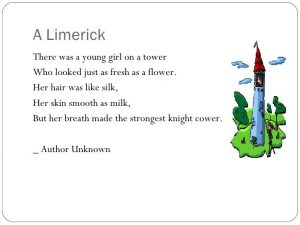
Limericks are often humorous poems, with three long and two short lines with the rhyme scheme aabba. Some times these can be bawdy.

I share with you the Poetry Generator for Limericks.

Here’s mine:

There was a man named Trygg
Who used to dance a jig
But during a break
He made a mistake
What a terrible day for Trygg

There are days when you just need a little bit of fun.

National Poetry Month 2021

Welcome to National Poetry Month!

Please share your poetry related posts below, so I can stop by!

I have no hard and fast plans this month, but there will be reviews and activities, and perhaps some videos. I hope you stop by and check out some of the fun poetry.

I’d love to inspire some of you to write your own poetry, too. It can be cathartic, but you don’t have to share those poem drafts if you don’t want.

Raising King by Joseph Ross

Source: Purchased
Paperback, 144 pgs.
I am an Amazon Affiliate

As in stated in the introduction to Raising King by Joseph Ross, Dr. King “knew racism disfigured the white people who used it. Thus, he focused his life in such a way, built on compassion, that his work might free both those who suffer from racism and those who inflict the suffering.” Throughout this collection, Dr. King’s compassion infuses each line, even though “the boat [the slaves were on] is dust./The whip//survives.” (“Martin Luther King, Jr. — Prologue,” pg. 9)

The backbone of these poems are Dr. King’s own words in Stride Toward Freedom, Why We Can’t Wait, and Where Do We Go From Here. Through Dr. King’s words and teachings, Ross has recreated a compassionate look at a man frustrated with a system of oppression, but determined to save his oppressors and the oppressed. “a lunch counter/become[s] an altar,” but only after significant training in nonviolence. (“Be Broken,” pg. 32-3) This compassion stems from the realization that many whites who oppress have inherited their hate (it’s what they know, all they know, how they were taught). In “Inheritance,” Dr. King’s voice rings true: “I will not/destroy him just because/someone taught him//to destroy me.//” (pg. 37-8)

Compassion is often seen as a weakness, but in reality it is the strongest weapon we have against barbarity.

Bomb (pg.40)

War is like this: two women,
a baby, a man gone, a man lost.

I was lost like this: a baby
in the back bedroom.

a wife shaking, unable to be
still. A friend, calm but about

to break.

A crowd gathered. I ran home
to see what was left of me.

The crowd was angry.
I wanted their anger 

to love my own. But my wife's
shaking stopped, keeping me

from breaking.

Keeping me from becoming
the bomb I feared.

It is compassion and empathy that strengthen our character and our ability to rise above the baseness of our human nature.”We have not been victorious//over anyone. We want to ride/beside everyone.” (“We Prepared,” pg. 49) The collection also includes commandments as Dr. King’s movement becomes more urgent, almost as though he knows that the opportunity for real change is fleeting.

Ross’s poems are still relevant to the struggles we continue to face, with “Sheet, Cross, and Flame” calling to mind some recent reactions by parties who have lost and continue to rage against those losses. But Dr. King reminds us in Ross’s poems “Manners and decency/reach down and pat us//on the head. This is/about me grabbing//your hand demanding/you ask my permission//before you touch me.//” (“Decency,” pg. 108) With Ross’s words and poems, Dr. King rises again and leads by teaching.

I’m so glad that my last book of 2020 was Raising King by Joseph Ross. It was a comfort to read these words and remember why I treat others with compassion when I can, especially when it is hard to do so. While we must “choose//never to throw them [stones]//at one another” (“Chaos or Community,” pg. 136-7), we also need to “Let the/bones//rest.” (“The Bones,” pg. 119)

RATING: Cinquain

About the Poet:

Joseph Ross is the author of four books of poetry: Raising King (2020), Ache (2017), Gospel of Dust (2013), and Meeting Bone Man (2012). His poetry has appeared in a wide variety of publications including The New York Times Sunday Magazine, The Los Angeles Times, The Southern Quarterly, Xavier Review, Poet Lore, Tidal Basin Review, Beltway Poetry Quarterly, and Sojourners. His work appears in many anthologies including What Saves Us: Poems of Empathy and Outrage in the Age of Trump, edited by Martin Espada. His poems also appear in Collective Brightness, Poetic Voices without Borders 1 and 2, Full Moon on K Street, and Come Together; Imagine Peace. He served as the 23rd Poet-in-Residence for the Howard County Poetry and Literature Society, just outside Washington, D.C. He is a seven-time Pushcart Prize nominee, most recently for “The Mountain Top,” from Raising King. His poem “If Mamie Till Was the Mother of God” won the 2012 Pratt Library/Little Patuxent Review Poetry Prize. As a teacher and writer, Ross was awarded the University of Notre Dame’s Reinhold Niebuhr Award in 1997 and the William A. Toohey, C.S.C. Award in 1993. In 2006, he was awarded Teacher of the Year by the senior class at Carroll High School in Washington, D.C. In 2020, he delivered the Robert L. Giron Global Humanities Lecture for Montgomery College, Takoma Park, Maryland. The lecture was titled: “Literature Consoles and Confronts: When Poetry Is a Tool for Justice.”

Check out the Gaithersburg Book Festival Panel discussion with Joseph Ross, Tara Campbell, Kim Roberts, and E. Ethelbert Miller:

2020 Gaithersburg Book Festival Poetry Contest Winners!

Thank you to everyone who entered the Gaithersburg Book Festival High School Poetry Contest!

There were some fantastic poems.  Thank you to Shout Mouse and our first round readers. Thanks to Elizabeth Lund, our final judge and her director/producer who helped us put together an official announcement for our first, second, and third place winners, as well as our Fan Favorite.

Congratulations to all of the winners and this year’s fan favorite.