Quantcast

Virtual Poetry Circle: Mahmoud Darwish

Hello everyone!

It’s National Poetry Month and in honor of April as Arab-American Heritage Month, I wanted to share one of my favorite poems from Mahmoud Darwish.

I Belong There

I belong there. I have many memories. I was born as everyone is
     born.
I have a mother, a house with many windows, brothers, friends, and
    a prison cell
with a chilly window! I have a wave snatched by seagulls, a panorama 
    of my own.
I have a saturated meadow. In the deep horizon of my word, I have
    a moon,
a bird's sustenance, and an immortal olive tree.
I have lived on the land long before swords turned man into prey.
I belong there. When heaven mourns for her mother, I return 
    heaven to her mother.
And I cry so that a returning cloud might carry my tears.
To break the rules, I have learned all the words needed for a trial by 
    blood.
I have learned and dismantled all the words in order to draw from 
    them a
single word: Home.

This poem is a reflection on the trauma and turmoil, but also the blessed things in a home torn by fighting. There a deep longing for the home in his mind, one filled with light and beauty, but the reality is that it is a country torn.

Please share one of your favorite Arab-American poets. Or take some time check find one on poets.org.
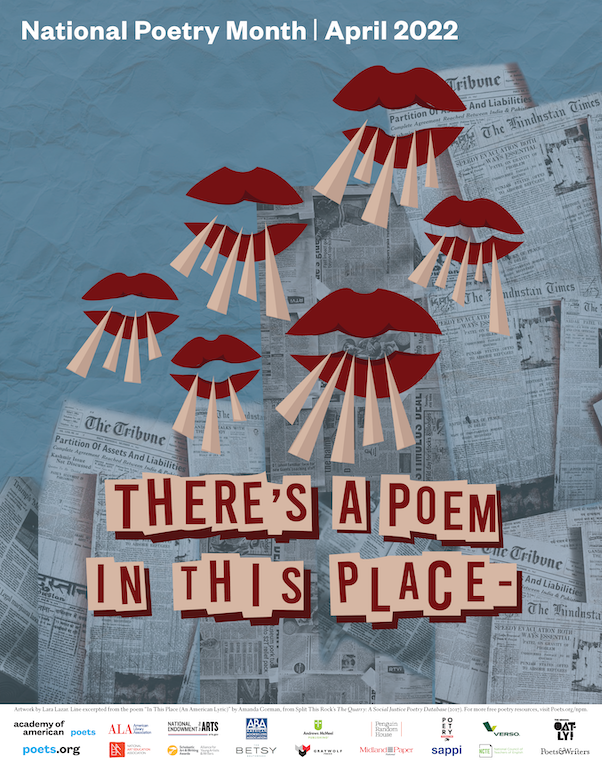
Poetry Events: Roundup of Weekend Poetry Events

Here’s some local D.C. area and online poetry events for you to check out this weekend!

In-Person:

Pop-Up & Poetry: poetry series dedicated to the synergy of BLACK lyricism, artists, and space in the home of Nubian Hueman. (21+ audience only) April 15 7-9 p.m.

Nubian Hueman – Baltimore
211 West Read Street
Baltimore, MD 21201

For kids ages 5-12, you can pick up a Poetry Packet at the Tenley-Friendship Neighborhood Library. (pick up during library hours on April 15)

Tenley-Friendship Neighborhood Library
4450 Wisconsin Ave., NW
Washington, D.C.

Charlottesville Reading Series with poet Aran Donovan and fiction writer Anna Caritj. (April 15 at 7 p.m.)

New Dominion Bookshop
404 E Main St
Charlottesville, VA  22902

Online Events:

Virtual: National Poetry Month Celebration w/ The Rumpus with Derrick Austin, Michael Chang, Chen Chen, & Brionne Janae. (April 15 at 7 p.m.)

What poetry events are you excited about? Drop the details in the comments.

Poetry Activity: Limericks

Limericks are a fun poetry form to create. They remind me of stand-up comics where anything becomes fodder for humor.

Definition of Limericks:

A limerick is a humorous poem consisting of five lines. The first, second, and fifth lines must have seven to ten syllables while rhyming and having the same verbal rhythm. The third and fourth lines should only have five to seven syllables; they too must rhyme with each other and have the same rhythm.

Edward Lear is one of the most well known writers of Limericks, and this is one of my favorites:

There was an Old Man with a beard
Who said, "It is just as I feared!
Two Owls and a Hen,
Four Larks and a Wren,
Have all built their nests in my beard!"

I love using the limerick generator, and I hope you’ll give it a try, too. Here’s mine:

There once was a lass called sally.
She said, "See the great vitaly!"
It was rather poor,
But not louis pasteur,
She just couldn't say no to the halle.

Share yours below.

Any Dumb Animal by AE Hines

Source: Purchased
Paperback, 88 pgs.
I am an Amazon Affiliate

Any Dumb Animal by AE Hines, which toured with Poetic Book Tours, is a compact powerhouse of poems where the poet tackles his demons, the rejection of his father, becoming at father himself, turning 50, and so much more. Hines is brave in these poems where he lays bare his fears, heartbreaks, and deep regrets, but these poems also offer glimmers of light, love, and hope.

***Be aware that some of the poems can be triggering if you’ve suffered abuse, trauma, and hate because of your sexual orientation.***

“Phone Call” opens the collection with a harrowing experience of a father pinning his son to floor after dragging him from his bed and squeezing his hands in the hardware store, as if force could mold him into what his father wishes him to be. However, Hines’ torment doesn’t stop there as he finds himself with a marriage counselor and a spouse who diminishes him in the same way. This poem explores trauma and how that trauma lasts years and years unless it is addressed.

In “How We Learn,” we find Hines has some anxieties: “Having nearly drowned as a child,/having been terrified to leave/the confines of dry land, I already knew/a thing or two about avoiding/the obvious dangers./” (pg. 5) But here we see a father “tossing” him “into the deep end of pools”. This dynamic between father and son is the anchor of the collection and a trauma that infects all of the other relationships he speaks about until he has come to terms with his deep-seated pain.

I don’t want to go into too much detail about these poems because you should read these poems for yourself. Any Dumb Animal by AE Hines is devastating all the more so because these personal experiences will make your heart break.

RATING: Cinquain

About the Poet:

AE Hines (he/him) grew up in rural North Carolina and currently resides in Portland, Oregon. His poetry has been widely published in anthologies and literary journals including I-70 Review, Sycamore Review, Tar River Poetry, Potomac Review, Atlanta Review, Crosswinds Poetry Journal and Crab Creek Review. He is winner of the Red Wheelbarrow Prize and has been a finalist for the Montreal International Poetry Prize. He is currently pursuing his MFA in Writing at Pacific University. Follow him on Twitter, Facebook, Instagram.

Poetry Activity: Cento (Patchwork) Poem

Check out Write Shop for more on Cento poems

The Cento is one of the easiest poems to create because it is a collage of poetic lines from other poets’ poems.

According to the Academy of American Poets, John Asbury’s “The Dong with the Luminous Nose” and Peter Gizzi’s “Ode: Salute to the New York School” are two of the most famous Cento poems.

Please feel free to check out other examples, here.

For our cento, I’d love for everyone to take a look at my starting line and add their own (please identify the poem and poet):

How dreary – to be – Somebody! (Emily Dickinson, “I’m Nobody! Who are you? – 260)

Add your lines in the comments and I’ll post the full cento at month’s end.

Virtual Poetry Circle: Naomi Shihab Nye

Hello everyone! It’s National Poetry Month and in honor of April as Stress Awareness Month, I wanted to share one of my favorite poems from Naomi Shihab Nye.

Sometimes There Is A Day

Sometimes there is a day you just want
to get far away from.
Feel it shrink inside you like an island,
as if you were on a boat.
I always wish to be on a boat.
Then, maybe, no more fighting
about land. I want that day to feel
as if it never happened, when Ahmad was burned,
when people were killed, when my cousin was shot.
The day someone went to jail
is not a day that shines. I want to have a clear mind
again, as a baby who stares at the light
wisping through the window and thinks,
That’s mine.

In this poem, I see that island. Maybe there’s a large erupting volcano, much like the stress we can face from war, pandemics, etc. Even little eruptions that strike fear and deep loss in us, like the bills piling up or the dead end job or family drama, can seem overwhelming. In this poem, we get to journey away from that island on a boat, watch that stress shrink until we are babies discovering the world anew.

What are some of your favorite poems that provide you stress in times of solace or just speak to you about stress/turmoil in general?

Poetry Events: Roundup of Weekend Poetry Events

I wanted to share some poetry events that are happening today and throughout the weekend. There’s a mix of online events and in-person events for your pleasure.

I hope you’ll check out some of these poets:

In Person Events near Washington, D.C.:

Busboys & Poets presents 9th Hour Poetry Slam hosted by Charity Blackwell at 2021 14th St NW, Washington, District of Columbia, 20009 (April 8 at 9 p.m.) Bring something to read.

DiVerse Gaithersburg presents Pamela Murray Winters and Rocky Jones at Java Junction 5 S Summit Ave, Gaithersburg, MD 20877 (April 9 at 1:30 p.m.) Bring something to read at the open mic.

Politics & Prose presents a Poetry Panel with Danielle Badra, Carol Jennings, Phil Goldstein and Angelo Nikolopoulos at 5015 Connecticut Ave NW Washington, D.C. 20008 (April 10 at 3 p.m.)

America Poetry Museum presents the Where We Stand: Book Launch (my review) at 716 Monroe St NE #25th, Washington, D.C. 20017 (April 10 at 3 p.m.)

Online:

Indelible Literary and Arts Journal presentsPoetry and the Diaspora with André Naffis-Sahely, Anthony Anaxagorou, Antonia Taylor, Maria Taylor, Omar Sabbagh, Roula-Maria Dib, Kostya Tsolakis via Zoom (April 8 at 11 a.m.)

If you know of any and would like me to share them, please email me the details and I can update this post.

I’d love to hear about what events are near you.

Surviving Home by Katerina Canyon

Source: Book Publicity Services
Paperback, 108 pgs.
I am an Amazon Affiliate

Surviving Home by Katerina Canyon is a collection of poems that reflect on how home is not always the haven many of us feel that it is or should be. “The vast dark but sunlight-speckled ocean/While knowing they have everywhere/And nowhere in the world to flee.//” (from “Involuntary Endurance,” pg. 13)

The opening poems of this collection explore the dark shadows of home, and the narrator often tells us that they wish for a “happy ending,” but these are not those kinds of poems. Canyon unflinchingly explores the scars of abuse, neglect, and the fear that propels the narrator to consider suicide. “I held the knife in my hand/I propped open the blade/I sharpened it against petrified wood/But I could not slice my flesh//” (from “I Wish I Could Tell You This Has a Happy Ending,” pg. 15) The poems also explore what it means to be a woman and a Black woman in a white world.

These poems make you weep. In “Thoracic Biology,” the narrator says, “For the most part I want to learn to let go,/to hurt a little less./My heart is what hurts the most.//Where did I learn to/breathe through the pain, to/cut off the sword piercing through//” I find that I do this; try to breathe through the pain of whatever moment I’m in. Where did we learn to do that? Why is it OK that we need to do this? My experiences are not the same as Canyon’s or any other Black person, but I empathize with those feelings of deep loss, fear, and emptiness. These poems make you want to take action; reach inside these lines and pull these young children out and protect them from harm.

At 13, I found a Bra

...
Along my Sierras grows an
    orchard of knowledge of good
    and evil. I take my beatings. I 
    bind myself in woman's hood.

I hook the clasps
along my curved spine.
Only the band knows
the stress of my heart.

I am told every woman 
pays her debt with pain.

    When the daffodil opens,
    the last breath of childhood releases.

Canyon asks the reader how can we survive home when it is at the root of so much trauma? Shall we keep on praying as the narrator suggests in “A Plea to the Inane”? Or do we “hold my brother’s hand./I clench my breath./His scream lowers to a bleat.//” (pg. 47, “All Day Long”)? How can so much pain not force us to go crazy, to lose our minds? Surviving Home by Katerina Canyon is a harsh look at abuse, racism, gender discrimination, and so much more; it is a testament to survival and what it means to hold hands and push through the pain and into the light.

RATING: Cinquain

About the Poet:

Katerina Canyon is a 2020 and 2019 Pushcart Prize Nominee. Her stories have been published in New York Times and Huffington Post. From 2000 to 2003, she served as the Poet Laureate of Sunland-Tujunga. During that time, she started a poetry festival and ran several poetry readings.

She was featured in the Los Angeles Times and was awarded the Montesi Award from Saint Louis University in 2011, 2012, and 2013. She has published multiple chapbooks and an album.

Useful Junk by Erika Meitner

Source: GBF
Paperback, 104 pgs.
I am an Amazon Affiliate

Useful Junk by Erika Meitner is a poetic exploration of memory and desire, but also a collection of perspectives on the body and how it is seen and what it sees. The collection opens with the poem, “I would like to be the you in someone’s poem.” Here, Meitner’s narrator expresses a desire to be seen in all her glory and quirkiness, even if it is just a fiction.

When you enter this collection, you’re in a surreal world where the poet explores what the junk mail knows about us and our finances, but also what junk mail fails to know about our feral nature and our desires to be wanted and seen with all of our flaws. Meitner’s poems offer vignettes of “multitudinous and wild pasts” and our many futures. “don’t you worry about how/scattered memory gets (pick-up-sticks, a box//of buttons, shards of plastic beached across/an entire coastline) and how we’re just trying//to find the origin,” (from “All the Past and Futures” pg. 18-9)

She tells us in “Medium Adam 25”: “I am not an abstracted/self in the wet night. I am not a static/enterprise either, and as I move through//time and space, many things are vanishing/in exchange for a wanting with no end…” Isn’t it the truth of each of us. We are not this abstract perception that others have of us; we are fluid and changing even if it isn’t as obvious by our physical selves — though those change too.

Useful Junk by Erika Meitner is intimate and existential all at once, and readers will swim in the morass and indulge in memory and perception imparted with quick wit and contemplative angst. Meitner provides us with a bridge between our memories and their changing patterns and our desires to be seen coupled with the anxiety of how we are perceived by others and ourselves.

RATING: Cinquain

About the Poet:

Erika Meitner was born and raised in Queens and Long Island, New York. She attended Dartmouth College (for a BA in Creative Writing and Literature), Hebrew University on a Reynolds Scholarship, and the University of Virginia, where she received her MFA in Creative Writing as a Henry Hoyns Fellow, and her MA in Religious Studies as a Morgenstern Fellow in Jewish Studies.

Poetry Activity: Texting Poems

I love to share fun and inspiring poetry creation activities, and one of my favorites is still to come. But as I was checking around for new activities, I came across one for students that I think writers might enjoy trying.

We all know how to text each other on our phones at this point, so how about we create a text poem in the form of couplets.

  • Couplets: two lines of verse, usually in the same meter and joined by rhyme, that form a unit

For this writing exercise, you can choose something conversational you would have with a friend and write just 2 lines with the same meter (usually we speak in Iambic pentameter) and a rhyme.

There’s also this Rhyming Couplet Generator, though it is a bit more formal.

We can start a conversation in the comments if you’re up for it.

Here’s my attempt:

I walked at dawn in the orange glow.
My boots crunched on icy snow.

Something very simple for your Tuesday!

Local D.C. Event: Gallery Opening of Photopoetry by Gordana Gerskovic, Serena Agusto-Cox, and More

What: Opening Reception of Photopoetry
When: Sunday, April 3 at 4 p.m. to 6 p.m.
Where: Foundry Gallery at 2118 8th Street NW, Washington, D.C.

Two of my poems have been paired with Gordana Gerskovic‘s wonderful art. I hope that if you are in the area, you’ll drop by the opening reception on April 3.

Also featured:

We will host a reading later in the month.

Virtual Poetry Circle: Nikki Giovanni


Hello everyone! It’s National Poetry Month and in honor of Women’s History Month in March, I wanted to share one of my favorite Nikki Giovanni poems.


Legacies

her grandmother called her from the playground   
       “yes, ma’am”
       “i want chu to learn how to make rolls” said the old   
woman proudly
but the little girl didn’t want
to learn how because she knew
even if she couldn’t say it that
that would mean when the old one died she would be less   
dependent on her spirit so
she said
       “i don’t want to know how to make no rolls”
with her lips poked out
and the old woman wiped her hands on
her apron saying “lord
       these children”
and neither of them ever
said what they meant
and i guess nobody ever does

I love how the exchange here between the older woman and the girl is simple. It is a normal conversation between an elder looking to teach a child and a child’s response, but there is that undercurrent of fear and connection that I love so much about this poem.

The child wants to stay connected to this woman, but knows that death is nearing for her and she hopes that by rejecting the teaching, she can stave off that inevitable moment and disconnection.

What are some of your favorite poems celebrating women?