Quantcast

Strange Theater by John Amen

Source: John Amen
Paperback, 112 pgs.
I am an Amazon Affiliate

Strange Theater by John Amen includes surrealism and introspection, as well as poems dedicated to individuals that speak to a broader scope of readers.  It is a peek behind the theater curtain at the backstage machinations of life and the true identity of the theater’s players.  Examining the roles of those on the stage, in the background, the understudies, and the roles that we take in our own lives, Amen takes readers on a roller coaster journey.

From "folk singer" (pg. 91)

of course you're suffering
that goes without saying
alone in yr own private tundra
staggering through the snow

Many of us feel alone with our suffering, and theater, movies, stories, and poetry often help connect us, creating tangential connections between our own suffering to that of others. Some of these poems often draw out the egoism we have about our own lives and suffering, like in “biography,” “ferry approaching in the haze/the monuments he built/he built for himself/for this reason are destined to crumble//” (pg. 17) Many of these players are haunted, haunted by their pasts, their futures, their missteps, and their inability to meet the expectations of others.

from "diaspora" (pg. 30)

last time we talked
I saw deadbolts turning in yr eyes
from light years away you demanded

Amen keeps his readers on their toes as they move from line to line and poem to poem, exploring the uncertainty in all of our lives as it plays out on the biggest stage. Strange Theater by John Amen is wonderfully disconcerting even among the most common of places and people. Imagine looking back on a body of work and seeing only a darkness — a future that hasn’t been written yet — and feel that insecurity that breeds alongside the wondrous possibilities, and you’ll know what it is to walk out on Amen’s poetic stage.

Other Reviews:

About the Poet:

John Amen is the author of three collections of poetry: Christening the Dancer (Uccelli Press 2003), More of Me Disappears (Cross-Cultural Communications 2005), and At the Threshold of Alchemy (Presa 2009), and has released two folk/folk rock CDs, All I’ll Never Need and Ridiculous Empire (Cool Midget 2004, 2008). His poetry has appeared in various journals and anthologies, including, most recently, Rattle, The New York Quarterly, The International Poetry Review, Gargoyle, and Blood to Remember. He is also an artist, working primarily with acrylics on canvas. Amen travels widely giving readings, doing musical performances, and conducting workshops. He founded and continues to edit the award-winning literary bimonthly, The Pedestal Magazine.
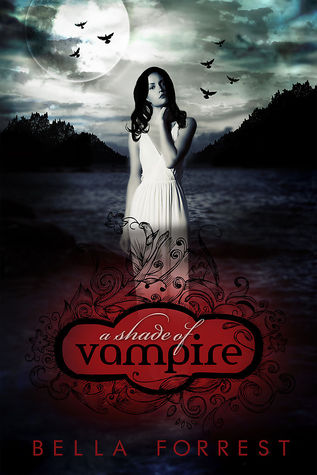
A Shade of Vampire by Bella Forrest

Source: Purchased
ebook, 296 pgs.
I am an Amazon Affiliate

A Shade of Vampire by Bella Forrest is a short novella in which Sophia Claremont is kidnapped by vampires and brought to The Shade to become a slave. She’s given to Prince Derek Novak as a gift from his siblings, though his brother Lucas has already claimed her in his mind. Sophia has had a rough time growing up and was finally settled with a neighboring family and her best friend Ben, whom she’s had a crush on for some time. But she also has debilitating anxiety in crowded spaces, almost like she’s on sensory overload.  However, when she finally awakes on this vampire island, very little is seen of her disorders, until she’s attacked one evening.

“She was beautiful because, at a time when she had every right to be terrified, she managed to show comfort to another person who needed it.”

Derek, who has awakened from a 400 year long sleep, cannot stay away from Sophia and he keeps her like a caged bird in his treetop penthouse.  Her humanity has captured his attention, and even though her blood calls to him, he makes every effort to battle his desires.  As she teaches him about technology and he begins to show her respect, their bond intensifies.  Sophia is a naive character who is led by her emotions easily, and in many ways, she falls for the guy who acts like her protector — whether its teenage Ben at home or Derek the powerful vampire on The Shade.

“I know an excuse when I hear one.  Don’t you dare deceive yourself into believing that you’re the victim.”

A mantra that Ben has used many times to snap her out of her anxiety trances, Sophia finds it can be useful in more ways than one, but even as she tames Derek’s inner beast, she fails to see how she is a victim and needs to take action.  One failed escape attempt is all it takes for her to become complacent, which does little for the tension in the book.  While the characters, setting, and world are intriguing, there is little back story, which can leaving the feud between Derek and Lucas seem empty and can leave the lore of this vampire series feel incomplete.

A Shade of Vampire by Bella Forrest provides an engaging way to spend the afternoon, but unless there is more back story in the subsequent novels less telling, rather than showing, it would be hard to sustain interested beyond two more books.  There are 18 books in this series.  It boils down to wanting more from the setting and lore beyond the main characters who are dynamic and troubled.

About the Author:

Bella Forrest is the million-bestselling author of the “A Shade of Vampire” series.

The Uncertainty Principle: Poems by Roxanna Bennett

Source: Tightrope Books
Paperback, 126 pgs.
I am an Amazon Affiliate

The Uncertainty Principle: Poems by Roxanna Bennett is a debut collection of poems in which the observation of events can have an impact on its outcome on the human and atomic level.  It is broken down into five sections — The Dominant O, Come From Away, Symptoms of the Disorder, The November Revolution, and Diminishing Returns — and each section delves deeper into the murk to uncover the momentum or the setting of events in motion.  Was it the abuse in childhood that forced her to be bitter and angry or was it being stood up that made her demand more power over her own life?

From “The Bottle Genie” (pg. 26-8)

I’m the empty window panes in a scissored newspaper, finger
of air beneath the door. I’m the cold chisel killing the torch singer,

the alembic that distills you to vapour. I’m what analyzes your
labelled slides, you in my eyes, magnified. I’m your cellar door.

Observation is not the mere passing of time for these narrating personas; it is an art form and a curiosity seeking to be quenched, even in the darkness of human suffering. There is a deep need to get at the root of a person, a situation, a motivation, a hurt. Beyond those who are observing, there are those who self-reflect, looking at the choices made and the life they live but from the outside — detaching themselves from those lives. Like in “Uprising” (pg. 31), “Limits of middle age fence/her in, a dozen lives ride/on her decisions. Memories,//raw beauty of teenage selves, memories,/youth that saw thoughtless uprising,/” where the woman is a decision-maker for those around her — probably her children and husband — and she is looking back to a time when she was not bound by her constraints and was free to turn on a dime and do something new without fearing the consequences — at least not having to fear how the consequences would impact those who rely on her.

From “Diminishing Returns” (pg. 121)

“We have navigated our worth
by the map of skin worn by another.”

“Hours dark wing-beats over the contours of her face.
We are the sum of all our choices, the origin of grace.”

Bennett also has a great series of poems in different sections of the collection that rely on echo, in which lines or phrases from one poem appear at the start of the next. These also ratchet up the tension in this collection, as readers are taken on a journey through rough waters and the unpredictability of the churning sea keeps them guessing. The Uncertainty Principle: Poems by Roxanna Bennett is a wounded animal howling in the dark, trying to make sense of the harm that has come and laid its insides bear for the alley cats to sneer and pick at, but it also is an examination of those trials and how they can define us or not, depending on the choices we make.

About the Poet:

Roxanna Bennett studied experimental arts at the Ontario College of Art and Design and creative writing at the University of Toronto. She lives in Whitby, Ontario.


The Same-Different: Poems by Hannah Sanghee Park

Source: Academy of American Poets (purchased)
Paperback, 72 pgs.
I am an Amazon Affiliate

The Same-Different: Poems by Hannah Sanghee Park, 2014 Walt Whitman Award winner, straddles the line between myth and reality, as Park examines some global myths from China and India to Norway and Greece.  She uses phonemes to uncover the secrets in the words she’s chosen to get at the heart of their meaning to not only reach an origin but to generate a response.  Upon first reading, these poems seem like an exercise in word play, but reading more deeply encourages readers to see the similarities and differences inhere in the words chosen and how those nuances should be celebrated.

From "Bang" (pg. 3)

Just what they said about the river:
rift and ever.

And nothing was left for the ether
there either.

And if anything below could mature:
a matter of nature.

Here the interplay of words peeks beneath the surface of creation myths from the big bang theory to the story of creation in scripture. Rather than focus on the age-old battle between whether creationism or evolution is the correct theory of what happened, Park asks “to have left the world,/to what is left of it –/could you have anything left to cove?” Rather than battle for the correct theory and covet the glory of being correct, shouldn’t we be more focused on the awe of it all and our minor part in it? Park forces readers to question their perceptions of what is important about life, not just what happens in their own lives but also the life around them.

& A (pg 22)

Being a matter
of importance, there

is no mastering
this but to bind you,

thrash and all, to the 
mast.  O you won't reach

irresistible song,
but the rope will teach

you the body's give.
Go down to the bone,

then tell me again
there what matters.  It

will give you every
-thing you need to know

about what I cannot tell you and then,
just maybe then, could it be enough.

Similarities and differences are looked at with new eyes, and in many ways, those differences can be dangerous. However, these poems suggest that even in these perceived dichotomies there is beauty, something to be savored and to be loved. In the final section of poems — Fear — the sum of the poems reads like a single force, gyrating and churning the seas of perception until the final lines. Park wonders aloud what it means to be the fear-driven species that strives to become the sole survivor and upon reaching the summit what is there left but more fear. From “Beyond the meadow, the horizon fails” (pg. 47), “what then to our victor’s highest marks?/Only fear regrouping in your heart of hearts.” And yet, despite all this dreariness and dark, Park leaves readers with a hope, a bleak hope — “everything in life is a placeholder.” The Same-Different: Poems by Hannah Sanghee Park is stunning in its twists and turns, but it will require several reads and recitation aloud in some cases. But the gems within these lines and phrases are well worth the work.

About the Poet:

Hannah Sanghee Park was born in Tacoma, Washington and earned a BA from the University of Washington and an MFA from the Iowa Writers’ Workshop. She is the author of a chapbook, Ode Days Ode (Catenary Press, 2011). She is the recipient of fellowships and awards from The Fulbright Program, 4Culture, The Iowa Arts Council/National Endowment for the Arts, and the MacDowell Colony. Her work has appeared in various journals and publications, including LVNG, Petri Press, Poetry Northwest, and Best New Poets 2013. In 2014, Park won the Academy of American Poets’ Walt Whitman Award.

Park lives in Los Angeles, where she attends the Writing for Screen & Television Program at the USC School of Cinematic Arts.


Dark Sparkler by Amber Tamblyn

Source: Harper
Paperback, 128 pgs.
I am an Amazon Affiliate

Dark Sparkler by Amber Tamblyn, an actress herself, has embarked upon an ambitious collection that looks at the narcissistic and self-mutilating world of Hollywood through the eyes of actresses’ whose lives ended prematurely by their own hands or through the actions of others.  From the famous Marilyn Monroe to the less well-known Barbara La Marr, Tamblyn calls into question the need for perfection among female actresses and how hard it is to find work once these actresses reach a certain age.  There’s also one poem about Lindsay Lohan, which readers may have various reactions to, including shock, dismay, and possibly laughter. (if you want to read what happened when she read the poem, beware it is a bit of a spoiler about the poem)

From "Thelma Todd" (pg. 3-5)

At the bar I run into Nancy,
drinking away her forties,
her eyes are flush broken compasses.
Lost between age fifteen and fifty.

Fermented blood.
Deep-sea drinker.

I do not look into her ocean.
The fish there float to the bottom.
I fear I'll go down there too,
identifying with the abyss.
Washed up.
Banging on the back door of a black hole.

These poems are at best depressing and at worst horrifying. These sparkling actresses are snuffed out by the pressures of Hollywood, but they also have their own demons chasing them. Tamblyn’s sense of the tragic is acute when exposed in lines like these: “But first she said, I’m sorry, Charles, it’s over between us,/tied together the sheets of their love letters,/climbed out the window of his soul.//” (from “Dominique Dunne,” pg. 25) and “I’m going to floss my teeth with the public hair/of the Hollywood night air,/memorize my lines before I snort them.//” (from “Bridgette Andersen,” pg. 30-1) These women’s lives and those of living actress continue to become objectified, and it’s hard to imagine living with that on a day-to-day basis. In many ways, the collection almost suggests to those female actresses who have lived in Hollywood longer, continue to work, and do not fall into a spiral of depression that they are the exceptions.

There is a sense of fight in these poems, as if Tamblyn is calling attention to these tragic stories not only to encourage female actresses to shun these arbitrary pressures, but also to call attention to the public’s role in these tragedies. Celebrity lives have become fodder for the American public, and these poems want to demonstrate the darkness that can follow such attention. Dark Sparkler by Amber Tamblyn is an ambitious collection of poems that will have readers thinking about their own roles in celebrity gossip and objectification.

About the Poet:

Amber Rose Tamblyn is an American actress, author and film director. She first came to national attention in her role on the soap opera General Hospital as Emily Quartermaine. She also starred in the prime-time series Joan of Arcadia, portraying the title character. Her feature film work includes roles in The Sisterhood of the Traveling Pants, The Grudge 2, The Ring, and 127 Hours; she had an extended arc as Martha M. Masters on the main cast of the medical drama House, M.D. She also had a starring role on the CBS sitcom Two and a Half Men during its eleventh season as Jenny, the illegitimate daughter of Charlie Harper.


Lives of Crime and Other Stories by L. Shapley Bassen

Source: L. Shapley Bassen
Paperback, 194 pgs.
I am an Amazon Associate

Lives of Crime and Other Stories by L. Shapley Bassen is an odd little short story collection in which the characters are hit with an unimaginable situation and they must cope with the ripples that disturbance creates.  Like many short story collections, some stories will resonate more easily than others.  The title story, Lives of Crime, has a surprise ending, while others are a little more predictable and some are cryptic.  Bassen provides a wide range of characters in a variety of dark situations, including one in which a student’s idea could be published under a credentialed professor’s name, rather than his own.

One of the best stories in the collection, Triptych, involves the restoration of artwork and the lonely life one restorer. Once she finds happiness with someone in her building and things seem to be going well, fate intervenes and turns her world upside down.  As echoes of the art world play out in reality, Bassen creates a series of devastating events that could leave some depressed in the corner.  However, like other stories in the mix, the reader is held at arms length from the characters by the narrative style.

Lives of Crime and Other Stories by L. Shapley Bassen is a collection of vignettes in the lives of those who are unaware that their fate is about to be taken out of their hands.  Each story is intriguing, but many felt unfinished or like they had abruptly finished before the reader was satisfied.  However, the unique situations and characters do provide readers with a lot to ponder, particularly about how they would react in similar situations.

About the Author:

L. Shapley Bassen‘s half dozen plays include Atlantic Pacific Press’s 2009 prizewinner, a comedy, The End of Shakespeare & Co , directed by Pulitzer judge George W. Hayden (Audio excerpt published online). Two more prize winners, from the Fitton Center in Ohio, the one-acts Next of Kin and The Reckoning Ball (the day Brooklyn’s Ebbett’s Field was torn down), were produced in 1998 and 1997. Next of Kin has also been published twice recently in Prick of the Spindle and Ozone Park Journal and was produced in 1999 at NYC’s The American Theatre of Actors. Ms. Shapley-Bassen was a 2011 Finalist for the Flannery O’Connor Short Fiction Award, and currently (2013) she is Fiction Editor at The Prick of the Spindle. In 2009, she was on the team of the first 35 readers for successful start-up Electric Literature. She was co-author of a WWII memoir by the Scottish bride of Baron Kawasaki and won a Mary Roberts Rinehart Fellowship. Her stories, book reviews, and poems appear in many lit magazines and zines, including The Rumpus, Horse Less Press, The Brooklyner, Press 1, Melusine, New Pages, and Galatea Resurrects. She is a reluctant ex-pat New Yorker living in Rhode Island, now at work on a new play, Dramatic Anatomy.

The Small Backs of Children by Lidia Yuknavitch

Source: Public Library
Hardcover, 240 pgs
I am an Amazon Affiliate

The Small Backs of Children by Lidia Yuknavitch is carnal and grotesque in ways that are vastly unsettling and may be tough to read for many.  Told from a variety of artistic points of view, the story begins with a young girl whose world is literally atomized in war-torn Eastern Europe and the photograph of her that makes the career of one narrator.  While the girl and the photo play a major role in the story, they are not the crux of Yuknavitch’s story.  They are merely a vehicle through which she explores the selfish need for artistic expression and the distortions that emerge.

“We are who we imagine we are.
Every self is a novel in progress.
Every novel a lie that hides the self.
This, reader, is a mother-daughter story.” (pg. 11)

The narration is urgent, like a slapshot in the gut at nearly every turn. While the writer’s friends and family seek to save the girl from the life she has been thrown into after the death of her family, it is clear that a birth has happened. It is the birth of art within the gruesome world the girl inhabits, and it is the birth of connection beyond art and family ties.  The girl reaches from within and from without to recreate her life to be reborn — not as a victim, but as a warrior.

Pity the small backs of children, he heard her saying.  They carry death for us the second they are born.” (pg. 59)

The stories that begin at the heart of this girl, like the spokes in a wheel, turn and turn, spiraling out of control on a wagon that is hurtling toward a cliff, unless someone can stop it or redirect it. Will these players be destroyed? Will they be saved? Can this “blast particle … looking for form” endure the weight of these stories and their implications?

The Small Backs of Children by Lidia Yuknavitch pushed the envelope repeatedly, searching for the edge and spilling over it with its haunting images, desperate characters, and narcissistic art-making. It is the crucible of pain and suffering that molds us and pushes us to become, to move beyond the child of mere potential into something more tangible that can be criticized and critical. This crucible does not define us, however, unless we allow it to, and Yuknavitch is shoving readers toward a greater understanding of art and themselves.

**Beth Kephart reviewed this book, and I just had to get it from the library.***

About the Author:

Lidia Yuknavitch is the author of the widely acclaimed memoir The Chronology of Water and the novel Dora: A Headcase. Her writing has appeared in the Atlantic, the Iowa Review, Mother Jones, Ms., the Sun, the Rumpus, PANK, Zyzzyva, Fiction International, and other publications. She writes, teaches and lives in Portland, Oregon with the filmmaker Andy Mingo and their renaissance man son Miles. She is the recipient of the Oregon Book Award – Reader’s Choice, a PNBA award, and was a finalist for the 2012 Pen Center creative nonfiction award. She is a very good swimmer.


The Race for Paris by Meg Waite Clayton

tlc tour host

Source: TLC Book Tours
Hardcover, 336 pgs.
I am an Amazon Affiliate

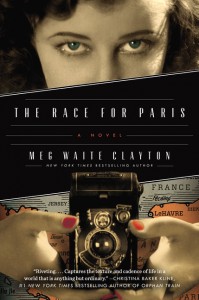
The Race for Paris by Meg Waite Clayton is riveting from the start and a careful blend of fact and fiction about WWII and the female reporters and photographers who were often relegated to the field hospitals and sidelines while their male counterparts were allowed closer to the front and on reconnaissance missions.  Clayton’s characters tough cookies, and they have to be as they face the possibility of death once they’ve ignored their orders to remain at the field hospital.  Liv Harper, an Associated Press photographer know for her blurred faces, and Jane, a reporter for the Nashville Banner, find themselves accompanied by Fletcher, Liv’s husband’s friend.  Fletcher is a British military photographer who often goes it alone in the field to gather intelligence with his photos for the Allied forces, but he’s had a flame burning for Liv ever since he met her.  This unlikely trio is determine to make it to Paris before the other reporters to photograph and tell the tale of its liberation.

“That was the way it was, covering war.  The little bits of detail you could get on paper or on film were just that, little bits that didn’t tell the whole story.  And you couldn’t possibly capture the whole of it no matter how far back you stepped.” (pg. 217 ARC)

Liv has secrets too, and only Jane is aware of some of them.  While Fletcher and Liv are striving toward the front as if chased by ghosts, Jane is tagging along, not so much for the good of her career as someone who cushions the blows that they receive along the way.  She becomes the sounding board for each of them, while she keeps her own council.  Jane is a strong woman, though timid, while Liv is a wild wire set to explode.  Fletcher has taken it upon himself to protect them both, though his desire for Liv often steers him into danger.  While Clayton’s triangle here could be construed merely as a romantic tug-of-war, it is isn’t.  There are more nuanced dynamics at play here, as WWII has touched Fletcher and Liv in very different ways and Jane is observing it as it plays out.

The Race for Paris by Meg Waite Clayton looks through the lens of journalists during one of the most sweeping, horrifying, and tense wars in our world history to provide an encapsulated view of the fighting, the discrimination against female journalists, and the battles dedicated people had to endure to achieve their goals.

About the Author:

Meg Waite Clayton is the New York Times bestselling author of four previous novels: The Four Ms. Bradwells; The Wednesday Sisters; The Language of Light, a finalist for the Bellwether Prize; and The Wednesday Daughters. She’s written for the Los Angeles Times, the New York Times, the Washington Post, the San Jose Mercury News, Forbes, Writer’s Digest, Runner’s World, and public radio. A graduate of the University of Michigan Law School, she lives in Palo Alto, California.

Find out more about Meg at her website, and connect with her on Facebook and Twitter.


The Story of Beautiful Girl by Rachel Simon (audio)

Source: Hachette
Audiobook, 12 hours
I am an Amazon Affiliate

The Story of Beautiful Girl by Rachel Simon, narrated by Kate Reading, is rough story with a shining light of hope at its center.  Beautiful girl, who has a developmental disability, meets a deaf African-American man at the School, which is really just an institution for disabled people, in 1968.  Spanning about 40 years, readers are taken on a mysterious journey with beautiful girl, Lynnie, and with Homan as they seek to achieve self-actualization, while still hoping that their dearest wishes will come true.  After a fateful escape from the school and leaving her baby with Martha at a farmhouse nearby, Lynnie is recaptured and returns under the secret tutelage of Kate, who helps her learn to speak again.  As Lynnie grows as an artist and as a young woman, she still harbors the desire to see the man she loved, even though she did not know his name, and her baby again.

Lynnie and Homan are drawn incredibly well and with a compassionate hand by Simon, and the narration by Kate Reading is superb.  Readers will be drawn into their hardships, their hopes, their dreams, and their friendships along the way, and like them, readers will hope for the best possible outcome.  Despite speech difficulties, learning to read, learning sign language, and overcoming harsh disappointments, Lynnie and Homan never become more than human, while they have buried their hopes inside and think about them, they face their disappointments as many of us would.  They despair, they cry, they worry, and they dream.

As a sister of a disabled brother, Simon’s novel hit home in a lot of ways because we knew about these institutions and my parents had decided to keep my brother home and found him area programs that would help him when they could afford them.  The abuse that the disabled suffered in these institutions was nothing short of horrific, and I cannot imagine how my brother would have endured those things.  Lynnie and Homan are discriminated against, made fun of, and more, but its the moments of kindness, compassion, and love that field their journeys.

The Story of Beautiful Girl by Rachel Simon, narrated by Kate Reading, is stunning, compassionate, and emotional.  It is a testament to a world in need of healing and greater inclusion and understanding.  I’m only sorry that it took me so long to listen to this phenomenally touching story.

About the Author:

Rachel Simon is an American author of both fiction and non-fiction. Her six books include the 2011 novel The Story of Beautiful Girl, and the 2002 memoir Riding The Bus With My Sister.


About the Narrator:

Kate Reading has been a freelance narrator for over twenty years. She received an Audie Award for Bellwether by Connie Willis; an Audie nomination for The Gathering Storm by Robert Jordan and Brandon Sanderson, recorded with her husband, Michael Kramer; and an Audie nomination for Blow Fly by Patricia Cornwell. She has also received numerous Earphones Awards from AudioFile magazine, which has named her Narrator of the Year and, for two years running, Best Voice in Science Fiction and Fantasy for her narration of Jim Butcher’s Codex Alera series. As Jennifer Mendenhall, she has worked as a stage actor in the Washington, D.C.

How the Trees Got Their Voices by Susan Andra Lion

Source: Conscious Media Relations
Hardcover, 30 pgs.
I am an Amazon Affiliate

How the Trees Got Their Voices by Susan Andra Lion uses colored pencil-like drawings to bring the woods to life as a group of girls and their chaperone enjoy camping.  While the girls are singing in the tent after a long day of hiking and other activities, the chaperone hears whispers.  These whispers are carried on the wind, and she begins to realize that the creator’s trees are speaking to her.  They are carefully telling her about how they wanted what all of the other animals had — voices.

At the beginning of the book there’s an author’s note that indicates the book has two layers — the story of the woman learning of the myth of how the trees got their voices and the story of the animals in the woods.  Reading through the first story, its hard to keep a younger child’s attention focused on just what the chaperone is hearing and learning and passing on to the younger girls.  Kids tend to want to know everything all at once, and when an animal catches their eye, it’s best to read the little box of information to them.  Not only does it satisfy their own curiosity, but it will enrich their understanding of how the world in interconnected.

How the Trees Got Their Voices by Susan Andra Lion is a cute story but its set up may be a little distracting for younger readers, but like other picture books, it can be used as a teaching tool.  It has some great information about ecology and the animal kingdom, and Lion clearly aims to teach younger readers how to respect their surroundings.

Piglet Bo Can Do Anything! by Geert de Kockere, illustrated by Tineke Van Hemeldonck

Source: Sky Pony Press
Hardcover, 32 pgs.
I am an Amazon Affiliate

Piglet Bo Can Do Anything! by Geert de Kockere, illustrated by Tineke Van Hemeldonck, is a story that will give kids the self-confidence to embark on any journey no matter how big or small.  Piglet Bo psyches himself up through his mantra, “If I want to, I can do anything.”  He thinks about each task and repeats his mantra, and even as kids and parents know that some of the feats he strives to accomplish are impossible, Piglet Bo overcomes the odds, with a little bit of help from nature and the animals around him.  Even though Piglet Bo believes he has accomplished great things on his own, it will become clear to kids and their parents that he’s had help along the way.

This collection of vignettes involving Piglet Bo can become a series of teachable moments for kids about having confidence in their own abilities but also learning to be humble enough to realize that they may need help along the way.  My daughter believes she can do anything, and she’s confident that she can accomplish any task she sets her mind to, whether it’s as simple as putting the straw in her own juice box or getting the dresses out of her closet.  While she still has trouble accepting help, books like Piglet Bo can help reassure her that accepting help does not mean she is incapable of the task.  My mantra for her is, give it a try and when you think you want help, ask.  This enables her to try new things and do it herself, while letting her know that she can ask me for assistance and still garner a sense of accomplishment.

The illustrations in Piglet Bo Can Do Anything! by Tineke Van Hemeldonck, are wonderfully done, with a mixture of simply drawn animals and paint strokes.  Piglet Bo is set to have a series of adventures in this book, right alongside younger readers.

About the Author:

Geert De Kockere studied to become a teacher but instead became a professional journalist. Currently he is the editor of Buitenbeen, a nature magazine for Flanders and the Netherlands. He has written many children’s books, including several collections of poems, and has won a variety of book prizes for his work. He resides in Kempen, Belgium.

About the Illustrator:

Tineke Van Hemeldonck studied graphic design, specializing in illustration, at Provinciale Hogeschool Limburg in Hasselt. She has done all kinds of graphic design work, and this is her first children’s book. She currently resides in Bunsbeek, Belgium.

Sharp Objects by Gillian Flynn

Source: Purchased
Paperback, 254 pgs.
I am an Amazon Affiliate

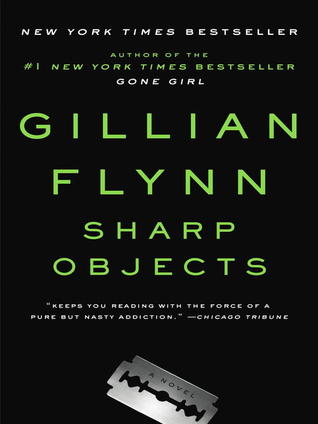
Sharp Objects by Gillian Flynn, which was our book club selection for August, is a suspenseful, twisted tale for a modern audience of Grimms’ fairytale lovers.  Camille Preaker is a mediocre reporter from a small paper in Chicago, and while her editor remains behind her 100%, he sends her home to Wind Gap — a place she has not visited in nearly a decade — to cover a couple of child murders.  Flynn’s style can be abrasive and abrupt, but it fits the mood of the novel well, instilling suspense and the right amount of creepiness.

“For no good reason, I held my breath as I passed the sign welcoming me to Wind Gap, the way kids do when they drive by cemeteries.  It had been eight years since I’d been back, but the scenery was visceral.” (pg. 7)

This small town has dark secrets, and these secrets are about to explode as Camille and the cop from Kansas City start poking around to find the killer.  Flynn’s narration is clipped and fast moving, and her characters are off-the-chain and some are surreptitiously evil.  Camille’s dysfunctional relationship with her mother is just the tip of the iceberg, and the more she sees about her step-sister’s life with their mother, the more disturbed she becomes.  Identifying with the young victims in the case she’s reporting on, Camille is falling down a dark rabbit hole that could possible swallow her whole.

Sharp Objects by Gillian Flynn is an train wreck that readers will be unable to look away from, but its graphic language and description could be a bit much for some readers.  Fans of Stephen King and other horror writers will find this novel as equally twisted.  As a debut novel, Flynn has clearly made a splash in this genre.

About the Author:

Gillian Flynn is an American author and television critic for Entertainment Weekly. She has so far written three novels, Sharp Objects, for which she won the 2007 Ian Fleming Steel Dagger for the best thriller; Dark Places; and her best-selling third novel Gone Girl.

Her book has received wide praise, including from authors such as Stephen King. The dark plot revolves around a serial killer in a Missouri town, and the reporter who has returned from Chicago to cover the event. Themes include dysfunctional families,violence and self-harm.