Quantcast

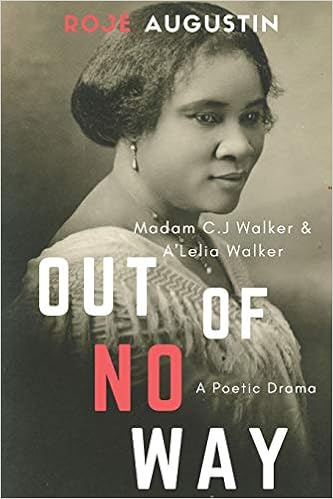
Out of No Way by Rojé Augustin

Source: Purchased
Paperback, 156 pgs.
I am an Amazon Affiliate

Out of No Way by Rojé Augustin, which toured with Poetic Book Tours, is a poetic drama that explores not only the complex woman of Madam C.J. Walker, but also her relationship with her daughter, A’Lelia Walker, who continues the Walker legacy. Sarah Breedlove, who became Madam C.J. Walker, was the first free born child to former Louisiana slaves. Her life was far from easy, orphaned at age seven and married at age 14, but she never let that stop her. She was determined to give her family a better life even as the obstacles like Jim Crow mounted and hatred were everywhere and out in the open. After years of back-breaking labor, earning very little, Madam C.J. Walker invented a hair care formula for Black women and she built an empire, training a number of women as sale agents.

“Out of No Way (which takes its title from an old saying in the African American community to ‘make a way out of no way,’ or to thrive against impossible odds)” (pg. xi)

This title is ever present throughout the poetic drama. It explores the mother-daughter relationship through not only narratives and lyrics, but also sonnets and haiku, elegies, and so many other forms. How can a daughter live up to her mother’s legacy — a mother who struggled to provide the best for her family and did little mothering? From “Le Wa. Ro,” “I became beautiful but bored, and now I find that my things do nothing to my shadows, they are merely sharpened and darkened and cast in high relief…” (pg. 12) Could she live in the shadow of the empire or would she break out on her own?

Augustin chronicles not only the mother’s building of her family and the business, but also the struggles of a daughter who feels abandoned by her traveling mother. “The Lost Letters, 1905-1908” are a testament to these struggles — “Forgive me if I sound hopeless,/It’s just so lonely in St. Louis.” (pg. 27)

Augustin’s poems go beyond the relationship of these two women, touching on the empowerment these women found in their own careers, building their own inner strength. Like in “Why Our Hair is not Straight,” Black women’s hair is not straight because they “curve while dancing” or because “we swirl with high hopes” or because “we bend in prayer.” These women needed to be flexible, to meet the obstacles and find a way around them. Although not always the best or ideal option, some choices left scars.

Augustin’s blackout poem, “Sculptures of Envy,” takes on advertisements for Walker’s hair care system to explore the envy felt by women everywhere when they see another with the appearance or the job they want and how appearance, and hair especially, is a must if women want the job. Black women are particularly held to a different standard. Each of the blackout poems in this section are very exploratory about appearance, envy, desire, and how Black women can take back their power through hair care.

Like the teachings of Dr. Martin Luther King, Jr., Out of No Way by Rojé Augustin explores how oppression harms not only the oppressed by the oppressor. Her words in “Resilience: Making a Way Out of No Way” (a fictitious speech by Madam C.J. Walker), “For the oppressed, the damage is self-evident. For the oppressor, it gives rise to a violent and divided society where the unbridled pressures of injustice rise to a level of self-destruction. White supremacy is the moral ignorance that will destroy America if left unchecked.” (pg. 90)

RATING: Quatrain

About the Author:

Rojé Augustin is a native New Yorker who grew up on the Upper West Side of Manhattan. Her first novel, The Unraveling of Bebe Jones, won the 2013 National Indie Excellence Award in African American fiction. She wrote the novel while living in London and Sydney as a stay-at-home-mom. She established Breaknight Films shortly after her move to Sydney in 2009 to develop and produce television projects across a range of formats, including television, web, and audio. Her first Sydney based project was a podcast and visual web series called The Right Space, which explores the relationship between creatives and their workspace. Rojé continues to work as a television producer while also writing in her spare time. She is an Australian citizen who currently lives in Sydney with her Aussie husband and two daughters.

Raising King by Joseph Ross

Source: Purchased
Paperback, 144 pgs.
I am an Amazon Affiliate

As in stated in the introduction to Raising King by Joseph Ross, Dr. King “knew racism disfigured the white people who used it. Thus, he focused his life in such a way, built on compassion, that his work might free both those who suffer from racism and those who inflict the suffering.” Throughout this collection, Dr. King’s compassion infuses each line, even though “the boat [the slaves were on] is dust./The whip//survives.” (“Martin Luther King, Jr. — Prologue,” pg. 9)

The backbone of these poems are Dr. King’s own words in Stride Toward Freedom, Why We Can’t Wait, and Where Do We Go From Here. Through Dr. King’s words and teachings, Ross has recreated a compassionate look at a man frustrated with a system of oppression, but determined to save his oppressors and the oppressed. “a lunch counter/become[s] an altar,” but only after significant training in nonviolence. (“Be Broken,” pg. 32-3) This compassion stems from the realization that many whites who oppress have inherited their hate (it’s what they know, all they know, how they were taught). In “Inheritance,” Dr. King’s voice rings true: “I will not/destroy him just because/someone taught him//to destroy me.//” (pg. 37-8)

Compassion is often seen as a weakness, but in reality it is the strongest weapon we have against barbarity.

Bomb (pg.40)

War is like this: two women,
a baby, a man gone, a man lost.

I was lost like this: a baby
in the back bedroom.

a wife shaking, unable to be
still. A friend, calm but about

to break.

A crowd gathered. I ran home
to see what was left of me.

The crowd was angry.
I wanted their anger 

to love my own. But my wife's
shaking stopped, keeping me

from breaking.

Keeping me from becoming
the bomb I feared.

It is compassion and empathy that strengthen our character and our ability to rise above the baseness of our human nature.”We have not been victorious//over anyone. We want to ride/beside everyone.” (“We Prepared,” pg. 49) The collection also includes commandments as Dr. King’s movement becomes more urgent, almost as though he knows that the opportunity for real change is fleeting.

Ross’s poems are still relevant to the struggles we continue to face, with “Sheet, Cross, and Flame” calling to mind some recent reactions by parties who have lost and continue to rage against those losses. But Dr. King reminds us in Ross’s poems “Manners and decency/reach down and pat us//on the head. This is/about me grabbing//your hand demanding/you ask my permission//before you touch me.//” (“Decency,” pg. 108) With Ross’s words and poems, Dr. King rises again and leads by teaching.

I’m so glad that my last book of 2020 was Raising King by Joseph Ross. It was a comfort to read these words and remember why I treat others with compassion when I can, especially when it is hard to do so. While we must “choose//never to throw them [stones]//at one another” (“Chaos or Community,” pg. 136-7), we also need to “Let the/bones//rest.” (“The Bones,” pg. 119)

RATING: Cinquain

About the Poet:

Joseph Ross is the author of four books of poetry: Raising King (2020), Ache (2017), Gospel of Dust (2013), and Meeting Bone Man (2012). His poetry has appeared in a wide variety of publications including The New York Times Sunday Magazine, The Los Angeles Times, The Southern Quarterly, Xavier Review, Poet Lore, Tidal Basin Review, Beltway Poetry Quarterly, and Sojourners. His work appears in many anthologies including What Saves Us: Poems of Empathy and Outrage in the Age of Trump, edited by Martin Espada. His poems also appear in Collective Brightness, Poetic Voices without Borders 1 and 2, Full Moon on K Street, and Come Together; Imagine Peace. He served as the 23rd Poet-in-Residence for the Howard County Poetry and Literature Society, just outside Washington, D.C. He is a seven-time Pushcart Prize nominee, most recently for “The Mountain Top,” from Raising King. His poem “If Mamie Till Was the Mother of God” won the 2012 Pratt Library/Little Patuxent Review Poetry Prize. As a teacher and writer, Ross was awarded the University of Notre Dame’s Reinhold Niebuhr Award in 1997 and the William A. Toohey, C.S.C. Award in 1993. In 2006, he was awarded Teacher of the Year by the senior class at Carroll High School in Washington, D.C. In 2020, he delivered the Robert L. Giron Global Humanities Lecture for Montgomery College, Takoma Park, Maryland. The lecture was titled: “Literature Consoles and Confronts: When Poetry Is a Tool for Justice.”

Check out the Gaithersburg Book Festival Panel discussion with Joseph Ross, Tara Campbell, Kim Roberts, and E. Ethelbert Miller:

The Year of Magical Thinking by Joan Didion (audio)

Source: Purchased
Audiobook, 1+ hours
I am an Amazon Affiliate

The Year of Magical Thinking by Joan Didion, narrated by Vanessa Redgrave, is an adaptation of Joan Didion’s memoir of the same name. It has been transformed into a one-act play. The devastation felt by Didion is immense but the undulating way in which this story is told is as disjointed as her emotions must have been during this time in her life, losing a husband and daughter. This shattering loss propelled the author into a world of magical thinking.

There’s an examination of marriage and its push and pull and the motherly promise that you’ll never leave your child. There is that magical thinking that your own motherly focus can keep things moving forward into the future as you’d like them to be.

Redgrave is the perfect narrator for this play. Her voice lulls you into the story and breaks your heart when Didion’s is broken. But Didion’s narrative is also very factual and linear in some parts. I honestly think this is probably best viewed as a play, rather than on audio because my mind would wander away from the story when it was a bit too clinical. I might read the memoir at a later date.

RATING: Tercet

Music for the Dead and Resurrected by Valzhyna Mort

Source: Publisher

Hardcover, 112 pgs.

I am an Amazon Affiliate

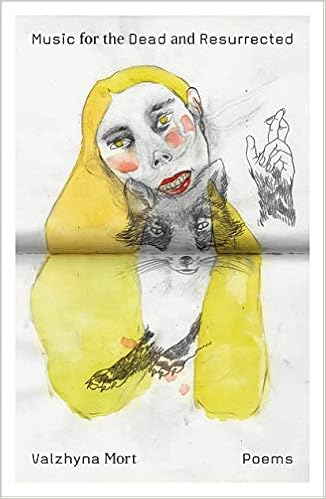
Music for the Dead and Resurrected by Valzhyna Mort is a collection of poems that raises the dead in a new language of verse that recalls the past, including Antigone, and mingles it with more modern history in Belarus. This is a collection that hinges on history and the language of the past and present to create a new language and shared history. Mort’s verses recall the dead in the most beautifully grotesque ways. In “To Antigone, a Dispatch,” “My guts have been emptied/like bellows/for the best sound.//” In this poem, she imagines Antigone as her sister, a life in which death has become something that is an every day thing with bodies buried in hillsides and grave markers in abundance.

Mort’s poems call to the lost men whose “bodies” become “their graves” and the women whose dresses are torn from them and worn by Aryan women in “Singer” (pg. 41) The horrors are laid bare and the larger questions are left in the sound, waiting for answers that never come. “What could a tongue remember after loss and hunger?” (“Music Practice,” pg. 43-45)

Music for the Dead and Resurrected by Valzhyna Mort is lyricless song played on a breathless accordion, calling to the dead and those she wishes to resurrect/breathe life into again. She’s calling not only our attention to the sorrow and grief of her country, but to the loneliness we, ourselves, can cure through song and memory. Our memories may be imperfect and altered truth, but we can sing them and resurrect those we miss most. Mort cautions that in this process “borders spill.” (“Music for Girl’s Voice and Bison,” pg.81-92)

RATING: Quatrain

Poetry Reading Challenge 2021

In 2020, I read 21 books of poetry and listened to one collection on audio. Some were published last year, but some were languishing on my bookshelf for no good reason. All of these books were 4 and 5 stars.

I think last year’s challenge went well, so the options will remain the same:

  • One of the easiest, and possibly most difficult, will be getting people to sign up to read a poem-a-day through the Academy of American Poets Poem-a-Day service. The challenge is to read a poem-a-day for a week once per month and write about which poems were your favorite and why. You can write up a short blurb on your Facebook page, Twitter, Instagram, or your blog. I’d love for you to share your experience in the comments each month.
  • Second, read at least 1 book of poetry (doesn’t have to be cover-to-cover) and write about your favorite poems and what you learned about yourself while reading those poems.
  • Third, if you want to go all out, feel free to read as many books of poetry as you can in one year and link to your reviews in the comments.

If you accept one of the options or the whole challenge, leave a comment with where you will be posting about your year in poetry.

If you want to leave your blog link, sign up in a post and leave your blog URL to your post below:

Don’t forget to grab the image!

Who’s Your Daddy by Arisa White

Source: the poet

Preordered book, 138 pgs.

I am an Amazon Affiliate

Who’s Your Daddy by Arisa White, on tour with Poetic Book Tours, is a poetic memoir in which the poet explores the absence of her father in her life, how it has impacted who she has become, and how she can reconnect with her absent father in adulthood.

“When it came to the conjunction “and” I was illiterate. For it makes you larger, more. Expands into distances beyond my eyes.” (pg. 124)

White articulates deftly the nuanced feelings of a desire to belong and the sense that belonging requires the reconnection with an absent father. While she has others in her life who love and care for her, there are traumas that she faces while her father is absent. But reconnecting with a man ejected from the United States and back to Guyana and who fails to even write a letter or call her is a tall order.

“Am I a site of abandonment?” (pg. 97)

“Guyana is abandonment from my father. I feel the weight of the people in me and I in them, guilt I carry myself alone.” (pg. 108)

The poetic memoir begins at home in the United States, as Arisa grows up in a broken home, a home of harsh realities. These realities are not my own, but this collection creates a palpable reminiscence of sorrow, anger, confusion, absence, and more. Despite these trials and her struggles with connections, she is a strong woman — caring for herself, willing to reach out to someone who abandoned her, and seeking self-care and healing.

What she finds in this journey is a man incapable of giving her a sense of belonging — a man who rambles just to hear himself speak, to make him relevant to those who hear him.

“Breaks my heart along the same fault lines that ache for him.” (pg. 83)

Who’s Your Daddy by Arisa White is a journey into the poet’s past as she reconciles the abandonment of her father and her struggles with connecting to others. The poetic memoir is beautiful and the landscapes within it (emotional and physical) are tumultuous and heartbreaking. White is a deft storyteller, and readers will be emotionally spent by this poetic memoir.

RATING: Cinquain

Follow the rest of the blog tour with #WhosYourDaddyMemoir #ArisaWhite

Photo Credit: Nye’ Lyn Tho

About the Poet:

Arisa White is a Cave Canem fellow and an assistant professor of creative writing at Colby College. She is the author of four books, including the poetry collection You’re the Most Beautiful Thing That Happened, and coauthor of Biddy Mason Speaks Up, winner of the Maine Literary Book Award for Young People’s Literature and the Nautilus Book Award Gold Medal for Middle-Grade Nonfiction. She serves on the board of directors for Foglifter and Nomadic Press. Find her at arisawhite.com.

Nerdlet: Animals by T J Resler

Source: Media Masters Publicity

Paperback, 216 pgs.

I’m an Amazon Affiliate

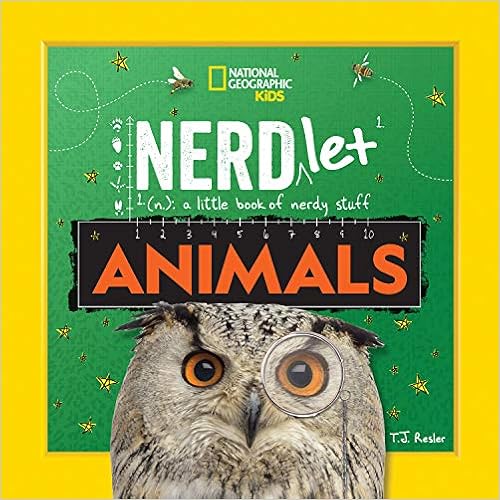
Nerdlet: Animals by T J Resler is another fun and fact-packed book for kids to learn about the animal kingdom. The book includes some fun and unusual facts about animals, including spiders (which we are not too fond of). The pictures are gorgeous as always. Even though we’ve seen some of these animals in other books before, this little gem includes some quirky and fun facts about these animals. You’ll learn about why lemurs sit up and stretch their arms wide and how the cute faced platypus can be dangerous.

One of our favorite parts of the book are quizzes that you can take to find out what superhero you are based on animal characteristics, what species of fox you are based on how you like to play, and what kind of pet is best for you. These are the types of quizzes we love to take and enjoy as a family. We learn how we’re similar and different, but sometimes the choices are hard, especially for my daughter who definitely wanted the pet quiz to demonstrate to her parents that she was best suited for a pet cat.

Nerdlet: Animals by T J Resler can be read together as a family or dipped into occasionally on your own. What we love is that this is a book for sharing. We love animals and this is definitely something we’ll enjoy on more than one occasion. The only thing we wanted more of were those quizzes. We had a blast with those and would have liked at least 3 or 5 or 10 more. A good gift for the animal lover in your life.

RATING: Quatrain

Greenlights by Matthew McConaughey (audio)

Source: Purchased

Audible, 6+ hours

I am an Amazon Affiliate

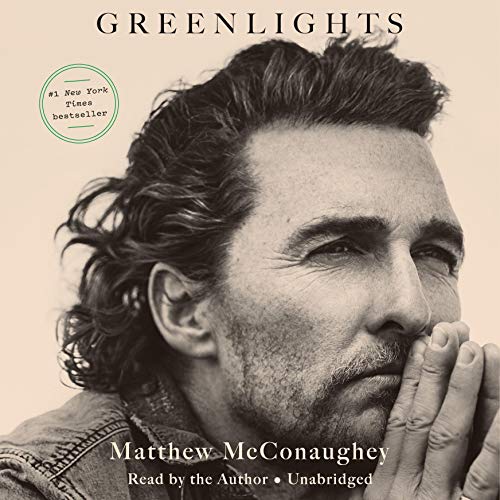
Greenlights by Matthew McConaughey, narrated by himself, is a look at his 50 years of life and his outlaw code and how he’s lived his life and what he’s learned by living it. If you’re looking for gossip, this is not the book for you. I did like his approach to Hollywood and rebranding himself as an actor — that was definitely a risk and it panned out for him.

His career is one of luck, perseverance, hard work, and self-examination. Unlike many people, he pauses to think about where he is in life and analyze why he feels stagnant or unsatisfied when he seemingly has everything he could ever want. Like those of us who strive to learn and grow, he pauses to examine his life and make changes he thinks will lead him where he wants to go. As he says, sometimes there are red lights in life and sometimes there are yellow and green lights — he notes that a red light at one point in your life might turn green eventually later on. You have to be aware enough to know why the lights are red, move forward and return to those lights to see them turn green when it is the right time.

His early years with his family and his stay in Australia were very eye opening and I can say I applaud him and his upbringing for tolerating that Australian family like he did. I think I would have lost it. He does include some “prescriptions,” bumper stickers, and poems. These are what he considers some insightful advice, which it could be for those who haven’t experienced these teachable moments or who need something to articulate what they’re feeling in a succinct way. It seemed like he was shouting these sections at you in the audio, which got more obnoxious as I listened (but it might be less annoying if you don’t listen to it too long in one sitting). My one main issue here is people will probably take this as life lessons for them, and these will not work in every day people’s lives because they have obligations that are bigger than these seemingly easy fixes he talks about.

Greenlights by Matthew McConaughey is a series of stories that are likely a bit inflated (at least one had to be hyperbole). It was entertaining, but not life affirming or life changing. And while the stories are fun and sometimes outrageous, they are by no means that deep and tell us little beyond what we know about McConaughey and his “outlaw” look at life. I use the “outlaw” term very loosely here. Judging on his performance alone (which was stellar) would be a disservice to the content. I do admire his self-awareness, and that’s something others should take note of and try to incorporate into their lives.

RATING: Tercet

African American Poetry: 250 Years of Struggle and Song edited by Kevin Young

Source: NetGalley

Ebook, 1170 pgs.

I am an Amazon Affiliate

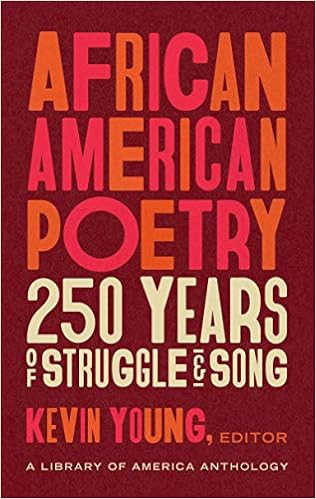
African American Poetry: 250 Years of Struggle and Song edited by Kevin Young is a compendium like no other, exploring the wide breadth of African American poetry from songs to poems and much more. There are eight sections in this collection and there are the familiar, often anthologized poems we’ve come to know, but there are also the unfamiliar poets who have been obscured by American culture for far too long. The struggle is real and it continues 250 years later, and it will likely continue into the next several decades (I’m being optimistic — I would like to see less struggle sooner).

“For African Americans, the very act of composing poetry proves a form of protest,” says Kevin Young in the introduction. From Phillis Wheatley and Lucy Terry, whose untitled poem “Bars Fight” was first composed orally and shared for generations before being in print, to the present day poets, Young says the collection covers those who experienced bondage first hand, modernist movement, the Harlem Renaissance, the Chicago Renaissance, wartime and postwar poets, Beat poets, political poets, poems about ancestry, and so much more. Young says the collection contains “poems we memorize, pass around, carry in our memory, and literally inscribe in stone.” Folk songs, ballads, and poems that have never been published. You can imagine the treasure trove within these pages.

Normally, I would share excerpts from this collection but I prefer that you discover these for yourself. I want you to journey into the African American Poetry: 250 Years of Struggle and Song edited by Kevin Young on your own without preconceived notions of what you’ll find there. There is so much more than Langston Hughes. This is a collection that should be brought to classrooms as young as elementary schools. These are the poems and truths that need to be taught so that we can learn from the past and move forward as a nation to a brighter future.

RATING: Quatrain

Heart-Shaped Box by Joe Hill (audio)

Source: Purchased

Audible, 11+ hours

I am an Amazon affiliate

Heart-Shaped Box by Joe Hill, narrated by Stephen Lang, is a ghost story from the beginning to the end, but Judas Coyne (formerly Justin Cowzynski) is an unlikable character with a penchant for collecting macabre items. This penchant is what gets him into a big mess — all of his sins come to roost as he battles the unseen man tied to a suit he buys online in a heart-shaped box. He has effectively retired from public life after his bandmates have either killed themselves or died, but little else has changed with his life — still moving from woman to woman and collecting oddities on the underground web.

Lang is a decent narrator no matter the character and he has the timbre to create a creepy atmosphere.

Jude and his latest woman (like all his women are called by their former state of residence) find that they are locked together in a battle against a ghostly man who is out for revenge. It’s clear this ghost hasn’t had a lot of practice with revenge from beyond the grave, but Jude gets some help from his former girlfriend who has been dead for some time. Heart-Shaped Box by Joe Hill, narrated by Stephen Lang, is a dark tale of beyond-the-grave revenge.

RATING: Quatrain

Chaos Theories by Elizabeth Hazen

Source: the poet

Paperback, 88 pgs.

I am an Amazon Affiliate

Chaos Theories by Elizabeth Hazen is a collection of poems that explore the spiraling, out-of-control nature our lives can sometimes take on and how to cope with that chaos and uncertainty. It’s a collection for the current times in that it provides us with a look at life amidst uncertainty, albeit unrelated to COVID-19. Through the art of words and the certainty of science, Hazen strikes into new frontiers with her poems, exploring divorce, motherhood, the turbulent nature of emotions. In “Chaos Theory,” Hazen establishes the unstable ground of these poems by grounding it into a personal moment of “rage [that] comes out of nowhere — the glass explodes/when it hits the wall, as physics says it must,//” (pg. 3)

Ghosts haunt in “Ghost Story” but are they just voices in the narrator’s head spilling her secrets? But the secrets won’t stop just because there are three or four fingers of warm liquid in the glass. Hazen calls us to face our own ghosts head on, not to dull the sharpness of their criticisms or their secrets. To understand the chaos, we must all start from the beginning. “…and no matter what you tell/yourself tonight, no matter what you tell//yourself in twenty years, you are still there,/” (pg. 10, from “Girls at the Bus Depot”)

Hazen’s poems are like an archeological dig, an excavation of the self. In “Extraction,” the narrator says, “…A body holds more mysteries/than the mouth can bring itself to speak./” It’s true that when we’re young and sometimes as we age, we don’t really know our true selves, unless we’ve taken that time to delve deep into who we are, what our desires may be, and what we’re passionate about. It is a journey we must take on our own, but also one that must be done. Without it, we can be lost and make many harmful and wrong decisions.

There are many losses along the way in our journeys, as we search for the truth of ourselves, but those losses are memories that can be recalled with the slightest scent or picture. “or a room holds the vibration of a voice,/a person’s scent, long after he has gone.” (pg. 43, “The Spectroscope”) While loss can be sad and make us feel empty, there are those losses that can bring joy at the happiness some moments held, like uncovering trilobites in the soil.

Chaos Theories by Elizabeth Hazen warns us not to get too caught up in the loss and the memories — “My memory is a haunted house that will/not let me leave.” (pg. 44, “When I Was a Girl”) We must learn to break free from the chaos — sometimes self-created — to find the right path, the calm, and the joy we all seek. At the heart, we’re all working against nature and the passage of time, like the house in “Erosion.”

RATING: Quatrain

Other Reviews:

About the Poet:

Elizabeth Hazen is a poet, essayist, and teacher. A Maryland native, she came of age in a suburb of Washington, D.C. in the pre-internet, grunge-tinted 1990s, when women were riding the third wave of feminism and fighting the accompanying backlash. She began writing poems when she was in middle school, after a kind-hearted librarian handed her Lawrence Ferlinghetti’s A Coney Island of the Mind. She has been reading and writing poems ever since.

Hazen’s work explores issues of addiction, mental health, and sexual trauma, as well as the restorative power of love and forgiveness. Her poems have appeared in Best American Poetry, American Literary Review, Shenandoah, Southwest Review, The Threepenny Review, The Normal School, and other journals. Alan Squire Publishing released her first book, Chaos Theories, in 2016. Girls Like Us is her second collection. She lives in Baltimore with her family.

Whale Day by Billy Collins

Source: Purchased
Hardcover, 144 pgs.
I am an Amazon Affiliate

Whale Day and Other Poems by Billy Collins often takes the most mundane situation and spirals it out into something that is by turns humorous and poignant. Aging is a theme throughout the collection, but it is not aging with grace, but with a sense of humor. Imagine your aging dog and walking them down the street, how the gait of the dog changes and how the dog stops to be picked up by the owner rather than continue under its own power. This is exactly the situation in “Walking My Seventy-Five-Year-Old Dog.” Collins takes this situation and reminds us that it isn’t polite to ask a lady her age (a bit tongue in cheek), reminding us that to age is a normal course of life that we need to observe but not dwell on.

Other humorous poems that made me laugh (at a time when a pandemic has made us all stressed and sad) include “Down on the Farm” with its fainting goats, “Imperial Garden” in which a Chinese cookie fortune says less about the recipient than the giver, “Mice” where the observer views the burning down of a house as a new adventure for his small friends, “The Card Players” in which he compares his current game to a Cezanne painting and realizes his game may not be as artful, among so many others.

One of the most selfish statements, “Me First,” is turned on its ear in this collection and becomes a moment of love, while still being a little bit selfish but understandable given the attachment of the narrator to the object of his affections. Like “Anniversary,” there is a selfishness in wanting the “love” to remain alive for as long as possible, even if that life is lived by a baby born on the person’s day of death. The final section of the collection is a homage to devotion and love, even as things begin to fade away like the “tear-off calendars,/the days disappearing one page at a time.//” (from “My Father’s Office, John Street, New York City, 1953”, pg. 103-107)

Collins’ latest collection is one to keep on the shelf for always. His conversational style is dominant here, and his poems will leave readers with joy and hope, but also more things to think about. Whale Day and Other Poems by Billy Collins is another splendid collection of more than just ordinary moments in time and it explores the effects of aging and how we can handle them if we choose to be less serious.

RATING: Cinquain

Other Reviews:

About the Poet:

Billy Collins, is an American poet, appointed as Poet Laureate of the United States from 2001 to 2003. In 2016, Collins retired from his position as a Distinguished Professor at Lehman College of the City University of New York after teaching there almost 50 years.