Quantcast

Field Study by Chet’la Sebree

Source: Publisher
Paperback, 176 pgs.
I am an Amazon Affiliate

Field Study by Chet’la Sebree reminds me of those scientific notebooks kept by scientists in the field who are observing animals or others as they take notes. Peppered with quotations from bell hooks and many others, Sebree explores Black female identity and sexual desire. The poem is less like a poem than a list of observations and comments on Black identity and female desire.

Black women and girls face additional burdens of protecting the reputations of black boys and men. -- Tressie McMillan Cottom
My secret ... I'm always angry. -- Bruce Banner
 ___________

And why wouldn't I be?

In addition the female desire and the struggle of Black women who love and are attracted to white men, Sebree voices some of the issues she’s found in the Black community — how the community does not address mental health enough.

In my early twenties, I worked on an epistolary series.
I didn't know I wrote a book-length suicide note.
I titled it And If I Die Before I Wake.
A prayer and a promise.
__________

I'm alive; I'm alive; I'm alive.
Cry it with me.
It doesn't always feel like it, but it's a good thing.

Sebree has created a poetry collection in which mental health is entwined with Black female identity, the racial tensions that women feel from all sides, and the responsibility they have to project a sense that they are indeed whole. “No matter how far I go, there is never enough makeup for the bullet hole.” Field Study by Chet’la Sebree, which publishes in June, worries and rationalizes and assesses herself like a scientist. Her observations are keen and deeply probing, and she doesn’t let up on herself. This is a frank look at one woman’s struggle with desire and identity, but it has universal applications to others in all communities — less judgment and more love. Definitely not your typical, confessional poetry collection — it’s much more.

RATING: Quatrain

In the Lateness of the World by Carolyn Forché

Source: Publisher
Paperback, 96 pgs.
I am an Amazon Affiliate

In the Lateness of the World by Carolyn Forché is a tapestry of human history that traverses time and place, and it calls upon the reader to take in the totality of history. This includes the moment of now, as well as all the past moments that make up the “now” and the world as it is and how it was envisioned. Forché has created a collection that looks back on the totality of moments so that we can see everything at once.

From “Water Crisis” to “Report from an Island,” her poems look at the crises humanity faces, losses of clean water, pollution of our seas by plastic, and those who are forced to live in trash piles. “This work is slow,” the narrator of “Report from an Island” says. Time always seems to move slowly and progress can be even slower.

From real-world issues, these poems spin the folklore of individuals. The stories of who we are or were can be lost to the ravages of time. In “The Lost Suitcase,” Forché says, “Here are your books, as if they were burning./Be near now, and wake to tell me who you were.//” Many of her poems build these stories from ash and memory. We walk the streets of a city under siege: “Turning the pages of the book you have lent me of your wounded city,/reading the braille on its walls, walking beneath ghost chestnuts/past fires that turn the bullet-shattered windows bronze,/”

One of my favorite poems is a tribute to the late Larry Heinemann, author of Paco’s Story, (I still miss our FB conversations) and his fellow veterans, Kevin Bowen, Bruce Weigl, Nguyen Ba Chung, “Hue: From a Notebook,” which pays tribute to the past, their present, and their ghosts.

We went down the Perfume River by dragon boat
as far as the pagoda of the three golden Buddhas.

Pray here. You can ask for happiness.
We light joss sticks, send votives downriver in paper sacks,

then have trouble disembarking from the boat.
Our bodies disembark, but our souls remain.

A thousand lanterns drift, a notebook opens in the dark
to a page where moonlight makes a sound.

These soldiers are decades from war now:
pewter-haired, steel haired, a moon caught in plumeria.

We are like the clouds that pass and pass.
What does it matter then if we are not the same as clouds?

There was then the whir of stork wings, and bicycle chains ringing.
It is still now the way the air is still just before the mine explodes.

Once we fired at each other. Now we pass silence back and forth.
On the ten thousand graves, we lay chrysanthemum.

Forché’s poems are powerful in the silent and calm voice she uses to speak about the “lateness” of the world. When we come to the end of a life, who hears those memories, those echoes of the past? Is it in the breeze? Is it in the smell of the flowers? Is it in the books and stories we tell? In the Lateness of the World by Carolyn Forché is our tapestry, and it grows larger each day.

RATING: Quatrain

Emerge by Francesca Marais

Source: Poet
Hardcover, 25 pgs.
I am an Amazon Affiliate

Emerge by Francesca Marais is a chapbook about learning to let go of our angst, anxiety to learn to trust our selves to be us without worry. Marais’ water imagery calls to mind the tumultuous waves and stormy seas we can face, but also the gently lapping waves that can cradle us into calm. In “Bookworm,” the comfort of books “We could safely escape/Rattling instability,/Where our safety and fears/Were in our own hands.//” In this image, the poet reminds us that our own hands are where our safety and our fears reside. We may not always be in control of our emotions, but we can be and learn to trust ourselves.

Moving to “Inheritance,” the poet weaves in generational passage of traits from one generation to another and that there is a lineage we pass along without knowing it. “He sees them bloom amidst their agony–/Their ability to prevail, his joy./In the smiles of his children,/He sees the youth he once knew/And how it continues in them–/”

Marais’ poems teach us to breathe, learn how to be calm and observe and live. Emerge by Francesca Marais is a journey and one we all embark on at some point in our lives. Gather your own power from the darkness and the trials of your life, emerge from the ashes.

RATING Quatrain

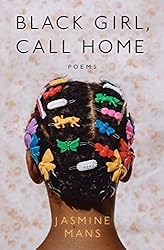
Black Girl, Call Home by Jasmine Mans

Source: Publisher
Paperback, 256 pgs.
I am an Amazon Affiliate

Black Girl, Call Home by Jasmine Mans is a collection of poems that explore mother-daughter relationships, identity, and the racism many Blacks face every day. There are so many moments in this collection where your heart will break, just as the relationship between mother-daughter breaks. The narrator of these poems struggles with who she is and how to reconcile that with her mother’s disappointments about that identity.

In “We Host These Variables,” she says, “There’s something I want to honor here. I/ want to honor the silent story, the emotions/unaccompanied by human language. I want to/honor the weight of stillness. I want to/honor the silent ceremony between mother/ and daughter.” In this poem she explores the silence that become tense between mother and daughter because they are mirrors of one another. Later, she says, “I know the/distance between mother and daughter. How/we are many burned bridges, as well as a/wealth of brick and clay, ready to be made/anew from everything unmade of us.”

Mans explores the harsh history facing Blacks — women who get the worst part of it all. Men with the dreams, but the women who bear the burden of those dreams. One of the most powerful poems in this collection that brings this history to the forefront is “Nerf Guns: Christmas 2019 Tulsa” where the past and the burdens of racism are never far away. “The/only way a bullet becomes laughter is when it/plays pretend in its own foam shadow./” In this poem, little boys play with nerf guns and play dead and the narrator was never allowed to until she was grown and playing with her cousins. She realizes the ironies and implications of this game, while her cousins do not. “My father knew death too well to let us mimic it. Or, maybe death mimicked us too well for him to allow it’s ‘pretend’ in his house.” She wraps “herself in/that joy. The joy that nothing spilled of them/but the sound of their own silly.”

Black Girl, Call Home by Jasmine Mans is a journey of identity and learning how to cope with the past to bring oneself into the future. There are truths in this collection that shouldn’t be shied away from, especially for Black men and women. We need these stories to remind us that we can do better. “I know trauma uses silence as a survival mechanism.” Let’s break that cycle and break that silence.

Rating: Cinquain

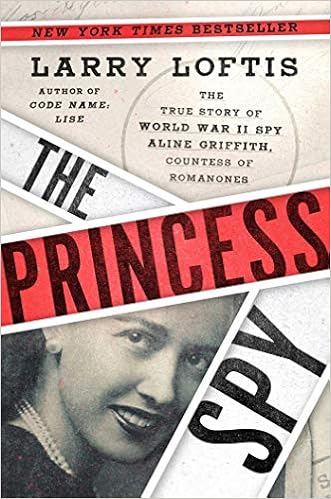
The Princess Spy by Larry Loftis

Source: Publisher
Hardcover, 384 pgs.
I am an Amazon affiliate

The Princess Spy by Larry Loftis takes another look at Aline Griffith, a small town girl looking for big adventure and to serve her country. Loftis uses source material from the National Archives, Griffith’s own fictionalized accounts of her time as a spy with the Office of Strategic Services (OSS), and many are source materials to suss out the truth of her time as a spy. Aline was a model who trained to be a spy at The Farm and her own accounts of her exploits are likely to have been embellished because as publishers will do, they want to sell books and car chases, murders, and more sell books. While Aline may have wanted to recount her life honestly, other marketing experts were at play and Loftis strives to piece out what was true from those accounts with secondary sources. I also think some people have a glamorous view of spies and what they do (e.g., James Bond), and the reality is much more mundane and nuanced — it’s about building trust and relationships that can be leveraged for information.

Was Loftis successful in finding the truth? For the most part, he did his best based on what was classified and what isn’t any longer. What I loved about Loftis’ narrative is that it read like historical fiction, and I think with any book based on research there’s a tendency to be too dry in the narrative. Because he chose to narrate it more like a novel, it was easier to eat up the pages and get engrossed in Aline’s story. Her time at The Farm was fascinating, and some may wonder why her family wasn’t in the book and asking about her whereabouts, etc., but I think it’s clear that when you become a spy and have a cover story, the family must accept it as truth and you make sure that they do. Adding those conversations would have bogged down this narrative.

Being part of the OSS coding room in Spain (considered neutral in the war) to send information to the U.S. State Department during WWII is not a glamorous job but no less important than being a spy. She spent much of her career in that room, but she also attended parties, social events, and had a semi-romance with a bullfighter. When she finally became a field agent, it is clear that all those parties and social events she was invited to opened the door for her career because she was in places where she could probe without drawing attention and could overhear conversations that might be of importance with regard to Nazi movements.

Loftis also creates a wider link between espionage and the Spanish bullfights. Like the matador, Aline lures her targets closer to her with the hope that she can evade capture, jail, and death. She’s weaving her spell on the crowd around her and she’s masterfully moving her cape to lure the bulls and create an illusion of a career woman learning about her current home — Spain. It probably helped that she was genuinely captivated by the Spanish culture.

The Princess Spy by Larry Loftis is engaging, thrilling, and insightful, and he provides a great deal of information about the spy business (but I’m not an expert). I do think there are holes and gaps that could be filled, and I would love to know more about her time doing “odd jobs” for the CIA after her marriage and her life in Spain was in full swing, but alas that information is still classified (my guess is it had a lot to do with preventing communism’s spread). Aline Griffith served her country with honesty and dignity, and she enjoyed doing it, even if she was in danger. She clearly was a people person and the relationships she maintained throughout her life are a testament to her personality and care for others. Loftis has humanized a spy who believed her efforts helped the country during WWII, but I’m still curious about some of the characters in her life like Pierre and Ryan (two figures who are much more mysterious — perhaps there’s a fictionalized account of them in Loftis’ future).

RATING: Quatrain

Review & Giveaway: The Lamps of History by Michael Sandler

Source: TLC Book Tours
Paperback, 98 pgs.
I am an Amazon Affiliate

The Lamps of History by Michael Sandler explores the human condition and our struggle to grapple with our own mortality. Sandler begins the collection with just that concept in “Gauze” where the narrator has surgery and as he goes under from anesthesia “Now breathe deeply, and I vanish,/a plastic wristband flashing Vacancy/” (pg. 9) There is that fear, especially as we age, that our lives will vanish and our bodies will be cast aside as empty shells.

It is easy for us to foster a myopic point of view — “Isolation arrests a point of view” (“Lighthousing”, pg. 19) But on occasion, changes in our view can help us see the best, like in the title poem, “Lamp,” where amber light can dull the anguish of the past. From bullying to loss, Sandler tackles many of the trials of the human condition, rooting his poems in recipes, family tradition, and advice from his father. While not all of these moments prevented sadness, anger, or loss, the narrator looks back on how each represented the care and love of family — a foundation that strengthened over time even as those family members passed.

from "Garlic Press" (pg. 44-45)

until desire flashes again.
What keeps drawing me to those blades?
When the ensuing sight of blood
subverts a show of nonchalance.
I try to take a firmer grip,
one more inexorable squeeze.

Sandler explores desire and how it draws us to things that may not be good for us. In the same collection, “Cenobite” explores shyness and antisocial behavior as the narrator walks in a dog park and finds that he’s unlike the social dogs, standing apart he fails at small talk and interacting. He needs to force himself to try to move beyond his neutral ground apart. There is a peace in aloofness and a camaraderie that can be found with animals alone.

The Lamps of History by Michael Sandler is about the human condition in all of its stripes of good and bad, memory and action. Sandler’s use of science, science fiction, and photographs helps to illustration of struggle, perseverance, and peace with what has come before and what awaits the future.

RATING: Cinquain

About the Poet:

Michael Sandler is the author of The Lamps of History, a poetry collection that explores connections between personal and historical experience while wrestling with the ambiguities (and choices) between connection/estrangement and faith/doubt. For much of his adulthood, Michael wrote poems for the desk drawer, while working as a lawyer and later as an arbitrator. He began to publish in 2009. Since then, his poems have appeared in scores of literary journals including Arts & Letters, Valparaiso Poetry Review, and Zone 3. He lives in the Seattle area. To learn more about Michael and his work, please go to sandlerpoetry.com.

GIVEAWAY: 1 copy of The Lamps of History

Leave a comment on this post about why you want to read the collection and an email where I can reach you by March. 8.

White Fragility by Robin DiAngelo (audio)

Source: Purchased
Audible, 6+ hrs.
I am an Amazon Affiliate

White Fragility: Why It’s So Hard for White People to Talk about Racism by Robin DiAngelo, narrated by Amy Landon, takes a sociologists’ approach to race (which does involve generalizations). White Americans must remember that we are products of our socialization and culture, and no aspect of society lies outside the forces of racism, even if you come from a mixed-race family, had ancestors who were once discriminated against (Irish, Italian, etc.), or experienced poverty, etc. The trick is not to see our unique experiences as making us exempt from racism but to see how those experiences shaped who we are within a racist society and to see the larger picture of how racism impacts others. Secondly, she says we need to redefine the term “racist” — we’ve been taught that racists are immoral and mean and that they consciously hate/oppress others based upon their race. However, this assumption is a societal definition propagated by a racist society. White people need to first examine what it means to be white and what that has brought them in society and cost others — this examination will be a struggle for many.

Superficial differences between races and genders are a result of geographical location and evolution, but biologically we are all the same. The race construct is just that – made up. White supremacy has taken that construct and divided resources based on a false hierarchy, hence the accessibility gaps for non-white groups and non-male groups. Many of these discussions are ones I’ve had before in college with courses and other groups — open dialogue is essential about things that are not “fact” even though they were credited as such. She does touch on exploitation as the catalyst for racism (I would read Stamped From the Beginning for more on this).

Imagine going to court to proclaim you are white because you were misclassified as another race! This actually occurred and scientific experts were called into these cases to provide “expert” testimony. DiAngelo indicates that those European immigrants are the only ones who were successful in becoming “white” after assimilation, etc. Assimilation — think about that — casting aside their customs, speaking English only, and eating only American foods, etc. Those assimilated people now benefit from their whiteness. DiAngelo also points out that if poor and working class Americans across all “races” worked together – they could become a powerful force against the upper “white” classes. However, many perceived as “white” also tend to look down on other poor and working class peoples because of their “whiteness” and the system that oppresses them both. The irony!

“Scholar Marilyn Frye uses the metaphor of a birdcage to describe the interlocking forces of oppression.16 If you stand close to a birdcage and press your face against the wires, your perception of the bars will disappear and you will have an almost unobstructed view of the bird. If you turn your head to examine one wire of the cage closely, you will not be able to see the other wires. If your understanding of the cage is based on this myopic view, you may not understand why the bird doesn’t just go around the single wire and fly away. You might even assume that the bird liked or chose its place in the cage.

But if you stepped back and took a wider view, you would begin to see that the wires come together in an interlocking pattern—a pattern that works to hold the bird firmly in place. It now becomes clear that a network of systematically related barriers surrounds the bird.

Taken individually, none of these barriers would be that difficult for the bird to get around, but because they interlock with each other, they thoroughly restrict the bird. While some birds may escape from the cage, most will not. And certainly those that do escape will have to navigate many barriers that birds outside the cage do not.”

We all have prejudices (it is the way our brain operates) or a sense of discomfort around certain people or groups — acting on those prejudices is discrimination. Racism is a structure (white supremacy) and we need to remember that we have a role to play in that structure. We need to learn to recognize our prejudices and work toward not acting on them and dismantling the structures that employ discrimination against groups different from white males. This is a tall order because many of these ideologies are reinforced in our daily lives.

One notion that came to mind, however, is the “kafkatrap” by which an accused is guilty by merely being silent. Many of us are silent, many of us fail to stand up and point out discrimination (even subtle discrimination), and does this mean we’re all complicit in racism? While this may be true, I prefer less circular arguments and prefer that we work as a human race to improve our systems for all of us. THIS will require us to have discomforting conversations and require actions that run counter to our normal daily actions. It will require us to reform and dismantle white supremacy. We’ll need to widen our view of history, particularly in schools, to acknowledge both the good and the bad, highlighting those who have exploited and committed racism to obtain the upper economic hand, among other things.

My only complaint is that DiAngelo was very repetitive toward the end. She would bring up examples she already used and talk about them again in the same manner she did in the previous chapter. I wouldn’t have noticed it as much if it wasn’t back-to-back repetition. Perhaps she believes repetition will stick with readers more and help them to see the situations she discusses in a new light. I’m unsure.

White Fragility: Why It’s So Hard for White People to Talk about Racism by Robin DiAngelo, narrated by Amy Landon, asks us to recognize our faults, work to fix them, and to question ideologies that are considered the norm. There is much work to do. Challenging racism starts with recognizing your own prejudices and being conscious of how to modify/change your reactions and behaviors going forward. This is a very academic look at racism, which some may find too high-brow for them. Racism is real and present today (across the globe) — it is not a thing of the past, and we need to tackle it head on and in a multitude of ways. While some of her arguments are circular, she provides a good overview of racism in today’s society and the reactions that white people have when confronted with its subtleties.

RATING: Quatrain

The Last Tree by Emily Haworth-Booth

Source: Media Masters Publicity
Hardcover, 32 pgs.
I am an Amazon Affiliate

The Last Tree by Emily Haworth-Booth will remind readers of The Giving Tree by Shel Silverstein and The Lorax by Dr. Seuss, though here the tree is not personified, there is no Lorax, and the messages are very clear cut. In Haworth-Booth’s book, the focus is on the group of villagers who are seeking a place to live — the desert too hot, the valley too wet, the mountains too windy — until they find a forest with the perfect amount of light and shadow and breeze. But they soon need to build shelters and then homes to protect themselves from the natural elements, and they build and build until they are walled in and blocked from one another. One tree remains, which they call a weed. The children from different families are sent out to cut down that last tree for various structures, but the children have other ideas.

The people in this village are not demonized as taking from the world around them — the message is clear without being heavy-handed. However, it is clear that as they separate themselves from one another by barriers, their happiness declines and their ability to enjoy life falls. But is that because of their use of their resources and the scarcity of them in their present? Not necessarily. While the use/overuse of resources is clear in this book and can be talked about by parents and children, the authors is seeking to address the separation of families from their communities and their perceptions of others as a source of unhappiness.

The Last Tree by Emily Haworth-Booth is a gorgeous picture book that looks like crayon-colored drawings that kids can easily identify with. The text is definitely easy to read for younger readers, and the subject matter is broad and important for parents and their children. It would also make a great addition to school libraries and classrooms. I loved the redemption of this village in the book — we can all make positive changes.

Suburban Souls by Maria Espinosa

Source: Publicist
Paperback, 232 pgs.
I am an Amazon Affiliate

Suburban Souls by Maria Espinosa is a disturbing story with emotional and physical abuse, but the real crux of the novel is the impact of trauma on not only the generations immediately affected but how that trauma becomes a ripple effect throughout more than one generation. Gerda and Saul are survivors of the Holocaust and after escaping to the United States, they fall into a marriage because of their shared past, but is that enough to heal them.

“It began for Hannah during the winter of eighth grade.

The artificial feeling. I am not acting real, she would think. I am not real. I don’t exist, pressed between my mother’s and father’s spirits, suffocated by their warring. While she responded cheerily to her friends’ overtures, she felt as if she were artificial, a windup doll.” (pg. 91)

Readers will be taken into the tormented mind of Gerda and how her outbursts and physical abuse of Saul and her children leads to her daughter, Hannah, internalizing Gerda’s psychological issues. Readers will be drawn into this family quickly, but at the start, readers will likely be slack jawed in disbelief. Trauma affects people in different ways. Saul is no less affected by trauma, but his manifests in less violent ways. He withdraws from his family completely to protect himself, he doesn’t act to protect his children, he’s a passive observer of his life.

Espinosa is a gifted storyteller and her novel pulls no punches about mental health and its reverberating effects from parent to child. She clearly has some experience with mental illness and it shows in the realistic portrayal of this family and their struggles. Like many with mental illness, there is no resolution or solution that remedies everything in their lives, and Espinosa doesn’t pretend that there will be. Her characters are broken, the edges are sharp, and the story is stark. Don’t miss out on reading Suburban Souls by Maria Espinosa.

RATING: Quatrain

About the Author:

Maria Espinosa, a former Bay Area resident who now lives in Albuquerque, has been an author for over 50 years. A novelist, poet, translator, and teacher, who has been reviewed in Publishers Weekly, Kirkus Reviews, Library Journal, New York Review of Books, and The San Francisco Chronicle, she is featured in the Contemporary Authors Autobiography Series. Her five novels include: Incognito: Journey of a Secret Jew, Dark Plums, and Longing, which received an American Book Award, as well as Dying Unfinished, which received a Josephine Miles Award for Literary Excellence from PEN Oakland. Her fifth and most recent novel Suburban Souls, tells a tale of Jewish German Holocaust survivors in 1970s San Francisco. She has also published two collections of poems, Love Feelings, and Night Music, and a critically acclaimed translation of George Sand’s novel, Lelia. Concerned with human communication on a level that transcends the norms permitted by society, her novels focus on the subtle as well as the obvious forces that shape a human being.

By Broad Potomac Shore: Great Poems from the Early Days of Our Nation’s Capital edited by Kim Roberts

Source: Publisher
Paperback, 356 pgs.
I am an Amazon Affiliate

By Broad Potomac Shore: Great Poems from the Early Days of Our Nation’s Capital edited by Kim Roberts is a well crafted and contains some well-known poets as well as some obscured by history. In the preface, Roberts says, “These poets were born in, or drawn to, the nation’s capital as it grew from its founding, through such major upheavals as the Civil War, Reconstruction, and World War I. … But I have taken particular pleasure in seeking out poems by lesser-known poets as well, especially women, working-class writers, and writers of color.” The anthology also speaks about the homes in which these poets lived and whether they still exist today, as well as what they are today, with some of them homes to embassies of other nations. Roberts has clearly done her research and it is appreciated.

If there was ever a time for a literary historian, that’s today. Kim Roberts has done painstaking research and it it is evident in this look at 100 years of our nation’s history. Of note in the first part of the anthology is Emma Willard, who was a passionate advocate for women’s rights and dedicated her life to educating women and girls. I loved learning about this early advocate for women to be educated, especially about her speech in which she says that women are “primary existences … not the satellites of men.”

It was also interesting to note that a white man, John Pierpont, wrote a persona poem from the point of view of an enslaved man, which is found in the second part of the anthology. To my modern sensibilities, I was wondered aloud how on earth this white man could capture that point of view, especially a man who worked in finance. “Oft, in the Chilly Night,” is chilling in how it depicts an enslaved man almost at peace looking at the night and seeking God’s guidance, but by the end, it seems the man now simply wishes for the peace of death! But it is not the only persona poem from an enslaved person’s point of view written by a man.

Not only are these poems significant in demonstrating that ideas of equality were present in the early years of our nation, but they also show that even as the country evolved slowly there were very forward thinkers inside and outside government who wrote those ideas in poetry. And some of the homes of these poets became part of antislavery efforts and so many other efforts.

By Broad Potomac Shore: Great Poems from the Early Days of Our Nation’s Capital edited by Kim Roberts is chock full of information about the poets, poems, the nation’s capital and so much more. You can dip into this collection at any time to explore the time period, and you’ll see different styles and topics throughout each second. As you move through the collection, the poems do take on more modern styles and are less antiquated in language. It does provide a good evolutionary look at poetry in Washington, D.C., and written by a variety of poets.

RATING: Cinquain

Check out the Gaithersburg Book Festival Panel discussion with Joseph Ross, Tara Campbell, Kim Roberts, and E. Ethelbert Miller:

Pink by Sylvie Baumgartel

Source: Publisher
Paperback, 62 pgs.
I am an Amazon Affiliate

Pink by Sylvie Baumgartel is startlingly does not have a pink cover. In fact, it has a gray cover, which perfectly mirrors the gray in the relationships explored — mother-daughter, father-daughter, narrator-art, changes in climate, and more.

The collection opens with “The Washing” in which mothers and daughters wash together — a mother who washes secrets — and it is compared to the “washing” of the Sistine Chapel, in which fig leaves are removed to expose genitals and the windows to the soul are lost. It makes you think about what we wash away when the secrets are cleansed or kept hidden — how awful can the truth be?

We move later in the collection to “Pregnancy” (pg. 9) in which the narrator feels numb but everything is out of sorts as the “Blood that feeds my/Part parasite,/Part god, baby boy.//” is a far cry from how it is portrayed in art. The narrator says, “I wonder if what paintings/Really want is to reproduce./A baby of their own.// With many paintings made famous by men, perhaps the narrator is right because those painters are unable to do so naturally.

The collections call on the color of femininity, love, and kindness stands in juxtaposition to the nearly clinical precision with which Baumgartel examines relationships and art. She even explores the abuse suffered by boys at the hands of priests who believed “they could get away with it/Because the boys couldn’t hear each other/Scream.//” (from “The Mission Bell”, pg. 11-2).

Pink by Sylvie Baumgartel is a stunning poet with stark imagery in each poem that will force readers to reorient themselves and rethink the world around them. Between the grotesque and the use of color, she creates a world in which the narrator needs to break through the morass and the societal norms to be born again.

RATING: Quatrain

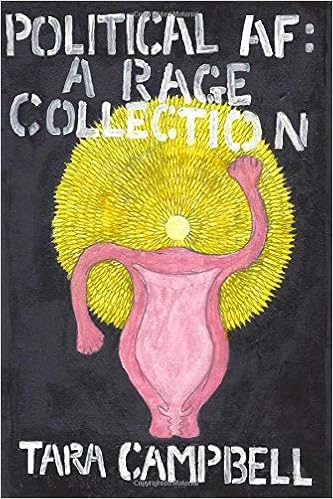
Political AF: A Rage Collection by Tara Campbell

Source: Purchased
Paperback, 74 pgs.
I am an Amazon Affiliate

Political AF: A Rage Collection by Tara Campbell is a slim collection with a powerful anthem and story arc that begins with “The meadow.” This prose poem sets the reader up for the themes to come — self-indulgence, dark desire and hate, outrage, and pain. That meadow is the nation that certain people have built, hiding it behind the ideals of liberty, while at the same time bleeding its people and waiting for the blood to spill.

The anthem of this collection, “Shut up and dribble,” is a chant that calls us to action. We [and I mean everyone, not just the oppressed] should not be silent like they tell us, we should rise up for the ideals and equality denied. This is personified in “Four-cent Father,” a poem in which the death of a Black man in his own garage is settled with four cents. How can a man’s life be worth so little, and how can a man who plays music in his garage be killed by bullets? He was minding his own business, he was spending time at his home — his home was not his castle, he was not safe.

There is a deep, simmering rage in this collection. A raging against injustice, a raging against the expectations of a society that’s created a false sense of justice, and a rage that builds against the circumstances created by these illusions. “Would my grandmother’s/German immigrant bones/have ached for the man/she would never have known/but for the slavers’ greed?’ (“After the Pedestal,” pg. 21) The “American Beast” rears its ugly head, slithering under the covers and slipping into rooms where “rumbling in the voices of grownups/speaking softly after dinner/about the problems of the world.//” (pg. 25) and becomes commonplace.

The poems in Political AF: A Rage Collection by Tara Campbell will get under your skin, making you uncomfortable not just in the dark but in the light of day. These poems call on us to break the silence, acknowledge the horrors of the past, see the bleak present, and get off our butts and do something about it.

RATING: Cinquain

About the Poet:

Tara Campbell is a Kimbilio Fellow, a fiction editor at Barrelhouse, and an MFA candidate at American University. Publication credits include SmokeLong Quarterly, Masters Review, Jellyfish Review, Booth, Strange Horizons, and Luna Station Quarterly.

She is the recipient of the following awards from the DC Commission on the Arts and Humanities: the 2016 Larry Neal Writers’ Award in Adult Fiction, the 2016 Mayor’s Arts Award for Outstanding New Artist, and Arts and Humanities Fellowships for 2018 and 2019. She is also a recipient of the 2018 Robert Gover Story Prize.

Her novel TreeVolution was published in 2016, followed in 2018 by her hybrid fiction/poetry collection Circe’s Bicycle. Her third book, a short story collection called Midnight at the Organporium, will be released by Aqueduct Press in 2019.

Check out the Gaithersburg Book Festival Panel discussion with Joseph Ross, Tara Campbell, Kim Roberts, and E. Ethelbert Miller: