Quantcast

Carta Marina by Ann Fisher-Wirth

Carta Marina was the first largely accurate map of the Northern Countries, completed by the Swedish historian Olaus Magnus in 1539.  Ann Fisher-Wirth has taken her inspiration from this map–complete with its lions, sea monsters, and warriors–for her poem in three parts–Olaus Magnus’ Carta Marina, The Coming of Winter, and Les Tres Riches Neures.

“When I was young, Yeats said, I wanted to take off my clothes,/
now I want to take off my body.” (From April 3. In the Restaurant, Page 61)

Each poem within the overarching three parts of the larger poem, Carta Marina, chart the story of the narrator as she travels through Sweden and the inner heart and soul.  The poems are dated so readers can follow the poet narrator’s progress as they deal with old age, finding a lost love, and incredible loss.

In section one of the poem, readers follow Olaus Magnus on his journey into the north interspersed with email from Paris between lovers.  Fisher-Wirth uses a combination of images and stylistic devices to create her own unique account of a cartographer’s journey, but in some cases, the use of the alphabet was a bit difficult to follow and at times distracting.  Readers may need to sit with these poems, allowing their meaning to simmer to the surface.

“But in the booth facing me the twenty-first child/
chews stolidly, gazing . . ./
lost in whatever dream, as her duckling-colored//

braids bob and her jaws revolve./
Above her pale blue jacket her eyes meet mine;/
I look away, look back, she is watching me./
In this season of coming winter she is my daughter.//”  ( From November 14, Page 33)

The second section of the poem, the narrator is reflecting on her existence and how she relates to those in in her life and life-changing events.  But there is also a reflective self-examination of who she once was and how to reconcile that person who is no longer present with the woman she has become.  From beautiful and mysterious phrases like “icy mercury blackness” to jarring images such as “Three skulls form the base of the table,” readers will transition from thoughtful to alert awe.

In the final third of the book, Fisher-Wirth incorporates some musical rhythm through repetition.  Carta Marina may resemble a cartography of life and aging, but the poem in three parts is a journey, like a journey through the northern lands of Sweden, wrought with harsh weather and rough terrain.  The background story behind the map inspiring these poems is intriguing, but readers could find that they will have to take their time with some of these poems, churning over their images like the Baltic Sea.

December 17, 4 a.m.

I know how to find you.
I go where your sleeping
is filled with the shadows
of leaves, where the leaves have
bled their green,
and all that remain are
their skeletons, nearly
transparent, translucent,
and tissue gone blurred as
the moon among clouds, as
the fur on a moth’s wing,
and tips as if trailing
through water . . .

Such leaves are not common.
In this snowy country
they cherish them, save them,
the white skelettbladen–
like us, they have died, to
become more enduring.

(From Page 47)

I’d like to thank Ann Fisher-Wirth (click her name for my interview) for sending me a free copy of her book, Carta Marina, for review.   Also, clicking on images and text links to books will bring you to my Amazon Affiliate page.  No purchases are required.

This is my 5th book for the poetry review challenge.
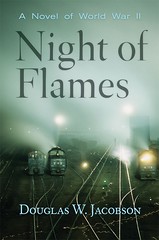
Night of Flames by Douglas Jacobson

Douglas Jacobson’s Night of Flames is a gritty “spy” novel set during World War II beginning in 1939 during the invasion of Poland by the Nazis.  The main protagonists Anna and Jan Kopernik are separated by war and face near misses with the wrath of the Germans.  Anna joins the resistance in Belgium reluctantly, while Jan jumps at the opportunity to help MI6 on a secret mission in Poland with the hope that he can find his wife.

“Anna’s eyes snapped open and she sat bolt upright.  The shrill sound blasted into her brain, penetrating through the fog of sleep like an icy wind.  She blinked and looked around the dark room, trying to focus on shadowy images as the sound wailed on and on.”  (Page 11)

Anna is in Poland with her friend, Irene, and her son when the bombings start in earnest, leaving them and their driver very few options on the way back to Krakow and her father, a professor at the local university.  Anna is hit by significant loss and constant worry about her husband, who’s career is with the Polish military.  Night of Flames is a fast-paced novel that pushed through the front lines and skulks in the shadows of the resistance.

“‘The best thing any of us can do is try and keep out of their way, and if you get stopped or challenged, be as cooperative as you can.’

‘So you’re telling us to act like house pets in our own city.'” (Page 65)

Jacobson’s no-nonsense writing style will place readers in the heart of the resistance, though some readers could get bogged down by the military strategy and direction, such as how the resistance used holes dug in the earth to hold lanterns that were lit to signal the Allies as to where to drop supplies.  Readers will either enjoy the detailed strategy or wish for a greater focus on the characters.  Anna is the most developed of the two protagonists, though Jacobson does give each nearly equal time through alternating chapters.  These chapters help build tension, leaving the reader in suspense as to whether they will ever be reunited.

Readers who enjoy learning about World War II and who enjoy spy novels will like this novel.  But Night of Flames is more than just a war novel; it is about how ordinary citizens can rise up to reclaim their homeland and their dignity in the face of adversity signifying an indelible human spirit.

Check out this video for Night of Flames:

I want to thank Douglas Jacobson, McBooks Press, and Pump Up Your Book Promotion for sending me a free copy of Night of Flames to review.  If you click on the title links, you’ll be taken to my Amazon Affiliate page, but there is no obligation to buy.

They’ve also kindly provided an additional copy for one reader of my blog from anywhere in the world.  To Enter:

1.  Leave a comment on this post.
2.  Check out the War Through the Generations blog and leave me a relevant comment here about something you read or learned.

3.  Blog, Tweet, and spread the word about the giveaway and leave a comment here.

Deadline is Nov. 4, 2009, at 11:59 PM EST

This marks the 7th book I’ve read for the WWII Reading Challenge.  Though I officially met my goal of reading 5 WWII-related books some time ago, I’ve continued to find them on my shelves and review them here.  I’m sure there will be more, stay tuned.

A Match for Mary Bennet by Eucharista Ward

Eucharista Ward O.S.F.’s A Match for Mary Bennet: Can a serious young lady ever find her way to love? is delightful and reminiscent of the regency craftswoman Jane Austen herself.  The novel’s pace is dead on, unfurling Mary Bennet’s character slowly, allowing readers to sit with her, getting to know her mind, her choices and motivations, and her true heart’s desire.

“‘I fell asleep in Inferno, and the candle went out.  I awoke in Purgatorio.  But all the light is on now.  I have found Paradiso.'” (Page 323 of ARC)

With her older sisters, Jane and Elizabeth married to Mr. Bingley and Mr. Darcy, and her youngest sister, Lydia, married off to Mr. Wickham, Mary and Catherine Bennet are left at home with their meddling mother, eager to marry them off.  Mary continues her ways of sitting alone with her books and her music, content to expand her mind rather than chase after men in society.

“‘You sat so creep mouse in a corner with, of all things, a book! What a way to comport yourself at a dance! Why, you might as well scream to all the world that no man is good enough for you. . . .'” (Page vi of ARC)

Despite her shyness and unconscious judgment of others, Mary comes to learn there is more to life than just books and music, though they certainly enhance her journey and even direct her ultimate place in society.  Readers will revisit with Mr. & Mrs. Darcy and Mr. & Mrs. Bingley following their marriages and how Mary perceives their married lives.  Lydia, Mr. Wickham, Mr. and Mrs. Bennet, Lady Catherine de Bourgh, her daugher, and Kitty Bennet return as well.  But there are new characters to love and dislike from the new pastor Mr. Oliver to the odd Mr. Grantley and the musical Mr. Stilton. 

Ward lives in Austen’s world, manipulates language easily to emulate regency England, and expands the characterizations sketched out in Pride and Prejudice: (Penguin Classics Deluxe Edition) without losing Austen’s vision.  However, Ward’s Mary Bennet is more than the thinly sketched, judgmental, religious, bookworm on the sidelines.  She is observant, knowledgeable, and deeply committed to her family and her faith.  Overall, readers will find A Match for Mary Bennet fills out the other Bennet sisters deftly and makes a perfect addition to any Austen lovers’ collection.

Sourcebooks has kindly offered 1 copy of A Match for Mary Bennet: Can a serious young lady ever find her way to love? by Eucharista Ward O.S.F. for a U.S./Canada reader.  To Enter:

1.  Leave a comment here about why you want to read about Mary Bennet or what your first impressions of her were when you first read Pride & Prejudice.

2.  Blog, Tweet, Facebook, or spread the word about the giveaway and leave me a comment. 

Deadline is October 16, 2009 at 11:59PM EST 

This is my 4th item for the Everything Austen Challenge 2009.

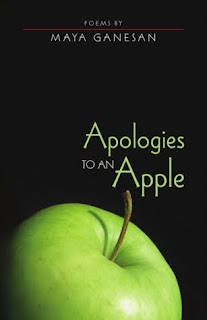
Apologies to an Apple by Maya Ganesan

Apologies to an Apple by Maya Ganesan is a breath of fresh air in contemporary poetry.  At eleven years old, Maya has a crisp style and is very observant and critical.  Her poems do not criticize overtly, like some poets that tend to hammer their messages home.

“They see the horizon, a smoky gold line
over the sea,
and call it names like faraway and
we’ll-never-reach-there.
To them,
horizon is a dream” (From Ash-Colored, pg. 10)

In these simple lines, the narrator observes the horizon in terms of what it means, its location, and how it is perceived by others.  It is an unattainable destination or a dream.

Maya uses short lines to let readers examine the images and statements and discern their own meaning–the greater meaning.  Readers will be reminded of William Carlos Williams‘ short lines, but Ganesan’s work holds a veiled innocence.  For such a young age, Ganesan has an old soul with a great deal of wisdom.  Some of these poems will make readers blush with their self-imposed innuendo.

A Message for You (Page 21)

I have traced your name
with
my finger

on the steamy
glass doors surrounding
the shower.

Readers will find poems to treasure, to savor, and to hold close to their hearts in this slim volume.  As a debut book of poetry, it stands tall among a vast crowd, waiting for readers to hear its whisper.

Yesterday (Page 24)

Yesterday is one book,
today is another.

Different books, telling
different stories.

I like to be part of 
both yesterday and
today, falling out of

one, tipped into
the other.

Her poem, September, was recently showcased in this past weekend’s Virtual Poetry Circle.  Readers enjoyed how the narrator speaks of trees as having souls and feelings.  It is a great commentary on how little we pay attention to the environment and its importance.

Susan at ColorOnline let me borrow her signed copy of Ganesan’s work for this review, though I did first read about this poetry book on 5-Squared.  I’m going to have to get my hands on another copy for myself.

Also Reviewed By:

5-Squared
Book of Kells
ReadWritePoem (also has a list of virtual tour sites for the book)

4th book for the poetry review challenge.

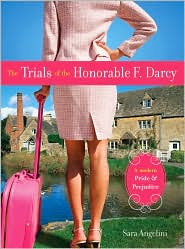
The Trials of the Honorable F. Darcy by Sara Angelini

The Trials of the Honorable F. Darcy by Sara Angelini is loosely based upon Jane Austen’s Pride & Prejudice. Fitzwilliam Darcy is the youngest judge appointed to the bench of San Francisco and Meryton is not a town in England, but a town outside of San Francisco, California. Elizabeth Bennet is an attorney with Gardiner & Associates, and the lead attorney is not her uncle Mr. Gardiner, but her boss. California has laws about fraternization between judges and attorneys who work on the same cases, and when sparks fly between Elizabeth and Will, it becomes a sticky situation.

“‘So, what are you doing during the first two weeks of June?’ Jane asked. Elizabeth switched the phone cradle to her other ear and spread the California Bar Journal in the desk before her.

‘Um, same thing as usual. Bill ten hours and work fourteen. Go home, eat Lean Cuisine over the sink, and go to bed convinced I’m never going to meet Mr. Right. I blame Mom. Oh, and I’ll probably have Lou give me a massage.'” (Page 63 of ARC)

Angelini has a brash style all her own in this modern take on these famous characters, but readers could find the explicit sex scenes and sometimes crass language tough to take if they are looking for the same Elizabeth and Fitzwilliam. However, The Trials of the Honorable F. Darcy exhibits the dynamics of modern relationships well, from the frenzied first glimpses of attraction to the obsessive first moments together and more.

Elizabeth and Darcy spar well in the courtroom before they realize their attraction, but attorneys, clients, and readers will cringe at the biting remarks they make to one another in the courtroom following a break from the realities of California.

“‘How did it go?’ he asked anxiously.

‘I’ve got competition,’ Elizabeth replied.

‘Lady Boobs-a-Lot?’ he asked, referring to Caroline.

‘Yep. She’s catty too.’

‘I know you. You can match her bitch-slap for bitch-slap.'” (Page 251 of ARC)

Readers will enjoy this retelling, though they should expect differences in the characters’ personalities from Elizabeth’s greater outspoken nature and stubbornness to Lou Hurst, Elizabeth’s gay friend and confidante. Jane is in the novel with Bingley–both work at the hospital in Meryton–but their love story is more of a sideline and is derailed less by Darcy and more by Jane’s need to defend her sister against Bingley’s sister, Caroline.

Overall, The Trials of the Honorable F. Darcy by Sara Angelini could have been its own stand-alone chicklit novel without the references to Pride & Prejudice, but the modern spin Angelini gives to the characters and the plot makes the novel a quick, fun read. A great way to spend a lazy afternoon.


Thanks to Sourcebooks for providing the advanced readers copy of The Trials of the Honorable F. Darcy. Stay tuned for a guest post from Sara Angelini on Sept. 28, 2009 with a giveaway.

This is the second book or third item I’ve completed for the Everything Austen Challenge 2009.


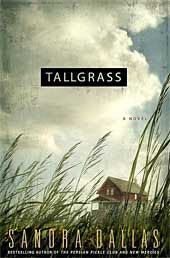
Tallgrass by Sandra Dallas

“I’d sneaked away from my parents and gone to the depot, too, because I’d never seen any Japanese. I expected them to look like the cartoons of Hirohito in the newspaper, with slanted eyes and buckteeth and skin like rancid butter. All these years later, I recall I was disappointed that they didn’t appear to be a ‘yellow peril’ at all. They were so ordinary.” (Page 2)

Sandra Dallas’ Tallgrass is set in Colorado in 1942 just after the bombing of Pearl Harbor in Hawaii. The book is narrated by Rennie Stroud, who was a 13-year-old girl when the Japanese are rounded up and placed into an internment camp–known as Tallgrass Ranch–in Ellis, Colorado. Many of the Japanese in the camp just up from the Stroud’s farm had been evacuated from their homes in California and their presence causes a major stir.

“They’d heard the sirens, too, and said it wasn’t anything, but I feared that somebody had gone under the bobwire surrounding the camp and was going to break into our house and kill us.” (Page 17)

Readers travel along with Rennie as she uncovers the truth about humanity regardless of color or creed and as she discovers the truth about her family. She grows into a woman more quickly than her parents would like, but given the rationing, the war effort, the harvest, and the increasing racial tension, Rennie has little choice but to mature.

“Things were tense even for the kids in the camp who never came in contact with people from Ellis. Little boys there played war games, just like the boys in Ellis. Daisy told us she’d watched a group of Tallgrass kids pretending they were fighting in the South Pacific and heard one complain, ‘How come I have to be the damn Jap all the time?'” (Page 238)

Readers will enjoy growing along with Rennie and getting into trouble with her and Betty Joyce. Dallas does an exceptional job of rounding out Rennie’s character from her naivete to her compassion and empathy for the plights of those less fortunate, like the Japanese and her friends. However, Tallgrass is more than a coming of age story; it also touches upon the harm caused by wrong-headed government policies, the fear that leads to prejudice and hatred, and the impact a war can have on everyone.

While readers may see some holes in how one of the main mysteries is resolved, Dallas’ resolution is in tune with the narrator she chose, a 13-year-old who is not privy to serious adult conversation. Overall, Tallgrass is a novel about WWII, family, growing up, and learning how to build a community even when differences exist.


This is my 6th book for the War Through the Generations: WWII Reading Challenge.

Thanks to Staci at Life in the Thumb for reviewing Tallgrass with several other WWII books that I had to pick up from the library and read all together.

Also Reviewed By:
Adventures in Reading
Jo-Jo Loves to Read!!!
Life in the Thumb


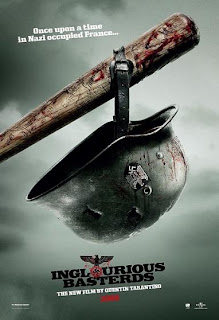
Movie Review: Inglourious Basterds

You know what I was doing over weekend, don’t you?

Naturally, watching the latest QT, Inglourious Basterds, with Anna from Diary of an Eccentric.

Can I just Say…AWESOME!

Ok, you want a real review? Go ahead, check it out at War Through the Generations.

You know I gave it a great review, but what did Anna say?

Dead Until Dark by Charlaine Harris

“I’d been waiting for the vampire for years when he walked into the bar.” (Page 1, sentence 1; yes, that’s my hook, how about you?)

In Dead Until Dark by Charlaine Harris, readers are introduced to Sookie Stackhouse, a resident telepath, waitress, and spunky young woman, her brother Jason who has a revolving door in his bedroom, her boss Sam Merlotte, and of course, her vampire, Bill Compton. They all live in Bon Temps, Louisiana.

(If you haven’t watched the HBO series True Blood based upon this series of books you better get watching. But I digress.)

“His voice was quiet and rustling, like feet through dry grass.” (Page 166)

Sookie and Bill meet at Merlotte’s and they quickly fall into bed after some initial posturing. Readers should know where this relationship was headed from the way Sookie looks at Bill and the way Bill reacts to her presence. The plot is thick with sexual tension and drama, from the way Bill silently stares at Sookie to the way she feels at ease because she cannot hear Bill’s thoughts and from the entrance of outrageous vampires from nearby Monroe to the murders of two fang-bangers.

“I got a tight feeling in my chest, a bitterness, at another thing I was denied. And I thought, Why not?

I stopped him by pulling gently on his hand. I stretched up and lay my lips on his shining cheek. I inhaled the scent of him, ordinary by faintly salty. He was wearing a trace of cologne.

I felt him shudder. He turned his head so his lips touched mine.” (Page 58)

Dead Until Dark will suck readers into the swampy, wooded south populated with vampires, telepaths, and more. Sookie is strong, hot tempered, loyal, and eager to help those in need, while Bill is her polar opposite, struggling to regain his humanity against his vampiric qualities. Like any good vampire story, there is a “love” triangle of sorts, murder, mayhem, and triumph. A good start to the series, which vampire/fantasy readers will love and other readers can enjoy as well.

Also Reviewed By:
Melancholy Musings
Well-Read Reviews
1morechapter.com
Bermudaonion
Rhapsody in Books 


Charlaine Harris’ Dead Until Dark is the first book in the Sookie Stackhouse series and my first book for the Sookie Stackhouse Reading Challenge.

Savvy Recap . . .

I just wanted to take a moment to recap some goings on here at Savvy Verse & Wit and at D.C. Literature Examiner.

I started out pledging to read 5 books for the War Through the Generations: WWII Reading Challenge, and I met my goal. However, I think I’ll probably read some more books for the challenge throughout the year, but for now I’m officially saying I’ve finished this challenge.

Check out the books I reviewed for the challenge:

1. Reading by Lightning by Joan Thomas
2. Bloody Good by Georgia Evans
3. T4 by Ann Clare LeZotte
4. Now Silence by Tori Warner Shepard
5. The Guernsey Literary and Potato Peel Pie Society by Mary Ann Shaffer and Annie Barrows

I also recently signed up for the Everything Austen Challenge in which you could mix and match movies and book reviews. I just have to read or watch 6 books or movies through January 2010.

So far, I’ve read one book and watched one movie, check out my reviews:

1. Mr. Darcy, Vampyre by Amanda Grange
2. Focus Features’ Pride & Prejudice (2005)

I joined the Sookie Stackhouse Reading Challenge as well; you might be thinking I’ve lost my mind.

I have to read the entire series, including the new book that just came out. I haven’t fared as well on this challenge, but I will have a review forthcoming for:

1. Dead Until Dark by Charlaine Harris

Ok, now for D.C. Literature Examiner news, I’ve been busy posting interviews and reviews:

1. Susan Helene Gottfried here and here.
2. Review of Shapeshifter: The Demo Tapes Year 1
3. Kyle Semmel here and here.
4. Review of The Woodstock Story Book
5. Joseph Sohm here, here, and here.

I hope you will take the time to check out some of these great interviews and reviews and leave a comment or two.

Also, I have a great international giveaway for the Rooftops of Tehran going on through August 24, 2009.

Jane Austen Mix-and-Match Mini Challenge

Books and Bards is hosting the Jane Austen Mix-and-Match Mini Challenge for all Everything Austen participants, and there are prizes.

If you haven’t checked it out, you should. Deadline is September 14.

For now, here are my romantic pairs from the list Books and Bards provided.

Come on down, couple #1:

Edmund Bertram and Lydia Bennet

Don’t you just see the possibilities in this match? They are polar opposites; him with his God-like devotion and her with her pleasure-seeking. Imagine how many adventures these two could get into together. He’d attempt to temper her wild ways and she would love to help him open up and have some fun.

And behind door #2, we have:

Caroline Bingley and General Tilney

You may wonder why I selected these two. Caroline’s head is turned by rich, well-connected men, why not a military man with an outrageous fortune for her to spend. However, once she has him, can she whip him into shape and keep him under her thumb? Maybe not this guy, but by the time she realizes it, General Tilney may have tamed her or at least gotten her to submit to him through fear alone.

Couple #3:

Colonel Brandon and Julia Bertram

Colonel Brandon means well and loves to protect young women from themselves, which is why I think Julia Bertram is a perfect match. She’s lingered too long in the shadows behind her sister and Colonel Brandon would be the perfect man to make her center stage.

Couple #4 was a tough one, but I finally settled on these two:

Lady Catherine De Bourgh and Henry Crawford

If for no other reason than I would like to see Lady Catherine engage in a relationship outside her character’s principles. I think Henry Crawford would be some juicy meat for her to sink her teeth into, and just think of all the gossip in society about this pair. Is he after her money; does he love her; is she using him; is she being an old fool? A lot of giggling to be had in society about this one.

My bonus couple:

Mary Bennet and John Dashwood

Mary is plain and always striving to be the best she can be, while John is always struggling against his wife’s wishes to push his half-sisters into obscurity. I think Mary could help John see the error of his ways and be the kind brother he wishes to be, while John would be satisfied to dote on her as much as she would be happy to be the “ideal” wife.

These are my selections, what are yours?

Focus Features Presents Pride & Prejudice (2005)

Focus Features’ Pride & Prejudice stars Keira Knightley and Matthew MacFadyen and was released in 2005. What’s to love about this version of the classic Jane Austen novel is the performances, the score, the cinematography, the screenplay adaptation, and everything.

Keira Knightley plays Elizabeth Bennet and she does a beautiful job expressing the character’s emotions, prejudices, and nuances, and Matthew MacFadyen, who plays Fitzwilliam Darcy, plays off of her so well. The chemistry between the two actors sizzles on the screen, and the tension between the characters is palatable.

My love of piano music is catered to in the score of this movie from the scene with Elizabeth looking out over the countryside on her way to Pemberley with her aunt and uncle to the consistent pianoforte playing by the various characters.

While there are scenes from the book that are not in this movie, the pacing is perfect. Knightley easily portrays Elizabeth’s fire and her love for her sister. MacFadyen’s performance is equally captivating as Mr. Darcy from the touch of Elizabeth’s hand and the clenching and unclenching of his fist to the longing gazes he casts in Elizabeth’s direction.

The supporting cast is brilliant from Donald Sutherland as Mr. Bennet to Dame Judi Dench as Lady Catherine de Bourg, providing moments of laughter and anger.

***May contain spoilers***

Some of the best scenes are when it rains and Darcy professes his ardent love against his better judgment, the witty repartee between Darcy and Elizabeth at Rosings, the first dance between Darcy and Elizabeth, and the short exchange between Darcy and Bingley when he visits Jane after a long absence. The best scene of course is when Darcy and Elizabeth meet in the field early in the morning after his aunt visits late the previous evening.

Check out this P&P video set to music. Check out the trailer.

Focus Features’ Pride & Prejudice (2005) receives 5 bags of popcorn from me and makes the first movie for the Everything Austen Challenge.

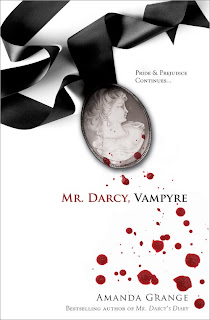
Mr. Darcy, Vampyre by Amanda Grange

“Her attention was attracted by movement close at hand and she saw the dark shape of a bird–no, a bat–heading towards the window. She closed it quickly, leaving the bat to hover outside. As she looked at it she was seized with a strange feeling. She thought how lonely it must feel, being shut out; being a part and yet not a part of the warmth and light within.” (Page 67 of the ARC)

Amanda Grange’s Mr. Darcy, Vampyre, published by Sourcebooks, catches up with Mr. & Mrs. Darcy right before their nuptials and follows them along their wedding tour. As plans change and the Darcys spontaneously tour Europe, mingling with Mr. Darcy’s friends, Elizabeth begins to feel that there is a deep dark secret her husband is hiding from her.

Throughout the novel, Grange adheres to Jane Austen’s characters and the time in which those characters live. Readers of Pride & Prejudice may have wondered why Fitzwilliam Darcy was so reserved, but Grange provides a paranormal alternative to mere position and wealth considerations in the 19th century. The lush landscape and dramatic plot will suck readers into Mr. Darcy, Vampyre as they travel with Elizabeth and Darcy through Paris, Italy, and the Alps.

“She needed no urging. The sumptuous atmosphere was starting to oppress her and the strangely sinuous people were unsettling. She was relieved to get outside and breathe the fresh air.

Night hung over the city like a dark mantle, pierced with the light of flambeaux and, up above, there seemed to be a thousand stars.” (Page 47 of ARC)

Elizabeth is captivated by her foreign surroundings, but eventually she begins to feel weary of her new acquaintances and the tension in her marriage. Readers will grow anxious and paranoid just as Elizabeth does. From bandits and wolves in the woods outside a secluded castle to the reappearance of Lady Catherine de Bourgh and her ties to Darcy’s secret, Grange weaves a twisted narrative that leaves Elizabeth, Darcy, and readers on the edge of their seats.

Mr. Darcy, Vampyre is a paranormal continuation of Austen’s Pride & Prejudice that is executed successfully. Even though the title does the novel a disservice by telling readers Darcy is a vampire, Grange is a master of this time period and her imagination shines through in this novel. There are enough descriptive clues and dialogue in Grange’s novel that a different title would not have detracted from its paranormal quality. It took me less than 3 days to read this novel in the free time I had at home. Readers will be absorbed by this paranormal world. Mr. Darcy, Vampire is another notch in Grange’s repertoire, and if readers have enjoyed Mr. Darcy’s Diary (click on the link for my review), they will enjoy this paranormal novel.

Feel free to check out the Mr. Darcy, Vampyre blog. And stay tuned for my interview with Amanda Grange and a giveaway on August 7. Check out more of the Mr. Darcy, Vampyre tour on the book’s blog.

This is my first book for the Everything Austen Reading Challenge. What books have you read for the challenge? What movies have you watched?

Also reviewed by:
Cafe of Dreams
Diary of an Eccentric