Quantcast

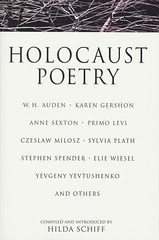
Holocaust Poetry Complied by Hilda Schiff

Holocaust Poetry compiled by and introduced by Hilda Schiff is a collection of poetry dealing with World War II and the Holocaust.  The compilation is divided into six sections:  Alienation; Persecution; Rescuers, Bystanders, Perpetrators; Afterwards; Second Generation; and Lessons.  There are well-known poems in this collection and poems from young children.  A few of the poems in this collection already have been featured on the blog as part of the Virtual Poetry Circle; check out “If” by Edward Bond and “The Butterfly” by Pavel Friedmann.

Each poem in the collection uses all-too-familiar images to demonstrate connections with family, friends, and strangers. and as each poem unfolds readers feel the devastation and hopelessness of each narrator.  Schiff says in the introduction, “The more or less contemporaneous literature of any period of history is not only an integral part of that period, but it also allows us to understand historical events and experiences better than the bare facts alone can do because they enable us to absorb them inwardly.”  More or less, readers of poetry will find these observations valid, as will readers of fiction.

However, there are moments of levity when narrators poke fun at the devastating events of Nazi Germany’s actions.

The Burning of the Books (Page 8)

When the Regime commanded that books with harmful knowledge
Should be publicly burned on all sides
Oxen were forced to drag cart loads of books
To the bonfires, a banished
Writer, one of the best, scanning the list of the
Burned, was shocked to find that his
Books had been passed over.  He rushed to his desk
On wings of wrath, and wrote a letter to those in power.
Burn me! he wrote with flying pen, burn me.  Haven’t my
  books
Always reported the truth? And here you are
Treating me like a liar! I command you:
Burn me!

Beyond the poems in the collection depicting the horrors and the losses of persecuted people in Germany, the poems of bystanders, perpetrators, and others are surprising.  They talk of how they stood by and did nothing, how they want to help even if they are too late.  Despite the time for help being long passed, these narrators express not guilt so much as regret — a deep regret at having been so paralyzed by fear that they did nothing or acted contrary to who they believed themselves to be.

I Did Not Manage to Save (page 86)

I did not manage to save
a single life

I did not know how to stop
a single bullet

and I wander round cemeteries
which are not there

I look for words
which are not there
I run

to help where no one called
to rescue after the event

I want to be on time
even if I am too late

The poems selected for the “Second Generation” section will tug at readers heart strings, deepening the sense of loss.  An emptiness is present in some of these poems.  Short biographies are included at the back of the book for readers interested in the poets’ lives and connections to WWII and the Holocaust.

Holocaust Poetry is a collection that should be read in chunks rather than all at once.  Readers may succumb to sorrow if they attempt to read the entire collection in once sitting, but even then, readers will fall into the darkness and emerge in the light.  Overall, the collection is a must have for anyone interested in this time period and learning more about how WWII and the Holocaust impacted individual lives and families.
This is the 9th book I’ve read that qualifies for the 2009 WWII Reading Challenge.  Though I officially met my goal of reading 5 WWII-related books some time ago, I’ve continued to find them on my shelves and review them here.

This also qualifies as my 9th book for the Poetry review challenge.

FTC Disclosure:  I purchased my copy of Holocaust Poetry compiled by Hilda Schiff at the local library sale.  Clicking on title links will bring you to my Amazon Affiliate page, no purchase necessary.
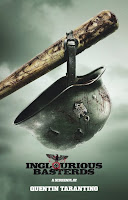
Inglourious Basterds by Quentin Tarantino

Quentin Tarantino’s Inglourious Basterds is the screenplay for the revenge war film of the same name.  Moviegoers love Tarantino’s films for a multitude of reasons or they hate them for a multitude of reasons, but the screenplay provides a whole new insight into the filmmaker and his work.

Author David L. Robbins says in the forward, “The script remembers, too, the classic propaganda films of Leni Riefenstahl and Joseph Goebbels.  It glimpses the faces of Hitler and Churchill and the interior of a wartime movie house in Paris, and zooms in on the horrors of close combat, the mania of vendetta.  . . . Inglourious Basterds does not indulge in lampoonery or mere cobbling.  It is reverently authentic as a war story, working the same tense, edge-of-the-seat magic as the best of the genre, book or movie.  At the same time, it’s Tarantino, its own thing.”

There are two main storylines in the film — one deals with the death and ultimate revenge plot of Shosanna Dreyfus and the other follows the basterds through Germany as they take on the Nazis and bumble around during secret missions to win the war.  In typical Tarantino fashion, the script bounces from each group and several moments in time, quilting together the larger arc of the story and conclusion of the war.

The script includes little tidbits about the characters that are never seen or talked about on screen.  Readers will be amazed by the depth of detail Tarantino provides in stage direction, the description of the scene, and explanation.

“Lt. Aldo [played by Brad Pitt] has one defining physical characteristic, a ROPE BURN around his neck — as if, once upon a time, he survived a LYNCHING.”  (Page 19)

“WE SEE all the pagentry below.  Tons of SPECTATORS.  Tons of guests dressed in Nazi uniforms, tuxedoes, and female finery, walking up the long red carpet (with a big swastika in the middle, naturally) leading into Shosanna’s cinema.  The German brass band omm-pa-pa-ing away.  German radio and film crews covering the event for the fatherland back home.  And, of course, MANY GERMAN SOLDIERS providing security for this joyous Germanic occasion.”  (Page 125)

Although the script does not depict the true conclusion of World War II, Tarantino illuminates the horrors of war and creates an atmosphere of the ridiculous in its revenge themes.  Watching the film is fast-paced, hilarious at moments, and gruesome, but reading the script plunges readers into their own personal version of the events and enables them to sink their teeth into Tarantino’s witty and poignant dialogue.  The basterds’ dialogue drips with disdain and self-righteousness, while Col. Hans Landa, or the Jew Hunter, uses language to demonstrate his superiority, even though his outward actions border on comedic.

Lt. Aldo:  Well, Werner, if you heard of us, you probably heard we ain’t in the prisoner-takin’ business.  We in the killin’ Nazi business.  And cousin, business is boomin’.  (Page 28)

FEMALE SGT. BEETHOVEN and STIGLITZ bring their guns toward each other and FIRE.  They BOTH TAKE and GIVE each other so many BULLETS it’s almost romantic when they collapse DEAD on the floor.  (Page 108)

Overall, Inglourious Basterds by Quentin Tarantino is an excellent specimen of a screenplay from its detailed stage direction and description to its witty and insightful dialogue, it will capture readers imaginations just as the film did on screen.  There are portions of the script that did not make it onto the big screen, but that’s to be expected with any film; there also are scenes in the movie that are not in the script.  The beauty of a screenplay is that it is not a stationary work of art, but one that evolves from page to screen under the guidance of its maker.

This is my 9th book for the WWII Reading Challenge 2009.  I can’t believe I’m still finding these on my shelves even now in December.  There may have to be a time when we revisit this war.

Additionally, I would like to thank Hachette Group for sending me a free copy of Inglourious Basterds for review.  Clicking on title links will bring you to my Amazon Affiliate page, no purchase necessary. 

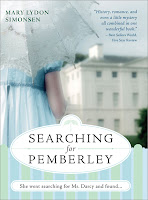
Searching for Pemberley by Mary Lydon Simonsen

Mary Lydon Simonsen’s Searching for Pemberley starts was a premise many interviewers often ask authors about their fiction:  “Are any of your characters based upon real people?”  Did Jane Austen use real people to write the great love story of Elizabeth Bennet and Fitzwilliam Darcy?  Simonsen’s book may not offer the truth behind Austen’s characters, but it does spin a unique mystery tale through which one possible reality of Mr. Darcy and Ms. Bennet are discovered.

“‘Mr. Crowell, you don’t know me.  I’m Maggie Joyce, but I was wondering if . . .’  But that was as far as I got.

‘You’re here about the Darcy’s right?  Don Caton rang me to let me know you might be coming ’round.  Come through.  Any friend of Jane Austen’s is a friend of mine.'”  (Page 12 of the ARC)

Maggie Joyce is the main protagonist and an American from a coal mining town in Pennsylvania.  She quickly leaves her hometown of Minooka for Washington, D.C., to help with the government with its World War II-related administrative work.  Eventually she is stationed in Germany and later in England following the end of the war.  She meets a fantastic family, the Crowells, who help her unravel the real family behind Jane Austen’s characters.

“Beth gestured for me to follow her into the parlor.  She had a way of carrying herself that was almost regal, especially when compared to her husband, who reminded me of a former football player who had taken a hit or two.”  (Page 25 of ARC)

Told from Maggie’s point of view, the novel grabs readers with its immediacy as Maggie moves through war-torn Europe and reads through a variety of diary entries and letters to uncover the origins of Pride & Prejudice.  Readers who have read Austen’s novel once or more than a dozen times will recognize echoes of Elizabeth Bennet and Fitzwilliam Darcy in the Crowells and may even find parts of the mystery obvious.  However, this story is more than a look at where Austen may have found inspiration, it is about a nation (England) and its people in the midst of rebuilding after the devastation of the German blitzkrieg and World War II.  There also a healthy dose of romance between Maggie and two beaus that add to the tension.

“‘Nightmares from the war that I hadn’t had in ten, fifteen years came back.  Jesus, they all came back,’ he said, massaging his temples as if the act would block out any unwanted images.  ‘Picking up bodies and having them fall apart in my hands.  Stepping on limbs.  Being scared shitless during barrages.'”  (Page 254 of ARC)

Simonsen does an excellent job examining the shell shock felt by airmen and other military personnel and how their war experiences could impact their relationships with family, friends, and lovers.  While there are some occasions in this nearly 500-page book that are bogged down by too much detail, Simonsen’s characters are well developed and the twists and turns as Maggie unravels the mystery of the Bennets and the Darcys are fun.  The aftermath of World War II is well done and rich in emotional and physical detail, showing Simonsen’s deft research and keen eye.  Searching for Pemberley is an excellent addition to the every growing market of Jane Austen spin-offs.

This is the 8th book I’ve read that qualifies for the 2009 WWII Reading Challenge.  Though I officially met my goal of reading 5 WWII-related books some time ago, I’ve continued to find them on my shelves and review them here.  I’m sure there will be more, stay tuned.

Searching for Pemberley is the 6th item and fulfills my obligations under the Everything Austen Challenge 2009.   I hope that everyone has been reading along for this challenge.  It has been fun to see the mix of books and movies that everyone has reviewed.  I may even read another book before this challenge ends, since my main goal in joining was to read Persuasion, one of the only Austen novels I haven’t read.

Have you missed the giveaway for Searching for Pemberley?  Don’t worry there’s still time to enter.  Go here, and comment on Mary Lydon Simonsen’s interview for an additional entry.  Deadline is Dec. 14, 2009 at 11:59PM EST.


THIS GIVEAWAY IS NOW CLOSED!!

Additionally, I would like to thank Mary Lydon Simonsen and Sourcebooks for sending me a free copy of Searching for Pemberley for review.  Clicking on title links will bring you to my Amazon Affiliate page, no purchase necessary. 
War Through the Generations Challenge 2010: Vietnam War

2010 is right around the corner.  Have you signed up for your reading challenges yet?  I know you’ve seen some of mine, which I posted over Thanksgiving break.  Take a look if you’re interested.

But today isn’t about any old reading challenge.  Today is my announcement unveiling the 2010 War Through the Generations Reading Challenge on the Vietnam War.

In 2009, Anna and I were surprised by the number of participants.  Many of you already have finished your goals.  Don’t worry there are still prizes to be had.  So, congrats to you, and I hope you’ll think about joining us for the new year.

Sign ups for the 2010 Vietnam War Reading Challenge are up NOW.  Click here to find out the various reading goal options.

Sign up officially using this Google Form link.  We’d love to have you.  The minimum is 5 books in 12 months, and you know you want to see your name on this list.

If you’re not sure about joining because you haven’t seen many or read many Vietnam War fiction, nonfiction, poetry, or other books, you’re in luck!  We’re compiling a list for you.  Check out the recommended reading.

Signups for this challenge are ongoing throughout 2010, so you have plenty of time to decide based on books you have lined up or come across on a whim.

For those who sign up, we have a bunch of buttons for you to use on your blog, but Vietnam War specific buttons are still in the works.  Keep your eyes on the War Through the Generations blog for other announcements.

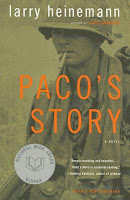
The only things I have left to talk about are the fun group reading project we have planned this year with Paco’s Story by Larry Heinemann, which we hope to have read and reviewed with everyone who participates midway through the challenge, and my own reading goals.

Ok, I guess I just did tell you about Paco’s Story!

So here are my reading goals; I will read 11 or more books throughout 2010 in which the Vietnam War is a primary or secondary theme.

At the Threshold of Alchemy by John Amen

the woman in the shower (Page 36)

the woman in the shower washes herself constantly and never ages.  she
scrubs her nails, shampoos her hair, lathers her body.  she’s attractive, and
many serenade her, offering love songs in various languages.  newspapers
send interviewers to ascertain her greater mission.  she receives letters from
admirers around the world.  political and religious leaders pay a visit.  a few
crazies try to break into the shower stall and molest the woman, but guards
throw them out.  one man masturbates, shooting his seed onto the glass
before he is arrested.  nothing, though, distracts or fazes the woman in the
shower.  she keeps lathering and scrubbing and rinsing.  generations pass;
the woman is considered a saint of sorts, her shower stall a mecca.  it’s 
assumed, finally, that the woman in the shower, the woman who never 
stops washing, has always been, always will be.  she’s a timeless fact, like air
or war or hunger or god.

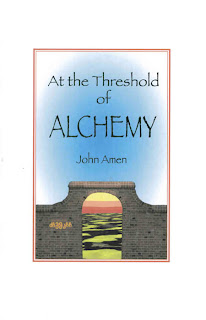
At the Threshold of Alchemy by John Amen conjures profound statements about the human condition often from unusual or incongruous elements in nature, pop culture, and religion.  Many of these poems comment on the darker side of humanity, and the narrator tends to seek out destruction and mischief.  There are some longer poems in the collection that could become tedious for certain readers, but taken in slowly — one section at a time — readers can delve deeper into the verse.

“. . . Mary plants clematis and bougainvillea.
I’m writing ballads on a ’71 Gibson.  We’re purchasing
mulch, two tons of soil.  We’re collecting ripe moments,”  (Portraits of Mary, Page 43)

Vivid images and situations permeate these pages, and Amen is a poet prepared to comment on the taboo or the elephant in the room.  Several poems titled “missive” address unknown recipients and offer harsh criticisms in which the sarcastic undertones is palpable.

“Had I known you were more concerned with baubles
than the outcomes of the election, I’d have planned
to craft a wreath for the occasion.  Bless tabloids
and puppet governments, I take my salvation as
I can get it.”  (Missive #12, Page 68)

Musical elements also weave their way into the poems, much like they did in Amen’s More of Me Disappears (click for my review).  Entwined with these musical lines, readers will note an atmosphere of self-deprecation created by the narrator’s repentance or observations.

“Forgive me for eating this bountiful meal.
Forgive me for sleeping beneath this roof.
Forgive me for making love to my wife.
Forgive me for everything I fail to see and do
and avenge.  Forgive me for this insular life.”  (Rampage, Page 24) 

At the Threshold of Alchemy by John Amen is a collection that readers will need to let simmer, breathing in each line like an exotic incense.  Readers can read each poem in this collection more than once and still uncover new layers of meaning.  From short poems to long poems, this collection has a variety to please a multitude of readers. 

***On a side note, At the Threshold of Alchemy is published on acid-free, recycled paper.***  Ever since the Green Books Campaign, I’ve been keeping a watchful eye on my books to see what their “green” properties may be.

FTC Disclosure:  I received a free copy of At the Threshold of Alchemy from the poet John Amen for review.  Additionally, title and image links will bring readers to my Amazon Affiliate page; no purchases are necessary, but are appreciated to cover the costs of international giveaway shipping.

I read this book as part of the recent Thankfully Reading Weekend Challenge.  Did you participate?  Which books did you read?  I only read two.

This also qualifies as my 8th book for the Poetry review challenge.

Thankfully Reading Weekend Wrap-up

Well, I didn’t get as much reading done this weekend as I hoped.  Of course, that is all directly related to the holiday shopping hubby and I did for the apartment.  We spent his only day off over the holiday weekend putting together my new shelves.  Check out that post, here.

I finished The Girl on Legare Street by Karen White, click here for my review.  And started, again, At the Threshold of Alchemy by John Amen.  I should finish this book up today.

I escaped for most of Sunday into my books, much of the previous days was spent cooking, cleaning, and putting together bookshelves.  I’d probably guess about 9 hours total.

Did anyone else in your family take time to read?

Nope!  The hubby was working and even if he wasn’t it would be more likely that he’d be in front of the television than with his nose in a book.

I wouldn’t say that either of these books was a winner over the other since they are very different.  I’ve enjoyed them both.

That’s my recap of the Thankfully Reading Weekend.   Did you participate? How many books did you read?

FTC Disclosure:  Clicking on title links will lead to my Amazon Affiliate page; no purchases are necessary.

The Girl on Legare Street by Karen White

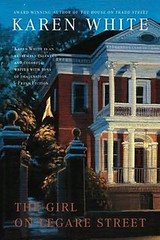
The Girl on Legare Street by Karen White pits Melanie Middleton, a Realtor who guards her emotions like most would protect buried treasure, against Jack Trenholm, a confident author and potential suitor, and elements of the supernatural.  Melanie must face her fears about her abilities and the truth behind the break-up of her family when her famous mother and opera singer returns to Charleston, South Carolina.

“We stood gaping at the marble-tiled floor with the faux-zebra shag area rug galloping down the middle of the hall.  The elegant egg-and-dart carved cornices had been painted black to offset the fuchsia hue of the walls.  Lime green beanbag chairs with legs offered seating to anybody with enough taste to make their knees go weak upon viewing the psychedelic colors of the hallway.  (Page 44-45)

White creates an intricate mystery that Melanie must unravel for herself without relying heavily on Jack, as she did in the previous book, The House on Tradd Street (click for my review).  White’s characters are vivid; so much so, that readers may want to smack Melanie through the pages and tell her to get a grip.  The beginning chapters spend a bit of time with Melanie as she attempts to sort out her feelings for Jack, her mother, and her abilities.  In some cases, Melanie’s whining may be a bit much for readers, but the action picks up and the knotted lives of Melanie’s ancestors will hook readers until the very last pages.

“I didn’t wait for a response, and was glad he didn’t show any resistance as I dragged him toward the back door.  . . .  I gave a brief wave and had pulled Jack through the door and closed it before my mother made it into the kitchen.

‘I think I like it when you’re rough,’ Jack said.”  (Page 143)

White introduces new characters, like Rebecca Eggerton, and resurrects some of the older characters, like Sophie and Chad, from the first book.  This provides readers with new relationship triangles to navigate, while trying to work through the paranormal mystery.  If readers have read and enjoyed The House on Tradd Street, they will enjoy this tale.

The Girl on Legare Street by Karen White is an entertaining and a good second book in this paranormal-gothic romance-mystery series.  At times, readers could find the repetitive elements in Melanie’s narration distracting, as she repeats her grudge against her mother and her indecision about letting go of her self control where Jack is concerned.  It is clear that this is a second book and that there is more to come given the final lines of the book.

Stay tuned tomorrow, Dec. 1., for a guest post from Karen White about her writing.

FTC Disclosure:  Clicking on images and title links will bring you to my Amazon Affiliate page; No purchases are necessary.  I received my free review copy of The Girl on Legare Street by Karen White from the author and Joan Schulhafer Publishing & Media Consulting.

I read this book as part of the recent Thankfully Reading Weekend Challenge.  Did you participate?  Which books did you read?  I only read two.

2009 and 2010 Challenges

I’m participating all weekend Nov. 27-29, 2009, in the Thankfully Reading Weekend as well.  Check out the details at the Book Blog Social Club.

It’s that time again to start thinking about some reading challenges. Anna and I at War Through the Generations are working on the announcement post for the 2010 Viet Nam Reading Challenge.  I hope that you will all consider our challenge in the new year, since we had such a great time with the WWII Reading Challenge this year.

Ok, here are some of the challenges I’m planning on for 2010:

For the All About the Brontes Challenge, sponsored by Laura’s Reviews, you just need to commit to reading, watching, or listening to between 3 and 6 Bronte items (books, movies, audiobooks, etc.) between January 2010 and June 30, 2010.

I’m going to strive to read/watch 3-5 items, and these are the three I’ve picked, though I could change my mind:

1.  Jane Eyre by Charlotte Bronte (Book/Movie)
2.  Wuthering Heights by Emily Bronte (Book/Movie)
3.  The Secret Diaries of Charlotte Bronte by Syrie James (Book)
4.  Emily’s Ghost: A Novel of the Bronte Sisters by Denise Giardina (Book)

Won’t you join me?!

S. Krishna’s Books is hosting the South Asian Author Challenge, which given the swath of South Asian Books I’ve seen and those I’ve read, I’m going to commit to reading 3 books that qualify between January 2010 and December 2010.

These are the 3 books I’m currently considering for this challenge: (Links are to S. Krishna’s reviews)

1.  The Sari Shop Widow – Shobhan Bantwal
2.  Burnt Shadows – Kamila Shamsie
3.  The Enchantress of Florence – Salman Rushdie

Please check out her list of South Asian Authors’ Books that qualify for the challenge and the breakdown of those authors by genre.  Won’t you join the fun?!

Next up is a challenge that is likely to be tough to finish for me, but I’m going to sign up anyway because I love the genre.  Book Chick City is hosting the Thriller & Suspense Reading Challenge 2010.  The goal is to read 12 thriller/suspense books between January 2010 and December 2010.

I haven’t preselected any books for this challenge.  I think I’m going to pick these twelve books as I go along.

I hope you’ll consider this great challenge too.

Last, but not least.  I’m jumping on this bandwagon late, but Regular Rumination is hosting the Valparaiso Poetry Review of contemporary Poets and Poetics.  I’m going to dive into the deep end on this one, since I adore poetry.   This means I have to read between 11 and 15 books between May 16, 2009 and May 16, 2010.

I’m hoping that some of the poetry books I’ve read this year count for the challenge, which would be the following:  (Click on the links for my reviews).

1.  How to Read a Poem by Molly Peacock
2.  Becoming the Villainess by Jeannine Hall Gailey
3.  Green Bodies by Rosemary Winslow
4.  Apologies to an Apple by Maya Ganesan
5.  Carta Marina by Ann Fisher-Wirth
6.  More of Me Disappears by John Amen
7.  Fair Creatures of an Hour by Lynn Levin

If they don’t, I have my work cut out for me.  I hope you’ll consider adding some poetry to your reading!

Here are the guidelines from Literary Escapism:

1. The challenge will run from January 1, 2010 through December 31, 2010.

2. Since this is an author challenge, there is no restriction on choosing your novels. They can definitely be from other challenges. However, the authors must be new to you and, preferably from novels. Anthologies are a great way to try someone new, but only a third of your new authors can be from anthologies.

3. I want this to be an easy challenge, so you can pick to do either 15, 25 or 50 new authors. It all depends on how fast you read and how adventurous you want to be. If you reach your goal halfway through the year, don’t stop. Any new author you try can be added to Mr. Linky. We all want to know about your new experience.

4. After reading your new author, write your review and then add your link to Mr. Linky. Make sure you include your name and the author.

5. Bloggers or Non-Bloggers alike are welcome

I don’t have a list ready for this challenge yet, but I think it will fill out throughout 2010 with all the challenges I’ve joined. I’m going to start with a small goal of 15 50 new-to-me authors.

What challenges are you joining?

FTC Disclosure:  Clicking on certain book titles will bring you to my Amazon Affiliate Page; No purchase necessary.
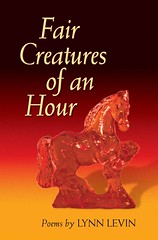
Fair Creatures of an Hour by Lynn Levin

Lynn Levin‘s Fair Creatures of an Hour is a collection of poetry that draws on current events — Smarty Jones in “Little Red Telegram” and skydivers Sara Loshe and Ron Samac in “Freefall” — imagery, and culture to draw in its readers.  Levin intertwines traditional Jewish rituals and stories into her poems, and interjects a fresh perspective.  Readers will intimately understand her and mimic her lines.

“What finer thing is there than to pour out
your thoughts and have someone drink
of your meaning?
It is better than being loved
I sometimes think
for love is not everything.”  (Page 61, “I Wanted to Tell You”)

Levin creates a wistful atmosphere in some of her poems, but easily turns that into something playful.  Even in her most serious poems, Levin cultivates an undercurrent of sarcasm, playfulness, and hope.  From “Peace Is the Blithe Distraction,” Levin repeats the word “peace” and uses each subsequent line to illustrate what peace can mean to even the worst of enemies and how hope plays an integral role.

On the other hand, her humor is ever present as she begins more than one poem with horoscope predictions and planet alignments.  Readers will enjoy the wit shown in these poems and will nod in agreement with many of them.  Levin has an eye for the human condition and the emotions, even those not most desirable. 

The White Puzzle (Page 42)

To love jigsaw puzzles, you have to love trouble —
the mad messing of a picture, the slow steps back to art.
Years ago, my brother and I spent hours
breaking up then piecing back
The Skating Pond by Currier & Ives,
Remington’s The Old Stage-Coach of the Plains
the cardboard pieces colonizing
the game table in the family room.
There was satisfaction in the fitting together
the doing of the definite task
then some days of admiration
of the solved thing before the sundering.
Once someone gave us a white puzzle,
a real head-breaker, the blank pieces
many and small like the counties of a state.
This was fitting for the sake of fitting.
No art in it that we could see, but we stuck to it,
and after a while the pieces began to clump together
like new snow on the lawn.
I remember the way our small talk
scribbled itself over the gathering page:
something about a math bee and Old Man Sprague
who kept sheep in his backyard and had a gun.
We nibbled popcorn, made Montana take shape
with its three sides and human profile,
the pieces knit like bone.
When the white puzzle was complete
we loved the way it lay like moonlight on the floor
then sat before our conquered space,
two Alexanders wanting more.

The poet includes references and explanations in the back of Fair Creatures of an Hour, of which the title is taken from a John Keats poem, “When I Have Fears That I May Cease to Be.”  Levin’s collection is about embracing the moment and being comfortable with oneself before fate steps in.  Well worth reading again and again, Levin’s collection will leave readers wanting more.

Please check out 20th Virtual Poetry Circle for a discussion of Levin’s “Helium.”  Also, for another review, please check out The Pedestal Magazine.  Stay tuned for an interview with Lynn Levin.

I want to thank the poet, Lynn Levin, and Arlene Ang for setting me up with a free copy for review. 

This is my 7th book for the poetry review challenge.

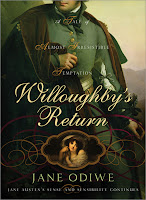
Willoughby’s Return by Jane Odiwe

Willoughby’s Return by Jane Odiwe reunites readers with Mr. and Mrs. Brandon and Marianne’s sisters Margaret and Elinor from Sense & Sensibility by Jane Austen. 

“But three years of married life had done little to really change her.  Marianne still had an impetuous nature, she still retained a desire for impulse and enterprises undertaken on the spur of the moment.”  (Page 3)

Truer words were never spoken about Marianne.  She is the same impetuous girl from Austen’s book, even though she is married to Colonel Brandon and has a son, James.  Her husband, however, has obligations to his ward, the daughter of his deceased first love, and her child–a child she had with Marianne’s first love, Mr. Willoughby.  Drama, drama, drama fills these pages, just as they filled Marianne’s life in Ausen’s work, but Odiwe adds her own flare to these characters.

Marianne continues to hide things from her husband no matter how innocent the situations may be and her jealousies drive her to make nearly scandalous decisions and snap judgments.  However, while this book is titled Willoughby’s Return, he is more of a minor character and his storyline with Marianne looms from the sidelines as her younger sister Margaret and her beau Henry Lawrence take center stage.

“She watched two raindrops slide down the glass, one chasing the other but never quite catching up.”  (Page 39)

Margaret is very like Marianne in that she is passionate, romantic, and impetuous.  She’s opposed to marriage and Marianne’s matchmaking until Margaret sets eyes on Henry Lawrence.  She falls head-over-heels for him, but Odiwe throws a number obstacles in their way.

Readers may soon notice some similarities between Henry Lawrence and Frank Churchill from Emma by Jane Austen, but the romance unravels differently for Henry and Margaret than it does from Frank and Emma.  Readers that enjoy Jane Austen’s books and the recent spin-offs will enjoy Willoughby’s Return — a fast-paced, regency novel with a modern flair.

This is the 5th item I’ve completed for the Everything Austen Challenge 2009.  I’m one item away from meeting my goal, which will be coming up either later this month or in December.

Don’t forget the Willoughby’s Return giveaway, here.

Additionally, I would like to thank Jane Odiwe and Sourcebooks for sending me a free copy of Willoughby’s Return for review.  Clicking on title links will bring you to my Amazon Affiliate page, not purchase necessary.
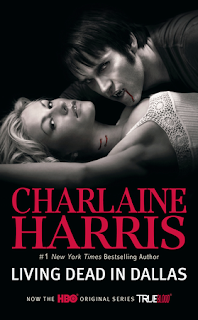
Living Dead in Dallas by Charlaine Harris

Charlaine Harris’ Living Dead in Dallas continues the Sookie Stackhouse series.  Sookie has agreed to use here telepathic powers to help the vampires when necessary so long as the interviewees go free.  The death of a co-worker and friend thrusts Sookie deep into the vampire world.

“‘Angelic Sookie, vision of love and beauty, I am prostrate that the wicked, evil maenad violated your smooth and voluptuous body, in an attempt to deliver a message to me.’

‘That’s more like it.'” (Page 40)

The Sookie Stackhouse series is full of vampires and other supernatural creatures, mystery, and witty dialogue.  Readers will find the vampire world created by Charlaine Harris dark, intricate, and mysterious.  As their world unravels to reveal its connections with other supernatural communities or its battles with other groups who wish vampires were back in the coffin, readers will be absorbed.

“I realized I’d been rented, like a chainsaw or backhoe.  I wondered if the vampires of Dallas had had to put down a deposit against damage.” (Page 47)

Sookie is soon sent to help vampires in Dallas where she is caught up in the community’s feud with the Fellowship of the Sun.  Some of the most interesting elements of this novel was learning about Anubis Air and its business of transporting vampires across state lines as cargo and offering them protection when they travel during the day.  Living Dead in Dallas is a quick read.

Living Dead in Dallas is a book I purchased from Borders and is in my personal library.  Also, clicking on images and text links to books will bring you to my Amazon Affiliate page.  No purchases are required.

This is the second book I’ve read for the Sookie Stackhouse Reading Challenge, which I read during the October 2009 24-Hour Read-a-Thon.  I’m hopeful I can read the rest and complete the challenge, though the deadline for this one escapes me at the moment.

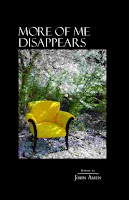
More of Me Disappears by John Amen

John Amen’s More of Me Disappears is broken down into three separate sections and each poem in each section is accessible, vivid, and explosive.  In a number of poems, Amen’s musical and song writing talents permeate the lines.  However, these are more than rhythmic dances, his work gradually moves toward a vanishing point. 

From Verboten (Page 17)

“They are drinking wine and speaking
of French-U.S. relations when the long
sleeve on her arm falls down.  Before
she can clutch it, I see the faded blue
tattoo on her flesh.  “What are those
numbers?” I ask.  A silence explodes
through the room like spores.”

Each poem in this collection tells a story, reflects on a bright memory, and picks these events apart to reveal the truth beneath.  There are times in this volume when the narrator is sure of his path and at other times ideas run contrary to one another.  Some of my favorite lines will leave readers squirming or gritting their teeth.

From Walking Unsure of Myself (Page 65)

“The fortune teller is battling a migraine.
Wind has swallowed my itinerary.

A man in blue goggles is on his knees outside the bank.
The rape victim is scrubbing herself with a steel brush.”

Readers will enjoy the music of these poems and how these poems pop off the pages, with an in your face quality.  Subtlety is not a prevalent style in Amen’s work, but readers will appreciate his frankness.  From poems where the narrator takes an active role to poems to observances from a distance, Amen draws the reader in with immediate and concrete details.  One of the best collections I’ve read in 2009.

New York Memory #3 (Page 36)

“When I get to my dead father’s apartment,
Liz emerges from ruptured planks and exploded plaster.
She is covered with soot, like some pagan baptized
in refuse.  The wrecking crew has come before
we had a chance to vacate the place, stripped the loft
to its skeleton.  My father’s furniture has been destroyed,
a lifetime buried beneath an avalanche of wood and iron.
Beds have been gutted, paintings raped by protruding nails.
A fast-food cup rises from the ruin like a conqueror’s flag.
The apartment is quickly remodeled, rent raised;
the revolving door of humanity spins.  Over the years,
I make a point of knowing who is living there.  I see tenants
come and go.  I accept that we’re not so unlike animals.
I mean, I have this friend who tells me all about bees,
how the queen is revered and protected, ultimately
replaced in a savage deposition, how the mad
hive continues, greater than any one member.
And everything he says sounds familiar, and stings.”

I want to thank John Amen for sending me a free copy of his book More of Me Disappears for review.   For additional examples from this book, visit John Amen’s Web site.

Also, clicking on images and text links to books will bring you to my Amazon Affiliate page.  No purchases are required.

This is my 6th book for the poetry review challenge.