Quantcast

Guest Post & Giveaway: Linda Kass’s Writing Space

Linda Kass is visiting the blog to share her writing space with us today. She has a new novel, A Ritchie Boy, out in the world today from She Writes Press. If you’ve read this blog for any length of time, you’ll already know that I have an affinity for WWII era stories, and Kass’s novel fits into that desire to read about that historical period. Also, enter the giveaway below.

Synopsis:

In this moving and memorable novel-in-stories—inspired by her father’s life—Linda Kass shares the little-known account of the Ritchie Boys. Often Jewish German-speaking immigrants, the Ritchie Boys worked in US Army Intelligence and helped the Allies win World War II.

A RITCHIE BOY follows the life of Eli Stoff. From facing down the anti-Semitism of Austrian classmates in 1938 to his family’s lucky escape; from arriving and assimilating in America to joining the Allied war effort; from the heartbreak of leaving family behind in Austria to setting down his roots in the Midwest, this is the story of a boy becoming a man, and of Eli’s journey from one homeland to another. In A RITCHIE BOY, Kass crafts an achingly powerful, beautifully wrought novel about war, survival, immigration, and hope.

“I devoured A Ritchie Boy over a single weekend. What a rich, beautiful book Linda Kass has written. I found such poignancy and delight in every facet of these characters’ lives. This is first-rate historical fiction.” —Alex George, national and international bestselling author of A Good American and The Paris Hours.

Please give Linda Kass a warm welcome.
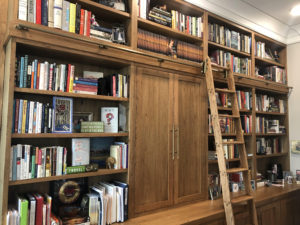
When I moved into our condo, I was determined that my writing space would allow me to be creative and comfortable. I wanted an entire wall to be a library for my prodigious book collection. Since I write historical fiction and do a great deal of research, it was important to me to have so many resources right at my fingertips. I even have a section of books on writing that includes everything from Robert Caro’s Working, about his experiences researching and writing The Power Broker and The Years of Lyndon Johnson to Aristotle’s Poetics and The Art of Time in Fiction (Joan Silber).

Speaking of time, given how much of it I spend sitting in front of my laptop, I wanted a stand-up desk that raises up at the push of a button. That desk surface faces a window so I can look outside and imagine. I can also look to the right of my laptop and see a framed photograph of my father in his ROTC uniform before he left his university to join the US Army. His life inspired my new novel, A Ritchie Boy, about one young immigrant’s journey to American in 1938 and his role as one of the Ritchie Boys, often Jewish German-speaking immigrants who worked in Intelligence and helped the Allies win World War II.

I can also pivot in my chair to a much larger and prettier desk where I can spread out all my papers and books. Under this desk, rests my mini labradoodle, Wally, who keeps me company every moment I am writing. When I hear him moving about, I know it is time to take a break from my writing space and take a walk around the neighborhood!

Photo Credit: Lorn Spolter

About the Author:

LINDA KASS, who began her career as a journalist, is the author of the historical novel TASA’S SONG, which Booklist praised, saying “Kass depicts a heartbreaking time with great sensitivity and detail in this beautifully rendered historical drama." Publishers Weekly called it “. . . a memorable tale of unflinching courage in the face of war—and the power of love and beauty to flourish amid its horrors.” Kass is the founder and owner of Gramercy Books, an independent bookstore in central Ohio. Visit her website.

You can also read an excerpt of A Richie Boy.

I previously reviewed Tasa’s Song.

Enter below with a comment about why you want to read A Ritchie Boy by Sept. 7  Sept. 23 at 11:59 pm EST. Must be 18 years or older and a U.S. resident with a U.S. mailing address.
Mailbox Monday #594

Mailbox Monday has become a tradition in the blogging world, and many of us thank Marcia of The Printed Page for creating it.

It now has it’s own blog where book bloggers can link up their own mailbox posts and share which books they bought or which they received for review from publishers, authors, and more.

Leslie, Martha, and I also will share our picks from everyone’s links in the new feature Books that Caught Our Eye. We hope you’ll join us.

Here’s what we received:

The Year of Magical Thinking by Joan Didion, an Audible freebie.

“Life changes fast….You sit down to dinner and life as you know it ends.” These were among the first words Joan Didion wrote in January 2004. Her daughter was lying unconscious in an intensive care unit, a victim of pneumonia and septic shock. Her husband, John Gregory Dunne, was dead. The night before New Year’s Eve, while they were sitting down to dinner, he suffered a massive and fatal coronary. The two had lived and worked side by side for nearly 40 years.

The weeks and months that followed “cut loose any fixed idea I had about death, about illness, about probability and luck…about marriage and children and memory…about the shallowness of sanity, about life itself.”

In The Year of Magical Thinking, Didion explores with electric honesty and passion a private yet universal experience. Her portrait of a marriage, and a life, in good times and bad, will speak directly to anyone who has ever loved a husband, a wife, or a child.

Listen to Joan Didion’s full-hour interview with Charlie Rose.

War Girl Ursula: A bittersweet novel of WWII (War Girls Book 1) by Marion Kummerow, a Kindle freebie.

In Berlin, 1943, compassion is a crime.

Newlywed Ursula Hermann is a simple woman, wanting nothing more than an end to the war and the return of her husband from the Russian front.

But some things are not meant to be.

The authorities determine that Ursula’s contribution to the war effort is to guard a prison for undesirables and political prisoners.

Then, the unthinkable happens. A prisoner, Royal Air Force pilot Tom Westlake escapes, and Ursula looks the other way. If her single act of mercy is discovered, her life is forfeit.

When the injured airman returns, seeking her help, it is her opportunity to turn over the enemy and save herself from destruction. In a world where right has become wrong, and wrong has become right, Ursula must make a decision: obey the fatherland, or follow her conscience.

Inspired by true historical events, War Girl Ursula is the unforgettable story of one young woman’s moral courage in the face of unspeakable suffering.

Pemberley: Mr. Darcy’s Dragon by Maria Grace, a win from Diary of an Eccentric.

Fitzwilliam Darcy of Pemberley has the good fortune to be in possession of the first English firedrake egg laid in a century. Or, at least, he was until some miscreant stole it.

Mr. Darcy tracks the thief to Hertfordshire. Catching the thief, however, proves to be an entirely different kettle of brimstone, especially when he encounters fellow Dragon Keeper, Miss Elizabeth Bennet of Longbourn.

Elizabeth Bennet’s deep connection to dragons and remarkable grasp of their lore make her the ideal companion for finding the egg. It’s too bad that from their introduction she finds Darcy arrogant, conceited, and selfishly disdainful of the feelings of others.

Time is running out for Darcy to win Elizabeth’s trust and recover the precious egg before it hatches, and the fragile peace between humans and dragons is lost forever.

What did you receive?

Giveaway & Interview with Elizabeth Grace, narrator of Elizabeth: Obstinate, Headstrong Girl edited by Christina Boyd

Welcome to today’s blog post for Elizabeth: Obstinate, Headstrong Girl edited by Christina Boyd. New out on AUDIO. Stay tuned for a few surprises and a giveaway!

Book Synopsis:

With timeless verve, the heroine of Pride and Prejudice, Elizabeth Bennet, bares her intimate thoughts while offering biting social commentary through a collection of romantic re-imaginings, sequels, and prequels, set in the Regency to present day by ten popular Austenesque authors. Foreword by NY Times & USA Today bestselling author Tessa Dare. “I think her as delightful a character as ever appeared in print…” wrote Jane Austen in a letter, January 1813―and we think so too! Stories by Amy D’Orazio, Jenetta James, Christina Morland, Beau North, Joana Starnes, Karen M Cox, Elizabeth Adams, Leigh Dreyer, J. Marie Croft, and Christina Boyd.

Our guest will be the audiobook narrator, Elizabeth Grace.

Check out this awesome interview with Elizabeth Grace:

1. Have you always wanted to be an audiobook narrator or how did you “fall” into the work?

Long story – No! When I was kid I really wanted to be an actress and did a lot of amateur dramatics and drama exams. I was taught how to speak with received pronunciation and perform poetry and prose for exams. When I got older it was drilled into me that acting was more of a pipe dream for a little girl from the midlands in the UK and so, I took the sensible route. I studied American Studies at University and joined the Drama Society on the side which is where I met my now husband. When I graduated, I got a job in Marketing and stayed there, steadily progressing for six years. Last year, when I was reviewing the future of my career, people kept asking what my dream job would be and I reassessed that old pipe dream and wondered if it could become a reality. I am lucky enough to have a partner who believes in me and has a job that can support us both to an extent so after we got married, we planned a long honeymoon and I quit my nine to five with the idea to focus on my acting career full time on our return from a 3 month South American adventure which was due to begin at the end of February this year. In January, I picked up a few projects here and there including some voice over work and audio dramas. I was told my voice would work well for audiobooks and while I hadn’t really considered this as an option for me, I was intrigued. Skip forward 2 months, my brand new husband and I are sat in Chile having the adventure of a lifetime when we are pulled back to the UK after completing 1/3 of our trip due to Covid 19. During lockdown, I had a lot of time to contemplate my next move, I bought some recording equipment, started auditioning for audiobooks and managed to get involved with some amazing JAFF authors and I couldn’t be happier with where I have ended up so far.

2. What is your favorite part about narrating audiobooks?

I love that I can bring the characters to life in the story. I like to get a visual of what a character looks like and then start to work on their voice. They obviously have to sound distinct from each other for the listener to know who is talking, and while that could be just accent and pitch, largely the distinction will become apparent in their demeanour and how they are as a person. So much goes into a person’s voice and it’s fascinating to see how this comes and develops even over the course of narrating a book – I sometimes don’t know where I will end up until I am there!

Elizabeth Grace

3. How much control do you have over the tone of your narration? Does the director provide a lot of guidance? Is the author heavily involved in the process?

I usually like to ask the authors I am working with for a little summary which includes the narrator’s tone as well as the characters’. Coming from a marketing background, I understand the importance of a brief! Oftentimes people know already what they want to hear, they know their characters inside out having created them from nothing so it’s important to respect that. Sometimes, a character may require a very specific accent, for this having some sources of reference is really helpful. Using this as a basis and reading through the book, I will do a sample of maybe one or two chapters then based on this I will receive feedback from the author. I will tweak the recording where necessary based on that feedback but Ultimately however, you have to consider your range as a narrator too and what is sustainable for you so because of that, it is very collaborative and super important that everyone is on the same page before you get too into the recording stage so you don’t waste anyone’s time.

4. What are some of your favorite ways to prepare for a narration project? (ie. listen to certain music beforehand, gargle with salt water, etc.)

I have some voice exercises I do before I begin narrating which I have learnt through my training, nothing too intense but some things that work for me on a day to day. There’s a lot of humming and huge facial stetches that go on behind closed doors. Definitely keep some water at hand and being hydrated is key, sometimes a little mid paragraph gargle is helpful but more often than not, taking a quick break and some deep breaths can set you right again. Dropping your breath (or breathing into your belly rather than your chest) is something that has taken me some time to learn but is essential to making sure you can get through those long sentences. Listening to your body and letting it tell you what it needs is my port of call, some days I will need more warming up than others.

5. Do you read through a certain number of chapters before taking a break? What’s the process and how many hours do you spend on narrating one book?

I record almost everyday, I have found that my voice sounds the best in short bursts and can tire easily after too many hours behind the mic and this becomes really evident in the post production. For me, a couple of hours each day is ideal and then it can then take three times as much time to edit those recordings into a finished version ready for the author to review. It keeps me busy all day and I can usually work this around my other commitments. I like to make sure the author I am working for has a steady drip of chapters to review so there isn’t too much down time on either side. I have learnt the importance of maintaining some “me time” more recently so I do take at least one day off at the weekends.

6. What does your recording studio look like if you have one at home (share photos if you like)?

My recording studio is in the bay window of my bedroom! It’s a cute little set up with a desk, and I have pop up screen that fits just nicely behind me to reduce some of that reverb. I would love a swishy, purpose built studio but for now, this works well for me and hopefully sounds alright on the finished edit you all hear!

7. What has been your favorite narration project and why?

I have loved all the projects I have worked on for their own individual reasons. I have to give a mention to Elizabeth Adams who was the first author I worked with within JAFF though that first book was a modern fiction called Green Card. We have a great connection and the way she writes is so easy to read – I guess we are similar in the way we speak. Elizabeth opened the door for me into the JAFF world and without her I wouldn’t have been introduced to all the amazing women I have worked with since then. Elizabeth: Obstinate, Headstrong Girl was the first anthology I have narrated and it really allowed me appreciate the concept of short stories. I adored picking each of them up and finding new tones, pacing and personality within them while staying true to Jane Austen’s characterisations. It has been such a privilege getting to know these talented authors and I am thrilled to be working with some of them again.

8. What is your favorite Jane Austen novel and why?

It’s a super basic answer but I love Pride and Prejudice, though that has definitely been rekindled after reading Elizabeth: Obstinate, Headstrong Girl. Like a lot of you, I have such an affinity with Elizabeth – we do share the same name after all! Tessa Dare put it so well in her foreword – “she is just like me, but awesome”. However, I do have an affliction whereby I become the biggest fan of the thing I am engaging with at any one time. I have noticed the BBC are rerunning a series of Emma from a few years ago that I am about to settle into again so I am certain I will be reviewing the answer next week.

Thank you, Elizabeth, for sharing your insights about audiobook narrating. I loved reading this and I know that my readers will too.

About the voice actor:

Originally from the East Midlands in the UK, Elizabeth Grace now lives in South London (via two years in Amsterdam). She is a full-time actor, voice over artist, and narrator.

Elizabeth began her professional performing career a little later in life and has been studying at Identity School of Acting in London since 2019. Prior to that, she had a career agency side in Marketing which explains her penchant for client services.

Since 2019, she has been growing her professional portfolio on top of the amateur theatre work she began in her formative years. She has now been a part of many projects from short films and web series to audio dramas and audiobook narration. Visit her website: https://www.elizabethgraceofficial.com/

Here’s an extra treat, an audio excerpt from J. Marie Croft’s excerpt from “The Age of Nescience“.

About the audio snippet: “Character driven vignettes, Elizabeth looks back on her adolescence up to when she meets Darcy, and she comes to admit her own folly, how she has not been wise as she thought. In this short opening scene, Elizabeth is preparing for her coming out and what that means to her.”

The Audio Snippet excerpt:

“But in such cases as these, a good memory is unpardonable.
This is the last time I shall ever remember it myself.”—Chapter LIX

THE AGE OF NESCIENCE

J. Marie Croft

When I was ten, my father told me I was precocious.

Glowing with pride, I beamed at him.

Ten years later, another gentleman told me, “Where there is a real superiority of mind, pride will
be always under good regulation.”

Turning away, I hid a knowing smirk.

What becomes of pride, though, when real superiority exists purely in one’s own narrow mind?

Only now, after throwing a retrospective glance over my adolescence, do I comprehend how
prideful and energetically wilful was my youthful conduct, how flawed was my biased
discernment…and such it had been from the innocent age of ten to the equally nescient age of
twenty.

Coming Out
1806

In honour of a former merchant’s elevated status, a soirée was hosted in Meryton by my aunt and
uncle Philips. On that moonlit evening, I was permitted to attend in company with my parents
and older sister.

Those of higher circles might have argued I, at fifteen, was not of an age to be introduced into
society; but it was the country, and children often accompanied their elders to social events.
Upon any objection to the scheme, my mother defended the propriety of her decision by claiming
a certain right, as sister of the hostess, to bring whomever she pleased to the gathering.

Neither Mama nor I was satisfied with the results when I donned my first half-dress gown and
had my ringleted hair dressed rather than left loose. She lamented my looks were nothing to
Jane’s, and I experienced a mixture of excitement and mortification at being on display in such
an adult fashion…especially since boys I had romped with in childhood might be in attendance
as eligible men.

In the habit of running, I was saddened to relinquish spirited antics and submit to more ladylike
behaviour. How suddenly we are expected to emerge from girlhood to womanhood, from maiden

to wife. The thought of being viewed as marriageable was as uncomfortable as the hairpins
poking into my scalp and the lightly boned stays thrusting my bosom unnaturally upwards.

“Elizabeth Margaret Bennet! You are not leaving the house looking like that!”

“But… Mama!”

Tut-tutting, she removed the fichu I had tucked into my bodice and flailed the triangle of muslin
in my face. “What were you thinking, child?”

“Of modesty. You went against my wishes and had the bodice lowered. I cannot face our
neighbours with so much of my…with so much of me exposed. New meaning might be given to
my coming out.”

“Oh, pish! ’Tis the latest evening fashion. Every elegant lady wears that cut, and no daughter of
mine will be seen as a dowd. Compared to Jane, you must flaunt whatever meagre, redeeming
features you own.”

Despite my mother’s hopes upon launching a second daughter into the society of adults, my
coming out was not an overwhelming success. Although I had been well liked as a precocious
youngster, my new status was paid scant attention by the local populace. The guest of honour, Sir
William Lucas—my friend Charlotte’s father—did pay me a number of “Capital, capital!”

compliments; and, after imbibing too much port wine, Uncle Philips proclaimed my altered looks
charming.

Home from university, a friend bowed over my hand and, in doing so, his eyes came to rest on
my bodice. Eyebrows hitched, he smirked, saying little before turning to speak with my drunken
uncle. It took willpower to still my hand from cuffing the back of his stupid head. Being genteel
will require tremendous effort, I fear. Discomfited over my erstwhile playmate noticing the
changes in my figure, I was—as if of a contrary nature—annoyed he found me unworthy of
further attention. Well, I would not marry you anyway, William Goulding, even were you the last
man on earth.


⭐️Giveaway: The #OmgItsOHG (Oh-my-gosh, it’s Obstinate Headstrong Girl) Audiobook Tour begins August 18 with voice actress reading and we hope you will continue to join us and connect at each stop for continued readings, narrator interviews, excerpts, and giveaways. We’ve included a $25 Amazon gift card giveaway, open worldwide, so be sure to participate. Simply comment on the blog stops to be counted for the giveaway (you need not comment everywhere to be entered in that drawing, but we hope you’ll have your share of the conversation.) Ends September 8.

The Institute by Stephen King (audio)

Source: Purchased
Audiobook, 18+ hrs.
I am an Amazon Affiliate

The Institute by Stephen King, narrated by Santino Fontana, is a really long listen and probably would have went much faster if I had read the print book or ebook, but the audio was enjoyable. Tim Jamieson is a young man on the road, seemingly aimlessly wandering after something tragic happened. He lands in DuPrey, South Carolina, as a night knocker. But his story is put on pause once he gets there and starts talking with the police department and settling into his life. (He’s clearly a plot device)

Shifting the story to the trail to The Institute, we’re introduced to genius boy, Luke Ellis. He is the latest child taken to The Institute, which has a room that looks just like Luke’s, except there is no window. Luke is unclear what has happened and why. He begins wandering the sterile halls where he sees kids like him but who smoke cigarettes and behaving oddly. He vaguely realizes he’s been kidnapped and begins to puzzle out what has happened and what is going on in The Institute. His high intelligence enables him to determine what is going on, but when Avery Dixon comes on the scene, the ball game changes and the scales tip in favor of the kids — the kids with telekinesis and telepathy.

Luke makes friends with those kids in Front Half — Kalisha, Nick, George, Iris, and ten-year-old Avery Dixon. But like those before them, they will “graduate” to Back Half where the real work begins. From the sinister Mrs. Sigsby to Trevor Stackhouse, there are men and women pulling the strings of the institute, but there is clearly a larger organization or group of people behind the scenes. Kids are punished and given tokens when they’re good — tokens they can be used for candy, food, cigarettes, and alcohol.

The Institute by Stephen King, narrated by Santino Fontana, is part dig at Trump and the administration and the wide reaching conspiracy theories that have been bandied about for decades about secret government groups controlling the world. The only twist is that King leans on previous work like the clairvoyance and the need to save the future in The Dead Zone and other work. This one seemed too long in places and in need of editing. I think the political commentary about the current administration, though it isn’t much in the greater scheme of things (though some can draw parallels if they look hard enough), could be grating to some looking for an escape.

RATING: Tercet

About the Author:

Stephen King is the author of more than fifty books, all of them worldwide bestsellers. His recent work includes Doctor Sleep and Under the Dome, now a major TV miniseries on CBS. His novel 11/22/63 was named a top ten book of 2011 by The New York Times Book Review and won the Los Angeles Times Book Prize for Mystery/Thriller as well as the Best Hardcover Book Award from the International Thriller Writers Association. He is the recipient of the 2003 National Book Foundation Medal for Distinguished Contribution to American Letters. He lives in Bangor, Maine, with his wife, novelist Tabitha King.

Other reviews can be found here.

Mailbox Monday #593

Mailbox Monday has become a tradition in the blogging world, and many of us thank Marcia of The Printed Page for creating it.

It now has it’s own blog where book bloggers can link up their own mailbox posts and share which books they bought or which they received for review from publishers, authors, and more.

Leslie, Martha, and I also will share our picks from everyone’s links in the new feature Books that Caught Our Eye. We hope you’ll join us.

Here’s what we received:

NOTHING! Can you believe it? I can. It’s going to be catch up on reading week.

What did you receive?

My Name Is Immigrant by Wang Ping

Source: Purchased
Paperback, 128 pgs.
I am an Amazon Affiliate

My Name Is Immigrant by Wang Ping is a collection of immigrant stories and songs of hardship and perseverance in a country that welcomes immigrants so long as they can be used and serve a purpose. Ping’s tales in some cases are like odes to immigrants who lost their lives pursuing their dreams or who were forced to give them up and return to their home countries. Her poems express a range of emotions that immigrants feel from anger and disappointment to shame and sometimes hope. There also are ghosts haunting these pages.

“All we want is a life like others/…Now the tide is rising to our necks/” (from “Cockle Pickers: Xu Yuhua, Liu Qinying)

In “How to Cross the Line,” Ping’s depiction of a border crossing runs readers through a litany of emotions. The patting of pockets as the immigrant approaches customs, the absence of luggage, and the deliberate choice to forgo identification — signaling that their past and their name are no longer theirs. The cry for asylum — a cry of many facing gangs, violence, poverty — is an echo throughout the collection. It is a cry for not only shelter from outside forces and fear, but also a cry for a chance to help themselves achieve their own dreams.

From Calling Ghosts from the Golden Venture (pg. 38-43)

and here we are
hovering around this New Jersey cemetery
our bodies gone
but our souls still hanging
like curtains soaked in rain
our summer clothes so thin!
so thin our dream!

How beautiful and harrowing language can be. These ghosts from a cargo ship bringing labor to America from China, who hang around waiting for their dream to be realized — a dream that died with them. The thinness of the dream — slipped from their grasp. It’s devastating. Ping provides some background stories for these poems, but even without them, these immigrant stories live and breathe. In “The Names You Call Me,” Ping calls out the hypocrisy of the names that immigrants are called, especially by those who actually embody those names. Throughout this poem, she refutes these names and descriptions and she rages against them in the only way she knows — through poetry. “I’m your parents on the road … your children in cages … named or nameless …I’m Truth that defies your lies … I’m Conscience that jolts you awake in a cold sweat … I’m Poetry that sails hope across the sea and desert.” (pg. 68) And from “Immigrant can’t write poetry,” “poetry, born as beast/move best when free, undressed//” (pg. 73)

My Name Is Immigrant by Wang Ping haunts, sings, rages, and breathes. It is more than a collection of immigrant stories and struggles, it is a homage to their lives and it is a commentary on the nation that claims to be the land of the free and the place where dreams can come true for all who enter and live here.

RATING: Cinquain

About the Poet:

Wang Ping was born in Shanghai and grew up in the East China Sea. Loves the body of water, its sound and smell, loves the touch of the muddy beach and golden sand.

Memorial Drive by Natasha Trethewey

Source: Purchased
Hardcover, 224 pgs.
I am an Amazon Affiliate

Memorial Drive by Natasha Trethewey is an emotional roller coaster that I read in a couple of days. I’ve read much of Trethewey’s poetry in the past, so I was aware that her memoir would be well written. Growing up the daughter of a white father and a Black mother in the south was hard for her parents, but for the most part, they tried to shelter her from the darkness of bigotry and the still segregated south (Yes, the laws had changed, but attitudes and operations definitely had not). But this memoir is not about the fight for equality so much as a mystery slowly unraveled by Trethewey herself. She’s avoided parts of her past surrounding the murder of her mother by her stepfather. In many ways, the memoir reads like an intimate look at her own unraveling of the past and a stitching of herself into a whole being after splicing herself into the girl she was before she saw the apartment where her mother was slain and the woman she became afterward.

“‘Do you know what it means to have a wound that never heals?'” (Prologue)

“I chose to mark the calendar year just after my mother and I left Mississippi as ending, and the moment of loss — her death — as beginning.” (pg. 51)

Trethewey will take readers on a very emotional journey, and I rarely cry at memoirs. This was a tough read from beginning to end, as Trethewey came to terms with her biracial heritage, the divorce of her parents, and the fateful entrance of her stepfather. When she and her mother move to Atlanta, founded as “Terminus” or the end of the line, their perspectives on the move are very different. A child missing her close-knit family life in Mississippi and her mother reaching for a new life. When Big Joe comes into their lives, there’s an immediate sense of dread and fear as he takes her on long rides on the 285 as punishment (mostly for things she didn’t do). But Trethewey still blames her silence for what happened to her mother, even if it is less pronounced than it must have been years ago. Silence is a conundrum for her. “…I can’t help asking myself whether her death was the price of my inexplicable silence.” (pg. 83) When she returns to Atlanta after fleeing the place, she avoids the past and takes any roads that are not 285.

“The truth, however, was waiting for me in my body and on the map I consulted to navigate my way around: how the outline of 285 bears the shape of an anatomical heart imprinted on the landscape, a wound where Memorial intersects it.” (pg. 86)

Memorial Drive by Natasha Trethewey is a gripping tale of healing and reconciling the past. Trethewey relies not only on her memory but on her mother’s own writing, testimony, and recorded phone conversations. I was emotionally wrecked by this memoir. The love she had as a child from both her parents provided her with the strong foundation she needed to revisit this tragic part of her past and to heal herself (at least I’m hopeful that she’s healing).

RATING: Cinquain

About the Author:

Natasha Trethewey is an American poet who was appointed United States Poet Laureate in 2012 and again in 2013. She won the 2007 Pulitzer Prize in Poetry for her 2006 collection Native Guard, and she is a former Poet Laureate of Mississippi.

Other Reviews:

The Migrant States by Indran Amirthanayagam

Source: Purchased
Paperback, 96 pgs.
I am an Amazon Affiliate

The Migrant States by Indran Amirthanayagam is part homage to Walt Whitman and homage to the globetrotter seeking a home in any state or country they land in. Whitman was often fond of wandering by foot, and like many other globetrotters or travelers of today who use planes and other means of travel, the happenstance of meeting others on the road was a call to which they heed. Born in Ceylon, a country Amirthanayagam says no longer exists (it is now Sri Lanka), it is clear that Whitman’s journeys spoke to him and helped him hear the muse for these Migrant states. The reader travels with the poet to Texas, Florida, Lima, and many more states, like Whitman in “Starting from Paumanok.”

In the opening poem, “Mind Breathing,” Amirthanayagam says, “I bear witness to these losses//here as my own attempts to speak, in breaths,/shall infuse a poem able still to coagulate, distill,/strain a few thousand disparate disappearances into verse.//” The reader knows that the poet plans to take us on a journey not only to different geographies but to different states of mind/emotion to ensure that these disappearing migrant states live on and breath. Whitman is always with us on the journey, as he’s recalled by the poet and spoken to about the way things have deteriorated environmentally (plastics in the rivers) in “Ode to and from Whitman.”

Through Amirthanayagam’s journey from punk rocker where he built nothing with a band that only wanted to cover other people’s songs to a “holy” man creating a world of poetry in “When I Left Punk and Took Holy Orders,” readers see that like us, he bucked the system, fought against an establishment. Poetry has a rebellious quality to it even as it is quiet and observing. Many of these poems are quietly rebellious in nature, with just one look at “Written in Advance” (my favorite poem in the collection) recalling the vans that take innocents away for expressing themselves and leaving a poem with editors across the land to tell the true tale.

The Migrant States by Indran Amirthanayagam is a journey into a community that is not housed in one place — it spans the whole of the human race. The poet understands that to commune with others, one must be part of the world, observe, and express the truths that are hardest to hear. To change the world, we must be in it. Engage with it. Mingle with others. Learn together and grow before time is up.

RATING: Quatrain

About the Poet:

Poet, essayist, and translator Indran Amirthanayagam was born in Colombo, Ceylon (now Sri Lanka). He was raised in Sri Lanka, London, and Honolulu. Amirthanayagam has authored numerous poetry collections, including The Elephants of Reckoning (1993), Ceylon, R.I.P. (2001), The Splintered Face (2008), Uncivil War (2013), and Coconuts On Mars (2019). He writes, translates, and publishes poetry and essays in English, Spanish, French, Portuguese, and Haitian Creole.

Mailbox Monday #592

Mailbox Monday has become a tradition in the blogging world, and many of us thank Marcia of The Printed Page for creating it.

It now has it’s own blog where book bloggers can link up their own mailbox posts and share which books they bought or which they received for review from publishers, authors, and more.

Leslie, Martha, and I also will share our picks from everyone’s links in the new feature Books that Caught Our Eye. We hope you’ll join us.

It’s my birthday today and I’m thinking about which books I might buy this week in celebration. Any recommendations are greatly appreciated.

Here’s what we received:

Fetch! A How to Speak Dog Training Guide by Dr. Gary Weitzman and Aubre Andrus; Read the review.

Whether teaching a puppy the basics–such as “sit,” “stand,” and “stay”– correcting behavioral problems, or training your pooch to perform more advanced tricks, this comprehensive guide will take you through all the steps to have your canine answering your call in no time. With the help of veterinarian Dr. Gary Weitzman, kids will bond with their pups through structured lessons that showcase easy-to-follow instructions and commands. Additional content introduces readers to Hollywood hounds, dogs on the job, and famous canines through history. This “paws-on” guide is perfect for families who are bringing home their very first puppy, or seasoned dog owners who want to teach their longtime four-legged family member a few new tricks.

Pounce! a How to Speak Cat Training Guide by Dr. Gary Weitzman and Tracey West; Read the review.

Whether you want to train your kitty to walk on a leash or are trying to teach your cat to scratch a scratching post instead of the couch, this comprehensive guide will take you through all the steps you need to know to get started. With the help of veterinarian Dr. Gary Weitzman, kids will learn basic training, corrective training, and tricks they can do with their cats. Fun special features introduce readers to famous trained cats, felines in ancient Egypt, and so much more. This easy-to-use guide is perfect for families who are bringing home a kitten for the first time or just want to teach their longtime feline family member some new tricks.

What did you receive?

Pounce! a How to Speak Cat Training Guide

Source: Media Masters Publicity
Paperback, 176 pgs.
I am an Amazon Affiliate

Pounce! a How to Speak Cat Training Guide by Dr. Gary Weitzman and Tracey West is a comprehensive look at cat behavior, full magazine-quality images, and so much more. Kids ages 8 and up can learn not only how to gauge when a cat is anxious or angry, but they can also learn about what it means when cats purr. There’s even a quiz about cats that kids can do to learn not only about their diets but also whether cats do have nine lives. Cats can be trained, which is true if you think about how they have to be trained to use a litter box — why wouldn’t you be able to train them to do other things?

We don’t own a cat, but my daughter’s best buddy in the neighborhood has several and she loves playing with them (when we’re not in a pandemic). I think this book would help her friend learn more about cat behavior and how to recognize when the cats have had enough. Beyond training cats to use the litter box and putting on a color, kids and parents can learn to train their cats to come when called, go into a carrier for the vet visit, and using a cat door, as well has how to play with a ball. We learned that much like dogs, cats can be trained to sit, stay, and beg, as well as shake paws.

There are even tips to help with destructive behavior and so much more. Pounce! a How to Speak Cat Training Guide by Dr. Gary Weitzman and Tracey West demonstrates that many animals can be taught tricks. Cats are likely candidates, and kids can be kept safer by learning how to read cat behavior.

RATING: Quatrain