Quantcast

Guest Post: M.J. Rose’s Inspiration for The Book of Lost Fragrances

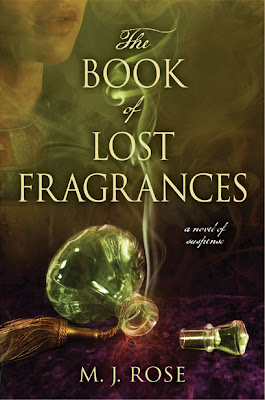
The Book of Lost Fragrances by M.J. Rose (my review) is a suspenseful mystery that takes readers through time from Egypt to present day New York City and Paris.  As with her other books in the series, Malachai Samuels is seeking memory tools to aid in his reincarnation work, but there is more at risk here as friends of his are endangered by his search and are embroiled in international political struggles.

 Today, I’ve got a treat for my readers from the author about what inspired her to write about lost fragrances in her latest reincarnationist book.

Without further ado, here’s M.J. Rose; Please give her a warm welcome.

M.J. Rose:  I’ve been fascinated with lost fragrances since long before I started writing The Book of Lost Fragrances… since I found a bottle of perfume on my great grandmother’s dresser that had belonged to her mother in Russia. Here is one of those lost fragrances that stirs the senses and the imagination… (researched and described with the help of the perfume writer Dimitrios Dimitriadis)

ISSEY MIYAKE – LE FEU D’ISSEY

A creation that came well ahead of its time, Le Feu d’Issey was launched amidst countless androgynous, unisex releases in the mid 90s, and represented the polar opposite of the scents that found their success at that time.

Sichuan pepper, amber and benzoin leant a combustable warmth to the composition, whilst Japanese lily, Bulgarian rose and lactic milk accords an opulent facet. Regarded as a huge commercial flop upon its release, Le Feu d’Issey is a perfume which many look upon now, some 15 years later, as an abstract masterpiece.

Click for the rest of the tour


Thanks, M.J. Rose, for sharing your inspiration with us.  Please follow the discussion on TwitterWith Hashtag: #LostFragrancesVirtualBookTour

The Picture of Dorian Gray by Oscar Wilde

The Picture of Dorian Gray by Oscar Wilde is a Gothic novel with strong themes of corruption, innocence, and the “grand” Faustian bargain.  The novel begins with Basil Hallward who speaks of a mysterious and beautiful young man, Dorian Gray, to his friend Lord Henry Wotton who has some very hedonistic world views.  With elements of Stevenson’s Jekyll and Hyde and Shakespeare’s Hamlet and Romeo and Juliet, Wilde has created a critique of the Victorian era by exaggerating elements of the Romantic age, particularly the horror, awe, and aesthetic experience, which is embodied in Lord Henry and eventually Dorian Gray — in the most absurd way.

Dorian is an insanely narcissistic man who meets Basil and Lord Henry, two men obsessed with beauty and pleasure and its fleeting nature.  Basil is more obsessed with Dorian’s stunning beauty as a fuel for his art, while Lord Henry pontificates his various theories about pleasure and beauty and its transient nature in an effort to garner Dorian’s favor and fuel his own ego that loves the art of influencing others.  Dorian is ripe for Henry’s picking as he seems to be — at least initially — like a child seeking stimulation and knowledge, but like a child, he does not have the tools to question what he is told and what he experiences.

“There was something terribly enthralling in the exercise of influence.  No other activity was like it.  To project one’s soul into some gracious form, and let it tarry there for a moment; to hear one’s own intellectual views echoed back to one with all the added music of passion and youth; to convey one’s temperament into another as though it were a subtle fluid or strange perfume:  there was a real joy in that — perhaps the most satisfying joy left to us in an age so limited and vulgar as our own, an age grossly carnal in its pleasures, and grossly common in its aims . . . ” (page 26)

Wilde’s prose is full of contradictions and theories about the age in which these characters live, and many of these theories (contradictory and otherwise) are espoused by Lord Henry, who remains a catalyst for Dorian’s thinking, which ultimately leads to his tragic downfall.  What’s interesting is that the Faustian bargain is not an outright bargain made by Dorian, but simply an expressed wish that comes true.  This technique is typical of Gothic literature in that some supernatural elements occur and are not explained.  However, Dorian is not blameless in the events that befall him because he is given several opportunities to amend his ways and to experience life more deeply than his superficial pleasure seeking.  For instance, he meets a young woman, Sibyl Vane, who mirrors his older self in that she is innocent of influence and able to see the good and beauty in all of life before her, in spite of its obvious crassness and dingy elements.  But rather than seizing the moment to become something more, Dorian again falls into Lord Henry’s mold, only able to see the superficial and abandons Sibyl, who like Ophelia and Juliet has little choice but to exit from his world.

“There is something of a child about her.  Her eyes opened wide in exquisite wonder when I told her what I thought of her performance, and she seemed quite unconscious of her power.” (page 39)

The Picture of Dorian Gray by Oscar Wilde is like a flippant response to an age where pleasure was the main concern, but its dark, Gothic undertones provide a horrifying examination of how pleasure-seeking and narcissism can lead to a corruption of the soul.  Dorian is a young man led willingly astray by his peers and willingly ignores reason and his conscience to improve his treatment of others and himself.  When the portrait takes on his sins, he becomes free of accountability and engages the world in more than one way that dirties his soul and that of those around him.

***This was the first selection for my new book club***

Only one member did not finish the book, and he said that the language and dialogue between the male characters was unrealistic to him and he had a hard time connecting with the characters and their story.  Other members seemed to like the book well enough, but no one was overly impressed with it, though it did generate a great deal of discussion as to whether Lord Henry was the devil or merely an influencer and why Dorian was so eager to follow the path laid out for him by Lord Henry.  There was a great deal of discussion as to what caused the painting to reflect Dorian’s sins and how that came about and whether the fact that the painting absorbed all his evilness allowed him to not be accountable for his actions and fueled his downfall.

There were some in the club who wanted to know more about certain events in the book (i.e. a poignant blackmail letter), and most of us agreed that the pages of description of Dorian’s collection of fabrics, jewelry, and musical instruments was dry and excessive, it did point to Dorian’s excessive existence.

While it was no one’s favorite book, it certainly generated a great deal of discussion.  I may have liked the book a little more than others and kept pimping the movie version with Ben Barnes.

We’re looking forward to March’s pick:  Star Wars & Philosophy by Kevin Decker and Jason Eberl

The Book of Lost Fragrances by M.J. Rose

The Book of Lost Fragrances by M.J. Rose continues the search for the 12 memory tools that Malachai Samuels continues to search for as part of his research and obsession with reincarnation.  The novel focuses not on Samuels per se, but on the history of the L’Etoile family and their development of perfumes and fragrances.  Jac has given up the family business, even though the family has insisted that she has the more discerning nose for scent, but her brother Robbie continues to believe that their family business can be saved from the brink of bankruptcy through the development of a new line of scents rather than from the sale of their trademark scents.

Rose weaves Napoleonic history with that of China and the oppression of Tibet and then brings those ties even further back into history to Egypt and Cleopatra.  In addition to archeology, her characters delve into mythology, history, and hieroglyphics translation and more, creating an even denser and more mysterious novel than expected.  How these moving pieces come together is unexpected and absorbing.

“The corpse on the left didn’t have his arms crossed on his chest, as was the custom.  Instead his right hand was extended and holding the hand of a woman with whom he’d been mummified.  Her left hand was knotted with his.  The two lovers were so lifelike, their bodies so uncorrupted, it appeared they had been buried months ago, not centuries.”  (Page 5 of ARC)

Through shifting time periods and places, readers travel with Rose’s characters to the deep recesses of their past lives, their memories, and their discoveries, while at the same time feeling the time pressure build as the House of L’Etoile draws nearer to demise and Jac’s brother Robbie disappears following a murder.  Jac must confront the loss of her mother and the expectations of her family as she strives to find her brother, find the perfume that people would kill for, and stay alive and grounded.  Jac must learn that forgetting or ignoring the past will not help her move into the future; she must accept what has happened, take it into herself, and move forward with those memories as a part of her.

“His family’s maison in Paris dated back to the mid-eighteenth century.  One shouldn’t tear down the past to make way for the future.  That’s how lessons were lost.  The art of keeping a civilization alive, like the art of making perfume, was in the blending.”  (page 46)

Meanwhile, Xie, a young calligrapher and artist in China, is living a secret life as a subversive.  Outwardly, he is the model citizen never saying too much but always thankful for opportunities presented to him by his teachers and the government.  He’s eventually chosen along with other artists to leave China on a European tour with their artwork, which makes him incredibly nervous given his communications with outsiders through his paintings.  He strives to free Tibetans from Chinese rule.  Although he is friends with others who are more outwardly subversive than he is, he tries desperately to rein in their tendencies, which could get him in trouble as well as ruin all of his plans.

The Book of Lost Fragrances by M.J. Rose blends history and mystery in an intellectual game of espionage and mythology surrounding a lost book of fragrances from the time of Cleopatra and a perfume that can help those who smell it relive their past lives.  But the novel also is about finding one’s soul mate, rekindling lost faith, and persevering against all odds.  Another winner from Rose in her series of books that will keep readers guessing adn second-guessing themselves until the memory tolls are discovered.

Also Reviewed:

The Hypnotist by M.J. Rose
The Memorist by M.J. Rose

About the Author:

M.J. Rose is the international best selling author of eleven novels and two non-fiction books on marketing. Her next novel THE BOOK OF LOST FRAGRANCES (Atria/S&S) will be published in March 2012.  Her fiction and non-fiction has appeared in many magazines and reviews including Oprah Magazine. She has been featured in the New York Times, Newsweek, Time, USA Today and on the Today Show, and NPR radio.  Rose graduated from Syracuse University, spent the ’80s in advertising, has a commercial in the Museum of Modern Art in NYC and since 2005 has run the first marketing company for authors – Authorbuzz.com.  The television series PAST LIFE, was based on Rose’s novels in the Renincarnationist series. She is one of the founding board members of International Thriller Writers and runs the blog- Buzz, Balls & Hype.  She is also the co-founder of Peroozal.com and BookTrib.com.

Rose lives in CT with her husband the musician and composer, Doug Scofield, and their very spoiled and often photographed dog, Winka.

For more information on M.J. Rose and her novels, please visit her WEBSITE. You can also find her on Facebook.

Click for the rest of the tour


Please follow the discussion on Twitter: With Hashtag: #LostFragrancesVirtualBookTour

Mailbox Monday #165

Mailbox Mondays (click the icon to check out the new blog) has gone on tour since Marcia at A Girl and Her Books, formerly The Printed Page passed the torch. This month’s host is the Metro Reader.

Kristi of The Story Siren continues to sponsor her In My Mailbox meme.

Both of these memes allow bloggers to share what books they receive in the mail or through other means over the past week.

Just be warned that these posts can increase your TBR piles and wish lists.

Here’s what I received this week:

1. Nostalgia for the Criminal Past by Kathleen Winter, which I purchased.

2. The Receptionist by Janet Groth, which came unrequested from Algonquin.

3. A Wedding in Haiti by Julia Alvarez, which came unrequested from Algonquin.

4. Elegy for Eddie by Jacqueline Winspear, which I receive from Harper.

5. A Lesson in Secrets by Jacqueline Winspear, which I received from Harper for a TLC Book Tour.

6. Hurrah’s Nest by Arisa White, which I received from the poet.

7. Real Courage by Michael Meyerhofer, which came from the poet.

8. A Farewell to Arms by Ernest Hemingway, which I bought at Novel Places for the WWI Read-a-Long this year.

9. Harlem’s Hell Fighters by Stephen L. Harris, which I bought at Novel Places.

10. Star Wars & Philosophy by Kevin Decker and Jason Eberl, which I bought at Novel Places for Book Club in March.

11. City of Thieves by David Benioff, which I bought at Novel Places for Book Club in May.

What did you receive?

137th Virtual Poetry Circle

Welcome to the 137th Virtual Poetry Circle!

Remember, this is just for fun and is not meant to be stressful.

Keep in mind what Molly Peacock’s books suggested. Look at a line, a stanza, sentences, and images; describe what you like or don’t like; and offer an opinion. If you missed my review of her book, check it out here.

Also, sign up for the 2012 Fearless Poetry Reading Challenge because its simple; you only need to read 1 book of poetry. Please visit the stops on the National Poetry Month Blog Tour from April 2011 and beginning again in April 2012.

Today’s poems is from Molly Peacock:

Couple Sharing a Peach

It's not the first time
we've bitten into a peach.
But now at the same time
it splits--half for each.
Our "then" is inside its "now,"
its halved pit unfleshed--

what was refreshed.
Two happinesses unfold
from one joy, folioed.
In a hotel room
our moment lies
with its ode inside,
a red tinge,
with a hinge.

What do you think?

Guest Post: Plot Hinge: Where Fact Shapes Fiction by Josh Martin

Today, I’ve got a guest post form Josh Martin about Plot Hinge, a website community dedicated to the serialized novel, especially those shaped by the real world.  The site offers a brief history of the serialized novel, and offers some bonus content, including an alternate chapter by Emily St. John Mandel (I reviewed her novel Last Night in Montreal).

If you are interested in participating, you can contribute by offering some writing, artwork or advice.  Now, without further ado, here’s Josh.

If. For such a little word it certainly packs a lot of significance. If we never met at that coffee shop all those years ago, we wouldn’t be married. If I hadn’t missed my flight I’d have gotten that job. If it keeps raining our basement is going to flood. It’s remarkable how much this tiny word shapes who we are and where we end up in life.

My latest writing project, Plot Hinge, is built around that two-letter word and lets chance decide the outcome of online serial novels.

Here’s how it works.

Each week a new chapter will be posted on the Plot Hinge website. At the end of each chapter the story will be left at a cliff hanger with the story able to progress in a couple different directions. We then connect the story to an upcoming, real-world event. The outcome of that event will decide which direction the plot will proceed and the following chapter is written accordingly.

For example, at the end of the current story’s Prologue (click here to go there now), the readers are left with the plot able to go in a couple directions. Whether or not Wiarton Willie sees his shadow on Groundhog Day (Feb 2) will decide which of those directions the story takes.

It’s a new approach to storytelling that leaves the fate of the plot to chance. The result is an unpredictable but hopefully very rewarding experience for both the reader and me as the author.

So how will these Plot Hinge serial novels end? Well, that’s a bit iffy.

We live in an exciting time where technology and social media are pushing the boundaries of traditional writing and publishing. The internet opens up opportunities to innovate and experiment with new forms of storytelling. Thanks to platforms like blogs, Facebook and Twitter, the walls between readers and writers are starting to crumble, allowing the two sides to interact and collaborate.

I think there will always be a place in the world for traditional, printed books. The tactile experience alone gives them value. But I’m excited about the future of publishing and finding new ways to create and share stories. My hope is that Plot Hinge, and interactive and dynamic stories like it, can contribute in some small way to this evolution of storytelling.

Plot Hinge’s debut serial novel, Run, is now live. You can learn more, read the latest installments and subscribe for free at www.plothinge.com.

Thanks, Josh, for sharing a little bit about your project with us. What do you think about serialized novels and bringing those to the Internet?

About the Creator:

Josh Martin is the creator and author of Plot Hinge serial novels. He was born and raised in rural southwestern Ontario, Canada, with seven siblings. He’s been a writer ever since his story “Super Something” won first prize at the Dungannon Fall Fair when he was in grade 1.

He now lives in the Guelph, Ontario, area where he works as a freelance writer, blogger, and serial novelist. He’s a cancer survivor, card-carrying member of the Sour Toe Cocktail Club, and an avid hiker.

Visit his Website to read more of his work: www.joshmartinink.com.

The Great Gatsby by F. Scott Fitzgerald

The Great Gatsby by F. Scott Fitzgerald is one of those classics that defines an author.  Set during the 1920s just after WWI, Jay Gatsby is a mysterious rich man who lives on the wrong side (West Egg) of the Manhasset Bay in New York.  Nick Carraway, who narrates this tale, is like Gatsby in that he is from the middle west and comes to New York after the war to make his fortune.  Unlike Gatsby, this self-made man has not taken great pains to hide his true past.  Carraway informs the reader of how he meets Gatsby and how he comes once again into contact with his cousin Daisy and her husband Tom, who live on the right side of the bay (East Egg).  While little action goes on in the book until the end, the interactions of the characters and their reactions to one another and Gatsby are telling of how class differences remain even in the United States where you’re supposed to lift yourself up by your bootstraps.  There is a distinct disdain on the part of Carraway for opulence and excess, which had become prevalent among the upper class and bootleggers.

“‘Whenever you feel like criticizing anyone,’ he told me, ‘just remember that all the people in this world haven’t had the advantages that you’ve had.'” (page 5)

Carraway has his suspicions about Gatsby’s fortune, but eventually, his charisma wins him over and he goes beyond any of Gatsby’s friends in the end, demonstrating that true friendship has little to do with one’s background or wealth.  Daisy is the great love in this novel, and while readers may not see her appeal, they must remember that she is seen through the eyes of Carraway, who already has expressed a bias against the wealthy and high social class since returning from the war.  Fitzgerald has not set up a love triangle that is difficult to uncover, but the conclusion of that love triangle — really its more like a love square — is utterly tragic.

“‘Anyhow he gives large parties,’ said Jordan, changing the subject with an urban distaste for the concrete.  ‘And I like large parties.  They’re so intimate.  At small parties there isn’t any privacy.'” (page 54)

In many ways, Gatsby has romanticized his time with Daisy and he hopes to rekindle what he lost when he was shipped off to fight in WWI.  However, the question remains whether what he had with Daisy before the war was real, romanticized, or even imagined by a soldier looking for something to cling to in an effort to survive the horrors of war.  Carraway is just as enigmatic as Gatsby, and while their initial circumstances differed in terms of riches, they both pursued the American Dream of success — albeit in different ways.  These two characters are juxtaposed for a reason, and Fitzgerald leaves it up to the reader to determine why.

“Gatsby believed in the green light, the orgastic future that year by year recedes before us.  It eluded us then, but that’s no matter — tomorrow we will run faster, stretch out our arms farther . . . And one fine morning –” (Page 189)

Fitzgerald’s writing was easy to understand, while there were moments where there were names dropped and mentioned in great paragraphs, if only to demonstrate the connectedness of the characters to high society and other “important” people.  Those moments were not necessary given the conversations Gatsby had at his parties.  The Great Gatsby by F. Scott Fitzgerald is an enduring look at a time when men and women were fully grasping at anything to improve their situation and earn their way in the world.  However, there is a blissful disenchantment with this way of life by the end of the novel that will have readers questioning their dedication to the rat race and beating out the Joneses.


This is my 11th book for the 2012 New Authors Challenge.


This is my 5th book for the WWI Reading Challenge.

Lovesick by Spencer Seidel

Lovesick by Spencer Seidel (available in ebook now, and paperback in June 2012) is a crime thriller with a psychological twist.  Dr. Lisa Boyers is a forensic psychologist and she agrees to assess Paul Ducharme, whose now infamous murder of his best friend Lee on the Eastern Promenade Trail in Portland is gaining national attention.  Boyers is brought closer to her past than she’s comfortable with when a former friend, Rudy Swaner, asks for her help on his case.  Boyers and Swaner tap dance around their past flirtation and her own dark secrets, while she attempts to discover the truth about Lee and Paul’s friendship and the disappearance of Lee’s girlfriend, Wendy.

“Lisa realized that she had barely moved since Paul had begun to tell his story.  He was still talking about that day in the Subway in Monument Square.  She could see in his dark eyes that he was reliving those hard memories.  He wasn’t looking at her.  It was as if she wasn’t in the room.  He was lost in his own mind.”  (page 90)

Lisa still harbors a deep fear of men, though she has tried to bury her memories and fears deep inside.  Rudy dredges up the past just by his presence, and he further confuses things for Lisa by asking her to help him on a case, as he defends Ducharme. Her students see her as an authority in the classroom, but even a teen who has impure thoughts about her freaks her out. Seidel has created a woman who on the outside appears to have it together — a great career and degree — on the inside she’s barely living emotionally.

What’s interesting is how Lisa’s story becomes so entwined with Ducharme’s from a psychological standpoint, and the narrative is told in a third-person format, even as Ducharme relates his story about Lee to Lisa. While Ducharme’s story may be best told from a first-person point of view, the third-person here is not distracting, though it does provide a certain distance between him and the reader. The distance seems to be deliberate to ensure that readers are left in suspense about the crime and Ducharme’s role in it. Seidel does a good job of fleshing out Dr. Boyers and Ducharme, as well as Lee and Wendy, but Rudy and some of the other characters are a bit flat. Rudy particularly seems to be simply a plot catalyst to get her involved in the case, while others are merely part of the setting.

Although the love triangle between Lee, Wendy, and Ducharme is predictable, the ways in which the murder is uncovered keep the story fresh and suspenseful. Lovesick by Spencer Seidel is a fast-paced thriller of sex, lies, abuse and murder that will leave readers on the edge of their seats as the characters struggle with the sickness that has taken over their lives.

Spencer Seidel; Photo by Chad Hunt

About the Author:

Spencer Seidel’s love of reading and writing began as a child after he discovered Roald Dahl’s Charlie and the Chocolate Factory. His first novel, Dead of Wynter, was published in 2011 and was well-received by critics and readers alike. When he’s not writing novels, Spencer enjoys playing loud rock guitar, something he’s been doing for over twenty-five years.

Also, check out his guest post and giveaway.


This is my 10th book for the 2012 New Authors Challenge.

Guest Post & Giveaway: The Lovesick Author by Spencer Seidel

Valentine’s Day is the time to celebrate your loved ones whether they are spouses, significant others, boyfriends, girlfriends, etc.  But there is a darker side to love that creeps into novels like Lovesick by Spencer Seidel.

In the novel, forensic psychologist Dr. Lisa Boyers receives a call from an old friend Attorney Rudy Swaner who needs her to interview young killer Paul Ducharme, who claims he does not remember the events of a murder.  However, as she helps him uncover his memories, she realizes that she must confront her troubled past.

Today, Spencer Seidel is offering us a guest post about the darker side of love.  Please give him a warm welcome.  Also, stay tuned for a giveaway for my U.S. and Canadian readers:

Fiction is best when the author’s voice cannot be heard. But sometimes, inevitably, that voice creeps in. Perhaps a character’s political views too conveniently match those of the author. Or perhaps the raunchy, inorganic sex scenes you’re reading in a new novel make you wonder if the author’s wife really turns her back to her husband at night.

That gets me to thinking. What if an author were to fall hopelessly head-over-heels in love with a character? Better yet, what if he were compulsively and obsessively (ahem) lovesick with his own creation? Hell, it’s Valentine’s Day! We can have a little creepy fun with that, right? Surely things would eventually take a turn for the worse for our poor lovesick author. . .

I imagine a messy desk, littered with manuscript paper, sketches, rejection letters, and overdue bill notices. Above this, a series of composite photos of a woman are pinned to the wall, every image lovingly and painstakingly photoshopped together from various files pulled from Google. Each is slightly different from its neighbor. The woman to the right has larger lips. The other, at the end of the row, smaller breasts. Our author hasn’t gotten her quite right yet and never will. It’s more fun that way. Perhaps she was an old lover or someone he used to know. Or maybe this woman is no one at all. A figment of his imagination. His perfect woman.

The author himself is seated there at his desk, a scotch just out of reach of his right hand. Next to it, a cigarette smolders in a dirty ashtray. The room is dark because the shades are always closed. A pale, unnatural glow from the computer monitor highlights our author. His brown hair spikes outward in greasy clumps. His beard is dark and patchy on his white skin. He wears a faded threadbare bathrobe, untied. He is naked underneath.

To our author’s left is a stack of manuscript paper a foot and a half high, each page neatly aligned with the one beneath and filled with double-spaced type. There must be 1,000 pages or more stacked there, representing years of work.

He types loudly, angrily, in bursts, while gazing absently at the monitor in front of him. Gulps his booze. Pulls hard on his cigarette from time to time. After each writing session, he masturbates compulsively while studying her picture and waiting for his laser printer to finish printing the day’s work.

For months before she left him for good with their young daughter and black lab in tow, his wife tried to understand. She begged him to stop, but like a compulsive gambler, our lovesick writer can’t. He loves his character too much to stop writing about her. And it will cost him everything: his wife, his writing career, his health, his house, and his sanity. In the end, having spent a lifetime writing about his imaginary woman, he will likely die in a psychiatric ward at his keyboard, and his creation will cease to exist shortly after.

On page 18,699.

Thanks, Spencer, for sharing this darker side of love with us.  If you’d like to win a copy of Lovesick, please leave a comment here about the dark obsession of love.  Deadline to enter will be Feb. 29, 2012, at 11:59PM EST.  Happy Leap Year and Happy Valentine’s Day!

For additional chances to win, check out the Blog Tour Scavenger Hunt.

Winners and a Reading

Thanks to all of you who entered the book club giveaway for The Art of Fielding by Chad Harbach.  With the help of Random.org, Anne Berger won a book for each of her club’s 8 members.

Congrats to her and her members, and we hope that you enjoy it.  Hachette Group will mail the books out to you and your book club soon.


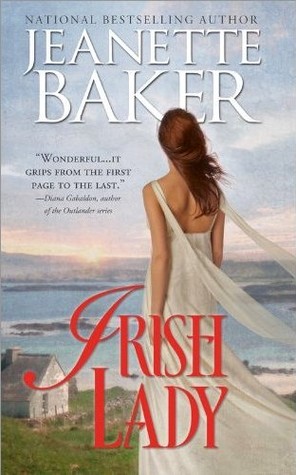
Also Congrats to Margaret who won a copy of Irish Lady by Jeanette Baker from Sourcebooks.


I also wanted to update you on the reading I attended at The Writer’s Center in Bethesda, Md., which turned out to be a mostly empty room and me as the only woman in the room — other than Wiggles.  The illustrious authors were Eric Goodman, author of Tracks — which I’m sure by now you’ve heard me rave about — and Eric Dezenhall, author of my newly acquired book, The Devil Himself.  Each author took to the reading in a different way, with Eric Goodman reading abridged short stories from his novel in stories, Tracks, and Eric Dezenhall deciding to tell the true story behind his historical fiction novel set during WWII.

Goodman read the Prologue, which is told from the point of view of the conductor, and Prewitt’s story from the beginning of the book.  Both stories are funny in their own quirky ways, and provides the initial set up for the rest of the book.  He also read the story about the poet and his climb on the mountain of sand, which is as true to the life of a poet as any story could be.

Dezenhall began by shying away from reading from the book and told us of how he verified the historical facts in his novel.  Operation Underground began when Naval Intelligence realized that German spies could have been responsible for the sinking of the Normandie near Manhattan following the bombing of Pearl Harbor.  In order to police the docks and discover the spies, the government made a devil’s pact with the Jewish and Italian mobs that controlled them at the time.  Meyer Lansky, a real life mobster, agreed to help the government in exchange for benefits for Lucky Luciano and other mobsters.  There is a convoluted spy game afoot here, but I’ll not recount it because you must read the book.

Want to learn more about the book, visit Dezenhall’s Website.

There was no formal question-and-answer following the reading, but there was a more informal reception for the readers and the guests, which turned out to be less than a dozen due to the cold weather.  I did not partake of the cheese and beverages, but did have a nice conversation with Goodman about Social Media and the firewall it provides those of us who are more shy in public.  I also got my copy of Tracks signed, and my new book signed by Dezenhall, who seemed to take a shine to Wiggles — I think it was the cheeks.

Here’s a couple of pictures and a really short video since my memory card ran out of space:

Have you been to any great readings in your area?