Quantcast

Mailbox Monday #168

Mailbox Mondays (click the icon to check out the new blog) has gone on tour since Marcia at A Girl and Her Books, formerly The Printed Page passed the torch. This month’s host is Diary of an Eccentric.

Kristi of The Story Siren continues to sponsor her In My Mailbox meme.

Both of these memes allow bloggers to share what books they receive in the mail or through other means over the past week.

Just be warned that these posts can increase your TBR piles and wish lists.

Here’s what I received this week:

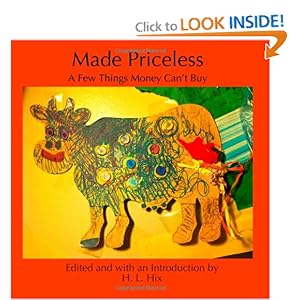
1.  Made Priceless: A Few Things Money Can’t Buy edited by H.L. Hix, which I received from Hix since I am a contributor.

Made Priceless presents snapshots of objects that their holders treasure: a 1950s swivel rocker, a fortune-cookie fortune that reads “The rubber bands are heading in the right direction” a marble with a world map painted on it, a bread-baking pan, a bar of soap, crocheted doilies, a masonry trowel… Each object has its own story, each its own meaning. The book’s contributors include artists, a banker, a retired career military officer, secretaries, a pilot, stay-at-home mothers, students, professors, and others, each with a testament in praise of something priceless. The result is a remarkable collection that honors what money can’t buy, and celebrates the extraordinary significance in an ordinary things.

2. Restoration by Olaf Olafsson, which the Literate Housewife passed on to me. Thanks so much!

Having grown up in an exclusive circle of wealthy British ex-pats in Florence in the 1920s, Alice Orsini shocks everyone when she marries the son of a minor Italian landowner and begins restoring San Martino, a crumbling villa in Tuscany, to its former glory. But after years of hard work, filling the acres with orchards, livestock, and farmhands, Alice’s growing restlessness pulls her into the heady social swirl of wartime Rome and a reckless affair that will have devastating consequences.

Her indiscretion is noticed by careful eyes—those of Robert Marshall, a renowned dealer of renaissance art. In exchange for his silence, he demands Alice hide a priceless Caravaggio, a national treasure that he has sold to the Germans, at San Martino. As the front creeps toward Tuscany, sending a wave of orphans, refugees, and wounded Allies to San Martino, Alice trusts that the painting she’s hiding will keep the Germans at bay. What she doesn’t know is the truth about a brilliant young artist she harbors named KristÍn, a prodigy who can restore any painting, and whose secrets may ruin them all.

Trapped between loyalists and resistors, cruel German forces and Allied troops, Alice and KristÍn must withstand the destruction of everything around them while painfully confronting the consequences of their past mistakes.

3. The Lola Quartet by Emily St. John Mandel, which came from LibraryThing Early Reviewers.

Gavin Sasaki is a promising young journalist in New York City, until he’s fired in disgrace following a series of unforgivable lapses in his work. It’s early 2009, and the world has gone dark very quickly; the economic collapse has turned an era that magazine headlines once heralded as the second gilded age into something that more closely resembles the Great Depression. The last thing Gavin wants to do is return to his hometown of Sebastian, Florida, but he’s drifting toward bankruptcy and is in no position to refuse when he’s offered a job by his sister, Eilo, a real estate broker who deals in foreclosed homes.

Eilo recently paid a visit to a home that had a ten-year-old child in it, a child who looks very much like Gavin and who has the same last name as Gavin’s high school girlfriend Anna, whom Gavin last saw a decade ago. Gavin—a former jazz musician, a reluctant broker of foreclosed properties, obsessed with film noir and private detectives—begins his own private investigation in an effort to track down Anna and their apparent daughter who have been on the run all these years from a drug dealer from whom Anna stole $121,000.

What did you receive?
The Yellow House Read-a-Long, Part 1

As part of the 2012 Ireland Reading Challenge, we’re reading The Yellow House by Patricia Falvey.  For the first week, we read pages 1-90.  I’m going to answer the read-a-long questions here.  Please be aware that the answers could have spoilers in them.

1.  What do you think of the writing?

Falvey’s writing is very in step with other Irish writers I’ve read in the past where the diction and the style resembles the time period and the very mythical Irish culture.  I’m enjoying the detail and the description a great deal; it gives me a sense that I am there in the valley below Slieve Mullion, the mountain looking down on the O’Neill house.

I had a hard time stopping after the second section in the book when I hit page 90.

2.  What do you think of Eileen’s parents?

Eileen’s parents have secrets, and these secrets are well hidden from the children, as to be expected during that time.  Parents did not openly talk about their courtships or previous relationships with their lovers and/or parents to their children.  I’m surprised at how lively Eileen’s mother talked of the past once it was revealed where their grandfather lived.  It seemed a bit incongruous to me that she would suddenly want to reminisce with her kids about a past she had kept so hidden and one that was fraught with despair and heartache.  I really was disappointed that such a strong woman was unable to bounce back after tragedy to help her other children!  It saddened me to think that she would withdraw so much, and after the death of the father, she became an unrecognizable woman…that seemed a bit extreme to me.

Eileen’s father is a typical dreamer, which has been seen in other Irish novels, but what’s intriguing here is that he is not a drunkard and does not make foolish monetary decisions that leave his family out in the cold for the most part.  He does make a go of farming, though eh fails miserably at it, but rather than gamble away the future, he takes the reasonable road and sells a portion of the land…at least until he takes out a mortgage on the house.

3.  It seems that the book is heading in a romantic direction when it comes to Eileen and Owen Sheridan. What do you think of this potential romance?

Eileen and Owen have a sort of forbidden love, which can be tempting, but for now it seems that Eileen is being level-headed…however, there also is the wild card of James, whom she is determined to hate.  But will she really, and will he really become a priest?  That remains to be seen.  It also seems to be a similar set up going on here that may mirror her mother’s past when she became pregnant with Frank and instead of marrying his father, she marries Eileen’s dad.

4.  As we closed the second section, the world is on the brink of the First World War, and Ireland is being torn apart by the fight for Home Rule. Have you learned anything about Ireland or the world at this time period that was new to you?

I finally understand the difference between the Unionists and the Nationalists!  These were mentioned in A Long Long Way by Sebastian Barry (my review), but it was so confusing given the main character, Willie had little knowledge of politics related to WWI or the Irish struggle for Home Rule.  I hope there is more of the politics behind the wars in this one.  It’s fascinating to me, though I don’t want the book to lose its pace or its dynamism.

***Some Other Observations***

I really love how Falvey has used nature here to demonstrate the struggles of the Irish, and her descriptions of the Music Men are fantastic at demonstrating the power of music and how it became a safe heaven for many Irish.  I’m also getting curious about the significance of yellow here; it seems to be recurring in the house paint, Eileen’s dress, and other events.  I cannot wait to see how that ties into the overall novel.

For next week, we’ll be reading pages 91-164 or sections “War, 1914-1918″ and “Insurrection, 1919-1920.”

140th Virtual Poetry Circle

Welcome to the 140th Virtual Poetry Circle!

Remember, this is just for fun and is not meant to be stressful.

Keep in mind what Molly Peacock’s books suggested. Look at a line, a stanza, sentences, and images; describe what you like or don’t like; and offer an opinion. If you missed my review of her book, check it out here.

Also, sign up for the 2012 Fearless Poetry Reading Challenge because its simple; you only need to read 1 book of poetry. Please visit the stops on the National Poetry Month Blog Tour from April 2011 and beginning again in April 2012.

Today’s poems is from Joy Harjo:

Equinox

I must keep from breaking into the story by force
for if I do I will find myself with a war club in my hand
and the smoke of grief staggering toward the sun,
your nation dead beside you.

I keep walking away though it has been an eternity
and from each drop of blood
springs up sons and daughters, trees,
a mountain of sorrows, of songs. 

I tell you this from the dusk of a small city in the north
not far from the birthplace of cars and industry.
Geese are returning to mate and crocuses have 
broken through the frozen earth.

Soon they will come for me and I will make my stand
before the jury of destiny. Yes, I will answer in the clatter
of the new world, I have broken my addiction to war
and desire. Yes, I will reply, I have buried the dead

and made songs of the blood, the marrow.

What do you think?

I’ve Been Keeping a Secret, But It’s Out Now….

Last year, a poet I interviewed for 32 Poems, H.L. Hix, asked if I would contribute to his blog about objects that are made priceless by how and why they are received/given for his blog project at IN QUIRE.  He published my little “object lesson” in 2011.  I know that some of you may have read it already, but the secret I’ve kept is that H.L. Hix had told me that he had hoped to create a book out of these lessons.  I wasn’t hopeful because it includes something I wrote, and I thought who the heck would want to read that.  But now, I’m coming clean.  The secret and the book are out!

Something I wrote in tribute to my nana (Aune Mullen — 1915-1998) has been published in a book, Made Priceless: A Few Things Money Can’t Buy.

I hope that you will buy this book to support not only this blog and my writing, but also the charities to which H.L. Hix will contribute.

I cannot begin to tell you what this publication means to me and how I feel it honors nana’s memory.  It is more than I could have ever dreamed of or asked for in my lifetime.  I’m glad that it has arrived in my home.  I hope to buy a few copies for my parents and aunts.  I urge you all to do the same because not only is this book important to me and the memories I’ve shared, but to all the other contributors.

Thanks to all of you who continue to support the blog, my writing, and everything I try to accomplish here.

***Updated at 11:40 AM***

If you want a signed copy, you can send a payment to my paypal account savvyverseandwit AT gmail DOT com and I can send you one.

I can get a discount as a contributor from the publisher, so it would $17 with shipping for those of you who are interested!

Winner of Lovesick by Spencer Seidel

The winner of Lovesick by Spencer Seidel was:

Ellie, who said, “This sounds like a realistic approach to the problems of substance abuse and the effects this illness has on relationships.”

Congrats to you.  I hope you enjoy the book.

I’ll be a bit silent this week as I’m on vacation and the in-laws are in town.  I hope everyone had a great week.

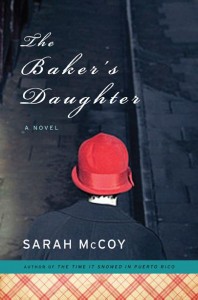
The Baker’s Daughter by Sarah McCoy

The Baker’s Daughter by Sarah McCoy is a novel told in a number of different points of view and spans several time periods, including the final year of World War II.  Two strong female protagonists, each haunted by the past and each past is tied to war in one way or another.

Elsie Schmidt is a German immigrant to El Paso, Texas, who spent the last year of WWII in her father’s bakery working and shying away from the decisions that came with living in Nazi Germany.  Unlike her sister, Hazel, who was in the Lebensborn program and praised for her work to help the Fatherland, Elsie sees herself as more of an outsider, lacking in the standard skills expected of a Good German.

“While Hazel thrived and grew more popular, Elsie felt oppressed and stifled by the uniforms and strict codes of conduct.  So at the tender age of eleven, she begged Mutti to work in the bakery.” (Page 16)

Reba Adams is also an El Paso transplant, but she’s a journalist looking for her latest feel-good piece for the magazine she works for, but she gets more than she bargained for when she meets Elsie.  Meanwhile, she’s hiding from her past and the ghosts of her dead Vietnam veteran father and failing to fully commit to the life she’s created in Texas with her fiance Riki, a border patrol officer.

“Everyone on campus knew her from the photograph in the Daily Cavalier: her lips bulging on the mouth guard; fuzzy, dark hair matted beneath the headgear; gloves up and ready.  They thought she was an anomaly coming from the Adams family.”  (Page 33)

The two different main perspectives in two different time periods is deftly handled by McCoy and each of her characters are strong and stubborn, but neither is lacking in dynamism or flaws.  Also unique to the novel is how well McCoy weaves in the elements of baking and pastry into her description; it is seamless and will make readers’ mouths water and have them itching to try the recipes in the back of the book.  Touching on family loyalty, mother-daughter bonds, father-daughter bonds, relationships of all kinds, plus the search for love and forgiveness, McCoy reaches deep inside the dough to knead the bonds of these women to help them grow outward and inward, allowing them to absorb more love and connections.  The recipe for a successful novel is two parts dynamic characters, one part intriguing plot and story lines, and one part clever writing style, and The Baker’s Daughter provides all the nourishment you’ll need.

Click for Tour Stops

About the Author:

SARAH McCOY is author of the novel, The Time It Snowed in Puerto Rico. She has taught English writing at Old Dominion University and at the University of Texas at El Paso. The daughter of an Army officer, her family was stationed in Germany during her childhood. She calls Virginia home but presently lives with her husband and dog, Gilbert, in El Paso, Texas. The Baker’s Daughter is her second novel. She is currently working on her next.

Website | Blog | Facebook | Twitter

This is my 16th book for the 2012 New Authors Challenge.

A Long, Long Way by Sebastian Barry

A Long, Long Way by Sebastian Barry is a historical fiction novel in which the main protagonist, Willie Dunne, joins the military to prove to himself and his father that he can be more than a short teenage boy.  As a young Irish boy, he dreamed of joining his father in the police force, but he never grew to the required height.  After disappointing his father, Willie meets a young woman, Gretta, and falls in love, just before he leaves for the front lines in Belgium.  Willie is a bit dull when it comes to the politics behind WWI, but he’s also dull about the politics and struggle facing his home country of Ireland.

Barry’s prose meanders is a storytelling fashion that dates back to the old days in Ireland, and is likely to remind readers of Frank Delaney’s storytelling style.  Willie’s mind wanders into his past as a boy to the present situations he finds himself in at the front lines, with a variety of men who are as young as he is.  It is clear that these men he mentions are names that will either be soon forgotten as the ravages of war take them or who are men that make an impression on Willie’s psyche, such as Father Buckley.

“Four men killed that day.  The phrase sat up in Willie’s head like a rat and made a nest for itself there.”  (Page 21)

“As they approached the war, it was as if they went through a series of doors, each one opened briefly and locked fast behind them.” (Page 37)

“The first layer of clothing was his jacket, the second his shirt, the third his longjohns, the fourth his share of lice, the fifth his share of fear” (Page 43)

Barry’s prose is clipped when necessary to demonstrate the immediacy of war-time battles, but also it slows down the action as Willie reflects on the battles, the gas attacks, the deaths of his comrades, and more as he attempts to process all that he’s seen.  There are gruesome gas attack scenes as the mustard gas inches its way across no-man’s land and down into the trenches, filling every open crevice with its nasty poison, including the open mouths of men caught in the trenches without gas masks or even well-secured gas masks.  Barry’s work not only demonstrates the physical trials of war, but also the mental hardships that accompany the loss of friends and people you didn’t even really have time to get to know, as well as deal with the bureaucracy that is the military and the perceptions of others about your commitment to the cause and battles that happened in the past that you witnessed first hand and may not be retold in the way in which they actually happened.  There is a battle that rages inside each soldier about when to speak up and when to keep quiet, and Willie struggles with that daily.

Willie can be a trying character in that he has little knowledge of the politics around him and has little opinion on the matter, and this can keep readers at an emotional distance.  However, Barry has crafted a novel that demonstrates the ins and outs of war at a time when modern mechanisms were just coming into play, even though much of the combat was still hand-to-hand and the troops conditions saw little improvement.  Additionally, it seems that Barry is attempting to comment on “authority” whether it is in the parent-son relationship, the soldier-military relationship, or the citizen-country relationship, but the message becomes quite muddled.  It would almost seem as though the narration is trying to tackle too much in the way of the “authority” figure relationship, making it harder for readers to clearly make out the purpose of so many “father” figures in the narration.

A Long, Long Way by Sebastian Barry takes a while to get into, but once you begin the journey with Willie, you’ll want to see if he returns to Ireland knowing his own mind — the one requirement Gretta has made of him before she will agree to marry.  While Willie thinks of her often, he also has to contend with the daily trials of war and military service.  The novel is does not gloss over the gruesome aspects of trench-life and warfare, so be warned.  In fact, some of the best and most suspenseful scenes were those involving mustard gas, which Willie and his fellow soldiers had never seen before; Barry did well in describing how it crept across the battlefields.  Overall, a worthwhile look at WWI from the point of view of an Irish soldier caught between his loyalties for Ireland and the British army.

About the Author:

Sebastian Barry was born in Dublin in 1955. His play, The Steward of Christendom, first produced in 1995, won many awards and has been seen around the world. His novel, The Whereabouts of Eneas McNulty, appeared in 1998. He lives in Wicklow with his wife and three children.

This is my 7th book for the WWI Reading Challenge.


This is my 15th book for the 2012 New Authors Challenge.


This is my 1st book for the 2012 Ireland Reading Challenge since the main protagonist is Irish and must cope with being away during WWI while uprisings are occurring in Ireland for independence from England.  The author also was born in Dublin.

Mailbox Monday #167

Mailbox Mondays (click the icon to check out the new blog) has gone on tour since Marcia at A Girl and Her Books, formerly The Printed Page passed the torch. This month’s host is Diary of an Eccentric.

Kristi of The Story Siren continues to sponsor her In My Mailbox meme.

Both of these memes allow bloggers to share what books they receive in the mail or through other means over the past week.

Just be warned that these posts can increase your TBR piles and wish lists.

Here’s what I received this week:

1.  What It Is Like to Go to War by Karl Marlantes, which I bought.

In 1968, at the age of twenty-three, Karl Marlantes was dropped into the highland jungle of Vietnam, an inexperienced lieutenant in command of a platoon of forty Marines who would live or die by his decisions. Marlantes survived, but like many of his brothers in arms, he has spent the last forty years dealing with his war experience. In What It Is Like to Go to War, Marlantes takes a deeply personal and candid look at what it is like to experience the ordeal of combat, critically examining how we might better prepare our soldiers for war. Marlantes weaves riveting accounts of his combat experiences with thoughtful analysis, self-examination, and his readings—from Homer to The Mahabharata to Jung. He makes it clear just how poorly prepared our nineteen-year-old warriors are for the psychological and spiritual aspects of the journey.

Just as Matterhorn is already being acclaimed as acclaimed as a classic of war literature, What It Is Like to Go to War is set to become required reading for anyone—soldier or civilian—interested in this visceral and all too essential part of the human experience.

2.  The Names of Things by John Colman Wood for review in May from Ashland Creek Press.

The anthropologist’s wife, an artist, didn’t want to follow her husband to the remote desert of northeast Africa to live with camel-herding nomads. But wanting to be with him, she endured the trip, only to fall desperately ill years later with a disease that leaves her husband with more questions than answers.

When the anthropologist discovers a deception that shatters his grief and guilt, he begins to reevaluate his love for his wife as well as his friendship with one of the nomads he studied. He returns to Africa to make sense of what happened, traveling into the far reaches of the Chalbi Desert, where he must sift through the layers of his memories and reconcile them with what he now knows.

3.  The Garden of Evening Mists by Tan Twan Eng for review in March from Myrmidon Books.

It’s Malaya, 1949. After studying law at Cambrige and time spent helping to prosecute Japanese war criminals, Yun Ling Teoh, herself the scarred lone survivor of a brutal Japanese wartime camp, seeks solace among the jungle fringed plantations of Northern Malaya where she grew up as a child. There she discovers Yugiri, the only Japanese garden in Malaya, and its owner and creator, the enigmatic Aritomo, exiled former gardener of the Emperor of Japan. Despite her hatred of the Japanese, Yun Ling seeks to engage Aritomo to create a garden in Kuala Lumpur, in memory of her sister who died in the camp. Aritomo refuses, but agrees to accept Yun Ling as his apprentice ‘until the monsoon comes’. Then she can design a garden for herself. As the months pass, Yun Ling finds herself intimately drawn to her sensei and his art while, outside the garden, the threat of murder and kidnapping from the guerrillas of the jungle hinterland increases with each passing day. But the Garden of Evening Mists is also a place of mystery. Who is Aritomo and how did he come to leave Japan? Why is it that Yun Ling’s friend and host Magnus Praetorius, seems to almost immune from the depredations of the Communists? What is the legend of ‘Yamashita’s Gold’ and does it have any basis in fact? And is the real story of how Yun Ling managed to survive the war perhaps the darkest secret of all?

4. A Demon Does It Better by Linda Wisdom, which I won from Peeking Between the Pages.

A MADHOUSE IS NO PLACE FOR A CURIOUS WITCH…
After more than a century, Doctor Lili Carter, witch healer extraordinaire, has returned to San Francisco and taken a job at Crying Souls Hospital and Asylum, where something peculiar and wicked his happening. Patients are disappearing, and Lil wants to know why. AND DOUBLY DANGEROUS FOR A DEMON… Lili finds herself undeniably attracted to perhaps the most mysterious patient of all-a demented but seriously sexy demon named Jared. What’s behind the gorgeous chameleon demon’s late-night escapades? Before long, Lili and Jared are investigating each other-and creating a whole new kind of magic.

What did you receive this week?

139th Virtual Poetry Circle

Welcome to the 139th Virtual Poetry Circle!

Remember, this is just for fun and is not meant to be stressful.

Keep in mind what Molly Peacock’s books suggested. Look at a line, a stanza, sentences, and images; describe what you like or don’t like; and offer an opinion. If you missed my review of her book, check it out here.

Also, sign up for the 2012 Fearless Poetry Reading Challenge because its simple; you only need to read 1 book of poetry. Please visit the stops on the National Poetry Month Blog Tour from April 2011 and beginning again in April 2012.

Today’s poems is from Federico García Lorca:

Arbolé, Arbolé . . . (translated by William Logan)

Tree, tree
dry and green.

The girl with the pretty face 
is out picking olives. 
The wind, playboy of towers, 
grabs her around the waist. 
Four riders passed by
on Andalusian ponies, 
with blue and green jackets 
and big, dark capes. 
"Come to Cordoba, muchacha." 
The girl won't listen to them. 
Three young bullfighters passed, 
slender in the waist, 
with jackets the color of oranges 
and swords of ancient silver. 
"Come to Sevilla, muchacha." 
The girl won't listen to them. 
When the afternoon had turned
dark brown, with scattered light, 
a young man passed by, wearing 
roses and myrtle of the moon. 
"Come to Granada, muchacha." 
And the girl won't listen to him. 
The girl with the pretty face
keeps on picking olives 
with the grey arm of the wind 
wrapped around her waist.
Tree, tree
dry and green.

What do you think?

Seuss and More

I’ve dropped all reading today

because today is Dr. Seuss’ birthday

or so they tell me

those bloggers I see.

Let’s celebrate

his wit and fate

to entertain children and adults

with whimsical words to exult.

He’ll be 108

isn’t that great.

Come share your rhymes

on Twitter; we’ll have good times.

Hashtag #SeussDay

Come and Play.

For the LOVE of Seuss

In all Seussiness, please join us and share your Seussian memories, favorite books, favorite rhymes, politics, and more today.  I’ll tell you that my love of poetry started with Seuss’ Cat in the Hat, which he didn’t have published until 1958!  If you have no idea why Seuss (Theodor Seuss Geisel) is so fun, you should check out Seussville where you can learn about the author, his life, his politics, and just have fun creating your own Whoville character!

In a twist on Necromancy Never Pays‘ weekly trivia game, I’ve crafted a set of Seussian lines for you to check out and tell me which book they came from.  A Seussian prize will be given to the winner who will be drawn at random from those who get all the answers right.

1.  “UNLESS someone like you cares a whole awful lot, nothing is going to get better.  It’s not.”

2.  “They kept paying money.  They kept running through until neither the Plain not the Star-Bellies knew whether this one was that one . . . or that one was this one or which one was what one . . . or what one was who.”

3.  “‘I will not let you fall.  I will hold you up high as I stand on a ball.  With a book on one hand! And a cup on my hat!  But that is not ALL I can do!'”

4.  “I hate this game, sir.  This game makes my tongue quite lame, sir.”

5.  “I’m sorry to say so but, sadly, it’s true that Bang-ups and Hang-ups can happen to you.  You can get all hung up in a prickle-ly perch.  And your gang will fly on.”

My daughter’s room is homage to Seuss in his books, his famous quotes, his color palette, and his characters.  I wanted her to be secure in her imagination, and I think that room will help her see that imagination can be

instrumental in success and happiness.  What I always loved about Seuss — besides his poetic rhymes — was the limitlessness of his imagination in the worlds and characters he created.  Worlds I just wanted to jump into and lose

myself in as a kid.  He showed me that life was full of possibilities as long as I was willing to grab onto opportunity or create it where there was none.

For some fun with kids older than mine, you should check out the Seuss crafts on CoffeeCupandCrayons (Mulberry Street, One Fish Two Fish Red Fish Blue Fish, Oobleck)!

***Also today, I wanted to let everyone know that the judging process is still going for the Indie Lit Awards, and that the winners will be announced this month.***