Quantcast

The Devil’s Scribe by Alma Katsu

The Devil’s Scribe by Alma Katsu is an e-short story released by Simon & Schuster this month, and it’s the first thing I’ve read on my Kindle!  Can you believe it?!  What prompted me to finally read on the Kindle?!  You’ll never guess, well maybe you will by the end of this unconventional review.

“He fell on the bottle before he took a seat, pouring two fingers of whiskey into his wineglass, streaked with the last of a red he’d consumed.  Now that he’d gotten his invitation, his tentative edge fell away, replaced by relief.”  (from the e-story)

Lanore McIlvrae from The Taker (my review) meets with the one and only Edgar Allan Poe by chance in an expensive Baltimore hotel in 1846 after having been gone from America for the last 20 years.  Poe describes himself as an orphan and a widower able to support himself as the “devil’s scribe,” but Lanny seems passingly interested in his life story and the fact that he’s a writer.  However, in spite of her preoccupation with why she came back to America, she walks with this stranger through the streets of Baltimore, careful not to reveal too much of herself to him.

The story raises the idea of telling strangers secrets as a way to unburden the soul without having to deal with the same consequences one would have to deal with should they tell someone they know intimately or should they tell a family member.  It is reminiscent of the relationship between dying soldiers and/or patients and the priest that comes to hear their sins, though in this situation, Poe cannot offer Lanny absolution.

Even in this short story, Katsu is adept at creating tension and suspense as Lanny and her new companion make their way to Boston.  The story is predictable — though because I’ve already read The Taker — but well written.  Readers who know anything about Edgar Allan Poe should realize where the story is headed, but I’ll not give it away.  I really enjoyed learning more about Lanny and her fears, and it will likely play into Katsu’s next book, The Reckoning.

***Reading on the Kindle***

It wasn’t too bad with a short story.  I actually was surprised how I remained focused, but I’m not sure that I can remain focused for a full length novel.  I may try doing that soon, but for now, I’m still a fan of “real” books.

Star Wars & Philosophy edited by Kevin S. Decker and Jason T. Eberl

Star Wars & Philosophy edited by Kevin S. Decker and Jason T. Eberl is a collection of philosophical essays that draw on the Star Wars movies for examples and the philosophies of St. Augustine, Sartre, and others.  The collection is moderately well done in some parts and blatantly falls short in others, with one particular essay not using secondary sources to back up its arguments at all and leaving readers to beg the question whether Trekkies can write about Star Wars at all.  The essays draw on ancient philosophers as far back as Plato and Aristotle as well as one essay about Eastern philosophies and mythologies.  There are also essays that point to the theories of Kant, Heidegger, and Hegel.

Broken up into four sections — May the Force Be With You: The Philosophical Messages of Star Wars; Try Not — Do or Do Not: Ethics in a Galaxy Far, Far Away; Don’t Call Me a Mindless Philosopher: Alien Technologies and the Metaphysics of the Force; and There’s Always a Bigger Fish: Truth, Faith and a Galactic Society — the collection tackles the hidden philosophies and ethics inherent in the story behind Star Wars and its characters, plus the ethics of future wars and whether droids can be considered people (not humans).  There also are questions about whether everything is preordained or if we have the free will to choose our own paths.  Moreover, religion and moral ambiguity are discussed as well, especially in terms of prophecy and whether one can choose to be moral even if a destiny signifies an opposite action.

In terms of Yoda, when watching the movies, there is a clear Eastern philosophical influence in his manner, his behavior and his teachings, but in the essay “Stoicism in the Stars” by William O. Stephens, the author also makes the case that Yoda is a Stoic and takes on the role of the Sage who never rises to anger and never gives into the desires or seeks out adventure or excitement.  Additionally, Stephens comments on how Stoics often live in agreement with Nature as Yoda does in his hut on Dagobah, and Yoda praises equanimity and peace of mind, which also is characteristic of Buddhists and others who meditate to find peace and separate themselves from ego.  In a way, several essays — even though they focus on Western philosophy — often draw out elements of those philosophies that are found in Eastern philosophy, such as the fluidity of the Force in Star Wars or the fluidity of the future despite prophecies and destinies referred to with regard to the Skywalker family, which is somewhat like the soul or the energy shared by all living things in Eastern philosophy that is reused and recycled in nature (i.e. reincarnation, etc.).

What does this collection offer that is new to someone who was a philosophy major or minor, probably very little, but what was intriguing was some of the history lessons, such as the parallels between the Jedi in Star Wars and the Hwa Rang as leaders of the “military.”  It does provide a great number of secondary resources for readers to check out should they need further explanation of a philosophy without the Star Wars references.  None of the references used were overly surprising in the well done essays, but there were times when references to the movies were inappropriate to the argument being made.  Such was the case in the essay “Send in the Clones:  The Ethics of Future Wars” by Richard Hanley (which cited no secondary sources other than a previous essay in the book) in which Hanley talks about Just War Theory — that is only satisfied by having the right intention, competent authority, just cause, reasonable prospect of success, discrimination, and proportionality — but does not use an example of actual war from the movie.  Rather, Hanley relies on the slaughter of the Sand people by Anakin Skywalker, which he engages in to revenge the killing of his mother by specific Sand people.  Clearly, the vengeful act of Anakin is not warfare and should not be used to demonstrate unjust war.

Star Wars & Philosophy edited by Kevin S. Decker and Jason T. Eberl offers little in the way of new theories about the movies, but does provide fodder for book club discussions and additional contemplation about our world and our selves.

***March Book Club Selection***

We all arrived early it seemed to Novel Places for our March meeting, which could have been a sign we were eager to discuss the book.

This selection was made by one of the males in the group and it did generate a great deal of discussion, even though he was likely the only one who finished the entire collection.  Most of the group picked a few essays to read, while some of us attempted to read more than half.  The essay about whether droids could be considered people generated a great deal of discussion as some of us could see the difference the author was trying to draw between being a “person” and likely being “human.”  Others thought that the argument was not well done, though the example in the essay of a blind woman believing C3P0 was a “man” and not a “droid” just from listening to the movie was telling about how well George Lucas had drawn the character to be human-like.

Another essay generating a great deal of discussion was the one regarding the gray areas of war and of course the use of clones in warfare, though the essay had fallen apart as the arguments were not backed by secondary sources and the author failed to sustain the foundation of his arguments.

Overall, the club would probably say it was a tepid read, but it did generate a great deal of discussion about the world around us, war, and morality.  For that reason, I’d recommend it alone.  I generally think this book would have worked better with two contrasting essays on a given point, such as whether clone armies should be used and whether clone armies should not be used and the reasons for each, because it would have provided a more rounded discussion.  I also think that even though there were Star Wars references illustrating the authors’ points, some essays could have benefited from a little more background and use of secondary sources.

For April, we’re reading A Lesson in Secrets by Jacqueline Winspear.

The Giveaway:

1. Leave a comment about why you’d want to read this book in the comments.

2.  Extra entries for those that Tweet, Facebook, or otherwise spread the word about the giveaway and leave me a link.

Deadline is March 31, 2012. Open Internationally.


This is my 18th book for the 2012 New Authors Challenge.

2011 Indie Lit Awards Revealed

2011 Indie Lit Awards Plain PoetryAs many of you already know, I’ve been working with the Indie Lit Awards for 2011 on as director of the Poetry panel.  This was the first year for an award in the poetry category, and I think the team picked the right two collections for the winner and runner-up slots.

This year’s winner is:

Laurie Soriano for Catalina (also available for Kindle), which was published by Lummox Press.  Please check out these videos of her reading from the collection.  Stay tuned to the Indie Lit Awards for our interview with Laurie.

The runner up in the poetry category was Edward Nudelman‘s collection, What Looks Like an Elephant, also from Lummox Press.

For the list of Fiction, Bio/Memoir, GLBTQ, Mystery, Nonfiction, and Speculative Fiction, please click on the Indie Lit Awards button in this post.

Congrats to all the winners, including Aine Greaney for Dance Lessons, which I reviewed here and who offered a look at her writing process after the novel is published, in the fiction category.

Mailbox Monday #169

Mailbox Mondays (click the icon to check out the new blog) has gone on tour since Marcia at A Girl and Her Books, formerly The Printed Page passed the torch. This month’s host is Diary of an Eccentric.

Kristi of The Story Siren continues to sponsor her In My Mailbox meme.

Both of these memes allow bloggers to share what books they receive in the mail or through other means over the past week.

Just be warned that these posts can increase your TBR piles and wish lists.

Here’s what I received this week:

1.  The Lorax Pop-Up! by Dr. Seuss, which I bought for “Wiggles.”

What did you receive?

The Yellow House Read-a-Long, Part 2

As part of the 2012 Ireland Reading Challenge, we’re reading The Yellow House by Patricia Falvey.  For the first week, we read pages 1-90.  I’m going to answer the read-a-long questions here for part 2, which is pages 91-164.

Please be aware that the answers to these questions could contain spoilers.

Were you surprised by the turn the romantic storyline took?

No!  I knew the minute Eileen said that she was determined to hate him that they would end up in some capacity.  With a passionate, fiery woman like Eileen, it is inevitable that her passions would lead her to a rebellious man like James.  However, her path to Owen has not ended with her marriage to James, as I suspect the life of a rebel and champion of a united Ireland under Home Rule is likely to be killed or jailed.

What do you think of James? Is his treatment of his family – all in the name of the cause – justified?

James is a man set in his own ways and his own idea of how family is expected to act.  Eileen does not fit into that mold, and though I feel for her, she should have known what marriage to him would have been like given his relationship with his mother.  More than once his mother placed the needs of James above everyone else in the family — he was given a room in the house while Fergus was relegated to the shed and the other two siblings were forced to work in the mill to pay for James’ seminary education, which he clearly abandoned.  James has always been put first, and he acts accordingly.  He has no other expectations of his wife.  While he was drawn to Eileen’s passion for the cause, he also believes that his ideas and needs are superior to everyone else’s.   Is his treatment of his family justifiable in the name of the cause? To him, it is!  To the rest of us and Eileen, it is not.  Given Eileen’s background and her father’s devotion to the family in spite of his inability to farm, she expects more from her husband than his dedication to the cause — she expects him to provide for and protect them.  But she fails to see who James really is.

What do you think of Eileen’s reaction to James’ final betrayal – the emptying of her savings account?

I think the reaction is typical of her character, but I also would have expected more of her by this point.  In a way, her reaction is still that of a girl who does not know how to react to betrayal.  She needed to calmly accept the news and craft a better plan.  While I think she’s passionate and has a tendency to react as her mother does, which could lead to a similar fate, she is likely stronger than her mother if she draws on that O’Neill warrior inside.

How do you think the author is handling the intricacies of the political situation?

I really like how the reader learns about the political situation as Eileen learns of it and becomes more involved in the movement.  I like that she also provides the translation of terms like Sinn Fein, which I didn’t know about before.  I do like how there is not the one-sided against the British feeling to the story.  I think Falvey is doing well here.

Other thoughts:

I really enjoy Falvey’s writing style and the way that she weaves in the political and historical aspects, but keeps it grounded in Eileen’s personal story.  Yellow continues to play a significant role here in the story, and I’m still pondering what it means…though at this point I’m leaning toward the notion of “hope.”

For next week’s discussion we’ll be reading through page 238, which includes these sections: “Truce, 1920-1921? and “Passion, 1921.”

141st Virtual Poetry Circle

Welcome to the 141st Virtual Poetry Circle!

Remember, this is just for fun and is not meant to be stressful.

Keep in mind what Molly Peacock’s books suggested. Look at a line, a stanza, sentences, and images; describe what you like or don’t like; and offer an opinion. If you missed my review of her book, check it out here.

Also, sign up for the 2012 Fearless Poetry Reading Challenge because its simple; you only need to read 1 book of poetry. Please visit the stops on the National Poetry Month Blog Tour from April 2011 and beginning again in April 2012.

Today’s poems is from Charlotte Elizabeth Tonna:

St. Patrick's Day: With an Irish Shamrock

From the region of zephyrs, the Emerald isle,
     The land of thy birth, in my freshness I come,
To waken this long-cherished morn with a smile,
     And breathe o’er thy spirit the whispers of home.
O welcome the stranger from Erin’s green sod;
  I sprang where the bones of thy fathers repose,
I grew where thy free step in infancy trod,
  Ere the world threw around thee its wiles and its woes.
         But sprightlier themes
         Enliven the dreams,
My dew-dropping leaflets unfold to impart:
         To loftiest emotion
         Of patriot devotion,
I wake the full chord of an Irishman’s heart.

The rose is expanding her petals of pride,
     And points to the laurels o’erarching her tree;
And the hardy Bur-thistle stands rooted beside,
     And sternly demands;—Who dare meddle wi’ me?
And bright are the garlands they jointly display,
     In death-fields of victory gallantly got;
But let the fair sisters their trophies array,
     And show us the wreath where the shamrock is not!
             By sea and by land,
             With bullet and brand,
My sons have directed the stormbolt of war;
             The banners ye boast,
             Ne’er waved o’er our host,
Unfanned by the accents of Erin-go-bragh!

Erin mavourneen! dark is thy night;
     Deep thy forebodings and gloomy thy fears;
And O, there are bosoms with savage delight
     Who laugh at thy plainings and scoff at thy tears!
But, Erin mavourneen, bright are the names
     Who twine with the heart-vein thy fate in their breast;
And scorned be the lot of the dastard, who shames
     To plant, as a trophy, this leaf on his crest!
             Thrice trebled disgrace
             His honours deface,
Who shrinks from proclaiming the isle of his birth!
             Though lowly its stem,
             This emerald gem
Mates with the proudest that shadow the earth!

What do you think?

An Arsonist’s Guide to Writers’ Homes in New England by Brock Clarke

An Arsonist’s Guide to Writers’ Homes in New England by Brock Clarke starts with a convicted criminal, Sam Pulsifer, who admits to burning down Emily Dickinson’s house in Amherst, Massachusetts.  Not only is he an arsonist, but he’s also a murderer and a liar.  He spends about 10 years in prison for his crime, but when he’s released, he goes to college, meets his sweetheart, and has some kids before everything goes horribly wrong.

“Even now, with Thomas in front of me, the fire and the smoke and his parents’ burning bodies were so far away they seemed like someone else’s problem, which is awfully mean to say and in that way perfectly consistent with most true things.” (Page 27)

There are hopes, dreams, and failures in these pages, and with the first person narration, readers will be left guessing if its all a surreal dream/nightmare or a fantasy world created by an unreliable narrator for much of the book.  With dark humor Clarke pokes fun at the white towers of academia and its unstable residents, while at the same time leading readers on a journey in which a son learns the truth about his parents and himself.  But there are whimsical moment too, in which readers familiar with New England residents and culture will see it clear as day in the northern parts of New Hampshire and the suburban sprawl of Massachusetts.

There are secrets in these pages, and much of it reads like the rambling of a lonely man or even a mad man.  Too much of it is dreamlike, with the reader left swimming in the ooze of self-doubt, judgment, and confusion that is Sam.  There are burning literary icons’ houses in the novel, but whether its actually a guide to anything other than constant meandering and second guessing is hard to tell.  Through a stream-of-consciousness prose, Clarke allows Sam to tell his heartbreaking story of how he became an arsonist, is subsequently set up for setting more fires, and how his ideas about what his family was are shattered.  While he blames most everyone or his own “bumbling,” which he claims cannot be controlled or modified, it is clear that Sam fails to have enough conviction or determination to make real changes.

“Was I angry? Of course I was.  Is this what memorists did? Steal someone else’s true story and pass it off as their own?” (Page 89)

An Arsonist’s Guide to Writers’ Homes in New England by Brock Clarke is hardly boring, but oftentimes, the reader is left too in the dark about the motivations of the character or what the point of the story is.  Readers will struggle with whether they should keep reading to find out what happens or whether to give up because they just don’t find Sam to be sympathetic.  Although the dark humor and literary jabs are entertaining, they can get old after a while.  Reading this as part of an informal read-a-long with Literate Housewife and Indie Reader Houston helped motivate me to finish the book, which was mildly entertaining at best.  In a way, it was like the author was trying too hard to be surreal and darkly humorous about literary figures, which took away from a story that could have been much deeper and dramatic.

There is a fantastic Q&A in the back of the book between the author and his main character, Sam, which would help book clubs navigate this puzzling predicament of a novel.

Other Reviews:
We Be Reading
Bloody Hell! It’s a Book Barrage
Shelf Monkey
Hey Lady! Whatcha Readin’
Literate Housewife

photo credit: Jon Hughes / Photopresse

About the Author:

Brock Clarke is the author of five books, most recently Exley and An Arsonist’s Guide to Writers’ Homes in New England, which was a national bestseller and has appeared in a dozen foreign editions.

His stories and essays have appeared in the Virginia Quarterly Review, OneStory, The Believer, the Georgia Review, and the Southern Review and have appeared in the annual Pushcart Prize and New Stories from the South anthologies and on NPR’s Selected Shorts. He lives in Portland, Maine, and teaches creative writing at Bowdoin College.


This is my 17th book for the 2012 New Authors Challenge.

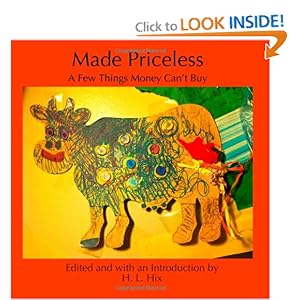
Made Priceless: A Few Things Money Can’t Buy edited by H.L. Hix

Made Priceless: A Few Things Money Can’t Buy edited by H.L. Hix is a collection of short essays about items writers have in their possession that they neither bought nor would they sell because they hold a value not measured by the marketplace.  The book pays homage to all that is held dear in today’s society from a time long past waiting to be recaptured in memories to places you can revisit, though the light will be slightly off or the wind will blow harder.  Hix has culled together a series of short essays that demonstrate the beauty we find in the most mundane things from flags to typewriters to playing cards found on the ground.

Contributors to the collection range from writers and poets to bricklayers and flight instructors, among many others.  The book also is broken down into more than 30 sections with titles like “emotionally pervaded,” “moral transactions,” and “No Ideas.”  While the book is in itself a collection, Hix has asked readers to keep the dialogue open and fluid in an open invitation to readers and reading groups to contribute their “object lessons” to his blog; find out more about that project from my previous post.

Since I’m a contributor to the project, I cannot call this a review due to the potential conflicts of interest it would present.  However, I can tell you that I’m pleased that this nonprofit project is published through a nonprofit publishing house, Serving House Books, and H.L. Hix has said he will donate 100 percent of any royalties he receives from the sales of the book, since he simply seeks to spread “wisdom and joy.”

Guest Post: Jack Caldwell Talks About Writing

Yesterday, I reviewed The Three Colonels:  Jane Austen’s Fighting Men by Jack Caldwell, which is set just after Napoleon is exiled to Elba and combines characters from Pride & Prejudice with those from Sense & Sensibility, along with some new characters.  From romance to intrigue and war, Caldwell combines the best of Austen’s social commentary with the action of a war novel, but tempers it with wit and drama. 

Today, Jack has offered to talk about his writing, his inspiration, and his writing space.  Please give him a warm welcome.

Good day, everybody. Jack Caldwell here, the author of THE THREE COLONELS – Jane Austen’s Fighting Men, a sequel to Pride & Prejudice and Sense & Sensibility, now available from Sourcebooks Landmark. My first novel, PEMBERLEY RANCH, a reimagining of Pride & Prejudice set in post-Civil War Texas, came out in 2010.

The kind and lovely Serena asked me to talk to you about how and where I write, and what inspires me. Well, I’m hesitant to do so. You know how shy we authors are. We never want to talk about our work—

Alright, Serena, you can stop laughing hysterically now.

The first thing you must know is that I’m a guy. Therefore, I own my own computer. That may sound like a strange boast, but from what I understand, many of my female compatriots must fight the rest of their family to get computer time to write. I don’t have that problem. This machine is mine. Nobody touches it but me!

(Note: My wife has her own laptop. I ain’t stupid. Happy wife – happy life.)

I’ve taken over one of the spare bedrooms to serve as my office. I have a desk, two printers, the computer, network equipment, files, and bookcases filled with novels and reference books. This is my Pemberley Library, my inner sanctum, my Batcave.

But this is not where I write. This is where I type.

Believe it or not, I write in bed while I sleep — while I dream. You see, I have this uncanny ability to control my dreams. I run the plot of my current writing project through my mind like a movie while I sleep. The best part is when I run into a dead end, stop everything, back up, and try again on a slightly different path, all while remaining asleep. The next day, I transcribe my dream into the computer. Cool, huh?

Now, that doesn’t mean I don’t have a roadmap. I do, because before I write a word, I put together a detailed outline. I know how my story ends before I write it; in fact, the last chapter is often one of the first I write. This way, I always finish my projects.

I also depend on a team of extraordinary women to help me. They are my editors, whom I call affectionately my Beta Babes. They go over every word I write. The group has changed membership slightly over the years, but the one constant has been Beta Babe #1, my wife, Barbara.

Writing is a lot of work. Some days I put down only a few hundred words, other days several thousand. But I need to write every day. Even at that pace, it takes between six to nine months to write a novel, averaging 100,000 words.

Then, if my publisher likes it, I get to cut it — a lot. It ain’t fun, but usually her suggestions are the right ones. The finished novel runs about 85,000-95,000 words. We bounce it back and forth, polishing it up, and after the final edit is accepted, we start all over again with a new book.

I’m having a ball.

So how do I get the ideas of what to write? My muse, my dear friends — that harsh mistress who lovingly and relentlessly drives me to write. Here’s her photo:

Hot, isn’t she? She’s the one who challenged me to write in the first place. She helped me overcome a high school teacher who thirty-five years ago told me I had no writing ability.

She also spurs my ideas, especially as she found out writers can write off a portion of their travel if it is used for research for their work. She’d LOVE it if I wrote a Pride & Prejudice reimagining set in Hawaii! Who knows—maybe one day…?

Anyhow, I hope all of you enjoy THE THREE COLONELS, especially as I’m writing a sequel to it right now. Which means that not everybody dies in it (I have such a bad reputation about that).

And remember, it takes a real man to write historical romance, so let me tell you a story.

~*~*~

So, which do you like better—sequels or reimaginings? Where would you move your favorite Austen characters in time and space? Let’s have some fun!

About the Author:

Jack Caldwell is an author, amateur historian, professional economic developer, playwright, and like many Cajuns, a darn good cook. Born and raised in the Bayou County of Louisiana, Jack and his wife, Barbara, are Hurricane Katrina victims who now make the upper Midwest their home.

His nickname—The Cajun Cheesehead—came from his devotion to his two favorite NFL teams: the New Orleans Saints and the Green Bay Packers. (Every now and then, Jack has to play the DVD again to make sure the Saints really won in 2010.)

Always a history buff, Jack found and fell in love with Jane Austen in his twenties, struck by her innate understanding of the human condition. Jack uses his work to share his knowledge of history. Through his characters, he hopes the reader gains a better understanding of what went on before, developing an appreciation for our ancestors’ trials and tribulations.

When not writing or traveling with Barbara, Jack attempts to play golf. A devout convert to Roman Catholicism, Jack is married with three grown sons.

Check out Jack’s blog, The Cajun Cheesehead Chronicles, at Austen Authors, his Website — Ramblings of a Cajun in Exile — and his Facebook page.

Thanks, Jack, for sharing your writing and inspirations with us.  Also check out my review of Pemberley Ranch.  I personally love both sequels and reimaginings!  And I cannot wait for the sequel to The Three Colonels!

The Three Colonels: Jane Austen’s Fighting Men by Jack Caldwell

The Three Colonels: Jane Austen’s Fighting Men by Jack Caldwell is set during a time in Europe when empires were being built and shifted, including the Napoleonic empire.  Colonel Brandon, Colonel Buford, and Colonel Fitzwilliam are the main players here, but Mr. Darcy’s connection to Fitzwilliam and Brandon and Fitzwilliam’s connections to Buford blend the picture seamlessly.  A Regency period novel that begins with the exile of Napoleon to Elba is the calm before the storm as the world teeters on the brink of war once again, which can only bring the three colonels into danger, alongside that love-to-hate rogue Wickham.  Caldwell can always be counted on for creating tension that leads to fast-paced action in an Austenesque novel, and he even sprinkles in the romance and common misunderstandings Austen’s characters have dealt with in the past.

“Buford!’ cried his companion.  ‘If you truly wish to be known as a respectable gentleman, there are other ways to go about it than imitating Fitzwilliam Darcy!’ Colonel Richard Fitzwilliam gave his comrade-in-arms a lopsided grin.

Buford’s eyes never left the crowd.  ‘I beg your pardon, but I am certainly not as stiff as Darcy!’

Fitzwilliam laughed.  ‘Oh, Buford, you make a fireplace poker look flexible!'” (Page 45 ARC)

Buford is a dashing colonel who has won the affections of Caroline Bingley, despite his rakish reputation among the ton.  Buford softens Caroline’s edges, making her blush as she gains confidence slowly after being humiliated, but can he cause her to be ultimately vulnerable and fall in love and can she redeem him as he hopes to be saved?  These are just some of the questions Caldwell tackles in his novel.  Meanwhile, happily married Darcy and Colonel Brandon are enjoying their wives and their children when news of possible war hits, causing the men to worry about their families and the future of England.

Colonel Fitzwilliam’s troubles begin when he must step into the role of Rosings trustee that Darcy was forced to vacate when he married Lizzy against Lady Catherine’s wishes.  He butts heads with Lady Catherine, is unsure of how much authority he has to make changes to save the estate, and finds himself hopelessly in love with someone far above his station.  Caldwell stays true to Austen’s original characters here, but modifies them in ways that help them evolve in the new story lines he has created for them.  They are fresh and fun, and fully dramatic, with plenty of intrigue and backstabbing to go around on the international stage.

The Three Colonels: Jane Austen’s Fighting Men by Jack Caldwell blends not only Austen’s characters from Pride & Prejudice and Sense & Sensibility, but also adds historical figures and new characters to the mix.  Readers will enjoy revisiting some of their favorite characters, seeing new sides of old characters, and being introduced to new, engaging characters.  Overall, a unique novel that brings some action to the upper echelons of society.

Also by Jack Caldwell:

Pemberley Ranch