Quantcast

Perla by Carolina De Robertis

Perla by Carolina De Robertis (giveaway following the review) is captivating and intoxicating in its setting, mystery, and the psychological unraveling of the main protagonist, Perla.  She’s growing into a young woman, but her cloistered existence threatens to explode until she begins to release herself in books and in her relationship with Gabriel.

The past haunts everything around her, though she does not know it at first.  She is proud of her family and her father’s naval career and her mother’s quirky penchant for picking up new hobbies and discarding them.  But her pride is suddenly shaken when she learns of the Disappeared, Argentinians who were silently taken from their workplaces and homes in the 1970s and 1980s by the government for allegedly being subversives.  In school she writes a short story that wins a prize and is published in the newspaper, but her story has other unintended consequences.  It opens up hidden fissures in her family, and forces her to rebel and question the father she’s loved with blind devotion.

“He was uninvited moisture.  He had leaked into this house.  I had every reason to find his presence an affront, to be enraged at his invasion, or at least to eject him in calm tones.  Certainly he made me feel combustible, unsafe in my own skin.  But though I didn’t know why, though the feeling shocked me, I did not want him to leave.”  (page 28)

The fluidity with which De Robertis tells the tale is much like the Dali painting, “The Persistence of Memory,” hung in Perla’s childhood home, weaving in and out of reality and shaping a psyche that is struggling with secrets that are too devastating to hold inside.  Perla is a novel about identity and how it is created or comes into being and whether it is alive within us before we are even born.  In accordance with this look at identity, the novel examines the harsh treatment society places on new generations for the transgressions of the past.  Struggling with the truth of her father’s job and how it may have contributed to the disappearance of many Argentinians is enough for Perla to deal with as a young adult, but she also must confront the sneer and the unspoken disgust in the eyes of her classmates and friends when her father’s occupation is revealed.

Retreating into herself and her books, Perla finds a way to cope and becomes strong in a way that even she is unaware of, and when she meets Gabriel, her strength is tested once again.  Can she love her father and still love this man who writes articles condemning the actions of former military and government leaders who now have immunity?  Can she reconcile the two worlds of her life into one and live with herself?  And how can she explain her love for her father amidst the knowledge of what his actions before she was born did to the country and to other families?

De Robertis takes readers on a psychological journey through Perla’s mind as she processes the revelations of her family life and the nation she was born into.  Legacy plays an important role and it is clear that Perla must uncover what that legacy should be as she grows into a woman and leads her own life.  The prose is so enchanting and intoxicating, hours of reading fly by as streets in Buenos Aires become crowded with footfall percussion beats and musical laughter countered with the closed off rooms of Perla’s childhood home and the dark, swirling violet waves of her aunt’s painting.  Water also is a significant image throughout the book as it gives life and sustains it in the womb and in the soil, but it also connects everyone and everything in the story, running underground and supplying the sustenance to the tale.

“Flowers lurked at every turn.  You could not rest your gaze without encountering a geranium, two geraniums, hundreds of geraniums, and you could not walk without the feeling that geraniums were following you close at heel, bright mobs of them, crowding the air at your back.  You could not help feeling vastly outnumbered.” (page 90)

In a few sections when Perla’s mother has taken up gardening as a hobby and begins overpopulating the house with geraniums, it is clear that these flowers are like the bodies of the disappeared blossoming despite the cover up and lurking around every corner, haunting those that took part.  These bodies even when the blossoms fade from lack of care, continue to haunt the house and its inhabitants, prodding Perla’s family to look about them, to question, to uncover the truth beneath the well-manicured soil.

Perla by Carolina De Robertis melds the supernatural with reality in a way that it becomes a testament to all of the disappeared and the children of the disappeared who were restored and not.  It is an examination of an ugly part of Argentinian history in which women, children, and men were taken from their families and homes without warning, tortured, and released from planes above the Atlantic Ocean — erased from existence.  De Robertis does not dwell on the horrors of those times, but on the consequences of those actions and the reverberations felt for generations following the political upheaval that caused them.  She does so with aplomb and breath-taking imagery that transports readers to a South American nation ripe with beauty and dark secrets to explore what it means to have an identity and to be an individual in spite of what your family may have done in the past.  One last note, get the tissues ready!  Another for the 2012 best of list.

Author Carolina De Robertis

About the Author:

Carolina De Robertis is the author of Perla and The Invisible Mountain, which was an international bestseller translated into fifteen languages, the recipient of Italy’s Rhegium Julii Prize, and a Best Book of 2009 according to the San Francisco Chronicle, O, The Oprah Magazine, and BookList. Her writings and literary translations have appeared in Zoetrope: Allstory, Granta, The Virginia Quarterly Review, and elsewhere. She is the translator of Alejandro Zambra’s Bonsai, which was just made into a film, and Roberto Ampuero’s internationally bestselling The Neruda Case, which will be published for the first time in English in July 2012. De Robertis has been awarded a 2012 fellowship from the National Endowment for the Arts.

De Robertis grew up in a Uruguayan family that immigrated to England, Switzerland, and California. Prior to completing her first book, she worked in women’s rights organizations for ten years, on issues ranging from rape to immigration. She lives in Oakland, California, where she is currently elbow-deep in writing her third novel, which explores migration, sexual frontiers, and the tango’s Old Guard in early twentieth century South America.  Connect with her on Facebook, Twitter, and through her Website.

tlc tour host

This is my 37th book for the 2012 New Authors Challenge.


To enter for 1 copy of Perla by Carolina De Robertis (US/Canada), leave a comment about what you’d like to learn about the disappeared of Argentina.

Deadline is May 17, 2012, at 11:59PM EST

Guest Post & Giveaway: Writing Space Evolutions by Deborah Michel

Prosper in Love by Deborah Michel is a book that takes misunderstandings and unexpected circumstances to a new level, but it certainly sounds like the book will provide humorous moments and joy.  Check out this synopsis from Amazon:

A good marriage lasts forever . . . until it doesn’t.

From the start, Lynn and Jamie Prosper were one of those couples who seem meant to be—so content with each other that they barely notice the rest of the world nodding approvingly at their wedded bliss. But sometimes, even in the very best of marriages, all it takes is a mischievous outsider to bring the perfect couple toppling off the top of the wedding cake. . .

True, Jamie has been working so hard and traveling so much as a young lawyer that he hardly has enough energy to show his devotion. Not that Lynn, a junior museum curator, has any reason to question it. But when Lynn’s old college friend turns up at a cocktail party, chinks in their marriage’s previously unassailable armor start to show.

Suddenly, without meaning to, Lynn and Jamie have both acquired divorce lawyers. And those benevolent onlookers—meddling in-laws and competitive friends alike—eagerly bear witness to each new misstep. Is love really enough to make a marriage last?

Doesn’t this sound like a fun book about the intricacies and follies of marriage? Today, Deborah Michel is going to share her writing space with us — with photos — and of course, there’s a chance for a U.S. resident to win a copy of her book.

Without further ado, please give Deborah a warm welcome.

First Abandoned Writing Space

I have three separate desks in my house, each of which I have, over the years it took me to write my first novel, Prosper in Love, intended—with the best intentions—to make my writing space. The first desk came with the house—a cozy built-in in the family room. It has heavy paneled file cabinets, matching cupboards perfect for writing and computer supplies, and pre-drilled holes to hide phone and computer cords. It even has what could be a charming reading nook if only I’d get around to having cushions made. When we first moved in I paid bills there. I don’t even do that there anymore. Never once did I sit down to write anything more than an email.

Glass Table Desk in Bedroom

Instead, I found my dream desk, a pretty, airy, glass-and-wood modernist table for my bedroom. As a former shelter-magazine writer and senior design editor, aesthetics were important to me. I know, you’re not supposed to put your workspace in your bedroom. But it was such a pretty space! I had a wall of glass looking out on verdant greenery, soaring ceilings, a place for ideas to fly. As it turned out, I didn’t need to worry about somehow sabotaging my bedroom as a place of relaxation. I barely worked at that desk for a season before my constant wandering into the kitchen for a snack or more tea ended with me moving my laptop there altogether, to a high stool at a butcher block island. Which isn’t to say the glass desk didn’t prove handy. It makes a lovely, translucent dumping ground for books, unfiled insurance papers, and the endless stacks of revisions. (Editing and re-editing the old is always so much easier than creating the new.)

Mudroom Desk

The kitchen counter wasn’t ideal. Never mind the chronic back and neck pain. (Did I mention the expensive ergonomic chair that went with my lovely glass desk?) My kids hated my working there! They hated coming home to see me bent over my laptop in work mode, too distracted to ask how their day was. And to prepare so much as a snack, everything had to be cleared away. So when we decided to add a mudroom off the kitchen, I included the perfect desk in the plan, carefully measuring for everything from the printer down to the shelf where the pencil sharpener would sit (I still write first drafts longhand). You guessed it. Never worked a day there. But it’s the perfect recharging center for everyone’s phones and gizmos—and even for my laptop on those nights when I’m forced to move it from my current writing spot.

Current Writing Space -- Dining Room Table

That would be the dining room table, where I agonized over the proofreading of my galleys and sat with a deep sigh of satisfaction to looks at my first author copy when it arrived. I still have to move everything on the nights when I cook dinner, but let’s face it, that doesn’t happen as often as it should. I’m like my protagonist, Lynn Prosper, that way. And it’s a beautiful table: a long, narrow stretch of shiny red glass in an airy room with walls of windows to the outside on three sides. So which direction do I face when writing? The only one with no view, of course.

Thanks, Deborah, for sharing all of your writing spaces with us. It can be difficult to find the perfect one.

Author Deborah Michel; Photo Credit: Shreya Ramachandran

About the Author:

Deborah Michel, a former magazine editor and freelance writer, has worked on a long list of publications that includes House Beautiful, Premiere, Los Angeles, and the Los Angeles Times Magazine. She worked as an editor and nightlife columnist for Avenue Magazine, was the west coast correspondent for Spy, and served as a contributing editor at Buzz.


To enter to win 1 copy of Prosper in Love, you must have a U.S. address and leave a comment on this post about your own marriage advice or funny stories.

Deadline to enter will be May 15, 2012, 11:59 PM EST

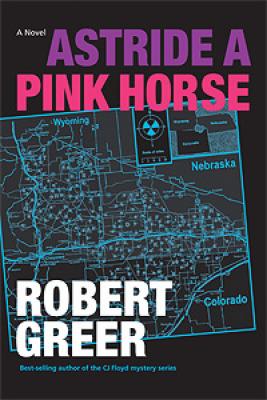
Astride a Pink Horse by Robert Greer

Astride a Pink Horse by Robert Greer is a thrilling ride steeped in the mystery of the west and its ties to the Cold War and nuclear missiles.  Elgin “Cozy” Coseia and Freddie Dames are college buddies who were drafted to major league baseball teams before an accident stopped Cozy’s career very short and they went into business as journalists in Denver.  A murder of a former Air Force Master Sergeant Thurmond Giles, a former nuclear-missile maintenance technician, has these boys running the bases faster than they ever did in college baseball, as they play tag with local law enforcement in Wyoming and team up with Major Bernadette Cameron of the Air Force.  The back-and-forth investigation has the journalists and Cameron working closer than her superiors want her to be, but a murder and possible national security breach are at the top of all of their agendas.

Greer intricately weaves in the story of the murder with anti-nuclear protesters from the 50s and 70s, a WWII Japanese-American internment camp survivor, and a hospital equipment transporter into the story in a way that keeps readers guessing as to how they are all connected to one another and possibly the murder.  Giles is far from well liked by anyone given his large ego and his womanizing, and navigating civilian and military investigations into not only the security breach at Tango-11 a decommissioned missile silo, but also the murder of Giles.

“‘As the pitiful-looking beast approached me, faltering with each step, I realized that it was carrying a rider who was charred almost black from head to toe.  I watched for a few moments as animal and rider, unaware of my presence, veered to my left and walked toward the river to disappear into the yellow haze.  Thoughts of my wife and children, coworkers and countrymen, worked their way through my head, but it was the image of the charbroiled rider astride a pink horse that stayed with me the rest of the day.'” (page 159 ARC)

Greer’s characters are eccentric and downright odd at times, especially WWII Japanese-American internment camp survivor Kimiko Takata who’s battling dementia and her nephew Rikia, who is paranoid that his math colleagues are eager to steal his work and ultimately the glory that he knows it will come with.  Egos are big with some of Greer’s characters, but what sets some of them apart is their purpose, like Freddy Dames’ search for the biggest story that will make his Web-based news service shine.  Cozy and Cameron are strong-willed and used to working alone, but in this case, they come to realize that standing alone all of the time can be too comfortable and lonely at the same time.

Astride a Pink Horse by Robert Greer is well crafted mystery that will leave readers guessing for most, if not all, of the book.  His characters are unique, eccentric, and witty, which helps keep the pace fast and the suspense thick.

The novel is a standalone, but Greer also has a mystery series with CJ Floyd.

About the Author:

Robert Greer is a native of Columbus, Ohio, who spent his formative years in the steel mill town of Gary, Indiana. He graduated from Miami University at Oxford, Ohio, in 1965 with a Bachelor of Arts degree and subsequently earned degrees in dentistry, medicine and pathology from Howard University and Boston University. He is a professor of pathology, medicine, surgery, and dentistry at the University of Colorado Health Sciences Center where he specializes in head and neck pathology and cancer research. He also holds a masters degree in Creative Writing from Boston University and an Honorary Doctorate of Humane Letters from Miami University, his alma mater. Greer has lived in Denver for thirty years.  Visit his Website.

This is my 36th book for the 2012 New Authors Challenge.

Mailbox Monday #175

Mailbox Mondays (click the icon to check out the new blog) has gone on tour since Marcia at A Girl and Her Books, formerly The Printed Page passed the torch. This month’s host is Martha’s Bookshelf.

Both of these memes allow bloggers to share what books they receive in the mail or through other means over the past week.

Just be warned that these posts can increase your TBR piles and wish lists.

Here’s what I received over the past two weeks:

1.  My Cross to Bear by Gregg Allman, which came unrequested from the publisher William Morrow and for which I will find a new home.

As one of the greatest rock icons of all time, Gregg Allman has lived it all and then some. For almost fifty years, he’s been creating some of the most recognizable songs in American rock, but never before has he paused to reflect on the long road he’s traveled. Now, he tells the unflinching story of his life, laying bare the unvarnished truth about his wild ride that has spanned across the years.

The story begins simply: with Gregg and his older brother, Duane, growing up in the South, raising hell with their guitars, and drifting from one band to another. But all that changed when Duane and Gregg came together with four other men to forge something new—a unique sound shaped by soul, rock, and blues and brimming with experimentation; a sound not just of a band, but of a family. . . .

2.  The Cottage at Glass Beach by Heather Barbieri, which is for a TLC Book Tour in May.

Married to the youngest attorney general in Massachusetts state history, Nora Cunningham is a picture-perfect political wife and a doting mother. But her carefully constructed life falls to pieces when she, along with the rest of the world, learns of the infidelity of her husband, Malcolm.

Humiliated and hounded by the press, Nora packs up her daughters—Annie, seven; and Ella, twelve—and takes refuge on Burke’s Island, a craggy spit of land off the coast of Maine. Settled by Irish immigrants, the island is a place where superstition and magic are carried on the ocean winds, and wishes and dreams wash ashore with the changing tides. . . .

3.  Bridge of Scarlet Leaves by Kristina McMorris from the author for review.

Los Angeles, 1941. Violinist Maddie Kern’s life seemed destined to unfold with the predictable elegance of a Bach concerto. Then she fell in love with Lane Moritomo. Her brother’s best friend, Lane is the handsome, ambitious son of Japanese immigrants. Maddie was prepared for disapproval from their families, but when Pearl Harbor is bombed the day after she and Lane elope, the full force of their decision becomes apparent. In the eyes of a fearful nation, Lane is no longer just an outsider, but an enemy.

When her husband is interned at a war relocation camp, Maddie follows, sacrificing her Juilliard ambitions. Behind barbed wire, tension simmers and the line between patriot and traitor blurs. As Maddie strives for the hard-won acceptance of her new family, Lane risks everything to prove his allegiance to America, at tremendous cost. . . .

4.  Ninepins by Rosy Thornton from the author for review.

Deep in the Cambridgeshire fens, Laura is living alone with her 12-year old daughter Beth, in the old tollhouse known as Ninepins. She’s in the habit of renting out the pumphouse, once a fen drainage station, to students, but this year she’s been persuaded to take in 17-year-old Willow, a care-leaver with a dubious past, on the recommendation of her social worker, Vince. Is Willow dangerous or just vulnerable? It’s possible she was once guilty of arson; her mother’s hippy life is gradually revealed as something more sinister; and Beth is in trouble at school and out of it. Laura’s carefully ordered world seems to be getting out of control. With the tension of a thriller, NINEPINS explores the idea of family, and the volatile and changing relationships between mothers and daughters, in a landscape that is beautiful but – as they all discover – perilous.

5.  Next to Love by Ellen Feldman, which Audra at Unabridged Chick sent for me to read.

It’s 1941. Babe throws like a boy, thinks for herself, and never expects to escape the poor section of her quiet Massachusetts town. Then World War II breaks out, and everything changes. Her friend Grace, married to a reporter on the local paper, fears being left alone with her infant daughter when her husband ships out; Millie, the third member of their childhood trio, now weds the boy who always refused to settle down; and Babe wonders if she should marry Claude, who even as a child could never harm a living thing. As the war rages abroad, life on the home front undergoes its own battles and victories; and when the men return, and civilian life resumes, nothing can go back to quite the way it was. . . .

6.  The Aleppo Codex by Matti Friedman, another unsolicited copy from Algonquin that I will be finding a new home for.

In an age when physical books matter less and less, here is a thrilling story about a book that meant everything. This true-life detective story unveils the journey of a sacred text—the tenth-century annotated bible known as the Aleppo Codex—from its hiding place in a Syrian synagogue to the newly founded state of Israel. Based on Matti Friedman’s independent research, documents kept secret for fifty years, and personal interviews with key players, the book proposes a new theory of what happened when the codex left Aleppo, Syria, in the late 1940s and eventually surfaced in Jerusalem, mysteriously incomplete. . . .

7.  The Revised Fundamentals of Caregiving by Jonathan Evison, which also came unsolicited from Algonquin.

Benjamin Benjamin has lost virtually everything—his wife, his family, his home, his livelihood. With few options, Ben enrolls in a night class called The Fundamentals of Caregiving taught in the basement of a local church. There Ben is instructed in the art of inserting catheters and avoiding liability, about professionalism, and how to keep physical and emotional distance between client and provider. But when Ben is assigned to nineteen-year-old Trev, who is in the advanced stages of Duchenne muscular dystrophy, he discovers that the endless mnemonics and service plan checklists have done little to prepare him for the reality of caring for a fiercely stubborn, sexually frustrated adolescent. As they embark on a wild road trip across the American West to visit Trev’s ailing father, a new camaraderie replaces the traditional boundary between patient and caregiver. . . .

What did you receive in your mailboxes?

National Poetry Month Winners….

Click for all the posts from the 2012 tour, including those from Savvy Verse & Wit

Even though National Poetry Month is over and the blog tour has ended, I’ve still got a couple poetry items to wrap up.

First, thanks to everyone who participated this year, and I hope to see you all again in 2013. I’d like to recruit more poets, academics, and poetry readers to provide guest posts to other tour stops and to offer up their own blog stops on the tour. So if you’re interested, feel free to email me at any time.

We had some great guest posts and reviews, and you can visit any of the posts or tour stops by clicking on the tour button.  All of the links have been added to the Mr. Linky.  If I missed a post from you, please feel free to add it.

Second, I want to congratulate the winners of the National Poetry Month Blog Tour giveaway.

Congrats to Liviania from In Bed With Books and Lilian of Circus Toybox

Congrats to Jill from Rhapsody in Books

Congrats to Lilian from Circus Toybox

Congrats to the five winners of the Trembling Pillow Press Journals: Elizabeth, Gerry, and Parrish Lantern.

Congrats to the nine winners of Real Courage by Michael Meyerhofer: Leslie from Under My Apple Tree, Anna from Diary of an Eccentric, Kathy of Bermudaonion, Diane, and Chris.

There are some winners I still have not received an address from, please send it along so I can mail out your prizes.

148th Virtual Poetry Circle

Welcome to the 148th Virtual Poetry Circle!

Remember, this is just for fun and is not meant to be stressful.

Keep in mind what Molly Peacock’s books suggested. Look at a line, a stanza, sentences, and images; describe what you like or don’t like; and offer an opinion. If you missed my review of her book, check it out here.

Also, sign up for the 2012 Fearless Poetry Reading Challenge because its simple; you only need to read 1 book of poetry. Please visit the stops on the 2012 National Poetry Month Blog Tour.

Today’s poem is from Gary Soto; Happy Cinco de Mayo:

A Red Palm

You're in this dream of cotton plants.
You raise a hoe, swing, and the first weeds
Fall with a sigh. You take another step,
Chop, and the sigh comes again,
Until you yourself are breathing that way
With each step, a sigh that will follow you into town.

That's hours later. The sun is a red blister
Coming up in your palm. Your back is strong,
Young, not yet the broken chair
In an abandoned school of dry spiders.
Dust settles on your forehead, dirt
Smiles under each fingernail.
You chop, step, and by the end of the first row,
You can buy one splendid fish for wife
And three sons. Another row, another fish,
Until you have enough and move on to milk,
Bread, meat. Ten hours and the cupboards creak.
You can rest in the back yard under a tree.
Your hands twitch on your lap,
Not unlike the fish on a pier or the bottom
Of a boat. You drink iced tea. The minutes jerk
Like flies.

	         It's dusk, now night,
And the lights in your home are on.
That costs money, yellow light
In the kitchen. That's thirty steps,
You say to your hands,
Now shaped into binoculars.
You could raise them to your eyes:
You were a fool in school, now look at you.
You're a giant among cotton plants.
Now you see your oldest boy, also running.
Papa, he says, it's time to come in.


You pull him into your lap
And ask, What's forty times nine?
He knows as well as you, and you smile.
The wind makes peace with the trees,
The stars strike themselves in the dark.
You get up and walk with the sigh of cotton plants.
You go to sleep with a red sun on your palm,
The sore light you see when you first stir in bed.

What do you think?

Guest Post & Giveaway: Graham Parke’s Unspent Time

Unspent Time Launch Party

Get free books and win a Kindle Fire or a Kindle Touch


Warning: reading this novel may make you more attractive and elevate your random luck by about 9.332%*
(* These statements have not been evaluated by any person of consequence!)

From the award winning author of ‘No Hope for Gomez!’ comes a collection of impossible tales. Permeating the cracks between the past and the present is the realm of Unspent Time; time that was allotted but never spent. This is where we find the stories that could have been true.

Read how to enter below.

Excerpt

Sunday brunch; the table overflowing with food and drink, the fine china and silverware laid out, the clock ticking away painfully slow minutes before father finally speaks. “Well son,” he says, “isn’t it about time you got yourself a job?”

John looks up from his plate. “Dad,” he says, “I have a job.”

Father nods thoughtfully, chewing his medium rare steak. “I guess it’s about time you moved out then. Found a place of your own. Planted some roots.”

John is baffled. “But dad, I moved out five years ago. In fact, this is the first time I’ve been back.” He looks over at mother, who shrugs and says, “You know dear, your brother has his own business. He set up an accountancy firm.”

John rolls his eyes. “That’s me, mom. I set up an accountancy firm. John Williams and Associates.”

“That’s good to hear,” father says. “Always said you should run your own business. You have a keen business sense. You always had.”

“I just wish he’d find himself a girlfriend,” mother complains.

“What do you mean?” John smiles apologetically at Annabel. “I have a girlfriend, mother, she’s sitting next to you. She gave you flowers at the door, remember?” He points at the vase. “You put them in water.”

Mother waves it away with a warm smile. “Sorry dear, I meant a proper girlfriend.” She squeezes Annabel’s hand. “You know what I mean, don’t you dear?”

Annabel opens her mouth, but can’t think of anything to say.

“Didn’t you used to have dark hair,” father says suddenly, “and not quite so many arms?” He looks John over carefully. “Yes, yes,” he says, “you definitely look different. Did you get shorter?”

“That’s enough!” John gets up. He gestures at Annabel to do the same. “If you cannot behave like civilized human beings, then we’re going! I can’t believe you’d treat Annabel and myself this way. It’s appalling!”

Father throws down his napkin and stands as well. “Serves you right, young man,” he says. “Serves you right for not going home for five years and then ending up in the wrong house!”

… continued in Unspent Time

How to enter:

For the launch of the new novel I decided to discount it to $0.99 for the month of May (PC and eBook), give away some exclusive content, and raffle off two Kindles. All entrants will get:

  • An exclusive spin-off novelette (not available for purchase anywhere!)
  • Making of Gomez: behind the scenes eBook
  • Signature for their paperback or kindle edition
  • Chance to win a Kindle Fire or a Kindle Touch


(Prizes can be traded for Amazon gift certificates if you already own them.)
Just email your receipt to [email protected] to enter.
Each purchase counts, so stock up on birthday presents (for people you don’t like that much, for instance) The discount ends May 31, but be sure to send the receipts no later than June 1st.


(Or order the books from any bookstore.)
Coupon code for the month: ZB77D

And then get by tweeting about your purchase:

Sound bites from Unspent Time:

“I’m looking into my past lives. I’m convinced some of them still owe me money.”

“I’m very polite by nature, even the voices in my head let each other finish their sentences.”

“I didn’t actually want to do it,” Kiala told the boy. “The universe just kind of conspired to force me to make a fool of myself. It does that quite a lot, actually.”

“Sadly, my socks are like snowflakes, no two are exactly alike.”

Here’s what reviewers had to say:

“A veritable page turner of nonstop laughs!” — Reader Views
“An unputdownable read. a Coens Brothers’ film in book form.” — BookReview.com
“Extremely witty and clever writing.” — California Chronicle
“A Party for your Brain!” — Warren Baxter

Bio:

Graham Parke is responsible for a number of technical publications and has recently patented a self-folding map. He has been described as both a humanitarian and a pathological liar. Convincing evidence to support either allegation has yet to be produced.

www.grahamparke.com
www.grahamparke.blogspot.com
GoodReads
Facebook

The Last Brother by Nathacha Appanah, translated by Geoffrey Strachan

The Last Brother by Nathacha Appanah, translated by Geoffrey Stachan is a quiet novel that hits the heart, twisting it until tears pour from the reader’s eyes.  Beginning slowly with the main character awaking from a dream, the novel builds to a crescendo, followed by still powerful diminuendo of reflection.  Appanah and Stachan’s translation provide a sense of distance from the characters at first, but pull readers in through the magic of the dreams and the jungle, generating the sense of hollowness and fullness of love in tension.

Set in Mauritius, Raj is in his 70s and is looking back on his time as an abused child in a poor family and the one friend he made following a major disaster that struck his small village of Mapou, which forced his family to leave and live near the island’s Beau-Bassin prison.  Raj’s family is poor, but happy as his two other brothers — Anil and Vinod — look out for him, even though he is the middle brother.  He is the one chosen to attend school, which he gladly shares with his brothers when he returns home to share the chore of obtaining water from the well.

“. . . in the old days at Mapou we used to crouch down, eating our mangoes with both hands, with the juice trickling down our forearms, quickly catching it with our tongues.  In the old days at Mapou we ate the whole mango, the skin, the little, rather hard tip that had held it to the branch and we sucked the stone for a long, long time until it was rough and insipid, good only to throw on the fire.” (page 44)

The connection between the brothers is severed and Raj is forced to leave his home with his parents as his father begins working as a guard at the Beau-Bassin prison, where in 1940 Jews were exiled during WWII.  Raj is still a child by modern standards at age 9 when he discovers the true wrath of his father and the world around him.  His father is easily displeased, particularly when drunk, and he often beats his children after taking whatever displeasure he has out on his wife.  In many ways, this rage shapes the boy that Raj becomes — secretive and imaginative.  He spends afternoons in the jungle, hiding and observing, especially once he learns of the prison and the bad man his father says are imprisoned there. It is his father’s rage and beatings that send Raj to the hospital inside the prison to recover and where he meets David.

Much of Raj’s life after leaving Mapou has been empty, but meeting David awakens in him his childhood and renews feelings of brotherhood.  The Last Brother by Nathacha Appanah and translated by Geoffrey Stachan is stunning in its double entendre as the story of the last brother Raj and his own last “brother” David.  Raj is a deeply complex character as he looks at the past, his regrets about the choices he made and promises he could not keep, and his hope that the future will learn about the past so as to maintain the memory of those who have been lost.

About the Author:

Nathacha Devi Pathareddy Appanah is a Mauritian-French author. She comes from a traditional Indian family.

She spent most of her teenage years in Mauritius and also worked as a journalist/columnist at Le Mauricien and Week-End Scope before emigrating to France.

Since 1998, Nathacha Appanah is well-known as an active writer. Her first book Les Rochers de Poudre d’Or (published by Éditions Gallimard) received the ” Prix du Livre RFO”. The book was based on the arrival of Indian immigrants in Mauritius.

She also wrote two other books Blue Bay Palace and La Noce d’Anna which also received some prizes for best book in some regional festivals in France.

***I read this because of Anna’s glowing review at Diary of an Eccentric.

This is my 35th book for the 2012 New Authors Challenge.

Guest Post: Do Photos Lie? by Joshua Graham

Today, I’ve got Joshua Graham, author of Darkroom, visiting today to talk about photography, the media, and whether everything is as it appears.  Like photographs and media stories, humans often hide their secrets, but what we condemn in others may not necessarily be the same things we condemn in ourselves.  I’ve been fascinated with this concept ever since dabbling into photography and reading Believing Is Seeing by Errol Morris (my review).

About Darkroom:

After scattering her mother’s ashes in Vietnam, photojournalist Xandra Carrick comes home to New York to rebuild her life and career. When she experiences supernatural visions that reveal atrocities perpetrated by American soldiers during the Vietnam War, she finds herself entangled in a forty-year-old conspiracy that could bring the nation into political turmoil. Launching headlong into a quest to learn the truth from her father, Peter Carrick, a Pulitzer Prize Laureate who served as an embedded photographer during the war, Xandra confronts him about a dark secret he has kept–one that has devastated their family.

Her investigations lead her to her departed mother’s journal, which tell of love, spiritual awakening, and surviving the fall of Saigon.

Pursued across the continent, Xandra comes face-to-face with powerful forces that will stop at nothing to prevent her from revealing the truth. But not before government agencies arrest her for murder, domestic terrorism and an assassination attempt on the newly elected president of the United States.

Darkroom is a riveting tale of suspense that tears the covers off the human struggle for truth in a world imprisoned by lies.

Doesn’t this book sound awesome?! Without further ado, please give Joshua Graham a warm welcome and stay tuned for my review later in the month.

This photo and the photographer’s commentary inspired the epitaph in the opening pages of my novel, Darkroom.

“I won a Pulitzer Prize in 1969 for a photograph of one man shooting another. Two people died in that photograph: the recipient of the bullet and GENERAL NGUYEN NGOC LOAN. The general killed the Viet Cong; I killed the general with my camera. Still photographs are the most powerful weapon in the world. People believe them, but photographs do lie, even without manipulation. They are only half-truths.” –Eddie Adams, Photographer

Read more here at TIME Magazine.

Adams, who believed Brig. Gen. Loan’s contention that the man he shot had just murdered a friend of his, a South Vietnamese army colonel, as well as the colonel’s wife and six children. “How do you know you wouldn’t have pulled the trigger yourself?” Adams would later write in a commentary on the image.

Often the media puts things together in ways that have little to do with the truth. Impressions are fabricated for various agendas, and unfortunately most are created to boost the ratings with sensationalism. But what happens when the truth is distorted or even buried completely? And what happens if the contained truth is uncovered?

This is not just a global concern, but a personal one as well. Do we try to cover up our weaknesses and failures at the expense of authenticity or integrity? We cry foul when politicians and elected officials are caught doing this, but do we ever ask how we are doing the very same thing, in our own personal lives?

Constantly looking over your shoulder, trying to contain a secret that no one must ever know has got to be one of the worst prisons anyone can face, especially because it is self-imposed. There’s a reason why the scriptures say, “The truth shall set you free.” And this is what Darkroom is all about.

Take a moment to examine yourself and see if you’re sitting in a self-imposed cell. And consider the freedom you’ll enjoy because of the truth.

Thanks, Joshua, for sharing your thoughts on truth and fiction.

About the Author:

Joshua Graham is the award winning author of the #1 Amazon and Barnes & Noble legal thriller Beyond Justice. His latest book, Darkroom, won a First Prize award in the Forward National Literature award and was an award-winner in the USA Book News “Bests Books 2011” awards. Connect with Josh at his Website, Facebook, and on Twitter.

Domestic Violets by Matthew Norman

Domestic Violets by Matthew Norman is written very frankly and is told from the point of view of corporate cube dweller Tom Violet, whose father just happens to be the famous writer Curtis Violet who has just won the Pulitzer Prize for Fiction.  Tom is having marriage problems, hates his corporate job as a copywriter, and continues to have daddy issues; he’s on the precipice.  At work, he cuts into his enemy Greg every chance he gets and flirts with his underling, copywriter Katie.  He’s filling his days with useless interactions and writing that has no meaning for him.  He’s aimlessly adrift, but still wants his father’s approval, but how far is he willing to go to get it.  Will he become his father and chase after younger and younger skirts?  Will he become pretentious and full of himself, while looking down at other writers?  Norman’s character is adrift, but blissfully unaware of it until he loses his job and his thin connections to the “real” world.

“Then I realize that despite what both of them must suspect about me and my abilities as a man, Anna and Allie are looking at me.  They’re waiting for me to do something.  Waiting for me to protect them.  Even Hank is looking at me now, perfectly still, the rigid statue of an ugly little dog.”  (Page 9)

Like the characters his father writes about in his novels, Tom acts on impulse and very rarely worries about the consequences, and in fact, on occasion, thinks that the consequences will be positive.  The banter between Tom and Greg is highly entertaining and almost surreal because in a normal work environment wouldn’t Tom have been fired after how many complaints were filed against him by Greg?

“She tried to read it, but she had to put it down, stunned that she’d married a man who is so bad at writing books.  On almost every page, there’s something egregious to change.  There are typos, cliches, errors in logic, rambling sentences, and narration where there should be dialogue.”  (Page 163)

When Tom uncovers the truth about his family and his father, he’s faced with a hard choice.  He has to either move on and forgive or continue to flounder in self-pity, regret, and indecision to the point at which decisions will be made for him.  Norman has a clear grasp of what it means to be a writer, full of self-doubt and self-confidence at the same time, and his characters are dynamic and incredibly flawed.  Although there are moments when readers will not like Tom or his father, there are other moments where their hearts will soften for him.

How do you domesticate a writer, who is trained to run wild, at least in his imagination?  Domestic Violets by Matthew Norman is about finding peace with oneself and their family even if events are beyond their control and immutable.  It’s an adventure for readers and writers alike, and a true page turner.

***This is a book I picked up thanks to so many great reviews, including those from Booking Mama, Rhapsody in Books, Book Chatter, and Literate Housewife.

Author Matthew Norman

About the Author:

Matthew Norman is an advertising copywriter. He lives with his wife and two daughters in Baltimore. His first novel, Domestic Violets, was recently nominated in the Best Humor Category at the 2011 Goodreads Choice Awards. Read more on his blog or follow him on Twitter.


This was a stop on The Literary Road Trip because the author lives in Baltimore and the novel takes place in Washington, D.C., Maryland, and Virginia.




This is my 34th book for the 2012 New Authors Challenge.