Quantcast

Emily & Herman: A Literary Romance by John J. Healey

Source: Arcade Publishing
Hardcover, 238 pages
I am an Amazon Affiliate

Emily & Herman: A Literary Romance by John J. Healey begins with the pretext that the author finds the manuscript among his deceased grandfather’s belongings and that the author’s name has been concealed.  The manuscript is set during the period in which Herman Melville is writing Moby Dick and is enticed by his sometime-mentor Nathaniel Hawthorne to take a trip to Boston and onto New York.  But on the way, which logistically makes no sense, they stop in Amherst to pay a visit to Hawthorne’s friend, the father of Emily and Austin Dickinson.  But the elder children are the only ones at home.  Barely age 20 and far from the hermetic woman she becomes, Emily Dickinson’s imagination is running wild as her esteemed guests propose a journey outside of her home town, an adventure she has a few reservations about, but ultimately decides to go for her brother’s sake, if not her own secretive yearnings to see more of the world.

The Dickinsons having been raised in a stern, Christian home are much more reserved than Melville, who has a reputation for his sea-faring adventures and his amorous encounters with natives.  Hawthorne is slightly less reserved, but still bristles at some of Melville’s more controversial statements about religion and humans’ animal instincts.  Meanwhile, Austin has a secret life outside the home in which he has been sowing his wild oats before committing fully to his soon-to-be betrothed — a more proper fit for the reserved Dickinson family.  Emily, on the other hand, enjoys reading as her escape and her solitude, until she glimpses what life could be outside of her cloistered existence in Amherst.

“‘If I were to answer with honesty, I would say there is wild within all of us, lurking underneath as you say.  It is perhaps our most irksome, mysterious and profound characteristic.'” (page 30)

Based upon the “Master” letters found among Dickinson’s belongings — letters which were never sent — an imagined relationship blooms between Melville and Dickinson.  They match wits on an intellectual level, and Melville finds in her a naive, but thoughtful young woman who is eager to learn and grow beyond what she has been taught.  Despite the changes around them, Dickinson is still confined by the role of a woman and her ruin can come from even just a whiff of scandal — something she is very much aware of even as she speaks most boldly about religion, animal instinct, and more.

The novel’s strength lies in the intellectual connections made over literature and the discussions they have about the world and its machinations.  When Whitman and an escaped slave William Johnson enter their path, even more of the changing world around them is revealed.  While there are some transitional moments that are bumpy, like when William Johnson is first introduced and when the narrative shifts from Hawthorne to Melville and the Dickinsons, the multiple perspectives help to round out the story.

Healey’s novel is graphic about certain sexual encounters, which could be troublesome for some readers — particularly those who do not wish to see Emily Dickinson or any author as objects of desire.  In some ways, perhaps the novel would have been better served had it been told from Dickinson’s point of view, looking backward on her affair with Melville.  The novel raises a number of questions not only about the differences between love freely given and the love codified by marriage vows, but also about how change can be a long, arduous process.  Emily & Herman: A Literary Romance by John J. Healey is more about the world as it changes from one in which strict puritan ideals are the only way to live to one in which slavery is slowly becoming less acceptable.

About the Author:

John J. Healey is the author of the recently published novel EMILY & HERMAN, (Arcade), a love story between Emily Dickinson and Herman Melville. He has been published in the Harvard Review and has directed two documentary films, ‘Federico García Lorca’ and the award-winning ‘The Practice of the Wild’. He lives in the United States and Spain and is currently working on a new work of fiction: ‘riverrun’.
This is my 48th book for the 2013 New Authors Challenge.
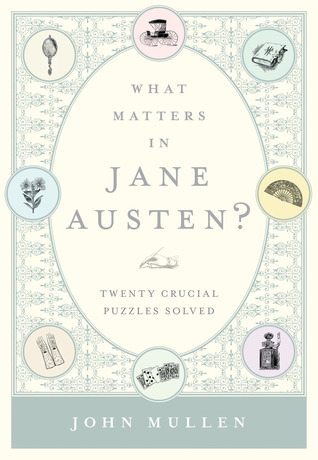
What Matters in Jane Austen? by John Mullan

Source: Public Library
Hardcover, 320 pages
I am an Amazon Affiliate

What Matters in Jane Austen by John Mullan is a detailed look at 12 stylistic techniques and concerns in Jane Austen’s numerous works, including the unfinished The Watsons and Sanditon.  The twelve puzzles Mullan explores range from the importance of age in her books, what characters call one another, and what games characters play to why her plots rely on blunders, what her characters read, and how experimental a novelist she was.  There are moments in the book where Mullan’s examinations become bogged down and overly verbose, but he clearly enjoys picking apart the most innocuous moments in Austen’s novels to support his theories.  Most of the theories he offers and backs up with source material from Austen’s books and letters to family members also are discussed by other scholars, whom he cites.  For aspiring writers, Mullan’s book can be used as a guide for creating those unique moments and nuances in a novel, emulating Austen but adapting it for modern sensibilities.  Although it is not a how-to guide for writers, it does offer some insight into elements of the craft.

“Admission to a bedroom is a rare privilege, for the reader as well as for a character.” (page 29)

“Names are used by Austen, as well as by her characters, as though they are precious material, so we sometimes hear only once, glancingly, what someone’s name is.  Thus the label on the trunk seen by Harriet Smith, directed to Mr. Elton at his hotel in Bath, which names him as Philip (II. v).” (page 46)

“But Austen wants us to think not so much about how characters look, but how they look to each other.  Her sparing use of specification when it comes to looks is striking when looks can be so important.”  (Page 57)

“Meteorology clues us in to the passing of the year.  But it is more than this.  Austen likes to make her plots turn on the weather.  Having arranged her characters and defined their situations, having planned her love stories and hatched the misunderstandings that might impede them, she lets the weather shape events.  It is her way of admitting chance into her narratives.” (page 101)

“The rather few critics who have written on speech in Austen’s fiction have discovered how each of her speakers seems to have their own idiolect — a way of speaking that is individually distinctive.”  (page 132)

Austen is an often underestimated author, especially in light of the writers who dismissed her early on.  Mullan pinpoints the genius of Austen beyond the morays of the time period in which she wrote and the social commentary.  Readers who have read all of Austen’s major works but once are likely to want to read them anew after reading Mullan’s examination.  Even those have read certain Austen books multiple times could find new theories in this book.  It is interesting to see what it means when characters blush, why weather is important, and what seaside resorts mean in Austen’s work.  Mullan also asks whether there is sex in her books.

What Matters in Jane Austen by John Mullan is less about the puzzles of Austen than about her techniques as a writer and creator of fiction.  It was an interesting look at how she stacked up to her contemporaries and offered something more.

About the Author:

John Mullan is a Professor of English at University College London. He specialises in 18th century fiction. He is currently working on the 18th-century section of the new Oxford English Literary History. He also writes a weekly column on contemporary fiction for The Guardian and reviews books for the London Review of Books and New Statesman. He occasionally appears as an 18th-century and contemporary literature expert for BBC Two’s Newsnight Review and BBC Radio 4’s In Our Time. Mullan was a judge for The Best of the Booker in 2008 and for the Man Booker Prize in 2009. He was a Research Fellow at Jesus College, Cambridge and a Lecturer at Fitzwilliam College, Cambridge, before coming to UCL in 1994.

This is my 47th book for the 2013 New Authors Challenge.

Giveaway: Lisa Gardner Beach Bag

LisaGardnerbeachbag
Lisa Gardner is one of my mother’s favorite authors, and in this great giveaway, one lucky reader, age 18 and over living in the United States, could win the following:

  • A Briscoe Designs Beach Bag
  • Beach Towel
  • Signed copies of Catch Me and Touch & Go
  • Lisa Gardner Pen
  • Summer Reading Sampler with previews of Maggie’s Man, MacNamara’s Woman, Brandon’s Bride and Fear Nothing

Charlene Grant believes she is going to die. For the past few years, her childhood friends have been murdered one by one. Same day. Same time. Now she’s the last of her friends alive, and she’s counting down the final four days of her life until January 21. Charlene doesn’t plan on going down without a fight. She has taken up boxing, shooting, and running. She also wants Boston’s top homicide detective, D. D. Warren, to handle the investigation. But as D.D. delves deeper into the case, she starts to question the woman’s story. Instinct tells her that Charlene may not be in any danger at all. If that’s true, the woman must have a secret—one so terrifying that it alone could be the greatest threat of all.

This is my family: Vanished without a trace…

Justin and Libby Denbe have the kind of life that looks good in the pages of a glossy magazine. A beautiful fifteen-year old daughter, Ashlyn. A gorgeous brownstone on a tree-lined street in Boston’s elite Back Bay neighborhood. A great marriage, admired by friends and family. A perfect life. This is what I know: Pain has a flavor… When investigator Tessa Leoni arrives at the crime scene in the Denbes’ home, she finds scuff marks on the floor and Taser confetti in the foyer. The family appears to have been abducted, with only a pile of their most personal possessions remaining behind. No witnesses, no ransom demands, no motive. Just an entire family, vanished without a trace. This is what I fear: The worst is yet to come…

About the Author:

LISA GARDNER is the #1 New York Times bestselling author of fifteen previous novels, including her most recent, Touch & Go. Her Detective D. D. Warren novels include Catch Me, Love You More, and The Neighbor, which won the International Thriller of the Year Award. She lives with her family in New England.

To enter, leave a comment below with what you like to read at the beach. Deadline to enter is July 27, 2013, at 11:59 p.m.

Announcing the 2014 Split This Rock Poetry Festival in D.C.

SAVE THE DATE: March 27-30, 2014

Join me and 16 poets at the 2014 Split this Rock Poetry Festival: Poems of Provocation & Witness

  • Sheila Black
  • Franny Choi
  • Eduardo C. Corral
  • Gayle Danley
  • Natalie Diaz (click for my review)
  • Joy Harjo
  • Maria Melendez Kelson
  • Yusef Komunyakaa (click for my reviews and news about him)
  • Dunya Mikhail
  • Shailja Patel
  • Wang Ping
  • Claudia Rankine
  • Tim Seibles
  • Myra Sklarew
  • Danez Smith
  • Anne Waldman

Where; in Washington, D.C. of course. The hub of politics and protest.

Split This Rock Poetry Festival is DC’s premiere poetry event and the only festival of its kind the country, highlighting poets working at the intersection of the imagination and social change. The festival features readings, workshops, panel discussions, youth programming, activism—opportunities to speak out for justice, build connection and community, and celebrate the many ways poetry can act as an agent for social change. Registration will open in the fall of 2013.

“We are thrilled to bring these exemplary poets from all over the country to DC’s stages,” says Executive Director Sarah Browning. “Poetry can tell hard truths, can challenge and succor us. These poets are visionaries, helping imagine a future based on principles of justice, one that honors the transformative power of the imagination.”

I hope to see you there!

Library Loot #10

Library Loot is a weekly event co-hosted by Claire from The Captive Reader and Marg from The Adventures of an Intrepid Reader that encourages bloggers to share the books they’ve checked out from the library. If you’d like to participate, just write up your post-feel free to steal the button-and link it using the Mr. Linky any time during the week. And of course check out what other participants are getting from their libraries.


1.  Raised from the Ground by José Saramago

First published in 1980, the City of Lisbon Prize–winning Raised from the Ground follows the changing fortunes of the Mau Tempo family—poor landless peasants not unlike Saramago’s own grandparents. Set in Alentejo, a southern province of Portugal known for its vast agricultural estates, the novel charts the lives of the Mau Tempos as national and international events rumble on in the background—the coming of the republic in Portugual, the two world wars, and an attempt on the dictator Salazar’s life. Yet nothing really impinges on the grim reality of the farm laborers’ lives until the first communist stirrings.

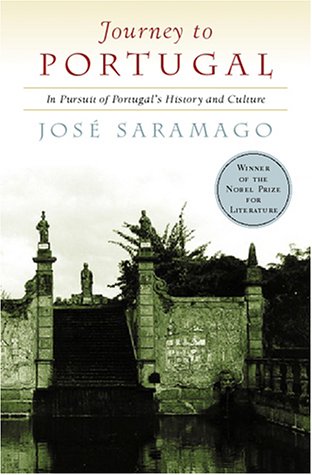
2.  Journey to Portugal by José Saramago

When José Saramago decided to write a book about Portugal, his only desire was that it be unlike all other books on the subject, and in this he has certainly succeeded. Recording the events and observations of a journey across the length and breadth of the country he loves dearly, Saramago brings Portugal to life as only a writer of his brilliance can. Forfeiting the usual sources such as tourist guides and road maps, he scours the country with the eyes and ears of an observer fascinated by the ancient myths and history of his people. Whether it be an inaccessible medieval fortress set on a cliff, a wayside chapel thick with cobwebs, or a grand mansion in the city, the extraordinary places of this land come alive.

And for the little one:

What have you picked up lately?

211th Virtual Poetry Circle

Welcome to the 211th Virtual Poetry Circle!

Remember, this is just for fun and is not meant to be stressful.

Keep in mind what Molly Peacock’s books suggested. Look at a line, a stanza, sentences, and images; describe what you like or don’t like; and offer an opinion. If you missed my review of her book, check it out here.

Also, sign up for the 2013 Dive Into Poetry Challenge because its simple; you only need to read 1 book of poetry. Check out the stops on the 2013 National Poetry Month Blog Tour and the 2012 National Poetry Month Blog Tour.

Today’s poem is from David Raikes, who was a WWII pilot and recently laid to rest:

Let It Be Hushed

Let it be hushed; let the deep ocean close
Upon these dead. Others may laud the parts they played,
Raise monuments of marble in their names.
But we who flew with them and laughed with them,
We other crews who, living side by side,
In outward contacts slowly came to know
Their inmost parts, would rather leave untouched
The wound we healed, the love we buried there.
These men knew moments you have never known,
Nor ever will; we knew those moments too,
And talked of them in whispers late at night;
Such confidence was born of danger shared.
We shared their targets, too; but we came back.
Lightly we talked of it. We packed their kit,
Divided up such common useful things
As cigarettes and chocolate, rations stored
Against a rainy day that never came.
'And they cast lots among them!' Someone said,
'It was a pity that he wore his watch;
It was a good one, twenty pounds he said
He paid for it in Egypt. Now, let's see,
Who's on tonight. Ah, Taffy - you've a good one!
You'd better leave it with me.' And we laughed.
Cold were we? Cold at heart. You get that way.
Sometimes we knew what happened; how they crashed.
It was not always on the other side.
One pranged upon the runway, dipped a wing,
The navigator bought it, and the gunner.
The other two got out, a little shaken.
Bob crashed when doing an air test, just low flying
- At least they think it was, they couldn't say.
The plane was burning fiercely when they found it;
One man thrown clear, still living, but he died
On way to hospital. The loss was ours, -
Because I shared an aeroplane with Bob.
We had to get another D for dog.
And some did not come back. We never knew
Whether they lived - at first just overdue,
Till minutes changed to hours, and still no news.
One went to bed; but roused by later crews,
Asked 'Were they back yet?' and being answered 'No',
Went back to sleep.
One's waking eyes sought out the empty beds,
And 'Damn', you said, 'another kit to pack';
I never liked that part, you never knew
What privacies your sorting might lay bare.
I always tried to leave my kit arranged
In decent tidiness. You never knew.
But that is past. The healing river flows
And washes clean the wound with passing years.
We grieve not now. There was a time for tears,
When Death stood by us, and we dared not weep.
Let the seas close above them, and the dissolving deep.

What do you think?

The Nine Fold Heaven by Mingmei Yip

Source: Mingmei Yip, the author
Paperback, 320 pages
I am an Amazon Affiliate

Skeleton Women‘s Heavenly Songbird Camilla returns in The Nine Fold Heaven by Mingmei Yip (check out Chapter One) after a quick exit from Shanghai in the 1930s into Hong Kong.  She’s hiding out away from the gangsters she betrayed, but this once emotionless spy now must endure guilt and longing.  She does not know the fate of her love Jinying, nor of her lover Gao, but more importantly, she knows that her baby, Jinjin, is alive but not where he is.  Yip has a firm grasp of the atmosphere during this period in Shanghai, a time when gangs ran the government, businesses, and held everyone else at gunpoint.  The corruption, backroom deals, and fear permeate this novel, and Camilla is forced to return to Shanghai even though her life is clearly going to be in danger there.  Using her skills as a trained skeleton woman — which include seduction — she is able to disguise herself and create plausible stories on the spot, but the trick now is not to let her emotions rule her, which in some instances they do, leading to trouble.

“Unwilling to give up, I forced my tired feet to carry me into the hall and through the door to the next room.  Once I had stepped across the threshold, I noticed something different, even eerie, but I couldn’t pinpoint what that was–except it came with an unpleasant smell.  Instead of rows of cribs as in the other room, this one had only one single large bed in which was what looked like a huge lump covered with a black cloud.  I couldn’t tell what it was in the distance, but it was heaving like a collective heartbeat.  I went up to take a closer look.” (page 102 ARC)

While Camilla searches for her baby, she’s also searching for her lovers, but in the midst of her investigations she meets up with an American ambassador who could offer her protection from the gangs and falls into the hands of Rainbow Chang, a gossip columnist and head of the Pink Skeleton Women.  At many times, she is in danger, and in spite of this danger, she’s confident she has the perfect plan for escape, but given that the novel is told from her point of view, readers also will hear her inner demons and learn of her shaky confidence.  Wallowing in self-pity becomes a mantra for Camilla early on in the novel, and it becomes a drone in the background even as the plot moves forward, making it difficult to like the protagonist.  However, her determination to find peace and her family are rewarding and helps build an emotional connection with the reader, especially given her sordid past as a skeleton woman and a sad orphan.

“So after seemingly endless gentle twisting in all the auspicious and inauspicious directions and angles, with the application of just a little strength, the lock finally surrendered with a long-awaited sigh of release.  I couldn’t help but feel satisfaction at the culmination of my courtship of the lock.”  (page 249 ARC)

The Nine Fold Heaven by Mingmei Yip is peppered with poetry, proverbs, and more, and it’s a solid follow-up to Skeleton Women (which does not have to be read first), though the ending could be an opening for a third book.  Yip is talented and understands how to create a story that is deep in its passions and exciting in plot.  While Camilla can be hard to love, her plight is age-old.

About the Author:

Kensington author Mingmei Yip believes that one should, besides being entertained, also get something out of reading a novel. Her new novel is Skeleton Women is about survival, letting go, and finding love and compassion.

Her debut novel Peach Blossom Pavilion is the story about the last Chinese Geisha and also that of courage and the determination to succeed and attain happiness. Her second novel Petals from the Sky, a poignant Buddhist love story, is about wisdom, compassion, when to persist and when to let go. Her third novel Song of the Silk Road is an adventure love story between an older woman and a younger man with a three million award on China’s famous, dangerous route.

For more about the author and her books visit her Website, on Twitter, and on Facebook.

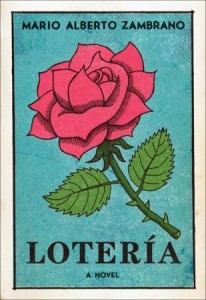
Lotería by Mario Alberto Zambrano

Source: TLC Book Tours and Harper
Hardcover, 288 pages
I am an Amazon Affiliate

Lotería by Mario Alberto Zambrano is an imaginative coming-of-age story for eleven-year-old Luz Castillo that uses the cards from a Mexican game that resembles American bingo.  Each card can be covered in the game once the riddle is called and the players know what card it is based on the riddle, and each card is placed in a tablas in any order or in a standard order.  Like the game, Luz unwinds her memories just before a tragic event lands her in a center and her father arrested.  As she turns the cards over, a memory is triggered, and she writes it down in her journal at the behest of her auntie Tencha.  Like any child traumatized by a startling event, Luz’s memories do not follow any kind of straightforward timeline, but they do reveal a great deal about her family’s immigration, ties to Mexico, and adjustment in America.

“And because quiero can mean either want or love, I asked if it meant “I want you” or “I love you.”  Come here, because I love you,or, come here, because I want you? If you were saying to someone, come to me, then the person you loved wasn’t there, and if you had to tell someone to come to you then maybe he didn’t love you.  And to want someone to come to you is like an order.  If you have to order someone to come to you, how much love is in that anyway?”  (page 13 ARC)

Like the journal entries, Luz’s family life is complex and multilayered with her older sister, Estrella, having been born in Mexico and knowing to smoothly speak Spanish, while Luz is a natural born American who is self-conscious about speaking Spanish aloud even though she knows what those around her say.  While there are moments in this novel when Luz has more adult thoughts, the experiences she has at home with her parents always fighting and her cousins taking advantage of her youth when she visits in Mexico, it is clear that she is mature beyond her years and has given a great deal of thought to her life experiences.

Peppering the story with Spanish words, the meaning of which can be mostly gleaned from the context of the story, Zambrano has crafted a puzzle that will spur readers to keep reading and take the journey with Luz as she uncovers the memories she’s tried to forget about her family.  While Luz has grown up in a typically male-oriented household, it is clear that America has had an influence on the family as her mother takes a job outside the home and never cowers behind her skirts when her husband is out of control with drink.  Despite the hardships, Luz has faced, she still remains optimistic and open to the possibilities of a better life, as she speaks to God in her journal entries about her past and her own confusion and feelings.

Lotería by Mario Alberto Zambrano is well-crafted, stunning, and highly recommended.  It brings to light the horrors of familial dysfunction, abuse, and general family discord through the eyes of a mature child, who strives to cope with it all in the best way possible.  Not only does it highlight the transition of a family from life in Mexico to one in America — with its opportunities and disappointments — but it also examines the dichotomy of family relationships that produce both love and hate.  Zambrano is an author to watch for.

About the Author:

Mario Alberto Zambrano was a Riggio Honors Fellow at the New School and recently completed his MFA at the Iowa Writers’ Workshop as an Iowa Arts Fellow. He is a recipient of the John C. Schupes Fellowship for Excellence in Fiction. Lotería is his first novel.

Find out more about Mario at his Website and connect with him on Facebook.

This is my 46th book for the 2013 New Authors Challenge.
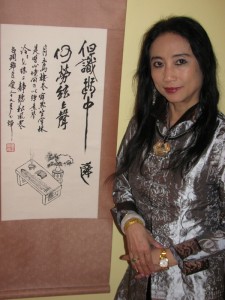
Writing Space of Mingmei Yip

Mingmei Yip has been writing and publishing since she was fourteen years old and now she has twelve books to her credit.  Her five novels are published by Kensington Books and her two children’s books are published by Tuttle Publishing.  Mingmei is also a renowned qin (ancient string instrument) musician, calligrapher and painter.  In Hong Kong, she was a columnist for seven major newspapers.  She has appeared on over sixty TV and radio programs in Hong Kong, Taiwan, China, and the US. Visit her Website.

Last year, I really enjoyed Skeleton Women, and The Nine Fold Heaven picks up where the previous book ends.  “An ex spy and nightclub singer who undertakes an emotional and dangerous journey to reunite with her lost lover and the baby she was told was stillborn, and to discover the secret of her parents’ murder.”

Mingmei Yip - Author of Nine Fold HeavenCome along with an ex spy as she returns to Shanghai where she’s a wanted woman – but she has to search for her baby and her lost lover. Is her baby really alive? Will she be able to find her lover? Can she elude the police long enough to find them? Learn much more about The Nine Fold Heaven and Mingmei Yip.

Nine Fold Heaven is part of a series about Camilla the songbird and female spy – you can also read Skeleton Women, the first book about Camilla.

Today, I’ve got a great guest post from Yip about her writing space.  Please give her a warm welcome.

Writing space: I only write at home. I can’t write at cafes, since most have loud music which is a distraction for me. But when they play classical music, then I stop writing and listen, so that does not work for me, either.

Writing Space - 3I consider myself lucky to have a small room just for myself in my apartment which I use as my writing space. Luckily, my little room has a view of the north side of Manhattan and the East River. So, when I just can’t type anymore, I lift my head and soothe my eyes by staring at the peaceful scene outside the window. Soon I am refreshed and back at work.

I have decorated my writing room with some of my favorite things – books, plants, flowers, my own paintings and calligraphy. Writing is a solitary and difficult journey, so I try to fill my space with what I find both beautiful and spiritually inspiring. I also keep amulets next to me for protection, just in case.

Writing Space - 1Writing habits: I don’t have a chance to write every day, because like everyone else, I have other responsibilities in life. So when I have a chance to write, I write as much and as long as I can. This is like gorging yourself when you don’t know where your next meal is coming from. In any case, it is what works for me. It helps that I can take a nap whenever I want.

Writing tips: I plunge into writing and ignore everything around me. Since I was a tiny girl I have always preferred life inside my own head. Whenever I have writer’s block, I’ll read or watch a movie. This usually triggers ideas for me so I can go back to write. I also read a lot, not only to feed my imagination and creativity, but also to have a point of comparison for my own writing.

Writing Space - 2I think it is still essential to master the basics. Not only voice, characterization, dialogue, plot, but also sentence structure, its rhythm and music. I always try to vary the length of my sentences and start each one with a different subject. It’s essential to spent whatever time it takes to find the right word. Sometimes, it is a single word that brightens a whole paragraph.

There is a Chinese saying “Slap on the thigh and exclaim!” That’s how the readers will react to a good choice of word. Readers may not be aware of the meticulous hard work behind a smooth sentence, but if you don’t pay attention, they will soon become bored. I also think it’s good for authors to attend other cultural activities such as movies, concerts, art exhibitions. Have as diverse a background as you can cultivate, that really helps.

Most important, don’t give up! The ancient Chinese philosophy classic, the Daode Jing says more things are spoiled in the end than the beginning. Stick through to the end.

Thanks, Mingmei, for sharing your writing space with us, as well as your writing habits. I’m the opposite, too much quiet and I can’t write.

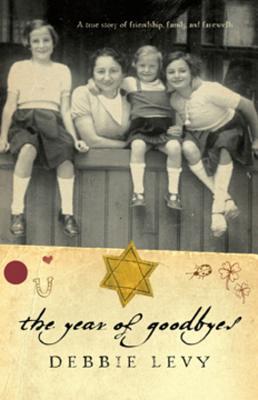
The Year of Goodbyes by Debbie Levy

Source: Book Expo America 2010
Hardcover, 136 pages
I am an Amazon Affiliate

The Year of Goodbyes by Debbie Levy is an adaptation of her mother’s poesiealbum (poetry album) into a narrative poem, peppered with images and actual entries, and a WWII historical time line as well as a resource listing and a section catching up with Jutta Salzberg’s family and friends and their ultimate fates.  This powerful hybrid poem/memoir not only examines the horrifying snowball effect of Nazi Germany’s laws against Jews, but also how Jewish children still found ways to maintain their childhood and enjoy the joyous moments they still had.

Salzberg lived in Hamburg, Germany, and was the daughter of a Polish born Jew who emigrated to Germany before the Nazi’s came to power, and the poetry album, much like American autograph books, begins in 1938, which became a pivotal year for Jutta.  Her father was a successful, belt, suspender, etc. salesman, who is eventually dismissed from his job because he’s a Jew. As a young lady on the verge of womanhood, she is capable of not only enjoying gossip and games with classmates, but also understand the deep seriousness of the changes around her.

Parents (page 32)
...
He sags
and I think how Father could use something
to hold him up--
a belt,
a suspender,
a garter...

She also has the ability to question the changes around her within the context of the words from her friends, like respecting one’s elders. Jutta wonders how she can respect someone like Hitler, who is her elder, when he spread such fear and hatred.  There is great tension in this short, narrative poem/journal as a young girl tries to find the silver lining in her circumstances, remember her friends, and enjoy moments with her family, while at the same time worrying that her immediate family will be unable to leave Germany for America as the consulate will not issue them U.S. visas.  The section of the narrative poem that is the most heart-wrenching is when Jews are forced to seek out kindness from strangers in America who just happen to have their same last name.

The Year of Goodbyes by Debbie Levy is powerful and a great testament to her mother’s memory, her own family’s past, and the hope generated by that remembering.  The book is not only a year of goodbyes between Jutta and her family and friends, it also contains information that may not be as well known, including the role of Jutta’s cousin Guy Gotthelf in the French Resistance and the impact of one Jewish man, Herschel Grynszpan, on those left behind in Germany when he avenged the murder of his own family back in Germany.  Lasting, eye-opening, and a must read for young and old.

About the Author:

Debbie Levy writes books — fiction, nonfiction, and poetry — for people of all different ages, and especially for young people. Before starting her writing career, she was a newspaper editor, and a lawyer with a Washington, D.C. law firm. She has a bachelor’s degree in government and foreign affairs from the University of Virginia, and a law degree and master’s degree in world politics from the University of Michigan. She lives in Maryland and spends as much time as she can kayaking and otherwise messing around in the Chesapeake Bay region.  Follow her on Twitter and Facebook.  Also please check out the article on her family’s journey in The Washington Post, and her own article on finding the journal in the same publication.

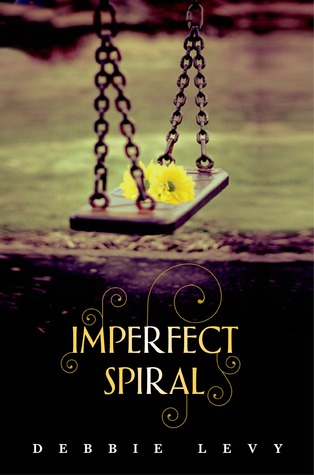
Also, check out her new book, Imperfect Spiral, which is published today!

Danielle Snyder’s summer job as a babysitter takes a tragic turn when Humphrey, the five-year-old boy she’s watching, runs in front of oncoming traffic to chase down his football. Immediately Danielle is caught up in the machinery of tragedy: police investigations, neighborhood squabbling, and, when the driver of the car that struck Humphrey turns out to be an undocumented alien, outsiders use the accident to further a politically charged immigration debate. Wanting only to mourn Humphrey, the sweet kid she had a surprisingly strong friendship with, Danielle tries to avoid the world around her. Through a new relationship with Justin, a boy she meets at the park, she begins to work through her grief, but as details of the accident emerge, much is not as it seems. It’s time for Danielle to face reality, but when the truth brings so much pain, can she find a way to do right by Humphrey’s memory and forgive herself for his death?

On July 27, 2013, at 3:30 pm for those in the Alexandria, Va., area, Debbie will be with Beth Kephart in a joint event at Hooray for Books.

This is my 45th book for the 2013 New Authors Challenge.