Quantcast

Mailbox Monday #228 and Library Loot #9

Mailbox Monday (click the icon to check out the new blog) has gone on tour since Marcia at To Be Continued, formerly The Printed Page passed the torch.  July’s host is Book Obsessed.

The meme allows bloggers to share what books they receive in the mail or through other means over the past week.

Just be warned that these posts can increase your TBR piles and wish lists.

Here’s what Wiggles got at the library sale:
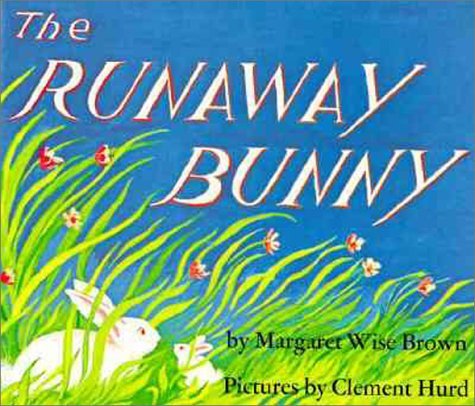
1.  The Runaway Bunny by Margaret Wise Brown

The Runaway Bunny begins with a young bunny who decides to run away: “‘If you run away,’ said his mother, ‘I will run after you. For you are my little bunny.'” And so begins a delightful, imaginary game of chase. No matter how many forms the little bunny takes–a fish in a stream, a crocus in a hidden garden, a rock on a mountain–his steadfast, adoring, protective mother finds a way of retrieving him. The soothing rhythm of the bunny banter–along with the surreal, dream-like pictures–never fail to infuse young readers with a complete sense of security and peace. For any small child who has toyed with the idea of running away or testing the strength of Mom’s love, this old favorite will comfort and reassure.
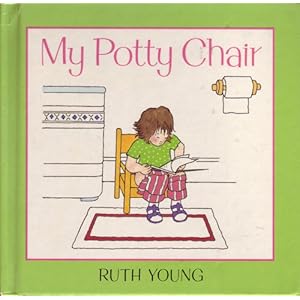
2.  My Potty Chair by Ruth Young

In My Potty Chair, a girl matter-of-factly discusses the use of her potty chair.
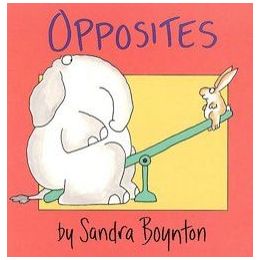
 

3.  Opposites by Sandra Boynton

Serious silliness for all ages. Artist Sandra Boynton is back and better than ever with completely redrawn versions of her multi-million selling board books. These whimsical and hilarious books, featuring nontraditional texts and her famous animal characters, have been printed on thick board pages, and are sure to educate and entertain children of all ages.

4.  Doggies: A Counting and Barking Book by Sandra Boynton

Serious silliness for all ages. Artist Sandra Boynton is back and better than ever with completely redrawn versions of her multi-million selling board books. These whimsical and hilarious books, featuring nontraditional texts and her famous animal characters, have been printed on thick board pages, and are sure to educate and entertain children of all ages.

5.  I am a Train by Ace Landers

Simple train facts in a board book shaped like a train!

I am a train.
I travel on railroad tracks.

All aboard for this fun and sturdy board book shaped like a train. Read along as trains travel from town to town delivering passengers and important cargo to train stations across the country.  Little engineers will love seeing these big machines in action. It’s a book and a toy in one!

What did you receive?
Library Loot is a weekly event co-hosted by Claire from The Captive Reader and Marg from The Adventures of an Intrepid Reader that encourages bloggers to share the books they’ve checked out from the library. If you’d like to participate, just write up your post-feel free to steal the button-and link it using the Mr. Linky any time during the week. And of course check out what other participants are getting from their libraries.

1.  Timmy Time Hide and Seek for Wiggles

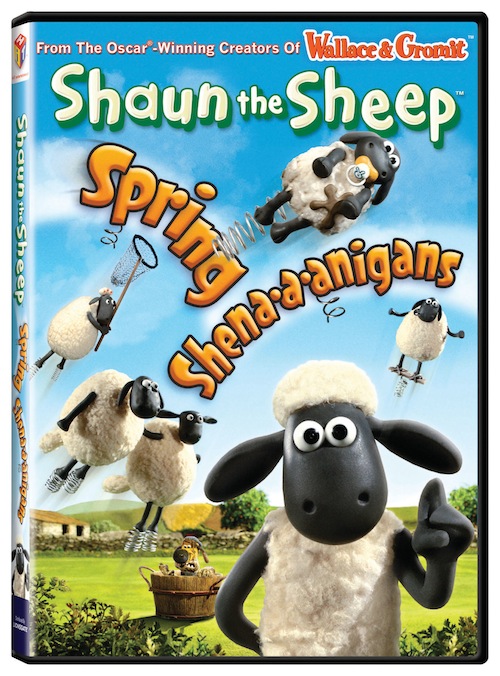
2.  Shaun the Sheep: Spring Shena-a-anigans

She has a slight addiction to these sheep adventures, and we’ve been snagging them from the library on a pretty regular basis.  Have you watched these? or Wallace & Gromit?


3.  The Real Jane Austen by Paula Byrne because my ARC did not include the photos and images that are talked about in the text, making it harder for me to read the review copy.

In The Real Jane Austen, acclaimed literary biographer Paula Byrne provides the most intimate and revealing portrait yet of a beloved but complex novelist.

Just as letters and tokens in Jane Austen’s novels often signal key turning points in the narrative, Byrne explores the small things – a scrap of paper, a gold chain, an ivory miniature – that held significance in Austen’s personal and creative life.

Byrne transports us to different worlds, from the East Indies to revolutionary Paris, and to different events, from a high society scandal to a case of petty shoplifting. In this ground-breaking biography,  Austen is set on a wider stage than ever before, revealing a well-traveled and politically aware writer – important aspects of her artistic development that have long been overlooked.

4.  Queen of America by Luis Alberto Urrea

After the bloody Tomochic rebellion, Teresita Urrea, beloved healer and “Saint of Cabora,” flees with her father to Arizona. But their plans are derailed when she once again is claimed as the spiritual leader of the Mexican Revolution. Besieged by pilgrims and pursued by assassins, Teresita embarks on a journey through turn-of-the-century industrial America-New York, San Francisco, St. Louis. She meets immigrants and tycoons, European royalty and Cuban poets, all waking to the new American century. And as she decides what her own role in this modern future will be, she must ask herself: can a saint fall in love?

Have you visited your library?
210th Virtual Poetry Circle

Welcome to the 210th Virtual Poetry Circle!

Remember, this is just for fun and is not meant to be stressful.

Keep in mind what Molly Peacock’s books suggested. Look at a line, a stanza, sentences, and images; describe what you like or don’t like; and offer an opinion. If you missed my review of her book, check it out here.

Also, sign up for the 2013 Dive Into Poetry Challenge because its simple; you only need to read 1 book of poetry. Check out the stops on the 2013 National Poetry Month Blog Tour and the 2012 National Poetry Month Blog Tour.

Today’s poem is from Louise Bogan:

Epitaph for a Romantic Woman

She has attained the permanence
She dreamed of, where old stones lie sunning.
Untended stalks blow over her
Even and swift, like young men running.

Always in the heart she loved
Others had lived,—she heard their laughter.
She lies where none has lain before,
Where certainly none will follow after. 

What do you think?

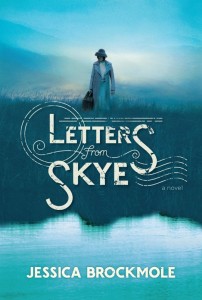
Letters From Skye by Jessica Brockmole

Source: TLC Book Tours and Random House
Hardcover, 304 pages
I am an Amazon Affiliate

Letters from Skye by Jessica Brockmole, an epistolary novel that straddles two World Wars, is about falling in love, finding your soul mate, and poetry.  Elspeth Dunn, a Scottish poet on the Isle of Skye, lives a rather cloistered life on her island but one of her books makes its way across the Atlantic to a young man in Illinois, David Graham, who writes her a fan letter.  Over the course of several years beginning when WWI breaks out in Europe, Elspeth and David begin a correspondence that takes on a life of its own.

“It’s the war talking.  I know; I’ve seen it.  They head off, invincible, feeling as if the future is a golden pool before them, ready to dive into.  And then something happens — a bomb, a sprained wrist, a bullet that whizzes by too close for comfort — and suddenly they are grabbing for whatever they can hold on to.  That golden pool, it swirls around them, and they worry they might drown if they’re not careful.  They hold tight and make whatever promise comes to mind.  You can’t believe anything said in wartime.  Emotions are as fleeting as a quiet night.”  (page 33 ARC)

While David is in America struggling through college and hoping to subvert his father’s plans for medical school, Elspeth is busy writing poetry and becoming even more entrenched in the lines her muse is offering.  Her relationship with her brother Finlay is the closest she has, but war does change things.  The more her muse speaks, the more she’s pulled away from the life she’s always known and the more she is challenged to face her fears — including her fear of water.

Through Elspeth and David’s correspondence the wider impact of war is experienced, complete with the tension of the home front as wives and families wait for their loved ones.  But at the same time, the lives of women are broadening as they are able to enter into jobs once thought of as men’s work.  The feminist leanings of Elspeth are clearly front and center in some of her correspondence with David, but it never deters him in his pursuit of her.  The moral high ground has no place in this romantic jaunt across Scotland, London, and France as a young woman and man succumb to their emotional connection on the page.

Letters from Skye by Jessica Brockmole weaves Elspeth and David’s story with that of Margaret, Elspeth’s daughter, and her search for the past.  Margaret has never met her father, and her mother remains close-lipped about her past and her daughter’s father.  But when WWII begins to break out, all of the old transgressions and emotional upheaval of Elspeth’s past resurfaces, threatening to leave her unmoored once again.  But Margaret’s life is far from pristine when it comes to the tentacles of war as her fiance flies for the RAF.  Brockmole’s letters are frank, honest, and engaging as these relationships unfold and enfold, creating a family history that will be hard to forget.  And yes, there is a poem included!

About the Author:

Jessica Brockmole spent several years living in Scotland, where she knew too well the challenges in maintaining relationships from a distance. She plotted her first novel on a long drive from the Isle of Skye to Edinburgh. She now lives in Indiana with her husband and two children.

To learn more about Jessica and her work, visit her Website.

To WIN a copy of this book, leave a comment by July 19, 2013, at 11:59 PM EST; You must be a U.S. resident 18 years and older.

This is my 44th book for the 2013 New Authors Challenge.

Changes Are Afoot

sunflower

I hope everyone’s summer is full of fun, relaxation, and great books. (my sunflower, which I am happy to say, I grew from a wee seed)

I just wanted to check in and mention briefly that there are some assessments going on in my head about the blog and my own writing.  I have been posting M-Th and Saturdays, but I want to cut back some as I’m working full time still, potty training my young daughter, and just generally tired in the evenings from all the hustle and bustle.

Are there particular days that you read blogs more regularly?

I’m considering posting reviews on the days that get the most traffic/comments and leaving the others as breaks in between, though the Virtual Poetry Circle will stay on Saturdays for now as I often prepare those 1-2 weeks in advance.

On my off days for the blog, I plan to spend that 1-2 hours I would be writing a review working on my own fiction or poetry.  It’s time for me to carve out the time and get disciplined.  The toddler cannot be an excuse for laziness on my part.

So you see, this is part check in, and part pep talk for myself.

Also, I’m also in the midst of revising my review policy to cut back on the number of review copies I accept on a yearly basis.  I’m considering a specific target number and once I hit that number, I will have to close to review copy submissions/requests.

In that vein, I wonder how many review copies you each accept per year or what your hard and fast rules are?

Any feedback is appreciated.

What Changes Everything by Masha Hamilton

Source: Unbridled Books, unsolicited
Hardcover, 288 pages
I am an Amazon Affiliate

What Changes Everything by Masha Hamilton is a look at the reverberating impact of war on not only the countries directly affected, but also those countries who send people to help refugees and the injured.  Todd Barbery coordinates aid for refugees and hospitals with the help of his Afghan contact, Amin.  Todd is far from his wife Clarissa of about three years and his only daughter Ruby, who is just beginning her own life, but while Clarissa fears for his safety and has wrestled a promise from him that this will be his last rotation in Afghanistan, Todd wishes not to be so closely guarded and insists on moments of freedom.

“Already wearing sweatpants and a T-shirt, she tied the laces to her tennis shoes, tugged a sweatshirt over her head, and slipped downstairs.  Her stomach felt hollow.  Hunger had largely left her during these last days — she’d always been an indifferent eater, but now she found herself forgetting about food altogether until she’d notice her hands were shaking.”  (Page 135 ARC)

Each section is from a different perspective that alternates between Todd, the subject who is kidnapped and the major driver of the plot; Clarissa; Amin; Mandy; and Stela and Danil — a mother and her son, a young graffiti artist who lost his brother to Afghanistan and friendly fire.  While many of these characters’ experiences and lives intersect, Mandy and the letters written by Najibullah — a former ruler of the nation who is held by the UN and not allowed to leave for exile with his wife and daughters — are outside those interactions and direct connections to demonstrate a more compassionate and empathetic side of the story to juxtapose the heartbreak and devastation of war.

“The man turned toward Todd.  He was about twenty-five years old.  He wore a blue-gray turban and a brown vest over his salwar kameez, and his eyebrows were unusually thick, like angry storm clouds hovering over his eyes.”  (page 31 ARC)

There is great compassion and hidden understanding in these fictional lives, and much of that seems to stem from the torture and death of a historical figure, Najibullah, at least as a driving force for Amin.  However, the letters from the former president to his daughters in exile tend to pull the reader out of the rest of the story until the connection is made to Amin, and the novel may have been better served had those letters been truncated and included in Amin’s portion of the story as flashbacks or memories.  The tension with the kidnapping is well done as is the tension between Clarissa and her step-daughter as negotiations continue and the FBI is looking for the go-ahead for a military distraction even though they claim they do not know her husband’s exact location.

Danger is around every corner, or that’s how it should be perceived in this novel, and when it isn’t unfortunate things happen but at other times unexpectedly good things happen as well.  Hamilton’s prose is easy to read and is packed with emotion and perspectives that are rarely examined in war-based fiction.  The novel seeks to be well-rounded in perspective, which is tough given the complexities of the factions in Afghanistan.  What Changes Everything by Masha Hamilton is engaging and hammers home the impact of war not just on the immediate participants and their families, but also those on the periphery and who are actively compassionate in their work and have a need to assist in any way they can.

About the Author:

Masha Hamilton is currently working in Afghanistan as Director of Communications and Public Diplomacy at the US Embassy. She is the author of four acclaimed novels, most recently 31 Hours, which the Washington Post called one of the best novels of 2009 and independent bookstores named an Indie choice. She also founded two world literacy projects, the Camel Book Drive and the Afghan Women’s Writing Project. She is the winner of the 2010 Women’s National Book Association award.  Check out the inspiration behind the book, What Changes Everything.  She is also behind the Afghan Women’s Writing Project.

This is my 43rd book for the 2013 New Authors Challenge.

A Small Death in Lisbon by Robert Wilson

Source: Public Library
Hardcover, 440 pages
I am an Amazon Affiliate

A Small Death in Lisbon by Robert Wilson is a mystery set in Lisbon, Portugal, in the 1990s, but also a novel that has routes in World War II when Germans were looking for an escape route when the war looked to be ending, and not in their favor.  The novel opens with the death of a young teen, Catarina Oliveira, who has a promiscuous past and a less-than-ideal family life.  Inspector Zé Coelho is on the case, which drags him into conspiratorial intrigues and the dark, convoluted past of his home nation.  Shifting back to 1941, Wilson unveils Klaus Felsen, a German businessman who is “recruited” by the German SS for a particular purpose that takes him into Spain, Portugal, and later Africa, as some Nazis, including his recruiter Lehrer, begin to see the campaign against Russia as folly.  Wilson’s novel is about political regimes and how even their single-minded focus can be derailed by the most personal of matters.

Felsen is an opportunist who attempts to make the most of his new position in the SS, doing the best he can to game the Wolfram markets and garner more of the mineral and other materials away from Britain and the allies from neutral countries, like Portugal.  His meeting with a British agent Edward Burton turns ugly, marring his character and leading him down an ever darkening path that sets him adrift.  Coelho, meanwhile, is slowly investigating the murder of young girl, finding that the ghosts in Salazar‘s closet are not so hidden.  The links between the Oliveira girl and the Nazis’ past in Portugal are convoluted and sinister even as publicly the nation remained neutral.

“‘So you’ve seen some of Lisbon,’ he said.  ‘Now when you see Salazar’s capital after dark perhaps you understand my point about the harlot.  Lisbon’s a whore, a peasant Arab whore, who wears a tiara at night.'”  (page 92)

Wilson successfully paints an atmosphere of paranoia among the Germans as the war winds down, and demonstrates through a series of minor characters the tensions between fascism and communism in Portugal following the war.  These political tensions weigh heavily throughout the mystery novel creating a multilayered, interlocking puzzle to be unraveled by Coelho.  Ripe with sex scenes and the underbelly of prostitution in Lisbon, the darker elements of Felsen and later Miguel Rodrigues’s desires come into the light, along with incest, adultery, perversity, and murder.

Unfortunately, these multiple story lines seem forced together toward the end with newer, less important plot lines that could have remained unresolved by Wilson.  Ultimately, the most well drawn character in the book is Felsen, though for the latter third he disappears until the very end when there seems to be no other way to tie up the mystery.  Coelho is a carbon cut out of any police detective and doesn’t seem particularly Portuguese with any respect, which could be due to the time he spent in England with his wife and child.  His time in England, however, may have made him less old-world Portuguese in some sense, but at his core, readers may expect him to still have those old world values, which could leave readers feeling that Wilson’s detective is not authentic enough.  A Small Death in Lisbon by Robert Wilson works as a mystery novel but not as well as one would expect given the high number of coincidences, but the historical parts of this book are deeply engaging and unique.  Overall, a satisfying read that will keep readers turning the pages.

About the Author:

Robert Wilson is the author of nine previous novels, including A Small Death in Lisbon and The Company of Strangers. A graduate of Oxford University, he has worked in shipping, advertising, and trading in Africa, and has lived in Greece and West Africa.

This is my 42nd book for the 2013 New Authors Challenge.

Mailbox Monday #227

Mailbox Monday (click the icon to check out the new blog) has gone on tour since Marcia at To Be Continued, formerly The Printed Page passed the torch.  July’s host is Book Obsessed.

The meme allows bloggers to share what books they receive in the mail or through other means over the past week.

Just be warned that these posts can increase your TBR piles and wish lists.

Here’s what I received:

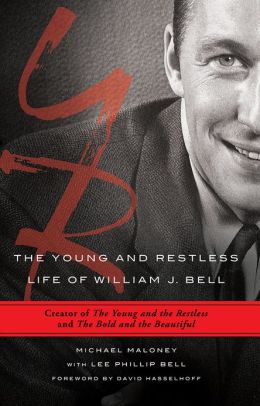
1.  The Young and Restless Life of William J. Bell: Creator of The Young and the Restless and The Bold and the Beautiful by Michael Maloney and Lee Phillip Bell, which I bought.

For the first time fans will be able to discover the true stories behind the creation and growth of the most popular and iconic soap operas of all time, and they’ll learn about the man behind their favorite storylines. Filled with dramatic turns, dangerous risks, and an overall devotion to bringing life to the show, this biography will offer fans a backstage pass to the fascinating world of soaps!

Bill Bell worked from a love of his characters and his family, and was never afraid to fight for what he knew to be important to both. For any fans of Bill’s shows or anyone working on creating dramas, this is an unprecedented look into the life of one of the men who did it best.

2.  Black Aperture by Matt Rasmussen, which I received as a member of the Academy of American Poets, and the book won the Walt Whitman Award.

In his moving debut collection, Matt Rasmussen faces the tragedy of his brother’s suicide, refusing to focus on the expected pathos, blurring the edge between grief and humor. In Outgoing, the speaker erases his brother’s answering machine message to save his family from “the shame of dead you / answering calls.” In other poems, once-ordinary objects become dreamlike. A buried light bulb blooms downward, a “flower / of smoldering filaments”. A refrigerator holds an evening landscape, a “tinfoil lake”, “vegetables / dying in the crisper”. Destructive and redemptive, Black Aperture opens to the complicated entanglements of mourning: damage and healing, sorrow and laughter, and torment balanced with moments of relief.

What did you receive?

209th Virtual Poetry Circle

Welcome to the 209th Virtual Poetry Circle!

Remember, this is just for fun and is not meant to be stressful.

Keep in mind what Molly Peacock’s books suggested. Look at a line, a stanza, sentences, and images; describe what you like or don’t like; and offer an opinion. If you missed my review of her book, check it out here.

Also, sign up for the 2013 Dive Into Poetry Challenge because its simple; you only need to read 1 book of poetry. Check out the stops on the 2013 National Poetry Month Blog Tour and the 2012 National Poetry Month Blog Tour.

Today’s poem is from John Brehm:

Fourth of July

Freedom is a rocket,
isn’t it, bursting
orgasmically over
parkloads of hot
dog devouring
human beings
or into the cities
of our enemies
without whom we
would surely
kill ourselves
though they are
ourselves and
America I see now
is the soldier
who said I saw
something
burning on my
chest and tried
to brush it off with
my right hand
but my arm
wasn’t there—
America is no
other than this
moment, the
burning ribcage,
the hand gone
that might have
put it out, the skies
afire with our history.

What do you think?

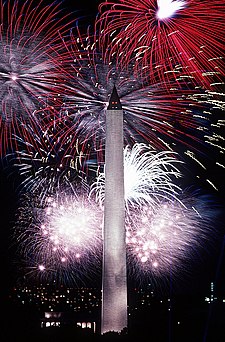
Happy Independence Day!

The 4th of July was often such an innocent thing for me as a kid with the carnival and the fireworks and the cotton candy in my small town, but as I’ve grown older and studied some of the nation’s history, I find it a more reverent occasion.

Rather than just sit back and enjoy the revelry, my mind often wanders to my grandfather and my uncle and the sacrifices they made in the name of freedom to ensure the U.S. and other countries remained free from tyranny.  I miss my grandfather and his ability to move beyond those dark days in WWII, and his love of life — embracing it full on, though not without grumbling from time to time.

It is in times like the ones we are in now where our own government spies on our activities — though I am not as naive to think that they have never done so before — that I feel we take our freedoms for granted.

However, with my little girl nearing school age, I find that I want to spend quiet moments and enjoy her experiences — things that are all new to her, those are the moments of wonder and joy that we sometimes miss out on when we’re hustling to and from work, etc.  So take time to spend with family and enjoy those moments before they disappear once again into the background.

Happy Independence Day to you all!

Interview with Poet Kathryn Kirkpatrick

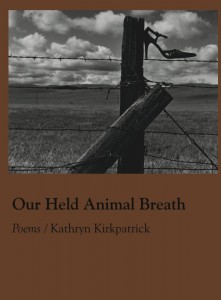
I reviewed Our Held Animal Breath by Kathryn Kirkpatrick back in June and found that the book stayed with me long afterward, forcing me to revisit some particularly resonant pieces, like “Millennium” and “At the Turkey Farm,” that question the loneliness we feel when what we should see and feel is that connection we have with the animals and world around us.  There is so much to discuss in the collection, that it would make an interesting book club discussion.  I was intrigued enough to pose my own questions to the poet, and today, I share with you her answers.

Please give Kathryn Kirkpatrick a warm welcome.

Our Held Animal Breath seems to refer to the connections between ourselves and the wider animal kingdom; what is your view of humanity’s place in the animal kingdom and nature?

I’ve always felt myself to be what would now be called bio-centric or eco-centric.  That means our species doesn’t have any greater right to the planet than any other; we should be sharing it with all the other creatures.  I can remember as a sophomore in college giving an impassioned report to my biology class on endangered species.  That was back in the early 1970s when it was becoming widely known how human activities were depriving so many species of their habitats.  As a poet, I am increasingly working to develop my already strong empathy for animals.

How hard is it to change perceptions about how humans should treat animals and the environment and how important is it that we do so, in your opinion?

I think it’s critical that we change because our anthropomorphic beliefs and behaviors have already created what Bill McKibben has called Eaarth; he’s changed the spelling of earth to denote the radical shifts that have already happened to our atmosphere and our oceans such that the severe effects of climate change are now here and coming.  I find it heartbreaking that this wasn’t inevitable; the scientists have been warning us for decades.

But perhaps what the scientists missed was that at the root of this environmental crisis is the human assumption that nature is here exclusively for our use, and we can see this everywhere in the U.S., most especially in our attitudes toward and our treatment of animals.  We value those animals who serve a function for us–as companions, as workers; we encroach on the habitats of wild animals; and, we warehouse animals for food in the most appalling conditions.  But animals are subjects of their own lives, and if we believed that we would respect their habitats and see that ultimately treating the earth with respect and gratitude is good for both us and all the others.

Most people actually love animals, and it takes a lot of work by the dominant culture to get them to ignore the suffering of animals.  So when I can evoke feelings in a poem for other creatures, I can remind readers of the empathy they have always had.  That might be some small step toward changing behaviors.

Ecofeminist ideas seem to make their way into your poems as well, have you studied the philosophy and its principles or stumbled upon them?

I’ve had my thinking transformed by the great eco-feminist thinkers of the last decades—Carol Adams, Val Plumwood, Vandana Shiva, Karen Warren, Greta Gaard.  They make the crucial connections between oppressions of women, other marginalized peoples, and nature.  It’s the most compelling philosophy we’ve come up with as a species, and if I were to have one hope for the 21st century, it’s that we’d act on those insights.

As a poet, do you find it difficult to build readership in today’s Internet driven world or is it easier?


The Internet, assuming we can keep it free, is a wonderful tool, and I think it’s brought poetry to a great many more people than ever before.  A poem in a good online magazine reaches far more people than it does in a print journal.  That doesn’t mean I think we should get rid of print journals—there’s a place for all of it.  The monolithic thinking that says we’re all digital is the same kind of thinking that has brought us monocultures in all their limiting forms—in our food, our languages, our mindsets.

Finally, what are some of your favorite poems/poets who you’d like to see gain a wider audience?

I’d include in any list of my favorite poets Adrienne Rich, Seamus Heaney, Eavan Boland, Denise Levertov, Sylvia Plath, Paula Meehan, Gary Snyder, William Butler Yeats, and Carolyn Kizer.  I have written a number of essays in the last ten years on the work of the Dublin poet, Paula Meehan.  There is no one working today that I know of whose craft and vision interest me more.

Thanks, Kathryn, for sharing your views on nature, poetry, and behavior with us today.