Quantcast

Guest Post & Giveaway: Career Girl: Elizabeth (Eli) Bennet

I hadn’t heard of Cat Gardiner until Anna asked me to go with her to a Jane Austen panel in Bethesda.  And winning a bunch of Austen-inspired books didn’t have much to do with it.

What has a lot to do with my interest in Gardiner’s books is her plucky characters, and Elizabeth Bennet in the 1950s, after WWII, is nothing short of independent in Undercover.  You’ll have to read my review later for more on this gem.

Today, Cat Gardiner is going to share with us her love of Austen and the WWII-era, as well as how Elizabeth Bennet got to be so independent and feisty.  Please give her a warm welcome.

What an absolute delight it is to visit Savvy Verse & Wit! Thank you, Serena for inviting me to share with your readers a little bit about my newest release, Undercover – An Austen Noir, and my love of romantic, 20th Century historical fiction. Some of your readers may recognize me as a writer of Jane Austen-Inspired Contemporary, but my newest book opens the door to another passion of mine that I have longed to write.

Now, in the 21st Century, some younger readers may not be aware of the struggle women had during the 1940s and 50s as it pertained to working outside of the home. For the record, I dislike labels, and would never slap “feminist” on myself, but I am a gal who believes in progress, equality, and teaching to preserve the lessons from the past. I would like to discuss this particular role of women in the early 20th Century and how it affects Undercover’s heroine, Elizabeth (Eli) Bennet.

Undercover takes place in New York City seven years after the end of the Second World War. It was a time when suburbia was popping up all over America, cookie-cutter homes in tranquil little communities, restoring a nation that had come through the Great Depression, followed by war―to re-embrace the cultural norm of family life. It was also a time in history when claims of Communists hidden among us and fears of atomic war were threatening at our doorstep. Family was considered a safe haven in the “duck and cover” scare of the Atomic Age. Men were the providers, bread winners, and head of the happy home. Women were the heart of it, many of whom embraced the idea―others conformed begrudgingly. Yet others, fought it, and it was around this time that America saw an uptick of women, once again, enter into the workforce despite the societal expectation that they should remain homemakers and mothers. The model of white, middle-class, domestic perfection would, in 1957, be embodied by wholesome June Cleaver, homemaker, wife, and mother in the television show “Leave it to Beaver.” And it is that model that gave us the Baby Boomer Generation.

But I’m getting ahead of myself. To better understand Undercover’s Elizabeth and the culture she grew up in, let’s step back to 1942 with the government’s rallying call for women to enter into factories for defense production.  Previously, traditional jobs held by women (mostly spinsters) were considered “women’s work” of clerical, school teaching, nursing, or as librarians. Uncle Sam said entering the labor force was their patriotic duty from 1942 through 1945, even encouraging young ladies to join the military for specific roles. With their husbands leaving to fight, wives had suddenly become the sole money earner. That was an amazing opportunity following a period when those same women had been discouraged from working outside the home during the Great Depression as men fought a different fight: epidemic unemployment following the Stock Market Crash of 1929. For many women these three years were a taste―a tease―of the possibilities.

How were the 19 million female war workers rewarded for their “temporary” call to action? Apart from lower wages to their male counterparts (something our gender still struggles against) these new employees were simply given pink slips even though they had excelled at their jobs. After all, the war had ended and the millions of men returning home needed to re-take their place as breadwinners in peacetime production. Close to 90% of women wanted to remain working when asked to give up their newfound sense of individuality, as well as liberation. Further, the G.I. Bill was also putting men through school and dreams of higher education for women were met by closed doors. What choice did our 1940s counterparts have but to settle back into life with a good man and raise a family while pursuing the American Dream?

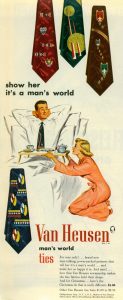
When the war began, Elizabeth Bennet once dreamed of becoming a housewife, raising a family of 3.2 children when her sweetheart returned from Europe―only he returned with another woman and a baby! Her sister, Jane, a mercenary creature, wanted that prescribed gender role, living the ideal life with her wealthy husband who brought home the bacon. Elizabeth sought a different avenue: She became a “career girl”, a private investigator, moved from her parent’s home at the age of 24, and took an apartment next door to a boarding house in Hell’s Kitchen, Manhattan. She is considered a spinster when we meet her in 1952 at the age of 26. As far as her family knew, she was a bookkeeper for Macy’s department store. Independent and spirited, she financially managed in a career path dominated by men. This was a culture where sexism was so common that many advertisements denigrated women, even in the role that society demanded they take. Here are just a few.

6f3643072eeaa8e9a7dd31b9653d5bb5van-heusen-1951-show-her-its-a-mans-world

According to Smithsonian magazine: “This ad isn’t frightening women into thinking their genitals smell badly.  According to historian Andrea Tone, “feminine hygiene” was a euphemism.   Birth control was illegal in the U.S. until 1965 (for married couples) and 1972 (for single people).  These Lysol ads are actually for contraception.  Even still, it poisoned/killed hundreds of women while killing sperm.

chase-and-sanborn-1952-this-ad-makes-light-of-domestic-violence

But Elizabeth surrounded herself with men, who themselves, were non-conformists: a hard-boiled homicide detective who took her under his wing, as well as a corrupt restauranteur acting as an informant in her investigations. Both men respected her moxie and determination and neither treated her with disrespect. Enter Darcy, the enigmatic financier whom she considered a “real sourpuss.” He, too, respected her―even if she was from the wrong side of town from a low-class family of lushes.

It was the best damn time he’d had in his life. Honest to goodness fun and exhilaration brought on by her laughter and keen wit, her attention and fine footwork. The babe was quite a hoofer. In spite of her particular career, her obvious undercover work to find Wickham, and, not to mention, her low-class family—he had fallen for her like a ton of bricks. The evening had confirmed everything he already knew: She was brilliant and not afraid to live life on her terms. He admired her. Unlike her sister Jane, who married up attempting to make something of herself, Elizabeth was out there on her own working hard for a living, making her way in a man’s world. And using what she had to get what she needed. She was good at it, too.

Once he fell hook, line, and sinker for her, he wasn’t looking to cage her or “domesticate” her. He only wanted her happiness and, like a man in love, thought nothing of allowing her to continue in her career after “I do.” In 1952, Undercover’s Darcy was one in a million―real cream. Of course, not all men were sexist in viewing women as the above advertisements indicate. But it was the culture―a man’s world―and women had to deal with the derision and censure that came with stepping outside the social norms. Overall, men were gentlemen, polite, and stylish. But ladies, they wore the pants in the home. (Or so a brilliant woman led him to believe. And if you were like Elizabeth [Eli], you did what the heck you wanted, anyway.)

Oh how far we have come … yet, some things stay the same.

If you’re a 20th Century Historical Fiction lover, and adore getting lost in a saga, look for my soon-to- be-released WWII-era Romance. A Moment Forever (A Liberty Victory Series Novel). Check out my 1940s Experience blog: cgardiner1940s.com for more information.

Thank you again, Serena, for the warm welcome! I look forward to chatting with your readers.

Thanks Cat for joining us today! 

***THE GIVEAWAY IS CLOSED!***

Giveaway:

For those of you who cannot wait to read her books, we’re hosting a 2 e-book giveaway of Undercover!

Leave a comment about what your passions are with your email address by May 31, 2016, to enter.

GIVEAWAY IS CLOSED
Guest Review: Doc by Mary Doria Russell


Kansas U.S. of Books — Review by Elisha at Rainy Day Reviews 

Entertainment Weekly says – “Set in the saloons of Dodge City in 1878 before the shoot-out at the O.K. Corral, this murder mystery paints Doc Holiday as a tragic hero and gambler, bringing one of the state’s most legendary events and personages to life.”

Synopsis from GoodReads:

Born to the life of a Southern gentleman, Dr. John Henry Holliday arrives on the Texas frontier hoping that the dry air and sunshine of the West will restore him to health. Soon, with few job prospects, Doc Holliday is gambling professionally with his partner, Mária Katarina Harony, a high-strung, classically educated Hungarian whore. In search of high-stakes poker, the couple hits the saloons of Dodge City. And that is where the unlikely friendship of Doc Holliday and a fearless lawman named Wyatt Earp begins– before the gunfight at the O.K. Corral links their names forever in American frontier mythology when neither man wanted fame or deserved notoriety

Review:

I have to say, I had heard of this book, was told about this book, but never read the book. Until now. The synopsis was intriguing yet kept an air of mystery. I was even more intrigued and excited to read this book after finding out it was based off of a true story. I love a good non-fiction read, and this did not disappoint. Set in western Texas during the frontier, Doc Holliday makes his name known through gambling with his co-conspirators. Then, there’s a twist among all the other twists in the story…a murder. Or was it a murder?

I loved the thick plot, the western touch, the “old days” feel, the relationships…especially with Doc’s “special” on again-off again friend. I found this story very interesting and it did captivate my attention. I was worried it wouldn’t because I am not a fan of a lot of westerns, I am a but picky in that area. But all in all, it was really good and I would definitely recommend this story.

kansasusofbooks

Mailbox Monday #376

Mailbox Monday, created by Marcia at To Be Continued, formerly The Printed Page, has a permanent home at its own blog.

To check out what everyone has received over the last week, visit the blog and check out the links.  Leave yours too.

Also, each week, Leslie, Vicki, and I will share the Books that Caught Our Eye from everyone’s weekly links.

Here’s what I received:

15th Affair by James Patterson and Maxine Paetro from my mom.

Detective Lindsay Boxer has everything she could possibly want. Her marriage and baby daughter are perfect, and life in Homicide in the San Francisco Police Department is going well. But all that could change in an instant.

Lindsay is called to a crime scene at the Four Seasons Hotel. There is a dead man in one of the rooms, shot at close range. The man checked in under a false name with no ID on him, so the first puzzle will be finding out who he is.

In the room next door are a dead young man and woman, also shot. They are surrounded by high-tech surveillance equipment. Could they have been spying on the man now dead in the room next to them?

And in the utilities cupboard down the hall is the dead body of a house maid. The murders are all clearly linked and professionally executed. But what is the motive behind it all? Lindsay will need to risk everything she has to find out.

Obliterations by Heather Aimee O’Neill and Jessica Piazza for review from Red Hen Press.

Every day we are forced to integrate the world’s news into our personal lives; we all have to decide what parts of the flood of news resonate with us and what we need to turn away from, out of necessity or sensitivity. Obliterations—a collection of erasure poems that use The New York Times as their source texts—springs from that seemingly immediate process of personalizing news information. By cutting, synthesizing and arranging existing news items into new poems, the erasure process creates a link between the authors’ poetic sensibilities and the supposedly more “objective” view of the newsmakers. Each author used the same articles but wrote separate erasures without seeing the other’s versions, highlighting the wonderful similarities and differences that arise when two works—or any two people with individual tastes and lenses—share the same stories.

What did you receive?

358th Virtual Poetry Circle

Welcome to the 358th Virtual Poetry Circle!

Remember, this is just for fun and is not meant to be stressful.

Keep in mind what Molly Peacock’s book suggested.

Look at a line, a stanza, sentences, and images; describe what you like or don’t like; and offer an opinion. If you missed my review of her book, check it out here.

Today’s poem is from Gretchen Marquette, read by Kurt Milberger:

Painted Turtle

Summer road the ring around the lake, we drove mostly in silence.
Why aren’t I your wife?
You swerved around a turtle sunning itself.
I wanted to go back. To hold the hot disc of it and place it in the grass.
We were late for dinner.
One twentieth of a mile an hour, I said. Claws in tar. You turned the car around.
Traffic from the direction of the turtle, and you saw before I did, the fifty bones of the carapace,
crushed roman dome, the surprise of red blood.
I couldn’t help crying, couldn’t keep anything from harm.
I’m sorry, you said, and let it hurt.
The relief, always, of you in the seat beside me, you’ll never know.
Driving that road next winter, you remembered that place in the road. Your turtle.
During hibernation, a turtle’s heart beats once for every ten minutes.
It cannot voluntarily open its eyes.

What do you think?

Mixed Me! by Taye Diggs, illustrated by Shane W. Evans

Source: Public Library
Hardcover, 40 pgs.
I am an Amazon Affiliate

Mixed Me! by Taye Diggs, illustrated by Shane W. Evans, uses rhyme and vivid color to demonstrate the confidence of Mike, a young biracial boy with loving parents.  While his father has darker skin and his mother has fairer skin, he’s a perfect mix of the two, and those who stare better beware that this kid knows who he is and has no reason to feel like he needs to explain himself.

His parents have given him that confidence, allowing him to be who he wants to be, wear what he wants to wear, and zoom past those who stop to stare.  Young readers will feel the jive in these rhymes as their parents read the book aloud, and even if they read it on their own.  With Evans’ colorful pencil and textured drawings, this is a perfect pairing to illustrate the many ways in which the world can be viewed.

There is nothing resentful or hurtful in these pages, just the beauty of being you.  A story of growing up, noticing people who notice you, and choosing to be yourself no matter what.  Mixed Me! by Taye Diggs, illustrated by Shane W. Evans, sends a great message to all kids — and their parents — no matter what their racial background may be.  My daughter loved this book so much, we’ve taken it out of the library multiple times.

Rating: Cinquain

About the Author:

Taye Diggs was born in Newark, New Jersey, and was raised in Rochester, New York. He is the son of Marcia (Berry), a teacher and actress, and Andre Young, a visual artist. When he was a child, his mother married Jeffries Diggs, whose surname Taye took. He received a BFA degree in musical theater from Syracuse University. Taye made his show business debut in the ensemble cast of the five-time Tony Award winning play “Carousel.” Taye Diggs is the oldest of five. His two brothers are musicians, one sister is a dancer and the other is going to college to be a veterinarian.

About the Illustrator:

Shane W. Evans is the illustrator of several children’s books, including HOMEMADE LOVE by bell hooks and OSCEOLA: MEMORIES OF A SHARECROPPER’S DAUGHTER by Alan Govenar. He lives in Missouri.


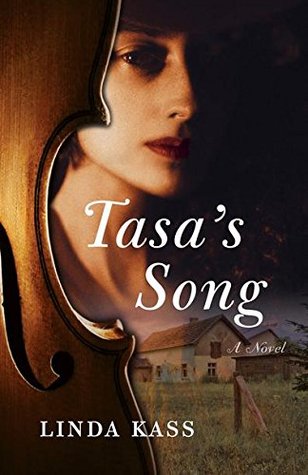
Tasa’s Song by Linda Kass

Source: Caitlin Hamilton Marketing & Publicity and She Writes Press
Paperback, 256 pgs.
I am an Amazon Affiliate

Tasa’s Song by Linda Kass, BRONZE WINNER, IPPY AWARD for HISTORICAL FICTION, is a concerto built on the jarring experiences of young violinist Tasa Rosinski in war-torn Poland during WWII.  Poland has changed hands many times before and does so again during the war, a war that many never expected to get as far as it did. As a young girl, she’s sent for additional schooling in Brody with her cousin Danik, but even as she enjoys school, she sees how the townspeople begin to treat their Jewish neighbors.  As fear creeps along the streets, Tasa softens the sharp edges with her violin, practicing music and losing herself in its timbres.

“In conveying the complicated history of Poland, Tasa’s schoolteacher used Podkamien as an example when she said you could live and die in one spot and occupy four different countries, because this part of Poland was constantly being invaded and carved up, then ‘liberated’ by somebody.” (pg. 15)

Tasa’s Jewish family is well liked by the townspeople of Podkamien because her father invested in the town, even as his family’s wealth grew.  He helped bring electricity and infrastructure to the village, making the lives of others better.  When the Nazis move on Poland and it is caught in between them and the Soviets, her family is able to escape for the most part with the help of non-Jewish families.  However, the tensions in the village are immediate, and the fear of being discovered can be difficult to live with.  Tasa, however, finds strength in her memories of her encouraging grandfather and her supportive mother, but also in her music, which provides her an escape from fear and loss.  She’s a strong young woman, and her strength helps others to keep going.

Tasa’s Song by Linda Kass demonstrates the tension within families at a time when there is so much uncertainty, and it illustrates the changing tides in just one nation during WWII.  Being Jewish in Europe during WWII was dangerous, and while luck can be with you, that luck also can turn out to be a bad omen.  This is a story of growing up in war, but also of learning to navigate uncertainty and reach into the future for something better without losing hope or the memory of those left behind, many in unmarked graves.

RATING: Quatrain

About the Author:

Linda Kass wrote for regional and national publications, including Columbus Monthly, TIME and The Detroit Free Press, early in her career as a journalist. TASA’S SONG, her debut novel, is inspired by her mother’s life in eastern Poland during the Second World War.

Linda lives in Columbus, Ohio, where she is a strong advocate of education, literacy, and the arts. Her past experience as a trustee and board chair of the Columbus Symphony Orchestra fed into much of the music that fills the pages of TASA’S SONG. Linda enjoys long distance road cycling and rides in an annual event to support cancer research.

Gaithersburg Book Festival 2016

gbfIt’s that time again for the Gaithersburg Book Festival.  I really love this festival because it’s very low key and includes activities for children of all ages.

Attendees can listen to authors speak about their books and topics, and they can get their books signed, among other things.

This year, I’ll be introducing two panels, and I’d love to see you there:

I’m also looking forward to these panels:

I hope to see you there.

John Dies @ the End by David Wong

Source: Public Library and Audible
Hardcover, 362 pgs.
I am an Amazon Affiliate

John Dies @ the End by David Wong, which was our April book club selection, is like falling off the frame and into a Salvador Dalí surrealist painting and its topsy-turvy world where very little makes sense and there is no straight path to some kind of satisfactory resolution.

Wong is a long-time editor at Cracked.com, which from what I gather is a humor website, and Wong is really a pen name.  So should you take anything in his novel seriously, even if it is considered in the horror genre?  My answer would be no.

In this novel, the soy sauce is a drug that enables John and David to see ghosts, demons, and other underworld-like things, and these unsuspecting and slacker heroes are less-than-motivated to take action, unless they have to.  Our unreliable narrator, David Wong, is socially inept and ogles women everywhere he goes, but readers are not even sure if he is David or John or someone else because the names of been changed.  In B-horror movie fashion, plots are introduced, left hanging, and reworked into even more ridiculous adventures.

“‘I call it Dante’s Syndrome,’ John said.  I had never heard him call it any such thing. ‘Meaning, I think Dave and I gained the ability to peer into Hell. Only it turns out Hell is right here, it’s all through us and around us and in us like the microbes that swarm through your lungs and guts and veins. Hey, look! An owl!'” (pg. 7)

“‘But I can bless water to make it holy. The ice statue, I mean.’
John’s face brightened and he said, ‘That’s perfect!’ He thrust his index finger into the air. ‘We bless the ice, then we just have to somehow get all hundred or so of those monsters to lick the statue!'” (130 pgs.)

These examples should provide you with the humor in this book, but some of this just seemed inserted for humor’s sake and did little to add to the story.  My final impression of John Dies @ the End by David Wong — the narrator for Audible was Stephen R. Thorne — is one of being overwhelmed by the descriptive info-dumps and the absurdity.  Because of the overwhelming and topsy-turvy nature of the narrative, this one did not work well on audio at all, leaving me lost most of the time, which is why I switched to the book.

RATING: Couplet

What the book club thought:

Sounded like most everyone thought the book was OK, but was not overly excited about the book. One member who said they were not sad to have read the book, said that they were not interested in reading any of the sequels. Another member said that the book was humorous, but most members said that the book had a plot that went nowhere and where there were no consequences for anything that happened.

Yellow Brick War by Danielle Paige (audio)

Source: Purchased
Audible, 8+ hours
I am an Amazon Affiliate

Yellow Brick War by Danielle Paige, narrated by Devon Sorvari, is the third part of this young adult series in an alternative world to the one we grew up with in Oz. This is a series that would be hard to follow without having read the first two books in the series — Dorothy Must Die and The Wicked Will Rise.

Amy Gumm finds herself back in Kansas, but she’s not alone.  The Wicked are with her as well, and she must find something to help get them back to Oz before Dorothy destroys everything.  This is Amy’s worst nightmare — returning to high school where she’s picked on by her peers and her mother is too drunk to even care where she is or if her homework is finished.  However, the witches show her that things have changed since her disappearance, and her mother is now sober and her former bullies are nicer now that they’ve been ostracized.

In this installment, the action is much slower as Amy reunites with her mother and the peers that once tortured her.  She feels just as out of place here as she did in Oz, but at least in Oz she could use magic and had a purpose.  She meets up with the former quarterback and his former girlfriend — Amy’s nemesis — and they strive to uncover the truth about the real Dorothy from Kansas.  It’s clear that Dorothy’s story was real and that no one believed her, but there is something magic still hidden in Kansas, and Amy must find it.

Yellow Brick War by Danielle Paige, narrated by Devon Sorvari, is a unique retelling of the Oz story, and readers will enjoy the characters and plot twists.  However, the dangling cliffhanger means there is sure to be another book in this series.  When the action abruptly ends, readers can be frustrated, especially in the case here where there is a big question mark over everyone’s fate.

Rating: Tercet

About the Author:

Danielle Paige is a graduate of Columbia University and the author of Dorothy Must Die and its digital prequel novellas, No Place Like Oz and The Witch Must Burn. Before turning to young adult literature, she worked in the television industry, where she received a Writers Guild of America Award and was nominated for several Daytime Emmys. She currently lives in New York City.

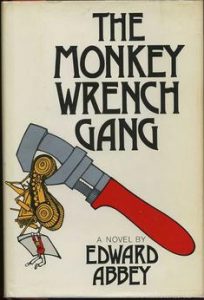
Guest Review: The Monkey Wrench Gang by Edward Abbey

Review by Laura at 125Pages.

Rating: 1 star

EdwardAbbeyTheMonkeyWrenchGangGoodReads Synopsis:

Ed Abbey called The Monkey Wrench Gang, his 1975 novel, a “comic extravaganza.” Some readers have remarked that the book is more a comic book than a real novel, and it’s true that reading this incendiary call to protect the American wilderness requires more than a little of the old willing suspension of disbelief.

The story centers on Vietnam veteran George Washington Hayduke III, who returns to the desert to find his beloved canyons and rivers threatened by industrial development. On a rafting trip down the Colorado River, Hayduke joins forces with feminist saboteur Bonnie Abbzug, wilderness guide Seldom Seen Smith, and billboard torcher Doc Sarvis, M.D., and together they wander off to wage war on the big yellow machines, on dam builders and road builders and strip miners.

As they do, his characters voice Abbey’s concerns about wilderness preservation (“Hell of a place to lose a cow,” Smith thinks to himself while roaming through the canyonlands of southern Utah. “Hell of a place to lose your heart. Hell of a place… to lose. Period”). Moving from one improbable situation to the next, packing more adventure into the space of a few weeks than most real people do in a lifetime, the motley gang puts fear into the hearts of their enemies, laughing all the while. It’s comic, yes, and required reading for anyone who has come to love the desert.

Review:

Today we visit Utah with The Monkey Wrench Gang by Edward Abbey. EW says – “Abbey’s tale of four ecological activists seeking to destroy the Glen Canyon Dam became a primer for other green-minded saboteurs.”

The Monkey Wrench Gang by Edward Abbey is touted as a comic look at social justice warriors. True environmentalists that strive to bring the land back to its natural state. Um, no. That is not at all the book I read. What I read was a book steeped in misogyny, homophobia, stereotyping and stupidity. From the derision of Native Americans, to showing the only Mormon member of the group as a polygamist, this book played everyone as a buffoon.

The plot was a grand look at what a bored drunk man will concoct when he gives no thought to others. George is painted as a lover of the natural state who is upset by the creeping industrialism on the desert he calls home. He decides that action must be taken, extreme action. Because blowing up bridges is cool but littering is just fine – “Of course I litter the public highway. Every chance I get. After all, it’s not the beer cans that are ugly; it’s the highway that is ugly.”  The writing was a mishmash of clichés and was difficult to read at times due to the constant changing of tone and pace. The world built was also difficult to navigate as locations moved frequently and at times I was unsure what state they were even in. The emotions and the characters were also all over the place. Everyone but the “gang” was painted as ignorant and useless and it became quite grating.

Some books get better with age and become classics. The Monkey Wrench Gang is not one of those books. It was a draining experience to read it and I cannot understand why it is considered by many to be so good. It has a 4.3 star rating on Amazon but I cannot fathom how. An example of the comedic showcases, to me, what was once thought great, but I just see it as super lowbrow.

“All this violence,” Doc said. “We are a law-abiding people.” “What’s more American than violence?” Hayduke wanted to know. “Violence, it’s asmerican as pizza pie.” “Chop suey,” said Bonnie. “Chile con carne.” “Bagels and lox.”

As for the connection to Utah, I did not really see it as an overall. Utah was not mentioned until 60% into the book and then as more of a joke (see the polygamist). Sadly my home state of Arizona fielded most of the action with New Mexico coming in second and Utah as third. The Glen Canyon Dam, the featured target, is also in Arizona not Utah, so again, I have to wonder if the EW staff read the books before placing them in the states.

The five players are Dr. and Mrs. Sarvis, Mr. and Mrs. Smith, and their communal probation officer, a young fellow named Greenspan, who is a relative newcomer to the state of Utah. (Newcomers are always welcome in the Beehive State but are advised to set their watches back fifty years when entering.)

Favorite lines – “The river in its measureless sublimity rolled softly by, whispering of time. Which heals, they say, all. But does it? The stars looked kindly down. A lie. A wind in the willows suggested sleep.”

Biggest cliché – I will save you even if you do not want saving.

Have you read The Monkey Wrench Gang, or added it to your TBR?

utahUSofbooks

See all of the United States of Books here.